

Ten-year impacts of China's rural health scheme: lessons for universal health coverage
Open accessThe DOI matches its Crossref record; 14 of the 14 references it cites were found in a registry or an index.
Abstract
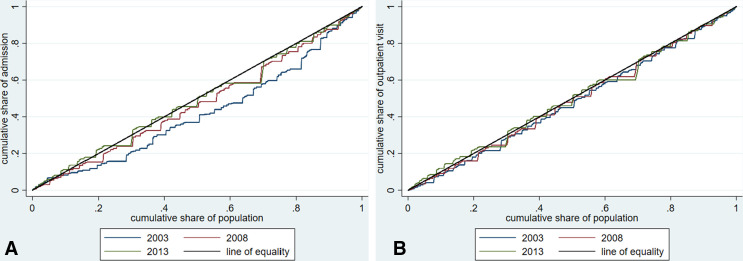
China has made profound progress in advancing universal health coverage (UHC) over the past two decades. New Cooperative Medical Scheme (NCMS) was initiated in 2003 to provide health insurance coverage to rural population. Its benefit packages and cost-sharing mechanism have changed significantly over time. This study aims to assess the impact of changing NCMS policies on NCMS enrollees’ service utilisation, medical financial burden and equity between 2003 and 2013. Data are from China National Health Services Survey (NHSS) which is conducted every 5 years. We used the subsample of NHSS that were enrolled in NCMS in 2003, 2008 and 2013. From 2003 to 2013, we found increased service utilisation and an elimination of inequity in service utilisation with respect to income. Contradicting prior findings of increasing financial burden after the NCMS implementation, we identified significant protective effect of NCMS against financial risks, and a reduction in percentage of households with high medical expenditure in the middle-income and high-income quintiles. The rural residents from the low-income groups have high financial risk, therefore, should be the priority target for future reforms. In pursuit of UHC globally, many countries struggle to provide good coverage to the disadvantaged rural population and balance between the competing priorities of various UHC dimensions. Our trend analysis revealed China’s two-stage approach with NCMS reform that first focused on expanding population coverage, then on service coverage and financial risk protection. This path could potentially be replicated in other middle-income and low-income countries to pave the way for UHC.
Overview
The claims and statistics of this paper haven’t been checked yet.
Free: it reads the open-access text and checks the first 5 claims that cite a source we can check. Create a free account to check every claim.
Integrity signals
Registry
Cites
Statistics
Figures
Verification
Claims the paper makes
The claims and statistics of this paper haven’t been checked yet.
Free: it reads the open-access text and checks the first 5 claims that cite a source we can check. Create a free account to check every claim.
Self-check
Percentages, sums and reported differences re-computed from the paper’s own numbers.
The self-check needs the paper’s full text.
Citations
Cites
Wagstaff, A., Lindelow, M., Jun, G., Ling, X., & Juncheng, Q. (2009) · Journal of Health Economics · doi:10.1016/j.jhealeco.2008.10.007 · Cited by 765 · cited 1×
“3 First, the policy framework and fund pooling are decentralised, and the level of decentralisation varies across provinces, ranging from provincial-level to county-level management.”
Self-citationLei, X., & Lin, W. (2009) · Health Economics · doi:10.1002/hec.1501 · Cited by 476
Can insurance increase financial risk?
Wagstaff, A., & Lindelow, M. (2008) · Journal of Health Economics · doi:10.1016/j.jhealeco.2008.02.002 · Cited by 447
Reform of how health care is paid for in China: challenges and opportunities
Hu, S., Tang, S., Liu, Y., Zhao, Y., Escobar, M.-L., & de Ferranti, D. (2008) · The Lancet · doi:10.1016/s0140-6736(08)61368-9 · Cited by 441
Self-citationChina's health system and its reform: a review of recent studies
Wagstaff, A., Yip, W., Lindelow, M., & Hsiao, W. C. (2009) · Health Economics · doi:10.1002/hec.1518 · Cited by 306
Yip, W., & Hsiao, W. C. (2009) · Social Science & Medicine · doi:10.1016/j.socscimed.2008.09.066 · Cited by 251
Cheng, L., Liu, H., Zhang, Y., Shen, K., & Zeng, Y. (2015) · Health Economics · doi:10.1002/hec.3053 · Cited by 199
Self-citationBabiarz, K. S., Miller, G., Yi, H., Zhang, L., & Rozelle, S. (2010) · BMJ · doi:10.1136/bmj.c5617 · Cited by 168
Yu, B., Meng, Q., Collins, C., Tolhurst, R., Tang, S., Yan, F., Bogg, L., & Liu, X. (2010) · BMC Health Services Research · doi:10.1186/1472-6963-10-116 · Cited by 165
Self-citationSun, Q., Liu, X., Meng, Q., Tang, S., Yu, B., & Tolhurst, R. (2009) · International Journal for Equity in Health · doi:10.1186/1475-9276-8-42 · Cited by 117
Self-citation
Cited by
Rahman, T., Gasbarro, D., & Alam, K. (2022) · Health Research Policy and Systems · doi:10.1186/s12961-022-00886-3 · Cited by 184
Global health 2050: the path to halving premature death by mid-century
Jamison, D. T., Summers, L. H., Chang, A. Y., Karlsson, O., Mao, W., Norheim, O. F., Ogbuoji, O., Schäferhoff, M., Watkins, D., Adeyi, O., et al. (2024) · The Lancet · doi:10.1016/s0140-6736(24)01439-9 · Cited by 125
Self-citationArsenault‐Lapierre, G., Bui, T., Berre, M. L., Bergman, H., & Vedel, I. (2023) · BMC Health Services Research · doi:10.1186/s12913-023-09100-8 · Cited by 101
“It is possible this difference was driven by the fact that China has recognized the need to improve rural care and has invested substantial resources [80] to combat this inequity.”
BackgroundZhou, Y., Li, C., Wang, M., Xu, S., Wang, L., Hu, J., Ding, L., & Wang, W. (2022) · The Lancet Public Health · doi:10.1016/s2468-2667(22)00251-1 · Cited by 61
Financial risk protection against noncommunicable diseases: trends and patterns in Bangladesh
Rahman, T., Gasbarro, D., & Alam, K. (2022) · BMC Public Health · doi:10.1186/s12889-022-14243-0 · Cited by 33
Metadata
- Authors
- Zhang, Y., Dong, D., Xu, L., Miao, Z., Mao, W., Sloan, F., & Tang, S.
- Affiliations
- National Health and Family Planning Commission (CN)
- Duke Kunshan University (CN)
- Duke University (US)
- Corresponding author
- Tang, Shenglan
- Venue
- BMJ Global Health
- Publisher
- BMJ
- Published
- 2021-04
- Volume
- 6
- Issue
- 4
- Pages
- e003714
- ISSN
- 2059-7908 (ISSN-L)
- PMC
- PMC8070863
- OpenAlex
- W3153153181
- Cited by
- 44
- References
- 14
- Citations by year
- 2026: 5 · 2025: 7 · 2024: 12 · 2023: 5 · 2022: 15
- FWCI
- 6.63
- Type
- journal article
- Language
- en
- Open access
- gold
- doi.org
- Licence
- Locations
- BMJ Global Health (publishedVersion, cc-by-nc)
- PubMed Central (publishedVersion, cc-by-nc)
- PubMed (publishedVersion)
- DOAJ (DOAJ: Directory of Open Access Journals) (submittedVersion, cc-by-sa)
- Funders
- Duke University research grant
- Duke Kunshan University research grant
- Topics
- Health Sciences › Medicine › Public Health, Environmental and Occupational Health › Healthcare Systems and Reforms
- Social Sciences › Economics, Econometrics and Finance › Economics and Econometrics › Healthcare Policy and Management
- Health Sciences › Medicine › Public Health, Environmental and Occupational Health › Healthcare Systems and Practices
- Keywords
- New Rural Cooperative Medical Scheme, universal health coverage, rural health insurance, health insurance reform, health care utilization, financial protection, out-of-pocket costs, health equity, China
- MeSH terms
- China, Health Expenditures, Humans, Insurance, Health, Rural Health, Universal Health Insurance
About these checks
Registry, retraction, Cites and statistics results are computed, not judged, with one exception: a printed reference that no index lists is read once by a model before it counts as a citation error. Claims are extracted by a model and kept only when their quote appears verbatim in the text; each cited source is then checked, with a model’s help, for whether it says what the claim relies on. Those verdicts can be wrong — read the claim’s quote and the cited source before relying on one.
Statistics and arithmetic are recomputed, not judged.
Confidence bands are shown only for fields calibrated on our annotated test set. None is calibrated yet, so no band is shown.
What counts as a claim ›How we measure confidence ›How we check this ›
Are you an author, or do you see a problem with this page? Request a review
How to cite
Cite CoChat for the checks on this page, and the paper for its own findings.
- This page
- CoChat. (2026). Citation check: Ten-year impacts of China's rural health scheme: lessons for universal health coverage. https://app.cochat.ai/papers/10.1136/bmjgh-2020-003714
- The paper
- Zhang, Y., Dong, D., Xu, L., Miao, Z., Mao, W., Sloan, F., & Tang, S. (2021). Ten-year impacts of China's rural health scheme: lessons for universal health coverage. BMJ Global Health. https://doi.org/10.1136/bmjgh-2020-003714
Data sources
Bibliographic data: Semantic Scholar, OpenAlex, Crossref.
Contains information from the Semantic Scholar Academic Graph Datasets, made available under the ODC Attribution License (ODC-BY 1.0).
Semantic Scholar’s data is described in: Kinney, R., et al. (2023). The Semantic Scholar Open Data Platform. arXiv:2301.10140.
