

The DOI matches its Crossref record; 24 of the 30 references it cites were found in a registry or an index; 7 of the 13 sources its claims cite were checked for support.
Effect of mobile application user interface improvements on minimum expected home visit coverage by community health workers in Mali: a randomised controlled trial
Open accessAbstract
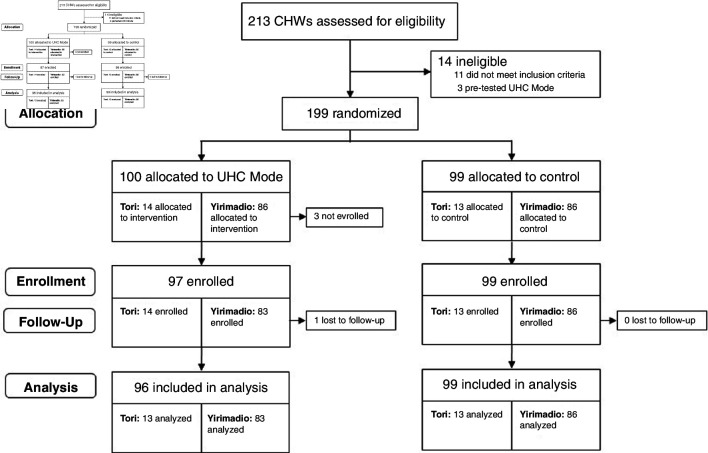
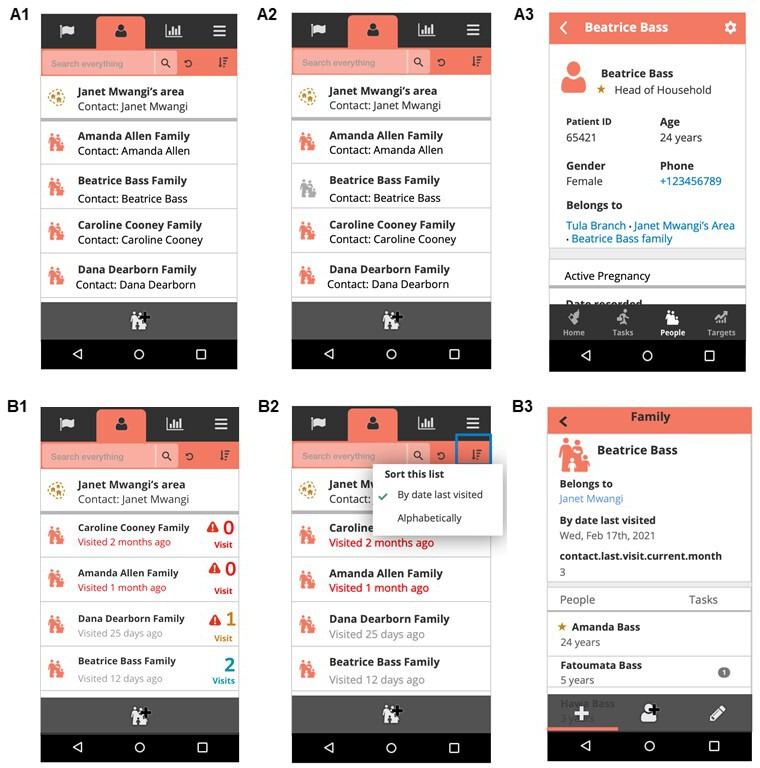
BACKGROUND: Proactive community case management (ProCCM) has shown promise to advance goals of universal health coverage (UHC). ProCCM community health workers (CHWs) face operational challenges when pursuing their goal of visiting every household in their service area at least twice monthly to proactively find sick patients. We developed a software extension (UHC Mode) to an existing CHW mobile application featuring user interface design improvements to support CHWs in planning daily home visits. We evaluated the effect of UHC Mode on minimum expected home visit coverage. METHODS: We conducted a parallel-group, two-arm randomised controlled trial of ProCCM CHWs in two separate regions in Mali. CHWs were randomly assigned to UHC Mode or the standard mobile application (control) with a 1:1 allocation. Randomisation was stratified by health catchment area. CHWs and other programme personnel were not masked to arm allocation. CHWs used their assigned intervention for 4 months. Using a difference-in-differences analysis, we estimated the mean change in minimum expected home visit coverage from preintervention to postintervention between arms. RESULTS: Enrolment occurred in January 2019. Of 199 eligible CHWs randomised to the intervention or control arm, 196 were enrolled and 195 were included in the analysis. Households whose CHW used UHC Mode had 2.41 times higher odds of minimum expected home visit coverage compared with households whose CHW used the control (95% CI 1.68 to 3.47; p<0.0005). Minimum expected home visit coverage in the UHC Mode arm increased 13.6 percentage points (95% CI 8.1 to 19.0) compared with the control arm. CONCLUSION: Our findings suggest UHC Mode is an effective tool that can improve home visit coverage and promote progress towards UHC when implemented in the ProCCM context. User interface design of health information systems that supports health workers' daily practices and meets their requirements can have a positive impact on health worker performance and home visit coverage. TRIAL REGISTRATION NUMBER: NCT04106921.
Overview
CoChat Summary
## TL;DR
This randomized controlled trial in Mali found that a mobile app user-interface add-on called UHC Mode improved community health workers’ minimum expected home visit coverage. Across 195 CHWs serving 45,873 households, UHC Mode increased coverage by 13.6 percentage points and was associated with 2.41 times higher odds of households receiving at least two visits per month.
## Key findings
- Of 199 eligible CHWs randomized, 195 were included in the analysis; these CHWs served 45,873 unique households during the study period.
- Households whose CHW used UHC Mode had 2.41 times higher odds of minimum expected home visit coverage than control households (95% CI 1.68 to 3.47; p<0.0005).
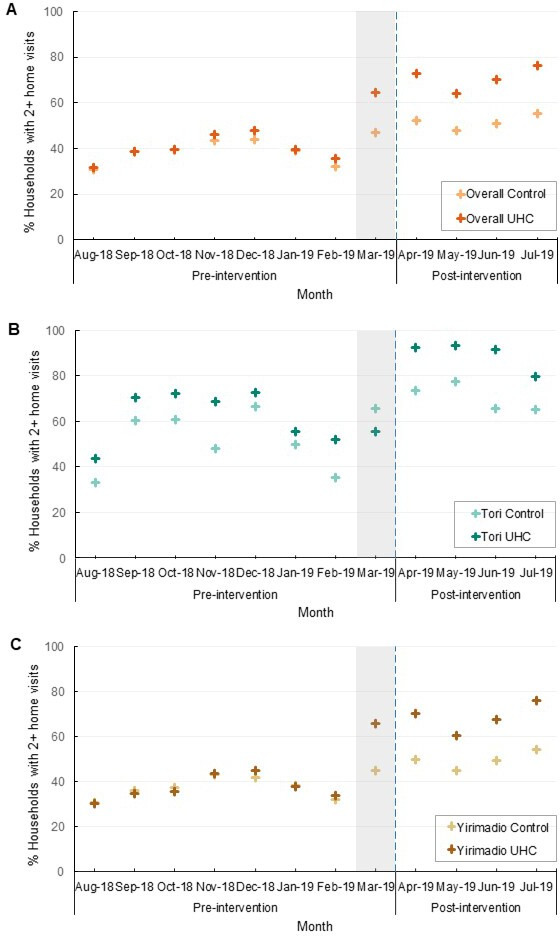
- Minimum expected home visit coverage in the UHC Mode arm increased by 13.6 percentage points compared with the control arm (95% CI 8.1 to 19.0).
- The unadjusted difference in service area coverage was 15.5 percentage points higher in UHC Mode than control (95% CI 9.8 to 21.2; p<0.0005), with baseline-to-postintervention coverage rising from 43% to 71% in UHC Mode and from 40% to 52% in control.
## Methods
- Parallel-group, two-arm randomized controlled trial in two health catchment areas in Mali (Tori, rural; Yirimadio, periurban), conducted from August 2018 to July 2019.
- Eligible participants were ProCCM community health workers; 199 were randomized 1:1 to UHC Mode or the standard mobile application, stratified by health catchment area.
- Primary analysis used a difference-in-differences logit model with CHW-level random effects; standard errors were clustered by CHW, with sensitivity and subgroup analyses by catchment area, baseline coverage, household load, and wealth quintile.
## Limitations
- The paper states that the small sample size in Tori left that site underpowered.
- The study relied on CHWs to accurately record visits and household status, and although audits were done, they were not systematic for all CHWs; the paper says service-area coverage estimates were likely subject to measurement error.
- CHWs and program personnel could not be masked to allocation, which the paper says may have introduced bias; the 4-month postintervention period was also relatively brief.
- Evident from the text: the intervention was evaluated in two specific ProCCM sites in Mali, so broader generalizability is limited by the study context.
Model-written summary. Check it against the paper before relying on it.
Integrity signals
Registry
Cites
Statistics
Figures
Verification
Claims the paper makes
4 Valid · 4 Not valid · 1 Not checked · 48 Own results and interpretations
A result the paper reports from its own data — it cites no other source for it, so there is none to check. The quote shows it is in the paper.
In the paper
“The odds of minimum expected home visit coverage significantly increased in both arms from preintervention to postintervention (OR 1.88, 95% CI 1.54 to 2.30; p<0.0005).”
§ Effect of mobile application user interface improvements on minimum expected home visit coverage by community health workers in Mali: a randomised controlled trial > Results
plainstates a cause- Asserted: passes — The authors put it forward as true.
- Checkable: passes — It can be checked against evidence.
- Load-bearing: unclear — It is unclear whether the paper’s conclusions depend on it.
- Based: passes — The paper gives a reason why it holds.
A result the paper reports from its own data — it cites no other source for it, so there is none to check. The quote shows it is in the paper.
In the paper
“There were no differences in UHC Mode’s effect by actual household load (online supplemental appendix 4).”
§ Effect of mobile application user interface improvements on minimum expected home visit coverage by community health workers in Mali: a randomised controlled trial > Results
plain- Asserted: passes — The authors put it forward as true.
- Checkable: passes — It can be checked against evidence.
- Load-bearing: unclear — It is unclear whether the paper’s conclusions depend on it.
- Based: passes — The paper gives a reason why it holds.
A result the paper reports from its own data — it cites no other source for it, so there is none to check. The quote shows it is in the paper.
In the paper
“Minimum expected home visit coverage in the UHC Mode arm increased 13.6 percentage points (95% CI 8.1 to 19.0) compared with the control arm.”
- Also stated in: § Results · plain
“On average, minimum expected home visit coverage in the UHC Mode arm increased 13.6 percentage points (95% CI 8.1 to 19.0) compared with the control arm.”
§ Effect of mobile application user interface improvements on minimum expected home visit coverage by community health workers in Mali: a randomised controlled trial > Abstract > Results
plainstates a cause- Asserted: passes — The authors put it forward as true.
- Checkable: passes — It can be checked against evidence.
- Load-bearing: passes — The paper’s conclusions depend on it.
- Based: passes — The paper gives a reason why it holds.
- Also stated in: § Results · plain
A result the paper states — it cites no source for it, so there is none to check. The quote shows it is in the paper.
In the paper
“Service area coverage of minimum expected home visits was consistently lower in the periurban versus the rural area during the study period.”
§ Effect of mobile application user interface improvements on minimum expected home visit coverage by community health workers in Mali: a randomised controlled trial > Discussion
plainstates an association- Asserted: passes — The authors put it forward as true.
- Checkable: passes — It can be checked against evidence.
- Load-bearing: unclear — It is unclear whether the paper’s conclusions depend on it.
- Based: passes — The paper gives a reason why it holds.
A result the paper reports from its own data — it cites no other source for it, so there is none to check. The quote shows it is in the paper.
In the paper
“Households whose CHW used UHC Mode had 2.41 times higher odds of minimum expected home visit coverage compared with households whose CHW used the control (95% CI 1.68 to 3.47; p<0.0005).”
- Also stated in: § Results · plain
“Households whose CHW used UHC Mode had 2.41 times higher odds of minimum expected home visit coverage from preintervention to postintervention compared with households whose CHWs used the control (95% CI 1.68 to 3.47; p<0.0005) (table 3).”
§ Effect of mobile application user interface improvements on minimum expected home visit coverage by community health workers in Mali: a randomised controlled trial > Abstract > Results
plainstates an association- Asserted: passes — The authors put it forward as true.
- Checkable: passes — It can be checked against evidence.
- Load-bearing: passes — The paper’s conclusions depend on it.
- Based: passes — The paper gives a reason why it holds.
- Also stated in: § Results · plain
12 more claims
Create a free account to see all 57 claims and to verify the 1 reference still open.
- It may state two separate claims as one. 28
- Probably not a substantial claim. 22
Citations
Cites
Ash, J. S. (2003) · Journal of the American Medical Informatics Association · doi:10.1197/jamia.m1471 · Cited by 1,789
Lewin, S., Munabi-Babigumira, S., Glenton, C., Daniels, K., Bosch-Capblanch, X., van Wyk, B. E., Odgaard-Jensen, J., Johansen, M., Aja, G. N., Zwarenstein, M., et al. (2010) · Cochrane Database of Systematic Reviews · doi:10.1002/14651858.cd004015.pub3 · Cited by 985
Middleton, B., Bloomrosen, M., Dente, M. A., Hashmat, B., Koppel, R., Overhage, J. M., Payne, T. H., Rosenbloom, S. T., Weaver, C., & Zhang, J. (2013) · Journal of the American Medical Informatics Association · doi:10.1136/amiajnl-2012-001458 · Cited by 618
Lassi, Z. S., & Bhutta, Z. A. (2015) · Cochrane Database of Systematic Reviews · doi:10.1002/14651858.cd007754.pub3 · Cited by 579
Physician stress and burnout: the impact of health information technology
Gardner, R. L., Cooper, E., Haskell, J., Harris, D. A., Poplau, S., Kroth, P. J., & Linzer, M. (2019) · Journal of the American Medical Informatics Association · doi:10.1093/jamia/ocy145 · Cited by 566
Hogan, D. R., Stevens, G. A., Hosseinpoor, A. R., & Boerma, T. (2018) · The Lancet Global Health · doi:10.1016/s2214-109x(17)30472-2 · Cited by 444
Zurovac, D., Sudoi, R. K., Akhwale, W. S., Ndiritu, M., Hamer, D. H., Rowe, A. K., & Snow, R. W. (2011) · The Lancet · doi:10.1016/s0140-6736(11)60783-6 · Cited by 403
Pallas, S. W., Minhas, D., Pérez-Escamilla, R., Taylor, L., Curry, L., & Bradley, E. H. (2013) · American Journal of Public Health · doi:10.2105/ajph.2012.301102 · Cited by 320
Bhattacharyya, K., WINCH, P. J., LeBan, K., & Tien, M.-H. (2001) · Cited by 293
Human-centered design for global health equity
Holeman, I., & Kane, D. (2020) · Information Technology for Development · doi:10.1080/02681102.2019.1667289 · Cited by 285 · cited 1×
“UHC Mode was the result of an iterative, human-centred design process, 20 which involved direct observations of CHWs planning their daily home visits, focus groups with CHWs and CHW supervisors to elicit feedback on design features to promote higher minimum expected home visit coverage, and months…”
BackgroundSelf-citation
Research works printed but not linked: 1
- Norman DA . The design of everyday things. revised and expanded editon. Cambridge, MA, London: The MIT Press, 2013: 347.
Cited by
Marongwe, P., Wasunna, B., Gavera, J., Murenje, V., Gwenzi, F., Hove, J., Mauhy, C., Xaba, S., Mugwanya, R., Makunike-Chikwinya, B., et al. (2022) · PLOS Digital Health · doi:10.1371/journal.pdig.0000066 · Cited by 26
Self-citationFeldacker, C., Pienaar, J., Wasunna, B., Ndebele, F., Makhele, C., Day, S., Tweya, H. M., Oni, F., Sardini, M., Adhikary, B., et al. (2023) · Journal of Medical Internet Research · doi:10.2196/42111 · Cited by 16
“For this study, we adapted the Zimbabwe 2wT digital app that was built on the Community Health Toolkit (CHT) [61], an open-source global public good [62] that is highly secure, highly configurable, runs offline, supports use in multiple languages, and has >40,000 users across 16 countries [63-66].”
MethodKang, B., Poddar, M., Luitel, A., Rimal, R. N., Ayalew, B. M., & Black, D. P. (2025) · Global Health Science and Practice · doi:10.9745/ghsp-d-24-00164 · Cited by 26
Oliphant, N. P., Sy, Z., Koné, B., Berthé, M., Beebe, M., Samaké, M., Diabaté, M., Tounkara, S., Diarra, B., Diarra, A. B., et al. (2022) · PLOS Global Public Health · doi:10.1371/journal.pgph.0000626 · Cited by 12
“Planning for the scale-up of the CHW network should consider the comprehensive needs of CHWs (and their dedicated supervisors) so that they can be most effective [5,6,55,56].”
BackgroundRotejanaprasert, C., Armatrmontree, P., Chienwichai, P., & Maude, R. J. (2024) · PLoS neglected tropical diseases · doi:10.1371/journal.pntd.0012387 · Cited by 13
Metadata
- Authors
- Yang, J. E., Lassala, D., Liu, J. X., Whidden, C., Holeman, I., Keita, Y., Djiguiba, Y., N’Diaye, S. I., Fall, F., Kayentao, K., & Johnson, A. D.
- Affiliations
- Muso, San Francisco, California, USA
- Muso, Bamako, Mali
- University of California, San Francisco (US)
- University of Washington (US)
- Medic, Dakar, Senegal
- Université des Sciences, des Techniques et des Technologies de Bamako (ML)
- Corresponding author
- Yang, Jane E
- ORCID
- Venue
- BMJ Global Health
- Publisher
- BMJ
- Published
- 2021-11
- Volume
- 6
- Issue
- 11
- Pages
- e007205
- ISSN
- 2059-7908 (ISSN-L)
- PMC
- PMC8609935
- OpenAlex
- W3215426111
- Cited by
- 17
- References
- 30
- Citations by year
- 2026: 1 · 2025: 2 · 2024: 9 · 2023: 2 · 2022: 3
- FWCI
- 3.93
- Type
- journal article
- Language
- en
- Open access
- gold
- doi.org
- Locations
- BMJ Global Health (publishedVersion, cc-by)
- PubMed Central (publishedVersion, cc-by)
- PubMed (publishedVersion)
- DOAJ (DOAJ: Directory of Open Access Journals) (submittedVersion, cc-by-sa)
- eScholarship (California Digital Library) (submittedVersion, cc-by)
- Funders
- Bill and Melinda Gates Foundation (OPP1183755)
- Topics
- Health Sciences › Health Professions › General Health Professions › Mobile Health and mHealth Applications
- Physical Sciences › Computer Science › Information Systems › ICT in Developing Communities
- Physical Sciences › Computer Science › Human-Computer Interaction › Usability and User Interface Design
- Keywords
- community health workers, universal health coverage, health information systems, health worker performance
- MeSH terms
- Community Health Workers, House Calls, Humans, Mali, Mobile Applications
About these checks
Registry, retraction, Cites and statistics results are computed, not judged, with one exception: a printed reference that no index lists is read once by a model before it counts as a citation error. Claims are extracted by a model and kept only when their quote appears verbatim in the text; each cited source is then checked, with a model’s help, for whether it says what the claim relies on. Those verdicts can be wrong — read the claim’s quote and the cited source before relying on one.
The claim verdicts this report counts are experimental: their accuracy is not yet measured.
A language model drew the claims from the paper on 2026-10-10, under version 3 of the claim definition (model deepseek-v4.1-flash, prompt extract-v3).
A second model labelled each claim on 2026-10-10 (model jev-1.13-20260917, definition revision gold-guideline-v0.2).
Statistics and arithmetic are recomputed, not judged.
Confidence bands are shown only for fields calibrated on our annotated test set. None is calibrated yet, so no band is shown.
What counts as a claim ›How we measure confidence ›How we check this ›
Are you an author, or do you see a problem with this page? Request a review
How to cite
Cite CoChat for the checks on this page, and the paper for its own findings.
- This page
- CoChat. (2026). Citation check: Effect of mobile application user interface improvements on minimum expected home visit coverage by community health workers in Mali: a randomised controlled trial. https://app.cochat.ai/papers/10.1136/bmjgh-2021-007205
- The paper
- Yang, J. E., Lassala, D., Liu, J. X., Whidden, C., Holeman, I., Keita, Y., Djiguiba, Y., N’Diaye, S. I., Fall, F., Kayentao, K., & Johnson, A. D. (2021). Effect of mobile application user interface improvements on minimum expected home visit coverage by community health workers in Mali: a randomised controlled trial. BMJ Global Health. https://doi.org/10.1136/bmjgh-2021-007205
Data sources
Bibliographic data: Semantic Scholar, OpenAlex, Crossref.
Contains information from the Semantic Scholar Academic Graph Datasets, made available under the ODC Attribution License (ODC-BY 1.0).
Semantic Scholar’s data is described in: Kinney, R., et al. (2023). The Semantic Scholar Open Data Platform. arXiv:2301.10140.
