

The DOI matches its Crossref record; 125 of the 130 references it cites were found in a registry or an index; 4 of the 14 sources its claims cite were checked for support.
Drivers of health workers’ migration, intention to migrate and non-migration from low/middle-income countries, 1970–2022: a systematic review
Open accessAbstract
Background: The migration of healthcare workers (HWs) from low/middle-income countries (LMICs) is a pressing global health issue with implications for population-level health outcomes. We aimed to synthesise the drivers of HWs’ out-migration, intention to migrate and non-migration from LMICs. Methods: We searched Ovid MEDLINE, EMBASE, CINAHL, Global Health and Web of Science, as well as the reference lists of retrieved articles. We included studies (quantitative, qualitative or mixed-methods) on HWs’ migration or intention to migrate, published in either English or French between 1 January 1970 and 31 August 2022. The retrieved titles were deduplicated in EndNote before being exported to Rayyan for independent screening by three reviewers. Results: We screened 21 593 unique records and included 107 studies. Of the included studies, 82 were single-country studies focusing on 26 countries, while the remaining 25 included data from multiple LMICs. Most of the articles focused on either doctors 64.5% (69 of 107) and/or nurses 54.2% (58 of 107). The UK (44.9% (48 of 107)) and the USA (42% (45 of 107)) were the top destination countries. The LMICs with the highest number of studies were South Africa (15.9% (17 of 107)), India (12.1% (13 of 107)) and the Philippines (6.5% (7 of 107)). The major drivers of migration were macro-level and meso-level factors. Remuneration (83.2%) and security problems (58.9%) were the key macro-level factors driving HWs’ migration/intention to migrate. In comparison, career prospects (81.3%), good working environment (63.6%) and job satisfaction (57.9%) were the major meso-level drivers. These key drivers have remained relatively constant over the last five decades and did not differ among HWs who have migrated and those with intention to migrate or across geographical regions. Conclusion: Growing evidence suggests that the key drivers of HWs’ migration or intention to migrate are similar across geographical regions in LMICs. Opportunities exist to build collaborations to develop and implement strategies to halt this pressing global health problem.
Overview
AI snapshot
Written from the paper’s full text.
TL;DR
This systematic review of 107 studies found that health workers’ migration or intention to migrate from low/middle-income countries is driven mainly by macro-level remuneration and security problems and meso-level career prospects, working environment and job satisfaction. These drivers were similar across migration status and geographical regions and remained relatively constant from 1970 to 2022.
Key findings
- The review included 107 studies: 82 single-country studies covering 26 countries and 25 multi-LMIC studies. Most focused on doctors (64.5%, 69/107) and/or nurses (54.2%, 58/107). Top destination countries were the UK (44.9%, 48/107) and USA (42%, 45/107); top source countries were South Africa (15.9%, 17/107), India (12.1%, 13/107) and the Philippines (6.5%, 7/107).
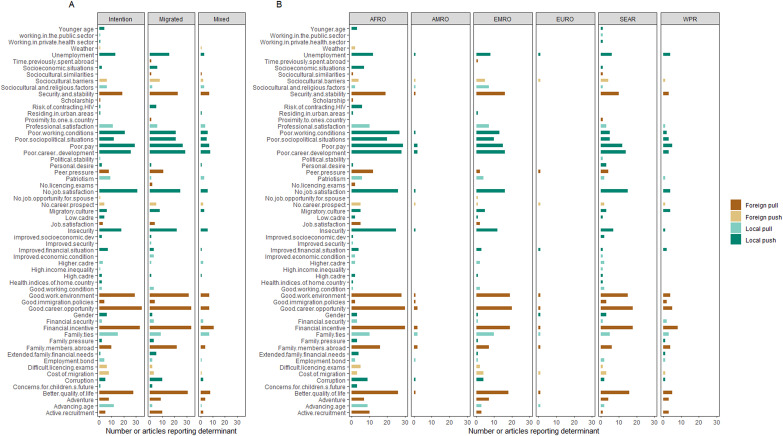
- Major macro-level drivers were remuneration (83.2%) and security problems (58.9%). Major meso-level drivers were career prospects (81.3%), good working environment (63.6%) and job satisfaction (57.9%). Micro-level drivers included improved quality of life (69.7%) and family ties (61.6%).
- Local push factors mirrored foreign pull factors: poor pay, work environment, career development, infrastructure and job satisfaction were common local push factors, while financial incentives, good work environment and career development were top foreign pull factors. Local pull factors for non-migration were family ties, job satisfaction and advancing age; foreign push factors were sociocultural barriers and cost of migration.
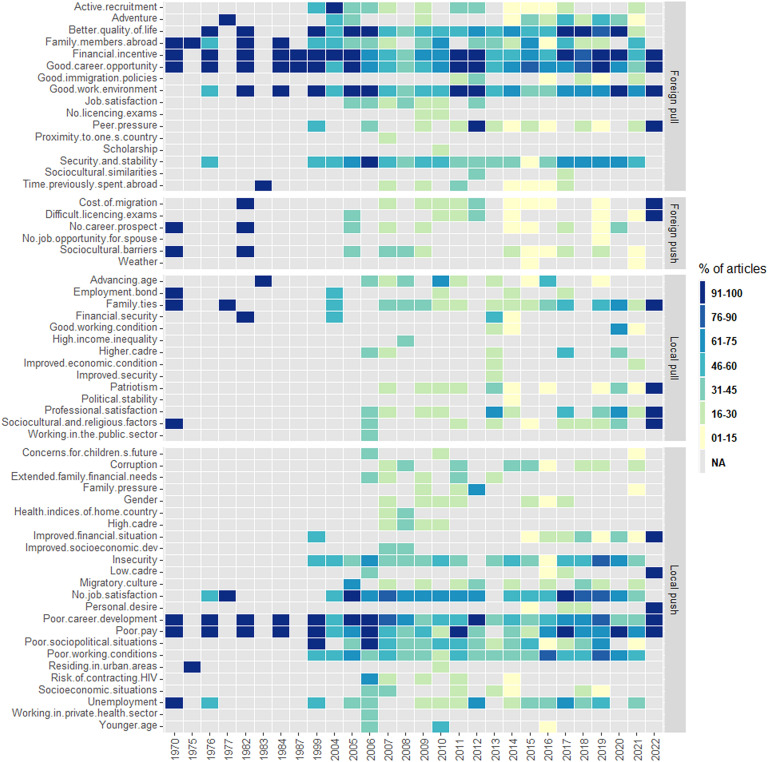
- Key drivers were similar for health workers who had migrated and those intending to migrate, and across regions. Financial incentives and career advancement were consistently reported from 1970–2022, with quality of life, working conditions, insecurity/security and unfavourable sociopolitical situations cited more frequently from the early 2000s onward.
Methods
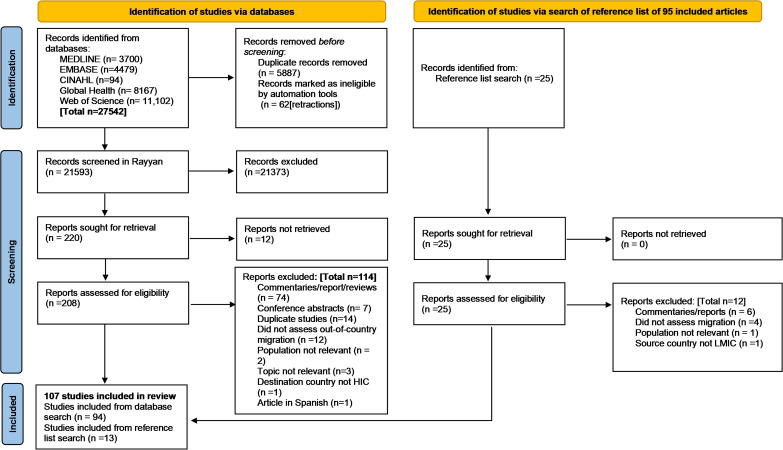
- PRISMA systematic review searching Ovid MEDLINE, EMBASE, CINAHL, Global Health and Web of Science, plus reference lists; included quantitative, qualitative or mixed-methods studies on health workers’ migration or intention to migrate from LMICs, published in English or French, with databases searched in August 2022.
- Screening yielded 21,593 unique records and 107 included studies; three independent reviewers screened titles/abstracts in Rayyan, with consensus or a fourth arbiter resolving disagreements. Methodological quality was assessed with the Mixed Methods Appraisal Tool, and no studies were excluded based on quality.
- Because of heterogeneity in study design, population and outcome, no meta-analysis was conducted; findings were narratively synthesised using push-pull migration theory and Young’s macro-level, meso-level and micro-level framework.
Limitations
- The paper states that some source countries were disproportionately represented—South Africa, India and the Philippines accounted for over one-third (34.5%) of included studies—which may have skewed findings.
- The paper states that most included studies focused only on doctors (64.5%) and nurses (54.2%), with limited focus on other essential cadres, and many did not differentiate drivers by cadre, so the review could not examine whether drivers differed across cadres as originally proposed.
- The paper states that included studies were mainly cross-sectional, so they did not examine changing trends within a particular cohort over time; evident from the text, the review also relied on narrative synthesis rather than meta-analysis because of heterogeneity, and 12 full texts were inaccessible.
Model-written summary. Check it against the paper before relying on it.
Integrity signals
Registry
Cites
Statistics
Figures
Verification
Claims the paper makes
29 Own result · 14 Own interpretation · 6 Not checked yet · 4 No basis given · 2 Partly supported · 1 Own method · accuracy not yet measured
The cited sources support only part of this claim — read each source’s verdict below.
In the paper
“These countries are situated in regions persistently dealing with conflicts and social inequality.137 138”
§ Drivers of health workers’ migration, intention to migrate and non-migration from low/middle-income countries, 1970–2022: a systematic review > Discussion
What the sources say
- Partly supportedcites [137] Jain-Chandra, 2019, Sharing the growth dividend: analysis of inequality in Asia, JBFE sourceExperimental — accuracy not yet measured
The Introduction (page unavailable) describes rising inequality in Asia and names India and the Philippines in its discussion of inclusive-growth plans. The paper does not establish that South Africa, India, and the Philippines are all in regions persistently affected by conflict; it mentions political instability only as a possible consequence of widening inequality. (LLM, conf=0.86)
- Not checked yetcites [138] source
plain- Asserted: passes — The authors put it forward as true.
- Checkable: passes — It can be checked against evidence.
- Load-bearing: unclear — It is unclear whether the paper’s conclusions depend on it.
- Based: passes — The paper gives a reason why it holds.
- Partly supported
A result the paper reports from its own data — it cites no other source for it, so there is none to check. The quote shows it is in the paper.
In the paper
“some source countries such as South Africa, India and the Philippines were disproportionately represented, accounting for over one-third (34.5%) of all the included studies”
§ Drivers of health workers’ migration, intention to migrate and non-migration from low/middle-income countries, 1970–2022: a systematic review > Discussion
plain- Asserted: passes — The authors put it forward as true.
- Checkable: passes — It can be checked against evidence.
- Load-bearing: unclear — It is unclear whether the paper’s conclusions depend on it.
- Based: passes — The paper gives a reason why it holds.
A result the paper reports from its own data — it cites no other source for it, so there is none to check. The quote shows it is in the paper.
In the paper
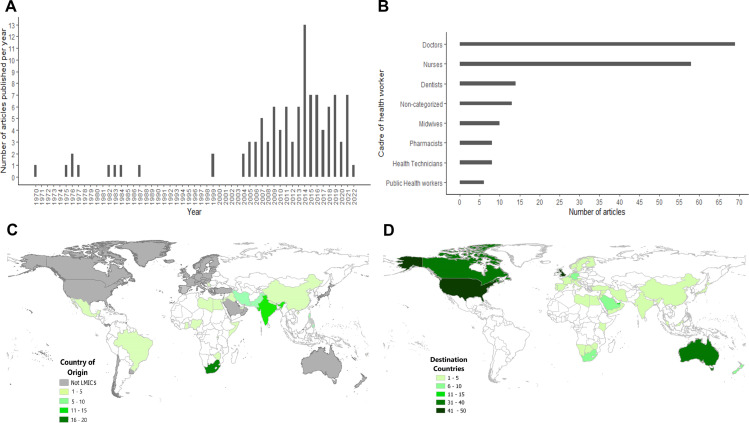
“The LMICs with the highest number of studies were South Africa (15.9% (17 of 107)), India (12.1% (13 of 107)) and the Philippines (6.5% (7 of 107)).”
- Also stated in: § Publication trend, the cadres of HRH studied, the source and the destination countries · plain
“The top source countries, as determined by studies with single-country data, are South Africa (15.9% (17 of 107) of articles), India (12.1% (13 of 107)) and the Philippines (6.5% (7 of 107)).”
§ Drivers of health workers’ migration, intention to migrate and non-migration from low/middle-income countries, 1970–2022: a systematic review > Abstract > Results
plain- Asserted: passes — The authors put it forward as true.
- Checkable: passes — It can be checked against evidence.
- Load-bearing: unclear — It is unclear whether the paper’s conclusions depend on it.
- Based: passes — The paper gives a reason why it holds.
- Also stated in: § Publication trend, the cadres of HRH studied, the source and the destination countries · plain
A result the paper reports from its own data — it cites no other source for it, so there is none to check. The quote shows it is in the paper.
In the paper
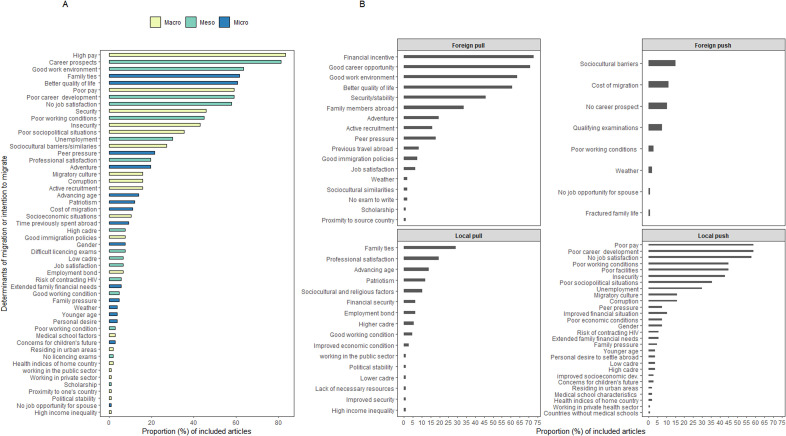
“In contrast, financial incentives, a good work environment and career development were the topmost foreign pull factors”
§ Drivers of health workers’ migration, intention to migrate and non-migration from low/middle-income countries, 1970–2022: a systematic review > Results > Drivers of out-migration, intention to migrate and non-migration
plain- Asserted: passes — The authors put it forward as true.
- Checkable: passes — It can be checked against evidence.
- Load-bearing: unclear — It is unclear whether the paper’s conclusions depend on it.
- Based: passes — The paper gives a reason why it holds.
A result the paper reports from its own data — it cites no other source for it, so there is none to check. The quote shows it is in the paper.
In the paper
“the majority of included studies (64.5%) focused solely on doctors”
§ Drivers of health workers’ migration, intention to migrate and non-migration from low/middle-income countries, 1970–2022: a systematic review > Discussion
plain- Asserted: passes — The authors put it forward as true.
- Checkable: passes — It can be checked against evidence.
- Load-bearing: passes — The paper’s conclusions depend on it.
- Based: passes — The paper gives a reason why it holds.
A result the paper reports from its own data — it cites no other source for it, so there is none to check. The quote shows it is in the paper.
In the paper
“or across geographical regions”
- Also stated in: § Evaluating drivers of migration by migration status and geographical regions · plain
“the key drivers were consistent across geographical regions, as the same drivers were consistently reported in articles from different regions, particularly in Africa, the Eastern Mediterranean and Southeast Asia”
§ Drivers of health workers’ migration, intention to migrate and non-migration from low/middle-income countries, 1970–2022: a systematic review > Abstract > Results
plain- Asserted: passes — The authors put it forward as true.
- Checkable: passes — It can be checked against evidence.
- Load-bearing: passes — The paper’s conclusions depend on it.
- Based: passes — The paper gives a reason why it holds.
- Rests on an assumption: The 107 included studies are representative of health workers in LMICs.
- Rests on an assumption: The drivers reported in the included studies accurately reflect the actual drivers of health worker migration.
- Rests on an assumption: The search strategy and databases captured all relevant studies on HRH migration from LMICs.
- Rests on an assumption: The English/French language restriction did not bias the findings.
- Rests on an assumption: The 2020 World Bank classification of LMICs is appropriate for studies spanning 1970–2022.
- Also stated in: § Evaluating drivers of migration by migration status and geographical regions · plain
A result the paper reports from its own data — it cites no other source for it, so there is none to check. The quote shows it is in the paper.
In the paper
“The WHO African Region had the highest number of source studies from single-source countries (27.1% (29 of 107)) compared with other LMIC regions.”
§ Drivers of health workers’ migration, intention to migrate and non-migration from low/middle-income countries, 1970–2022: a systematic review > Results > Publication trend, the cadres of HRH studied, the source and the destination countries
plain- Asserted: passes — The authors put it forward as true.
- Checkable: passes — It can be checked against evidence.
- Load-bearing: unclear — It is unclear whether the paper’s conclusions depend on it.
- Based: passes — The paper gives a reason why it holds.
The paper states this without a source or data behind it here, so there is nothing to check it against. The quote shows it is in the paper.
In the paper
“The UK, USA, Canada and Australia were the most preferred destination countries.”
§ Drivers of health workers’ migration, intention to migrate and non-migration from low/middle-income countries, 1970–2022: a systematic review > Discussion
plain- Asserted: passes — The authors put it forward as true.
- Checkable: passes — It can be checked against evidence.
- Load-bearing: unclear — It is unclear whether the paper’s conclusions depend on it.
- Based: passes — The paper gives a reason why it holds.
The paper states this without a source or data behind it here, so there is nothing to check it against. The quote shows it is in the paper.
In the paper
“thus, did not examine the changing trend of a particular cohort of HRH over time”
§ Drivers of health workers’ migration, intention to migrate and non-migration from low/middle-income countries, 1970–2022: a systematic review > Discussion
plain- Asserted: passes — The authors put it forward as true.
- Checkable: passes — It can be checked against evidence.
- Load-bearing: passes — The paper’s conclusions depend on it.
- Based: passes — The paper gives a reason why it holds.
A result the paper reports from its own data — it cites no other source for it, so there is none to check. The quote shows it is in the paper.
In the paper
“Most of the articles focused on either doctors 64.5% (69 of 107) and/or nurses 54.2% (58 of 107).”
- Also stated in: § Publication trend, the cadres of HRH studied, the source and the destination countries · plain
“Most articles focused on doctors and nurses, representing 64.5% and 54.2% of the included articles, respectively”
§ Drivers of health workers’ migration, intention to migrate and non-migration from low/middle-income countries, 1970–2022: a systematic review > Abstract > Results
plain- Asserted: passes — The authors put it forward as true.
- Checkable: passes — It can be checked against evidence.
- Load-bearing: unclear — It is unclear whether the paper’s conclusions depend on it.
- Based: passes — The paper gives a reason why it holds.
- Also stated in: § Publication trend, the cadres of HRH studied, the source and the destination countries · plain
- It may state two separate claims as one. 23
- Probably not a substantial claim. 9
The cited sources support only part of this claim — read each source’s verdict below.
In the paper
“Our findings are consistent with prior research demonstrating that financial safety needs, opportunities for professional development through training and research, and the desire for improved quality of life for HRH and their families are critical drivers of HRH emigration.19 141–143”
§ Drivers of health workers’ migration, intention to migrate and non-migration from low/middle-income countries, 1970–2022: a systematic review > Discussion
What the sources say
- Partly supportedcites [19] Davda, 2018, Migration motives and integration of international human resources of health in the United Kingdom: systematic review and meta-synthesis of qualitative studies using framework analysis, Hum Resour Health sourceExperimental — accuracy not yet measured
The Results (Migration motives of nurses and doctors to the UK; page unavailable) identify financial gain for workers and families, training and career advancement, and better quality of life as migration drivers. The paper does not identify opportunities to conduct research as a driver, and its findings concern migration to the UK rather than HRH emigration generally. (LLM, conf=0.84)
- Partly supportedcites [141] Dohlman, 2019, Global brain drain: how can the maslow theory of motivation improve our understanding of physician migration?, Int J Environ Res Public Health sourceExperimental — accuracy not yet measured
The Results and Discussion (pages unavailable in our copy) identify financial security, training, research opportunities, and a higher standard of living as motives for physician emigration. The paper focuses on physicians, however, and the retrieved passages do not establish improved quality of life for their families as a distinct driver or extend these findings to all human resources for health (HRH). (LLM, conf=0.86)
- Partly supportedcites [142] Humphries, 2017, The consequences of Ireland’s culture of medical migration, Hum Resour Health sourceExperimental — accuracy not yet measured
The Results section, “A culture of medical migration” (page unavailable), identifies career progression and, for some respondents, financial motivation as drivers of Irish doctors’ emigration. The Background (page unavailable) describes migration as an opportunity to improve earning potential and provide a better future for doctors and their families. The paper does not establish research opportunities as a driver, and its findings about doctors do not establish these as critical drivers for HRH generally. (LLM, conf=0.86)
- Not checked yetcites [143] Clarke, 2017, Factors influencing trainee doctor emigration in a high income country: a mixed methods study, Hum Resour Health source
boosteddirect- Asserted: passes — The authors put it forward as true.
- Checkable: passes — It can be checked against evidence.
- Load-bearing: unclear — It is unclear whether the paper’s conclusions depend on it.
- Based: passes — The paper gives a reason why it holds.
It may state two separate claims as one.
- Partly supported
A result the paper reports from its own data — it cites no other source for it, so there is none to check. The quote shows it is in the paper.
In the paper
“The local push factors were the most reported and mirrored the foreign pull factors.”
§ Drivers of health workers’ migration, intention to migrate and non-migration from low/middle-income countries, 1970–2022: a systematic review > Results > Drivers of out-migration, intention to migrate and non-migration
plaincorrelational- Asserted: passes — The authors put it forward as true.
- Checkable: passes — It can be checked against evidence.
- Load-bearing: unclear — It is unclear whether the paper’s conclusions depend on it.
- Based: passes — The paper gives a reason why it holds.
It may state two separate claims as one.
A result the paper reports from its own data — it cites no other source for it, so there is none to check. The quote shows it is in the paper.
In the paper
“Remuneration (83.2%) and security problems (58.9%) were the key macro-level factors driving HWs’ migration/intention to migrate.”
- Also stated in: § Drivers of out-migration, intention to migrate and non-migration · plain
“Remuneration and security were the most common macro-level factors driving HRH migration from LMICs, with 83.2% and 58.9% of studies, respectively, identifying these factors”
§ Drivers of health workers’ migration, intention to migrate and non-migration from low/middle-income countries, 1970–2022: a systematic review > Abstract > Results
plaindirect- Asserted: passes — The authors put it forward as true.
- Checkable: passes — It can be checked against evidence.
- Load-bearing: passes — The paper’s conclusions depend on it.
- Based: passes — The paper gives a reason why it holds.
It may state two separate claims as one.
- Also stated in: § Drivers of out-migration, intention to migrate and non-migration · plain
A result the paper reports from its own data — it cites no other source for it, so there is none to check. The quote shows it is in the paper.
In the paper
“We screened 21 593 unique records and included 107 studies.”
- Also stated in: § Results · plain
“In the end, 107 articles11 29–134 were eligible for the final analysis”
§ Drivers of health workers’ migration, intention to migrate and non-migration from low/middle-income countries, 1970–2022: a systematic review > Abstract > Results
plain- Asserted: passes — The authors put it forward as true.
- Checkable: passes — It can be checked against evidence.
- Load-bearing: unclear — It is unclear whether the paper’s conclusions depend on it.
- Based: passes — The paper gives a reason why it holds.
It may state two separate claims as one.
- Also stated in: § Results · plain
A result the paper reports from its own data — it cites no other source for it, so there is none to check. The quote shows it is in the paper.
In the paper
“The UK (44.9% (48 of 107)) and the USA (42% (45 of 107)) were the top destination countries.”
- Also stated in: § Publication trend, the cadres of HRH studied, the source and the destination countries · plain
“The UK is the leading destination country, with 44.9% (48 of 107) of the articles studied, followed closely by the USA at 42% (45 of 107)”
§ Drivers of health workers’ migration, intention to migrate and non-migration from low/middle-income countries, 1970–2022: a systematic review > Abstract > Results
plain- Asserted: passes — The authors put it forward as true.
- Checkable: passes — It can be checked against evidence.
- Load-bearing: unclear — It is unclear whether the paper’s conclusions depend on it.
- Based: passes — The paper gives a reason why it holds.
It may state two separate claims as one.
- Also stated in: § Publication trend, the cadres of HRH studied, the source and the destination countries · plain
A result the paper reports from its own data — it cites no other source for it, so there is none to check. The quote shows it is in the paper.
In the paper
“However, in the early 2000s, we found a surge in research on HRH migration that peaked in 2014 and covered a wider range of healthcare workers, including those who had already migrated and those planning to do so.”
§ Drivers of health workers’ migration, intention to migrate and non-migration from low/middle-income countries, 1970–2022: a systematic review > Discussion
plaincorrelational- Asserted: passes — The authors put it forward as true.
- Checkable: passes — It can be checked against evidence.
- Load-bearing: unclear — It is unclear whether the paper’s conclusions depend on it.
- Based: passes — The paper gives a reason why it holds.
It may state two separate claims as one.
A result the paper reports from its own data — it cites no other source for it, so there is none to check. The quote shows it is in the paper.
In the paper
“In contrast, the most common foreign push factors were sociocultural barriers and the cost of migration.”
§ Drivers of health workers’ migration, intention to migrate and non-migration from low/middle-income countries, 1970–2022: a systematic review > Results > Drivers of out-migration, intention to migrate and non-migration
plain- Asserted: passes — The authors put it forward as true.
- Checkable: passes — It can be checked against evidence.
- Load-bearing: unclear — It is unclear whether the paper’s conclusions depend on it.
- Based: passes — The paper gives a reason why it holds.
It may state two separate claims as one.
A result the paper reports from its own data — it cites no other source for it, so there is none to check. The quote shows it is in the paper.
In the paper
“At the micro-level, family ties in the destination country and the quest for improved quality of life were the major drivers of migration.”
§ Drivers of health workers’ migration, intention to migrate and non-migration from low/middle-income countries, 1970–2022: a systematic review > Discussion
plaindirect- Asserted: passes — The authors put it forward as true.
- Checkable: passes — It can be checked against evidence.
- Load-bearing: passes — The paper’s conclusions depend on it.
- Based: passes — The paper gives a reason why it holds.
It may state two separate claims as one.
A result the paper reports from its own data — it cites no other source for it, so there is none to check. The quote shows it is in the paper.
In the paper
“In comparison, career prospects (81.3%), good working environment (63.6%) and job satisfaction (57.9%) were the major meso-level drivers.”
- Also stated in: § Drivers of out-migration, intention to migrate and non-migration · plain
“The main drivers at the meso-level were career prospects (81.3%), a good working environment (63.6%) and job satisfaction (57.9%).”
§ Drivers of health workers’ migration, intention to migrate and non-migration from low/middle-income countries, 1970–2022: a systematic review > Abstract > Results
plaindirect- Asserted: passes — The authors put it forward as true.
- Checkable: passes — It can be checked against evidence.
- Load-bearing: passes — The paper’s conclusions depend on it.
- Based: passes — The paper gives a reason why it holds.
It may state two separate claims as one.
- Also stated in: § Drivers of out-migration, intention to migrate and non-migration · plain
A result the paper reports from its own data — it cites no other source for it, so there is none to check. The quote shows it is in the paper.
In the paper
“we included a large number (107) of studies, most of which were of medium quality”
§ Drivers of health workers’ migration, intention to migrate and non-migration from low/middle-income countries, 1970–2022: a systematic review > Discussion
plain- Asserted: passes — The authors put it forward as true.
- Checkable: passes — It can be checked against evidence.
- Load-bearing: passes — The paper’s conclusions depend on it.
- Based: passes — The paper gives a reason why it holds.
It may state two separate claims as one.
A result the paper reports from its own data — it cites no other source for it, so there is none to check. The quote shows it is in the paper.
In the paper
“The most cited micro-level factors (ie, personal factors) were family ties (61.6%) and improved quality of life (69.7%).”
§ Drivers of health workers’ migration, intention to migrate and non-migration from low/middle-income countries, 1970–2022: a systematic review > Results > Drivers of out-migration, intention to migrate and non-migration
plain- Asserted: passes — The authors put it forward as true.
- Checkable: passes — It can be checked against evidence.
- Load-bearing: unclear — It is unclear whether the paper’s conclusions depend on it.
- Based: passes — The paper gives a reason why it holds.
It may state two separate claims as one.
A result the paper reports from its own data — it cites no other source for it, so there is none to check. The quote shows it is in the paper.
In the paper
“Of the included studies, 82 were single-country studies focusing on 26 countries, while the remaining 25 included data from multiple LMICs.”
- Also stated in: § Results · plain
“Out of the included articles, 82 were single-country studies that focused on 26 countries. The remaining 25 articles were based on data collected from multiple LMICs.”
§ Drivers of health workers’ migration, intention to migrate and non-migration from low/middle-income countries, 1970–2022: a systematic review > Abstract > Results
plain- Asserted: passes — The authors put it forward as true.
- Checkable: passes — It can be checked against evidence.
- Load-bearing: unclear — It is unclear whether the paper’s conclusions depend on it.
- Based: passes — The paper gives a reason why it holds.
It may state two separate claims as one.
- Also stated in: § Results · plain
A result the paper reports from its own data — it cites no other source for it, so there is none to check. The quote shows it is in the paper.
In the paper
“Few studies on HRH migration were published before 2004 (figure 2A). However, the publication of articles on the topic gained momentum in 2004, peaking in 2014 with 13 articles”
§ Drivers of health workers’ migration, intention to migrate and non-migration from low/middle-income countries, 1970–2022: a systematic review > Results > Publication trend, the cadres of HRH studied, the source and the destination countries
plain- Asserted: passes — The authors put it forward as true.
- Checkable: passes — It can be checked against evidence.
- Load-bearing: unclear — It is unclear whether the paper’s conclusions depend on it.
- Based: passes — The paper gives a reason why it holds.
It may state two separate claims as one.
A conclusion the paper draws from its own results — it cites no other source for it, so there is none to check. The quote shows it is in the paper.
In the paper
“means that our findings may largely be representative”
§ Drivers of health workers’ migration, intention to migrate and non-migration from low/middle-income countries, 1970–2022: a systematic review > Discussion
hedgedconditional- Asserted: passes — The authors put it forward as true.
- Checkable: passes — It can be checked against evidence.
- Load-bearing: passes — The paper’s conclusions depend on it.
- Based: passes — The paper gives a reason why it holds.
It may state two separate claims as one.
A conclusion the paper draws from its own results — it cites no other source for it, so there is none to check. The quote shows it is in the paper.
In the paper
“as their similarity across regions suggests that effective strategies implemented in one LMIC may be applicable to others.”
§ Drivers of health workers’ migration, intention to migrate and non-migration from low/middle-income countries, 1970–2022: a systematic review > Discussion
hedgedconditional- Asserted: passes — The authors put it forward as true.
- Checkable: fails — It may be too vague to check against evidence.
- Load-bearing: passes — The paper’s conclusions depend on it.
- Based: passes — The paper gives a reason why it holds.
Probably not a substantial claim. It may be too vague to check against evidence.
- Rests on an assumption: The 107 included studies are representative of health workers in LMICs.
- Rests on an assumption: The drivers reported in the included studies accurately reflect the actual drivers of health worker migration.
- Rests on an assumption: The search strategy and databases captured all relevant studies on HRH migration from LMICs.
- Rests on an assumption: The English/French language restriction did not bias the findings.
- Rests on an assumption: The 2020 World Bank classification of LMICs is appropriate for studies spanning 1970–2022.
In the paper
“In addition, policies that improve the overall quality of life in LMICs would have a positive spillover effect in reducing the migration of HRH.144”
§ Drivers of health workers’ migration, intention to migrate and non-migration from low/middle-income countries, 1970–2022: a systematic review > Discussion
What the sources say
- Not checked yetcites [144] Witt, 2009, Addressing the migration of health professionals: the role of working conditions and educational placements, BMC Public Health source
hedgeddirect- Asserted: passes — The authors put it forward as true.
- Checkable: fails — It may be too vague to check against evidence.
- Load-bearing: passes — The paper’s conclusions depend on it.
- Based: passes — The paper gives a reason why it holds.
Probably not a substantial claim. It may be too vague to check against evidence.
In the paper
“In 2010, another global call to action was made during the WHO World Health Assembly when the Code of Practice on the international recruitment of health personnel was adopted.136”
§ Drivers of health workers’ migration, intention to migrate and non-migration from low/middle-income countries, 1970–2022: a systematic review > Discussion
What the sources say
- Not checked yetcites [136] World Health Organization . The who global code of practice on the International recruitment of health personnel. Geneva, Switzerland: World Health Organization, 2010.
plain- Asserted: passes — The authors put it forward as true.
- Checkable: passes — It can be checked against evidence.
- Load-bearing: fails — The paper’s conclusions may not depend on it.
- Based: passes — The paper gives a reason why it holds.
Probably not a substantial claim. The paper’s conclusions may not depend on it.
In the paper
“In 2006, the WHO World Health Report was dedicated to HRH—launching a Decade of Human Resources for Health.135”
§ Drivers of health workers’ migration, intention to migrate and non-migration from low/middle-income countries, 1970–2022: a systematic review > Discussion
What the sources say
- Not checked yetcites [135] World Health Organization . Working together for health: the World Health Report 2006. Geneva, Switzerland: World Health Organization, 2006.
plaindirect- Asserted: passes — The authors put it forward as true.
- Checkable: passes — It can be checked against evidence.
- Load-bearing: fails — The paper’s conclusions may not depend on it.
- Based: passes — The paper gives a reason why it holds.
Probably not a substantial claim. The paper’s conclusions may not depend on it. It may state two separate claims as one.
In the paper
“National health scheme implementation, ageing populations and a shortage of trained HRH in these countries may have created a demand for foreign-trained HRH to fill gaps in the local workforce.135”
§ Drivers of health workers’ migration, intention to migrate and non-migration from low/middle-income countries, 1970–2022: a systematic review > Discussion
What the sources say
- Not checked yetcites [135] World Health Organization . Working together for health: the World Health Report 2006. Geneva, Switzerland: World Health Organization, 2006.
hedgedconditional- Asserted: passes — The authors put it forward as true.
- Checkable: passes — It can be checked against evidence.
- Load-bearing: unclear — It is unclear whether the paper’s conclusions depend on it.
- Based: passes — The paper gives a reason why it holds.
It may state two separate claims as one.
A conclusion the paper draws from its own results — it cites no other source for it, so there is none to check. The quote shows it is in the paper.
In the paper
“It is likely that the relative stability of family structures, the communal nature of societies in many LMIC contexts and the relative lack of additional benefit to older persons who migrate partly explain this finding.”
§ Drivers of health workers’ migration, intention to migrate and non-migration from low/middle-income countries, 1970–2022: a systematic review > Discussion
hedgedconditional- Asserted: passes — The authors put it forward as true.
- Checkable: passes — It can be checked against evidence.
- Load-bearing: passes — The paper’s conclusions depend on it.
- Based: passes — The paper gives a reason why it holds.
Probably not a substantial claim. It may state two separate claims as one.
A conclusion the paper draws from its own results — it cites no other source for it, so there is none to check. The quote shows it is in the paper.
In the paper
“These events may have contributed to the increased publications that sought to understand the drivers of HRH migration and intention to migrate.”
§ Drivers of health workers’ migration, intention to migrate and non-migration from low/middle-income countries, 1970–2022: a systematic review > Discussion
hedgedconditional- Asserted: passes — The authors put it forward as true.
- Checkable: passes — It can be checked against evidence.
- Load-bearing: fails — The paper’s conclusions may not depend on it.
- Based: passes — The paper gives a reason why it holds.
Probably not a substantial claim. The paper’s conclusions may not depend on it.
None of the sources cited for this claim have been checked yet.
In the paper
“Furthermore, some of these countries also struggle with other issues such as corruption, unemployment, rising xenophobia attacks, and murder targeting migrants and minority groups.139 140”
§ Drivers of health workers’ migration, intention to migrate and non-migration from low/middle-income countries, 1970–2022: a systematic review > Discussion
What the sources say
plain- Asserted: passes — The authors put it forward as true.
- Checkable: passes — It can be checked against evidence.
- Load-bearing: unclear — It is unclear whether the paper’s conclusions depend on it.
- Based: passes — The paper gives a reason why it holds.
It may state two separate claims as one.
A conclusion the paper draws from its own results — it cites no other source for it, so there is none to check. The quote shows it is in the paper.
In the paper
“Thus, it is unsurprising that security and poor working environment were key drivers of migration/intention to migrate reported among HRH from these countries.”
§ Drivers of health workers’ migration, intention to migrate and non-migration from low/middle-income countries, 1970–2022: a systematic review > Discussion
plaindirect- Asserted: passes — The authors put it forward as true.
- Checkable: passes — It can be checked against evidence.
- Load-bearing: passes — The paper’s conclusions depend on it.
- Based: passes — The paper gives a reason why it holds.
It may state two separate claims as one.
None of the sources cited for this claim have been checked yet.
In the paper
“This review shows that most of the included studies focused on doctors and nurses, which is unsurprising since these cadres are the largest and disproportionately represented in the health workforce of many countries globally.5 6”
§ Drivers of health workers’ migration, intention to migrate and non-migration from low/middle-income countries, 1970–2022: a systematic review > Discussion
What the sources say
- Not checked yetcites [5] Scheffler RCG , Tulenko K , Bruckner T . Health workforce requirements for universal health coverage and the Sustainable Development Goals – Background paper N.1 to the WHO Global Strategy on Human Resources for Health: Workforce 2030. Human Resources for Health Observer Series No 17. Geneva, Switzerland: WHO, 2016.
- Not checked yetcites [6] World Health Organization . Global strategy on human resources for health: Workforce 2030. Geneva, Switzerland: WHO, 2016.
plain- Asserted: passes — The authors put it forward as true.
- Checkable: passes — It can be checked against evidence.
- Load-bearing: unclear — It is unclear whether the paper’s conclusions depend on it.
- Based: passes — The paper gives a reason why it holds.
It may state two separate claims as one.
A conclusion the paper draws from its own results — it cites no other source for it, so there is none to check. The quote shows it is in the paper.
In the paper
“This shift coincided with the growing global concern about the adverse effects of a chronic global shortage of well-trained HRH, which was most acutely felt in the countries that need them most.”
§ Drivers of health workers’ migration, intention to migrate and non-migration from low/middle-income countries, 1970–2022: a systematic review > Discussion
plaincorrelational- Asserted: passes — The authors put it forward as true.
- Checkable: passes — It can be checked against evidence.
- Load-bearing: fails — The paper’s conclusions may not depend on it.
- Based: passes — The paper gives a reason why it holds.
Probably not a substantial claim. The paper’s conclusions may not depend on it.
A conclusion the paper draws from its own results — it cites no other source for it, so there is none to check. The quote shows it is in the paper.
In the paper
“Nevertheless, personal issues of advancing age and family ties are not affected by policies aimed at halting HRH emigration from LMICs.”
§ Drivers of health workers’ migration, intention to migrate and non-migration from low/middle-income countries, 1970–2022: a systematic review > Discussion
plain- Asserted: passes — The authors put it forward as true.
- Checkable: passes — It can be checked against evidence.
- Load-bearing: fails — The paper’s conclusions may not depend on it.
- Based: fails — The paper may give no reason why it holds.
Probably not a substantial claim. The paper’s conclusions may not depend on it. The paper may give no reason why it holds.
A conclusion the paper draws from its own results — it cites no other source for it, so there is none to check. The quote shows it is in the paper.
In the paper
“We found that the prospect of a safer environment, opportunities for career advancement and conducive immigration policies with a promise of improved quality of life motivated HRH to leave their home countries.”
§ Drivers of health workers’ migration, intention to migrate and non-migration from low/middle-income countries, 1970–2022: a systematic review > Discussion
plaindirect- Asserted: passes — The authors put it forward as true.
- Checkable: passes — It can be checked against evidence.
- Load-bearing: passes — The paper’s conclusions depend on it.
- Based: passes — The paper gives a reason why it holds.
It may state two separate claims as one.
A conclusion the paper draws from its own results — it cites no other source for it, so there is none to check. The quote shows it is in the paper.
In the paper
“This review identified remuneration-related issues and future career prospects as critical drivers of HRH emigration or intention to migrate, operating at macro-level and meso-level, respectively.”
§ Drivers of health workers’ migration, intention to migrate and non-migration from low/middle-income countries, 1970–2022: a systematic review > Discussion
plaindirect- Asserted: passes — The authors put it forward as true.
- Checkable: passes — It can be checked against evidence.
- Load-bearing: passes — The paper’s conclusions depend on it.
- Based: passes — The paper gives a reason why it holds.
It may state two separate claims as one.
A conclusion the paper draws from its own results — it cites no other source for it, so there is none to check. The quote shows it is in the paper.
In the paper
“Sadly, as the health workforce may not be immune from these dangers, they often leave these countries entirely for their safety.”
§ Drivers of health workers’ migration, intention to migrate and non-migration from low/middle-income countries, 1970–2022: a systematic review > Discussion
hedgedconditional- Asserted: passes — The authors put it forward as true.
- Checkable: passes — It can be checked against evidence.
- Load-bearing: fails — The paper’s conclusions may not depend on it.
- Based: passes — The paper gives a reason why it holds.
Probably not a substantial claim. The paper’s conclusions may not depend on it. It may state two separate claims as one.
The paper relies on this without support.
The 107 included studies are representative of health workers in LMICs.
“In the end, 107 articles11 29–134 were eligible for the final analysis”
The paper relies on this without support.
The drivers reported in the included studies accurately reflect the actual drivers of health worker migration.
“Overall, the most common drivers were the macro-level (global and national) and meso-level (professional) factors.”
The paper relies on this without support.
The search strategy and databases captured all relevant studies on HRH migration from LMICs.
“We systematically searched five electronic databases: Ovid MEDLINE, EMBASE, CINAHL, Global Health and Web of Science.”
The paper relies on this without support.
The English/French language restriction did not bias the findings.
“published in either English or French between 1 January 1970 and 31 August 2022”
The paper relies on this without support.
The 2020 World Bank classification of LMICs is appropriate for studies spanning 1970–2022.
“based on the 2020 World Bank classification24”
The paper relies on this without support.
Migration intention is a valid proxy for actual migration when comparing drivers.
“Overall, the key factors driving migration were similar for HRH who have already migrated and those who plan to migrate”
Self-check
Percentages, sums and reported differences re-computed from the paper’s own numbers.
Each contradiction between two passages listed here was confirmed by an independent check.
Rated minor: it would not touch a result — a value no result rests on, a p-value that stays on the same side of the significance level, or a conflict that is clerical, resolved elsewhere in the paper, or outside its own findings.
In the paper
§ Drivers of health workers’ migration, intention to migrate and non-migration from low/middle-income countries, 1970–2022: a systematic review > Discussion
“the majority of included studies (64.5%) focused solely on doctors, and an additional 54.2% focused on nurses”
§ Drivers of health workers’ migration, intention to migrate and non-migration from low/middle-income countries, 1970–2022: a systematic review > Abstract > Results
“Most of the articles focused on either doctors 64.5% (69 of 107) and/or nurses 54.2% (58 of 107).”
Rated minor: it would not touch a result — a value no result rests on, a p-value that stays on the same side of the significance level, or a conflict that is clerical, resolved elsewhere in the paper, or outside its own findings.
In the paper
“| Emigrated | 34 35 37 41 44 46 49 51–56 59–63 66 71 72 77–79 82 83 86 92–96 99 101 103 106–109 111–113 119 122 125 127 131 132 | 49 (47.8) |”
§ Drivers of health workers’ migration, intention to migrate and non-migration from low/middle-income countries, 1970–2022: a systematic review > Results
Reported 47.8 · recomputed 45.794393
Rated minor: it would not touch a result — a value no result rests on, a p-value that stays on the same side of the significance level, or a conflict that is clerical, resolved elsewhere in the paper, or outside its own findings.
In the paper
“| Qualitative | 11 36–38 46 56 59 60 65 67 71 77 78 83 90 93 96 98 99 101 107 108 111 113 117 119 123 125 126 129 132 | 31 (30.0) |”
§ Drivers of health workers’ migration, intention to migrate and non-migration from low/middle-income countries, 1970–2022: a systematic review > Results
Reported 30 · recomputed 28.971963
Citations
Cites
The PRISMA 2020 statement: An updated guideline for reporting systematic reviews
Page, M. J., McKenzie, J. E., Bossuyt, P. M., Boutron, I., Hoffmann, T. C., Mulrow, C. D., Shamseer, L., Tetzlaff, J. M., Akl, E. A., Brennan, S. E., et al. (2021) · BMJ · doi:10.1136/bmj.n71 · Cited by 108,283
Rayyan-a web and mobile app for systematic reviews.
Ouzzani, M., Hammady, H., Fedorowicz, Z., & Elmagarmid, A. (2016) · Systematic Reviews · doi:10.1186/s13643-016-0384-4 · Cited by 26,092
Lee, E. S. (1966) · Demography · doi:10.2307/2060063 · Cited by 4,535
Global Health Workforce Labor Market Projections for 2030
Liu, J. X., Goryakin, Y., Maeda, A., Bruckner, T. A., & Scheffler, R. M. (2017) · Human Resources for Health · doi:10.1186/s12960-017-0187-2 · Cited by 544
Haakenstad, A., Irvine, C. M. S., Knight, M., Bintz, C., Aravkin, A. Y., Zheng, P., Gupta, V., Abrigo, M. R. M., Abushouk, A. I., Adebayo, O., et al. (2022) · The Lancet · doi:10.1016/s0140-6736(22)00532-3 · Cited by 454
The workforce for health in a globalized context – global shortages and international migration
Aluttis, C., Bishaw, T., & Frank, M. W. (2014) · Global Health Action · doi:10.3402/gha.v7.23611 · Cited by 423
Regional Inequalities and Civil Conflict in Sub-Saharan Africa
Østby, G., Nordås, R., & Rød, J. K. (2009) · International Studies Quarterly · doi:10.1111/j.1468-2478.2009.00535.x · Cited by 302
Health workers and vaccination coverage in developing countries: an econometric analysis
Anand, S., & Bärnighausen, T. (2007) · The Lancet · doi:10.1016/s0140-6736(07)60599-6 · Cited by 268
Astor, A., Akhtar, T., Matallana, M. A., Muthuswamy, V., Olowu, F., Tallo, V. L., & Lie, R. K. (2005) · Social Science & Medicine · doi:10.1016/j.socscimed.2005.05.003 · Cited by 195
The flight of physicians from West Africa: Views of African physicians and implications for policy
Hagopian, A., Ofosu, A. A., Fatusi, A. O., Biritwum, R. B., Essel, A. P., Hart, L. G., & Watts, C. A. (2005) · Social Science & Medicine · doi:10.1016/j.socscimed.2005.03.027 · Cited by 193
Medical brain drain: How many, where and why?
Adovor, E., Czaika, M., Docquier, F., & Moullan, Y. (2020) · Journal of Health Economics · doi:10.1016/j.jhealeco.2020.102409 · Cited by 148
El‐Jardali, F., Dimassi, H. I., Dumit, N. Y., Jamal, D., & Mouro, G. (2009) · BMC Nursing · doi:10.1186/1472-6955-8-3 · Cited by 143
The migration of doctors and nurses from South Pacific Island Nations
Brown, R. P., & Connell, J. (2003) · Social Science & Medicine · doi:10.1016/j.socscimed.2003.08.020 · Cited by 126
Health worker migration from South Africa: causes, consequences and policy responses
Labonté, R., Sanders, D., Mathole, T., Crush, J., Chikanda, A., Dambisya, Y., Runnels, V., Packer, C., MacKenzie, A., Murphy, G. T., et al. (2015) · Human Resources for Health · doi:10.1186/s12960-015-0093-4 · Cited by 122
Wibulpolprasert, S., Pachanee, C.-A., Pitayarangsarit, S., & Hempisut, P. (2004) · Human Resources for Health · doi:10.1186/1478-4491-2-10 · Cited by 117
Walton‐Roberts, M., Runnels, V., Rajan, S. I., Sood, A., Nair, S., Thomas, P., Packer, C., MacKenzie, A., Murphy, G. T., Labonté, R., et al. (2017) · Human Resources for Health · doi:10.1186/s12960-017-0199-y · Cited by 105
Migration by Graduates of the University of Ghana Medical School: A Preliminary Rapid Appraisal
Dovlo, D. Y. T., & Nyonator, F. K. (1999) · Cited by 104
Dohlman, L., DiMeglio, M., Hajj, J., & Laudanski, K. (2019) · International Journal of Environmental Research and Public Health · doi:10.3390/ijerph16071182 · Cited by 100 · cited 1×
“19 141–143 These findings highlight the complex, multilayered, inter-related factors that may influence HRH emigration or intention to migrate.”
BackgroundAlonso‐Garbayo, A., & Maben, J. (2009) · Human Resources for Health · doi:10.1186/1478-4491-7-37 · Cited by 99
Reasons for doctor migration from South Africa
Bezuidenhout, M., Joubert, G., Hiemstra, L., & Struwig, M. C. (2009) · South African Family Practice · doi:10.1080/20786204.2009.10873850 · Cited by 99
Health workers at the core of the health system: Framework and research issues
Anand, S., & Bärnighausen, T. (2011) · Health Policy · doi:10.1016/j.healthpol.2011.10.012 · Cited by 98
Arah, O. A., Ogbu, U. C., & Okeke, C. E. (2007) · American Journal of Public Health · doi:10.2105/ajph.2006.095844 · Cited by 94
Davda, L. S., Gallagher, J. E., & Radford, D. R. (2018) · Human Resources for Health · doi:10.1186/s12960-018-0293-9 · Cited by 94
Work place violence (wpv) against healthcare workers in Africa: a systematic review
Njaka, S., Edeogu, O. C., Oko, C. C., Goni, M. D., & Nkadi, N. (2020) · Heliyon · doi:10.1016/j.heliyon.2020.e04800 · Cited by 92
Determinants and mitigating factors of the brain drain among Egyptian nurses: a mixed-methods study
Hashish, E. A. A., & Ashour, H. M. A. A. (2020) · Journal of research in nursing · doi:10.1177/1744987120940381 · Cited by 86
Brain drain of doctors from southern Africa: brain gain for Australia
Oberoi, S., & Lin, V. K.-W. (2006) · Australian Health Review · doi:10.1071/ah060025 · Cited by 85
Nurse migration from Zimbabwe: analysis of recent trends and impacts
Chikanda, A. (2005) · Nursing Inquiry · doi:10.1111/j.1440-1800.2005.00273.x · Cited by 82
Hagander, L. E., Hughes, C. D., Nash, K. A., Ganjawalla, K. P., Linden, A. F., Martins, Y., Casey, K. M., & Meara, J. G. (2012) · World Journal of Surgery · doi:10.1007/s00268-012-1795-6 · Cited by 79
Contexts, motives and experiences of Nigerian overseas nurses: understanding links to globalization
Aboderin, I. (2007) · Journal of Clinical Nursing · doi:10.1111/j.1365-2702.2007.01999.x · Cited by 78
The two cultures of health worker migration: A Pacific perspective
Connell, J. (2014) · Social Science & Medicine · doi:10.1016/j.socscimed.2014.06.043 · Cited by 77
Labonté, R., Packer, C., & Klassen, N. (2006) · Human Resources for Health · doi:10.1186/1478-4491-4-22 · Cited by 73
Brain drain: Do economic conditions “push” doctors out of developing countries?
Okeke, E. N. (2013) · Social Science & Medicine · doi:10.1016/j.socscimed.2013.09.010 · Cited by 71
Migration of Lebanese nurses: A questionnaire survey and secondary data analysis
El‐Jardali, F., Dumit, N. Y., Jamal, D., & Mouro, G. (2008) · International Journal of Nursing Studies · doi:10.1016/j.ijnurstu.2007.10.012 · Cited by 70
Imran, N., Azeem, Z., Haider, I. I., Amjad, N., & Bhatti, M. R. (2011) · BMC Research Notes · doi:10.1186/1756-0500-4-417 · Cited by 66
The Iraqi Medical Brain Drain: A Cross-Sectional Study
Al-Khalisi, N. (2013) · International Journal of Health Services · doi:10.2190/hs.43.2.j · Cited by 66
Security and skills: the two key issues in health worker migration
Bidwell, P., Laxmikanth, P., Blacklock, C., Hayward, G., Willcox, M. L., Peersman, W., Moosa, S., & Mant, D. (2014) · Global Health Action · doi:10.3402/gha.v7.24194 · Cited by 64
Ronquillo, C., Boschma, G., Wong, S. T., & Quiney, L. J. (2011) · Nursing Inquiry · doi:10.1111/j.1440-1800.2011.00545.x · Cited by 64
Philippine nurses and the brain drain
Joyce, R. E., & Hunt, C. L. (1982) · Social Science & Medicine · doi:10.1016/0277-9536(82)90147-2 · Cited by 62
Poppe, A., Jirovsky, E., Blacklock, C., Laxmikanth, P., Moosa, S., Maeseneer, J. D., Kutalek, R., & Peersman, W. (2014) · Global Health Action · doi:10.3402/gha.v7.24071 · Cited by 62
The international migration of Indian nurses
Thomas, P. (2006) · International Nursing Review · doi:10.1111/j.1466-7657.2006.00494.x · Cited by 61
What made Lebanese emigrant nurses leave and what would bring them back? A cross-sectional survey
Alameddine, M. S., Kharroubi, S. A., Dumit, N. Y., Kassas, S., Diab-El-Harake, M., & Richa, N. (2019) · International Journal of Nursing Studies · doi:10.1016/j.ijnurstu.2019.103497 · Cited by 59
Exploring migration intention of nursing students in Nepal: A mixed-methods study
Poudel, C., Ramjan, L. M., Everett, B., & Salamonson, Y. (2017) · Nurse Education in Practice · doi:10.1016/j.nepr.2017.11.012 · Cited by 57
Wages and health worker retention: Evidence from public sector wage reforms in Ghana
Antwi, J., & Phillips, D. C. (2012) · Journal of Development Economics · doi:10.1016/j.jdeveco.2012.10.004 · Cited by 56
Schumann, M., Maaz, A., & Peters, H. (2019) · Globalization and Health · doi:10.1186/s12992-018-0434-x · Cited by 56
Adebayo, A., & Akinyemi, O. O. (2021) · Journal of International Migration and Integration / Revue de l integration et de la migration internationale · doi:10.1007/s12134-021-00898-y · Cited by 56
Nursing brain drain from India
Hawkes, M., Kolenko, M., Shockness, M., & Diwaker, K. (2009) · Human Resources for Health · doi:10.1186/1478-4491-7-5 · Cited by 53
“Brain drain” and “brain waste”: experiences of international medical graduates in Ontario
Lofters, A., Slater, M. B., Fumakia, N., & Thulien, N. S. (2014) · Risk Management and Healthcare Policy · doi:10.2147/rmhp.s60708 · Cited by 51
Factors influencing trainee doctor emigration in a high income country: a mixed methods study
Clarke, N., Crowe, S., Humphries, N., Conroy, R., O’Hare, S., Kavanagh, P., & Brugha, R. (2017) · Human Resources for Health · doi:10.1186/s12960-017-0239-7 · Cited by 48
Witt, J. (2009) · BMC Public Health · doi:10.1186/1471-2458-9-s1-s7 · Cited by 46
The consequences of Ireland’s culture of medical migration
Humphries, N., Crowe, S., McDermott, C., McAleese, S., & Brugha, R. (2017) · Human Resources for Health · doi:10.1186/s12960-017-0263-7 · Cited by 46
Factors intended to brain drain among nurses working at private hospitals of Biratnagar, Nepal
Kadel, M., & Bhandari, M. (2018) · BIBECHANA · doi:10.3126/bibechana.v16i0.21642 · Cited by 46
Factors that may influence South African nurses’ decisions to emigrate
Oosthuizen, M. J., & Ehlers, V. J. (2007) · Health SA Gesondheid · doi:10.4102/hsag.v12i2.246 · Cited by 44
Do higher salaries lower physician migration?
Okeke, E. N. (2013) · Health Policy and Planning · doi:10.1093/heapol/czt046 · Cited by 43
An Analysis of Factors Influencing the International Migration of Indian Nurses
Oda, H., Tsujita, Y., & Rajan, S. I. (2018) · Journal of International Migration and Integration / Revue de l integration et de la migration internationale · doi:10.1007/s12134-018-0548-2 · Cited by 43
Caribbean nurse migration—a scoping review
Sands, S. R., Ingraham, K., & Salami, B. O. (2020) · Human Resources for Health · doi:10.1186/s12960-020-00466-y · Cited by 43
Evaluation of international recruitment of health professionals in England
Young, R., Noble, J., Mahon, A., Maxted, M., Grant, J., & Sibbald, B. (2010) · Journal of Health Services Research & Policy · doi:10.1258/jhsrp.2010.009068 · Cited by 40
A mixed-methods study of health worker migration from Jamaica
Murphy, G. T., MacKenzie, A., Waysome, B., Guy-Walker, J., Palmer, R., Rose, A. E., Rigby, J. A., Labonté, R., & Bourgeault, I. L. (2016) · Human Resources for Health · doi:10.1186/s12960-016-0125-8 · Cited by 40
Jirovsky, E., Hoffmann, K., Maier, M., & Kutalek, R. (2015) · BMC Health Services Research · doi:10.1186/s12913-015-0737-z · Cited by 39
Migration of Sri Lankan medical specialists
Silva, A. P. D., Liyanage, I. K., Silva, S. D., Jayawardana, M. B., Liyanage, C. K., & Karunathilake, I. M. (2013) · Human Resources for Health · doi:10.1186/1478-4491-11-21 · Cited by 39
Specialist training in Fiji: Why do graduates migrate, and why do they remain? A qualitative study
Oman, K. M., Moulds, R. F. W., & Usher, K. J. (2009) · Human Resources for Health · doi:10.1186/1478-4491-7-9 · Cited by 39
Factors affecting intent to immigration among Iranian health workers in 2016
Asadi, H., Ahmadi, B., Nedjat, S., Sari, A. A., Gorji, H. A., & Zalani, G. S. (2017) · Electronic physician · doi:10.19082/4669 · Cited by 37
The skills and brain drain what nurses say
Likupe, G. (2013) · Journal of Clinical Nursing · doi:10.1111/j.1365-2702.2012.04242.x · Cited by 36
Motivations of nurses who migrate to C anada as domestic workers
Salami, B. O., Nelson, S., Hawthorne, L., Muntaner, C., & Hall, L. M. (2014) · International Nursing Review · doi:10.1111/inr.12125 · Cited by 36
Kalifa, T., Ololo, S., & Tafese, F. (2016) · Open Journal of Preventive Medicine · doi:10.4236/ojpm.2016.61003 · Cited by 36
Factors influencing the migration of Iranian healthcare professionals: A qualitative study
Asadi, H., Ahmadi, B., Nejat, S., Sari, A. A., Garavand, A., Kia, A. A., & Hasoumi, M. (2018) · PLoS ONE · doi:10.1371/journal.pone.0199613 · Cited by 36
Determinants of intention to work abroad of college and specialist nursing graduates in Serbia
Santric-Milicevic, M. M., Matejic, B. R., Terzić-Šupić, Z., Vasić, V., BABIC, U. U., & Vukovic, V. (2015) · Nurse Education Today · doi:10.1016/j.nedt.2014.12.022 · Cited by 34
Ghanaian nurses’ emigration intentions: The role of workplace violence
Boafo, I. M. (2016) · International Journal of Africa Nursing Sciences · doi:10.1016/j.ijans.2016.11.001 · Cited by 33
The Libyan doctors' brain drain: an exploratory study
Benamer, H. T. S., Bredan, A., & Bakoush, O. (2009) · BMC Research Notes · doi:10.1186/1756-0500-2-242 · Cited by 30
Moosa, S., Wojczewski, S., Hoffmann, K., Poppe, A., Nkomazana, O., Peersman, W., Willcox, M. L., Derese, A., & Mant, D. (2014) · British Journal of General Practice · doi:10.3399/bjgp14x680089 · Cited by 29
Nepalese health workers’ migration to the United Kingdom: A qualitative study
Toya, S. (2014) · ICUS and Nursing Web Journal · Cited by 29
Hajian, S., Yazdani, S., Jadidfard, M., & Khoshnevisan, M. H. (2020) · Journal of Contemporary Medical Sciences · doi:10.22317/jcms.v6i6.897 · Cited by 29
Kallström, A., Al-Abdulla, O., Jan, P., Häkkinen, M., Juusola, H., & Kauhanen, J. (2021) · BMJ Open · doi:10.1136/bmjopen-2021-049941 · Cited by 29
International migration patterns of physicians to the United States: A cross-national panel analysis
Hussey, P. S. (2007) · Health Policy · doi:10.1016/j.healthpol.2007.04.005 · Cited by 28
Factors influencing migration among Nepalese nurses
Baral, R., & Sapkota, S. (2015) · Journal of Chitwan Medical College · doi:10.3126/jcmc.v5i2.13151 · Cited by 27
Does Perceived HIV Stigma Contribute to Nurses' Intent to Migrate in Five African Countries?
Kohi, T. W., Portillo, C. J., Durrheim, K. L., Dlamini, P. S., Makoae, L. N., Greeff, M., Chirwa, M. L., Naidoo, J. R., Uys, L. R., & Holzemer, W. L. (2010) · Journal of the Association of Nurses in AIDS Care · doi:10.1016/j.jana.2009.09.004 · Cited by 27
Balasubramanian, M., Brennan, D., Spencer, A. J., & Short, S. D. (2014) · Health Policy and Planning · doi:10.1093/heapol/czu032 · Cited by 27
Why do China-educated nurses emigrate? A qualitative exploration
Zhou, Y., Roscigno, C. I., & Sun, Q. (2015) · International Journal of Nursing Studies · doi:10.1016/j.ijnurstu.2015.08.008 · Cited by 26
Ibrahim, H., Sharif, F. Z. A., Satish, K. P., Hassen, L., & Nair, S. C. (2019) · The International Journal of Health Planning and Management · doi:10.1002/hpm.2819 · Cited by 26
The metrics and correlates of physician migration from Africa
Arah, O. A. (2007) · BMC Public Health · doi:10.1186/1471-2458-7-83 · Cited by 25
Brain Flight: The Exodus of Health Professionals from South Africa
Crush, J., & Pendleton, W. C. (2011) · International Journal of Migration Health and Social Care · doi:10.5042/ijmhsc.2011.0059 · Cited by 25
Motives for migration of South African doctors to Australia since 1948
Arnold, P. C., & Lewinsohn, D. E. (2010) · The Medical Journal of Australia · doi:10.5694/j.1326-5377.2010.tb03511.x · Cited by 24
Factors influencing the migration of West African health professionals
Lowe, M., & Chen, D. (2016) · Pan African Medical Journal · doi:10.11604/pamj.2016.24.237.9402 · Cited by 24
Aid for Health, Economic Growth, and the Emigration of Medical Workers
Lanati, M., & Thiele, R. (2020) · Journal of International Development · doi:10.1002/jid.3568 · Cited by 24
George, A., Blaauw, D., Thompson, J., & Green-Thompson, L. (2019) · Human Resources for Health · doi:10.1186/s12960-019-0439-4 · Cited by 23
Quality of medical training and emigration of physicians from India
Kaushik, M., Roy, A., Bang, A. A., & Mahal, A. S. (2008) · BMC Health Services Research · doi:10.1186/1472-6963-8-279 · Cited by 22
Indian nurses in Italy: a qualitative study of their professional and social integration
Stievano, A., Olsen, D. P., Diaz, M. Y. T., Sabatino, L., & Rocco, G. (2017) · Journal of Clinical Nursing · doi:10.1111/jocn.13746 · Cited by 22
Adeniyi, M. A., Efuntoye, O., Popoola, G., Adebayo, O., Ekundayo, O., Ibiyo, M., Igbokwe, M. C., Ogunsuji, O. O., Fagbule, O. F., Egwu, O., et al. (2022) · The International Journal of Health Planning and Management · doi:10.1002/hpm.3422 · Cited by 21
Balasubramanian, M., Spencer, A. J., Short, S. D., Watkins, K., Chrisopoulos, S., & Brennan, D. S. (2015) · International Dental Journal · doi:10.1111/idj.12154 · Cited by 20
Smith, D. M., & Gillin, N. (2021) · Social Science & Medicine · doi:10.1016/j.socscimed.2021.113881 · Cited by 20
Future Plans of Iraqi Physicians in Jordan: Predictors of Migration
Malik, S., Doocy, S., & Burnham, G. M. (2013) · International Migration · doi:10.1111/imig.12059 · Cited by 19
South African physician emigration and return migration, 1991–2017: a trend analysis
Nwadiuko, J., Switzer, G. E., Stern, J., Day, C., & Paina, L. (2020) · Health Policy and Planning · doi:10.1093/heapol/czaa193 · Cited by 19
Factors Influencing Brain Drain among Nepalese Nurses.
Thapa, B., & Shrestha, K. (2018) · PubMed · Cited by 18
Retention and Migration of Rwandan Anesthesiologists: A Qualitative Study
Skelton, T., Irakoze, A., Bould, M. D., Przybylak‐Brouillard, A., Twagirumugabe, T., & Livingston, P. L. (2020) · Anesthesia & Analgesia · doi:10.1213/ane.0000000000004794 · Cited by 17
Reasons reported by African ophthalmologists for staying in Africa and for considering migrating
Nentwich, M. M., Schaller, U. C., & Klauß, V. (2014) · International Ophthalmology · doi:10.1007/s10792-014-9896-x · Cited by 16
The Haemorrhage of Health Professionals from South Africa: Medical Opinions
Pendleton, W. C., Crush, J., & Lefko-Everett, K. (2007) · Cited by 16
Bourgeault, I. L., Runnels, V., Atanackovic, J., Spitzer, D. L., & Walton‐Roberts, M. (2021) · Human Resources for Health · doi:10.1186/s12960-021-00571-6 · Cited by 16
Brain Drain Of Doctors; Causes And Consequences In Pakistan
Tahir, M. W., Kauser, R., & Tahir, M. A. (2011) · doi:10.5281/zenodo.1328497 · Cited by 15
Sharing the growth dividend: analysis of inequality in Asia
IMF, U., Jain-Chandra, S., Kinda, T., IMF, U., Kochhar, K., IMF, U., Piao, S., Ant Financial Services Group, C., Schauer, J., & IMF, U. (2019) · Journal of Banking and Financial Economics · doi:10.7172/2353-6845.jbfe.2019.2.1 · Cited by 15
The changing patterns of physician migration from Zimbabwe since 1990
Chikanda, A. (2011) · International Journal of Migration Health and Social Care · doi:10.1108/17479891111180057 · Cited by 14
Managing Jordanian nurse migration to the Gulf Cooperation Council states
Al-Nawafleh, A. H. (2015) · Eastern Mediterranean Health Journal · doi:10.26719/2015.21.3.220 · Cited by 14
Ikhurionan, P., Kwarshak, Y. K., Agho, E. T., Akhirevbulu, I. C. G., Atat, J., Erhiawarie, F., Gbejewoh, E. O., Iwegim, C., Nnawuihe, U. C., Odogu, U., et al. (2022) · BMJ Open · doi:10.1136/bmjopen-2022-068522 · Cited by 14
Self-citationA Study of Factors Influencing Brain Drain among Medical Personnel in Nigeria.
Adetayo, J. O. (2010) · Nigerian Journal of Health and Biomedical Sciences · doi:10.4314/njhbs.v9i1.60969 · Cited by 13
An examination of the factors fueling migration amongst Community Service practitioners
Reardon, C. A., & George, G. (2014) · African Journal of Primary Health Care & Family Medicine · doi:10.4102/phcfm.v6i1.625 · Cited by 12
Commitment and the emigration intentions of South African professional nurses
Bagraim, J. J. (2013) · Health SA Gesondheid · doi:10.4102/hsag.v18i1.512 · Cited by 11
Violent-acts against doctors and healthcare professionals in India: call for action
Kumar, R., & Roy, P. (2019) · Journal of Family Medicine and Primary Care · doi:10.4103/jfmpc.jfmpc_896_19 · Cited by 10
RONAGHY, H. A., Zeighami, E., Farahmand, N., & Zeighami, B. (1976) · Academic Medicine · doi:10.1097/00001888-197604000-00005 · Cited by 9
From the Philippines to Finland: Nurses’ Expectations and Finnish Realities
Vartiainen, P., Pitkänen, P., Asis, M. M. B., Raunio, P., & Koskela, M. (2016) · Journal of Population and Social Studies · Cited by 9
Shojaeimotlagh, V., Valizadeh, S., Hasankhani, H., & Bozorgomid, A. (2018) · Europe PMC (PubMed Central) · Cited by 9
Philip, H., P., B. P., Babu, A., Cutinha, E., Joseph, J., & Vas, J. S. (2018) · Journal of Health and Allied Sciences NU · doi:10.1055/s-0040-1708765 · Cited by 8
BRAIN DRAIN: DOCTORS’ CAREER INTENTIONS AND ASSOCIATED FACTORS, A QUESTIONNAIRE SURVEY IN PAKISTAN
Sohail, I., & Habib, M. (2016) · Journal of Postgraduate Medical Institute · Cited by 7
Baker, S. R., Broe, D. M., & Kumar, V. (1984) · Social Science & Medicine · doi:10.1016/0277-9536(84)90407-6 · Cited by 6
Belsasso, G., Tapia, L. L., & Tapia, H. L. (1970) · American Journal of Psychiatry · doi:10.1176/ajp.126.9.1318 · Cited by 6
Globalization, Trade, and Health Economics
Smith, R. A., & Hanefeld, J. (2018) · Oxford Research Encyclopedia of Economics and Finance · doi:10.1093/acrefore/9780190625979.013.35 · Cited by 6
Migration of Baroda medical graduates, 1949—72
Bhatt, R. V., SONI, J. M., PATEL, N. F., & DOCTOR, P. S. (1976) · Medical Education · doi:10.1111/j.1365-2923.1976.tb00461.x · Cited by 5
Olalekan, A., Adeniran, O. O., Adebukola, A. M., & Adekunle, O. (2011) · Cited by 4
Reasons why South African qualified dentists are working in the UK.
Pj, V. W., Holtshousen, W. S. J., & Dj, G. (1999) · PubMed · Cited by 4
Emigração de médicos brasileiros para os Estados Unidos da América
da Mota, N. V. Y. V. P., & Ribeiro, H. (2019) · Saúde e Sociedade · doi:10.1590/s0104-12902019181027 · Cited by 4
Arif, M., Cruickshank, M., & Fraser, J. D. (2006) · Asia Pacific Journal of Health Management · doi:10.24083/apjhm.v14i3.321 · Cited by 3
Factors affecting migration abroad of dental practitioners from Karachi: A cross-sectional survey.
Firdous, S. N., Naqvi, S. M. Z. H., & Akhter, M. (2019) · PubMed · Cited by 3
Migration of Iranian nurses to the U.S.: a study of one school of nursing in Iran.
RONAGHY, H. A., Zeighami, B., Agah, T., Rouhani, R., & Zimmer, S. (1975) · PubMed · Cited by 2
López, M. G. V. (1988) · PubMed · Cited by 2
Medical manpower in South Africa--emigration during 1975 - 1981 of doctors qualifying after 1955.
Bourne, D. E. (1983) · PubMed · Cited by 2
Indian Perspective on Migration of Health Professionals from India
Thomas, P. (2022) · Nursing Journal of India · doi:10.48029/nji.2014.cv601 · Cited by 2
Factors affecting migration of dental practitioners from Karachi to abroad: a cross-sectional survey
Firdous, S. N., Naqvi, S. Q.-E.-H., & Akhter, M. (2019) · Journal of the Pakistan Medical Association · doi:10.5455/jpma.291597 · Cited by 2
What's behind the nursing brain drain? A study of the attitudes of Iranian nurses.
Zeighami, B., Zeighami, E., Agah, T., & Farahmand, N. (1977) · PubMed · Cited by 1
Research works printed but not linked: 6
- Dovlo D . The brain drain and retention of health professionals in Africa; a case study prepared for a regional training conference on improving tertiary education in sub-Saharan Africa: things that work. Accra 2003.
- Imran, 2012, Original article brain drain: a harsh reality. International migration of Pakistani medical graduates, J Postgraduate Med Institute, 26, 67
- Bidwell, 2014, Security and skills: the two key issues in health worker migration, Glob Health Action, 7, 10.3402/gha.v7.24194 · DOI
- 10.1176/appi.ajp.126.9.1318 · DOI
- 10.1186/s12960-015-0093-4 · DOI · Paper page
- Aggarwal, 2014, Migratory trends of medical graduates in India, J Pioneering Med Sci, 4, 155
Cited by
Sorted by citations
The negative impact of global health worker migration, and how it can be addressed
Eaton, J., Baingana, F. K., Abdulaziz, M., Obindo, T. J., Skuse, D., & Jenkins, R. (2023) · Public Health · doi:10.1016/j.puhe.2023.09.014 · Cited by 72
Drivers of Global Health Care Worker Migration
Leitão, C. A., Salvador, G. L. D. O., Idowu, B. M., & Dako, F. (2024) · Journal of the American College of Radiology · doi:10.1016/j.jacr.2024.03.005 · Cited by 39
Personalized medicine and health equity: overcoming cost barriers and ethical challenges
Francisco, K. K. Y., Apuhin, A. E. C., Maravilla, N. M. A. T., Byers, M. C., Karim, H. B. A., Tan, M. J. T., & AlDahoul, N. (2025) · International Journal for Equity in Health · doi:10.1186/s12939-025-02710-0 · Cited by 29
Ojo, T. O., Oladejo, B. P., Afolabi, B. K., Osungbade, A. D., Anyanwu, P., & Shaibu-Ekha, I. (2023) · BMC Medical Education · doi:10.1186/s12909-023-04683-6 · Cited by 25
Periodontal diseases in Africa
Olujitan, M., Ayanbadejo, P. O., Umeizudike, K. A., Oyapero, A., Okunseri, C. E., & Butali, A. (2024) · Periodontology 2000 · doi:10.1111/prd.12617 · Cited by 26
Metadata
- Authors
- Toyin-Thomas, P., Ikhurionan, P., Omoyibo, E. E., Iwegim, C., Ukueku, A. O., Okpere, J., Nnawuihe, U. C., Atat, J., Otakhoigbogie, U., Orikpete, E. V., Erhiawarie, F., Gbejewoh, E. O., Odogu, U., Akhirevbulu, I. C. G., Kwarshak, Y. K., & Wariri, O.
- Affiliations
- Dartmouth College (US)
- University of Benin Teaching Hospital (NG)
- Department of Paediatrics, Federal Medical Centre, Asaba, Nigeria
- Fraser Health (CA)
- University of Port Harcourt Teaching Hospital (NG)
- Department of Clinical Research, Alpha Research Clinic, Edmonton, Alberta, Canada
- Department of Clinical Services, Intercountry Centre for Oral Health for Africa, Jos, Nigeria
- University of Nigeria (NG)
- University of Port Harcourt (NG)
- Baylor College of Medicine (US)
- International Organization for Migration (CH)
- Lagos University Teaching Hospital (NG)
- Department of Surgery, Edo Specialist Hospital, Benin City, Nigeria
- Jos University Teaching Hospital (NG)
- London School of Hygiene & Tropical Medicine (GB)
- Corresponding author
- Wariri, Oghenebrume
- ORCID
- Venue
- BMJ Global Health
- Publisher
- BMJ
- Published
- 2023-05
- Volume
- 8
- Issue
- 5
- Pages
- e012338
- ISSN
- 2059-7908 (ISSN-L)
- PMC
- PMC10174016
- OpenAlex
- W4375955799
- Semantic Scholar
- ca8562f6c1bc1b81211318be53108fa06bb6eb07
- Cited by
- 160
- References
- 130
- Citations by year
- 2026: 54 · 2025: 56 · 2024: 40 · 2023: 10
- FWCI
- 10.18
- Type
- journal article
- Language
- en
- Open access
- gold
- doi.org
- Licence
- Locations
- BMJ Global Health (publishedVersion, cc-by-nc)
- PubMed Central (publishedVersion, cc-by-nc)
- PubMed (publishedVersion)
- LSHTM Research Online (London School of Hygiene and Tropical Medicine) (acceptedVersion, cc-by-nc)
- DOAJ (DOAJ: Directory of Open Access Journals) (submittedVersion, cc-by-sa)
- Topics
- Health Sciences › Medicine › Public Health, Environmental and Occupational Health › Global Health Workforce Issues
- Health Sciences › Medicine › Public Health, Environmental and Occupational Health › Global Health and Surgery
- Social Sciences › Sociology and Political Science › Migration and Labor Dynamics
- Keywords
- non-migration, low-middle income countries, physicians, nurses, remuneration, career prospects, work environment, job satisfaction, security, migration determinants, healthcare workers
- MeSH terms
- Developing Countries, Emigration and Immigration, Health Personnel, Humans, Physicians, Intention
About these checks
Registry, retraction, Cites and statistics results are computed, not judged, with one exception: a printed reference that no index lists is read once by a model before it counts as a citation error. Claims are extracted by a model and kept only when their quote appears verbatim in the text; each cited source is then checked, with a model’s help, for whether it says what the claim relies on. Those verdicts can be wrong — read the claim’s quote and the cited source before relying on one.
A language model drew the claims from the paper on 2026-10-07, under version 3 of the claim definition (model deepseek-v4.1-flash, prompt extract-v3).
A second model labelled each claim on 2026-10-07 (model jev-1.13-20260917, definition revision gold-guideline-v0.2).
Cited sources are checked with a language model’s help (gpt-6-sol).
Statistics and arithmetic are recomputed, not judged.
Confidence bands are shown only for fields calibrated on our annotated test set. None is calibrated yet, so no band is shown.
What counts as a claim ›How we measure confidence ›How we check this ›
Are you an author, or do you see a problem with this page? Request a review
