

Quantifying digital health inequality across a national healthcare system
Open accessPublished version of a preprint
The DOI matches its Crossref record; 13 of the 13 references it cites were found in a registry or an index.
Abstract
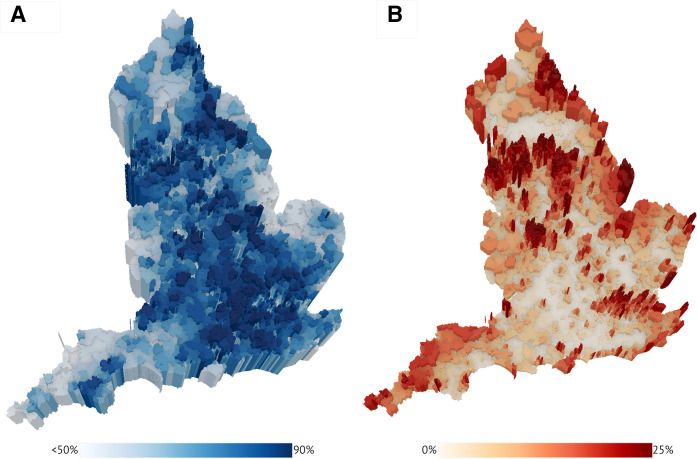
Objectives: Digital health inequality, observed as differential utilisation of digital tools between population groups, has not previously been quantified in the National Health Service (NHS). Deployment of universal digital health interventions, including a national smartphone app and online primary care services, allows measurement of digital inequality across a nation. We aimed to measure population factors associated with digital utilisation across 6356 primary care providers serving the population of England. Methods: We used multivariable regression to test association of population and provider characteristics (including patient demographics, socioeconomic deprivation, disease burden, prescribing burden, geography and healthcare provider resource) with activation of two independent digital services during 2021/2022. Results: We find a significant adjusted association between increased population deprivation and reduced digital utilisation across both interventions. Multivariable regression coefficients for most deprived quintiles correspond to 4.27 million patients across England where deprivation is associated with non-activation of the NHS App. Conclusion: Results are concerning for technologically driven widening of healthcare inequalities. Targeted incentive to digital is necessary to prevent digital disparity from becoming health outcomes disparity.
Overview
The claims and statistics of this paper haven’t been checked yet.
Free: it reads the open-access text and checks the first 5 claims that cite a source we can check. Create a free account to check every claim.
Integrity signals
Registry
Cites
Statistics
Figures
Verification
Claims the paper makes
The claims and statistics of this paper haven’t been checked yet.
Free: it reads the open-access text and checks the first 5 claims that cite a source we can check. Create a free account to check every claim.
Claims other papers make about this one
Each is checked against this paper’s own text: does it say what the citing paper says it does?
In the citing paper
“Although smartphones are used by a large majority of the global population and have been suggested to constitute a potential solution to reach individuals with a low socioeconomic position with health messages, health app usage has been associated with higher levels of education and less socioeconomic deprivation [50–52].”
From Multidomain Dementia Risk Reduction in Primary Care is Feasible: A Proof-of-concept study (2024) · cites this paper as [51]
Self-check
Percentages, sums and reported differences re-computed from the paper’s own numbers.
The self-check needs the paper’s full text.
Citations
Cites
Bundesgesundheitsblatt - Gesundheitsforschung - Gesundheitsschutz
(2013) · Bundesgesundheitsblatt - Gesundheitsforschung - Gesundheitsschutz · doi:10.1007/103.1437-1588 · Cited by 11,796
Digital inclusion as a social determinant of health
Sieck, C. J., Sheon, A., Ancker, J. S., Castek, J., Callahan, B., & Siefer, A. (2021) · npj Digital Medicine · doi:10.1038/s41746-021-00413-8 · Cited by 597
Digital health: a path to validation
Mathews, S. C., McShea, M. J., Hanley, C. L., Ravitz, A., Labrique, A. B., & Cohen, A. B. (2019) · npj Digital Medicine · doi:10.1038/s41746-019-0111-3 · Cited by 508
Gordon, N. P., & Hornbrook, M. C. (2016) · Journal of Medical Internet Research · doi:10.2196/jmir.5105 · Cited by 366
English indices of deprivation 2010 : technical report
McLennan, D., Noble, S., Noble, M., Plunkett, E., Wright, G., & Gutacker, N. (2011) · Digital Education Resource Archive (University College London) · Cited by 315
COVID-19 and the digital divide in the UK
Watts, G. (2020) · The Lancet Digital Health · doi:10.1016/s2589-7500(20)30169-2 · Cited by 274
Digital health and care in pandemic times: impact of COVID-19
Peek, N., Sujan, M., & Scott, P. (2020) · BMJ Health & Care Informatics · doi:10.1136/bmjhci-2020-100166 · Cited by 218
Advancing digital health applications: priorities for innovation in real-world evidence generation
Stern, A. D., Brönneke, J., Debatin, J. F., Hagen, J., Matthies, H., Patel, S., Clay, I., Eskofier, B., Herr, A., Hoeller, K., et al. (2022) · The Lancet Digital Health · doi:10.1016/s2589-7500(21)00292-2 · Cited by 147
Din, H. N., McDaniels-Davidson, C., Nodora, J., & Madanat, H. (2019) · Journal of Medical Internet Research · doi:10.2196/11931 · Cited by 103
Zhang, Y., Pratap, A., Folarin, A., Sun, S., Cummins, N., Matcham, F., Vairavan, S., Dineley, J., Ranjan, Y., Rashid, Z., et al. (2023) · npj Digital Medicine · doi:10.1038/s41746-023-00749-3 · Cited by 71
Research works printed but not linked: 1
- Hewitt P. The Hewitt review: an independent review of integrated care systems; 2023.
Cited by
Access and triage in contemporary general practice: A novel theory of digital candidacy
Dakin, F., Rybczynska‐Bunt, S., Rosen, R., Clarke, A., & Greenhalgh, T. (2024) · Social Science & Medicine · doi:10.1016/j.socscimed.2024.116885 · Cited by 58
Bucher, A., Chaudhry, B. M., Davis, J. W., Lawrence, K. S., Panza, E. A., Baqer, M., Feinstein, R. T., Fields, S. A., Huberty, J., Kaplan, D. M., et al. (2024) · PLOS Digital Health · doi:10.1371/journal.pdig.0000591 · Cited by 42
“…health tool; the use of modalities such as virtual or augmented reality or even smart watches may inadvertently exclude members of disadvantaged groups from the benefits of digital health [10], as indicated by research showing a negative relationship between SES and access to digital health [11].”
BackgroundArtificial intelligence and global health equity
Dychiao, R. G., Nazer, L. H., Mlombwa, D., & Celi, L. A. (2024) · BMJ · doi:10.1136/bmj.q2194 · Cited by 29
Self-citationMultidomain Dementia Risk Reduction in Primary Care is Feasible: A Proof-of-concept study
Van Asbroeck, S., Köhler, S., Wimmers, S. C. P. M., Muris, J. W. M., van Boxtel, M. P. J., & Deckers, K. (2024) · Journal of Alzheimer’s Disease · doi:10.3233/jad-240229 · Cited by 17
Perspective on the ethics of AI at the intersection of nutrition and behaviour change
Abrahams, M., & Raimundo, M. (2025) · Frontiers in Aging · doi:10.3389/fragi.2025.1423759 · Cited by 17
“However, a recent study found that digital health tools are unequally adopted and distributed amongst society, especially when considering age and ethnicity (Zhang et al., 2023).”
Moloney, M., Rubio, J., Palencia, I., Hollimon, L. A., Mejia, D., & Seixas, A. A. (2024) · The Journal of Rural Health · doi:10.1111/jrh.12903 · Cited by 12
“20 Technology barriers including design, access, and digital literacy must be adequately addressedtoclosethehealthdisparitygapinruralregions,andbeyond.”
Gangoiti, G. M., Fernández-López, M. J., Alzaga, E. V., Martín, U., & Ayala‐García, A. (2025) · Journal of Medical Internet Research · doi:10.2196/81841 · Cited by 15
“Of the 18 included studies [32-49], 56% (10/18) analyzed eHealth portals [32,34,35,38-41, 43, 48 ,49] , 33% ( 6 / 18 ) examined EHRs [ 37, 41, 42, 46-48 46-48]”
InfluentialSukriti, K. C., Papoutsi, C., Reidy, C., Gudgin, B., powell, J. A., Majeed, A., Greaves, F., & Laverty, A. A. (2024) · Journal of Medical Internet Research · doi:10.2196/56320 · Cited by 18
“A previous study exploring differences in the uptake of NHS primary care services, including the NHS App, highlighted reduced use of both the NHS App and web-based patient portals among the 4.27 million patients living in the most deprived quintiles in England [33].”
InfluentialSpence, T., Howarth, A., Reid, D., Sheringham, J., Apea, V., Crundwell, D., Day, S. L., Dewsnap, C., Jackson, L., Mercer, C. H., et al. (2024) · BMC Public Health · doi:10.1186/s12889-024-19741-x · Cited by 11
“There is wider evidence of certain populations being excluded by the shift towards digital healthcare, including some people with disabilities and those with fewer socioeconomic resources [12, 13].”
BackgroundDiversity and inclusion: A hidden additional benefit of Open Data
Charpignon, M., Celi, L. A., Cobanaj, M., Eber, R., Fiske, A., Gallifant, J., Li, C., Lingamallu, G., Petushkov, A., & Pierce, R. L. (2024) · PLOS Digital Health · doi:10.1371/journal.pdig.0000486 · Cited by 13
Self-citationDigital health equity: Crafting sustainable pathways
Pierce, R. L. (2025) · PLOS Digital Health · doi:10.1371/journal.pdig.0000703 · Cited by 10
Self-citationFadul, N., Alaskar, M. F., Jillahi, K. B., & El-Khaled, D. B. (2025) · Journal of Future Artificial Intelligence and Technologies · doi:10.62411/faith.3048-3719-298 · Cited by 14
Sun, Z., Chen, X., & Qian, D. (2025) · Journal of Medical Internet Research · doi:10.2196/60546 · Cited by 8
Unlocking digital health: inequalities in the adoption of a patient portal
Barker, R. D., Gökmen, R., Mistry, P., Naylor, D., & Teo, J. (2026) · BMJ Health & Care Informatics · doi:10.1136/bmjhci-2025-101587 · Cited by 6
Self-citationDo new models of primary care risk exacerbating existing inequity?
Payne, R. E., MacIver, E., & Clarke, A. (2024) · British Journal of General Practice · doi:10.3399/bjgp24x739449 · Cited by 5
Abdulwahab, L. O., Daniel, O., Gul, A., & Umar, H. B. (2026) · IGI Global eBooks · doi:10.4018/979-8-3373-3531-5.ch002 · Cited by 7
Lee, H., Shin, Y., Moon, H., Choi, Y., & Lee, A. (2025) · Internet Interventions · doi:10.1016/j.invent.2025.100850 · Cited by 8
Cheetham, N. J., Cantle, F., Guise, A., & Steves, C. J. (2025) · BMJ Open · doi:10.1136/bmjopen-2024-097178 · Cited by 6
Yang, J., Luo, B., & Hu, L. (2026) · Frontiers in Public Health · doi:10.3389/fpubh.2025.1699498 · Cited by 5
“Consequently, the digital divide may intensify credit constraints, undermine intertemporal consumption smoothing, reduce healthcare spending, and ultimately exacerbate healthcare consumption inequality (46).”
Acceptance of Digital Health in Portugal: An Example of Digital Divide
Lima, M. L., Camilo, C., Rodrigues, R. B., Campos, E. B., Espanha, R., Martins, H., & Sánchez‐García, J. (2025) · Portuguese Journal of Public Health · doi:10.1159/000546866 · Cited by 6
“Consequently, older people, those who are socio-economically disadvantaged, or those living in rural areas show disproportionately lower rates of use of digital health tools [26] and present lower levels of digital health literacy [27].”
Impact of a digital platform on genetic counselling encounters in the screening context
Mighton, C. E., Jan, A., Lee, L., Bouffler, S. E., Downie, L., Clausen, M., Gaff, C., Bombard, Y., Stark, Z., & Martyn, M. M. (2026) · European Journal of Human Genetics · doi:10.1038/s41431-026-02029-6 · Cited by 2
“These fi ndings demonstrate the utility of GA in supporting opportunistic genomic screening and suggest that digital tools have the potential to support the scalability of genomic screening.”
Palliative medicine in 2050: how will people live the last part of life?
Wakefield, D., Perrott, S. L., Turner, G., & Sallnow, L. (2026) · Future Healthcare Journal · doi:10.1016/j.fhj.2026.100512 · Cited by 2
“38 , 39 Implementing digital technologies requires extensive data collection and linkage, and questions of consent, access and governance must be addressed in highly sensitive end-of-life contexts.”
Clift, J., Dakin, F., Khan, A., Woodier, N., Greenhalgh, T., & Payne, R. E. (2026) · BMJ Quality & Safety · doi:10.1136/bmjqs-2026-020139 · Cited by 2
“3 Previous studies have highlighted barriers related to digital access, communication and system navigation 25–28 ; our study highlights the potential for this to be mitigated through structured, whole-team reflection allowing practices to identify and consider responses to these challenges within…”
Muñoz-Espinoza, K., Gutiérrez-Aguado, A., Caballero-Montes, A., & Donayre, M. M. A. (2024) · Educación Médica · doi:10.1016/j.edumed.2024.100976 · Cited by 2
Digital inequality in a developing context: A multifaceted approach
Jere, N. R., Mwansa, G., Ranga, M., Gamundani, A. M., & Maoneke, P. B. (2025) · doi:10.4102/aosis.2025.bk494 · Cited by 3
Digital Inclusion in a Scottish National Pulmonary Hypertension Population
Ingram, J., Stubbs, H., Lua, S., Brewis, M. J., Johnson, M., & Church, C. (2025) · Pulmonary Circulation · doi:10.1002/pul2.70135 · Cited by 2
“Inequality in digital access and utilization between socio-economic groups is commonly cited in the literature [17].”
Targeted Digital Health Intervention in End‐of‐Life and Hospice Care: A Scoping Review
Jeon, M., Jeon, H., & Kim, S. (2025) · Journal of Advanced Nursing · doi:10.1111/jan.16734 · Cited by 6
Dissecting reality: navigating the implementation gap of AI in the NHS
Aggarwal, A., & Ashrafian, H. (2025) · Bulletin of The Royal College of Surgeons of England · doi:10.1308/rcsbull.2025.57 · Cited by 1
Self-citationLi, R., Xu, X., Li, Q., Liu, H., Zhou, T. T., Amhare, A. F., Liu, P., Tang, L., Wang, W., Zheng, F., et al. (2026) · Journal of Medical Internet Research · doi:10.2196/78037 · Cited by 3
“Addressing these challenges requires coordinated policies that integrate infrastructure investment, targeted subsidies, and the inclusion of IH capacity indicators in routine health assessments [37,38].”
Jiang, J., Zhong, Q., Yin, Z., Zhou, Q., Wang, Y., & Yan, Z. (2026) · International Journal of Behavioral Nutrition and Physical Activity · doi:10.1186/s12966-026-01874-4 · Cited by 4
“Institutional fragmentation and pronounced social stratification have contributed to the concentration of digital health resources among middle-to high-income and highly educated groups [19, 34, 35].”
Trewartha, G., Janssens, L., & Harrison, S. L. (2026) · Chronic Respiratory Disease · doi:10.1177/14799731261441307 · Cited by 1
Patterson, S., Rennie, N., Mann, S., McCarthy, O., Palmer, M. J., & French, R. (2025) · BJOG An International Journal of Obstetrics & Gynaecology · doi:10.1111/1471-0528.18323 · Cited by 1
“Whilst good uptake of remote contraceptive services has been demonstrated among socioeconomically deprived populations in London [46] other analyses among general medical patients suggest that people living in deprived regions are less likely to engage with digital health innovations [31, 53].”
Sun, Z., Chen, X., & Qian, D. (2024) · Research Square · doi:10.21203/rs.3.rs-4461334/v1
Lee, H., Shin, Y., Choi, Y., Moon, H., & Lee, A. (2024) · doi:10.2196/preprints.63170
Asbroeck, S. V. (2024) · Research Publications (Maastricht University) · doi:10.26481/dis.20240618sa
Chapter 7: Addressing digital inequality in rural primary healthcare systems in sub-Saharan Africa
Oki, O. A., & Lukose, J. M. (2025) · doi:10.4102/aosis.2025.bk494.07
Digitálna priepasť a jej ekonomické konzekvencie v krajinách EÚ
Chyláková, V., & Huňady, J. (2025) · Acta aerarii publici. · doi:10.24040/aap.2025.22.1.57-72
Ye, R., Song, D.-M., & He, Y. (2025) · Urolithiasis · doi:10.1007/s00240-025-01805-1
“These refinements wouldn’t just enhance sta - tistical rigor but also offer more nuanced insights into how different patient profiles interact with digital educational tools [3].”
Ali, S. M., Masood, Y., Staniland, K., Dixon, W. G., van der Veer, S. N., & Sanders, C. (2025) · Research Square · doi:10.21203/rs.3.rs-6869744/v1
Social inequalities in digital access to healthcare in Europe: a systematic review (Preprint)Preprint
Gangoiti, G. M., Fernández-López, M. J., Alzaga, E. V., Unai Martín, R., & Ayala‐García, A. (2025) · doi:10.2196/preprints.81841
Ali, S. M., Masood, Y., Staniland, K., Dixon, W. G., van der Veer, S. N., & Sanders, C. (2026) · JMIR Human Factors · doi:10.2196/82333 · Cited by 1
“However, despite this growing attention to digital health technologies, South Asian individuals have lower use rates of digital health tools within the NHS [35] and remain underre-presented in related research [36,37].”
Taylor, S. C., Zelinsky, M., Lioi, A. B., Petschek, I., Aguiar, M., Kundu, S., Darling, S., Arrotta, K., Gallagher, L. M., Supan, A., et al. (2025) · Telemedicine Journal and e-Health · doi:10.1177/15305627251401524
Ethics Applied to Digital Healthcare: Navigating the Moral Landscape
Niazkhani, Z., Wallenburg, I., Hendriks, J. M., & Wehrens, R. (2026) · Springer eBooks · doi:10.1007/978-3-031-89820-4_24
Semayobe, E., Ukala, A., Ukala, C. C., Thomas, M. A., & Ogbodo, E. A. (2025) · Photonics & Electromagnetics Research Symposium - Fall (PIERS-Fall) · doi:10.23919/piers-fall62445.2025.11394410
“The COVID-19 pandemic further disrupted service provision: shelter capacities were halved, while many homeless individuals lacked smartphones or stable electricity to engage in contact tracing and online services [3].”
InfluentialBeyond the gut: digital transformation redefining holistic IBD care in the UK
Gomez, D. A., Deliyannis, E. P., & Zaré, B. (2026) · Frontline Gastroenterology · doi:10.1136/flgastro-2025-103482
Evaluating the national rollout of the NHS App in England using qualitative and quantitative methods
Greaves, F., Papoutsi, C., Sukriti, K. C., Tewolde, S., Reidy, C., Gudgin, B., Laverty, A. A., Majeed, A., Costelloe, C., & Powell, J. (2026) · Health and Social Care Delivery Research · doi:10.3310/xyrv6485
Cooper, T., Martin, G., Beckley, I., Gao, W., & Williams, B. (2026) · doi:10.2196/preprints.103490
Nayak, K. (2026) · Journal of Public and Clinical Health Research · doi:10.63486/jpchr.26060801
“[12] Several adjacent frameworks already address digital health equity, AI lifecycle assessment, implementation equity, ethical appraisal, and sources of algorithmic harm.”
InfluentialFuger, J. M., Voggenberger, L., & Zelko, E. (2026) · Journal of Medical Internet Research · doi:10.2196/83343
“National-level analyses of remote consultation uptake in general practice likewise show higher digital use in less-deprived populations and lower uptake among older and more disadvantaged groups, even where services are universally available [7,115].”
Kohut, K., Cable, S., Ashokan, A., Vicari, S., Ditchfield, H., Young, J., Bux, B., & Lalloo, F. I. (2026) · Familial Cancer · doi:10.1007/s10689-026-00597-6
Household Food Insecurity and Digital Health-Related Activities Among Lower-Earning Chinese Adults
Zhou, J., Qiao, Z., Li, Z., Xu, K., & Men, F. (2026) · Health Policy and Technology · doi:10.1016/j.hlpt.2026.101331
Akıncı, H., & DALKILIÇ, S. (2026) · Frontiers in Public Health · doi:10.3389/fpubh.2026.1958637
Metadata
- Authors
- Zhang, J., Gallifant, J., Pierce, R. L., Fordham, A., Teo, J., Celi, L., & Ashrafian, H.
- Affiliations
- St Thomas' Hospital (GB)
- University of Exeter (GB)
- NHS England (GB)
- Guy's Hospital (GB)
- Beth Israel Deaconess Medical Center (US)
- University of Leeds (GB)
- Corresponding author
- Zhang, Joe
- Venue
- BMJ Health & Care Informatics
- Publisher
- BMJ
- Published
- 2023-11
- Volume
- 30
- Issue
- 1
- Pages
- e100809
- ISSN
- 2632-1009 (ISSN-L)
- PMC
- PMC10680008
- OpenAlex
- W4389028364
- Semantic Scholar
- ef25a55f63ecab2f4a7927d57b2900e6f78c5a04
- Cited by
- 52
- References
- 12
- Citations by year
- 2026: 18 · 2025: 21 · 2024: 13
- FWCI
- 14.05
- Type
- journal article
- Language
- en
- Open access
- gold
- doi.org
- Licence
- Locations
- BMJ Health & Care Informatics (publishedVersion, cc-by-nc)
- Research Square (acceptedVersion, cc-by)
- PubMed Central (publishedVersion, cc-by-nc)
- PubMed (publishedVersion)
- DOAJ (DOAJ: Directory of Open Access Journals) (submittedVersion, cc-by-sa)
- Figshare (submittedVersion, cc-by-nc)
- Open Research Exeter (University of Exeter) (submittedVersion, cc-by-nc)
- Spiral (Imperial College London) (submittedVersion, cc-by-nc)
- Funders
- Wellcome Trust (203928/Z/16/Z, 203928)
- National Institute for Health and Care Research
- Imperial College London (203928/Z/16/Z)
- Topics
- Social Sciences › Health › Health disparities and outcomes
- Health Sciences › Medicine › Geriatrics and Gerontology › Technology Use by Older Adults
- Health Sciences › Health Professions › Health Information Management › Electronic Health Records Systems
- Keywords
- socioeconomic deprivation, NHS App, primary care providers, health disparities, digital divide, health technology adoption, disease burden
- MeSH terms
- England, Humans, State Medicine, Health Status Disparities, Healthcare Disparities
About these checks
Registry, retraction, Cites and statistics results are computed, not judged, with one exception: a printed reference that no index lists is read once by a model before it counts as a citation error. Claims are extracted by a model and kept only when their quote appears verbatim in the text; each cited source is then checked, with a model’s help, for whether it says what the claim relies on. Those verdicts can be wrong — read the claim’s quote and the cited source before relying on one.
Statistics and arithmetic are recomputed, not judged.
Confidence bands are shown only for fields calibrated on our annotated test set. None is calibrated yet, so no band is shown.
What counts as a claim ›How we measure confidence ›How we check this ›
Are you an author, or do you see a problem with this page? Request a review
Data sources
Bibliographic data: Semantic Scholar, OpenAlex, Crossref.
Contains information from the Semantic Scholar Academic Graph Datasets, made available under the ODC Attribution License (ODC-BY 1.0).
Semantic Scholar’s data is described in: Kinney, R., et al. (2023). The Semantic Scholar Open Data Platform. arXiv:2301.10140.
