

Parental comprehension of the benefits/risks of first-line randomised clinical trials in children with solid tumours: a two-stage cross-sectional interview study
Open accessThe DOI matches its Crossref record; 30 of the 31 references it cites were found in a registry or an index.
Abstract
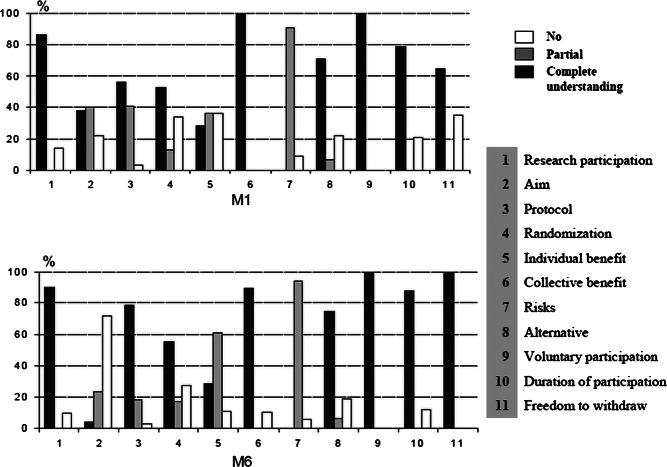
Objectives: To analyse the parental understanding of informed consent information in first-line randomised clinical trials (RCTs) including children with malignant solid tumours and to assess parents’ needs for decision-making. Design: Observational prospective study. Setting: 3 paediatric oncology centres in the Parisian region in France. Participants: 53 parents were approached to participate in a RCT for their child with malignant solid tumour, over a 1-year period. 40 parents have been interviewed in our study. Primary and secondary outcome measures: Parental understanding of information in RCTs, parents’ needs for decision-making. Parents were questioned by a psychologist, independent of the paediatric oncology teams, using a semidirected interview, 1 (M1) and 6 months (M6) after the consent was sought. Results: 18 parents (45%) did not understand the concept of randomisation. Half of the parents could explain neither the aim of the clinical trial nor the potential benefit to their child of inclusion. 35 parents (87.5%) expressed very few specific risks related to the trial. Being mostly French-speaking (p=0.03) and the reading of the information sheet by the parents (p=0.0025) improved their understanding. The parental comprehension did not differ between M1 and M6. The principal factors underlying their decision were confidence in the medical team (39%), wish to access to the best treatment (37%) and the best quality of life (37%). Conclusions: Despite medical explanations, parents have limited knowledge in some areas in first-line RCTs and improvements of information process are required. The risks specific to the randomised trial are underestimated by parents and the unproven nature of the treatment is not well-known or understood.
Overview
The claims and statistics of this paper haven’t been checked yet.
Free: it reads the open-access text and checks the first 5 claims that cite a source we can check. Create a free account to check every claim.
Integrity signals
Registry
Cites
Statistics
Figures
Verification
Claims the paper makes
The claims and statistics of this paper haven’t been checked yet.
Free: it reads the open-access text and checks the first 5 claims that cite a source we can check. Create a free account to check every claim.
Claims other papers make about this one
Each is checked against this paper’s own text: does it say what the citing paper says it does?
The cited source says what the claim attributes to it.
In the citing paper
“The difficulty that participants had in describing randomisation, in expressing the purpose of the research or specific details about the FiCTION RCT’s three arm design mirrors findings from previous medical RCTs involving children [36].”
From Parental attitudes to randomised controlled trials in primary dental care: A qualitative study (2026) · cites this paper as [36]
Self-check
Percentages, sums and reported differences re-computed from the paper’s own numbers.
The self-check needs the paper’s full text.
Citations
Cites
Informed consent: how much and what do patients understand?
Falagas, M. E., Korbila, I. P., Giannopoulou, K. P., Kondilis, B. K., & Peppas, G. (2009) · The American Journal of Surgery · doi:10.1016/j.amjsurg.2009.02.010 · Cited by 428
Snowdon, C., Garcia, J., & Elbourne, D. (1997) · Social Science & Medicine · doi:10.1016/s0277-9536(97)00063-4 · Cited by 296
Communication of Randomization in Childhood Leukemia Trials
Kodish, E. (2004) · JAMA · doi:10.1001/jama.291.4.470 · Cited by 226
Parents' attitudes to children's participation in randomized controlled trials
Caldwell, P. H. Y., Butow, P. N., & Craig, J. C. (2003) · The Journal of Pediatrics · doi:10.1067/mpd.2003.192 · Cited by 187
The extent of patients' understanding of the risk of treatments
Lloyd, A. J. (2001) · Quality and Safety in Health Care · doi:10.1136/qhc.0100014 · Cited by 159
Parental perceptions and attitudes about informed consent in clinical research involving children
HARTH, S. C., & Thong, Y. H. (1995) · Social Science & Medicine · doi:10.1016/0277-9536(95)00058-f · Cited by 145
Factors Associated With Participation in Breast Cancer Treatment Clinical Trials
Avis, N. E., Smith, K. W., Link, C. L., Hortobágyi, G. N., & Rivera, E. (2006) · Journal of Clinical Oncology · doi:10.1200/jco.2005.03.8976 · Cited by 143
Informed consent, parental awareness, and reasons for participating in a randomised controlled study
van Stuijvenberg, M., Suur, M. H., de Vos, S., Tjiang, G. C. H., Steyerberg, E. W., Derksen-Lubsen, G., & Moll, H. A. (1998) · Archives of Disease in Childhood · doi:10.1136/adc.79.2.120 · Cited by 133
COX, K., & MCGARRY, J. (2003) · European Journal of Cancer Care · doi:10.1046/j.1365-2354.2003.00396.x · Cited by 130
Cited by
Tam, N. T., Huy, N. T., Thoa, L. T. B., Long, N. P., Trang, N. T. H., Hirayama, K., & Karbwang, J. (2015) · Bulletin of the World Health Organization · doi:10.2471/blt.14.141390 · Cited by 315
Woolfall, K., Young, B., Frith, L., Appleton, R. E., Iyer, A., Messahel, S., Hickey, H., & Gamble, C. L. (2014) · BMJ Open · doi:10.1136/bmjopen-2014-005045 · Cited by 75
Informed Consent in Pediatric Oncology: A Systematic Review of Qualitative Literature
Alahmad, G. (2018) · Cancer Control · doi:10.1177/1073274818773720 · Cited by 56
Dekking, S. A. S., van der Graaf, R., Meeteren, A. Y. N. S., Kars, M. C., & van Delden, J. J. M. (2016) · Pediatric Drugs · doi:10.1007/s40272-015-0158-9 · Cited by 34
Neyro, V., Élie, V., Thiele, N., & Jacqz-Aigrain, É. (2018) · PLoS ONE · doi:10.1371/journal.pone.0198097 · Cited by 29
Challenges of Clinical Trial Design for Targeted Agents Against Pediatric Leukemias
Mussai, F., Yap, C., Mitchell, C., & Kearns, P. R. (2015) · Frontiers in Oncology · doi:10.3389/fonc.2014.00374 · Cited by 26
Ethical issues of clinical trials in paediatric oncology from 2003 to 2013: a systematic review
Dupont, J. K., Pritchard‐Jones, K., & Doz, F. (2016) · The Lancet Oncology · doi:10.1016/s1470-2045(16)00142-x · Cited by 26
Self-citationEthical Challenges of Pediatric Cancer Care: Interviews With Nurses in Saudi Arabia
Alahmad, G., Al-Kamli, H., & Alzahrani, H. (2020) · Cancer Control · doi:10.1177/1073274820917210 · Cited by 24
Parental decision making regarding consent to randomization on Children's Oncology Group AALL0932
Parker, K. N., Cottrell, E., Stork, L. C., & Lindemulder, S. (2021) · Pediatric Blood & Cancer · doi:10.1002/pbc.28907 · Cited by 20
Narikawa, Y., Zheng, Y.-F., Kikuya, M., Kawai, M., Ishida, T., Kuriyama, S., & Ohuchi, N. (2014) · Trials · doi:10.1186/1745-6215-15-375 · Cited by 20
Béranger, A., Bouazza, N., de Sigy, A. D. H., Foubert-Wenc, A.-C., Davous, D., Aerts, I., Geoerger, B., Auvrignon, A., Brethon, B., Leblond, P., et al. (2018) · Archives of Disease in Childhood · doi:10.1136/archdischild-2018-315237 · Cited by 15
Self-citationTromp, K., & van de Vathorst, S. (2019) · Journal of Empirical Research on Human Research Ethics · doi:10.1177/1556264619845599 · Cited by 15
Patterson, J. K., Pant, S., Jones, D. F., Taha, S., Jones, M. S., Bauserman, M., Montaldo, P., Bose, C. L., & Thayyil, S. (2021) · PLoS ONE · doi:10.1371/journal.pone.0248263 · Cited by 14
Trial Characteristics That Affect Parental Consent in Neonatal Drug Trials
Hanvey, I. B., Aliaga, S. R., Laughon, M. M., Testoni, D., Smith, P. B., & Bauserman, M. (2018) · American Journal of Perinatology · doi:10.1055/s-0038-1675157 · Cited by 10
End-of-Life Childhood Cancer Research: A Systematic Review
Hasan, F., Widger, K. A., Sung, L., & Wheaton, L. (2021) · PEDIATRICS · doi:10.1542/peds.2020-003780 · Cited by 9
Approaches for Discussing Clinical Trials with Pediatric Oncology Patients and Their Families
Blazin, L., Cuviello, A., Spraker‐Perlman, H. L., & Kaye, E. C. (2022) · Current Oncology Reports · doi:10.1007/s11912-022-01239-7 · Cited by 8
Koonrungsesomboon, N., Traivaree, C., Chamnanvanakij, S., Rungtragoolchai, P., Thanapat, Y., & Karbwang, J. (2017) · Archives of Disease in Childhood Fetal & Neonatal · doi:10.1136/archdischild-2017-312615 · Cited by 8
Koonrungsesomboon, N., Traivaree, C., Tiyapsane, C., & Karbwang, J. (2019) · BMJ Open · doi:10.1136/bmjopen-2019-029530 · Cited by 8
Shiely, F., Murphy, E. K., Gillies, K., Hood, K., O’Sullivan, L., Harman, N., Isaacs, T., & Treweek, S. P. (2024) · Trials · doi:10.1186/s13063-024-08217-3 · Cited by 7
Chappuy, H., Foubert, A.-C., & de Sigy, A. D. H. (2013) · Revue d Oncologie Hématologie Pédiatrique · doi:10.1016/j.oncohp.2013.12.002 · Cited by 3
Self-citationGuilmatre, A., Davous, D., de Sigy, A. D. H., Asselain, B. J. R., Chevret, S., & Petit, A. (2022) · Bulletin du Cancer · doi:10.1016/j.bulcan.2022.07.001 · Cited by 3
Self-citationSpécificités pédiatriques en cancérologie
Michon, J. M. (2016) · ONCOLOGIE · doi:10.1007/s10269-016-2674-9 · Cited by 2
La recherche pour guérir plus et guérir mieux
Ducassou, S., Minard‐Colin, V., Pérel, Y., & Vassal, G. (2017) · doi:10.1016/b978-2-294-74470-9.00032-x · Cited by 1
Self-citationParental attitudes to randomised controlled trials in primary dental care: A qualitative study
Coventry, H., Maguire, A., McColl, E., & Haighton, C. (2026) · PLoS ONE · doi:10.1371/journal.pone.0330055
“The difficulty that participants had in describing randomisation, in expressing the purpose of the research or specific details about the FiCTION RCT’s three arm design mirrors findings from previous medical RCTs involving children [36].”
Between Protection and Participation : Moral promises and perils in pediatric clinical research
Tromp, K. (2019) · EUR Research Repository (Erasmus University Rotterdam)
Egervári, K. L. (., & Boos, J. (. (2016) · URN:NBN Resolver for Germany & Switzerland (German National Library)
La protection des sujets de recherche vulnérables selon la loi sur la recherche sur l'être humain
Junod, V., & Baud, C.-A. (2015) · Archive ouverte UNIGE (University of Geneva)
Dahl, A. B. (2015) · UA Campus Repository (The University of Arizona)
Metadata
- Authors
- Chappuy, H., Bouazza, N., Minard-Colin, V., Patte, C., Brugières, L., Landman-Parker, J., Auvrignon, A., Davous, D., Pacquement, H., Orbach, D., Tréluyer, J. M., & Doz, F.
- Affiliations
- Hôpital Necker-Enfants Malades (FR)
- Université Paris-Saclay (FR)
- Hôpital Armand-Trousseau (FR)
- Institut Curie (FR)
- Assistance Publique – Hôpitaux de Paris (FR)
- Corresponding author
- Chappuy, Hélène
- ORCID
- Venue
- BMJ Open
- Publisher
- BMJ
- Published
- 2013
- Volume
- 3
- Issue
- 5
- Pages
- e002733
- ISSN
- 2044-6055 (ISSN-L)
- PMC
- PMC3657641
- OpenAlex
- W2126985615
- Cited by
- 28
- References
- 31
- Citations by year
- 2026: 1 · 2024: 2 · 2022: 2 · 2021: 3 · 2020: 1 · 2019: 2 · 2018: 4 · 2017: 3 · 2016: 3 · 2015: 3 · 2014: 3 · 2013: 1
- FWCI
- 3.41
- Type
- journal article
- Language
- en
- Open access
- gold
- doi.org
- Licence
- cc-by-nc
- Locations
- BMJ Open (publishedVersion, cc-by-nc)
- Europe PMC (PubMed Central) (publishedVersion, cc-by-nc)
- PubMed Central (publishedVersion, cc-by-nc)
- PubMed (publishedVersion)
- HAL (submittedVersion, cc-by)
- Funders
- Société Française de lutte contre les Cancers et les leucémies de l'Enfant et de l'Adolescent
- Assistance publique-Hôpitaux de Paris
- Topics
- Health Sciences › Medicine › Public Health, Environmental and Occupational Health › Ethics in Clinical Research
- Health Sciences › Medicine › Pediatrics, Perinatology and Child Health › Ethics and Legal Issues in Pediatric Healthcare
- Health Sciences › Medicine › Public Health, Environmental and Occupational Health › Ethics and bioethics in healthcare
- Keywords
- parental comprehension, informed consent, pediatric clinical trials, randomized controlled trials, parental decision-making, risk understanding, randomization, pediatric oncology
About these checks
Registry, retraction, Cites and statistics results are computed, not judged, with one exception: a printed reference that no index lists is read once by a model before it counts as a citation error. Claims are extracted by a model and kept only when their quote appears verbatim in the text; each cited source is then checked, with a model’s help, for whether it says what the claim relies on. Those verdicts can be wrong — read the claim’s quote and the cited source before relying on one.
Statistics and arithmetic are recomputed, not judged.
Confidence bands are shown only for fields calibrated on our annotated test set. None is calibrated yet, so no band is shown.
What counts as a claim ›How we measure confidence ›How we check this ›
Are you an author, or do you see a problem with this page? Request a review
Data sources
Bibliographic data: Semantic Scholar, OpenAlex, Crossref.
Contains information from the Semantic Scholar Academic Graph Datasets, made available under the ODC Attribution License (ODC-BY 1.0).
Semantic Scholar’s data is described in: Kinney, R., et al. (2023). The Semantic Scholar Open Data Platform. arXiv:2301.10140.
