

What can qualitative research do for randomised controlled trials? A systematic mapping review
Open accessThe DOI matches its Crossref record; 39 of the 40 references it cites were found in a registry or an index.
Abstract
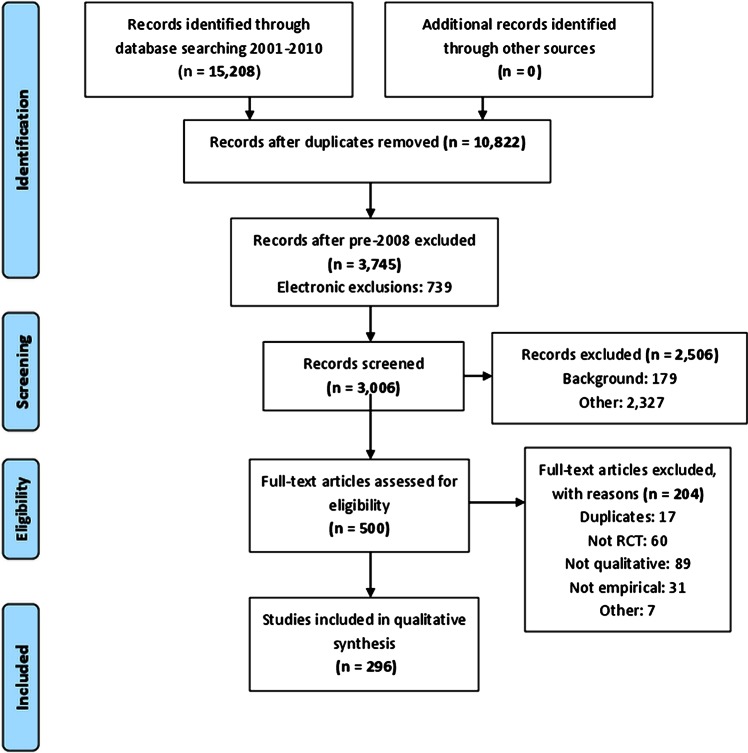
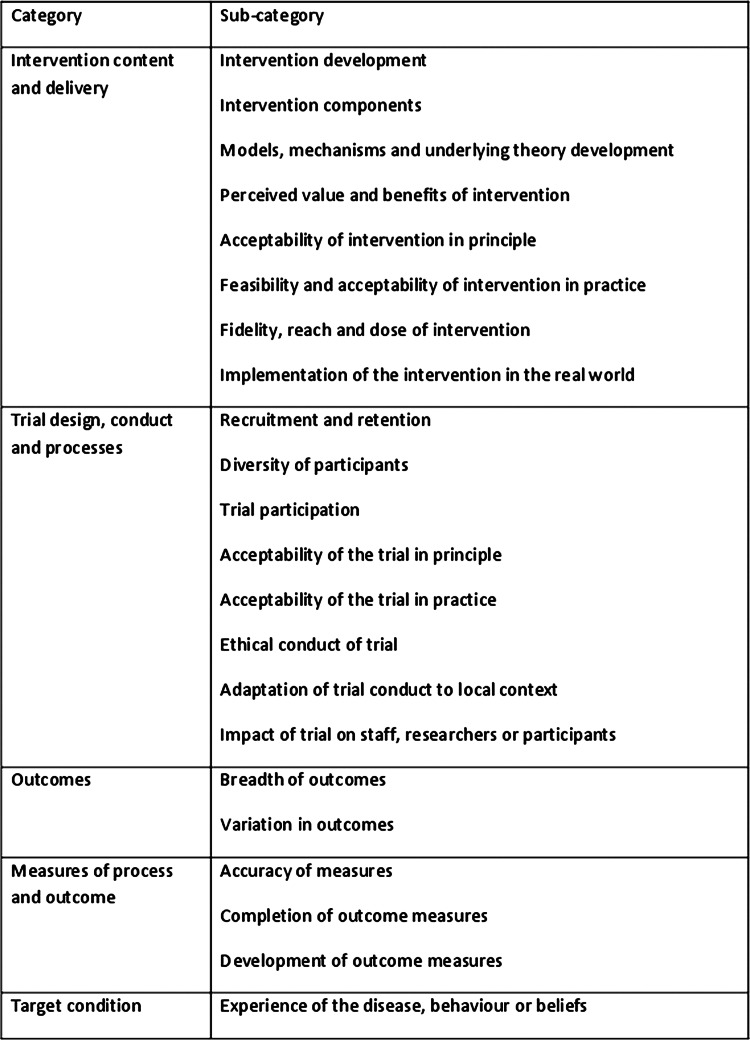
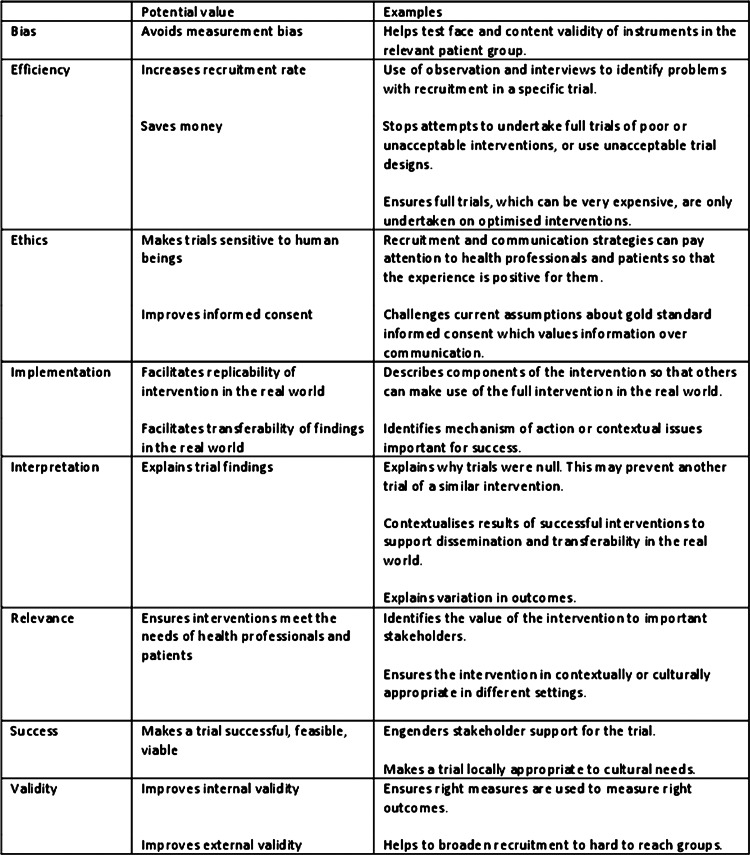
Objective: To develop an empirically based framework of the aspects of randomised controlled trials addressed by qualitative research. Design: Systematic mapping review of qualitative research undertaken with randomised controlled trials and published in peer-reviewed journals. Data sources: MEDLINE, PreMEDLINE, EMBASE, the Cochrane Library, Health Technology Assessment, PsycINFO, CINAHL, British Nursing Index, Social Sciences Citation Index and ASSIA. Eligibility criteria: Articles reporting qualitative research undertaken with trials published between 2008 and September 2010; health research, reported in English. Results: 296 articles met the inclusion criteria. Articles focused on 22 aspects of the trial within five broad categories. Some articles focused on more than one aspect of the trial, totalling 356 examples. The qualitative research focused on the intervention being trialled (71%, 254/356); the design, process and conduct of the trial (15%, 54/356); the outcomes of the trial (1%, 5/356); the measures used in the trial (3%, 10/356); and the target condition for the trial (9%, 33/356). A minority of the qualitative research was undertaken at the pretrial stage (28%, 82/296). The value of the qualitative research to the trial itself was not always made explicit within the articles. The potential value included optimising the intervention and trial conduct, facilitating interpretation of the trial findings, helping trialists to be sensitive to the human beings involved in trials, and saving money by steering researchers towards interventions more likely to be effective in future trials. Conclusions: A large amount of qualitative research undertaken with specific trials has been published, addressing a wide range of aspects of trials, with the potential to improve the endeavour of generating evidence of effectiveness of health interventions. Researchers can increase the impact of this work on trials by undertaking more of it at the pretrial stage and being explicit within their articles about the learning for trials and evidence-based practice.
Overview
The claims and statistics of this paper haven’t been checked yet.
Free: it reads the open-access text and checks the first 5 claims that cite a source we can check. Create a free account to check every claim.
Integrity signals
Registry
Cites
Statistics
Figures
Verification
Claims the paper makes
The claims and statistics of this paper haven’t been checked yet.
Free: it reads the open-access text and checks the first 5 claims that cite a source we can check. Create a free account to check every claim.
Claims other papers make about this one
Each is checked against this paper’s own text: does it say what the citing paper says it does?
The cited source says what the claim attributes to it.
In the citing paper
“There is also a framework for the work undertaken by qualitative research with trials [4].”
From Maximising the impact of qualitative research in feasibility studies for randomised controlled trials: guidance for researchers (2015) · cites this paper as [4]
The cited source says what the claim attributes to it.
In the citing paper
“Qualitative research can be used to examine and address key uncertainties prior to a full trial.”
From Maximising the impact of qualitative research in feasibility studies for randomised controlled trials: guidance for researchers (2015) · cites this paper as [4]
The cited source says what the claim attributes to it.
In the citing paper
“Across disciplines there is increasing recognition of the value of qualitative research conducted alongside effectiveness trials [8, 9].”
From A qualitative understanding of the effects of reusable sanitary pads and puberty education: Implications for future research and practice (2017) · cites this paper as [9]
In the citing paper
“A review of 296 journal articles reporting the use of qualitative research with trials published between 2008 and 2010 identified that 28 % of articles reported qualitative research undertaken prior to the full trial [4].”
From Maximising the impact of qualitative research in feasibility studies for randomised controlled trials: guidance for researchers (2015) · cites this paper as [4]
Self-check
Percentages, sums and reported differences re-computed from the paper’s own numbers.
The self-check needs the paper’s full text.
Citations
Cites
Developing and evaluating complex interventions: the new Medical Research Council guidance
Craig, P., Dieppe, P., Macintyre, S., Michie, S., Nazareth, I., & Petticrew, M. (2008) · BMJ · doi:10.1136/bmj.a1655 · Cited by 10,995
A typology of reviews: an analysis of 14 review types and associated methodologies
Grant, M. J., & Booth, A. (2009) · Health Information & Libraries Journal · doi:10.1111/j.1471-1842.2009.00848.x · Cited by 10,817
Qualitative data analysis for applied policy research
Ritchie, J., & Spencer, L. (2010) · Analyzing qualitative data · doi:10.4324/9780203413081_chapter_9 · Cited by 4,800
Framework for design and evaluation of complex interventions to improve health
Campbell, M. (2000) · BMJ · doi:10.1136/bmj.321.7262.694 · Cited by 3,474
Designing and evaluating complex interventions to improve health care
Campbell, N. C., Murray, E., Darbyshire, J., Emery, J., Farmer, A., Griffiths, F., Guthrie, B., Lester, H., Wilson, P., & Kinmonth, A. L. (2007) · BMJ · doi:10.1136/bmj.39108.379965.be · Cited by 1,331
Process evaluation in randomised controlled trials of complex interventions
Oakley, A., Strange, V., Bonell, C., Allen, E., & Stephenson, J. (2006) · BMJ · doi:10.1136/bmj.332.7538.413 · Cited by 1,247 · cited 1×
“For example, qualitative research can be used with RCTs, either alone or as part of a mixed methods process evaluation, to consider how interventions are delivered in practice.(4) The potential value of understanding how actual implementation differs ARTICLE SUMMARY”
MethodLewin, S., Glenton, C., & Oxman, A. D. (2009) · BMJ · doi:10.1136/bmj.b3496 · Cited by 678
Lefebvre, C., Manheimer, E., & Glanville, J. (2008) · Cochrane Handbook for Systematic Reviews of Interventions · doi:10.1002/9780470712184.ch6 · Cited by 559
Donovan, J., Little, P., Mills, N., Smith, M., Brindle, L., Jacoby, A., Peters, T., Frankel, S., Neal, D., & Hamdy, F. (2002) · BMJ · doi:10.1136/bmj.325.7367.766 · Cited by 533
Mowatt, G., Zhu, S., Kilonzo, M., Boachie, C., Fraser, C., Griffiths, T., N'Dow, J., Nabi, G., Cook, J., & Vale, L. (2010) · Health Technology Assessment · doi:10.3310/hta14040 · Cited by 313
Research works printed but not linked: 2
- Lefebvre C Manheimer E Glanville J Chapter 6: searching for studies. In: Higgins JPT Green S, eds. Cochrane handbook for systematic reviews of interventions. Version 5.0.2 [updated September 2009] The Cochrane Collaboration, 2009 http://www.cochrane-handbook.org
- Grant MJ Searching for qualitative research studies on the Medline database [oral presentation]. Qualitative Evidence Based Practice Conference 14–16 May 2000 Coventry University, UK, 2000
Cited by
Items 401–438 of 438
Davies, M., Kristunas, C., Huddlestone, L., Alshreef, A., Bodicoat, D. H., Dixon, S., Eborall, H., Glab, A., Hudson, N., Khunti, K., et al. (2020) · Figshare · doi:10.6084/m9.figshare.12361223
Condon, B., Griffin, A., Fitzgerald, C., Shanahan, E., Glynn, L., O’Connor, M., Hayes, C., Manning, M., Galvin, R., Leahy, A. M., et al. (2024) · Figshare · doi:10.6084/m9.figshare.25357967
Lowrie, R., McPherson, A., Mair, F. S., Stock, K., Jones, C. E., Maguire, D., Paudyal, V., Duncan, C., Blair, B., Lombard, C., et al. (2024) · Figshare · doi:10.6084/m9.figshare.26580263
Condon, B., Griffin, A., Fitzgerald, C., Shanahan, E., Glynn, L., O’Connor, M., Hayes, C., Manning, M., Galvin, R., Leahy, A. M., et al. (2024) · Figshare · doi:10.6084/m9.figshare.26689649
Lie, M. L. S., McParlin, C., McColl, E., Graham, R. H., & Robson, S. C. (2022) · Figshare · doi:10.6084/m9.figshare.20317516
French, C. M., Pinnock, H., Forbes, G., Skene, I., & Taylor, S. J. (2020) · Figshare · doi:10.6084/m9.figshare.13212346
Poltawski, L., van Beurden, S. B., Morgan-Trimmer, S., & Greaves, C. (2020) · Figshare · doi:10.6084/m9.figshare.12211283
French, C. M., Pinnock, H., Forbes, G., Skene, I., & Taylor, S. J. (2020) · Figshare · doi:10.6084/m9.figshare.13212337
Romøren, M., Hermansen, K. B., Sævareid, T. J. L., Brøderud, L., Westbye, S. F., Wahl, A. K., Thoresen, L., Rostoft, S., Førde, R., Ahmed, M., et al. (2024) · Figshare · doi:10.6084/m9.figshare.26682556
Sherratt, F. C., Fisher, P., Mathieson, A. M., Cherry, M. G., Pettitt, A. R., & Young, B. (2022) · Figshare · doi:10.6084/m9.figshare.20098777
Steinskog, T.-L. D., Tranvåg, O., Nortvedt, M. W., Ciliska, D. K., & Graverholt, B. (2021) · Figshare · doi:10.6084/m9.figshare.14820842
Lowrie, R., McPherson, A., Mair, F. S., Stock, K., Jones, C. E., Maguire, D., Paudyal, V., Duncan, C., Blair, B., Lombard, C., et al. (2024) · Figshare · doi:10.6084/m9.figshare.26580266
Poltawski, L., van Beurden, S. B., Morgan-Trimmer, S., & Greaves, C. (2020) · Figshare · doi:10.6084/m9.figshare.12211274
French, C. M., Pinnock, H., Forbes, G., Skene, I., & Taylor, S. J. (2020) · Figshare · doi:10.6084/m9.figshare.13212343
Poltawski, L., van Beurden, S. B., Morgan-Trimmer, S., & Greaves, C. (2020) · Figshare · doi:10.6084/m9.figshare.12211280
Davies, M., Kristunas, C., Huddlestone, L., Alshreef, A., Bodicoat, D. H., Dixon, S., Eborall, H., Glab, A., Hudson, N., Khunti, K., et al. (2020) · Figshare · doi:10.6084/m9.figshare.12361217
Serrano, M., Elías, M., Llorens, M., Bolasell, M., Vall‐Roqué, H., & Villalta, L. (2024) · Figshare · doi:10.6084/m9.figshare.26752231
Segrott, J., Channon, S., Lloyd, A., Glarou, E., Henley, J., Hughes, J., Jacob, N., Milosevic, S., Moriarty, Y., Pell, B., et al. (2024) · Figshare · doi:10.6084/m9.figshare.25834215
Moore, A., Wylde, V., Bruce, J., Howells, N., Bertram, W., Eccleston, C., & Gooberman-Hill, R. (2022) · Figshare · doi:10.6084/m9.figshare.19766297
Condon, B., Griffin, A., Fitzgerald, C., Shanahan, E., Glynn, L., O’Connor, M., Hayes, C., Manning, M., Galvin, R., Leahy, A. M., et al. (2024) · Figshare · doi:10.6084/m9.figshare.26689652
French, C. M., Pinnock, H., Forbes, G., Skene, I., & Taylor, S. J. (2020) · Figshare · doi:10.6084/m9.figshare.13212340
Davies, M., Kristunas, C., Huddlestone, L., Alshreef, A., Bodicoat, D. H., Dixon, S., Eborall, H., Glab, A., Hudson, N., Khunti, K., et al. (2020) · Figshare · doi:10.6084/m9.figshare.12361184
Lie, M., McParlin, C., McColl, E., Graham, R. H., & Robson, S. C. (2022) · Figshare · doi:10.6084/m9.figshare.20317519
O’Keeffe, S., Weitkamp, K., Isaacs, D., Target, M., Eatough, V., & Midgley, N. (2020) · Figshare · doi:10.6084/m9.figshare.13279140
Clapp, J. T., Dinh, C., Hsu, M., & Neuman, M. D. (2023) · Figshare · doi:10.6084/m9.figshare.23583537
Condon, B., Griffin, A., Fitzgerald, C., Shanahan, E., Glynn, L., O’Connor, M., Hayes, C., Manning, M., Galvin, R., Leahy, A. M., et al. (2024) · Figshare · doi:10.6084/m9.figshare.25357802
Cameron, E. E., Morrison, K. M., Ho, J., Roos, L. E., Katz, L. Y., Mushquash, A. R., Dart, A. B., Wicklow, B. A., Sénéchal, M., Jung, M. E., et al. (2026) · BMJ Open · doi:10.1136/bmjopen-2025-106645 · Cited by 1
Pouplier, A., Fridh, M. K., Schmidt‐Andersen, P., Hoffmann, M. H., Winther, H., Christensen, J., & Larsen, H. B. (2026) · Frontiers in Pediatrics · doi:10.3389/fped.2026.1768975
Palmer, C. K., Wylde, V., Price, C., Ashton, K. E., & Moore, A. J. (2026) · British Journal of Pain · doi:10.1177/20494637261450519 · Cited by 1
Wagenknecht, A., Verleger, K., Möckel, M., Stier, B., Huscher, D., Slagman, A. C., & Schenk, L. (2026) · BMJ Open · doi:10.1136/bmjopen-2025-115064
Stub, T., Alræk, T., & Kristoffersen, A. E. (2026) · Evidence-Based Chinese Medicine and Technology Assessment · doi:10.26599/ecmta.2026.9570036
Patients’ Perspectives and Experiences of Participating in Anesthesia Research: A Qualitative Study
Pennington, B. R. T., Janda, A. M., Rosen, S., Alrubaie, N., Percich, J., Kumar, S., Kheterpal, S., Avidan, M. S., & Politi, M. C. (2026) · Anesthesia & Analgesia · doi:10.1213/ane.0000000000008173
Hermansen, K. B., Sævareid, T. J. L., Pedersen, R., Alnes, R. E., Brøderud, L., Romøren, M., & Midtbust, M. H. (2026) · BMC Health Services Research · doi:10.1186/s12913-026-15112-x
Hermansen, A., Peterson, G., Peolsson, A. L. C., & Strid, E. N. (2026) · Digital Health · doi:10.1177/20552076261483535
Zamanillo‐Campos, R., Chela-Àlvarez, X., Mateu-Estrany, E. M., Colom-Rosselló, M., Taltavull-Aparicio, J. M., Ripoll-Amengual, J., Serrano-Ripoll, M. J., Fiol-deRoque, M. A., & Ricci‐Cabello, I. (2026) · Digital Health · doi:10.1177/20552076261484739
Hypnosis intervention for sleep quality in caregivers of individuals with Alzheimer’s Disease
Padilla, V., Otte, J. L., Sanford, K., Scullin, M., Corlett, C. E., & Elkins, G. (2026) · American Journal of Clinical Hypnosis · doi:10.1080/00029157.2026.2713606
Kuppusamy, M. K., Arumugam, V., & Balakrishnan, A. (2026) · European Journal of Integrative Medicine · doi:10.1016/j.eujim.2026.102778
Metadata
- Authors
- O'Cathain, A., Thomas, K. J., Drabble, S. J., Rudolph, A., & Hewison, J.
- Affiliations
- Medical Care Research Unit, School of Health and Related Research (ScHARR), University of Sheffield, Sheffield, UK
- University of Sheffield (GB)
- University of Leeds (GB)
- Venue
- BMJ Open
- Publisher
- BMJ
- Published
- 2013-05
- Volume
- 3
- Issue
- 6
- Pages
- e002889
- ISSN
- 2044-6055 (ISSN-L)
- PMC
- PMC3669723
- OpenAlex
- W2123009097
- Cited by
- 438
- References
- 40
- Citations by year
- 2026: 14 · 2025: 38 · 2024: 48 · 2023: 38 · 2022: 37 · 2021: 46 · 2020: 64 · 2019: 33 · 2018: 30 · 2017: 25 · 2016: 31 · 2015: 19 · 2014: 15
- FWCI
- 39.24
- Type
- journal article
- Language
- en
- Open access
- gold
- doi.org
- Licence
- cc-by-nc
- Locations
- BMJ Open (publishedVersion, cc-by-nc)
- Europe PMC (PubMed Central) (publishedVersion, cc-by-nc)
- PubMed Central (publishedVersion, cc-by-nc)
- PubMed (publishedVersion)
- DOAJ (DOAJ: Directory of Open Access Journals) (acceptedVersion)
- Funders
- Medical Research Council
- Topics
- Health Sciences › Health Professions › General Health Professions › Health Policy Implementation Science
- Social Sciences › Education › Qualitative Research Methods and Applications
- Social Sciences › Decision Sciences › Statistics, Probability and Uncertainty › Meta-analysis and systematic reviews
- Keywords
- qualitative research, randomized controlled trials, trial design, intervention development, trial conduct, trial outcomes, evidence-based practice, health interventions
About these checks
Registry, retraction, Cites and statistics results are computed, not judged, with one exception: a printed reference that no index lists is read once by a model before it counts as a citation error. Claims are extracted by a model and kept only when their quote appears verbatim in the text; each cited source is then checked, with a model’s help, for whether it says what the claim relies on. Those verdicts can be wrong — read the claim’s quote and the cited source before relying on one.
Statistics and arithmetic are recomputed, not judged.
Confidence bands are shown only for fields calibrated on our annotated test set. None is calibrated yet, so no band is shown.
What counts as a claim ›How we measure confidence ›How we check this ›
Are you an author, or do you see a problem with this page? Request a review
Data sources
Bibliographic data: Semantic Scholar, OpenAlex, Crossref.
Contains information from the Semantic Scholar Academic Graph Datasets, made available under the ODC Attribution License (ODC-BY 1.0).
Semantic Scholar’s data is described in: Kinney, R., et al. (2023). The Semantic Scholar Open Data Platform. arXiv:2301.10140.
