

The DOI matches its Crossref record; 38 of the 38 references it cites were found in a registry or an index.
Mobile phone text messages for improving adherence to antiretroviral therapy (ART): an individual patient data meta-analysis of randomised trials
Open accessAbstract
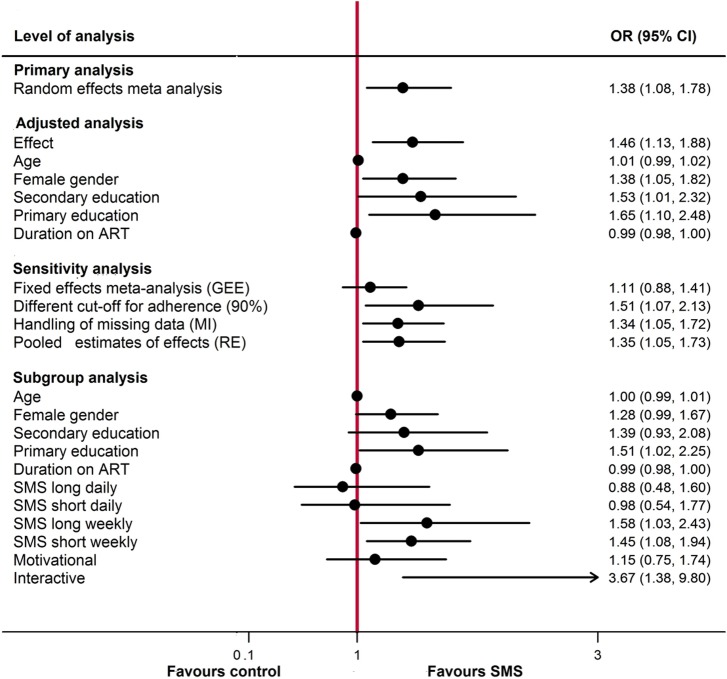
Objectives: Our objectives were to analyse the effects of text messaging versus usual care in improving adherence to antiretroviral therapy (ART) in people living with HIV using individual patient data meta-analysis. Adjusted, sensitivity and subgroup analyses were conducted. Setting: 3 randomised controlled trials conducted between 2010 and 2012 in rural and urban centres in Cameroon and Kenya (two studies) were used. Participants: A total of 1166 participants were included in this analysis (Cameroon=200; Kenya=428 and 538). Primary and secondary outcomes: The primary outcome was adherence to ART >95%. The secondary outcomes were mortality, losses to follow-up, transfers and withdrawals. Results: Text messaging improved adherence to ART (OR 1.38; 95% CIs 1.08 to 1.78; p=0.012), even after adjustment for baseline covariates (OR 1.46; 95% CI 1.13 to 1.88; p=0.004). Primary education (compared with no formal education) was associated with a greater intervention effect on adherence (OR 1.65; 95% CI 1.10 to 2.48; p=0.016) and also showed a significant subgroup effect (p=0.039). In sensitivity analysis, our findings were robust to a modified threshold of adherence, multiple imputation for missing data and aggregate level data pooling, but not to fixed-effects meta-analyses using generalised estimation equations. There was a significant subgroup effect for long weekly (p=0.037), short weekly text messages (p=0.014) and interactive messaging (p=0.010). Text messaging did not significantly affect any of the secondary outcomes. Conclusions: Text messaging has a significant effect on adherence to ART, and this effect is influenced by level of education, gender, timing (weekly vs daily) and interactivity. We recommend the use of interactive weekly text messaging to improve adherence to ART, which is most effective in those with at least a primary level of education.
Overview
The claims and statistics of this paper haven’t been checked yet.
Run the check — free, no account needed. It reads the open-access text and checks the sources it cites.
Integrity signals
Registry
Cites
Statistics
Figures
Verification
Claims the paper makes
The claims and statistics of this paper haven’t been checked yet.
Run the check — free, no account needed. It reads the open-access text and checks the sources it cites.
Claims other papers make about this one
Each is checked against this paper’s own text: does it say what the citing paper says it does?
In the citing paper
“Reviews have found variation in effect depending on how mechanisms were operationalised.”
From mHealth text and voice communication for monitoring people with chronic diseases in low-resource settings: a realist review (2018) · cites this paper as [49]
In the citing paper
“Similarly, text messaging used to improve adherence to antiretroviral therapy had more effect for those with at least primary education.49”
From mHealth text and voice communication for monitoring people with chronic diseases in low-resource settings: a realist review (2018) · cites this paper as [49]
In the citing paper
“and messages had more impact when they were linked with patient–health worker interaction.17 27 49 51–53”
From mHealth text and voice communication for monitoring people with chronic diseases in low-resource settings: a realist review (2018) · cites this paper as [49]
In the citing paper
“For example, weekly reminders worked better than daily reminders”
From mHealth text and voice communication for monitoring people with chronic diseases in low-resource settings: a realist review (2018) · cites this paper as [49]
Self-check
Percentages, sums and reported differences re-computed from the paper’s own numbers.
The self-check needs the paper’s full text.
Citations
Cites
The Cochrane Collaboration's tool for assessing risk of bias in randomised trials
Higgins, J. P. T., Altman, D. G., Gotzsche, P. C., Juni, P., Moher, D., Oxman, A. D., Savovic, J., Schulz, K. F., Weeks, L., Sterne, J. A. C., et al. (2011) · BMJ · doi:10.1136/bmj.d5928 · Cited by 33,817
Statistical Analysis With Missing Data
Lahiff, M., Little, R. J. A., & Rubin, D. B. (1989) · Journal of the American Statistical Association · doi:10.2307/2289883 · Cited by 17,385
Osterberg, L., & Blaschke, T. (2005) · New England Journal of Medicine · doi:10.1056/nejmra050100 · Cited by 7,974
Adherence to Long-Term Therapies: Evidence for Action
Geest, S. D., & Sabate, E. J. (2003) · European Journal of Cardiovascular Nursing · doi:10.1016/s1474-5151(03)00091-4 · Cited by 6,310
Adherence to Protease Inhibitor Therapy and Outcomes in Patients with HIV Infection
Paterson, D. L., Swindells, S., Mohr, J. A., Brester, M., Vergis, E. N., Squier, C. L., Wagener, M. M., & Singh, N. (2000) · Annals of Internal Medicine · doi:10.7326/0003-4819-133-1-200007040-00004 · Cited by 3,289
Antiretroviral Treatment of Adult HIV Infection
Thompson, M., Aberg, J. A., Hoy, J., Telenti, A., Benson, C., Cahn, P. E., Eron, J. J., Günthard, H. F., Hammer, S. M., Reiss, P., et al. (2012) · JAMA · doi:10.1001/jama.2012.7961 · Cited by 2,493
Statistical Analysis of Correlated Data Using Generalized Estimating Equations: An Orientation
Hanley, J. A. (2003) · American Journal of Epidemiology · doi:10.1093/aje/kwf215 · Cited by 2,185
Lester, R. T., Ritvo, P., Mills, E. J., Kariri, A., Karanja, S., Chung, M. H., Jack, W., Habyarimana, J., Sadatsafavi, M., Najafzadeh, M., et al. (2010) · The Lancet · doi:10.1016/s0140-6736(10)61997-6 · Cited by 1,278 · cited 4×
“The fi rst of these was the WelTel Kenya1 RCT that was a multisite two-arm trial of weekly interactive text messaging versus usual care conducted in Kenya.”
MethodResultInfluentialSelf-citationBehavior change interventions delivered by mobile telephone short message service
Fjeldsoe, B. S., Marshall, A. L., & Miller, Y. D. (2009) · American Journal of Preventive Medicine · doi:10.1016/j.amepre.2008.09.040 · Cited by 1,213
Text messaging as a tool for behavior change in disease prevention and management
Cole-Lewis, H., & Kershaw, T. (2010) · Epidemiologic Reviews · doi:10.1093/epirev/mxq004 · Cited by 1,190
Cited by
Sorted by citations
Mobile Telephone Text Messaging for Medication Adherence in Chronic Disease: A Meta-analysis
Thakkar, J., Kurup, R., Laba, T.-L., Santo, K., Thiagalingam, A., Rodgers, A., Woodward, M., Redfern, J., & Chow, C. K. (2016) · JAMA Internal Medicine · doi:10.1001/jamainternmed.2015.7667 · Cited by 685
From big data analysis to personalized medicine for all: challenges and opportunities
Alyass, A., Turcotte, M., & Meyre, D. (2015) · BMC Medical Genomics · doi:10.1186/s12920-015-0108-y · Cited by 575
Finitsis, D. J., Pellowski, J. A., & Johnson, B. T. (2014) · PLoS ONE · doi:10.1371/journal.pone.0088166 · Cited by 355
Berrouiguet, S., Baca-García, E., Brandt, S., Walter, M., & Courtet, P. (2016) · Journal of Medical Internet Research · doi:10.2196/jmir.5066 · Cited by 332
Tomás Pantoja, C., Opiyo, N., Lewin, S. A., Paulsen, E., Ciapponi, A., Wiysonge, C. S., Herrera, C. A., Gabriel Rada, G., Peñaloza, B., Dudley, L., et al. (2017) · Cochrane Database of Systematic Reviews · doi:10.1002/14651858.cd011086.pub2 · Cited by 272
Metadata
- Authors
- Mbuagbaw, L., van der Kop, M. L., Lester, R. T., Thirumurthy, H., Pop-Eleches, C., Ye, C., Smieja, M., Dolovich, L., Mills, E. J., & Thabane, L.
- Affiliations
- Central Hospital of Yaoundé (CM)
- Department of Medicine, University of British Columbia, Vancouver, British Columbia, Canada
- University of Nairobi (KE)
- University of North Carolina at Chapel Hill (US)
- Columbia University (US)
- St. Joseph’s Healthcare Hamilton (CA)
- University of Ottawa (CA)
- Population Health Research Institute (CA)
- Corresponding author
- Mbuagbaw, Lawrence
- ORCID
- Venue
- BMJ Open
- Publisher
- BMJ
- Published
- 2013-12
- Volume
- 3
- Issue
- 12
- Pages
- e003950
- ISSN
- 2044-6055 (ISSN-L)
- PMC
- PMC3884740
- OpenAlex
- W2105519498
- Cited by
- 147
- References
- 38
- Citations by year
- 2026: 1 · 2025: 3 · 2024: 2 · 2023: 10 · 2022: 5 · 2021: 13 · 2020: 10 · 2019: 8 · 2018: 21 · 2017: 15 · 2016: 24 · 2015: 25 · 2014: 9 · 2013: 1
- FWCI
- 2.36
- Type
- journal article
- Language
- en
- Open access
- gold
- doi.org
- Licence
- cc-by-nc
- Locations
- BMJ Open (publishedVersion, cc-by-nc)
- Europe PMC (PubMed Central) (publishedVersion, other-oa)
- PubMed Central (publishedVersion, cc-by-nc)
- PubMed (publishedVersion)
- Funders
- Grand Challenges Canada
- National Institutes of Health (2r24hd050924-06)
- Canadian Institutes of Health Research
- Eunice Kennedy Shriver National Institute of Child Health and Human Development (R24 HD-050924)
- Topics
- Health Sciences › Health Professions › General Health Professions › Mobile Health and mHealth Applications
- Health Sciences › Medicine › Infectious Diseases › HIV/AIDS Research and Interventions
- Health Sciences › Medicine › Family Practice › Medication Adherence and Compliance
- Keywords
- text messaging, antiretroviral therapy adherence, HIV, mobile health, primary education, treatment retention, Cameroon, Kenya
About these checks
Registry, retraction, Cites and statistics results are computed, not judged, with one exception: a printed reference that no index lists is read once by a model before it counts as a citation error. Claims are extracted by a model and kept only when their quote appears verbatim in the text; each cited source is then checked, with a model’s help, for whether it says what the claim relies on. Those verdicts can be wrong — read the claim’s quote and the cited source before relying on one.
Statistics and arithmetic are recomputed, not judged.
Confidence bands are shown only for fields calibrated on our annotated test set. None is calibrated yet, so no band is shown.
What counts as a claim ›How we measure confidence ›How we check this ›
Are you an author, or do you see a problem with this page? Request a review
