

Healthcare-seeking behaviour in rural Ethiopia: evidence from clinical vignettes
Open accessThe DOI matches its Crossref record; 14 of the 16 references it cites were found in a registry or an index.
Abstract
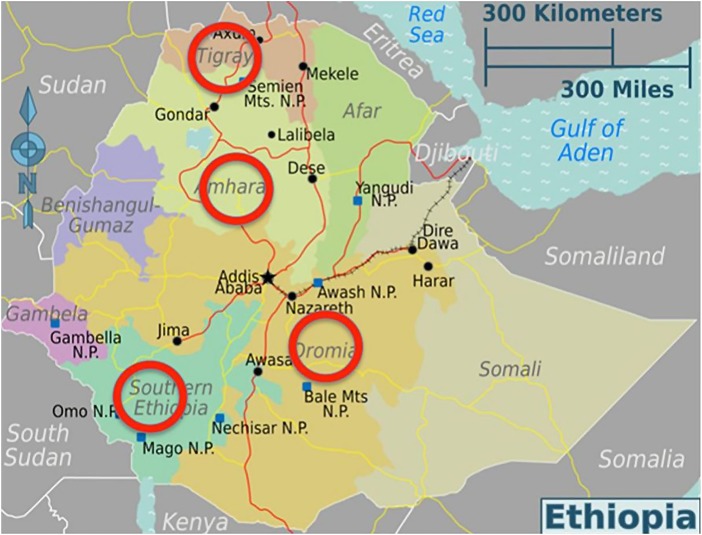
Objectives: To investigate the determinants of healthcare-seeking behaviour using five context-relevant clinical vignettes. The analysis deals with three issues: whether and where to seek modern care and when to seek care. Setting: This study is set in 96 villages located in four main regions of Ethiopia. The participants of this study are 1632 rural households comprising 9455 individuals. Primary and secondary outcome measures: Probability of seeking modern care for symptoms related to acute respiratory infections/pneumonia, diarrhoea, malaria, tetanus and tuberculosis. Conditional on choosing modern healthcare, where to seek care (health post, health centre, clinic and hospital). Conditional on choosing modern healthcare, when to seek care (seek care immediately, the next day, after 2 days, between 3 days to 1 week, a week or more). Results: We find almost universal preference for modern care. Foregone care ranges from 0.6% for diarrhoea to 2.5% for tetanus. There is a systematic relationship between socioeconomic status and choice of providers mainly for adult-related conditions with households in higher consumption quintiles more likely to seek care in health centres, private/Non-Government Organization (NGO) clinics as opposed to health posts. Delays in care-seeking behaviour are apparent mainly for adult-related conditions and among poorer households. Conclusions: The analysis suggests that the lack of healthcare utilisation is not driven by the inability to recognise health problems or due to a low perceived need for modern care.
Overview
The claims and statistics of this paper haven’t been checked yet.
Free: it reads the open-access text and checks the first 5 claims that cite a source we can check. Create a free account to check every claim.
Integrity signals
Registry
Cites
Statistics
Figures
Verification
Claims the paper makes
The claims and statistics of this paper haven’t been checked yet.
Free: it reads the open-access text and checks the first 5 claims that cite a source we can check. Create a free account to check every claim.
Claims other papers make about this one
Each is checked against this paper’s own text: does it say what the citing paper says it does?
The source backs part of the claim, not all of it — or backs it for a different population, condition or comparison.
In the citing paper
“Additionally, the observed drop-off when analyzing the cascade of respondents who express symptoms, to those who seek facility-based care, to those who are treated by a trained healthcare provider, is also observed in similar research contexts [30–32].”
From Community and facility-level barriers to achieving UHC in Kono District, Sierra Leone and Maryland County, Liberia (2023) · cites this paper as [32]
Experimental — accuracy not yet measured
Self-check
Percentages, sums and reported differences re-computed from the paper’s own numbers.
The self-check needs the paper’s full text.
Citations
Cites
Ababa, A. (2008) · Cited by 627
Barros, A. J., Ronsmans, C., Axelson, H., Loaiza, E., Bertoldi, A. D., França, G. V., Bryce, J., Boerma, J. T., & Victora, C. G. (2012) · The Lancet · doi:10.1016/s0140-6736(12)60113-5 · Cited by 549 · cited 3×
“Despite the potential advantages of using healthcare vignettes as an alternative technique to analyse healthcare-seeking behaviour, this approach has not been widely used in the context of low-income and middle-income countries where presumably variations in the perceived need for healthcare are much greater than in h…”
BackgroundInfluentialEthnicity, socio-economic position and gender—do they affect reported health—care seeking behaviour?
Adamson, J., Ben-Shlomo, Y., Chaturvedi, N., & Donovan, J. (2003) · Social Science & Medicine · doi:10.1016/s0277-9536(02)00458-6 · Cited by 212
Ethiopia's health extension program: improving health through community involvement
Banteyerga, H. (2011) · MEDICC Review · doi:10.1590/s1555-79602011000300011 · Cited by 205
Schoen, C., & Doty, M. M. (2003) · Health Policy · doi:10.1016/j.healthpol.2003.09.006 · Cited by 150
Lay diagnosis and health-care-seeking behaviour for chest pain in south Asians and Europeans
Chaturvedi, N., Rai, H., & Ben‐Shlomo, Y. (1997) · The Lancet · doi:10.1016/s0140-6736(97)06243-0 · Cited by 106
Mielck, A., Kiess, R., Knesebeck, O. V. D., Stirbu, I., & Kunst, A. E. (2009) · BMC Health Services Research · doi:10.1186/1472-6963-9-52 · Cited by 100 · cited 1×
“Available attempts at measuring foregone care for developed countries typically rely on explicitly asking survey respondents whether they did not use care when needed.(9) 10 For low-income and middle-income countries the evidence is mainly limited to the use and inequity in use of maternity and child (preventive) care.”
BackgroundImpact evaluation of the Ethiopian Health Services Extension Programme
Admassie, A., Abebaw, D., & Woldemichael, A. D. (2009) · Journal of Development Effectiveness · doi:10.1080/19439340903375724 · Cited by 96
Self-citationLow education, high gp consultation rates: the effect of psychosocial factors
van der Meer, J. B. W., & Mackenbach, J. P. (1998) · Journal of Psychosomatic Research · doi:10.1016/s0022-3999(97)00217-1 · Cited by 52
Ethnic Differences in Perceived Impairment and Need for Care
Chavez, L. M., Shrout, P. E., Alegria, M. M., Markle, S. L., & CANINO, G. J. (2010) · Research on Child and Adolescent Psychopathology · doi:10.1007/s10802-010-9428-8 · Cited by 40
Research works printed but not linked: 1
- UNDP The 2013 human development report: human progress in a diverse world, New York: Palgrave Macmillan, 2013; 140– 55
Cited by
Health Care Seeking Behavior in Southwest Ethiopia
Bekele, B. B., Tessema, F., & Gesesew, H. A. (2016) · PLoS ONE · doi:10.1371/journal.pone.0161014 · Cited by 113
Noordam, A. C., Carvajal-Vélez, L., Sharkey, A., Young, M., & Cals, J. (2015) · PLoS ONE · doi:10.1371/journal.pone.0117919 · Cited by 110
“Previous studies conducted in Ethiopia indicate that lack of knowledge and delay in recognition of the severity of an illness are important factors that predict care seeking [21, 22], as are religion [23] and household wealth [24].”
BackgroundMeasuring progress towards universal health coverage: national and subnational analysis in Ethiopia
Eregata, G. T., Hailu, A., Memirie, S. T., & Norheim, O. F. (2019) · BMJ Global Health · doi:10.1136/bmjgh-2019-001843 · Cited by 92
“26 Also, the low literacy rate, together with poor modern healthcare- seeking behaviour, could contribute to low coverage.(27) From the supply side, minimal investment in Ethiopian health services could be the main reason for low UHC service coverage.”
BackgroundHealth shocks, coping strategies and foregone healthcare among agricultural households in Kenya
Bonfrer, I., & Gustafsson‐Wright, E. (2016) · Global Public Health · doi:10.1080/17441692.2015.1130847 · Cited by 85
Poverty and health care demand in Kenya
Awiti, J. O. (2014) · BMC Health Services Research · doi:10.1186/s12913-014-0560-y · Cited by 68
“First, the literature shows that compared to the non–poor, the accessibility of health care services by the poor is low [22,50,51].”
Shaw, B., Amouzou, A., Miller, N. P., TSUI, A. O., Bryce, J., Tafesse, M., & Surkan, P. J. (2015) · American Journal of Tropical Medicine and Hygiene · doi:10.4269/ajtmh.14-0660 · Cited by 63
Ayalneh, A. A., Fetene, D. M., & Lee, T. J. (2017) · International Journal for Equity in Health · doi:10.1186/s12939-017-0561-7 · Cited by 57
“According to a research finding from Ethiopia, socio-economic status and religious beliefs were found to be the determinants of health care seeking behavior for childhood illnesses [21].”
BackgroundAsefa, A., & Teshome, W. (2014) · PLoS ONE · doi:10.1371/journal.pone.0102884 · Cited by 61
“This gender difference showed as women seek care faster than men and this is justified by other studies [30,31].”
ResultShaw, B., Amouzou, A., Miller, N. P., Tafesse, M., Bryce, J., & Surkan, P. J. (2015) · Health Policy and Planning · doi:10.1093/heapol/czv115 · Cited by 63
“Some researchers of access in rural Ethiopia have suggested that these considerations, to date, have been more political rather than based on policy objectives (Mebratie et al. 2014; Yitayal et al. 2014).”
Tilahun, H., Atnafu, D. D., Asrade, G., Minyihun, A., & Alemu, M. (2018) · Health Economics Review · doi:10.1186/s13561-018-0200-z · Cited by 56
“service utilization was 35% for insured households and 20% for uninsured household [17].”
BackgroundCommunity-Based Interventions for Newborns in Ethiopia (COMBINE): Cost-effectiveness analysis
Mathewos, B., Owen, H., Sitrin, D., Cousens, S., Degefie, T., Wall, S. N., Bekele, A., Lawn, J. E., & Daviaud, E. (2017) · Health Policy and Planning · doi:10.1093/heapol/czx054 · Cited by 55
“Poor access to health care facilities (Okwaraji et al. 2012) and low care-seeking behaviour (Central Statistical Authority 2012; Mebratie et al. 2014) have contributed to over 85% of women giving birth at home without a skilled birth attendant (Teferra et al. 2012; Bayou and Gacho 2013; Shiferaw et…”
BackgroundAhinkorah, B. O., Budu, E., Seidu, A., Agbaglo, E., Adu, C., Ameyaw, E. K., Ampomah, I. G., Archer, A. G., Kissah-Korsah, K., & Yaya, S. (2021) · PLoS ONE · doi:10.1371/journal.pone.0244395 · Cited by 50
Noordam, A. C., Sharkey, A., Hinssen, P., Dinant, G., & Cals, J. (2017) · BMC Health Services Research · doi:10.1186/s12913-017-2060-3 · Cited by 50
Miller, N. P., Ardestani, F. B., Wong, H., Stokes, S., Jembere, B. M., Paulos, M., Agonafir, N., Sylla, M., Ameha, A., Birhanu, B. G., et al. (2021) · Health Policy and Planning · doi:10.1093/heapol/czab047 · Cited by 44
Factors associated with healthcare seeking behaviour for children in Malawi: 2016
Ng’ambi, W. F., Mangal, T. D., Phillips, A. N., Colbourn, T., Mfutso‐Bengo, J., Revill, P. A., & Hallett, T. B. (2020) · Tropical Medicine & International Health · doi:10.1111/tmi.13499 · Cited by 37
Utilization of Healthcare in the Typhoid Fever Surveillance in Africa Program
Panzner, U., Pak, G. D., Aaby, P., Adu‐Sarkodie, Y., Ali, M., Aseffa, A., Baker, S. G., Bjerregaard-Andersen, M., Crump, J. A., Deerin, J. F., et al. (2016) · Clinical Infectious Diseases · doi:10.1093/cid/civ891 · Cited by 36
Hegde, S. T., Salje, H., Sazzad, H. M. S., Hossain, J., Rahman, M., Daszak, P., Klena, J. D., Nichol, S. T., Luby, S. P., & Gurley, E. S. (2019) · International Journal of Epidemiology · doi:10.1093/ije/dyz057 · Cited by 37
Kakietek, J. J., Eberwein, J. D., Stacey, N., Newhouse, D., & Yoshida, N. (2022) · Health Policy and Planning · doi:10.1093/heapol/czac024 · Cited by 39
“Three other published single-country studies from Africa (Ethiopia, Kenya and Liberia) estimated the prevalence of foregone care using different methodological approaches (Mebratie et al., 2014; Bonfrer and Gustafsson-Wright 2017; Gabani and Guinness 2019).”
BackgroundInfluentialČernauskas, V., Angeli, F., Jaiswal, A., & Pavlova, M. (2018) · BMC Health Services Research · doi:10.1186/s12913-018-3264-x · Cited by 38
“Berhane A, Enquselassie F. Patients’ preferences for attributes related to health care services at hospitals in Amhara region, northern Ethiopia: a discrete choice experiment.”
ResultInfluentialHabte, A., Tamene, A., Ejajo, T., Dessu, S., Endale, F., Gizachew, A., & Sulamo, D. (2022) · PLoS ONE · doi:10.1371/journal.pone.0272959 · Cited by 42
Jana, A., Chattopadhyay, A., & Saha, U. R. (2022) · BMC Public Health · doi:10.1186/s12889-022-13806-5 · Cited by 32
“There is also evidence that poor households are unable to utilize health care facilities due to the lack of accessibility and affordability [65, 66].”
BackgroundTirore, L. L., Mulugeta, A., Belachew, A. B., Gebremeskel, M. G., Kebede, A. S., Erkalo, D., & Atsbha, R. (2020) · Maternal and Child Nutrition · doi:10.1111/mcn.13063 · Cited by 30
Kawakatsu, Y., Tanaka, J., Ogawa, K., Ogendo, K., & Honda, S. (2017) · BMC Public Health · doi:10.1186/s12889-017-4107-0 · Cited by 32
Kajungu, D., Nabukeera, B., Muhoozi, M., Ndyomugyenyi, D. B., Akello, M., Gyezaho, C., Waako, J., & Kasirye, R. P. (2023) · BMC Health Services Research · doi:10.1186/s12913-023-09713-z · Cited by 30
“This consistent with studied conducted in contextually setting that found religion [42, 43] gender [44, 45] and occupation [46, 47] as important determinants for good practices for caretakers regarding management of pneumonia.”
ResultAreru, H. A., Dangisso, M. H., & Lindtjørn, B. (2021) · BMC Health Services Research · doi:10.1186/s12913-021-06846-x · Cited by 29
“This finding is in agreement with other studies done in Ethiopia and Zambia showing preference of health centres over hospitals, health posts and private facilities [21, 48].”
ResultTefera, Y. G., & Ayele, A. A. (2021) · Journal of Primary Care & Community Health · doi:10.1177/2150132721996889 · Cited by 25
Geda, N. R., Feng, C. X., Whiting, S. J., Lepnurm, R., Henry, C. J., & Janzen, B. L. (2021) · BMC Health Services Research · doi:10.1186/s12913-021-06704-w · Cited by 24
“A study in rural Ethiopia reported that Orthodox Christian households are more likely to seek modern health care and seek care earlier compared to Muslim-headed households [14].”
BackgroundShaw, B., Amouzou, A., Miller, N. P., Bryce, J., & Surkan, P. J. (2017) · BMC Health Services Research · doi:10.1186/s12913-017-2123-5 · Cited by 30
“conducting a qualitative study among a similar population in Ethiopia [32].”
BackgroundFikadu, K., Wassihun, B., & Mohammed, O. Y. (2022) · PLoS ONE · doi:10.1371/journal.pone.0268012 · Cited by 28
“Furthermore, because the women believe they are unfamiliar with conception and its changes [44], it is likely that nulliparous women will seek out additional information, allowing them to learn more about preconception health.”
BackgroundAbebe, H., Wagnew, F., Zeleke, H., Zewudie, B. T., Tesfa, S., & Terefe, T. F. (2021) · BMC Ophthalmology · doi:10.1186/s12886-021-01863-0 · Cited by 23
“Rural residents may not seek medical attention for early detection and treatment of eye problems due to ignorance and lack of concept on health, usually seeking eye care lately after visual disability that prevents them from working [33, 39] .”
BackgroundTemsesgen, D., Wordofa, B., Tesfaye, T., & Etafa, W. (2023) · BMC Pediatrics · doi:10.1186/s12887-022-03825-x · Cited by 20
Ndungu, E. W., Okwara, F. N., & Oyore, J. P. (2018) · American Journal of Pediatrics · doi:10.11648/j.ajp.20180403.15 · Cited by 21
“In addition, other studies carried out in Pakistan, Yemen and Ethiopia did find level of education as a significant determinant to timing of health seeking for ARI [16, 22, 23, 24].”
BackgroundResultDiriba, D. C., Suen, L. K. P., & Leung, D. Y. P. (2023) · Diabetic Medicine · doi:10.1111/dme.15094 · Cited by 20
Chilot, D., Shitu, K., Gela, Y. Y., Getnet, M., Mulat, B., Diress, M., & Belay, D. G. (2022) · BMC Pediatrics · doi:10.1186/s12887-022-03680-w · Cited by 17
Rheumatic Heart Disease in East Africa: A Systematic Review and Meta-Analysis
Mebrahtom, G., Hailay, A., Aberhe, W., Zereabruk, K., & Haile, T. G. (2023) · International Journal of Rheumatology · doi:10.1155/2023/8834443 · Cited by 19
Predictors of Rational Management of Diarrhea in an Endemic Setting: Observation from India
Mahapatra, T., Mahapatra, S., Banerjee, B., Mahapatra, U., Samanta, S., Pal, D., Chakraborty, N. D., Manna, B., Sur, D., & Kanungo, S. (2015) · PLoS ONE · doi:10.1371/journal.pone.0123479 · Cited by 16
Geta, E. T., Bidika, A. W., & Hailu, W. B. (2023) · BMC Health Services Research · doi:10.1186/s12913-023-09527-z · Cited by 15
Urama, C. E., Manasseh, C. O., Ukwueze, E. R., & Ogbuabor, J. E. (2020) · International Journal of Health Promotion and Education · doi:10.1080/14635240.2020.1730703 · Cited by 14
Hamid, S., Beko, Z. W., Mekonnen, H. S., & Salih, M. H. (2024) · BMC Public Health · doi:10.1186/s12889-024-19603-6 · Cited by 16
Gender difference in health seeking behaviour among mothers of under five children in Lucknow
Katiyar, R., Ahmed, N., Singh, J. V., & Singh, V. K. (2017) · International Journal of Community Medicine and Public Health · doi:10.18203/2394-6040.ijcmph20175796 · Cited by 12
Geta, E. T., Bidika, A. W., & Etana, B. (2023) · Frontiers in Public Health · doi:10.3389/fpubh.2022.1021660 · Cited by 11
Tariku, A., Okwaraji, Y. B., Worku, A., Biks, G. A., Persson, L. Å., & Berhane, Y. (2020) · Acta Paediatrica · doi:10.1111/apa.15380 · Cited by 12
Tareke, A. A., Getnet, M., Alem, A., Alamneh, Y. M., Alamneh, A. A., Deml, Y. A., Shiferaw, M., Kassahun, W. D., & Teym, A. (2022) · Stroke Research and Treatment · doi:10.1155/2022/7202657 · Cited by 12
Mulatu, H. A. (1970) · Ethiopian Journal of Health Sciences · doi:10.4314/ejhs.v29i1.10 · Cited by 10
“5 [11-32] Pulmonary hypertension Mild Moderate Severe 14 (9.”
BackgroundKnowledge and self-care practice of leprosy patients at ALERT Hospital, Ethiopia
Girma, L., Bobosha, K., Hailu, T., & Negera, E. (2019) · Leprosy Review · doi:10.47276/lr.90.1.78 · Cited by 9
Ong, K. I. C., Khattignavong, P., Keomalaphet, S., Iwagami, M., Brey, P. T., Kano, S., & Jimba, M. (2021) · BMJ Open · doi:10.1136/bmjopen-2021-055350 · Cited by 13
Berhanu, A., Alemayehu, M. A., Daka, K., Binu, W., & Obsa, M. S. (2020) · Pediatric Health Medicine and Therapeutics · doi:10.2147/phmt.s282698 · Cited by 9
World Bank Group (2016) · World Bank, Washington, DC eBooks · doi:10.1596/24590 · Cited by 10
Kakietek, J. J., Eberwein, J. D., Kerr, A., & Stacey, N. (2024) · BMJ Public Health · doi:10.1136/bmjph-2024-001027 · Cited by 7
Raga, I., Seyoum, D., Debelo, S., Fikadu, G., Regasa, M. T., Fayera, H., Jiren, R. T., & Ayana, W. G. (2024) · BMC Pediatrics · doi:10.1186/s12887-024-04937-2 · Cited by 7
Birlie, T. A., Amare, A. T., Agegn, S. B., Yirga, G. K., Bantie, B., Dires, T., Eshetie, Y., Alene, T., Adella, G. A., Belay, A. T., et al. (2023) · Heliyon · doi:10.1016/j.heliyon.2023.e23348 · Cited by 6
“However, lack of healthcare utilization was not found to be driven by a low perceived need for modern care [18].”
BackgroundDebel, L. N., & Nigusso, F. T. (2022) · Frontiers in Public Health · doi:10.3389/fpubh.2022.929764 · Cited by 6
“The questionnaires were contextually developed based on the study objective and study, and existing national and global scientific evidence (14, 15).”
BackgroundShiferie, F., Workneh, F., Shifraw, T., Eglovitch, M., Amanuel, H., Chan, G. J., Isanaka, S., Worku, A., Worku, A., Lee, A. C., et al. (2023) · Pan African Medical Journal · doi:10.11604/pamj.2023.45.142.39771 · Cited by 6
“Although Ethiopia has invested in its healthcare infrastructure by expanding health facilities and deploying health extension workers, the utilization of healthcare services by pregnant women remains among the lowest in Africa [17].”
BackgroundTamirat, Z. G., Gelagay, A. A., & Boke, M. M. (2022) · Research Square · doi:10.21203/rs.3.rs-1850638/v1 · Cited by 7
Abebe, H., & Belaineh, G. (2022) · doi:10.19088/sshap.2022.031 · Cited by 6
“Ethiopia has made significant investments in its health system over the last decade, especially through establishment of health posts and health centres and trained personnel.(55,56) This infrastructure, especially in war-torn Tigray, has been severely damaged by the conflict.”
BackgroundInfluentialHiggins, J., JEROME, J. G., Boima, F., Dally, E., Krangar, L., Boley, E. J., Toussaint, S., Dibba, Y., Kachimanga, C., Mhango, M., et al. (2023) · PLOS Global Public Health · doi:10.1371/journal.pgph.0002045 · Cited by 4
“Lack of drugs/ equipment 26% [20, 32] 46% [37, 55] 38% [30, 46] 31% [22, 40] 34% [30, 38] 16% [11, 21] 25% [9, 44] 18% [12, 24] 13% [10, 16]”
Siddique, M. K. B. (2016) · MOJ Public Health · doi:10.15406/mojph.2016.04.00090 · Cited by 4
“Delays in care-seeking behaviour are apparent mainly for adult-related conditions and among poorer households [9].”
BackgroundDiyana, D., Tafes, B. K., Beyene, D., Teklu, D. S., & Rao, C. (2026) · BMC Infectious Diseases · doi:10.1186/s12879-026-12982-8 · Cited by 3
Wonde, D., & Tadele, G. (2016) · Ethiopian Journal of Health Development · Cited by 6
Baruda, Y. S., Yilma, M., Gebremariam, M. B., & Assebe, L. F. (2022) · Journal of Maternal and Child Health · doi:10.26911/thejmch.2022.07.06.02 · Cited by 2
Essays on the Economics of Health-Risk and Insurance
Debebe, Z. Y. (2015) · RePub (Erasmus University Rotterdam) · Cited by 2
Yesuf, E. A., Woldie, M. K., Mariam, D. H., Koller, D., Früschl, G., & Grill, E. (2020) · International Journal for Quality in Health Care · doi:10.1093/intqhc/mzaa012 · Cited by 1
Behaviour-change communication on health related issues (part two)
(7235270), K. T. (2017) · OpenDocs (Institute of Development Studies) · Cited by 1
Inequalities in child care practices and health outcomes in Ethiopia
Geda, N. R. (2021) · HARVEST (University of Saskatchewan) · Cited by 5
Ayers, N. (2015) · University of Surrey Open Research repository · Cited by 2
Exploring Beliefs and Knowledge about Maternal Health: The Case of Women in Korogocho Slums, Nairobi
Shivachi, T. I., Sidha, Z. O., & Ayabei, C. (2019) · The International Journal of Humanities & Social Studies · doi:10.24940/theijhss/2019/v7/i7/hs1907-112
“Inadequate MHK is manifested by low utilization of ANC, delivery and PNC services, and delayed consultation, or failure to consult healthcare practitioners for illness during pregnancy and the post-partum period (Afulani, 2015; Mebratie et al., 2014).”
BackgroundFeng, C. X., Geda, N. R., Whiting, S. J., Lepnurm, R., Henry, C. J., & Janzen, B. L. (2020) · Research Square · doi:10.21203/rs.3.rs-44306/v1
ቁልፍ እይታወች፡ በሰሜን ኢትዮጵያ ለተፈጠረው ግጭት የማህበራዊ ሳይንስ የአደጋ ጊዜ ምላሽ ምልከታዎች
Abebe, H., & Belaineh, G. (2022) · doi:10.19088/sshap.2022.042
Factors Affecting Women’s Utilization of Prenatal Care Services in Gumuz Community
(2022) · Journal of Pediatrics & Neonatal Biology · doi:10.33140/jpnb.07.02.01
Abebe, H., Wagnew, F., Zeleke, H., Tefera, B., Tesfa, S., & Terefe, T. F. (2021) · Figshare · doi:10.6084/m9.figshare.14067956
Raga, I., Seyoum, D., Debelo, S., Fikadu, G., Regasa, M. T., Fayera, H., Jiren, R. T., & Ayana, W. G. (2024) · Figshare · doi:10.6084/m9.figshare.26333213
Jana, A., Chattopadhyay, A., & Saha, U. R. (2022) · Figshare · doi:10.6084/m9.figshare.20390801
Abeje, M. T., 39888, ミスガナウ, テ. ア., & 39889 (2020) · Institutional Repositories DataBase (IRDB)
Choeu, M. M. (2025) · University of the Witwatersrand, Johannesburg Institutional Repository on DSpace (University of the Witwatersrand, Johannesburg)
Metadata
- Authors
- Mebratie, A. D., Van de Poel, E., Yilma, Z., Abebaw, D., Alemu, G., & Bedi, A. S.
- Affiliations
- Erasmus University Rotterdam (NL)
- Institute of Health Policy and Management of Erasmus University Rotterdam, Rotterdam, The Netherlands
- Ethiopian Economic Association (ET)
- Addis Ababa University (ET)
- Georgetown University (US)
- Corresponding author
- Mebratie, Anagaw D
- Venue
- BMJ Open
- Publisher
- BMJ
- Published
- 2014-02
- Volume
- 4
- Issue
- 2
- Pages
- e004020
- ISSN
- 2044-6055 (ISSN-L)
- PMC
- PMC3927812
- OpenAlex
- W2098123301
- Cited by
- 69
- References
- 16
- Citations by year
- 2026: 1 · 2024: 4 · 2023: 9 · 2022: 12 · 2021: 8 · 2020: 7 · 2019: 4 · 2018: 3 · 2017: 6 · 2016: 5 · 2015: 6 · 2014: 3
- FWCI
- 12.20
- Type
- journal article
- Language
- en
- Open access
- gold
- doi.org
- Licence
- cc-by-nc
- Locations
- BMJ Open (publishedVersion, cc-by-nc)
- Europe PMC (PubMed Central) (publishedVersion, other-oa)
- PubMed Central (publishedVersion, cc-by-nc)
- PubMed (publishedVersion)
- EUR Research Repository (Erasmus University Rotterdam) (publishedVersion, other-oa)
- EUR Research Repository (Erasmus University Rotterdam) (submittedVersion, other-oa)
- RePub (Erasmus University Rotterdam) (submittedVersion, other-oa)
- HighWire Press Open Archive (submittedVersion)
- Funders
- Nederlandse Organisatie voor Wetenschappelijk Onderzoek (W07.45.103.00)
- Topics
- Health Sciences › Medicine › Public Health, Environmental and Occupational Health › Healthcare Systems and Reforms
- Health Sciences › Medicine › Pediatrics, Perinatology and Child Health › Global Maternal and Child Health
- Social Sciences › Health › Public Health and Social Inequalities
- Keywords
- health-seeking behavior, rural Ethiopia, clinical vignettes, treatment-seeking delay, service provider selection, socioeconomic status, acute respiratory infections, pneumonia, diarrhea, malaria, tetanus, tuberculosis, health posts, private clinics, household consumption
- MeSH terms
- Adult, Child, Ethiopia, Female, Humans, Male, Patient Acceptance of Health Care, Rural Population, Social Class, Patient Preference
About these checks
Registry, retraction, Cites and statistics results are computed, not judged, with one exception: a printed reference that no index lists is read once by a model before it counts as a citation error. Claims are extracted by a model and kept only when their quote appears verbatim in the text; each cited source is then checked, with a model’s help, for whether it says what the claim relies on. Those verdicts can be wrong — read the claim’s quote and the cited source before relying on one.
Statistics and arithmetic are recomputed, not judged.
Confidence bands are shown only for fields calibrated on our annotated test set. None is calibrated yet, so no band is shown.
What counts as a claim ›How we measure confidence ›How we check this ›
Are you an author, or do you see a problem with this page? Request a review
Data sources
Bibliographic data: Semantic Scholar, OpenAlex, Crossref.
Contains information from the Semantic Scholar Academic Graph Datasets, made available under the ODC Attribution License (ODC-BY 1.0).
Semantic Scholar’s data is described in: Kinney, R., et al. (2023). The Semantic Scholar Open Data Platform. arXiv:2301.10140.
