

Evaluating the feasibility and effectiveness of a critical care discharge information pack for patients and their families: A pilot cluster randomised controlled trial.
Open accessThe DOI matches its Crossref record; 49 of the 52 references it cites were found in a registry or an index, and 2 are not checked yet.
Abstract
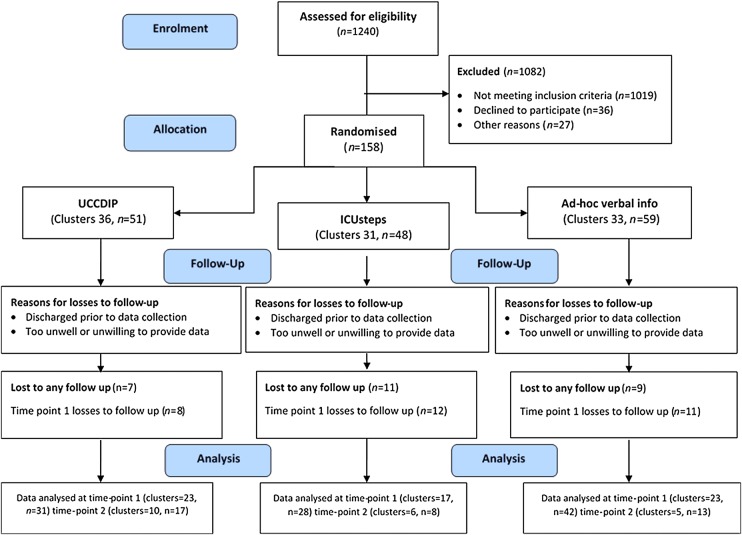
Objectives: To evaluate the feasibility and effectiveness of an information pack, based on self-regulation theory, designed to support patients and their families immediately before, during and after discharge from an intensive care unit (ICU). Design and setting: Prospective assessor-blinded pilot cluster randomised controlled trial (RCT; in conjunction with a questionnaire survey of trial participants’ experience) in 2 ICUs in England. Participants: Patients (+/− a family member) who had spent at least 72 h in an ICU, declared medically fit for discharge to a general ward. Randomisation: Cluster randomisation (by day of discharge decision) was used to allocate participants to 1 of 3 study groups. Intervention: A user-centred critical care discharge information pack (UCCDIP) containing 2 booklets; 1 for the patient (which included a personalised discharge summary) and 1 for the family, given prior to discharge to the ward. Primary outcome: Psychological well-being measured using Hospital Anxiety and Depression Scores (HADS), assessed at 5±1 days postunit discharge and 28 days/hospital discharge. Statistical significance (p≤0.05) was determined using χ 2 and Kruskal-Wallis (H). Results: 158 patients were allocated to: intervention (UCCDIP; n=51), control 1: ad hoc verbal information (n=59), control 2: booklet published by ICUsteps (n=48). There were no statistically significant differences in the primary outcome. The a priori enrolment goal was not reached and attrition was high. Using HADS as a primary outcome measure, an estimated sample size of 286 is required to power a definitive trial. Conclusions: Findings from this pilot RCT provide important preliminary data regarding the circumstances under which an intervention based on the principles of UCCDIP could be effective, and the sample size required to demonstrate this. Trial registration number: Current Controlled Trials ISRCTN47262088 ; results.
Overview
The claims and statistics of this paper haven’t been checked yet.
Free: it reads the open-access text and checks the first 5 claims that cite a source we can check. Create a free account to check every claim.
Integrity signals
Registry
Cites
Statistics
Figures
Verification
Claims the paper makes
The claims and statistics of this paper haven’t been checked yet.
Free: it reads the open-access text and checks the first 5 claims that cite a source we can check. Create a free account to check every claim.
Claims other papers make about this one
Each is checked against this paper’s own text: does it say what the citing paper says it does?
The source backs part of the claim, not all of it — or backs it for a different population, condition or comparison.
In the citing paper
“Several randomized studies have assessed physical rehabilitation programs for survivors of critical illness (581,606,(644)(645)(646)(647)(648)(649)(650)(651).”
From Surviving Sepsis Campaign: International Guidelines for Management of Sepsis and Septic Shock 2021. (2021) · cites this paper as [581]
Experimental — accuracy not yet measuredThe source backs part of the claim, not all of it — or backs it for a different population, condition or comparison.
In the citing paper
“ICU education did not appear to impact patients’ anxiety and depression [584, 586, 588], but did improve families’ satisfaction with care [583].”
From Surviving sepsis campaign: international guidelines for management of sepsis and septic shock 2021 (2021) · cites this paper as [584]
Experimental — accuracy not yet measuredThe cited source says what the claim attributes to it.
In the citing paper
“We identified six RCTs that evaluated educational interventions for critically ill patients and their families [583–588].”
From Surviving sepsis campaign: international guidelines for management of sepsis and septic shock 2021 (2021) · cites this paper as [584]
The check wasn’t confident either way, so it gives no verdict — never disputed.
In the citing paper
“A recent metaanalysis published since the finalization of the literature searches has suggested that there is a higher risk of recurrent Clostridioides difficile infections with proton pump inhibitors (495).”
From Surviving Sepsis Campaign: International Guidelines for Management of Sepsis and Septic Shock 2021. (2021) · cites this paper as [495]
Experimental — accuracy not yet measuredThe check wasn’t confident either way, so it gives no verdict — never disputed.
In the citing paper
“Almost 40% of sepsis survivors are re-hospitalized within 3 months, often for preventable conditions (580), contributing to increased healthcare costs (581).”
From Surviving Sepsis Campaign: International Guidelines for Management of Sepsis and Septic Shock 2021. (2021) · cites this paper as [581]
Experimental — accuracy not yet measured
Self-check
Percentages, sums and reported differences re-computed from the paper’s own numbers.
The self-check needs the paper’s full text.
Citations
Cites
The Hospital Anxiety and Depression Scale
Zigmond, A. S., & Snaith, R. P. (1983) · Acta Psychiatrica Scandinavica · doi:10.1111/j.1600-0447.1983.tb09716.x · Cited by 47,139
Depression and quality of life in older persons: A review
Sivertsen, H., Bjørkløf, G. H., Engedal, K., Selbæk, G., & Helvik, A.-S. (2015) · Dementia and Geriatric Cognitive Disorders · doi:10.1159/000437299 · Cited by 14,152
APACHE II: A severity of disease classification system
KNAUS, W. A., DRAPER, E. A., WAGNER, D. P., & ZIMMERMAN, J. E. (1985) · Critical Care Medicine · doi:10.1097/00003246-198510000-00009 · Cited by 13,664
APACHE II-A Severity of Disease Classification System: Reply
Knaus, W. A., Draper, E. A., Wagner, D. P., & Zimmerman, J. E. (1986) · Critical Care Medicine · doi:10.1097/00003246-198608000-00028 · Cited by 13,376
The validity of the Hospital Anxiety and Depression Scale
Bjelland, I., Dahl, A. A., Haug, T. T., & Neckelmann, D. (2002) · Journal of Psychosomatic Research · doi:10.1016/s0022-3999(01)00296-3 · Cited by 9,779 · cited 2×
“Outcomes The primary outcome was individual patients’ sense of psychological well-being (specifically anxiety and depression), measured using the internationally validated Hospital Anxiety and Depression Score (HADS) tool(28) with a threshold ≥8 used to identify possible clinical cases of anxiety and/or depression.(29…”
MethodYou want to measure coping but your protocol’ too long: Consider the brief cope
Carver, C. S. (1997) · International Journal of Behavioral Medicine · doi:10.1207/s15327558ijbm0401_6 · Cited by 7,361
APACHE II: a severity of disease classification system.
Knaus, W. A., Draper, E. S., Wagner, D. P., & Zimmerman, J. E. (1985) · PubMed · Cited by 6,034
A tutorial on pilot studies: the what, why and how
Thabane, L., Ma, J., Chu, R., Cheng, J., Ismaila, A., Rios, L. P., Robson, R., Thabane, M., Giangregorio, L., & Goldsmith, C. H. (2010) · BMC Medical Research Methodology · doi:10.1186/1471-2288-10-1 · Cited by 3,384
Design and analysis of pilot studies: recommendations for good practice
Lancaster, G. A., Dodd, S., & Williamson, P. R. (2004) · Journal of Evaluation in Clinical Practice · doi:10.1111/j..2002.384.doc.x · Cited by 2,572 · cited 1×
“In line with best practice recommendations, one of the purposes of this pilot RCT was to inform the power calculation for future work.(52) Mean HADS-A and HADS-D was 7 (SD 5) in the patient sample.”
MethodDeveloping and Evaluating Complex Interventions: New Guidance
Craig, P., Dieppe, P. A., MacIntyre, S., Michie, S., Nazareth, I., & Petticrew, M. P. (2006) · UCL Discovery (University College London) · Cited by 1,979
Research works printed but not linked: 3
- Coulter A, Ellis J Patient Focused Interventions; a review of the evidence. London: The Health Foundation, 2006.
- National Institute for Health and Clinical Excellence (NICE). Acutely Ill patients in hospital; recognition and response to acute illness in adults in hospital. 2007 http://www.nice.org.uk. (accessed Oct 2014). 21204323
- Department of Health (DH). Comprehensive critical care; a review of adult critical care services. London: Crown copyright, 2000.
Cited by
Surviving sepsis campaign: international guidelines for management of sepsis and septic shock 2021
Evans, L., Rhodes, A., Alhazzani, W., Antonelli, M., Coopersmith, C. M., French, C., Machado, F. R., Mcintyre, L., Ostermann, M., Prescott, H. C., et al. (2021) · Intensive Care Medicine · doi:10.1007/s00134-021-06506-y · Cited by 5,082
Surviving Sepsis Campaign: International Guidelines for Management of Sepsis and Septic Shock 2021.
Evans, L., Rhodes, A., Alhazzani, W., Antonelli, M., Coopersmith, C. M., French, C., Machado, F. R., Mcintyre, L., Ostermann, M., Prescott, H. C., et al. (2021) · Critical Care Medicine · doi:10.1097/ccm.0000000000005337 · Cited by 2,935
Sun, X., Huang, D., Zeng, F. J., Ye, Q., Xiao, H., Lv, D., Zhao, P., & Cui, X. (2021) · Journal of Advanced Nursing · doi:10.1111/jan.14706 · Cited by 74
Evans, C., Yorganci, E., Lewis, P. J., Koffman, J., Stone, K., Tunnard, I., Wee, B., Bernal, W., Hotopf, M. H., Higginson, I. J., et al. (2020) · BMC Medicine · doi:10.1186/s12916-020-01654-2 · Cited by 69
“Pilot RCTs of complex interventions (non-invasive) used deferred consent processes [109, 110].”
BackgroundHoog, S. A. J. J. O. ‘., Eskes, A. M., Bruin, M. V. M.-D., Pelgrim, T. C., van der Hoeven, H., Vermeulen, H., & Vloet, L. C. M. (2021) · Australian Critical Care · doi:10.1016/j.aucc.2021.04.010 · Cited by 64
Bohart, S., Møller, A. M., Andreasen, A. S., Waldau, T. E., Lamprecht, C. C., & Thomsen, T. (2021) · Intensive and Critical Care Nursing · doi:10.1016/j.iccn.2021.103156 · Cited by 64
Information or education interventions for adult intensive care unit (ICU) patients and their carers
Lewis, S. R., Pritchard, M., Schofield-Robinson, O. J., Evans, D. J., Alderson, P., & Smith, A. F. (2018) · Cochrane Database of Systematic Reviews · doi:10.1002/14651858.cd012471.pub2 · Cited by 50
“However, Bench 2015, which was a multi-arm study, also reported little or no difference in length of ICU stay for participants who had received tailored information alongside non-tailored information.”
BackgroundMethodResultInfluentialGarrouste-Orgeas, M., Flahault, C., Fasse, L., Ruckly, S., Amdjar-Badidi, N., Argaud, L., Badie, J. C., Bazire, A., Bigé, N., Boulet, É., et al. (2017) · Trials · doi:10.1186/s13063-017-2283-y · Cited by 57
Jónasdóttir, R. J., Jónsdóttir, H., Gudmundsdottir, B., & Sigurdsson, G. H. (2018) · Intensive and Critical Care Nursing · doi:10.1016/j.iccn.2017.06.001 · Cited by 38
Transition of care at discharge from the Intensive Care Unit: a scoping review
Hervé, M. E. W., Zucatti, P. B., & Lima, M. A. D. D. S. (2020) · Revista Latino-Americana de Enfermagem · doi:10.1590/1518-8345.4008.3325 · Cited by 40
“Factors related to the Intensive Care Unit Discharge at night(11,21,24,32-35), at shift changes(24) and on weekends(19,21) Negative Inadequate and/or non-standard communication of key information(21,23-25,27,36-38) Negative Premature discharge(11,20,28,37-38) Negative No discharge criteria(11,14,21,25,37) Negative Del…”
BackgroundCuzco, C., Torres‐Castro, R., Torralba, Y., Manzanares, I., Muñóz‐Rey, P., Romero‐García, M., Martínez-Momblán, M.-A., Estalella, G. M., Delgado‐Hito, P., & Castro, P. (2021) · International Journal of Environmental Research and Public Health · doi:10.3390/ijerph182111049 · Cited by 48
How and when post intensive care syndrome-family is measured: A scoping review
Hayes, K., Harding, S. A., Blackwood, B., & Latour, J. M. (2024) · Intensive and Critical Care Nursing · doi:10.1016/j.iccn.2024.103768 · Cited by 31
Joo, Y., Jang, Y., & Kwon, O. Y. (2024) · Nursing in Critical Care · doi:10.1111/nicc.13105 · Cited by 36
Bedford, Z. C., & Bench, S. D. (2018) · Nursing in Critical Care · doi:10.1111/nicc.12405 · Cited by 29
Self-citationDaily Written Care Summaries for Families of Critically Ill Patients: A Randomized Controlled Trial*
Greenberg, J. A., Basapur, S., Quinn, T. V., Bulger, J. L., Schwartz, N. H., Oh, S. K., Ritz, E. M., Glover, C. M., & Shah, R. C. (2022) · Critical Care Medicine · doi:10.1097/ccm.0000000000005583 · Cited by 33
“Previous studies of written information in the ICU have focused on the use of pamphlets that provide general information (11, 20, 23).”
BackgroundSurviving ICU : Stories of recovery
Ewens, B. A., Hendricks, J. M., & Sundin, D. (2018) · Journal of Advanced Nursing · doi:10.1111/jan.13556 · Cited by 32
“Discharge information has been well received by survivors on discharge (Bench et al., 2015) but is nonstandardised or regularly provided.”
BackgroundHuang, W., Gao, Y., Zhou, L., Xiao, X., Xu, H., Lu, L., Deng, J., & Wu, J. (2024) · Sleep Medicine · doi:10.1016/j.sleep.2024.08.002 · Cited by 30
Using an intervention mapping approach to develop a discharge protocol for intensive care patients.
van Mol, M., Nijkamp, M., Markham, C., & Ista, E. (2017) · BMC Health Services Research · doi:10.1186/s12913-017-2782-2 · Cited by 22
“, [25, 44, 56], writing a lay summary seemed far less feasible in the studied wards.”
BackgroundHengeveld, B., Maaskant, J. M., Lindeboom, R., Marshall, A. P., Vermeulen, H., & Eskes, A. M. (2020) · Journal of Advanced Nursing · doi:10.1111/jan.14719 · Cited by 26
Cuzco, C., Castro, P., Pérez, R. M., García, S. R., Delgado, A. I. N., Romero‐García, M., Martínez-Momblán, M.-A., Benito‐Aracil, L., Delgado, I. C., Reverter, M. C., et al. (2022) · Critical Care Medicine · doi:10.1097/ccm.0000000000005676 · Cited by 25
“Data from previous studies have found uncertain effects (22), with small sample sizes (23, 24) and very concrete population as coronary patients (25).”
ResultInterviews with primary care physicians identify unmet transition needs after ICU
Hauschildt, K. E., Hechtman, R. K., Prescott, H. C., Cagino, L. M., & Iwashyna, T. J. (2022) · Critical Care · doi:10.1186/s13054-022-04125-7 · Cited by 16
“Narrative, written, plain language information about a patient’s ICU stay, available after discharge, which can be discussed with outpatient providers, may alleviate some of these problems [13, 14].”
BackgroundExploring adult critical illness survivors’ experiences of fatigue: A qualitative study
Bench, S. D., Czuber‐Dochan, W., Shah, A., & Stayt, L. C. (2021) · Journal of Advanced Nursing · doi:10.1111/jan.14995 · Cited by 19
Self-citationAlrø, A. B., Nedergaard, H. K., Svenningsen, H., Jensen, H. I., & Dreyer, P. (2022) · Journal of Clinical Nursing · doi:10.1111/jocn.16490 · Cited by 21
Wu, J., Meng, J., & Li, H. (2022) · Frontiers in Psychology · doi:10.3389/fpsyg.2022.913940 · Cited by 14
Bulger, J. L., Quinn, T. V., Glover, C. M., Basapur, S., Shah, R. C., & Greenberg, J. A. (2021) · Critical Care Explorations · doi:10.1097/cce.0000000000000473 · Cited by 17
Millward, K., McGraw, C., & Aitken, L. M. (2021) · International Journal of Nursing Studies · doi:10.1016/j.ijnurstu.2021.104048 · Cited by 16
Alrø, A. B., Svenningsen, H., Nedergaard, H. K., Jensen, H. I., & Dreyer, P. (2023) · Intensive and Critical Care Nursing · doi:10.1016/j.iccn.2023.103611 · Cited by 12
Yangjin, L. V., Li, P., Li, R., Zhang, T., & Kaifang, C. (2024) · Brazilian Journal of Anesthesiology (English Edition) · doi:10.1016/j.bjane.2024.844577 · Cited by 20
Brown, S., Shah, A., Czuber‐Dochan, W., Bench, S. D., & Stayt, L. C. (2024) · Intensive and Critical Care Nursing · doi:10.1016/j.iccn.2024.103659 · Cited by 13
“The theory has previously been used successfully in the development of a critical care discharge information pack for patients and family members (Bench et al., 2015).”
Self-citationCastillo, M. I. A., Mitchell, M. L., Davis, C., Powell, M., Brocque, R. M. L., Ullman, A. J., Wetzig, K., Rattray, J. E., Hull, A. M., Kenardy, J. A., et al. (2020) · Australian Critical Care · doi:10.1016/j.aucc.2020.01.002 · Cited by 8
Ojeda, A., Calvo, A., Cuñat, T., Mellado-Artigas, R., Costas‐Carrera, A., Sánchez‐Rodríguez, M. M., Comino‐Trinidad, O., Aliaga, J., Arias, M., Martínez‐Palli, G., et al. (2024) · Revista Española de Anestesiología y Reanimación · doi:10.1016/j.redar.2023.05.008 · Cited by 6
Alrø, A. B., Svenningsen, H., Nedergaard, H. K., Jensen, H. I., & Dreyer, P. (2024) · Australian Critical Care · doi:10.1016/j.aucc.2024.05.004 · Cited by 7
Die Zeit nach der Intensivstation
Nydahl, P., Boehnke, D. J., Denke, C., Hoffmann, M. M., Jeitziner, M., Krampe, H., Teigeler, B., Sim, C., Spies, C., & Renner, C. I. E. (2024) · intensiv · doi:10.1055/a-2385-4496 · Cited by 3
Ojeda, A., Calvo, A., Cuñat, T., Mellado-Artigas, R., Costas‐Carrera, A., Sánchez‐Rodríguez, M. M., Comino‐Trinidad, O., Aliaga, J., Arias, M., Martínez‐Palli, G., et al. (2024) · Revista Española de Anestesiología y Reanimación (English Edition) · doi:10.1016/j.redare.2023.12.009 · Cited by 8
Wagner, J., Aboumatar, H. J., Nunemaker, M. S., & Treadwell, J. R. (2024) · Journal of Patient Safety and Risk Management · doi:10.1177/25160435241299112 · Cited by 3
“44 We also did not include measures of patient/caregiver understanding of care transition instructions, which may be an important indirect outcome.”
Psychology: Person-Centred Care a Key to Successful Recovery
Highfield, J. A., Beadman, M., & Wade, D. M. (2020) · Springer eBooks · doi:10.1007/978-3-030-38916-1_10 · Cited by 5
An audit of completion of diaries for rehabilitation in an intensive care unit
Ascough, L., & Morrell-Scott, N. (2018) · British Journal of Nursing · doi:10.12968/bjon.2018.27.18.1054 · Cited by 3
Recruitment and retention of intensive care unit survivors in follow-up studies: A systematic review
Ewens, B. A., Kemp, V., Middlewick, Y., Towell‐Barnard, A., & Whitehead, L. (2025) · Australian Critical Care · doi:10.1016/j.aucc.2025.101232 · Cited by 2
Alrø, A. B., Møller, M., Svenningsen, H., Jensen, H. I., Nedergaard, H. K., & Dreyer, P. (2025) · Nursing in Critical Care · doi:10.1111/nicc.70220 · Cited by 2
Cesari, J., Poujol, A.-L., Guinot, P., Gérard, P., & Laurent, A. (2026) · Journal of Critical Care · doi:10.1016/j.jcrc.2026.155658 · Cited by 5
Patients’ experiences of cognitive impairment following critical illness: a scoping review protocol
Alrø, A. B., Nedergaard, H. K., Svenningsen, H., Jensen, H. I., & Dreyer, P. (2022) · BMJ Open · doi:10.1136/bmjopen-2021-056156 · Cited by 3
Yusoff, R. M., Mulud, Z. A., & Mohammadnezhad, M. (2022) · Malaysian Journal of Medicine and Health Sciences · doi:10.47836/mjmhs.18.s15.45 · Cited by 2
Psychology: Person-Centred Care a Key to Successful Recovery
Highfield, J. A., Beadman, M., & Wade, D. M. (2024) · Springer eBooks · doi:10.1007/978-3-031-53019-7_10 · Cited by 1
Wang, X., He, R., Long, J., Chen, J., Karunakaran, M., Hariharan, V. S., Rushendar, R., & Xiang, L. (2025) · Archives of Psychiatric Nursing · doi:10.1016/j.apnu.2025.152042 · Cited by 1
Vanhanen, M., Ala‐Kokko, T., Kaakinen, P., & Meriläinen, M. H. (2023) · Intensive and Critical Care Nursing · doi:10.1016/j.iccn.2023.103395 · Cited by 1
Mellinghoff, J., van Mol, M. M. C., & Efstathiou, N. (2022) · Lessons from the ICU · doi:10.1007/978-3-030-94133-8_28 · Cited by 1
Alrø, A. B., Bjerregård, T. D., Thybo, A., & Holm, A. (2025) · Nursing in Critical Care · doi:10.1111/nicc.70239
The interconnectedness of the post–intensive care syndrome domains: A qualitative study
Alrø, A. B., Svenningsen, H., Overgaard, R., Nedergaard, H. K., Jensen, H. I., Dreyer, P., & Holm, A. (2025) · Australian Critical Care · doi:10.1016/j.aucc.2025.101471 · Cited by 3
Hauschildt, K. E., Hechtman, R. K., Prescott, H. C., Cagino, L. M., & Iwashyna, T. J. (2022) · Figshare · doi:10.6084/m9.figshare.20495895
Metadata
- Authors
- Bench, S., Day, T., Heelas, K., Hopkins, P., White, C., & Griffiths, P.
- Affiliations
- King's College London (GB)
- King's College Hospital NHS Foundation Trust (GB)
- Milton Keynes Hospital (GB)
- University of Southampton (GB)
- Corresponding author
- Bench, Suzanne
- Venue
- BMJ Open
- Publisher
- BMJ
- Published
- 2015-11
- Volume
- 5
- Issue
- 11
- Pages
- e006852
- ISSN
- 2044-6055 (ISSN-L)
- PMC
- PMC4663421
- OpenAlex
- W1846663651
- Semantic Scholar
- 80f15e59e593146e31f867c8897cc5b5cd5095c9
- Cited by
- 49
- References
- 48
- Citations by year
- 2026: 1 · 2025: 5 · 2024: 11 · 2023: 2 · 2022: 9 · 2021: 9 · 2020: 5 · 2018: 4 · 2017: 3
- FWCI
- 4.65
- Type
- journal article
- Language
- en
- Open access
- gold
- doi.org
- Licence
- cc-by
- Locations
- BMJ Open (publishedVersion, cc-by)
- PubMed Central (publishedVersion, cc-by)
- PubMed (publishedVersion)
- Research Portal (King's College London) (publishedVersion, cc-by)
- Research Open (London South Bank University) (acceptedVersion)
- ePrints Soton (University of Southampton) (acceptedVersion)
- Research Open (London South Bank University) (acceptedVersion, cc-by)
- Funders
- National Institute for Health and Care Research (PB-PG-0110-21026)
- University of Southampton
- King's College London
- Menzies Centre for Australian Studies, King's College London, University of London
- Research for Patient Benefit Programme
- Topics
- Health Sciences › Medicine › Critical Care and Intensive Care Medicine › Family and Patient Care in Intensive Care Units
- Health Sciences › Medicine › Critical Care and Intensive Care Medicine › Intensive Care Unit Cognitive Disorders
- Health Sciences › Medicine › Public Health, Environmental and Occupational Health › Palliative Care and End-of-Life Issues
- Keywords
- intensive care unit discharge, family caregivers, self-regulation theory, discharge summaries, anxiety, depression, psychological well-being, intensive care unit survivors, feasibility, attrition, sample size determination
- MeSH terms
- Adaptation, Psychological, Anxiety, Critical Care, Depression, England, Family, Feasibility Studies, Female, Humans, Male, Middle Aged, Patient Discharge, Patient Education as Topic, Pilot Projects, Prospective Studies, Surveys and Questionnaires
About these checks
Registry, retraction, Cites and statistics results are computed, not judged, with one exception: a printed reference that no index lists is read once by a model before it counts as a citation error. Claims are extracted by a model and kept only when their quote appears verbatim in the text; each cited source is then checked, with a model’s help, for whether it says what the claim relies on. Those verdicts can be wrong — read the claim’s quote and the cited source before relying on one.
Statistics and arithmetic are recomputed, not judged.
Confidence bands are shown only for fields calibrated on our annotated test set. None is calibrated yet, so no band is shown.
What counts as a claim ›How we measure confidence ›How we check this ›
Are you an author, or do you see a problem with this page? Request a review
Data sources
Bibliographic data: Semantic Scholar, OpenAlex, Crossref.
Contains information from the Semantic Scholar Academic Graph Datasets, made available under the ODC Attribution License (ODC-BY 1.0).
Semantic Scholar’s data is described in: Kinney, R., et al. (2023). The Semantic Scholar Open Data Platform. arXiv:2301.10140.
