

SCALS: a fourth-generation study of assisted living technologies in their organisational, social, political and policy context
Open accessThe DOI matches its Crossref record; 93 of the 95 references it cites were found in a registry or an index.
Abstract
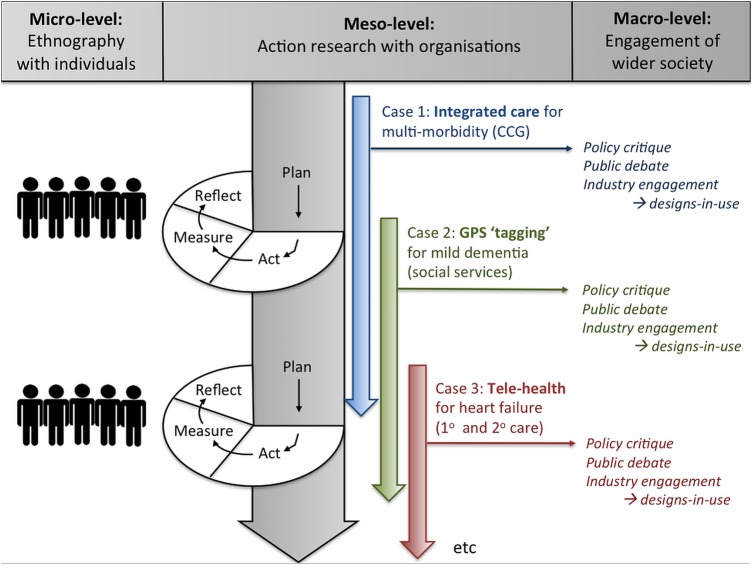
Introduction: Research to date into assisted living technologies broadly consists of 3 generations: technical design, experimental trials and qualitative studies of the patient experience. We describe a fourth-generation paradigm: studies of assisted living technologies in their organisational, social, political and policy context. Fourth-generation studies are necessarily organic and emergent; they view technology as part of a dynamic, networked and potentially unstable system. They use co-design methods to generate and stabilise local solutions, taking account of context. Methods and analysis: SCALS (Studies in Co-creating Assisted Living Solutions) consists (currently) of 5 organisational case studies, each an English health or social care organisation striving to introduce technology-supported services to support independent living in people with health and/or social care needs. Treating these cases as complex systems, we seek to explore interdependencies, emergence and conflict. We employ a co-design approach informed by the principles of action research to help participating organisations establish, refine and evaluate their service. To that end, we are conducting in-depth ethnographic studies of people's experience of assisted living technologies (micro level), embedded in evolving organisational case studies that use interviews, ethnography and document analysis (meso level), and exploring the wider national and international context for assisted living technologies and policy (macro level). Data will be analysed using a sociotechnical framework developed from structuration theory. Ethics and dissemination: Research ethics approval for the first 4 case studies has been granted. An important outcome will be lessons learned from individual co-design case studies. We will document the studies’ credibility and rigour, and assess the transferability of findings to other settings while also recognising unique aspects of the contexts in which they were generated. Academic outputs will include a cross-case analysis and progress in theory and method of fourth-generation assisted living technology research. We will produce practical guidance for organisations, policymakers, designers and service users.
Overview
The claims and statistics of this paper haven’t been checked yet.
Free: it reads the open-access text and checks the first 5 claims that cite a source we can check. Create a free account to check every claim.
Integrity signals
Registry
Cites
Statistics
Figures
Verification
Claims the paper makes
The claims and statistics of this paper haven’t been checked yet.
Free: it reads the open-access text and checks the first 5 claims that cite a source we can check. Create a free account to check every claim.
Claims other papers make about this one
Each is checked against this paper’s own text: does it say what the citing paper says it does?
The source backs part of the claim, not all of it — or backs it for a different population, condition or comparison.
In the citing paper
“These interactions are unlikely to be elucidated by the randomized controlled trial design that still dominates much health technology research [25].”
From Beyond Adoption: A New Framework for Theorizing and Evaluating Nonadoption, Abandonment, and Challenges to the Scale-Up, Spread, and Sustainability of Health and Care Technologies (2017) · cites this paper as [25]
Experimental — accuracy not yet measured
Self-check
Percentages, sums and reported differences re-computed from the paper’s own numbers.
The self-check needs the paper’s full text.
Citations
Cites
The Art of Case Study Research
Johnson, K. E., & Stake, R. E. (1996) · The Modern Language Journal · doi:10.2307/329758 · Cited by 15,826 · cited 1×
“In developing the organisational case studies, we will initially draw on the work of Stake, who emphasised the importance of understanding the case for its own sake (‘what is going on here?’) rather than as an example of a particular theoretical phenomenon (What is this a case of?).(82) 83 To understand the case for i…”
BackgroundFive misunderstandings about case-study research
Flyvbjerg, B. (2006) · Qualitative Inquiry · doi:10.1177/1077800405284363 · Cited by 14,266 · cited 1×
“a discipline without exemplars is an ineffective one’.(92) We believe the interdisciplinary field of assisted living will benefit greatly from our case studies, and furthermore, that our methodology”
ResultThe Computer for the 21st Century
Weiser, M. (1991) · Scientific American · doi:10.1038/scientificamerican0991-94 · Cited by 10,017
Orlikowski, W. J. (2000) · Organization Science · doi:10.1287/orsc.11.4.404.14600 · Cited by 4,760
Bijker, W. E., Hughes, T. P., & Pinch, T. (1987) · Cited by 2,957
Barley, S. R. (1986) · Administrative Science Quarterly · doi:10.2307/2392767 · Cited by 2,315
Barley, S. R. (2007) · Strategy as Practice · doi:10.1017/cbo9780511618925.007 · Cited by 2,116 · cited 2×
“31 Technologies may create opportunities but they do not, in and of themselves, cause personal, organisational or social change.(32) Qualitative studies documenting the design–reality gap on a case-by-case basis may inform, but they do not produce, solutions to this gap.”
BackgroundImplementing, Embedding, and Integrating Practices: An Outline of Normalization Process Theory
May, C., & Finch, T. (2009) · Sociology · doi:10.1177/0038038509103208 · Cited by 2,115 · cited 1×
“May’s normalisation process theory can also be thought of as addressing the recursive relationship between technologies, their users and the organisational and social context.(42) Nicolini has applied practice theory to study the complex, embodied, interactive and materially mediated nature of knowing in telemedicine.”
BackgroundThe Computer for the Twenty-First Century
Weiser, M. (1991) · Scientific American · Cited by 2,113
JAGOSH, J., MACAULAY, A. C., PLUYE, P., SALSBERG, J., BUSH, P. L., HENDERSON, J., SIRETT, E., WONG, G., CARGO, M., HERBERT, C. P., et al. (2012) · The Milbank Quarterly · doi:10.1111/j.1468-0009.2012.00665.x · Cited by 1,268 · cited 1×
“89 Two previous systematic reviews, one of community–campus partnerships and one of large-system change, identified partnership synergy and distributed leadership as key mechanisms through which positive change is generated in multistakeholder collaborations.(90) 91”
BackgroundSelf-citation
Research works printed but not linked: 1
- Procter R, Wherton J, Sugarhood P Master class: co-producing assisted living technologies and services. ECSCW 2013 Adjunct Proceedings; 2013.
Cited by
Greenhalgh, T., Wherton, J., Papoutsi, C., Lynch, J., Hughes, G., A'Court, C., Hinder, S., Fahy, N., Procter, R., & Shaw, S. (2017) · Journal of Medical Internet Research · doi:10.2196/jmir.8775 · Cited by 2,887
Self-citationChanging how we think about healthcare improvement
Braithwaite, J. (2018) · BMJ · doi:10.1136/bmj.k2014 · Cited by 524
The Challenges of Urban Ageing: Making Cities Age-Friendly in Europe
Van Hoof, J., Kazak, J. K., Perek-Białas, J. M., & Peek, S. T. M. (2018) · International Journal of Environmental Research and Public Health · doi:10.3390/ijerph15112473 · Cited by 268
“Furthermore, that the use of technology is dependent on the availability and use of technological and non-technological alternatives [79,88].”
BackgroundGreenhalgh, T., Wherton, J., Papoutsi, C., Lynch, J., Hughes, G., A’Court, C., Hinder, S., Procter, R., & Shaw, S. (2018) · BMC Medicine · doi:10.1186/s12916-018-1050-6 · Cited by 232
“technology design and functionality) and videorecording of both ends of remote consultations [31, 32].”
BackgroundSelf-citationParticipatory Design in Gerontechnology: A Systematic Literature Review
Merkel, S., & Kucharski, A. (2019) · The Gerontologist · doi:10.1093/geront/gny034 · Cited by 209
“Greenhalgh and colleagues (2016, 2) summarize that “assisted living technologies have been characterized by limited uptake [and] high rates of abandonment” (Greenhalgh et al., 2016; Turner & McGee-Lennon, 2013).”
BackgroundMarston, H. R., & van Hoof, J. (2019) · International Journal of Environmental Research and Public Health · doi:10.3390/ijerph16193525 · Cited by 144
Greenhalgh, T., Maylor, H., Shaw, S., Wherton, J., Papoutsi, C., Betton, V., Nelissen, N., Gremyr, A., Rushforth, A., Koshkouei, M., et al. (2020) · JMIR Research Protocols · doi:10.2196/16861 · Cited by 152
“The initial groundwork to develop the NASSS framework was undertaken as part of our SCALS (Studies in Co-creating Assisted Living Solutions, 2015-2020) and VOCAL (Virtual Online Consultations–Advantages and Limitations, 2015-2017) research programs, whose methodology [29,30] and main findings [24,25,31,32] have been r…”
MethodSelf-citationThe State of Evidence in Patient Portals: Umbrella Review
Antonio, M. G., Petrovskaya, O., & Lau, F. (2020) · Journal of Medical Internet Research · doi:10.2196/23851 · Cited by 147
“There are promising emergent qualitative designs that focus on the social, organizational, political, policy, and local context through emergent, ethnographic, and co-design approaches [47,48].”
BackgroundGibson, G., Dickinson, C., Brittain, K., & Robinson, L. A. (2018) · Ageing and Society · doi:10.1017/s0144686x18000661 · Cited by 131
“Drawing on research across the health and social sciences, a number of studies have begun to explore the processes through which ATs are adopted and used across different chronic illness populations (Greenhalgh et al. 2016; Mort, Roberts and Callen 2012; Pols 2012).”
BackgroundKhodadad-Saryazdi, A. (2021) · Technovation · doi:10.1016/j.technovation.2021.102273 · Cited by 108
Peek, S. T. M., Luijkx, K. G., Vrijhoef, H. J. M., Nieboer, M. E., Aarts, S., van der Voort, C. S., Rijnaard, M. D., & Wouters, E. J. M. (2019) · BMC Geriatrics · doi:10.1186/s12877-019-1241-9 · Cited by 84
“fact that the use of a particular technology may very well be dependent on the availability and use of technological and non-technological alternatives [9, 15].”
BackgroundA review: accessible technology through participatory design
Quintero, C. (2020) · Disability and Rehabilitation Assistive Technology · doi:10.1080/17483107.2020.1785564 · Cited by 94
“Computer systems are useful for designing ways of interaction, communication and usability, and the best designs must consider diverse disciplines such as engineering and design in a collaborative way [56].”
BackgroundStudying Scale-Up and Spread as Social Practice: Theoretical Introduction and Empirical Case Study
Shaw, J., Shaw, S., Wherton, J., Hughes, G., & Greenhalgh, T. (2017) · Journal of Medical Internet Research · doi:10.2196/jmir.7482 · Cited by 68
Self-citationKleiven, H. H., Ljunggren, B., & Solbjør, M. (2020) · BMC Health Services Research · doi:10.1186/s12913-020-05191-9 · Cited by 85
“Greenhalgh et al. [32] suggest that it is necessary to include multidisciplinary perspectives in the study of assisted living technology.”
BackgroundHoward, R. J., Gathercole, R. L., Bradley, R., Harper, E., Davis, L., Pank, L., Lam, N., Talbot, E., Hooper, E., Winson, R., et al. (2021) · Age and Ageing · doi:10.1093/ageing/afaa284 · Cited by 72
Jeffries, M., Keers, R. N., Phipps, D. L., Williams, R., Brown, B. C., Avery, A. J., Peek, N. B., & Ashcroft, D. M. (2018) · PLoS ONE · doi:10.1371/journal.pone.0205419 · Cited by 73
Gjestsen, M. T., Wiig, S., & Testad, I. (2017) · BMJ Open · doi:10.1136/bmjopen-2016-015455 · Cited by 51
Hensel, J. M., Shaw, J., Ivers, N. M., Desveaux, L., Vigod, S. N., Cohen, A., Onabajo, N., Agarwal, P., Mukerji, G., Yang, R., et al. (2019) · Journal of Medical Internet Research · doi:10.2196/10838 · Cited by 39
“Moreover, the general advancement and adoption of virtual care is often in the absence of rigorous evaluation and adequate planning for sustainability and spread [11,12].”
Maniatopoulos, G., Hunter, D. J., Erskine, J., & Hudson, B. (2020) · Journal of Health Organization and Management · doi:10.1108/jhom-05-2019-0144 · Cited by 44
Hidden Work and the Challenges of Scalability and Sustainability in Ambulatory Assisted Living
Procter, R., Wherton, J. P., & Greenhalgh, T. (2018) · ACM Transactions on Computer-Human Interaction · doi:10.1145/3185591 · Cited by 37
“Numerous studies (Kinder 2010; McLoughlin et al. 2012; Tinker et al. 2013; Procter et al. 2014; Greenhalgh et al. 2015; Wherton et al. 2015; Greenhalgh et al. 2016) have emphasized the importance of engaging much more closely with service users and, in particular, of taking a coproduction approach…”
BackgroundInfluentialSelf-citationGremyr, A., Andersson Gäre, B., Greenhalgh, T., Malm, U., Thor, J., & Andersson, A.-C. (2020) · Journal of Medical Internet Research · doi:10.2196/15521 · Cited by 31
“The developers of NASSS noted that it was crucial to understand the sociotechnical interaction between individuals, organizations, technology, and policy to explain why a new technology is adopted and sustained (or not) in health and social care [23,29].”
BackgroundSelf-citationLynch, J. K., Glasby, J., & Robinson, S. (2018) · Critical Social Policy · doi:10.1177/0261018318762737 · Cited by 34
Self-citationShi, C., Dumville, J. C., Juwale, H., Moran, C., & Atkinson, R. A. (2022) · Journal of Tissue Viability · doi:10.1016/j.jtv.2022.09.006 · Cited by 31
Impact of digital health on the safety and quality of health care
Shaw, T. J., Hines, M., & Kielly-Carroll, C. (2018) · Cited by 38
Eccles, A. (2020) · Ageing and Society · doi:10.1017/s0144686x19001776 · Cited by 33
“…surveillance technologies (Eccles, 2010; Mort et al., 2013) or the efficacy of remote care use in terms of its operability with service users, especially those with multiple morbidities (Greenhalgh et al., 2016) – by the dominance of ‘expert’ knowledge in policy decision making (Mort et al., 2013).”
BackgroundPapoutsi, C., A’Court, C., Wherton, J., Shaw, S., & Greenhalgh, T. (2020) · Trials · doi:10.1186/s13063-020-04817-x · Cited by 26
Self-citationWherton, J. P., Greenhalgh, T., Procter, R., Shaw, S. E., & Shaw, J. (2018) · Qualitative Health Research · doi:10.1177/1049732318798358 · Cited by 30
Self-citationCare organising technologies and the post-phenomenology of care: An ethnographic case study
Shaw, S. E., Hughes, G., Hinder, S., Carolan, S., & Greenhalgh, T. (2020) · Social Science & Medicine · doi:10.1016/j.socscimed.2020.112984 · Cited by 28
“…Co-creating Assisted Living Solutions (SCALS) – to ‘de-centre’ technology and instead place at the centre of our analysis the person's lived experience of illness, the social care micro-systems and the wider health and care systems within which that experience is nested (Greenhalgh et al., 2016).”
BackgroundSelf-citationMyall, M., May, C. R., Richardson, A. M., Bogle, S., Campling, N. C., Dace, S., & Lund, S. (2020) · Journal of Health Organization and Management · doi:10.1108/jhom-06-2020-0240 · Cited by 25
“In defining context a number of existing frameworks, exploring the recursive relationship between human agency and context, are drawn upon in this paper (Greenhalgh et al., 2016; Damschroder et al., 2009).”
BackgroundJeffries, M., Gude, W. T., Keers, R. N., Phipps, D. L., Williams, R., Kontopantelis, E., Brown, B. C., Avery, A. J., Peek, N. B., & Ashcroft, D. M. (2020) · BMC Medical Informatics and Decision Making · doi:10.1186/s12911-020-1084-5 · Cited by 27
Obayashi, K., Kodate, N., & Masuyama, S. (2021) · International Journal of Social Robotics · doi:10.1007/s12369-021-00815-4 · Cited by 26
Consulta no presencial en tiempos de coronavirus: información para médicos de Atención Primaria
Eguia, H. A., Vinciarelli, F., Muñiz, R. L. V., & García, F. J. S. (2020) · Medicina de Familia SEMERGEN · doi:10.1016/j.semerg.2020.08.005 · Cited by 21
Carroll, S., Kobayashi, K. M., Navarrete, M. C., Freeman, S., Saini, M., & Tracey, S. (2021) · Gerontology and Geriatric Medicine · doi:10.1177/23337214211023269 · Cited by 23
Niang, M., Alami, H., Gagnon, M., & Dupéré, S. (2023) · Global Health Action · doi:10.1080/16549716.2023.2230813 · Cited by 23
“As recommended by some studies [38,39], researchers should embrace ‘fourth generation’ approaches that are complex,”
ResultLynch, J. K., Hughes, G., Papoutsi, C., Wherton, J. P., & A’Court, C. (2021) · Social Science & Medicine · doi:10.1016/j.socscimed.2021.114553 · Cited by 22
“The wider programme initially included 6 case studies involving UK health and social care organisations embarking on new service provision supported by technology (Greenhalgh et al., 2016).”
Self-citationPiau, A., Vautier, C., Mauléon, A. D., Tchalla, A. E., Rumeau, P., Nourhashémi, F., & Soto‐Martin, M. (2020) · Geriatric Nursing · doi:10.1016/j.gerinurse.2020.07.009 · Cited by 18
“However, health professionals are facing a low level of diffusion of TM in real clinical care settings, including long-term care facilities.(23) Decades after the first TM initiatives, we should be focusing on how to overcome this relative failure.”
Curnow, E., Rush, R., Górska, S., & Forsyth, K. (2021) · BMC Geriatrics · doi:10.1186/s12877-021-02546-7 · Cited by 18
Jeffries, M., Salema, N.-E., Laing, L., Shamsuddin, A., Sheikh, A., Avery, A. J., Chuter, A., Waring, J. J., & Keers, R. N. (2023) · BMJ Open · doi:10.1136/bmjopen-2022-068798 · Cited by 19
Wanka, A., & Gallistl, V. (2021) · Zeitschrift für Gerontologie und Geriatrie · doi:10.1007/s00391-021-01862-2 · Cited by 21
Tang, U. H., Smith, F., Karilampi, U., & Gremyr, A. (2024) · JMIR Human Factors · doi:10.2196/50889 · Cited by 19
Network-based approaches for evaluating ambient assisted living (AAL) technologies
Gomersall, T., Nygård, L., Mihailidis, A., Sixsmith, A. J., Hwang, A. S., Hedman, A., & Astell, A. J. (2017) · Evaluation · doi:10.1177/1356389017697615 · Cited by 15
Wildevuur, S. E., Simonse, L. W. L., Groenewegen, P., & Klink, A. (2019) · BMJ Open · doi:10.1136/bmjopen-2018-025930 · Cited by 21
Hensel, J. M., Shaw, J., Jeffs, L. P., Ivers, N. M., Desveaux, L., Cohen, A., Agarwal, P., Wodchis, W. P., Tepper, J. D., Larsen, D., et al. (2016) · BMC Psychiatry · doi:10.1186/s12888-016-1057-5 · Cited by 15
Gonsalves, P. P., Bhat, B., Sharma, R., Jambhale, A., Chodankar, B., Verma, M., Hodgson, E., Weiss, H. A., Leurent, B., Cavanagh, K., et al. (2023) · BJPsych Open · doi:10.1192/bjo.2022.624 · Cited by 14
Disability Interactions: Creating Inclusive Innovations
Holloway, C., & Barbareschi, G. (2021) · Synthesis lectures on human-centered informatics · doi:10.2200/s01141ed1v01y202111hci053 · Cited by 14
Value and sustainability in technology-enabled care services: a case study from north-east England
Bhattacharya, S. D., Wainwright, D., & Whalley, J. (2021) · Public Money & Management · doi:10.1080/09540962.2021.1992123 · Cited by 12
“We used a single exploratory case study design, with an interpretive focus (Stake, 1995; Walsham, 2006) to investigate and analyse a TECS, embedded within its complex social, organizational, and technological contexts (Baker, 2011; Greenhalgh et al., 2016).”
BackgroundMethodCadre stratégique pour soutenir l’évaluation des projets complexes et innovants en santé numérique
Alami, H., Fortin, J., Gagnon, M., Lamothe, L., Ghandour, E. K., Ahmed, M. A. A., & Roy, D. A. (2020) · Santé Publique · doi:10.3917/spub.202.0221 · Cited by 15
Lukas, A., Maucher, I., Bugler, S., Flemming, D., & Meyer, I. (2020) · Zeitschrift für Gerontologie und Geriatrie · doi:10.1007/s00391-020-01763-w · Cited by 12
Mead, G., & Neves, B. B. (2018) · Policy Press eBooks · doi:10.51952/9781447339953.ch003 · Cited by 14
Working with Assistive Technologies and People Living with Dementia
Gibson, G., Brittain, K., & Robinson, L. A. (2019) · Springer eBooks · doi:10.1007/978-981-13-3693-5_13 · Cited by 11
Telecare at a crossroads? Finding researchable questions
Woolham, J., Freddolino, P. P., Gibson, G., & Daniels, S. (2021) · Journal of Enabling Technologies · doi:10.1108/jet-11-2020-0049 · Cited by 11
“…which combine current approaches to personalisation of care services with an appreciation of how successful examples of personalised AT/telecare arrangements are co-produced in partnership between services, technologies, end users and their families (Greenhalgh et al., 2016; Gibson et al., 2019).”
BackgroundJeffries, M., Abuzour, A. S., Ashcroft, D. M., Avery, A. J., Langridge, M., Francis, G., O'Brien, A., Millington, T., & Keers, R. N. (2025) · BMJ Open · doi:10.1136/bmjopen-2024-086309 · Cited by 7
“39”
Outcomes for older telecare recipients: The importance of assessments
Woolham, J., Steils, N., Fisk, M. J., Porteus, J., & Forsyth, K. (2019) · Journal of Social Work · doi:10.1177/1468017319883499 · Cited by 8
“An important outcome of this is that in the UK arrangements for assessing people for telecare are claimed to be ‘suboptimal’ (Greenhalgh et al., 2016) because the policy focus remains fixed on technological innovation and rapid ‘up-scaling’ rather than on achieving a better understanding of how existing telecare techn…”
BackgroundInfluentialManiatopoulos, G., Hunter, D. J., Erskine, J., & Hudson, B. (2020) · Organizational behaviour in health care · doi:10.1007/978-3-030-26684-4_1 · Cited by 8
Cerna, K., Paluch, R., Bäumer, F., Ertl, T., & Müller, C. (2021) · Interaction design & architecture(s)/ID&A Interaction design & architecture(s) · doi:10.55612/s-5002-050-002 · Cited by 10
“to a significant discrepancy between the national and international funding invested in research and development projects over the last decade and the very low level of payback that can be seen in market-ready products (see, among others, [21, 41].”
BackgroundGjestsen, M. T., Wiig, S., & Testad, I. (2019) · Journal of Medical Internet Research · doi:10.2196/12797 · Cited by 7
“By nature, the intervention is intimately and reciprocally entwined with the professional skills and networks that support technology use and the development of community care services and with the local, national, and transnational policy on technological innovation and assisted living [37,40,41].”
BackgroundMeyer, C., Dickins, M., O’Keefe, F., Hall, K. J., & Lowthian, J. A. (2023) · Gerontology and Geriatric Medicine · doi:10.1177/23337214221149772 · Cited by 5
MMM Duet System: New accessible musical technology for people living with dementia
Christensen, J., Kauenhofen, S., Loehr, J. D., Lang, J., Peacock, S., & Nicol, J. J. (2023) · Audio Mostly Conference (AM) · doi:10.1145/3616195.3616205 · Cited by 5
Bhattacharya, S. D., Wainwright, D. W., Waring, T., & Whalley, J. (2017) · AIS Electronic Library (AISeL) · Cited by 5
Woolham, J., Steils, N., Forsyth, K., Fisk, M. J., & Porteus, J. (2019) · Evidence & Policy · doi:10.1332/174426419x15730452200823 · Cited by 6
The Configuration of Older Users as Drivers of Innovation in the Design of Digital Technologies
Endter, C., Merkel, S., & Künemund, H. (2022) · NOvation - Critical Studies of Innovation · doi:10.5380/nocsi.v0i3.91147 · Cited by 9
“First, UCD – as it is for example mandatory in the German funding program on AAL – is a reaction to the lack of market success of the developed technologies (Greenhalgh et al. , 2016; Fachinger, 2018).”
BackgroundAssistive technology: Occupational therapy assessment and services for people with dementia
Curnow, E., Maclean, F., & McCormack, B. G. (2024) · British Journal of Occupational Therapy · doi:10.1177/03080226241252280 · Cited by 4
“However, there is scope for AT to be used in more imaginative ways to meet in response to the needs of people with dementia, which would in turn reduce the occurrence of adverse outcomes (Greenhalgh et al., 2016; Sugarhood et al., 2014).”
Barcelos, A., Moniz, A., Henriques, A. R., Mazeda, C., Mateus, E. F., Machado, A., Gonçalves, C. F., Moreto, M., de Almeida, M. F., Mendonça, N., et al. (2025) · JMIR Formative Research · doi:10.2196/72468 · Cited by 4
“These tools enable the customization of interventions, particularly in the management of chronic diseases [22-24].”
Ambient assisted living and European funds: a bibliometric approach
Puliga, G., Nasullaev, A., Bono, F., Gutiérrez, E., & Strozzi, F. (2020) · Information Technology and People · doi:10.1108/itp-10-2019-0565 · Cited by 5
Afzal, N., Nguyen, A., & Lau, A. Y. S. (2025) · Applied Clinical Informatics · doi:10.1055/a-2591-4016 · Cited by 2
Eriksen, S., Øye, C., & Dahler, A. M. (2026) · Journal of Medical Internet Research · doi:10.2196/79999 · Cited by 2
“Since its introduction, bricolage has found relevance across various disciplines [61-63], including studies on public sector innovation [7,45-49 , 64].”
Koubaa, N., Levasseur, M., Aubertin‐Leheudre, M., Verchère, C., Corbin, C., & Boissy, P. (2026) · Frontiers in Public Health · doi:10.3389/fpubh.2026.1777557 · Cited by 2
“Furthermore, literature focuses on individual-level experiences, leaving a gap in understanding the organizational and other contextual challenges of implementation from the perspective of health care professionals (HCP) such as managers, practitioners and administrators (47).”
Feasibility of Non-contact Smart Sensor-Based Falls Detection in a Residential Aged Care Environment
Borda, A., Said, C. M., Gilbert, C. A., Smolenaers, F., McGrath, M., & Gray, K. M. (2019) · Intelligent systems reference library · doi:10.1007/978-3-030-30817-9_7 · Cited by 3
Kodate, N., Obayashi, K., Mannan, H., & Masuyama, S. (2022) · Oxford University Press eBooks · doi:10.1093/oso/9780198799498.003.0015 · Cited by 3
Co-creating digital transformation in care of older persons A longitudinal mixed-methods study
Dugstad, J. (2020) · NVA (Nasjonalt vitenarkiv) · doi:10.13140/rg.2.2.29859.89123 · Cited by 2
Configuring Participatory Design of ICT for Aging Well as Matters of Care
Huldtgren, A., Klapperich, H., & Endter, C. (2023) · Communications in computer and information science · doi:10.1007/978-3-031-37496-8_9 · Cited by 1
Wanka, A., & Gallistl, V. (2023) · Revue des sciences sociales · doi:10.4000/revss.10264 · Cited by 1
Gjestsen, M. T. (2020) · Stavanger University Library eBooks · doi:10.31265/usps.40 · Cited by 1
“…interventions are defined as complex interventions (Salisbury et al., 2015), involving a number of components, such as the type of technology, the infrastructure, the human support available and the capabilities of the patient in relation to the technology (Greenhalgh et al., 2016).”
BackgroundInvestigating the effective factors on telemedicine in Iran of 2030: A futuristic approach
Ramezani, R., Sahebzadeh, M., & Ehteshami, A. (2025) · Journal of Education and Health Promotion · doi:10.4103/jehp.jehp_2024_23 · Cited by 3
“[17,18] Telemedicine futurology is a theoretical framework that explores the potential future development and implications of telemedicine.”
Technologies in care for older people: EPTA report 2019
Limén, H., Hill-Cawthorne, G. A., Niezen, M. G. H., Tennøe, T., Bechtold, U., Tecnologia, C. A. D. P. S. C. I., Quaglio, G., Boucher, P., Höyssä, M., Rahkola, M., et al. (2022) · UTUPub (University of Turku) · Cited by 1
Poba‐Nzaou, P., Kume, N., Kobayashi, S., & Galani, M. (2021) · doi:10.2196/preprints.29401
Technologien der Krise: Die Covid-19-Pandemie als Katalysator neuer Formen der Vernetzung
Krämer, D., Haltaufderheide, J., & Vollmann, J. (2022) · Digitale Gesellschaft · doi:10.1515/9783839459249
Características de la utilización de telemedicina en urólogos chilenos durante pandemia COVID-19
Inzunza, J. A., González, M. A., Valenzuela, R., Inostroza, C., & Inzunza, F. (2022) · Revista Chilena de Salud Pública · doi:10.5354/0719-5281.2022.69173
Galvão, W. R., Silva, L. K. C., Viana, R. T., Oliveira, P. H. A., Jucá, R. V. B. D. M., Martins, H. R., Rabelo, M., Fachin‐Martins, E., & Lima, L. A. O. (2024) · Hong Kong Journal of Occupational Therapy · doi:10.1177/15691861241241776
“As a result, device rejection rates increase, re fl ecting the small insertion of technological devices in the market (Greenhalgh et al., 2016).”
BackgroundRotvold, G.-H., Trondsen, M. V., & Sandaunet, A. G. (2025) · BMC Health Services Research · doi:10.1186/s12913-025-13047-3
“Welfare technology (WFT), also referred to as assistive technology [1] or telecare [2], is a broad and loosely defined concept that encompasses a range of digital technologies introduced into healthcare delivery.”
Jeffries, M., Gude, W. T., Keers, R. N., Phipps, D. L., Williams, R., Kontopantelis, E., Brown, B. C., Avery, A. J., Peek, N. B., & Ashcroft, D. M. (2020) · Figshare · doi:10.6084/m9.figshare.12150777
Kleiven, H. H., Ljunggren, B., & Solbjør, M. (2020) · Figshare · doi:10.6084/m9.figshare.12142665
Gil, A. P., Moniz, A. B., José, J. M. S. D. S., Krings, B., & Bäckström, B. (2019) · Portuguese National Funding Agency for Science, Research and Technology (RCAAP Project by FCT)
Mannheim, I., Urbaniak, A., White, E. B., Karadkar, U. P., Klincewicz, K., Kucharski, A. B., Reuter, A., Ribeiro, R. T., van Staalduinen, W. H., White, P. J., et al. (2026) · The Gerontologist · doi:10.1093/geront/gnag229
“Still, many technologies directed at improving the lives of older adults show low levels of adoption (Greenhalgh et al., 2016; Peek et al., 2014).”
Nguyen, A., Ryan, M., Lau, A. Y. S., & Afzal, N. (2026) · Applied Clinical Informatics · doi:10.1055/a-2969-2451
Metadata
- Authors
- Greenhalgh, T., Shaw, S., Wherton, J., Hughes, G., Lynch, J., A'Court, C., Hinder, S., Fahy, N., Byrne, E., Finlayson, A., Sorell, T., Procter, R., & Stones, R.
- Affiliations
- University of Oxford (GB)
- Blizard Institute, Barts and the London School of Medicine and Dentistry, London, UK
- Department of Politics and International Studies, University of Warwick, Warwick, UK
- Nuffield Department of Primary Care Health Sciences, University of Oxford, Oxford, UK
- Queen Mary University of London (GB)
- University of Warwick (GB)
- Western Sydney University (AU)
- Corresponding author
- Greenhalgh, Trisha
- ORCID
- Venue
- BMJ Open
- Publisher
- BMJ
- Published
- 2016-02
- Volume
- 6
- Issue
- 2
- Pages
- e010208
- ISSN
- 2044-6055 (ISSN-L)
- PMC
- PMC4762149
- OpenAlex
- W2284706559
- Cited by
- 85
- References
- 95
- Citations by year
- 2026: 3 · 2025: 6 · 2024: 3 · 2023: 6 · 2022: 8 · 2021: 11 · 2020: 20 · 2019: 10 · 2018: 12 · 2017: 5 · 2016: 1
- FWCI
- 26.07
- Type
- journal article
- Language
- en
- Open access
- gold
- doi.org
- Licence
- cc-by
- Locations
- BMJ Open (publishedVersion, cc-by)
- Europe PMC (PubMed Central) (publishedVersion, cc-by)
- PubMed Central (publishedVersion, cc-by)
- PubMed (publishedVersion)
- University of Hertfordshire Research Archive (University of Hertfordshire) (acceptedVersion, cc-by)
- Warwick Research Archive Portal (University of Warwick) (acceptedVersion)
- University of Hertfordshire Research Archive (University of Hertfordshire) (submittedVersion, cc-by)
- HighWire Press Open Archive (submittedVersion)
- Funders
- Wellcome Trust (WT104830MA, 104830/Z/14/Z)
- National Institute for Health and Care Research (RP-DG-1213-10003, NF-SI-0512-10031)
- Economic and Social Research Council (1464328)
- Topics
- Health Sciences › Medicine › Geriatrics and Gerontology › Technology Use by Older Adults
- Social Sciences › Health › Social Policies and Healthcare Reform
- Health Sciences › Health Professions › Occupational Therapy › Assistive Technology in Communication and Mobility
- Keywords
- assisted living technologies, co-design, complex systems, socio-technical framework, structuration theory, independent living, technology policy, action research, service development
- MeSH terms
- Anthropology, Cultural, United Kingdom, Humans, Interviews as Topic, Politics, Social Support, Technology, Program Evaluation, Qualitative Research, Independent Living, Policy
About these checks
Registry, retraction, Cites and statistics results are computed, not judged, with one exception: a printed reference that no index lists is read once by a model before it counts as a citation error. Claims are extracted by a model and kept only when their quote appears verbatim in the text; each cited source is then checked, with a model’s help, for whether it says what the claim relies on. Those verdicts can be wrong — read the claim’s quote and the cited source before relying on one.
Statistics and arithmetic are recomputed, not judged.
Confidence bands are shown only for fields calibrated on our annotated test set. None is calibrated yet, so no band is shown.
What counts as a claim ›How we measure confidence ›How we check this ›
Are you an author, or do you see a problem with this page? Request a review
Data sources
Bibliographic data: Semantic Scholar, OpenAlex, Crossref.
Contains information from the Semantic Scholar Academic Graph Datasets, made available under the ODC Attribution License (ODC-BY 1.0).
Semantic Scholar’s data is described in: Kinney, R., et al. (2023). The Semantic Scholar Open Data Platform. arXiv:2301.10140.
