

The DOI matches its Crossref record; 37 of the 37 references it cites were found in a registry or an index.
Sociodemographic differences in women’s experience of early labour care: a mixed methods study
Abstract
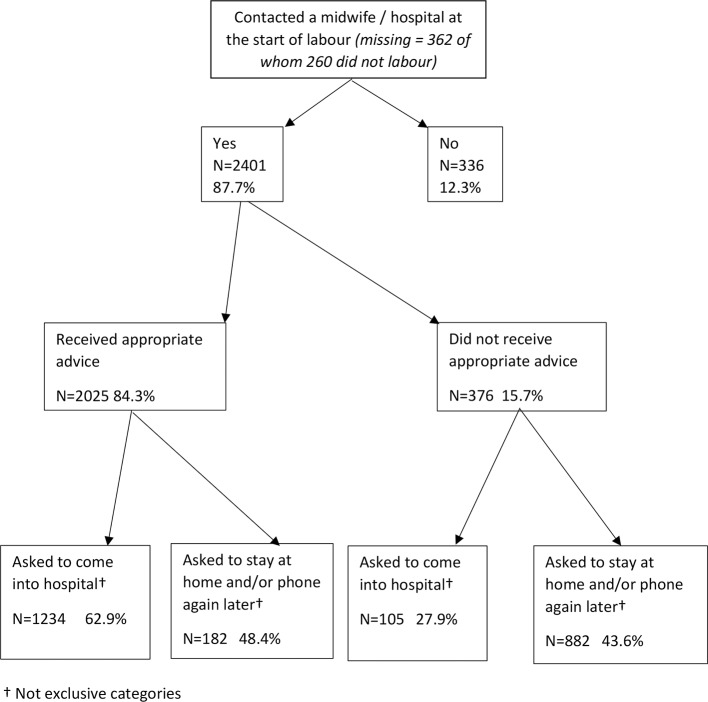
Objectives: To explore women’s experiences of early labour care focusing on sociodemographic differences, and to examine the effect of antenatal education, using mixed methods. Setting: England, 2014. Participants: Women who completed postal questionnaires about their experience of maternity care, including questions about antenatal education, early labour and sociodemographic factors, included space for free-text comments. Outcome measures: Worries about labour, contact with midwives in early labour and subsequent care. Methods: This study was based on secondary analysis of a national maternity survey carried out in England in 2014. Quantitative data were analysed using descriptive statistics and binary logistic regression; qualitative data were analysed using a thematic content analytic approach. Results: Completed questionnaires were received from 4578 women (47% response rate). There were significant differences by sociodemographic factors, particularly ethnicity, in women’s worries about early labour. Compared with white women, women from black or minority ethnic groups had an adjusted OR of 1.93 (95% CI 1.56 to 2.39) of feeling worried about not knowing when labour would start. Among women who contacted a midwife at the start of labour, 84% perceived their advice as appropriate, more in older and multiparous women. Overall, 64% of women were asked to come to the hospital at this time, more in multiparous women (adjusted OR 1.63, 95% CI 1.35 to 1.96). Those who did not have access to antenatal education experienced greater worry about early labour. Five themes emerged from the qualitative analysis: ‘Differentiating between early and active labour’, ‘Staff attitudes’, ‘Not being allowed…’, ‘Previous labours’ and ‘Perceived consequences for women’. Conclusion: These findings reinforce the importance of providing reassurance to women in early labour, taking care that women do not feel neglected or dismissed. In particular, primiparous and ethnic minority women reported greater worry about early labour and require additional reassurance.
Overview
The claims and statistics of this paper haven’t been checked yet.
Run the check — free, no account needed. It reads the open-access text and checks the sources it cites.
Integrity signals
Registry
Cites
Statistics
Figures
Verification
Claims the paper makes
The claims and statistics of this paper haven’t been checked yet.
Run the check — free, no account needed. It reads the open-access text and checks the sources it cites.
Claims other papers make about this one
Each is checked against this paper’s own text: does it say what the citing paper says it does?
The cited source says what the claim attributes to it.
In the citing paper
“In the context of the current study, this fi nding is surprising, given the vast body of evidence exploring this notion [17,19-21,23,44-50].”
From The birth trauma earthquake: A qualitative investigation of first-time mothers who perceived their birth as traumatic (2026) · cites this paper as [20]
In the citing paper
“Women from minority ethnic groups often report feeling as though staff are disrespectful [19], increased worry regarding labour and birth, and ultimately poorer experiences of maternity care [20].”
From The birth trauma earthquake: A qualitative investigation of first-time mothers who perceived their birth as traumatic (2026) · cites this paper as [20]
Self-check
Percentages, sums and reported differences re-computed from the paper’s own numbers.
The self-check needs the paper’s full text.
Citations
Cites
Understanding Reliability and Validity in Qualitative Research
Golafshani, N. (2015) · The Qualitative Report · doi:10.46743/2160-3715/2003.1870 · Cited by 5,157
Labor; clinical evaluation and management
Friedman, E. A. (1978) · Appleton-Century-Crofts eBooks · Cited by 262
Experiencing maternity care: the care received and perceptions of women from different ethnic groups
Henderson, J., Gao, H., & Redshaw, M. (2013) · BMC Pregnancy and Childbirth · doi:10.1186/1471-2393-13-196 · Cited by 184
Self-citationGarcia, J., Evans, J., & Reshaw, M. (2004) · Quality & Quantity · doi:10.1023/b:ququ.0000019394.78970.df · Cited by 168
Holmes, P., Oppenheimer, L. W., & Wen, S. W. (2001) · BJOG An International Journal of Obstetrics & Gynaecology · doi:10.1111/j.1471-0528.2003.00265.x · Cited by 150
Fear, pain and stress hormones during childbirth
Alehagen, S., Wijma, B. E., Lundberg, U., & Wijma, K. (2005) · Journal of Psychosomatic Obstetrics & Gynecology · doi:10.1080/01443610400023072 · Cited by 150
Outcomes of Women Presenting in Active Versus Latent Phase of Spontaneous Labor
Bailit, J. L., Dierker, L. J., Blanchard, M. H., & Mercer, B. M. (2005) · Obstetrics and Gynecology · doi:10.1097/01.aog.0000147843.12196.00 · Cited by 142
Women's experience of induction of labor: a mixed methods study
Henderson, J., & Redshaw, M. (2013) · Acta Obstetricia et Gynecologica Scandinavica · doi:10.1111/aogs.12211 · Cited by 114
Self-citationBat-Erdene, U., Metcalfe, A., McDonald, S., & Tough, S. (2013) · BMC Pregnancy and Childbirth · doi:10.1186/1471-2393-13-s1-s3 · Cited by 103
Lindquist, A., Kurinczuk, J. J., Redshaw, M., & Knight, M. (2014) · BJOG An International Journal of Obstetrics & Gynaecology · doi:10.1111/1471-0528.13059 · Cited by 97
Self-citation
Research works printed but not linked: 1
- 10.1016/S0306-5456(01)00265-0 · DOI
Cited by
Mothers’ experience of maternity and neonatal care when babies die: A quantitative study
Redshaw, M., & Henderson, J. (2018) · PLOS ONE · doi:10.1371/journal.pone.0208134 · Cited by 16
Self-citationBailey, E. C., Barry, Z., Buabeng, R., Fellows, R. E., Khazaezadeh, N., Rajasingam, D., Silverio, S. A., & Sheen, K. S. (2026) · Women and Birth · doi:10.1016/j.wombi.2026.102171
Metadata
- Authors
- Henderson, J., & Redshaw, M.
- Venue
- BMJ Open
- Publisher
- BMJ
- Published
- 2017-07
- Volume
- 7
- Issue
- 7
- Pages
- e016351
- ISSN
- 2044-6055
- PMC
- PMC5541638
- Cited by
- 16
- References
- 37
- Language
- en
- Funders
- Department of Health
About these checks
Registry, retraction, Cites and statistics results are computed, not judged, with one exception: a printed reference that no index lists is read once by a model before it counts as a citation error. Claims are extracted by a model and kept only when their quote appears verbatim in the text; each cited source is then checked, with a model’s help, for whether it says what the claim relies on. Those verdicts can be wrong — read the claim’s quote and the cited source before relying on one.
Statistics and arithmetic are recomputed, not judged.
Confidence bands are shown only for fields calibrated on our annotated test set. None is calibrated yet, so no band is shown.
What counts as a claim ›How we measure confidence ›How we check this ›
Are you an author, or do you see a problem with this page? Request a review
How to cite
Cite CoChat for the checks on this page, and the paper for its own findings.
- This page
- CoChat. (2026). Citation check: Sociodemographic differences in women’s experience of early labour care: a mixed methods study. https://app.cochat.ai/papers/10.1136/bmjopen-2017-016351
- The paper
- Henderson, J., & Redshaw, M. (2017). Sociodemographic differences in women’s experience of early labour care: a mixed methods study. BMJ Open. https://doi.org/10.1136/bmjopen-2017-016351
Data sources
Bibliographic data: Semantic Scholar, OpenAlex, Crossref.
Contains information from the Semantic Scholar Academic Graph Datasets, made available under the ODC Attribution License (ODC-BY 1.0).
Semantic Scholar’s data is described in: Kinney, R., et al. (2023). The Semantic Scholar Open Data Platform. arXiv:2301.10140.
