

Expectations and experiences of hospital postnatal care in the UK: a systematic review of quantitative and qualitative studies
Open accessThe DOI matches its Crossref record; 60 of the 62 references it cites were found in a registry or an index.
Abstract
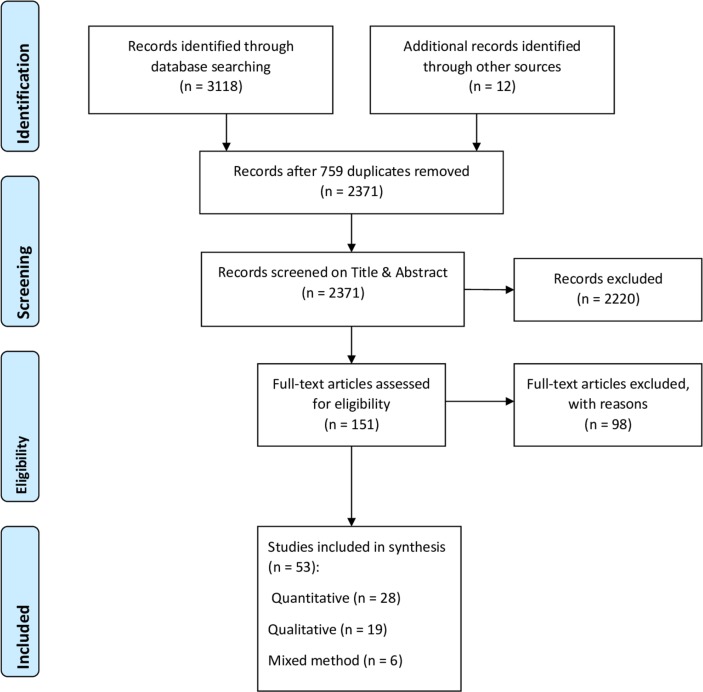
Objectives: To report on women’s and families’ expectations and experiences of hospital postnatal care, and also to reflect on women’s satisfaction with hospital postnatal care and to relate their expectations to their actual care experiences. Design: Systematic review. Setting: UK. Participants: Postnatal women. Primary and secondary outcomes: Women’s and families’ expectations, experiences and satisfaction with hospital postnatal care. Methods: Embase, MEDLINE, PsycINFO, Applied Social Sciences Index and Abstracts, Cumulative Index to Nursing and Allied Health (CINAHL Plus), Science Citation Index, and Social Sciences Citation Index were searched to identify relevant studies published since 1970. We incorporated findings from qualitative, quantitative and mixed-methods studies. Eligible studies were independently screened and quality-assessed using a modified version of the National Institutes of Health Quality Assessment Tool for quantitative studies and the Critical Appraisal Skills Programme for qualitative studies. Data were extracted on participants’ characteristics, study period, setting, study objective and study specified outcomes, in addition to the summary of results. Results: Data were included from 53 studies, of which 28 were quantitative, 19 were qualitative and 6 were mixed-methods studies. The methodological quality of the included studies was mixed, and only three were completely free from bias. Women were generally satisfied with their hospital postnatal care but were critical of staff interaction, the ward environment and infant feeding support. Ethnic minority women were more critical of hospital postnatal care than white women. Although duration of postnatal stay has declined over time, women were generally happy with this aspect of their care. There was limited evidence regarding women’s expectations of postnatal care, families’ experience and social disadvantage. Conclusion: Women were generally positive about their experiences of hospital postnatal care, but improvements could still be made. Individualised, flexible models of postnatal care should be evaluated and implemented. PROSPERO registration number: CRD42017057913.
Overview
The claims and statistics of this paper haven’t been checked yet.
Free: it reads the open-access text and checks the first 5 claims that cite a source we can check. Create a free account to check every claim.
Integrity signals
Registry
Cites
Statistics
Figures
Verification
Claims the paper makes
The claims and statistics of this paper haven’t been checked yet.
Free: it reads the open-access text and checks the first 5 claims that cite a source we can check. Create a free account to check every claim.
Claims other papers make about this one
Each is checked against this paper’s own text: does it say what the citing paper says it does?
The source backs part of the claim, not all of it — or backs it for a different population, condition or comparison.
In the citing paper
“Individualised and flexible care was described as the most central aspect of hospital care after childbirth [18, 19].”
From Support during the postnatal period: Evaluating new mothers' and midwives' experiences of a new, coordinated postnatal care model in a midwifery clinic in Sweden (2023) · cites this paper as [19]
Experimental — accuracy not yet measured
Self-check
Percentages, sums and reported differences re-computed from the paper’s own numbers.
The self-check needs the paper’s full text.
Citations
Cites
Liberati, A., Altman, D. G., Tetzlaff, J., Mulrow, C., Gøtzsche, P. C., Ioannidis, J. P. A., Clarke, M., Devereaux, P. J., Kleijnen, J., & Moher, D. (2009) · PLoS Medicine · doi:10.1371/journal.pmed.1000100 · Cited by 28,164
Liberati, A., Altman, D. G., Tetzlaff, J., Mulrow, C., Gotzsche, P. C., Ioannidis, J. P. A., Clarke, M., Devereaux, P. J., Kleijnen, J., & Moher, D. (2009) · BMJ · doi:10.1136/bmj.b2700 · Cited by 17,648
Beyond PICO: The SPIDER Tool for Qualitative Evidence Synthesis
Cooke, A., Smith, D., & Booth, A. (2012) · Qualitative Health Research · doi:10.1177/1049732312452938 · Cited by 2,608
Critical appraisal skills programme
Singh, J. (2013) · Journal of Pharmacology and Pharmacotherapeutics · doi:10.4103/0976-500x.107697 · Cited by 2,556
Effective Care in Pregnancy and Childbirth
Paintin, D. B. (1990) · BJOG: An International Journal of Obstetrics & Gynaecology · doi:10.1111/j.1471-0528.1990.tb02464.x · Cited by 1,330
How can systematic reviews incorporate qualitative research? A critical perspective
Dixon-Woods, M., Bonas, S., Booth, A., Jones, D. R., Miller, T., Sutton, A. J., Shaw, R. L., Smith, J. A., & Young, B. (2006) · Qualitative Research · doi:10.1177/1468794106058867 · Cited by 860
Women’s Perceptions and Experiences of Breastfeeding Support: A Metasynthesis: BIRTH
Schmied, V., Beake, S., Sheehan, A., McCourt, C., & Dykes, F. (2011) · Birth · doi:10.1111/j.1523-536x.2010.00446.x · Cited by 360
Maternity Satisfaction studies and their limitations: “what is, must still be best”
van Teijlingen, E. R., Hundley, V., Rennie, A., Graham, W., & Fitzmaurice, A. (2003) · Birth · doi:10.1046/j.1523-536x.2003.00224.x · Cited by 260 · cited 1×
“Multiparous women also reported receiving more information and explanations generally, and specifically about their own recovery,(22) that staff were kind and treated them as individuals,(11) 23 were happier with the ward environment and overall were more satisfied with their postnatal stay.(42) One qualitative study…”
BackgroundEarly postnatal discharge from hospital for healthy mothers and term infants
Brown, S., Small, R., Argus, B., Davis, P. G., & Krastev, A. (2002) · Cochrane Database of Systematic Reviews · doi:10.1002/14651858.cd002958 · Cited by 253 · cited 1×
“4 A Cochrane review by Brown et al(5) on length of postnatal hospital stay for healthy mothers who gave birth to healthy term babies suggests that early discharge home does not have an adverse effect on maternal health or breastfeeding outcomes when accompanied by a policy of offering women at least one nurse-midwife…”
BackgroundRandomised, controlled trial of efficacy of midwife-managed care
Tumbull, D., Holmes, A., Shields, N., Cheyne, H., Twaddle, S., Gilmour, W. H., McGinley, M., Reid, M., Johnstone, I., Geer, I., et al. (1996) · The Lancet · doi:10.1016/s0140-6736(95)11207-3 · Cited by 227
Research works printed but not linked: 7
- Redshaw M, Henderson J Safely delivered: a national survey of women’s experience of maternity care 2014. Oxford 2015.
- National Institute for Health and Care Excellence. Postnatal care up to 8 weeks after birth. London: NICE, 2006. 32065741
- NHS England. National Maternity Review. Better Births. Improving outcomes of maternity services in England. London, 2016.
- Redshaw M, Rowe R, Hockley C, et al Recorded delivery: a national survey of women’s experiences of maternity care 2006. Oxford: NPEU, 2006.
- McFadden C, Baker L, Lavender T Exploration of factors influencing women’s breastfeeding experiences following a caesarean section. Evidence Based Midwifery 2009; 7: 64– 70.
- Jomeen J, Redshaw M Black and minority ethnic women’s experiences of contemporary maternity care in England. J Reprod Infant Psychol 2011; 29: e9.
- Green JM, Coupland VA, Kitzinger JV Great expectations (2nd edn): Books for Midwives Press, 1998.
Cited by
What matters to women in the postnatal period: A meta-synthesis of qualitative studies
Finlayson, K., Crossland, N., Bonet, M., & Downe, S. (2020) · PLOS ONE · doi:10.1371/journal.pone.0231415 · Cited by 307
McLeish, J., Harvey, M., Redshaw, M., & Alderdice, F. A. (2020) · Women and Birth · doi:10.1016/j.wombi.2020.10.012 · Cited by 120
“evertheless, despite the perennial problem of inconsistent rofessional advice [23], mothers in this study generally wanted o get their information from health professionals or resources ecommended by health professionals.”
BackgroundInfluentialSelf-citationSocial support needs of first-time parents in the early-postpartum period: A qualitative study
Schobinger, E., Vanetti, M., Ramelet, A., & Horsch, A. (2022) · Frontiers in Psychiatry · doi:10.3389/fpsyt.2022.1043990 · Cited by 77
Positive postpartum well‐being: What works for women
Hannon, S., Newnham, E. C., Hannon, K., Wuytack, F., Johnson, L., McEvoy, E., & Daly, D. (2022) · Health Expectations · doi:10.1111/hex.13605 · Cited by 52
First-Time Mothers’ Expectations and Experiences of Postnatal Care in England
McLeish, J., Harvey, M., Redshaw, M., Henderson, J., Malouf, R. S., & Alderdice, F. A. (2020) · Qualitative Health Research · doi:10.1177/1049732320944141 · Cited by 50
“In surveys and qualitative studies, some women have reported negative experiences of the physical environment of postnatal wards, staff attitudes and communication, staff having insufficient time to offer meaningful support, lack of information about baby care, and inadequate support for infant feeding (Malouf et al.,…”
BackgroundSelf-citationLojander, J., Axelin, A., & Niela‐Vilén, H. (2024) · European Journal of Obstetrics & Gynecology and Reproductive Biology · doi:10.1016/j.ejogrb.2024.02.029 · Cited by 40
Tarasoff, L. A., Lunsky, Y., Welsh, K., Proulx, L., Havercamp, S. M., Parish, S. L., & Brown, H. K. (2023) · Journal of Advanced Nursing · doi:10.1111/jan.15642 · Cited by 36
Huda, M. N., Hailemariam, T. G., Hossain, S. Z., Malo, J. S., Khan, S., Hadisuyatmana, S., Ferdous, A., Akombi-Inyang, B. J., Islam, R. M., & Renzaho, A. M. N. (2022) · BMJ Open · doi:10.1136/bmjopen-2021-056037 · Cited by 33
Byrom, A., Thomson, G., Dooris, M., & Dykes, F. (2021) · Maternal and Child Nutrition · doi:10.1111/mcn.13114 · Cited by 27
Daly, D., Moran, P. S., Wuytack, F., Hannon, S., Hannon, K., Martin, Y., Peoples, M., Begley, C., & Newnham, E. C. (2021) · Women and Birth · doi:10.1016/j.wombi.2021.01.013 · Cited by 27
Perspectives about the baby friendly hospital/health initiative in Australia: an online survey
Esbati, A., Taylor, J., Henderson, A. J., Barnes, M., & Kearney, L. N. (2020) · International Breastfeeding Journal · doi:10.1186/s13006-020-00266-z · Cited by 25
“These studies identified that women need to feel that staff spend sufficient time with them so they feel listened to, while lack of time by staff has been identified as a major barrier [49, 50].”
BackgroundEluri, S., Baliga, B. S., Rao, S., Vinayagamoorthy, V., & Kamath, N. (2022) · Maternal and Child Health Journal · doi:10.1007/s10995-022-03409-2 · Cited by 24
“In their 2013 systematic review, Haroon et al. concluded that maternal education, either in groups or individually, is an effective means of increasing EBF practice (Haroon et al., 2013).”
BackgroundInfluentialAustralian Women’s Experiences of Establishing Breastfeeding after Caesarean Birth
Perrella, S. L., Abelha, S. G., Vlaskovsky, P., McEachran, J. L., Prosser, S. A., & Geddes, D. T. (2024) · International Journal of Environmental Research and Public Health · doi:10.3390/ijerph21030296 · Cited by 21
“The lower satisfaction rating and identified clinical care barriers to breastfeeding, including conflicting advice and ‘doing not showing’, are consistent with those of previous Australian studies [34,42] as well as those from studies in other high-income countries [35,43].”
ResultTurner, L., Culliford, D., Ball, J., Kitson-Reynolds, E., & Griffiths, P. (2022) · Women and Birth · doi:10.1016/j.wombi.2022.02.005 · Cited by 20
Johansson, M., Östlund, P., Holmqvist, C., & Wells, M. B. (2021) · Midwifery · doi:10.1016/j.midw.2021.103199 · Cited by 20
Hansen, M. K., Midtgaard, J., Hegaard, H. K., Broberg, L., & de Wolff, M. G. (2021) · Midwifery · doi:10.1016/j.midw.2021.103167 · Cited by 19
Song, J.-E., Lee, S., Lee, M. K., & Chae, H.-J. (2023) · BMC Pregnancy and Childbirth · doi:10.1186/s12884-023-05770-8 · Cited by 17
“However, many postpartum women reported negative experiences such as the lack of time for staff to provide meaningful support, lack of information about parenting, and inadequate support for breastfeeding [52].”
BackgroundYip, K., Yip, Y., & Tsui, W. (2022) · International Journal of Environmental Research and Public Health · doi:10.3390/ijerph19159511 · Cited by 17
Community midwives views of postnatal care in the UK; A descriptive qualitative study
Kokab, F., Jones, E., Goodwin, L., Taylor, B., & Kenyon, S. (2022) · Midwifery · doi:10.1016/j.midw.2021.103183 · Cited by 15
Schobinger, E., Vanetti, M., Ramelet, A., & Horsch, A. (2024) · Midwifery · doi:10.1016/j.midw.2024.104028 · Cited by 14
“Other studies underlined parents experiencing stressful feelings regarding the pressure around breast-feeding (Barimani and Vikstr ¨ om, 2015; Malouf et al., 2019).”
Alderdice, F. A., McLeish, J., Henderson, J., Malouf, R. S., Harvey, M., & Redshaw, M. (2020) · Midwifery · doi:10.1016/j.midw.2020.102815 · Cited by 14
Self-citationStakeholder’s perspectives of postnatal discharge: a qualitative evidence synthesis
Harvey, C. M., Smith, H. J. J., Portela, A. G., & Movsisyan, A. (2023) · BMJ Global Health · doi:10.1136/bmjgh-2023-011766 · Cited by 15
Eikemo, R., Vikström, A., Nyman, V., Jonas, W., & Barimani, M. (2023) · Scandinavian Journal of Caring Sciences · doi:10.1111/scs.13103 · Cited by 13
Thies‐Lagergren, L., & Johansson, M. (2023) · European Journal of Midwifery · doi:10.18332/ejm/161784 · Cited by 11
von Rieben, M. A., Boyd, L., & Sheen, J. A. (2022) · Frontiers in Psychology · doi:10.3389/fpsyg.2022.986472 · Cited by 11
Ran, M., Songwathana, P., & Damkliang, J. (2022) · Belitung Nursing Journal · doi:10.33546/bnj.2341 · Cited by 10
“Other adverse effects of cesarean section, if it is a lack of good preparation, are an increased rate of advanced postpartum hemorrhage, post-traumatic stress disorder (PTSD), postpartum depression, breastfeeding problems, and infant care skills (Malouf et al., 2019; Weiss & Lokken, 2009).”
BackgroundLambermon, F. J., van Duijnhoven, N. T. L., Kremer, J. A. M., & Dedding, C. W. M. (2021) · Midwifery · doi:10.1016/j.midw.2021.103068 · Cited by 10
Munabi-Babigumira, S. K., Lewin, S. A., Glenton, C., Vélez, C. M., Gonçalves, D. C., & Bohren, M. A. (2021) · Cochrane Database of Systematic Reviews · doi:10.1002/14651858.cd014790 · Cited by 9
Bekele, S. B., Yirdaw, B. W., Abuhay, M., & Gebremichael, M. A. (2022) · Patient Preference and Adherence · doi:10.2147/ppa.s348597 · Cited by 9
“Women’s satisfaction with immediate PNC is significantly influenced by provider-interaction during episodes of care, surrounding physical environment, interpersonal skills in terms of courtesy, respect by health-care providers, communication skills, explanation, and clear information, technical skills like clinical co…”
BackgroundJohansson, M., & Thies‐Lagergren, L. (2022) · European Journal of Midwifery · doi:10.18332/ejm/152547 · Cited by 8
Hildingsson, I., Parment, H., Öhrn, U., & Johansson, M. (2023) · European Journal of Midwifery · doi:10.18332/ejm/172573 · Cited by 8
“It was also obvious that ethnic-minority women were less satisfied with postnatal care than their non-ethnic-minority counterparts were 5 .”
BackgroundMaternal Evaluation of a Team-Based Maternity Care Model for Women of Low Obstetric Risk
Perrella, S. L., Miraudo, J., Rea, A., Geddes, D. T., & Prosser, S. A. (2022) · Journal of Patient Experience · doi:10.1177/23743735221092606 · Cited by 9
“Our findings concur with reports of inadequate care, a lack of support, and contradictory breastfeeding information during the peripartum hospital stay (6, 8, 9, 28).”
ResultKerkez, M., & Kaplan, M. (2025) · BMC Nursing · doi:10.1186/s12912-025-02966-5 · Cited by 8
“For example, postnatal care at home is common in the UK, which may lessen the negative effects of a short hospital stay [7, 8].”
Impact of the Thompson method on breastfeeding exclusivity and duration: Multi-method design
Allen, J., Gao, Y., Germain, J., O’Connor, M., Hurst, C. P., & Kildea, S. V. (2023) · International Journal of Nursing Studies · doi:10.1016/j.ijnurstu.2023.104474 · Cited by 7
Schmied, V. A., Myors, K., Burns, E., Curry, J., Pangas, J., & Dahlen, H. G. (2024) · BMC Health Services Research · doi:10.1186/s12913-024-11995-w · Cited by 5
“This is consistent with recent reports of lower satisfaction within hospital postnatal care when compared with other aspects of maternity care [55, 56].”
The experience of Family and Community Midwives in postnatal care: A qualitative study in Italy
Lumia, C., Molinari, I., Mazzoleni, B., & Nespoli, A. (2025) · European Journal of Midwifery · doi:10.18332/ejm/204272 · Cited by 5
“While there is extensive literature investigating women’s perspectives on the experience of postnatal care, there is a lack of literature exploring the views and experiences of Family and Community Midwives who provide this service 9,10 .”
ffrench‐O'Carroll, R., Saulnier, L., Bhiladvala, C., Albert, A., Mayer, U., & Chau, A. M. T. (2024) · International Journal of Obstetric Anesthesia · doi:10.1016/j.ijoa.2024.104227 · Cited by 5
Liebregts, J., Goodarzi, B., Valentijn, P., Downe, S. M., Erwich, J. J., Burchell, G. L., Batenburg, R. S., de Jonge, A., & Verhoeven, C. J. M. (2025) · BMJ Open · doi:10.1136/bmjopen-2025-107624 · Cited by 4
Najmi, L. A., Mohammad‐Alizadeh‐Charandabi, S., Jahanfar, S., Abbasalizadeh, F., Poormehr, H. S., & Mirghafourvand, M. (2024) · BMC Pregnancy and Childbirth · doi:10.1186/s12884-024-07109-3 · Cited by 4
“Most dissatisfaction has been reported in studies focusing on aspects such as the physical environment of postpartum wards, staff interactions, emotional support, communication quality, supervision levels, breastfeeding support, and parental education [11].”
Alinaitwe, B., Kisakye, F. S., Kato, C. D., Nkunzimaana, F., Ayebare, E. O., Winter, J. J., & Ngabirano, T. D. (2024) · Patient Preference and Adherence · doi:10.2147/ppa.s486921 · Cited by 4
Gidaszewski, B., Tan, L., King, J., Chua, S. C., Pasupathy, D., Steen, M., & Khajehei, M. (2025) · Midwifery · doi:10.1016/j.midw.2025.104590 · Cited by 4
Whyte, I., Morelli, A., Burns, E. E., & Rowe, R. E. (2024) · Heliyon · doi:10.1016/j.heliyon.2024.e29878 · Cited by 4
“Most UK-based research into postnatal care has focused on care in hospital obstetric settings [8,12,13], but in the UK around 15 % of women give birth in midwifery units (MUs), often also known as ‘birth centres ’ [14].”
BackgroundLojander, J. (2025) · UTUPub (University of Turku) · Cited by 4
Lojander, J., Axelin, A., Tekay, A., Heinonen, S. T., Polkko, S., Lehti, L., Kolari, T. A., & Niela‐Vilén, H. (2025) · Sexual & Reproductive Healthcare · doi:10.1016/j.srhc.2025.101127 · Cited by 3
Rouhi, M., Bettiol, S. S., Prior, S., Rouhi, N., Azu, T. D., Stirling, C., Staff, L., Jones, L., Leftherioti, A., & Nicholson, P. (2026) · Journal of Midwifery & Women s Health · doi:10.1111/jmwh.70142 · Cited by 3
Health education for women in postnatal wards at Kenyatta National Hospital, Kenya
Shitandi, T. M., Cheptum, J. J., & Matheka, E. (2024) · African Journal of Midwifery and Women s Health · doi:10.12968/ajmw.2023.0018 · Cited by 2
Pollock, D., Cooper, M., McArthur, A., Barker, T. H., & Munn, Z. (2020) · JBI Evidence Synthesis · doi:10.11124/jbies-20-00182 · Cited by 2
Lived experiences on postnatal care among postpartum women in the Maldives: a phenomenological study
Hassan, S., Viseskul, N., Kulunklin, A., & Chaloumsuk, N. (2025) · BMJ Open · doi:10.1136/bmjopen-2024-096815 · Cited by 2
“Enhancing the quality of PNC in these ways has the potential to improve both maternal satisfaction and long-term health outcomes for mothers and newborns.”
Sulemana, H. T., Alhassan, A. S., & Ziblim, S. (2026) · BMC Pregnancy and Childbirth · doi:10.1186/s12884-025-08581-1 · Cited by 1
“Malouf et al. (2019) has demonstrated how first-time mothers rebuild their childhood stories in retrospect [27].”
Why anaesthetists should care about postnatal care
Bamber, J. H. (2023) · Anaesthesia · doi:10.1111/anae.16090 · Cited by 1
Ramanathan, K., Subramanian, S. S., Eswaramoorthi, V., Somasundaram, N., Samundeeswari, V., & Alhalaiqa, F. (2023) · International Journal of experimental research and review · doi:10.52756/ijerr.2023.v33spl.001 · Cited by 1
Soutien des parents par les professionnel-les de santé lors du séjour postpartum
Schobinger, E., Ramelet, A., & Horsch, A. (2024) · JMIG · doi:10.53738/revmed.2024.20.879.1222
Mongwe, A., Ngoma, C. M., & Mbewe, N. (2024) · European Journal of Public Health Studies · doi:10.46827/ejphs.v7i2.177
“The findings align with those of Malouf et al. (2019), who indicated that expectations are associated with the experience of the same aspect of pregnancy.”
BackgroundResultInfluentialCuri Quinto, J. L. (2022) · LA Referencia (Red Federada de Repositorios Institucionales de Publicaciones Científicas)
Anttila, T. (2023) · Theseus (Ammattikorkeakoulujen)
Namyalo, J., Joseph, K. S., & Otieno, E. D. (2026) · Journal of Research and Health · doi:10.32598/jrh.16.1.2581.1
Kvinnors upplevelser av amningsstöd vid postnatal vård i hemmet
Heinrich, E., & Tabrizi, T. A. (2025) · Lund University Publications Student Papers (Lund University)
En delad start - kvinnors upplevelser av att dela rum på BB En intervjustudie
Schölin, E., & Kanne, F. (2025) · Lund University Publications Student Papers (Lund University)
Schobinger, E., Lacroix, A., Ramelet, A., & Horsch, A. (2026) · International Journal of Nursing Studies Advances · doi:10.1016/j.ijnsa.2026.100508
“The majority of mothers and partners reported high satisfaction with formal social support, in line with other European studies (Barimani et al., 2014; Malouf et al., 2019).”
Women‘s Satisfaction with Care Provided by Midwives in the Postpartum Period
Undaravičiūtė, N. (2024) · Lithuanian University of Health Sciences
Zuk, A. M., Green, S., Harry, J. A., Godfrey, C. M., Smith, G. N., Ospina, M. B., Premji, S., Goldie, C., Snelgrove‐Clarke, E., Ross‐White, A., et al. (2026) · JBI Evidence Synthesis · doi:10.11124/jbies-25-00403
Ashley, L., McCourt, C., Daniele, M., Olander, E. K., Waterfall, K., & Yeh, D. (2026) · Ethnicity and Health · doi:10.1080/13557858.2026.2726767
Al-Sayhati, T., Bakar, N. A. A., Ahmree, E. A., Adam, R., Sadiq, A. A., Al-Zaher, F., & Bazbouz, Z. (2024) · Law Policy and Social Science
Synnyttäneiden äitien kokemukset synnytyksen jälkeisestä tuesta ja ohjauksesta synnytyssairaalassa
Hiisivirta, H. (2026) · UTUPub (University of Turku)
Information needs and care experiences among antenatal and postnatal women: A mixed-methods studyPreprint
Raneberg, A., Cannon, D., Manori, S., Sanchez-Morris, M.-C., & Tuomainen, H. (2026) · Research Square · doi:10.21203/rs.3.rs-11288263/v1
Hasnita, Y., & Delima, M. (2026) · Jurnal Ners · doi:10.31004/jn.v10i4.64038
Kiyani-Mask, M., Nourizadeh, R., Mirghafourvand, M., Khamnian, Z., Sarbisheh, I., & Mehrabi, E. (2026) · International Journal of Qualitative Methods · doi:10.1177/16094069261505682
Metadata
- Authors
- Malouf, R., Henderson, J., & Alderdice, F.
- Affiliations
- University of Oxford (GB)
- Corresponding author
- Alderdice, Fiona
- Venue
- BMJ Open
- Publisher
- BMJ
- Published
- 2019-07
- Volume
- 9
- Issue
- 7
- Pages
- e022212
- ISSN
- 2044-6055 (ISSN-L)
- PMC
- PMC6661900
- OpenAlex
- W2964262885
- Cited by
- 55
- References
- 62
- Citations by year
- 2026: 4 · 2025: 6 · 2024: 10 · 2023: 8 · 2022: 13 · 2021: 7 · 2020: 7
- FWCI
- 1.07
- Type
- journal article
- Language
- en
- Open access
- gold
- doi.org
- Licence
- cc-by-nc
- Locations
- BMJ Open (publishedVersion, cc-by-nc)
- Europe PMC (PubMed Central) (publishedVersion, cc-by-nc)
- PubMed Central (publishedVersion, cc-by-nc)
- PubMed (publishedVersion)
- DOAJ (DOAJ: Directory of Open Access Journals) (publishedVersion)
- HighWire Press Open Archive (publishedVersion)
- Funders
- Department of Health
- Topics
- Health Sciences › Medicine › Obstetrics and Gynecology › Maternal and Perinatal Health Interventions
- Health Sciences › Health Professions › General Health Professions › Patient Satisfaction in Healthcare
- Health Sciences › Medicine › Pediatrics, Perinatology and Child Health › Maternal and Neonatal Healthcare
- Keywords
- patient expectations, patient satisfaction, women's experiences, family experiences, staff-patient interaction, ward environment, infant feeding support, ethnic minority women, social deprivation
- MeSH terms
- Female, United Kingdom, Health Facility Environment, Humans, Health Knowledge, Attitudes, Practice, Obstetrics and Gynecology Department, Hospital, Postnatal Care, Pregnancy, Quality of Health Care, Hospital-Patient Relations, Patient Satisfaction, Qualitative Research
About these checks
Registry, retraction, Cites and statistics results are computed, not judged, with one exception: a printed reference that no index lists is read once by a model before it counts as a citation error. Claims are extracted by a model and kept only when their quote appears verbatim in the text; each cited source is then checked, with a model’s help, for whether it says what the claim relies on. Those verdicts can be wrong — read the claim’s quote and the cited source before relying on one.
Statistics and arithmetic are recomputed, not judged.
Confidence bands are shown only for fields calibrated on our annotated test set. None is calibrated yet, so no band is shown.
What counts as a claim ›How we measure confidence ›How we check this ›
Are you an author, or do you see a problem with this page? Request a review
Data sources
Bibliographic data: Semantic Scholar, OpenAlex, Crossref.
Contains information from the Semantic Scholar Academic Graph Datasets, made available under the ODC Attribution License (ODC-BY 1.0).
Semantic Scholar’s data is described in: Kinney, R., et al. (2023). The Semantic Scholar Open Data Platform. arXiv:2301.10140.
