

Positive and negative social support and depressive symptoms according to economic status among adults in Korea: cross-sectional results from the Health Examinees-Gem Study
Open accessThe DOI matches its Crossref record; 55 of the 55 references it cites were found in a registry or an index.
Abstract
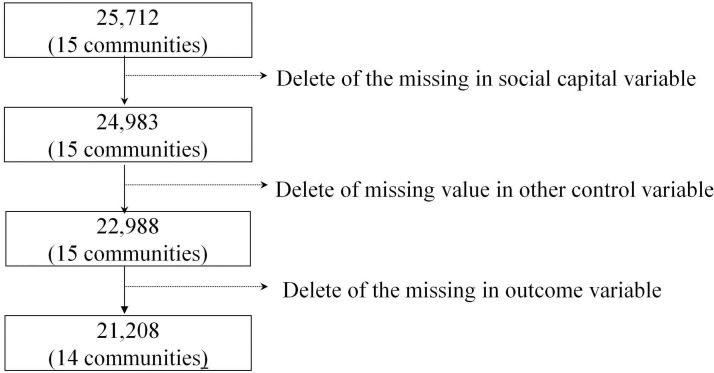
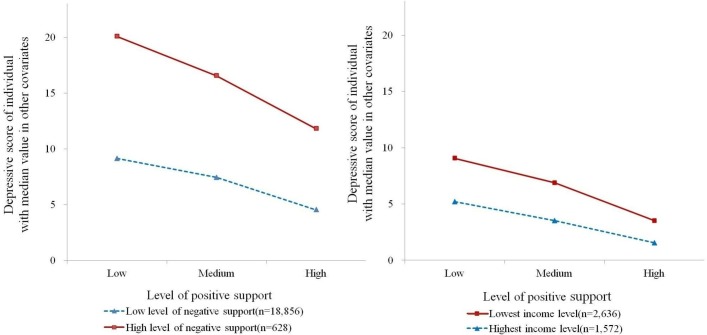
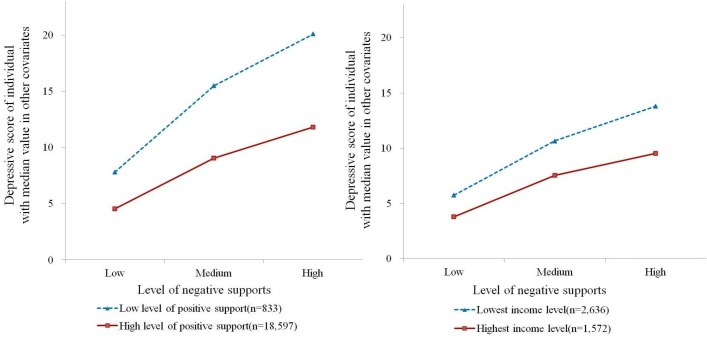
Objectives: The interaction between positive and negative social support as well as each domain of social support and income on depressive symptom has not been much explored. We aimed to examine the associations of positive and negative social support with the risk of depressive symptoms among urban-dwelling adults in Korea, focusing on those interaction effects. Design: We used the first wave of a large-scale cohort study called The Health Examinees-Gem Study. Positive and negative support scores ranged between 0 and 6; the variables were then categorised into low, medium, and high groups. A two-level random intercept linear regression model was used, where the first level is individual and the second is the community. We further tested for interactions between each domain of social supports and household income. Setting: A survey conducted at 38 health examination centres and training hospitals in major Korean cities and metropolitan areas during 2009–2010. Participants: 21 208 adult men and women aged between 40 and 69 in Korea (mean age: 52.6, SD: 8.0). Outcome measures: Depressive symptoms score measured by Epidemiologic Studies-Depression Scale, with scores ranging from 0 to 60. Results: Level of positive and negative social support showed a negative and positive association with depressive symptom score with statistical significance at p<0.05, respectively. When the interaction terms among household income and social supports were examined, a negative association between level of positive social support and depressive symptom score was more pronounced as income was lower and level of negative social support was higher. Similarly, positive association between level of negative social support and depressive symptom score was more pronounced as income was lower and level of positive social support was lower. Conclusions: Our findings suggest that strategies for encouraging positive social support and discouraging negative social support for disadvantaged individuals might be effective in reducing depression in Korea.
Overview
The claims and statistics of this paper haven’t been checked yet.
Free: it reads the open-access text and checks the first 5 claims that cite a source we can check. Create a free account to check every claim.
Integrity signals
Registry
Cites
Statistics
Figures
Verification
Claims the paper makes
The claims and statistics of this paper haven’t been checked yet.
Free: it reads the open-access text and checks the first 5 claims that cite a source we can check. Create a free account to check every claim.
Self-check
Percentages, sums and reported differences re-computed from the paper’s own numbers.
The self-check needs the paper’s full text.
Citations
Cites
The CES-D Scale: A Self-Report Depression Scale for Research in the General Population
Radloff, L. S. (1977) · Applied Psychological Measurement · doi:10.1177/014662167700100306 · Cited by 53,267
Stress, social support, and the buffering hypothesis
Cohen, S., & Wills, T. A. (1985) · Psychological Bulletin · doi:10.1037/0033-2909.98.2.310 · Cited by 18,093 · cited 2×
“IntrODuCtIOn Depression has been proven to be associated with adverse health outcomes including increased susceptibility to disease through multiple mechanisms, such as disrupted immune functioning and altered health-related behavioural patterns (eg, excessive alcohol use, smoking, poor diet).(4) 5 In addition, depres…”
BackgroundPickett, K. E., & Pearl, M. (2001) · Journal of Epidemiology and Community Health · doi:10.1136/jech.55.2.111 · Cited by 2,187
Andrade, L., Caraveo‐anduaga, J. J., Berglund, P., Bijl, R. V., Graaf, R. D., Vollebergh, W., Dragomirecka, E., Kohn, R., Keller, M., Kessler, R. C., et al. (2003) · International Journal of Methods in Psychiatric Research · doi:10.1002/mpr.138 · Cited by 1,068
Promoting Health: Intervention Strategies From Social and Behavioral Research: (720012007-001)
(2000) · PsycEXTRA Dataset · doi:10.1037/e720012007-001 · Cited by 791
Reliability of the CES-D scale in different ethnic contexts
Roberts, R. E. (1980) · Psychiatry Research · doi:10.1016/0165-1781(80)90069-4 · Cited by 744 · cited 1×
“Conversely, negative supports such as perception of arguing, being criticised, feelings of undue demand or too much intervention may serve as an additional source of stress for poor people who are already psychologically vulnerable due to financial stress.(40) While people with a high level of positive support have th…”
Stice, E., Ragan, J., & Randall, P. (2004) · Journal of Abnormal Psychology · doi:10.1037/0021-843x.113.1.155 · Cited by 736
Brown kids in white suburbs: Housing mobility and the many faces of social capital
de Souza Briggs, X. (1998) · Housing Policy Debate · doi:10.1080/10511482.1998.9521290 · Cited by 708
Depression and socio-economic risk factors: 7-year longitudinal population study
Lorant, V., Croux, C., Weich, S., Deliège, D., Mackenbach, J., & Ansseau, M. (2007) · British Journal of Psychiatry · doi:10.1192/bjp.bp.105.020040 · Cited by 496
Victimization of lesbian, gay, and bisexual youth in community settings
Pilkington, N. W., & D'Augelli, A. R. (1995) · Journal of Community Psychology · doi:10.1002/1520-6629(199501)23:1<34::aid-jcop2290230105>3.0.co;2-n · Cited by 479
Cited by
Zhong, Y., Wang, J., & Nicholas, S. (2020) · BMC Geriatrics · doi:10.1186/s12877-019-1403-9 · Cited by 145
Alsarrani, A., Hunter, R. F., Dunne, L., & Garcia, L. (2022) · BMC Public Health · doi:10.1186/s12889-022-14776-4 · Cited by 124
Harrigan, N., Labianca, G., & Agneessens, F. (2019) · Social Networks · doi:10.1016/j.socnet.2019.09.004 · Cited by 79
Alquwez, N., & Alshahrani, A. (2020) · Journal of Religion and Health · doi:10.1007/s10943-020-01081-w · Cited by 42
“support exists, which can bring negative experiences and lead to poor mental health and anxiety (Lee et al. 2019).”
BackgroundChu, W., Tange, C., Nishita, Y., Tomida, M., Shimokata, H., Otsuka, R., Lee, M., & Arai, H. (2023) · Archives of Gerontology and Geriatrics · doi:10.1016/j.archger.2023.104928 · Cited by 36
Classification of Deprivation Indices That Applied to Detect Health Inequality: A Scoping Review
Zelenina, A., Shalnova, S., Maksimov, S., & Drapkina, O. (2022) · International Journal of Environmental Research and Public Health · doi:10.3390/ijerph191610063 · Cited by 23
“An enormous number of studies were conducted around the world to establish the relationship between deprivation and health outcomes for a population, using separate indicators of deprivation, such as income [4,5], education [6–8], occupation [9–12], public security [13] and social support [14].”
BackgroundPowell, V. E., Riglin, L., Ng‐Knight, T., Frederickson, N. L., Woolf, K., McManus, I. C., Collishaw, S., Shelton, K. H., Thapar, A., & Rice, F. J. (2021) · Research on Child and Adolescent Psychopathology · doi:10.1007/s10802-021-00798-w · Cited by 26
“Those with ADHD are more likely to experience adversity in various areas of life (Harpin, 2005) and good social support can mitigate against depressive outcomes in those who experience adversity (Collishaw et al., 2016; Lee et al., 2019).”
BackgroundJu, Y. J., Kim, W., & Lee, S. Y. (2022) · International Journal of Social Psychiatry · doi:10.1177/00207640211066737 · Cited by 24
“Similar trends were also found in the Korean population, in which social support was correlated with depressive symptoms scores in adults (Lee et al., 2019).”
BackgroundResultJitaru, M., & Turliuc, M. N. (2022) · International Journal of Environmental Research and Public Health · doi:10.3390/ijerph191710506 · Cited by 19
“When it is too much, it can feel overwhelming, become a social strain [71,72], and influence the emotional state in a negative manner [73], which in turn could negatively affect couple satisfaction [74,75].”
BackgroundLiu, M., Li, L., Xiao, Y., Wang, X., Ye, B., Wang, X., & Geng, F. (2023) · Journal of Affective Disorders · doi:10.1016/j.jad.2023.01.092 · Cited by 15
Peng, J., Qi, H., Fan, Z., Zhou, Q., & Lin, Y. (2024) · BMC Public Health · doi:10.1186/s12889-024-20272-8 · Cited by 15
Yang, F., Fu, M., Qi-tu, H., & Guo, J. (2023) · Frontiers in Psychiatry · doi:10.3389/fpsyt.2023.1081209 · Cited by 13
Income and social support related with mental health during COVID-19 outbreak in China
Huang, C., Feng, Q., Zhang, B., Ren, H., Liu, Z., Kang, Y., & Zhang, F. (2022) · Medicine · doi:10.1097/md.0000000000029022 · Cited by 13
Abdi, S., Faramarzi, M., Bouzari, Z., Chehrazi, M., & Esfandiari, M. (2022) · Journal of the Egyptian Public Health Association · doi:10.1186/s42506-022-00113-5 · Cited by 11
“However, evidence has revealed a number of disadvantages related to social support [2].”
BackgroundInfluentialAboJabel, H., & Werner, P. (2022) · Dementia · doi:10.1177/14713012211053967 · Cited by 9
“Indeed, social support can be associated with negative outcomes and experiences, especially if such support makes a person feel uncomfortable, or does not align with their needs (Lee et al., 2019).”
BackgroundAbudiab, S., & Fuller‐Thomson, E. (2022) · International Journal of Environmental Research and Public Health · doi:10.3390/ijerph192316337 · Cited by 7
“The presence of social support, via a marriage partner or a close friendship/kinship, is associated with positive physical health outcomes in a wide range of chronic physical health conditions [34,35], as well as a lower prevalence of mental illness, such as depression [36].”
BackgroundSocial support as a protective factor against depressive symptoms: A review
Jain, A. M., & Jha, M. (2022) · doi:10.52228/jrua.2022-28-1-11 · Cited by 10
Dong, X., Bergren, S. M., Wang, B., & Kozlov, E. (2019) · Aging & Mental Health · doi:10.1080/13607863.2019.1680953 · Cited by 6
Qin, Y., Zhou, L., Wang, S., Wang, L., Zhuang, L., & Zhou, M. (2026) · Patient Preference and Adherence · doi:10.2147/ppa.s584707 · Cited by 4
“36,37 Our measure captured global perceived support, which may not have been sensitive enough to detect the specific, disclosure-related changes in support perception hypothesized by the Disclosure Processes Model.”
Nho, J., Kim, H. Y., & Kim, E. J. (2022) · Worldviews on Evidence-Based Nursing · doi:10.1111/wvn.12564 · Cited by 3
A longitudinal study over 9 years of the role of social support for people with epilepsy
Walker, C. F., & Peterson, C. L. (2024) · Exploration of Targeted Anti-tumor Therapy · doi:10.37349/en.2024.00054 · Cited by 3
Romance Fraud: Its Repercussions on Victims’ Wellbeing
Gauci, C., & Vella, M. G. (2025) · Women & Criminal Justice · doi:10.1080/08974454.2025.2600304 · Cited by 2
Shah, R. V., & Blais, R. K. (2024) · Military Medicine · doi:10.1093/milmed/usae507 · Cited by 2
Walker, C. F., & Peterson, C. L. (2022) · International Journal of Epilepsy · doi:10.1055/s-0043-1764396 · Cited by 2
Kimura, M., & Yamazaki, Y. (2023) · Asia Pacific Journal of Public Health · doi:10.1177/10105395231186008 · Cited by 1
“444 Asia Pacific Journal of Public Health 35(6-7)”
BackgroundInfluentialChina: Confucian Harmony and Dissonance
Fogel, B. S., & Jiang, X. (2025) · Oxford University Press eBooks · doi:10.1093/med/9780190850074.003.0010 · Cited by 1
Depression and Suicide in the “World’s Happiest Countries”
Fogel, B. S., & Jiang, X. (2025) · Oxford University Press eBooks · doi:10.1093/med/9780190850074.003.0013 · Cited by 1
Christmas cards: are senders full of joy and good cheer?
Gallagher, S. M., Howard, S., McMahon, J., & Palmieri, C. (2022) · Cogent Psychology · doi:10.1080/23311908.2022.2151727
“While we did not assess social networks in this study, research does confirm that those who are depressed report less social support compared to those not depressed (Gariépy et al., 2016; Kupferberg et al., 2016; Lee et al., 2019).”
ResultList of Abbreviations and Acronyms
Fogel, B. S., & Jiang, X. (2025) · Oxford University Press eBooks · doi:10.1093/med/9780190850074.002.0009
Dimensions and Implications of Cultural Identity
Fogel, B. S., & Jiang, X. (2025) · Oxford University Press eBooks · doi:10.1093/med/9780190850074.003.0004
Seeing Depression Through A Cultural Lens
Fogel, B. S., & Jiang, X. (2025) · doi:10.1093/med/9780190850074.001.0001
Fogel, B. S., & Jiang, X. (2025) · Oxford University Press eBooks · doi:10.1093/med/9780190850074.002.0006
Fogel, B. S., & Jiang, X. (2025) · Oxford University Press eBooks · doi:10.1093/med/9780190850074.003.0002
Fogel, B. S., & Jiang, X. (2025) · Oxford University Press eBooks · doi:10.1093/med/9780190850074.003.0006
Ancient Wisdom Meets Modern Science: Depression in Traditional Medicine
Fogel, B. S., & Jiang, X. (2025) · Oxford University Press eBooks · doi:10.1093/med/9780190850074.003.0009
South Korea: Han and Passionate Intensity
Fogel, B. S., & Jiang, X. (2025) · Oxford University Press eBooks · doi:10.1093/med/9780190850074.003.0012
Picturing Depression: Faces, Backgrounds, and Foregrounds
Fogel, B. S., & Jiang, X. (2025) · Oxford University Press eBooks · doi:10.1093/med/9780190850074.003.0001
Fogel, B. S., & Jiang, X. (2025) · Oxford University Press eBooks · doi:10.1093/med/9780190850074.002.0003
Cultural Identity and Personal Biography
Fogel, B. S., & Jiang, X. (2025) · Oxford University Press eBooks · doi:10.1093/med/9780190850074.003.0005
Fogel, B. S., & Jiang, X. (2025) · Oxford University Press eBooks · doi:10.1093/med/9780190850074.003.0018
Cultural Correlates and Clinical Consequences
Fogel, B. S., & Jiang, X. (2025) · Oxford University Press eBooks · doi:10.1093/med/9780190850074.003.0008
Depression and Social Class: A Four-Dimensional View
Fogel, B. S., & Jiang, X. (2025) · Oxford University Press eBooks · doi:10.1093/med/9780190850074.003.0007
Japan: Invisible Double-Edged Swords
Fogel, B. S., & Jiang, X. (2025) · Oxford University Press eBooks · doi:10.1093/med/9780190850074.003.0011
Beyond Shades of Gray: Depression and the Bipolar Spectrum
Fogel, B. S., & Jiang, X. (2025) · Oxford University Press eBooks · doi:10.1093/med/9780190850074.003.0003
Fogel, B. S., & Jiang, X. (2025) · Oxford University Press eBooks · doi:10.1093/med/9780190850074.002.0007
Flying High, Feeling Low: Depression in Airline Pilots
Fogel, B. S., & Jiang, X. (2025) · Oxford University Press eBooks · doi:10.1093/med/9780190850074.003.0017
American Regional Cultures and Geography of Mood
Fogel, B. S., & Jiang, X. (2025) · Oxford University Press eBooks · doi:10.1093/med/9780190850074.003.0014
Fogel, B. S., & Jiang, X. (2025) · Oxford University Press eBooks · doi:10.1093/med/9780190850074.002.0004
The Dark Side of Creative Talent
Fogel, B. S., & Jiang, X. (2025) · Oxford University Press eBooks · doi:10.1093/med/9780190850074.003.0015
Physicians in Pain: Depression in the Medical Profession
Fogel, B. S., & Jiang, X. (2025) · Oxford University Press eBooks · doi:10.1093/med/9780190850074.003.0016
Strayhorn, S. M., Harmon, B. E., Pichon, L. C., & Martin, M. Y. (2025) · International Journal of Environmental Research and Public Health · doi:10.3390/ijerph22111660
“Negative social support has also been associated with impacting specific mental well-being factors such as depression among Korean adults [47] and Chinese female cancer survivors [48].”
Engaging in and responding to daily positive events : roles of personality and age
Klaiber, P. (2023) · cIRcle (University of British Columbia) · doi:10.14288/1.0430334
Ramachandran, A. (2023) · City Research Online (City University London) · Cited by 2
Maternal stress, social support, coping and depression among B40 wives of drug addicts in Malaysia
Shahril, N. S. S. A. (2024) · Universiti Putra Malaysia Institutional Repository (Universiti Putra Malaysia)
Metadata
- Authors
- Lee, H.-Y., Oh, J., Kawachi, I., Heo, J., Kim, S., Lee, J.-K., & Kang, D.
- Affiliations
- Harvard University (US)
- Seoul National University (KR)
- Corresponding author
- Oh, Juhwan
- Venue
- BMJ Open
- Publisher
- BMJ
- Published
- 2019-04
- Volume
- 9
- Issue
- 4
- Pages
- e023036
- ISSN
- 2044-6055 (ISSN-L)
- PMC
- PMC6500322
- OpenAlex
- W2938288176
- Cited by
- 51
- References
- 55
- Citations by year
- 2026: 1 · 2025: 26 · 2024: 3 · 2023: 4 · 2022: 12 · 2021: 1 · 2020: 2 · 2019: 2
- FWCI
- 4.14
- Type
- journal article
- Language
- en
- Open access
- gold
- doi.org
- Licence
- cc-by-nc
- Locations
- BMJ Open (publishedVersion, cc-by-nc)
- Europe PMC (PubMed Central) (publishedVersion, cc-by-nc)
- PubMed Central (publishedVersion, cc-by-nc)
- PubMed (publishedVersion)
- HighWire Press Open Archive (submittedVersion)
- Funders
- Korea Centers for Disease Control and Prevention
- Topics
- Social Sciences › Health › Health disparities and outcomes
- Social Sciences › Psychology › Clinical Psychology › Health and Well-being Studies
- Health Sciences › Medicine › Psychiatry and Mental health › Mental Health Treatment and Access
- Keywords
- depressive symptoms, household income, socioeconomic status, depression prevention, middle-aged and older adults, Korean adults
- MeSH terms
- Adult, Aged, Cross-Sectional Studies, Depression, Female, Health Surveys, Humans, Income, Male, Middle Aged, Risk Factors, Social Class, Social Support, Cohort Studies, Logistic Models, Republic of Korea
About these checks
Registry, retraction, Cites and statistics results are computed, not judged, with one exception: a printed reference that no index lists is read once by a model before it counts as a citation error. Claims are extracted by a model and kept only when their quote appears verbatim in the text; each cited source is then checked, with a model’s help, for whether it says what the claim relies on. Those verdicts can be wrong — read the claim’s quote and the cited source before relying on one.
Statistics and arithmetic are recomputed, not judged.
Confidence bands are shown only for fields calibrated on our annotated test set. None is calibrated yet, so no band is shown.
What counts as a claim ›How we measure confidence ›How we check this ›
Are you an author, or do you see a problem with this page? Request a review
Data sources
Bibliographic data: Semantic Scholar, OpenAlex, Crossref.
Contains information from the Semantic Scholar Academic Graph Datasets, made available under the ODC Attribution License (ODC-BY 1.0).
Semantic Scholar’s data is described in: Kinney, R., et al. (2023). The Semantic Scholar Open Data Platform. arXiv:2301.10140.
