

The DOI matches its Crossref record; 31 of the 31 references it cites were found in a registry or an index.
Digital and online symptom checkers and health assessment/triage services for urgent health problems: systematic review
Open accessAbstract
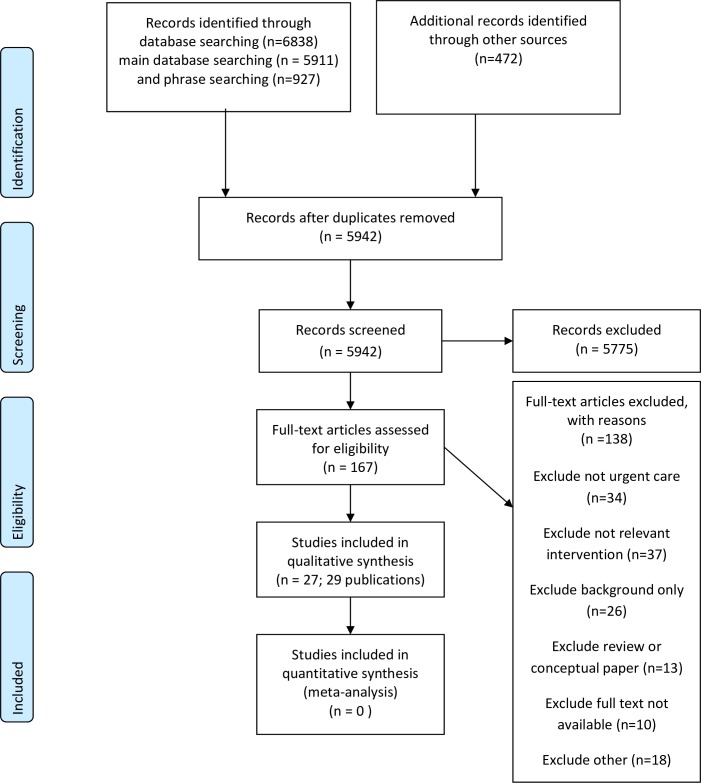
Objectives: In England, the NHS111 service provides assessment and triage by telephone for urgent health problems. A digital version of this service has recently been introduced. We aimed to systematically review the evidence on digital and online symptom checkers and similar services. Design: Systematic review. Data sources: We searched Medline, Embase, the Cochrane Library, Cumulative Index to Nursing and Allied Health Literature (CINAHL), Health Management Information Consortium, Web of Science and ACM Digital Library up to April 2018, supplemented by phrase searches for known symptom checkers and citation searching of key studies. Eligibility criteria: Studies of any design that evaluated a digital or online symptom checker or health assessment service for people seeking advice about an urgent health problem. Data extraction and synthesis: Data extraction and quality assessment (using the Cochrane Collaboration version of QUADAS for diagnostic accuracy studies and the National Heart, Lung and Blood Institute tool for observational studies) were done by one reviewer with a sample checked for accuracy and consistency. We performed a narrative synthesis of the included studies structured around pre-defined research questions and key outcomes. Results: We included 29 publications (27 studies). Evidence on patient safety was weak. Diagnostic accuracy varied between different systems but was generally low. Algorithm-based triage tended to be more risk averse than that of health professionals. There was very limited evidence on patients’ compliance with online triage advice. Study participants generally expressed high levels of satisfaction, although in mainly uncontrolled studies. Younger and more highly educated people were more likely to use these services. Conclusions: The English ‘digital 111’ service has been implemented against a background of uncertainty around the likely impact on important outcomes. The health system may need to respond to short-term changes and/or shifts in demand. The popularity of online and digital services with younger and more educated people has implications for health equity. PROSPERO registration number: CRD42018093564.
Overview
The claims and statistics of this paper haven’t been checked yet.
Run the check — free, no account needed. It reads the open-access text and checks the sources it cites.
Integrity signals
Registry
Cites
Statistics
Figures
Verification
Claims the paper makes
The claims and statistics of this paper haven’t been checked yet.
Run the check — free, no account needed. It reads the open-access text and checks the sources it cites.
Claims other papers make about this one
Each is checked against this paper’s own text: does it say what the citing paper says it does?
The cited source says what the claim attributes to it.
In the citing paper
“Research indicates that, although symptom checkers seem to be easy to use and well-accepted by most users [30,31], the diagnostic performance varies significantly between different symptom checkers and has been interpreted as low to moderate at best [32,33].”
From Diagnostic Performance of an App-Based Symptom Checker in Mental Disorders: Comparative Study in Psychotherapy Outpatients (2022) · cites this paper as [32]
The cited source says what the claim attributes to it.
In the citing paper
“We considered some major limitations of previous studies [32] given that we collected real-world patient data, which comes closer to the current intended laypeople-oriented application of symptom checkers.”
From Diagnostic Performance of an App-Based Symptom Checker in Mental Disorders: Comparative Study in Psychotherapy Outpatients (2022) · cites this paper as [32]
Self-check
Percentages, sums and reported differences re-computed from the paper’s own numbers.
The self-check needs the paper’s full text.
Citations
Cites
Hoffmann, T. C., Glasziou, P. P., Boutron, I., Milne, R., Perera, R., Moher, D., Altman, D. G., Barbour, V., Macdonald, H., Johnston, M., et al. (2014) · BMJ · doi:10.1136/bmj.g1687 · Cited by 10,548
The effects of integrated care: a systematic review of UK and international evidence
Baxter, S. K., Johnson, M., Chambers, D., Sutton, A., Goyder, E., & Booth, A. (2018) · BMC Health Services Research · doi:10.1186/s12913-018-3161-3 · Cited by 745 · cited 2×
“Overall strength of the evidence base for key outcomes was assessed using an adaptation of the method described by Baxter et al.(11) This involves classifying evidence as ‘stronger’, ‘weaker’, ‘conflicting’ or ‘insufficient’ based on study numbers and design.”
MethodSelf-citationEvaluation of symptom checkers for self diagnosis and triage: audit study
Semigran, H. L., Linder, J. A., Gidengil, C., & Mehrotra, A. (2015) · BMJ · doi:10.1136/bmj.h3480 · Cited by 489 · cited 5×
“Studies either evaluated a single system or multiple systems.(6) 21 We found only one study of a symptom checker specifically intended for the assessment of children’s symptoms, a development of the Strategy for Off-Site Rapid Triage system for influenza-like illness.”
BackgroundInfluentialElectronic healthcare: a study of people's readiness and attitude toward performing self‐diagnosis
Lanseng, E. J., & Andreassen, T. W. (2007) · International Journal of Service Industry Management · doi:10.1108/09564230710778155 · Cited by 177
Comparison of Physician and Computer Diagnostic Accuracy
Semigran, H. L., Levine, D. M., Nundy, S., & Mehrotra, A. (2016) · JAMA Internal Medicine · doi:10.1001/jamainternmed.2016.6001 · Cited by 145 · cited 3×
“In addition, the students’ complaints were generally common and uncomplicated, a scenario in which symptom checkers performed relatively well in the study by Semigran et al.(21)”
BackgroundResultInfluentialImpact of the urgent care telephone service NHS 111 pilot sites: a controlled before and after study
Turner, J., O’Cathain, A., Knowles, E., & Nicholl, J. P. (2013) · BMJ Open · doi:10.1136/bmjopen-2013-003451 · Cited by 114 · cited 1×
“For example, an evaluation of the NHS111 telephone service at four pilot sites and three control sites found that in its first year the service was not successful in reducing 999 emergency calls or in shifting patients from emergency to urgent care.(5) A recent study of 23 symptom checker algorithms providing diagnost…”
MethodSelf-citationCowie, J., Calveley, E., Bowers, G., & Bowers, J. (2018) · International Journal of Environmental Research and Public Health · doi:10.3390/ijerph15050896 · Cited by 89
Nijland, N., van Gemert-Pijnen, J. E. W. C., Boer, H., Steehouder, M. F., & Seydel, E. R. (2009) · International Journal of Medical Informatics · doi:10.1016/j.ijmedinf.2009.06.002 · Cited by 84 · cited 1×
“Patients with low to medium levels of education tended to be motivated toward indirect e-consultation (which involves contact with a health professional via email), mainly to reduce uncertainty.(27) Evidence from included studies suggests that users of e-consultation were more likely to be young,(7) 24–26 employed(20)…”
BackgroundSelf-triage for acute primary care via a smartphone application: Practical, safe and efficient?
Verzantvoort, N. C. M., Teunis, T., Verheij, T. J., & van der Velden, A. W. (2018) · PLoS ONE · doi:10.1371/journal.pone.0199284 · Cited by 77
Older Adult Experience of Online Diagnosis: Results From a Scenario-Based Think-Aloud Protocol
Luger, T. M., Houston, T. K., & Suls, J. M. (2014) · Journal of Medical Internet Research · doi:10.2196/jmir.2924 · Cited by 73
Research works printed but not linked: 2
- Reitsma JB , Rutjes AWS , Whiting P , et al ; Chapter 9: Assessing methodological quality. In: Deeks JJ , Bossuyt PM , Gatsonis C , eds. Cochrane Handbook for Systematic Reviews of Diagnostic Test Accuracy Version 100: The Cochrane Collaboration, 2009.
- Luger, 2011, Online health information and intentions to seek healthcare, Psychosomatic Medicine, 73
Cited by
Sorted by citations
Items 101–200 of 217
AI Triage in Primary Care: Building Safer and More Equitable Real-World Evidence
Alamoudi, A. K., Kontopantelis, E., Zghebi, S. S., & Brown, B. C. (2026) · Journal of Medical Internet Research · doi:10.2196/88396 · Cited by 6
“…this context, artificial intelligence (AI)–enabled triage combines structured questions, red-flag pathways, and machine learning (ML) risk stratification with electronic health record (EHR) integration and clinician oversight to route patients more efficiently and potentially improve safety [8-10].”
InfluentialUsing conversant artificial intelligence to improve diagnostic reasoning: ready for prime time?
Scott, I. A., Miller, T., & Crock, C. (2024) · The Medical Journal of Australia · doi:10.5694/mja2.52401 · Cited by 6
Reorganization of the Danish out-of-hours primary care – a descriptive study
Søvsø, M. B., Thomsen, J. L., Christensen, E. F., Iversen, K. K., Folke, F., Mogensen, C. B., Lassen, A. T., Søndergaard, J., Christensen, H. C., Elkjær, M., et al. (2025) · Scandinavian Journal of Primary Health Care · doi:10.1080/02813432.2025.2490915 · Cited by 6
“…and several initiatives have been taken internationally to sustain acute unplanned primary care, such as additional services and digital tools [5–7]. the reasons for reorganizing out-of-hours (OOh) care are not unique to Denmark; all neighboring countries struggle with high demand, lack of…”
The Utility of a Pediatric COVID-19 Online Forward Triage Tool in Switzerland
Michel, J., Mettler, A. C., Starvaggi, C. A., Travaglini, N., Aebi, C., Keitel, K., & Sauter, T. C. (2022) · Frontiers in Public Health · doi:10.3389/fpubh.2022.902072 · Cited by 6
Lowe, C., Browne, M., Marsh, W., & Morrissey, D. (2022) · Journal of Medical Internet Research · doi:10.2196/38352 · Cited by 6
“The implications of creating false positives are often underestimated, with most symptom checker development taking a conservative approach, resulting in systems typically being more risk averse than health care practitioners [59-61].”
A Utility Framework for COVID-19 Online Forward Triage Tools: A Swiss Telehealth Case Study
Michel, J., Mettler, A. C., Müller, M., Hautz, W. E., & Sauter, T. C. (2022) · International Journal of Environmental Research and Public Health · doi:10.3390/ijerph19095184 · Cited by 6
“When compared to health care professionals, OFTTs have been shown to be risk-averse [11].”
BackgroundResultNorth, F., Jensen, T. B., Pecina, J. L., Miller, N. E., Duvall, M. J., Nelson, E. M., Thompson, M. C., Johnson, B. J., Crum, B. A., & Stroebel, R. J. (2023) · Health Services Research and Managerial Epidemiology · doi:10.1177/23333928231186209 · Cited by 6
Syndromic detectability of haemorrhagic fever outbreaksPreprint
Glennon, E. E., Jephcott, F. L., Oti, A., Carlson, C. J., Carrillo, F. A. B., Hranac, C. R., Parker, E., Wood, J. L. N., & Restif, O. (2020) · medRxiv · doi:10.1101/2020.03.28.20019463 · Cited by 6
Will online symptom checkers improve health care in Australia?
Dunn, A. G. (2020) · The Medical Journal of Australia · doi:10.5694/mja2.50621 · Cited by 6
Koch, R., Steffen, M.-T., Wetzel, A.-J., Preiser, C., Klemmt, M., Ehni, H., Mueller, R., & Joos, S. (2025) · JMIR Formative Research · doi:10.2196/60647 · Cited by 5
“…in navigating health information play critical roles in shaping user experiences and engagement with symptom checker apps [3-7 There is limited and partly conflicting evidence to conclude whether symptom checker app use directly prompts HRB, such as seeking professional health care [3,9,13,16,17].”
InfluentialInformationstechnologie und E-Health zur Verbesserung der Patientensicherheit
Müller, T. (2020) · Der Internist · doi:10.1007/s00108-020-00780-6 · Cited by 7
Chambers, D., Cantrell, A. J., Baxter, S. K., Turner, J., & Booth, A. (2020) · Health Services and Delivery Research · doi:10.3310/hsdr08310 · Cited by 5
“comprised four broad facets: (1) emergency care, (2) rural or island services, (3) service reconfiguration”
BackgroundSelf-citation[Retracted] Telehealth for COVID‐19: A Conceptual Framework
Yousaf, W., Umar, A. I., Shirazi, S. H., Fayaz, M., Assam, M., Khan, J. A., Rasheed, A., & Mehmood, G. (2023) · Journal of Healthcare Engineering · doi:10.1155/2023/3679829 · Cited by 6
RetractedCan clinical decision support systems be an asset in medical education? An experimental approach
Kafke, S. D., Kuhlmey, A., Schuster, J., Blüher, S., Czimmeck, C., Zoellick, J. C., & Grosse, P. (2023) · BMC Medical Education · doi:10.1186/s12909-023-04568-8 · Cited by 7
“One such example for technological assistance would be digitised clinical decision support systems (CDSSs) which are now extensively used by clinicians [10] and patients [11] alike.”
BackgroundEuropean regulation of digital respiratory healthcare
Gilbert, S. (2023) · European Respiratory Society eBooks · doi:10.1183/2312508x.10000923 · Cited by 5
Artificial Intelligence Driving Change in Healthcare through Medical Innovation
Gupta, P., & Yadav, A. (2024) · IEEE International Conference on Computing, Power and Communication Technologies (IC2PCT) · doi:10.1109/ic2pct60090.2024.10486544 · Cited by 4
“[ 27][32] AI is being used by the healthcare sector to diagnose patients more quickly and accurately than humans.”
BackgroundMethodLowe, C., Sephton, R., Marsh, W., & Morrissey, D. (2024) · JMIR Formative Research · doi:10.2196/56715 · Cited by 4
Delaunay, J., & Cusidó, J. (2024) · Applied Sciences · doi:10.3390/app15010061 · Cited by 6
Lowe, C., Atherton, L., Lloyd, P. A., Waters, A., & Morrissey, D. (2025) · Journal of Medical Internet Research · doi:10.2196/67269 · Cited by 4
“Between 2019 and 2023 alone there have been 6 literature or scoping reviews evaluating published studies of their performance [26,46-50], with the same conclusions being drawn that there remains no confirmation of their assumed potential benefits.”
E-participation in policy-making for health: a scoping review protocol
Esmailzadeh, H., Mafimoradi, S., Gholami, M., Mansourzadeh, M. J., & Rajabi, F. (2024) · BMJ Open · doi:10.1136/bmjopen-2023-080538 · Cited by 5
The Role of Language in Remote Healthcare Triage: A Meta‐Aggregative Review
Spek, M., van Braak, M., Erkelens, D. C. A., Rutten, F. H., Venekamp, R. P., Zwart, D. L. M., & GROOT, E. D. (2024) · Journal of Advanced Nursing · doi:10.1111/jan.16528 · Cited by 4
Truong, L. K., Wrightson, J. G., Vincent, R., Lui, E., Couch, J. L., Wang, E., Starcevich, C., Giustini, D., Haagaard, A., Lopatina, E., et al. (2025) · Journal of Medical Internet Research · doi:10.2196/81578 · Cited by 4
“There is an increasing trend toward the use of digital triage, such as online symptom checkers by patients, to make an informed decision on the next and best course of action for their current problem [6-8].”
Christiansen, I. B. J., Zoch-Lesniak, B., Lindberg, B. H., Björkman, A., Ramerman, L., Payne, R. E., Herrmann, T., Homar, V., & Huibers, L. (2026) · Scandinavian Journal of Primary Health Care · doi:10.1080/02813432.2025.2600632 · Cited by 3
“…to avoid patient safety incidents. some countries introduced symptom checkers for self-advice, but the accuracy of such products vary significantly [39,40]. furthermore, artificial intelligence-based solutions able to synthesize multiple symptoms are being introduced in some healthcare systems…”
Jonsson, M., Gustavsson, C., Pettersson, L., Gulliksen, J., & Johansson, S. (2025) · Interacting with Computers · doi:10.1093/iwc/iwaf034 · Cited by 3
“There is also previous research regarding accuracy in digital and online symptom checkers (Chambers et al., 2019; Wallace et al., 2022).”
InfluentialMichel, J., Hautz, W. E., & Sauter, T. C. (2020) · Journal of the International Society for Telemedicine and eHealth · doi:10.29086/jisfteh.8.e9 · Cited by 3
Lowe, C., Sing, H. H., Marsh, W., & Morrissey, D. (2021) · JMIR Research Protocols · doi:10.2196/31541 · Cited by 3
“Studies regarding the effectiveness of generic symptom checkers have shown variable levels of system validity [23,24,29,40], and it cannot be assumed that these research findings translate to an mHealth system with a well-defined scope, such as DART with MSDs.”
BackgroundResultMillen, E., Salim, N., Azadzoy, H., Bane, M., O’Donnell, L., Schmude, M., Bode, P., Türk, E., Vaidya, R., & Gilbert, S. (2022) · BMJ Open · doi:10.1136/bmjopen-2021-055915 · Cited by 4
Shah, A. B., Oyegun, E., Hampton, W. B., Neri, A., Maddox, N., Raso, D., Sandhu, P. K., Patel, A., Koonin, L. M., Lee, L., et al. (2023) · Journal of Medical Internet Research · doi:10.2196/39054 · Cited by 3
“Evaluations of similar triage tools that compare tool-provided recommendations to caregiver assessments have found that automated symptom-checking tools tend to advise patients to seek higher levels of care than necessary [5,11,12].”
Harada, Y., Tomiyama, S., Sakamoto, T., Sugimoto, S., Kawamura, R., Yokose, M., Hayashi, A., & Shimizu, T. (2023) · JMIR Formative Research · doi:10.2196/49034 · Cited by 3
Muellers, K., Andreadis, K., Mkuu, R. S., Lin, J. J., Horowitz, C. R., Kaushal, R., & Ancker, J. S. (2024) · Health Policy and Technology · doi:10.1016/j.hlpt.2024.100839 · Cited by 3
Recommendation endpoints and safety of an online self-triage for depression symptoms
Miller, N. E., North, F., Curry, E. N., Thompson, M. C., & Pecina, J. L. (2024) · Journal of Telemedicine and Telecare · doi:10.1177/1357633x241245161 · Cited by 3
“10,11 Hennemann et al. used a symptom checker to look at accuracy of diagnosis for mental health disorders, 14 which may show some promise in aiding clinical diagnoses, but their study did not triage patients.”
What is the optimal length of an Online Forward Triage Tool? The need for a framework
Michel, J., Mettler, A. C., Hautz, W. E., & Sauter, T. C. (2020) · Journal of Global Health · doi:10.7189/jogh.10.0203103 · Cited by 3
Patientensicherheit in der Dermatologie: Optionen zu ihrer Optimierung
Elsner, P. U. (2021) · Aktuelle Dermatologie · doi:10.1055/a-1385-3215 · Cited by 3
“[32] Chambers D, Cantrell AJ, Johnson M et al.”
BackgroundCreating Mobile Self-Triage Applications: Requirements and Usability Perspectives
Ziabari, M. K., Amyot, D., Michalowski, W. J., Bouattane, E. M., & Hafez, N. (2021) · IEEE International Requirements Engineering Conference Workshops (REW) · doi:10.1109/rew53955.2021.00048 · Cited by 3
Michel, J., Mettler, A. C., Stuber, R., Müller, M., Ricklin, M. E., Jent, P., Hautz, W. E., & Sauter, T. C. (2022) · BMJ Open · doi:10.1136/bmjopen-2021-059765 · Cited by 3
Ledger, J., & Bakhai, M. (2021) · Organizational behaviour in health care · doi:10.1007/978-3-030-82696-3_12 · Cited by 2
Valmianski, I., Frost, N., Sood, N., Wang, Y., Liu, B., Zhu, J., Karumuri, S., Finn, I. M., & Zisook, D. S. (2020) · arXiv (Cornell University) · doi:10.48550/arxiv.2010.09905 · Cited by 3
“In recent years, there has been a broad proliferation of online symptom checkers and medical triage solutions as many patients seek web-based medical guidance prior to engaging with their health care provider (White and Horvitz, 2009; Semigran et al., 2015; Chambers et al., 2019; Dunn, 2020).”
Ding, J., Freeman, M., & Hasija, S. (2021) · SSRN Electronic Journal · doi:10.2139/ssrn.3806478 · Cited by 3
Kopka, M., von Kalckreuth, N., & Feufel, M. A. (2024) · medRxiv · doi:10.1101/2024.09.13.24313657 · Cited by 3
Chen, J., Lin, C., Park, M., Nutor, J. J., de Lisser, R., Hoffmann, T. J., & Kim, H. J. (2023) · BMC Medical Informatics and Decision Making · doi:10.1186/s12911-023-02139-x · Cited by 2
Gehlen, T., Joost, T., Solbrig, P., Stahnke, K., Zahn, R., Jahn, M., Amini, D. A., & Back, D. A. (2025) · Diagnostics · doi:10.3390/diagnostics15020221 · Cited by 2
“The study showed that around 20–30% of recommendations resulted in over-triage, while under-triage occurred in 10–15% of cases [29].”
Pecina, J. L., Curry, E. N., Miller, N. E., Thompson, M. C., & North, F. (2025) · Health Services Insights · doi:10.1177/11786329251385022 · Cited by 2
“10,11 Online self-triage checkers can be used to triage patients with chest pain.”
Artificial intelligence in diagnostics and medical decision making
Levi, M. M. (2026) · European Journal of Internal Medicine · doi:10.1016/j.ejim.2026.107056 · Cited by 2
A study about current digital assistants for healthcare and medical treatment monitoring
Martins, P. M., Vilaça, J. L., & Dias, N. S. (2021) · SeGAH ... IEEE ... International Conference on Serious Games and Applications for Health/IEEE International Conference on Serious Games and Applications for Health · doi:10.1109/segah52098.2021.9551864 · Cited by 2
“Complete the Test First” Prescreening Tests at the Margins of Digital Public Administration
Tarkkala, H., Koulu, R., Snell, K., & Soininvaara, H. (2025) · Social Inclusion · doi:10.17645/si.9971 · Cited by 3
“Symptom checkers have been analysed for their medical accuracy and validity (Chambers et al., 2019; Wallace et al., 2022), the variability of different tests (Ziebart et al., 2023), as well as the development of such services (Trifuljesko & Ruckenstein, 2024).”
Liu, J. X. (2020) · Figshare · Cited by 2
Conversational Agents in Health Care
Darcy, A. M., Robinson, A. H., & Wicks, P. J. (2020) · JAMA · doi:10.1001/jama.2020.21509 · Cited by 2
Ho, A. (2023) · Oxford University Press eBooks · doi:10.1093/med/9780197556269.003.0005 · Cited by 1
Ülgü, M. M., & Birinci, Ş. (2023) · Ankara Medical Journal · doi:10.5505/amj.2023.47887 · Cited by 1
Xie, Y., Zhang, H., Li, W., Yan, H., & Duan, H. (2025) · BMC Health Services Research · doi:10.1186/s12913-025-12710-z · Cited by 2
“However, studies on the practical impacts of HAMs on access to healthcare in rural areas are sparse, especially quantitative evidence for large sample sizes [16, 17].”
InfoKids+: A Validation Study of a Pediatric Acuity Risk Stratification Algorithm
Starvaggi, C. A., Affentranger, S., Lengeler, N., Siebert, J. N., Galetto-Lacour, A., Tan, R., Jaboyedoff, M., Kuehni, C. E., Hartley, M., & Keitel, K. (2025) · Mayo Clinic Proceedings Digital Health · doi:10.1016/j.mcpdig.2025.100220 · Cited by 1
Evaluating the integration of a COVID-19 symptom checker into an asthma-focused mHealth application
Foer, D., Flores, J. S., Sousa, J. L., Dalal, A. K., Plombon, S., Bates, D. W., & Rudin, R. S. (2025) · Healthcare · doi:10.1016/j.hjdsi.2025.100774 · Cited by 1
Kopka, M., & Feufel, M. A. (2026) · JMIR Human Factors · doi:10.2196/76168 · Cited by 1
Omiecińska, M., Stepinska, M., Maciejewska, A., Kaczor, M., Trynkiewicz, W., Rybka, Z., Żak, J., Lenkiewicz, E., Dąbrowska, K., & Winiarczyk, J. (2026) · International Journal of Innovative Technologies in Social Science · doi:10.31435/ijitss.2(50).2026.5252 · Cited by 1
Han, Q., & Zhao, C. (2026) · Digital Health · doi:10.1177/20552076261456584 · Cited by 1
“5 In Semigran and colleagues’ BMJ audit of publicly available symptom checkers, correct diagnoses were frequently not ranked first and triage advice showed notable variability, with a tendency toward risk-averse recommendations.”
AI-Powered Symptom Assessment and User Experience: A Case Study of Simtomi and Simtomi-Care
Lee, J., Lee, C. H., Lee, H., Kim, S., Lee, B. H., Shin, M., Shin, H., & Park, J. (2026) · IEEE Conference on Artificial Intelligence (CAI) · doi:10.1109/cai68641.2026.11536388 · Cited by 1
Authentication status and AI triage concordance among care seekers in a US health system
Naved, B. A., Slott, Q. M., Malik, D. A., Hmaidi, M., & Luo, Y. (2026) · npj Health Systems · doi:10.1038/s44401-026-00140-w · Cited by 1
“For instance, one study reported that over two-thirds of users were female and that the average user was in their mid-30s, indicating a skew toward younger, female users 12,16 – 19 .”
Ho, A. (2023) · Oxford University Press eBooks · doi:10.1093/med/9780197556269.003.0001 · Cited by 1
Technology and Information Management Supporting Resilience in Healthcare and Rescue Systems
Väyrynen, H., Vainikainen, J., Paunu, A., Helander, N., & Tenhovuori, S. (2023) · Public administration and information technology · doi:10.1007/978-3-031-20939-0_3 · Cited by 1
Painter, A., Hayhoe, B. W. J., Sasco, E. R., & El-Osta, A. A. R. (2022) · doi:10.2196/preprints.42481 · Cited by 1
El-Osta, A. A. R., Sasco, E. R., Al-Ammouri, M., Altalib, S., Neves, A. L., Majeed, A., & Hayhoe, B. W. J. (2024) · doi:10.2196/preprints.65314 · Cited by 1
Peracca, S. B., Sturgeon, D. J., Lamkin, R. P., Zepeda, E. D., Mohr, D. C., Lachica, O., King, H. A., Jackson, G. L., Morris, I. J., Gifford, A. L., et al. (2025) · doi:10.2196/preprints.75354 · Cited by 1
Madda, P., & Kondru, J. (2025) · medRxiv · doi:10.1101/2025.08.21.25333628 · Cited by 1
Symptoms Extraction from a Voice Input using Natural Language Processing
Saligram, C., DeepaliB, K., GowriK, S., Kumar, J., & Munavalli, J. R. (2020) · International Journal of Engineering Research and · doi:10.17577/ijertv9is040645
“To help such people, symptom checkers that provide fast and good aid in improving the health are used [1].”
BackgroundPainter, A., Hayhoe, B. W. J., & El-Osta, A. A. R. (2022) · doi:10.2196/preprints.37408
Fraser, H., Cohan, G., Koehler, C., Anderson, J. S., Lawrence, A., Patena, J. V., Bacher, I., & Ranney, M. L. (2022) · doi:10.2196/preprints.38364
Vuillaume, L. A., Turpinier, J., Cipolat, L., Depil-Duval, A., Dumontier, T., Peschanski, N., Kieffer, Y., Barbat, B., Riquier, T., Dinot, V., et al. (2022) · Research Square · doi:10.21203/rs.3.rs-1580704/v1
Patient Experience and Feedback after Use of an EHR-integrated COVID-19 Symptom Checker (Preprint)Preprint
Liu, A. W., Odisho, A. Y., rd, W. B., Gonzales, R., Neinstein, A. B., & Judson, T. J. (2022) · doi:10.2196/preprints.40064
Greenhalgh, T., Shaw, S. E., Nishio, A. A., et al. (2022) · NIHR Open Research · doi:10.3310/nihropenres.14413.r28751
Sampietro-Colom, L., Fernández-Barceló, C., Abbas, I., Valdasquin, B., Rabasseda, N., García‐Lorenzo, B., Sánchez, M., Sans-Corrales, M., García, N., & Granados, A. (2022) · International Journal of Environmental Research and Public Health · doi:10.3390/ijerph192113873
“Though few similar online and smartphones DAs already exist [22], weak scientific evidence of their effectiveness is available [30].”
Background(2023) · Oxford University Press eBooks · doi:10.1093/med/9780197556269.002.0014
Artificial Autonomy or Relational Intelligence
Ho, A. (2023) · Oxford University Press eBooks · doi:10.1093/med/9780197556269.003.0002
Ho, A. (2023) · Oxford University Press eBooks · doi:10.1093/med/9780197556269.003.0004
(2023) · Oxford University Press eBooks · doi:10.1093/med/9780197556269.002.0003
(2023) · Oxford University Press eBooks · doi:10.1093/med/9780197556269.002.0005
(2023) · Oxford University Press eBooks · doi:10.1093/med/9780197556269.002.0007
From One-Way Mirror to Two-Way Street
Ho, A. (2023) · Oxford University Press eBooks · doi:10.1093/med/9780197556269.003.0006
Independent Living With(out) Privacy
Ho, A. (2023) · Oxford University Press eBooks · doi:10.1093/med/9780197556269.003.0003
Greenhalgh, T., Shaw, S. E., Nishio, A. A., et al. (2023) · NIHR Open Research · doi:10.3310/nihropenres.14413.r29094
Greenhalgh, T., Shaw, S. E., Nishio, A. A., et al. (2023) · NIHR Open Research · doi:10.3310/nihropenres.14413.r29093
Kim, M., Kang, M., Lee, D., Choi, H., Choi, D., Ko, M., & Han, J. (2023) · doi:10.2196/preprints.48614
Gkouskos, D., Lindberg, S., & Weberg, O. (2023) · The International Journal of Design in Society · doi:10.18848/2325-1328/cgp/v17i02/17-42
Raman, S., Bacher, I., & Fraser, H. (2023) · Research Square · doi:10.21203/rs.3.rs-3571463/v1
Kobashi, Y., Oguni, M., Nakamura, N., Tsubokura, M., & Ito, S. (2024) · Frontiers in Communication · doi:10.3389/fcomm.2024.1292792
Marinelli, P., Saragiotto, B. T., Oliveira, R. F. F., Almeida, L., Fagundes, F. R. C., & Hespanhol, L. (2024) · Health and Technology · doi:10.1007/s12553-024-00887-y
“The present findings corroborate a previous system - atic review, which showed that patients who used online technology solutions reported high levels of satisfaction [ 19 ].”
Evolution of Generative AI in Healthcare
Thakur, N. (2024) · Advances in medical technologies and clinical practice book series · doi:10.4018/979-8-3693-3731-8.ch002
Clinical Decision Support Systems (CDSS) and Symptom Checkers in Primary Healthcare
Demurtas, J., Crescitelli, M. E. D., Meer, A., Laranjo, L., Oyugi, J. O., Kirk, U. B., & Huibers, L. (2025) · TELe-Health · doi:10.1007/978-3-031-89661-3_26
Truong, L. K., Wrightson, J. G., Vincent, R., Lui, E., Couch, J. L., Wang, E., Starcevich, C., Giustini, D., Haagaard, A., Lopatina, E., et al. (2025) · doi:10.2196/preprints.81578
Krüger, D., Legg, D., Jouhoff, D., Eienbröker, L., Köhne, N., Neumann, K., Möckel, M. M., & Slagman, A. C. (2025) · Trials · doi:10.1186/s13063-025-09101-4
“This finding is unexpected in light of the growing popularity of Symptom Assessment Applications (SAAs) among laypeople [16, 17] and their purported advantages for self-assessment and self-navigation, particularly in complex, non-gatekeeper systems.”
Mahlknecht, A., Engl, A., Piccoliori, G., & Wiedermann, C. J. (2023) · Figshare · doi:10.6084/m9.figshare.24079682
Mahlknecht, A., Engl, A., Piccoliori, G., & Wiedermann, C. J. (2023) · Figshare · doi:10.6084/m9.figshare.24079691
Mahlknecht, A., Engl, A., Piccoliori, G., & Wiedermann, C. J. (2023) · Figshare · doi:10.6084/m9.figshare.24079688
Mahlknecht, A., Engl, A., Piccoliori, G., & Wiedermann, C. J. (2023) · Figshare · doi:10.6084/m9.figshare.24079679
Sexton, V., Dale, J. R., & Atherton, H. (2021) · Figshare · doi:10.6084/m9.figshare.13572160
Mahlknecht, A., Engl, A., Piccoliori, G., & Wiedermann, C. J. (2023) · Figshare · doi:10.6084/m9.figshare.24079685
A RAG Based Clinical Chatbot with Bayesian Reasoning and LLMs Evaluation
Sohail, R., & Iqbal, S. (2025) · International Conference on Frontiers of Information Technology (FIT) · doi:10.1109/fit67061.2025.11333638
“Even though online symptom checkers such as NHS 111 enhance accessibility, they often over-refer the users to the higher level of care, which is why the balanced reasoning is required [2].”
McDougall, A. R. A., Guneratne, T., Mills, K., Makama, M., Gülmezoglu, A. M., Ammerdorffer, A., Keir, L. S., Ventola, C., Scott, J., Fernández-Suárez, M., et al. (2026) · PLOS Global Public Health · doi:10.1371/journal.pgph.0005766
Wang, X., Pan, C., Liu, Y., & Lai, G. (2026) · International Journal of Production Research · doi:10.1080/00207543.2026.2642418
Harada, Y. (2026) · Cureus · doi:10.7759/cureus.105878
“Subsequent systematic reviews and follow-up evaluations showed that triage accuracy is usually higher than diagnostic accuracy, but also that performance varies widely across products and clinical scenarios [2-5].”
Metadata
- Authors
- Chambers, D., Cantrell, A. J., Johnson, M., Preston, L., Baxter, S. K., Booth, A., & Turner, J.
- Affiliations
- University of Sheffield (GB)
- Corresponding author
- Chambers, Duncan
- ORCID
- Venue
- BMJ Open
- Publisher
- BMJ
- Published
- 2019-08
- Volume
- 9
- Issue
- 8
- Pages
- e027743
- ISSN
- 2044-6055 (ISSN-L)
- PMC
- PMC6688675
- OpenAlex
- W2965593496
- Cited by
- 218
- References
- 31
- Citations by year
- 2026: 28 · 2025: 24 · 2024: 27 · 2023: 46 · 2022: 37 · 2021: 27 · 2020: 28 · 2019: 1
- FWCI
- 3.80
- Type
- journal article
- Language
- en
- Open access
- gold
- doi.org
- Licence
- cc-by
- Locations
- BMJ Open (publishedVersion, cc-by)
- Europe PMC (PubMed Central) (publishedVersion, cc-by)
- PubMed Central (publishedVersion, cc-by)
- PubMed (publishedVersion)
- White Rose Research Online (University of Leeds, The University of Sheffield, University of York) (acceptedVersion)
- DOAJ (DOAJ: Directory of Open Access Journals) (submittedVersion, cc-by-sa)
- HighWire Press Open Archive (submittedVersion)
- Funders
- Health Services and Delivery Research Programme
- Topics
- Health Sciences › Medicine › Public Health, Environmental and Occupational Health › Telemedicine and Telehealth Implementation
- Health Sciences › Medicine › Emergency Medicine › Emergency and Acute Care Studies
- Health Sciences › Medicine › Health Informatics › Artificial Intelligence in Healthcare and Education
- Keywords
- telephone triage, diagnostic accuracy, patient safety, patient satisfaction, health equity, digital health services
- MeSH terms
- England, Health Services Accessibility, Health Services Research, Humans, Quality of Health Care, Triage, Hotlines, Telemedicine, Information Seeking Behavior
About these checks
Registry, retraction, Cites and statistics results are computed, not judged, with one exception: a printed reference that no index lists is read once by a model before it counts as a citation error. Claims are extracted by a model and kept only when their quote appears verbatim in the text; each cited source is then checked, with a model’s help, for whether it says what the claim relies on. Those verdicts can be wrong — read the claim’s quote and the cited source before relying on one.
Statistics and arithmetic are recomputed, not judged.
Confidence bands are shown only for fields calibrated on our annotated test set. None is calibrated yet, so no band is shown.
What counts as a claim ›How we measure confidence ›How we check this ›
Are you an author, or do you see a problem with this page? Request a review
