

The DOI matches its Crossref record.
Mainstreaming of genomic medicine in gastroenterology, present and future: a nationwide survey of UK gastroenterology trainees
Open accessAbstract
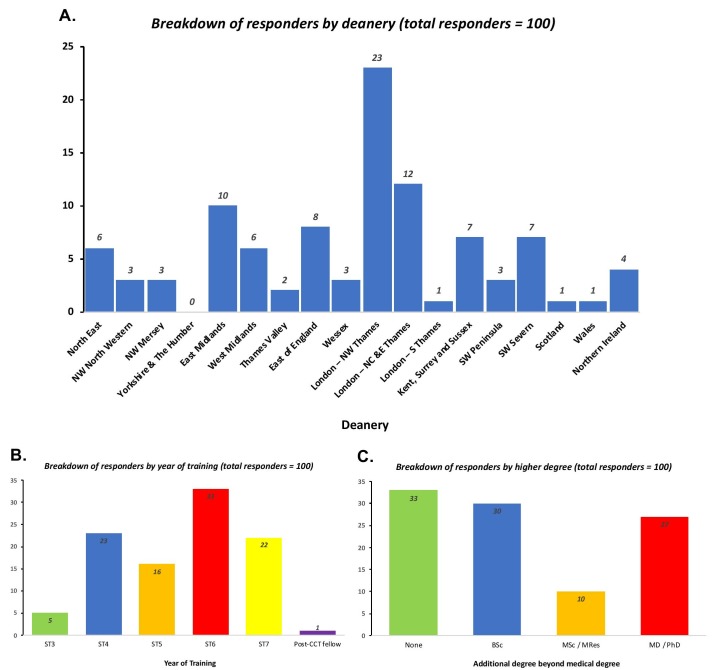
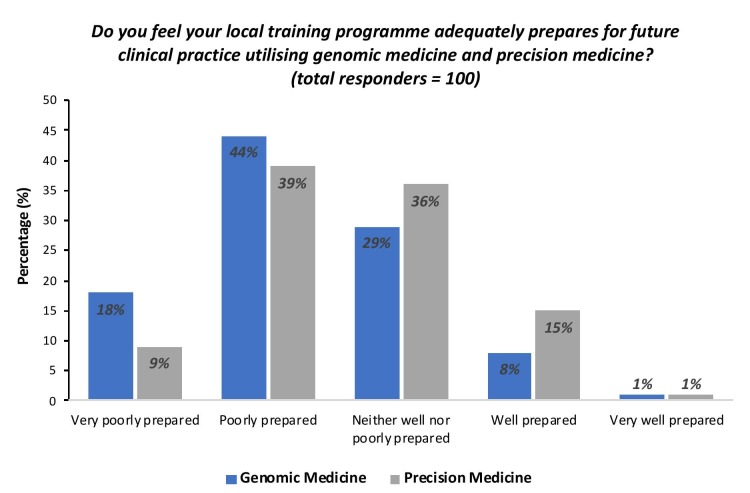
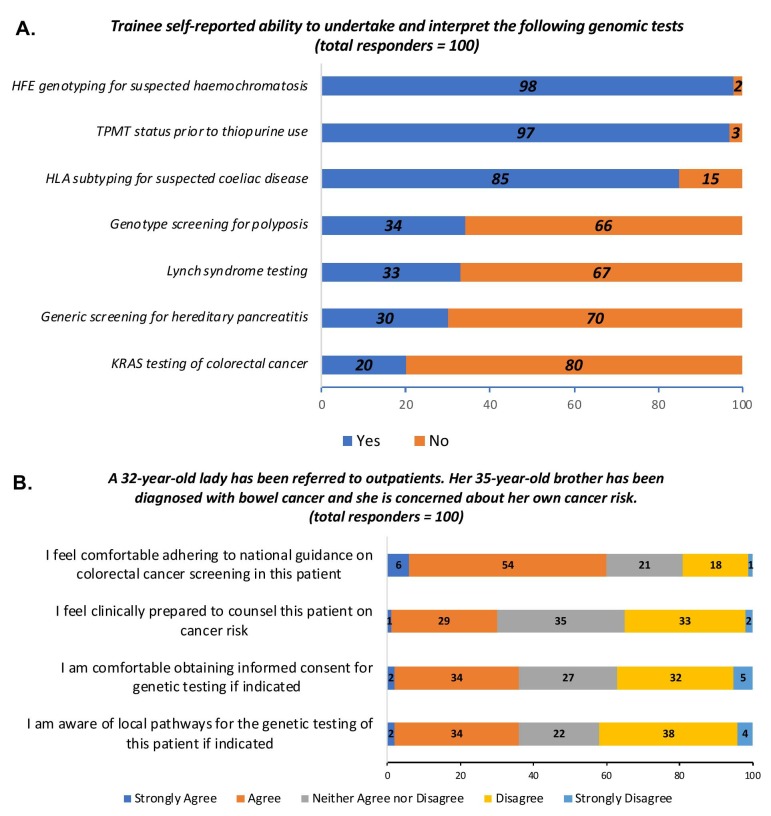
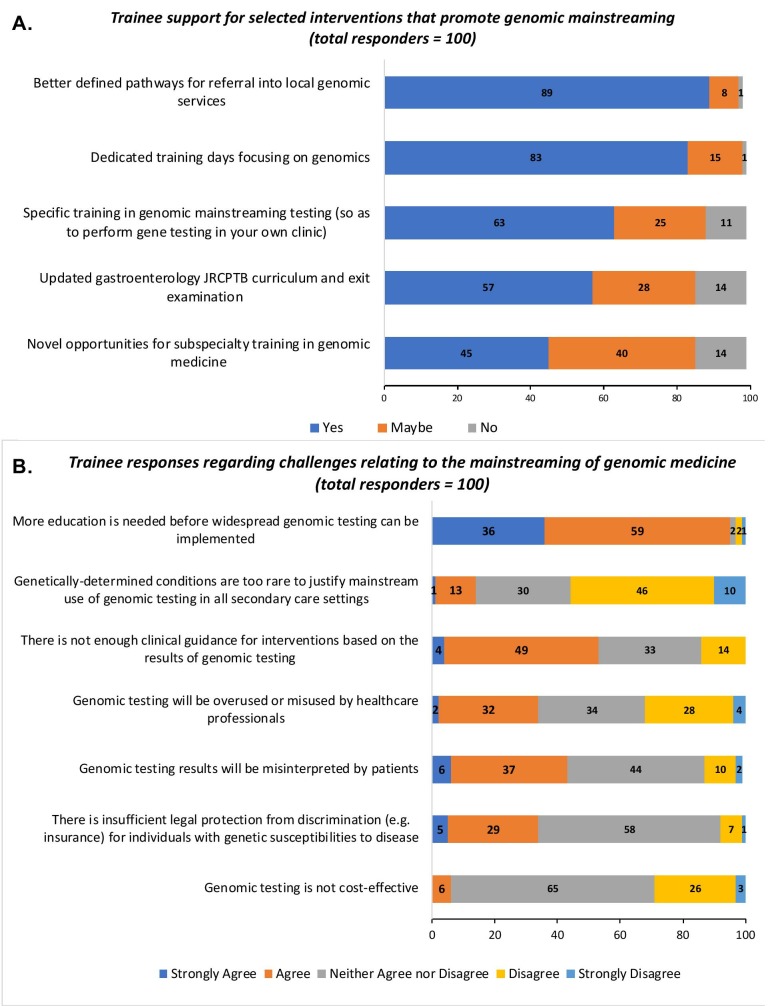
Objective: Genomics and personalised medicine are increasingly relevant for patients with gastroenterological conditions. We aim to capture the current state of genomics training in gastroenterology to review current understanding, clinical experience and long-term educational needs of UK trainees. Design and setting: A web-based nationwide survey of all UK gastroenterology specialty trainees was conducted in 2017. Results: 100 trainees (14% of UK gastroenterology trainees) completed this survey. Only 9% and 16% of respondents believe that their local training programme adequately prepares them for the future clinical practice using genomic medicine and personalised medicine, respectively. Barriers identified include the need for greater trainee education (95%), inadequate clinical guidance to base interventions on the results of genomic testing (53%), concerns over misinterpretation by patients (43%) and overuse/misuse of testing by clinicians (34%). Survey respondents felt prepared to perform HFE genotyping (98%), assess TPMT status (97%) and interpret HLA subtyping for suspected coeliac disease (85%). However, only a minority felt prepared to perform the following investigations: polyposis screening (34%), hereditary pancreatitis screening (30%), testing for Lynch yndrome (33%) and KRAS testing for colorectal cancer (20%). Most respondents would support holding dedicated training days on genomic medicine (83%), formal training provisions for the mainstreaming of genomic testing (64%), an update to the UK gastroenterology specialty training curriculum and examinations (57%) and better-defined referral pathways for local genomic services (91%). Conclusion: Most gastroenterology trainees in this survey feel ill equipped to practise genomic and personalised medicine as consultants. We propose specific revisions to the UK gastroenterology specialty curriculum that addresses trainees needs.
Overview
The claims and statistics of this paper haven’t been checked yet.
Run the check — free, no account needed. It reads the open-access text and checks the sources it cites.
Integrity signals
Registry
Cites
Statistics
Figures
Verification
Claims the paper makes
The claims and statistics of this paper haven’t been checked yet.
Run the check — free, no account needed. It reads the open-access text and checks the sources it cites.
Claims other papers make about this one
Each is checked against this paper’s own text: does it say what the citing paper says it does?
The cited source says what the claim attributes to it.
In the citing paper
“Professionals also describe a lack in their own knowledge or a limited understanding, as quantitative studies demonstrate [36, 37, 44, 81, 82, 92, 103, 104].”
From Patients’ and professionals’ views related to ethical issues in precision medicine: a mixed research synthesis (2021) · cites this paper as [37]
The cited source says what the claim attributes to it.
In the citing paper
“These and other studies [37, 44–47, 58, 86, 105–108] reveal the need for further education of many health care providers, however, this requirement may vary between professionals in different fields [53, 81].”
From Patients’ and professionals’ views related to ethical issues in precision medicine: a mixed research synthesis (2021) · cites this paper as [37]
Self-check
Percentages, sums and reported differences re-computed from the paper’s own numbers.
The self-check needs the paper’s full text.
Citations
Cites
No references could be resolved yet.
Research works printed but not linked: 6
- 10.1016/j.tig.2014.07.001 · DOI
- Stephens, 2017, Individualized medicine in gastroenterology and hepatology, Mayo Clin Proc, 92, 810, 10.1016/j.mayocp.2017.03.002 · DOI
- Turnbull, 2018, The 100 000 Genomes Project: bringing whole genome sequencing to the NHS, BMJ, 361, 10.1136/bmj.k1687 · DOI
- Schwarze, 2018, Are whole-exome and whole-genome sequencing approaches cost-effective? A systematic review of the literature, Genet Med, 20, 1122, 10.1038/gim.2017.247 · DOI
- 10.1136/flgastro-2013-100362 · DOI
- 10.1093/hmg/ddy170 · DOI
Cited by
Sorted by citations
Erdmann, A., Rehmann-Sutter, C., & Bozzaro, C. (2021) · BMC Medical Ethics · doi:10.1186/s12910-021-00682-8 · Cited by 86
Metadata
- Authors
- Al Bakir, I., Sebepos-Rogers, G. M., Burton, H., & Monahan, K. J.
- Affiliations
- University of Cambridge (GB)
- Cancer Clinic (US)
- Corresponding author
- Monahan, Kevin J
- Venue
- BMJ Open
- Publisher
- BMJ
- Published
- 2019-10
- Volume
- 9
- Issue
- 10
- Pages
- e030505
- ISSN
- 2044-6055 (ISSN-L)
- PMC
- PMC6830597
- OpenAlex
- W2981897222
- Cited by
- 24
- References
- 0
- Citations by year
- 2025: 7 · 2024: 2 · 2023: 7 · 2022: 2 · 2021: 4 · 2020: 1
- FWCI
- 0.58
- Type
- journal article
- Language
- en
- Open access
- gold
- doi.org
- Licence
- cc-by-nc
- Locations
- BMJ Open (publishedVersion, cc-by-nc)
- Europe PMC (PubMed Central) (publishedVersion, cc-by-nc)
- PubMed Central (publishedVersion, cc-by-nc)
- PubMed (publishedVersion)
- DOAJ (DOAJ: Directory of Open Access Journals) (submittedVersion)
- UCL Discovery (University College London) (submittedVersion)
- HighWire Press Open Archive (submittedVersion)
- Spiral (Imperial College London) (submittedVersion, cc-by-nc)
- Funders
- Barts Charity (MGU0423)
- Topics
- Life Sciences › Biochemistry, Genetics and Molecular Biology › Molecular Biology › Genetics, Bioinformatics, and Biomedical Research
- Social Sciences › Education › Innovations in Medical Education
- Health Sciences › Medicine › Public Health, Environmental and Occupational Health › Health and Medical Research Impacts
- Keywords
- genomic medicine, personalized medicine, gastroenterology training, specialist trainees, medical education, training curriculum, thiopurine S-methyltransferase, celiac disease, Lynch syndrome, KRAS testing, colorectal cancer, hereditary pancreatitis
- MeSH terms
- Attitude of Health Personnel, Curriculum, Education, Medical, Graduate, Gastroenterology, United Kingdom, Humans, Surveys and Questionnaires, Genomics, Precision Medicine
About these checks
Registry, retraction, Cites and statistics results are computed, not judged, with one exception: a printed reference that no index lists is read once by a model before it counts as a citation error. Claims are extracted by a model and kept only when their quote appears verbatim in the text; each cited source is then checked, with a model’s help, for whether it says what the claim relies on. Those verdicts can be wrong — read the claim’s quote and the cited source before relying on one.
Statistics and arithmetic are recomputed, not judged.
Confidence bands are shown only for fields calibrated on our annotated test set. None is calibrated yet, so no band is shown.
What counts as a claim ›How we measure confidence ›How we check this ›
Are you an author, or do you see a problem with this page? Request a review
