

Internet-based cognitive–behavioural therapy for prevention of depression during pregnancy and in the post partum (iPDP): a protocol for a large-scale randomised controlled trial
Open accessThe DOI matches its Crossref record; 55 of the 55 references it cites were found in a registry or an index.
Abstract
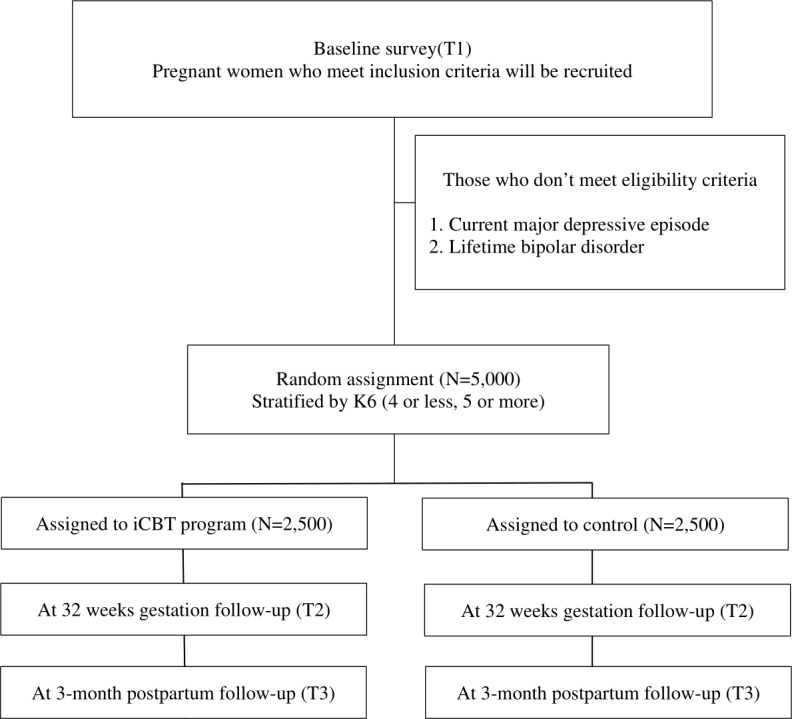
Introduction: The objective of this randomised controlled trial (RCT) is to examine the effects of smartphone-based cognitive–behavioural therapy (CBT) in preventing the onset of major depressive episodes (MDE) among pregnant women. Methods and analysis: The target study population will be pregnant women of 16–20 weeks gestation who are currently users of ‘Luna Luna Baby’, the most widely used app for pregnant women in Japan. Those who meet the eligibility criteria will be randomly allocated to the 6-module internet CBT programme that was newly developed for pregnant women (n=2500), or to a treatment-as-usual control group (n=2500). Participants in the intervention groups will be required to complete the programme by 32 weeks gestation. The primary outcomes are the number of new onsets of MDE, measured by using WHO Composite International Diagnostic Interview 3.0 at 32 weeks gestation and 3 months post partum. Survival analysis will be conducted to test for the effectiveness of the intervention on the time to the onset of MDE. Ethics and dissemination: The study plan has been approved by the Research Ethics Review Board of the Graduate School of Medicine/Faculty of Medicine, the University of Tokyo (2019150NI). If the intervention programmes are found to produce a significant positive effect in this RCT, these programmes can be made available for all users of the app in the future. Trial registration number: UMIN000038190; Pre-results.
Overview
The claims and statistics of this paper haven’t been checked yet.
Free: it reads the open-access text and checks the first 5 claims that cite a source we can check. Create a free account to check every claim.
Integrity signals
Registry
Cites
Statistics
Figures
Verification
Claims the paper makes
The claims and statistics of this paper haven’t been checked yet.
Free: it reads the open-access text and checks the first 5 claims that cite a source we can check. Create a free account to check every claim.
Claims other papers make about this one
Each is checked against this paper’s own text: does it say what the citing paper says it does?
The source backs part of the claim, not all of it — or backs it for a different population, condition or comparison.
In the citing paper
“Given the known prevalence of PMADs, additional screening during the prenatal period is an enhanced window of time to engage in early detection and intervention of psychological distress [10].”
From Technology-Based Approaches for Supporting Perinatal Mental Health (2022) · cites this paper as [10]
Experimental — accuracy not yet measured
Self-check
Percentages, sums and reported differences re-computed from the paper’s own numbers.
The self-check needs the paper’s full text.
Citations
Cites
(2003) · Journal of Machine Learning Research · doi:10.5555/944919.944937 · Cited by 32,337
Detection of Postnatal Depression: Development of the 10-item Edinburgh Postnatal Depression Scale
Cox, J. L., Holden, J. M., & Sagovsky, R. (1987) · British Journal of Psychiatry · doi:10.1192/bjp.150.6.782 · Cited by 14,183
KESSLER, R. C., ANDREWS, G., COLPE, L. J., HIRIPI, E., MROCZEK, D. K., NORMAND, S.-L. T., WALTERS, E. E., & ZASLAVSKY, A. M. (2002) · Psychological Medicine · doi:10.1017/s0033291702006074 · Cited by 10,327
Development and preliminary testing of the new five-level version of EQ-5D (EQ-5D-5L)
Herdman, M., Gudex, C., Lloyd, A., Janssen, M., Kind, P., Parkin, D., Bonsel, G., & Badia, X. (2011) · Quality of Life Research · doi:10.1007/s11136-011-9903-x · Cited by 9,795
Proctor, E., Silmere, H., Raghavan, R., Hovmand, P., Aarons, G., Bunger, A., Griffey, R., & Hensley, M. (2011) · Administration and Policy in Mental Health and Mental Health Services Research · doi:10.1007/s10488-010-0319-7 · Cited by 8,721
Validation of the Insomnia Severity Index as an outcome measure for insomnia research
Bastien, C. (2001) · Sleep Medicine · doi:10.1016/s1389-9457(00)00065-4 · Cited by 8,067
SPIRIT 2013 explanation and elaboration: guidance for protocols of clinical trials
Chan, A.-W., Tetzlaff, J. M., Gotzsche, P. C., Altman, D. G., Mann, H., Berlin, J. A., Dickersin, K., Hrobjartsson, A., Schulz, K. F., Parulekar, W. R., et al. (2013) · BMJ · doi:10.1136/bmj.e7586 · Cited by 6,251
(1999) · Cited by 5,934
Kessler, R. C., & Üstün, T. B. (2004) · International Journal of Methods in Psychiatric Research · doi:10.1002/mpr.168 · Cited by 4,771
(2005) · Medical Entomology and Zoology · Cited by 3,197
Research works printed but not linked: 3
- Okano T, Murata M, Masuji F, et al Validation and reliability of Japanese version of the EPDS. Arch Psychiatr Diag Clin Evaluat 1996; 7: 525– 33.
- Munezawa T, Morin CM, Inoue Y Development of the Japanese version of the insomnia severity index (ISI-J) Seishinkachiryogaku. 24, 2009: 219– 25.
- Kondo H, Okada M, Eto H Development of Cambridge-Hopkins questionnaire 13 Japanese version short form (CH-RLSq13) version 2.1 in the assessment of restless legs syndrome (in Japanese), 2016: 577– 84.
Cited by
Qin, X., Liu, C., Zhu, W. D., Chen, Y., & Wang, Y. (2022) · International Journal of Environmental Research and Public Health · doi:10.3390/ijerph192416824 · Cited by 57
Nishi, D., Imamura, K., Watanabe, K., Obikane, E., Sasaki, N., Yasuma, N., Sekiya, Y., Matsuyama, Y., & Kawakami, N. (2022) · Psychiatry and Clinical Neurosciences · doi:10.1111/pcn.13458 · Cited by 45
Self-citationArakawa, Y., Haseda, M., Inoue, K., Nishioka, D., Kino, S., Nishi, D., Hashimoto, H., & Kondo, N. (2023) · BMC Medicine · doi:10.1186/s12916-023-02918-3 · Cited by 41
Self-citationAttention to Prevention—Can We Stop Perinatal Depression Before It Starts?
Wisner, K. L., Miller, E. S., & Tandon, D. (2019) · JAMA Psychiatry · doi:10.1001/jamapsychiatry.2018.4085 · Cited by 36
Technology-Based Approaches for Supporting Perinatal Mental Health
Novick, A. M., Kwitowski, M., Dempsey, J., Cooke, D. L., & Dempsey, A. G. (2022) · Current Psychiatry Reports · doi:10.1007/s11920-022-01349-w · Cited by 35
“Given the known prevalence of PMADs, additional screening during the prenatal period is an enhanced window of time to engage in early detection and intervention of psychological distress [10].”
BackgroundPerinatal mental health and COVID ‐19 in Japan
Haruna, M., & Nishi, D. (2020) · Psychiatry and Clinical Neurosciences · doi:10.1111/pcn.13091 · Cited by 34
Self-citationPotential impacts of COVID-19 on reproductive health: Scientific findings and social dimension
Hashem, N. M., Abdelnour, S. A., Alhimaidi, A. R., & Swelum, A. A. (2020) · Saudi Journal of Biological Sciences · doi:10.1016/j.sjbs.2020.12.012 · Cited by 33
Sasaki, N., Obikane, E., Vedanthan, R., Imamura, K., Cuijpers, P. J., Shimazu, T., Kamada, M., Kawakami, N., & Nishi, D. (2021) · JMIR Formative Research · doi:10.2196/24332 · Cited by 31
Self-citationScaling up Mental Healthcare for Perinatal Populations: Is Telemedicine the Answer?
Singla, D. R., Savel, K. A., Dennis, C., Kim, J., Silver, R. K., Vigod, S. N., Dalfen, A., & Meltzer-Brody, S. E. (2022) · Current Psychiatry Reports · doi:10.1007/s11920-022-01389-2 · Cited by 27
Biotechnology to Combat COVID-19
Agrawal, M., & Biswas, S. (2021) · IntechOpen eBooks · doi:10.5772/intechopen.93713 · Cited by 17
Obikane, E., Sasaki, N., Imamura, K., Nozawa, K., Vedanthan, R., Cuijpers, P. J., Shimazu, T., Kamada, M., Kawakami, N., & Nishi, D. (2022) · International Journal of Environmental Research and Public Health · doi:10.3390/ijerph192315792 · Cited by 12
Self-citationMotrico, E., Cerón, S. C., Gómez, C. M., Gómez‐Gómez, I., Fonseca, A. C., & Moreno-Peral, P. (2021) · Internet Interventions · doi:10.1016/j.invent.2021.100471 · Cited by 10
Sasaki, N., Akiyama, H., Kawakami, N., & Nishi, D. (2021) · Journal of Psychosomatic Obstetrics & Gynecology · doi:10.1080/0167482x.2021.2010699 · Cited by 10
Self-citationLee, E., & Kim, M. (2021) · Korean journal of women health nursing/Yeoseong geon'gang ganho hag'hoeji/Yeoseong geon-gang ganho hakoeji · doi:10.4069/kjwhn.2021.11.15 · Cited by 7
Pemanfaatan Aplikasi Digital dalam Mencegah Depresi Postpartum: Literature Review
Sukmawati, S. T., Anshori, R. O., Pinem, L. H., Wardhani, M. A. K., Mega, M., Safitri, M. Z., Pratama, P. W. Y., & Sholeha, W. (2021) · Jurnal Kesehatan Holistic · doi:10.33377/jkh.v5i2.99 · Cited by 5
Suen, Y. N., Yau, J. Y., Wong, P. S., Li, Y. K., Hui, C. L. M., Chan, S. K. W., Lee, E. H. M., Chang, W. C., & Chen, E. Y. H. (2022) · Psychiatry Research · doi:10.1016/j.psychres.2022.114880 · Cited by 4
Ito, Y., Sasaki, N., Tezuka, K., Imamura, K., & Nishi, D. (2025) · Archives of Women s Mental Health · doi:10.1007/s00737-025-01632-8 · Cited by 3
Self-citationRestless legs syndrome without insomnia and antenatal depressive symptoms
Tezuka, K., Ito, Y., & Nishi, D. (2025) · BMC Pregnancy and Childbirth · doi:10.1186/s12884-025-07173-3 · Cited by 3
Self-citationTakae, A., Sasaki, N., Imamura, K., & Nishi, D. (2025) · JMIR mhealth and uhealth · doi:10.2196/73512 · Cited by 3
Self-citationMaryatun, Pratama, B. A., Indarwati, I., Andriyani, A., Kusumaningsih, R., Mulyani, S., Wahyuni, E. S., & Agustina, N. W. (2023) · International Journal of Public Health Excellence (IJPHE) · doi:10.55299/ijphe.v3i1.411 · Cited by 3
Ririn, R., Putri, A., Sigalingging, M., Rohani, R., Astuti, A. W., & Mahardya, R. T. K. (2024) · Women Midwives and Midwifery · doi:10.36749/wmm.4.3.82-92.2024 · Cited by 3
Ito, Y., & Nishi, D. (2024) · Journal of Reproductive and Infant Psychology · doi:10.1080/02646838.2024.2380416 · Cited by 2
Self-citationShariatpanahi, M., Faramarzi, M., Barat, S., Farghadani, A., & Shirafkan, H. (2025) · BMC Psychology · doi:10.1186/s40359-025-02839-1 · Cited by 2
Time-varying restless legs syndrome and risk of incident perinatal depression
Tezuka, K., Ito, Y., Sasaki, N., & Nishi, D. (2026) · Journal of Clinical Sleep Medicine · doi:10.1007/s44470-026-00168-7 · Cited by 2
Self-citationTezuka, K., Ito, Y., Sasaki, N., & Nishi, D. (2025) · Psychiatry and Clinical Neurosciences · doi:10.1111/pcn.13921 · Cited by 2
Self-citationCOGNITIVE BEHAVIOR THERAPY MENURUNKAN GEJALA DEPRESI PADA IBU POSTPARTUM
Muspitha, F. D., & Rophi, K. H. (2024) · JURNAL KEPERAWATAN TROPIS PAPUA · doi:10.47539/jktp.v7i1.379 · Cited by 1
Hidaka, Y., Kawakami, N., Watanabe, K., & Nishi, D. (2022) · Psychiatry and Clinical Neurosciences Reports · doi:10.1002/pcn5.27 · Cited by 1
Self-citationMahlalela, N. N. (2023) · Open University of Cape Town (University of Cape Town) · Cited by 1
Crosstalk between SARS-CoV-2 and Testicular Hemostasis: Perspective View
Ahmed, R. G. (2022) · IntechOpen eBooks · doi:10.5772/intechopen.98218 · Cited by 1
Strategi Penurunan Kecemasan Ibu Hamil Melalui Edukasi Kesehatan Mental
Sudirman, J., Stang, S., & Suriani, B. (2024) · Jurnal Kabar Masyarakat · doi:10.54066/jkb.v2i4.2648 · Cited by 1
Wan, Z., Liu, Y., Su, Z., Bai, C., Liu, X., Li, X., Zhao, X., Li, P., Song, L., & Rao, J. (2026) · Frontiers in Psychiatry · doi:10.3389/fpsyt.2026.1896124
Botyar, M., Moghaddam‐Banaem, L., Sadatmahalleh, S. J., Esmaeilinasab, M., & Ahmadi, F. (2024) · Research Square · doi:10.21203/rs.3.rs-4384742/v1
Arakawa, Y., Haseda, M., Inoue, K., Nishioka, D., Kino, S., Nishi, D., Hashimoto, H., & Kondo, N. (2023) · Figshare · doi:10.6084/m9.figshare.23583670
Self-citationArakawa, Y., Haseda, M., Inoue, K., Nishioka, D., Kino, S., Nishi, D., Hashimoto, H., & Kondo, N. (2023) · Figshare · doi:10.6084/m9.figshare.23583673
Self-citationRana, S., & Buster, R. (2026) · Exploration of Digital Health Technologies · doi:10.37349/edht.2026.1011103
Parramón, G. (2024) · Tesis Doctorals en Xarxa (Consorci de Serveis Universitaris de Catalunya)
Metadata
- Authors
- Nishi, D., Imamura, K., Watanabe, K., Obikane, E., Sasaki, N., Yasuma, N., Sekiya, Y., Matsuyama, Y., & Kawakami, N.
- Affiliations
- The University of Tokyo (JP)
- Corresponding author
- Nishi, Daisuke
- ORCID
- Venue
- BMJ Open
- Publisher
- BMJ
- Published
- 2020-05
- Volume
- 10
- Issue
- 5
- Pages
- e036482
- ISSN
- 2044-6055 (ISSN-L)
- PMC
- PMC7239549
- OpenAlex
- W3024025758
- Cited by
- 31
- References
- 54
- Citations by year
- 2026: 3 · 2025: 5 · 2024: 3 · 2023: 4 · 2022: 7 · 2021: 6 · 2020: 2
- FWCI
- 3.56
- Type
- journal article
- Language
- en
- Open access
- gold
- doi.org
- Licence
- Locations
- BMJ Open (publishedVersion, cc-by-nc)
- PubMed Central (publishedVersion, cc-by-nc)
- PubMed (publishedVersion)
- DOAJ (DOAJ: Directory of Open Access Journals) (submittedVersion, cc-by-sa)
- HighWire Press Open Archive (submittedVersion)
- Funders
- Japan Society for the Promotion of Science (19H01073)
- Topics
- Health Sciences › Medicine › Public Health, Environmental and Occupational Health › Maternal Mental Health During Pregnancy and Postpartum
- Social Sciences › Psychology › Applied Psychology › Digital Mental Health Interventions
- Health Sciences › Health Professions › General Health Professions › Mobile Health and mHealth Applications
- Keywords
- internet-based cognitive behavioral therapy, mobile application, depression prevention, major depressive episode, pregnancy, postpartum depression, pregnant women, digital mental health interventions
- MeSH terms
- Depression, Female, Humans, Japan, Pregnancy, Cognitive Behavioral Therapy, Randomized Controlled Trials as Topic, Internet, Postpartum Period
About these checks
Registry, retraction, Cites and statistics results are computed, not judged, with one exception: a printed reference that no index lists is read once by a model before it counts as a citation error. Claims are extracted by a model and kept only when their quote appears verbatim in the text; each cited source is then checked, with a model’s help, for whether it says what the claim relies on. Those verdicts can be wrong — read the claim’s quote and the cited source before relying on one.
Statistics and arithmetic are recomputed, not judged.
Confidence bands are shown only for fields calibrated on our annotated test set. None is calibrated yet, so no band is shown.
What counts as a claim ›How we measure confidence ›How we check this ›
Are you an author, or do you see a problem with this page? Request a review
Data sources
Bibliographic data: Semantic Scholar, OpenAlex, Crossref.
Contains information from the Semantic Scholar Academic Graph Datasets, made available under the ODC Attribution License (ODC-BY 1.0).
Semantic Scholar’s data is described in: Kinney, R., et al. (2023). The Semantic Scholar Open Data Platform. arXiv:2301.10140.
