

The DOI matches its Crossref record.
Change in prevalence rates of physical and sexual intimate partner violence against women: data from two cross-sectional studies in New Zealand, 2003 and 2019
Open accessAbstract
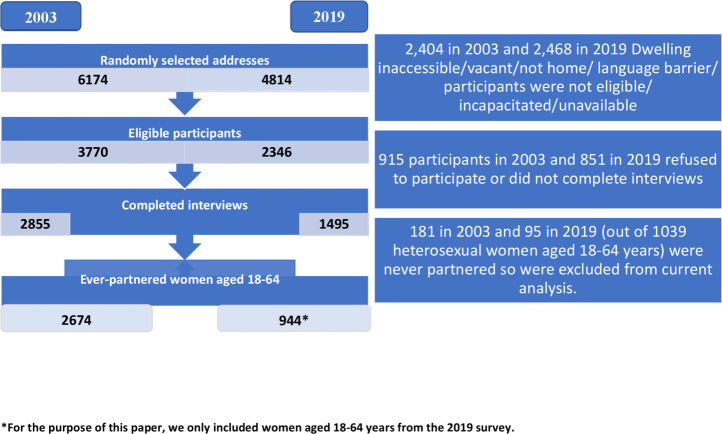
Objectives: To explore changes in reported prevalence of physical and sexual intimate partner violence (IPV) between 2003 and 2019. The impact of sociodemographic differences between the two samples and between group differences were also examined. Changes in attitudes supportive of violence and in help-seeking behaviour following disclosure were also explored. Design: Two cross-sectional studies. Setting and participants: Cross-sectional studies on family violence conducted in New Zealand in 2003 and 2019. Ever-partnered female respondents aged 18–64 years old were included (2003 n=2674, 2019 n=944). Main outcome measures: Prevalence rates of lifetime and past 12-month physical and sexual IPV, attitudes towards gender roles and acceptability of a man hitting his wife, help sought and received following disclosure were compared between the study years. Results: Lifetime prevalence of physical IPV was unchanged between 2003 and 2019 (AOR=0.89; 95% CI 0.73 to 1.08). There was a significant decrease in the proportion of women who reported experiencing 12-month physical IPV (AOR=0.53; 95% CI 0.29 to 0.97). Small reductions in rates for lifetime sexual IPV were also observed (AOR=0.74; 95% CI 0.59 to 0.95). In 2019, fewer women agreed with one or more statements supportive of traditional gender roles (48.1% (95% CI 45.7% to 50.5%) in 2003; 38.4% (95% CI 33.8% to 43.2%) in 2019). A significant decrease was noted in the proportion of women who sought help from informal sources (from 71.3% (95% CI 68.1% to 74.2%) in 2003 to 64.6% (95% CI 58.7% to 70.1%) in 2019). No significant changes in seeking help from formal sources, or perceived helpfulness from any source were noted. Conclusion: While the reductions in 12-month physical and lifetime sexual IPV are positive, prevention efforts need to be established, maintained and strengthened to address the substantial lifetime prevalence of IPV. Efforts to strengthen responses from formal and informal sources continue to be needed.
Overview
The claims and statistics of this paper haven’t been checked yet.
Run the check — free, no account needed. It reads the open-access text and checks the sources it cites.
Integrity signals
Registry
Cites
Statistics
Figures
Verification
Claims the paper makes
The claims and statistics of this paper haven’t been checked yet.
Run the check — free, no account needed. It reads the open-access text and checks the sources it cites.
Claims other papers make about this one
Each is checked against this paper’s own text: does it say what the citing paper says it does?
The cited source says what the claim attributes to it.
In the citing paper
“For example, a recent study conducted in New Zealand (J. Fanslow et al., 2021), using data from two cross-sectional population-based surveys, found changes in the reported prevalence rates of sexual IPV between 2003 and 2019 with a significant decrease in the reported lifetime prevalence of sexual IPV, from 16.9% in 2003 to 13.1% in 2019.”
From Global Prevalence and Mental Health Outcomes of Intimate Partner Violence Among Women: A Systematic Review and Meta-Analysis (2024) · cites this paper as J. Fanslow et al., 2021
Self-check
Percentages, sums and reported differences re-computed from the paper’s own numbers.
The self-check needs the paper’s full text.
Citations
Cites
No references could be resolved yet.
Research works printed but not linked: 29
- Kangaspunta K , Marshall IH . Trends in Violence against Women: Some Good News and Some Bad News. In: Jan van Dijk AT , Farrell G , eds. The International crime drop. London: Palgrave Macmillan, 2012: 103–55. · DOI
- 10.1177/0886260512441077 · DOI
- Orr, 2019, Trends in hospital admissions for intimate partner violence in Australian mothers with children born from 1990 to 2009, J Interpers Violence, 0886260519832905
- Tjaden P , Thoennes N . Prevalence, incidence, and consequences of violence against women: findings from the National violence against women survey. Washington, U.S.A: U.S. Department of Justice, Office of Justice Programs, National Institute of Justice, 1998. · DOI
- Mouzos J , Makkai T . Women’s Experiences of Male Violence: Findings from the Australian Component of the International Violence Against Women Survey (IVAWS), R.a.P.P. Series, Editor. 162. Australia. p: Australian Institute of Criminology, 2004. · DOI
- Sanz-Barbero, 2019, Prevalence, associated factors and health impact of intimate partner violence against women in different life stages, PLoS One, 14, 10.1371/journal.pone.0221049 · DOI · Paper page
- Fanslow, 2004, Violence against women in New Zealand: prevalence and health consequences, N Z Med J, 117
- Dahlberg LL , Krug EG . Violence a global public health problem, 2006. Available: http://www.scielo.br/scielo.php?script=sci_arttext&pid=S1413-81232006000200007&nrm=iso
- Heise, 1998, Violence Against Women:An Integrated, Ecological Framework, 4, 262
- 10.1177/0886260514567960 · DOI
- 10.1177/1077801208330433 · DOI
- Hindin, 2003, Understanding women’s attitudes towards wife beating in Zimbabwe / Michelle J. Hindin, Bulletin of the World Health Organization : the International Journal of Public Health, 81, 501
- 10.2105/AJPH.2004.050872 · DOI · Paper page
- Donovan, 1999, Targeting male perpetrators of intimate partner violence: Western Australia's "Freedom from Fear" campaign, Soc Mar Q, 5, 128
- 10.1016/j.socscimed.2005.04.035 · DOI
- Fanslow J , Gulliver P , Hashemi L . Methods for the 2019 New Zealand family violence study- a study on the association between violence exposure, health and well-being. New Zealand Journal of Social Sciences Online 2021:1–14. · DOI
- Goodey, 2017, Violence against women: placing evidence from a European Union-Wide survey in a policy context, J Interpers Violence, 32, 1760, 10.1177/0886260517698949 · DOI
- 10.1177/0886260510363420 · DOI
- 10.1186/1472-6874-11-52 · DOI
- Black, 2019, Prevalence and correlates of intimate partner violence against women in conflict affected Northern Uganda: a cross-sectional study, Confl Health, 13, 10.1186/s13031-019-0219-8 · DOI
- Khan, 2018, Women's attitude towards wife-beating and its relationship with reproductive healthcare seeking behavior: a countrywide population survey in Bangladesh, PLoS One, 13, 10.1371/journal.pone.0198833 · DOI
- Hindin, 2003, Understanding women’s attitudes towards wife beating in Zimbabwe, Bull World Health Organ, 81, p. 501
- Leonardsson, 2017, Prevalence and predictors of help-seeking for women exposed to spousal violence in India - a cross-sectional study, BMC Womens Health, 17, 10.1186/s12905-017-0453-4 · DOI
- 10.1136/jech-2012-202187 · DOI
- 10.1016/j.socscimed.2009.12.009 · DOI · Paper page
- 10.1007/s10896-007-9146-3 · DOI
- 10.1023/A:1025108103617 · DOI
- Mayhew P . The Case of Australia and New Zealand. In: Farrell JvDATG , ed. The International crime drop -2012 new directions in research. 2012, Palgrave Macmillan, a division of Macmillan Publishers Limited, 2012: 76–102. · DOI
- 10.1136/jech.2003.019604 · DOI
Cited by
Sorted by citations
White, S. J., Sin, J., Sweeney, A., Salisbury, T., Wahlich, C., Montesinos Guevara, C. M., Gillard, S., Brett, E., Allwright, L., Iqbal, N., et al. (2024) · Trauma, Violence, & Abuse · doi:10.1177/15248380231155529 · Cited by 465
Metadata
- Authors
- Fanslow, J., Hashemi, L., Malihi, Z., Gulliver, P., & McIntosh, T.
- Affiliations
- University of Auckland (NZ)
- Corresponding author
- Fanslow, Janet
- Venue
- BMJ Open
- Publisher
- BMJ
- Published
- 2021-03
- Volume
- 11
- Issue
- 3
- Pages
- e044907
- ISSN
- 2044-6055 (ISSN-L)
- PMC
- PMC7993160
- OpenAlex
- W3136766593
- Cited by
- 19
- References
- 0
- Citations by year
- 2026: 4 · 2025: 2 · 2024: 1 · 2023: 3 · 2022: 7 · 2021: 2
- FWCI
- 1.80
- Type
- journal article
- Language
- en
- Open access
- gold
- doi.org
- Licence
- Locations
- BMJ Open (publishedVersion, cc-by-nc)
- PubMed Central (publishedVersion, cc-by-nc)
- PubMed (publishedVersion)
- City Research Online (City University London) (acceptedVersion)
- DOAJ (DOAJ: Directory of Open Access Journals) (submittedVersion, cc-by-sa)
- ResearchSpace (University of Auckland) (submittedVersion, cc-by-nc)
- Funders
- Ministry of Business, Innovation and Employment (CONT-42799-HASTR-UOA)
- Health Research Council of New Zealand (02/207)
- Topics
- Social Sciences › Health › Intimate Partner and Family Violence
- Health Sciences › Medicine › Geriatrics and Gerontology › Elder Abuse and Neglect
- Social Sciences › Gender Studies › Sexual Assault and Victimization Studies
- Keywords
- intimate partner violence, intimate partner sexual violence, prevalence trends, women, gender roles, attitudes toward violence, domestic violence, New Zealand, sociodemographic differences
- MeSH terms
- Intimate Partner Violence, Adolescent, Adult, Cross-Sectional Studies, Female, Humans, Male, Middle Aged, New Zealand, Risk Factors, Sexual Partners, Prevalence, Young Adult
About these checks
Registry, retraction, Cites and statistics results are computed, not judged, with one exception: a printed reference that no index lists is read once by a model before it counts as a citation error. Claims are extracted by a model and kept only when their quote appears verbatim in the text; each cited source is then checked, with a model’s help, for whether it says what the claim relies on. Those verdicts can be wrong — read the claim’s quote and the cited source before relying on one.
Statistics and arithmetic are recomputed, not judged.
Confidence bands are shown only for fields calibrated on our annotated test set. None is calibrated yet, so no band is shown.
What counts as a claim ›How we measure confidence ›How we check this ›
Are you an author, or do you see a problem with this page? Request a review
