

Use and usability of GP online services: a mixed-methods sequential study, before and during the COVID-19 pandemic, based on qualitative interviews, analysis of routine eConsult usage and feedback data, and assessment of GP websites in Devon and Cornwall, England
Open accessThe DOI matches its Crossref record; 21 of the 21 references it cites were found in a registry or an index.
Abstract
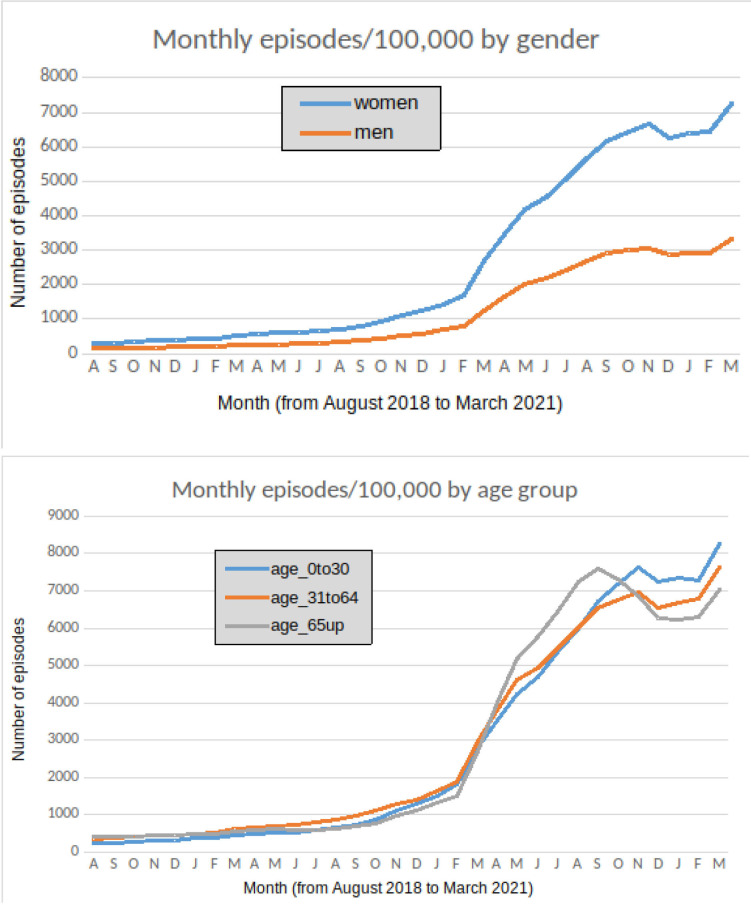
Objectives: We explored use and usability of general practitioner (GP) online services. Setting: Devon and Cornwall, England. Design: Mixed-methods sequential study based on qualitative interviews, analysis of routine eConsult usage and feedback data, and assessment of GP websites. Methods: First, we interviewed 32 staff and 18 patients from seven practices in June 2018. Second, we used routinely collected consultation meta-data and, third, patient feedback data for all practices using eConsult from June 2018 to March 2021. Lastly, we examined GP websites’ usability in January 2020 and September 2021. Results: Interviews suggested practices infrequently involved patients in eConsult implementation. Some patients ‘gamed’ the system to achieve what they wanted. Usage data showed a major increase in eConsult resulting from COVID-19. Women used eConsult twice as much as men. Older had similar eConsult consultation rates to younger patients. Patient feedback forms were completed for fewer than 3% of consultations. Patients were mostly satisfied with eConsult but some had concerns about its length and repetitiveness, lack of continuity over time and between eConsult and medical records. We did not find clear evidence that patients’ suggested improvements were acted on. Finally, few GP websites met accessibility guidelines and may hinder access to online national services such as eConsult. Conclusion: Given that, face to face, older people consult more, usage data suggest that older people have reduced online access. That the female-to-male ratio of eConsult use use was even greater than ‘traditional’ face-to-face ratio was unexpected and needs further research. Although eConsult collects and uses routine patient feedback to improve the system, more open systems for patient feedback, such as Care Opinion, may be more effective in helping online systems evolve. Lastly, we question the need for GP websites and suggest that national or regional services are better placed to maintain accessible services.
Overview
The claims and statistics of this paper haven’t been checked yet.
Free: it reads the open-access text and checks the first 5 claims that cite a source we can check. Create a free account to check every claim.
Integrity signals
Registry
Cites
Statistics
Figures
Verification
Claims the paper makes
The claims and statistics of this paper haven’t been checked yet.
Free: it reads the open-access text and checks the first 5 claims that cite a source we can check. Create a free account to check every claim.
Claims other papers make about this one
Each is checked against this paper’s own text: does it say what the citing paper says it does?
The cited source says what the claim attributes to it.
In the citing paper
“To avoid receiving a ‘phone 999’ message when using eConsult, patients downplayed symptoms. 26”
From Effectiveness and safety of asynchronous telemedicine consultations in general practice: a systematic review (2024) · cites this paper as [26]
The cited source says what the claim attributes to it.
In the citing paper
“Average asynchronous telemedicine users during the pandemic were younger, more likely to be employed. and had fewer chronic diseases than average users before the pandemic, 28 and the gap between numbers of female and male users increased. 26”
From Effectiveness and safety of asynchronous telemedicine consultations in general practice: a systematic review (2024) · cites this paper as [26]
The cited source says what the claim attributes to it.
In the citing paper
“Three studies reported patient use of asynchronous telemedicine increased gradually before the pandemic 26,31–33,40 and in 2016 20% of UK general practices planned to introduce it. 49”
From Effectiveness and safety of asynchronous telemedicine consultations in general practice: a systematic review (2024) · cites this paper as [26]
Self-check
Percentages, sums and reported differences re-computed from the paper’s own numbers.
The self-check needs the paper’s full text.
Citations
Cites
Using thematic analysis in psychology
Braun, V., & Clarke, V. (2006) · Qualitative Research in Psychology · doi:10.1191/1478088706qp063oa · Cited by 194,414
Murray, E., Treweek, S., Pope, C., MacFarlane, A., Ballini, L., Dowrick, C., Finch, T., Kennedy, A., Mair, F., O'Donnell, C., et al. (2010) · BMC Medicine · doi:10.1186/1741-7015-8-63 · Cited by 1,478
The Royal College of General Practitioners
Fry, J. (1983) · Present State and Future Needs in General Practice · doi:10.1007/978-94-011-7304-9_14 · Cited by 1,317
Do men consult less than women? An analysis of routinely collected UK general practice data
Wang, Y., Hunt, K., Nazareth, I., Freemantle, N., & Petersen, I. (2013) · BMJ Open · doi:10.1136/bmjopen-2013-003320 · Cited by 622
Mair, F. S., May, C., O’Donnell, C., Finch, T., Sullivan, F., & Murray, E. (2012) · Bulletin of the World Health Organization · doi:10.2471/blt.11.099424 · Cited by 553
Mo, P. K. H., Malik, S. H., & Coulson, N. S. (2009) · Patient Education and Counseling · doi:10.1016/j.pec.2008.08.029 · Cited by 156
The Impact of Digital-First Consultations on Workload in General Practice: Modeling Study
Salisbury, C., Murphy, M., & Duncan, P. (2020) · Journal of Medical Internet Research · doi:10.2196/18203 · Cited by 124
The Impact of Digital-First Consultations on Workload in General Practice: Modeling Study (Preprint)
Salisbury, C., Murphy, M., & Duncan, P. (2020) · doi:10.2196/preprints.18203 · Cited by 124
Use of an electronic consultation system in primary care: a qualitative interview study
Banks, J., Farr, M., Salisbury, C., Bernard, E., Northstone, K., Edwards, H., & Horwood, J. (2018) · British Journal of General Practice · doi:10.3399/bjgp17x693509 · Cited by 108
Alternatives to the face-to-face consultation in general practice: focused ethnographic case study
Atherton, H., Brant, H., Ziebland, S., Bikker, A., Campbell, J., Gibson, A., McKinstry, B., Porqueddu, T., & Salisbury, C. (2018) · British Journal of General Practice · doi:10.3399/bjgp18x694853 · Cited by 107
Cited by
Leighton, C., Cooper, A., Porter, A., Edwards, A., & Joseph-Williams, N. (2024) · BJGP Open · doi:10.3399/bjgpo.2023.0177 · Cited by 34
“Six reported patients who used asynchronous telemedicine were younger on average than users of face- to-Table eConsult, UK 26,31–33, Responses next working day. eConsulta, Spain 28,46,47 Two-way online messaging between patient and clinician.”
BackgroundAccess systems in general practice: a systematic scoping review
Eccles, A., Bryce, C., Driessen, A., Pope, C. J., MacLellan, J., Gronlund, T. A., Nicholson, B. D., Ziébland, S., & Atherton, H. (2024) · British Journal of General Practice · doi:10.3399/bjgp.2023.0149 · Cited by 23
“…have been studied consistently since 2001, whereas ‘add-ons’ became more popular from 2017 onwards, reflecting the advent of ‘add-on’ digital alternatives for contacting GPs. 41,43,46,47,55,78,80 Rationale for different access systems Nine studies did not report the access system’s rationale.”
Remote Cardiac Rehabilitation With Wearable Devices
Nakayama, A., Ishii, N. K., Mantani, M., Samukawa, K., Tsuneta, R., Marukawa, M., Ohno, K., Yoshida, A., Hasegawa, E., Sakamoto, J., et al. (2023) · Korean Circulation Journal · doi:10.4070/kcj.2023.0242 · Cited by 17
Did COVID-19 reduce the digital divide? A systematic review
Connolly, G., Costa‐Font, J., & Srivastava, D. (2025) · Health Policy and Technology · doi:10.1016/j.hlpt.2025.100979 · Cited by 19
Patient experiences during the COVID-19 pandemic: a qualitative study in Dutch primary care
Homburg, M., Brandenbarg, D., Hartman, T. O., Ramerman, L., Beugel, G., Rijpkema, C., Verheij, R. A., Berger, M. Y., & Peters, L. L. (2022) · BJGP Open · doi:10.3399/bjgpo.2022.0038 · Cited by 18
Metadata
- Authors
- Jones, R. B., Tredinnick-Rowe, J., Baines, R., Maramba, I. D. C., & Chatterjee, A.
- Affiliations
- University of Plymouth (GB)
- Centre for Health Technology, University of Plymouth, Plymouth, UK
- Corresponding author
- Jones, Ray B
- ORCID
- Venue
- BMJ Open
- Publisher
- BMJ
- Published
- 2022-03
- Volume
- 12
- Issue
- 3
- Pages
- e058247
- ISSN
- 2044-6055 (ISSN-L)
- PMC
- PMC8905989
- OpenAlex
- W4220657774
- Cited by
- 19
- References
- 20
- Citations by year
- 2026: 1 · 2025: 10 · 2024: 4 · 2023: 3 · 2022: 1
- FWCI
- 3.97
- Type
- journal article
- Language
- en
- Open access
- gold
- doi.org
- Licence
- Locations
- BMJ Open (publishedVersion, cc-by-nc)
- PubMed Central (publishedVersion, cc-by-nc)
- PubMed (publishedVersion)
- White Rose Research Online (University of Leeds, The University of Sheffield, University of York) (acceptedVersion)
- PEARL (University of Plymouth) (submittedVersion)
- DOAJ (DOAJ: Directory of Open Access Journals) (submittedVersion, cc-by-sa)
- Funders
- European Regional Development Fund (05R18P02814)
- South West Applied Health Science Network (RR204744)
- Topics
- Health Sciences › Medicine › Public Health, Environmental and Occupational Health › Telemedicine and Telehealth Implementation
- Health Sciences › Medicine › Public Health, Environmental and Occupational Health › Healthcare Systems and Technology
- Health Sciences › Health Professions › Health Information Management › Electronic Health Records Systems
- Keywords
- e-consultation, COVID-19 pandemic, website usability, patient feedback, patient satisfaction, accessibility guidelines, continuity of care, Devon and Cornwall
- MeSH terms
- COVID-19, SARS-CoV-2, Aged, England, Feedback, Female, Health Services Accessibility, Humans, Male, Primary Health Care, Referral and Consultation, General Practitioners, Pandemics
About these checks
Registry, retraction, Cites and statistics results are computed, not judged, with one exception: a printed reference that no index lists is read once by a model before it counts as a citation error. Claims are extracted by a model and kept only when their quote appears verbatim in the text; each cited source is then checked, with a model’s help, for whether it says what the claim relies on. Those verdicts can be wrong — read the claim’s quote and the cited source before relying on one.
Statistics and arithmetic are recomputed, not judged.
Confidence bands are shown only for fields calibrated on our annotated test set. None is calibrated yet, so no band is shown.
What counts as a claim ›How we measure confidence ›How we check this ›
Are you an author, or do you see a problem with this page? Request a review
Data sources
Bibliographic data: Semantic Scholar, OpenAlex, Crossref.
Contains information from the Semantic Scholar Academic Graph Datasets, made available under the ODC Attribution License (ODC-BY 1.0).
Semantic Scholar’s data is described in: Kinney, R., et al. (2023). The Semantic Scholar Open Data Platform. arXiv:2301.10140.
