

National cross-sectional cluster survey of tuberculosis prevalence in Timor-Leste: a study protocol
Open accessThe DOI matches its Crossref record; 7 of the 7 references it cites were found in a registry or an index; none of the 14 sources its claims cite is checked for support yet.
Abstract
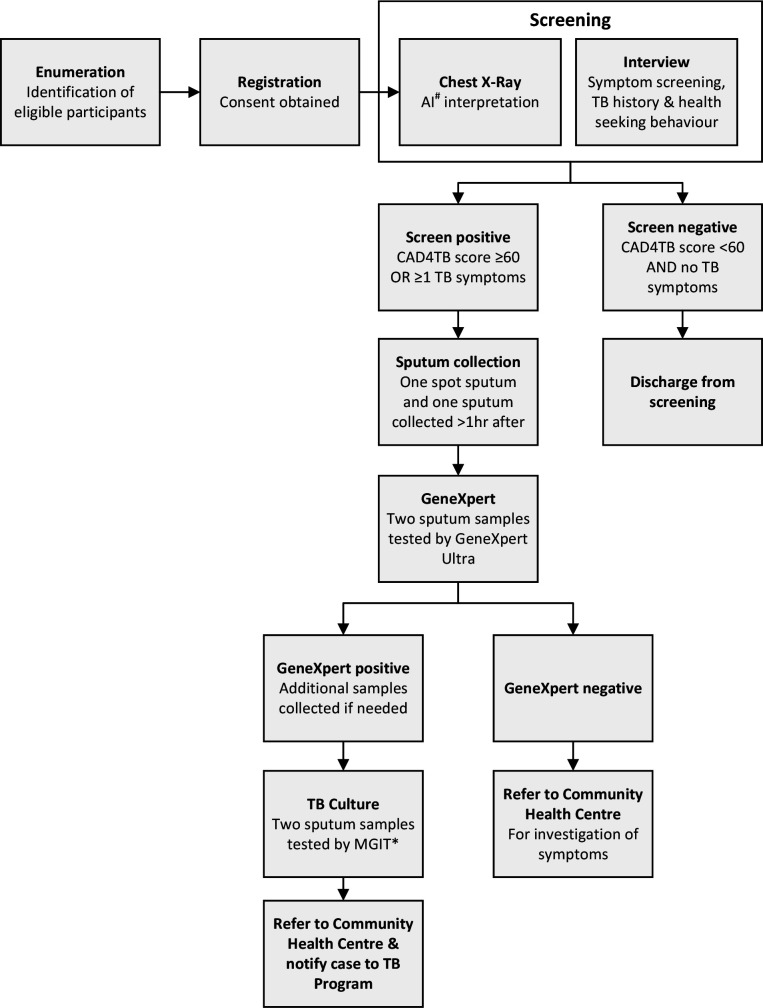
INTRODUCTION: Timor-Leste has one of the world's highest estimated tuberculosis (TB) incidences, yet the data which informs this estimate is limited and the true burden of TB disease is not known. TB prevalence surveys offer the best means of determining robust estimates of disease burden. This study aims to provide an estimate of the prevalence of bacteriologically confirmed pulmonary TB in Timor-Leste and provide additional insights into diagnostic coverage and health-seeking behaviour of persons with symptoms suggestive of TB. METHODS AND ANALYSIS: A national population-based cross-sectional cluster survey will be conducted in which participants aged 15 years and older will be screened for pulmonary TB using an algorithm consisting of symptom screening and digital X-ray of the chest with computer-aided detection software for X-ray interpretation. Xpert Ultra and liquid culture methods will be used to confirm survey TB cases. Additional data will be collected from persons reporting symptoms suggestive of TB to assess health-seeking behaviour and access to TB diagnosis and care. The survey aims to screen a target sample population of 20 068 people, living within 50 clusters, representing every municipality of Timor-Leste. Bacteriologically confirmed pulmonary TB prevalence will be estimated using WHO-recommended methods. ETHICS AND DISSEMINATION: Research ethics approval has been granted by the human research ethics committee of the Northern Territory, Australia, and the Instituto Nacional da Saúde, Timor-Leste. The results will be published in a peer-reviewed scientific journal and disseminated with relevant stakeholders. TRIAL REGISTRATION NUMBER: ACTRN12623000718640.
Overview
CoChat Summary
## TL;DR
This paper is a study protocol for a national cross-sectional TB prevalence survey in Timor-Leste, designed to estimate bacteriologically confirmed pulmonary TB prevalence among people aged 15 years and older. It also aims to assess diagnostic coverage and health-seeking behaviour among people with symptoms suggestive of TB.
## Key findings
- The survey plans to screen 20,068 people across 50 clusters, representing every municipality of Timor-Leste.
- The target population is people aged 15 years and older; the sample size is described as approximately 2.8% of the national population aged 15 years and older.
- The protocol states the survey will estimate bacteriologically confirmed pulmonary TB prevalence using WHO-recommended methods.
- The study is also designed to generate information on screening positivity, GeneXpert Ultra-positive TB cases, culture-confirmed TB cases, and prevalence-to-notification ratios.
## Methods
- Design: National population-based cross-sectional cluster survey conducted in Timor-Leste between September 2023 and December 2023.
- Sample/data: Eligible participants are aged 15+, resident in selected cluster areas for at least 2 weeks; the survey excludes people in congregate settings and those unable to consent.
- Main analysis: Screening uses symptom screening plus chest X-ray with CAD4TB v.7; screen-positive participants provide sputum for Xpert Ultra and MGIT liquid culture, and prevalence will be estimated with cluster-level and individual-level analyses including logistic regression and missing-data methods.
## Limitations
- The paper states that budget and laboratory capacity limitations preclude liquid culture testing if sputum is negative for TB on Xpert Ultra.
- The protocol notes that no local calibration study for the CAD4TB threshold was feasible; this is a stated constraint, and it may affect screening performance.
- Evidence evident from the text: this is a study protocol, so it reports planned methods and intended outcomes rather than actual results.
Model-written summary. Check it against the paper before relying on it.
Integrity signals
Registry
Cites
Statistics
Figures
Verification
Claims the paper makes
0 Valid · 0 Not valid · 14 Not checked · 17 Own results and interpretations
In the paper
“In high TB burden and resource constrained settings, such as Timor-Leste, where the treatment coverage rate (calculated as the number of notified TB cases/estimated number of incident TB cases) is low (50%, 95% CI: 35% to 75%),4 they are one of the few reliable ways to obtain such estimates.”
§ National cross-sectional cluster survey of tuberculosis prevalence in Timor-Leste: a study protocol > Introduction
What the sources say
- Not matchedcites [5] World Health Organization. Tuberculosis Prevalence Surveys: a handbook. Geneva: World Health Organization, 2011.
Its entry has no title and year that we can search by.
plain- Asserted: passes — The authors put it forward as true.
- Checkable: passes — It can be checked against evidence.
- Load-bearing: passes — The paper’s conclusions depend on it.
- Based: passes — The paper gives a reason why it holds.
- Not matched
In the paper
“Sample size calculation was conducted in line with WHO guidance for TB prevalence surveys.5”
§ National cross-sectional cluster survey of tuberculosis prevalence in Timor-Leste: a study protocol > Methods and analysis > Sample size
What the sources say
- Not matchedcites [5] World Health Organization. Tuberculosis Prevalence Surveys: a handbook. Geneva: World Health Organization, 2011.
Its entry has no title and year that we can search by.
plain- Asserted: passes — The authors put it forward as true.
- Checkable: passes — It can be checked against evidence.
- Load-bearing: passes — The paper’s conclusions depend on it.
- Based: passes — The paper gives a reason why it holds.
- Not matched
What the paper did — it cites no source for this, so there is none to check. The quote shows it is in the paper.
In the paper
“Due to anticipated differences in the burden of TB between urban and rural areas in Timor-Leste, stratification of the population into rural and urban areas was performed to ensure overall population representativeness.”
§ National cross-sectional cluster survey of tuberculosis prevalence in Timor-Leste: a study protocol > Methods and analysis > Sample size
plainstates a cause- Asserted: passes — The authors put it forward as true.
- Checkable: passes — It can be checked against evidence.
- Load-bearing: passes — The paper’s conclusions depend on it.
- Based: passes — The paper gives a reason why it holds.
In the paper
“The survey case definitions and testing algorithm are informed by WHO guidelines and advice from the survey’s technical working group and designed to be feasible, by minimising burden on the National TB Reference Laboratory, and have programmatic relevance in Timor-Leste by aligning with routine diagnostic practices and national case definitions.11”
§ National cross-sectional cluster survey of tuberculosis prevalence in Timor-Leste: a study protocol > Methods and analysis > Outcomes
What the sources say
- Not matchedcites [11] World Health Organization Country Office for Timor-Leste. Comprehensive TB guidelines for national tuberculosis program 5 ed. Dili: World Health Organization, 2020.
Its entry has no title and year that we can search by.
plain- Asserted: passes — The authors put it forward as true.
- Checkable: passes — It can be checked against evidence.
- Load-bearing: passes — The paper’s conclusions depend on it.
- Based: passes — The paper gives a reason why it holds.
- Not matched
In the paper
“The survey case definitions and testing algorithm are informed by WHO guidelines and advice from the survey’s technical working group and designed to be feasible, by minimising burden on the National TB Reference Laboratory, and have programmatic relevance in Timor-Leste by aligning with routine diagnostic practices and national case definitions.11”
§ National cross-sectional cluster survey of tuberculosis prevalence in Timor-Leste: a study protocol > Methods and analysis > Outcomes
What the sources say
- Not matchedcites [11] World Health Organization Country Office for Timor-Leste. Comprehensive TB guidelines for national tuberculosis program 5 ed. Dili: World Health Organization, 2020.
Its entry has no title and year that we can search by.
plainstates a cause- Asserted: passes — The authors put it forward as true.
- Checkable: passes — It can be checked against evidence.
- Load-bearing: unclear — It is unclear whether the paper’s conclusions depend on it.
- Based: passes — The paper gives a reason why it holds.
- Not matched
5 more claims
Create a free account to see all 31 claims and to verify the 3 references still open.
- Probably not a substantial claim. 19
- It may state two separate claims as one. 9
Citations
Cites
Harris, P. A., Taylor, R., Thielke, R., Payne, J., Gonzalez, N., & Conde, J. G. (2009) · Journal of Biomedical Informatics · doi:10.1016/j.jbi.2008.08.010 · Cited by 51,384
The REDCap consortium: building an international community of software platform partners
Harris, P. A., Taylor, R., Minor, B. L., Elliott, V., Fernandez, M., O'Neal, L., McLeod, L., Delacqua, G., Delacqua, F., Kirby, J., et al. (2019) · Journal of Biomedical Informatics · doi:10.1016/j.jbi.2019.103208 · Cited by 24,013
Law, I., Floyd, K., & the African TB Prevalence Survey Group (2020) · Tropical Medicine & International Health · doi:10.1111/tmi.13485 · Cited by 207
Onozaki, I., Law, I., Sismanidis, C., Zignol, M., Glaziou, P., & Floyd, K. (2015) · Tropical Medicine & International Health · doi:10.1111/tmi.12534 · Cited by 163
Analysis of tuberculosis prevalence surveys: new guidance on best-practice methods
Floyd, S., Sismanidis, C., Yamada, N., Daniel, R., Lagahid, J., Mecatti, F., Vianzon, R., Bloss, E., Tiemersma, E., Onozaki, I., et al. (2013) · Emerging Themes in Epidemiology · doi:10.1186/1742-7622-10-10 · Cited by 44
Deen, J. L., Matos, L. D. C., Temple, B., Su, J., da Silva, J., Liberato, S., da Silva, V., Soares, A. I. F. S., Joshi, V., Moon, S., et al. (2013) · Health Research Policy and Systems · doi:10.1186/1478-4505-11-8 · Cited by 42
The COVID-19 laboratory response in Timor-Leste: a story of collaboration
Sarmento, N., da Silva, E. S., Barreto, I. D. C., et al. (2023) · The Lancet Regional Health - Southeast Asia · doi:10.1016/j.lansea.2023.100150 · Cited by 9
Self-citation
Cited by
Freitas, J. D. C., Pires, A. M., Guterres, V. M. L., Amaral, A. C., & Tilman, Z. V. (2026) · Formosa Journal of Multidisciplinary Research · doi:10.55927/fjmr.v5i2.9
“…evidence indicates that infectious diseases such as tuberculosis, malaria, and dengue remain highly prevalent, while non-communicable diseases and mental health conditions are becoming increasingly prominent (Dawkins et al., 2015; Wangdi et al., 2018; Lopes et al., 2024; Lidia et al., 2024).”
Influential
Metadata
- Authors
- Lopes, C., Joao, J. C., Lowbridge, C., Martins, N., dos Santos, R. I. G., da Silva, E., Dias, J., Ramalingam, S., Amaral, S., Oakley, T., Ico, L. D. C., Sarmento, N., Yan, J., & Francis, J. R.
- Affiliations
- Ministry of Health, Dili, Timor-Leste
- Charles Darwin University (AU)
- Global and Tropical Health Division, Menzies School of Health Research, Charles Darwin University, Dili, Timor-Leste
- National Health Laboratory, Ministry of Health, Dili, Timor-Leste
- Corresponding author
- Lowbridge, Christopher
- ORCID
- Venue
- BMJ Open
- Publisher
- BMJ
- Published
- 2024-03
- Volume
- 14
- Issue
- 3
- Pages
- e079794
- ISSN
- 2044-6055 (ISSN-L)
- PMC
- PMC10928736
- OpenAlex
- W4392765755
- Cited by
- 0
- References
- 7
- FWCI
- 0.00
- Type
- journal article
- Language
- en
- Open access
- gold
- doi.org
- Licence
- Locations
- BMJ Open (publishedVersion, cc-by-nc)
- PubMed Central (publishedVersion, cc-by-nc)
- PubMed (publishedVersion)
- HighWire Press Open Archive (acceptedVersion)
- DOAJ (DOAJ: Directory of Open Access Journals) (submittedVersion, cc-by-sa)
- Funders
- Department of Foreign Affairs and Trade, Australian Government (76922)
- Topics
- Health Sciences › Medicine › Infectious Diseases › Tuberculosis Research and Epidemiology
- Health Sciences › Medicine › Public Health, Environmental and Occupational Health › HIV, TB, and STIs Epidemiology
- Health Sciences › Medicine › Infectious Diseases › Infectious Diseases and Tuberculosis
- Keywords
- tuberculosis prevalence, pulmonary tuberculosis, Timor-Leste, tuberculosis screening, computer-aided detection, Xpert Ultra, liquid culture, health-seeking behavior, diagnostic coverage
- MeSH terms
- Cross-Sectional Studies, Humans, Tuberculosis, Pulmonary, Northern Territory, Prevalence, Timor-Leste
About these checks
Registry, retraction, Cites and statistics results are computed, not judged, with one exception: a printed reference that no index lists is read once by a model before it counts as a citation error. Claims are extracted by a model and kept only when their quote appears verbatim in the text; each cited source is then checked, with a model’s help, for whether it says what the claim relies on. Those verdicts can be wrong — read the claim’s quote and the cited source before relying on one.
A language model drew the claims from the paper on 2026-10-10, under version 3 of the claim definition (model deepseek-v4.1-flash, prompt extract-v3).
A second model labelled each claim on 2026-10-10 (model jev-1.13-20260917, definition revision gold-guideline-v0.2).
Statistics and arithmetic are recomputed, not judged.
Confidence bands are shown only for fields calibrated on our annotated test set. None is calibrated yet, so no band is shown.
What counts as a claim ›How we measure confidence ›How we check this ›
Are you an author, or do you see a problem with this page? Request a review
Data sources
Bibliographic data: Semantic Scholar, OpenAlex, Crossref.
Contains information from the Semantic Scholar Academic Graph Datasets, made available under the ODC Attribution License (ODC-BY 1.0).
Semantic Scholar’s data is described in: Kinney, R., et al. (2023). The Semantic Scholar Open Data Platform. arXiv:2301.10140.
