

Understanding the preferences of young adults with type 2 diabetes mellitus with regard to diabetes self-management education: a qualitative study
Open accessThe DOI matches its Crossref record; 22 of the 22 references it cites were found in a registry or an index; 1 of the 22 sources its claims cite were checked for support.
Abstract
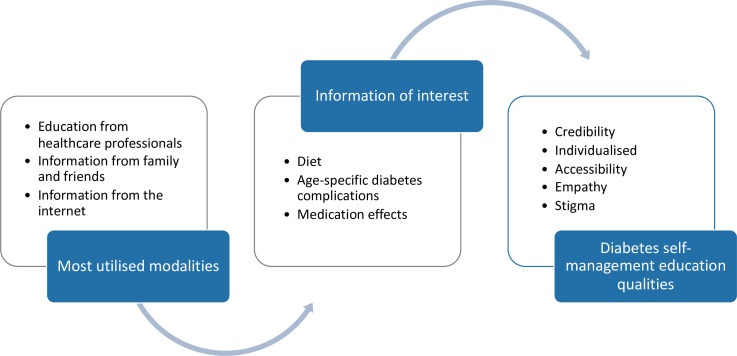
Aim: Young-onset type 2 diabetes (YOD) is associated with poorer clinical outcomes. To support the development of more effective diabetes self-management education (DSME) programmes, this study aimed to understand the preferences of young adults with YOD in relation to the modality, content and qualities of DSME. Methods: Maximal variation sampling was employed to recruit participants of varied age, ethnicity and marital status. In-depth interviews using a semistructured questionnaire were conducted. Subsequently, thematic analysis with coding and conceptualisation of data was applied to identify the main themes regarding DSME. Results: 21 young adult participants aged 22–39 years were interviewed from three polyclinics in Singapore. The most used modalities for DSME included education from healthcare providers, information and support from family and friends and information from internet sources. Participants were most interested in information regarding diet, age-specific diabetes-related conditions and medication effects. Additionally, participants valued DSME that was credible, accessible, individualised and empathetic. Conversely, absence of the above qualities and stigma hindered participants from receiving DSME. Conclusion: Our study explored the preferences of young adults with YOD with regard to DSME, identifying the most used modalities, preferred content and qualities that were valued by young adults. Our findings will help inform the development of DSME programmes that can better meet the needs and preferences of young adults with YOD.
Overview
CoChat Summary
TL;DR
In-depth interviews with 21 young adults with young-onset type 2 diabetes in Singapore found they used multiple diabetes self-management education (DSME) modalities and preferred content on diet, age-specific diabetes-related conditions, and medication effects. They valued DSME that was credible, accessible, individualised, empathetic, and avoided stigma.
Key findings
- The most used DSME modalities were education from healthcare providers (100%), information and support from family and friends (95.2%), and information from internet sources (85.7%).
- Participants were most interested in information about diet, age-specific diabetes-related conditions (including fertility concerns), and medication effects; when unconvinced about medication benefits or worried about side effects, some would not take medication or lower the dosage on their own, and often would not volunteer medication adherence behaviours to doctors.
- Five valued DSME qualities were identified: credibility, individualised care, accessibility, empathy, and avoidance of stigma; absence of these qualities and experiences of stigma hindered participants from receiving DSME.
Methods
- Qualitative study using in-depth semistructured interviews lasting 45–90 min with 21 participants aged 22–39 years with type 2 diabetes from three National Healthcare Group polyclinics in Singapore; maximal variation sampling was used for varied age, gender, ethnicity, and marital status, with interviews conducted April 2019–April 2021.
- Reflexive thematic analysis with an inductive approach was used; open coding was conducted independently by two study team members, themes were refined iteratively with team triangulation, and NVivo V.12 was used for analysis. Recruitment ceased at data saturation.
Limitations
- Stated: the study was conducted in a multiethnic Asian population in a developed nation and may not be generalisable to more resource-deficient populations; participants were recruited during clinic visits, so the experiences of young adults who avoided clinic visits may not be captured; social desirability bias may have occurred, potentially increased because two of the three interviewers were practising clinicians.
- Evident from reported sample characteristics: the qualitative design and small sample (21 participants) limit generalisability, and the sample was predominantly aged 30–39 years (16/21) and married (13/21), so younger and single perspectives may be less represented.
Model-written summary. Check it against the paper before relying on it.
Integrity signals
Registry
Cites
Statistics
Figures
Verification
Claims the paper makes
1 Valid · 0 Not valid · 15 Not checked · 42 Own results and interpretations
The cited sources support only part of this claim — read each source’s verdict below.
In the paper
“Previous studies similarly identified accessibility as a key reason for preferring technology-based DSME.19 20”
§ Understanding the preferences of young adults with type 2 diabetes mellitus with regard to diabetes self-management education: a qualitative study > Discussion
What the sources say
- Not checked yetcites [19] Jain SR, Sui Y, Ng CH, et al. Patients’ and healthcare professionals’ perspectives towards technology-assisted diabetes self-management education. a qualitative systematic review. Plos One 2020; 15. 10.1371/journal.pone.0237647 PMC7430746 32804989 source
Checked before — its earlier verdict is held back until a new check runs.
- Partly supportedcites [20] Greenwood DA, Gee PM, Fatkin KJ, et al. A systematic review of reviews evaluating technology-enabled diabetes self-management education and support. J Diabetes Sci Technol 2017; 11: 1015– 27. 10.1177/1932296817713506 28560898 PMC5951000 sourceExperimental — accuracy not yet measured
Greenwood et al. (2017) do treat access as an advantage of technology-enabled DSMES: the Discussion states that such solutions 'will facilitate engagement at these key times by reducing barriers of travel time and cost, time away from work or family,' and the Conclusion/Abstract say digital solutions 'can improve the reach of and access to diabetes self-management education and ongoing support' (with a related point that those affected by the 'digital divide' may gain greater access). However, these are the review authors' own inferences and forward-looking statements, not findings reported from prior studies; the review's extracted results concern A1c reduction and the four TES feedback-loop elements (2-way communication, PGHD, education, feedback), and no passage in our copy reports participant preference for technology-based education or accessibility as a key reason for that preference. So the accessibility-as-benefit part is supported, while 'previous studies identified accessibility as a key reason for preferring technology-based DSME' is not. (LLM, conf=0.72)
plainstates a cause- Asserted: passes — The authors put it forward as true.
- Checkable: passes — It can be checked against evidence.
- Load-bearing: unclear — It is unclear whether the paper’s conclusions depend on it.
- Based: passes — The paper gives a reason why it holds.
- Not checked yet
A result the paper reports from its own data — it cites no other source for it, so there is none to check. The quote shows it is in the paper.
In the paper
“Participants wanted to better understand how diabetes medications worked and their side effects.”
§ Understanding the preferences of young adults with type 2 diabetes mellitus with regard to diabetes self-management education: a qualitative study > Results > DSME information of interest
plain- Asserted: passes — The authors put it forward as true.
- Checkable: passes — It can be checked against evidence.
- Load-bearing: passes — The paper’s conclusions depend on it.
- Based: passes — The paper gives a reason why it holds.
A result the paper reports from its own data — it cites no other source for it, so there is none to check. The quote shows it is in the paper.
In the paper
“Participants perceived that diet had the greatest impact on glycaemic levels and wanted to know what types of food were beneficial for their diabetes.”
§ Understanding the preferences of young adults with type 2 diabetes mellitus with regard to diabetes self-management education: a qualitative study > Results > DSME information of interest
plain- Asserted: passes — The authors put it forward as true.
- Checkable: passes — It can be checked against evidence.
- Load-bearing: unclear — It is unclear whether the paper’s conclusions depend on it.
- Based: passes — The paper gives a reason why it holds.
A result the paper reports from its own data — it cites no other source for it, so there is none to check. The quote shows it is in the paper.
In the paper
“Interestingly, participants perceived that information from friends and family with experience in diabetes care was very credible, highlighting the influence of vicarious experiences.”
§ Understanding the preferences of young adults with type 2 diabetes mellitus with regard to diabetes self-management education: a qualitative study > Discussion
plain- Asserted: passes — The authors put it forward as true.
- Checkable: passes — It can be checked against evidence.
- Load-bearing: passes — The paper’s conclusions depend on it.
- Based: passes — The paper gives a reason why it holds.
A result the paper reports from its own data — it cites no other source for it, so there is none to check. The quote shows it is in the paper.
In the paper
“Additionally, participants valued DSME that was credible, accessible, individualised and empathetic.”
- Also stated in: § DSME qualities valued · plain
“Participants had multiple commitments and faced conflicting demands on their time; therefore, they preferred DSME that was highly accessible and provided information whenever needed, like through mobile applications.”
§ Understanding the preferences of young adults with type 2 diabetes mellitus with regard to diabetes self-management education: a qualitative study > Abstract > Results
plainn = 21- Asserted: passes — The authors put it forward as true.
- Checkable: passes — It can be checked against evidence.
- Load-bearing: passes — The paper’s conclusions depend on it.
- Based: passes — The paper gives a reason why it holds.
- Also stated in: § DSME qualities valued · plain
22 more claims
Create a free account to see all 58 claims and to verify the 21 references still open.
- It may state two separate claims as one. 17
- Probably not a substantial claim. 16
- The quote only partly states this claim. 3
Claims other papers make about this one
Each is checked against this paper’s own text: does it say what the citing paper says it does?
In the citing paper
“Similarly, Sim et al. described stigma arising from the self, others and healthcare professionals, which could discourage treatment-related behaviors such as medication taking (24).”
From Living with early-onset type 2 diabetes in young adulthood: a narrative review of lived experience and implications for developmentally appropriate care (2026) · cites this paper as [24]
In the citing paper
“Qualitative studies suggest that young adults with early-onset T2DM may interpret their diagnosis in relation to its perceived implications for future health, relationships and family life (24).”
From Living with early-onset type 2 diabetes in young adulthood: a narrative review of lived experience and implications for developmentally appropriate care (2026) · cites this paper as [24]
In the citing paper
“They valued practical information on diet, fertility, age-related complications and medication effects, especially when delivered in a credible, individualized, empathetic and non-stigmatizing manner (24, 33, 50).”
From Living with early-onset type 2 diabetes in young adulthood: a narrative review of lived experience and implications for developmentally appropriate care (2026) · cites this paper as [24]
In the citing paper
“Participants described limited consultation time as restricting opportunities to discuss important concerns”
From Living with early-onset type 2 diabetes in young adulthood: a narrative review of lived experience and implications for developmentally appropriate care (2026) · cites this paper as [24]
In the citing paper
“while medical jargon could reduce understanding and discouraged help-seeking (24).”
From Living with early-onset type 2 diabetes in young adulthood: a narrative review of lived experience and implications for developmentally appropriate care (2026) · cites this paper as [24]
17 more claims about this paper
Create a free account to see every claim other papers make about this one.
Self-check
Percentages, sums and reported differences re-computed from the paper’s own numbers.
Rated minor: it would not touch a result — a value no result rests on, a p-value that stays on the same side of the significance level, or a conflict that is clerical, resolved elsewhere in the paper, or outside its own findings.
In the paper
“11 participants (42.4%) had a diploma”
§ Understanding the preferences of young adults with type 2 diabetes mellitus with regard to diabetes self-management education: a qualitative study > Results > Participant characteristics
Reported 42.4 · recomputed 52.380952
Rated minor: it would not touch a result — a value no result rests on, a p-value that stays on the same side of the significance level, or a conflict that is clerical, resolved elsewhere in the paper, or outside its own findings.
In the paper
“6 (42.9%) participants had up to secondary education”
§ Understanding the preferences of young adults with type 2 diabetes mellitus with regard to diabetes self-management education: a qualitative study > Results > Participant characteristics
Reported 42.9 · recomputed 28.571429
Citations
Cites
Standards for Reporting Qualitative Research: A Synthesis of Recommendations
O’Brien, B. C., Harris, I. B., Beckman, T. J., Reed, D. A., & Cook, D. A. (2014) · Academic Medicine · doi:10.1097/acm.0000000000000388 · Cited by 12,211
Sample sizes for saturation in qualitative research: A systematic review of empirical tests
Hennink, M., & Kaiser, B. N. (2022) · Social Science & Medicine · doi:10.1016/j.socscimed.2021.114523 · Cited by 6,311
A worked example of Braun and Clarke’s approach to reflexive thematic analysis
Byrne, D. (2022) · Quality & Quantity · doi:10.1007/s11135-021-01182-y · Cited by 5,355
Physician Communication and Patient Adherence to Treatment: A Meta-Analysis
Haskard Zolnierek, K. B., & DiMatteo, M. R. (2009) · Medical Care · doi:10.1097/mlr.0b013e31819a5acc · Cited by 2,489
National Standards for Diabetes Self-Management Education and Support
Haas, L., Maryniuk, M., Beck, J., Cox, C. E., Duker, P., Edwards, L., Fisher, E. B., Hanson, L., Kent, D., Kolb, L., et al. (2012) · Diabetes Care · doi:10.2337/dc12-1707 · Cited by 663
Greenwood, D. A., Gee, P. M., Fatkin, K. J., & Peeples, M. (2017) · Journal of Diabetes Science and Technology · doi:10.1177/1932296817713506 · Cited by 526
Young-onset type 2 diabetes mellitus — implications for morbidity and mortality
Magliano, D. J., Sacre, J. W., Harding, J. L., Gregg, E. W., Zimmet, P. Z., & Shaw, J. E. (2020) · Nature Reviews Endocrinology · doi:10.1038/s41574-020-0334-z · Cited by 483
Yeung, R. O., Zhang, Y., Luk, A., Yang, W., Sobrepena, L., Yoon, K.-H., Aravind, S. R., Sheu, W., Nguyen, T. K., Ozaki, R., et al. (2014) · The Lancet Diabetes & Endocrinology · doi:10.1016/s2213-8587(14)70137-8 · Cited by 296
Diabetes self-management education core outcomes measures
Mulcahy, K., Maryniuk, M., Peeples, M., Peyrot, M., Tomky, D., Weaver, T., & Yarborough, P. (2003) · The Diabetes Educator · doi:10.1177/014572170302900509 · Cited by 273
The effectiveness of family interventions in people with diabetes mellitus: a systematic review
Armour, T. A., Norris, S. L., Jack, L., Zhang, X., & Fisher, L. (2005) · Diabetic Medicine · doi:10.1111/j.1464-5491.2005.01618.x · Cited by 193
Browne, J. L., Nefs, G., Pouwer, F., & Speight, J. (2015) · Diabetic Medicine · doi:10.1111/dme.12566 · Cited by 89
Jain, S. R., Sui, Y., Ng, C. H., Chen, Z. X., Goh, L. H., & Shorey, S. (2020) · PLOS ONE · doi:10.1371/journal.pone.0237647 · Cited by 70
Cioana, M., Deng, J., Nadarajah, A., Hou, M., Qiu, Y., Chen, S. S. J., Rivas, A., Banfield, L., Alfaraidi, H., Alotaibi, A., et al. (2022) · JAMA Network Open · doi:10.1001/jamanetworkopen.2021.47454 · Cited by 52
Nanayakkara, N., Pease, A. J., Ranasinha, S., Wischer, N., Andrikopoulos, S., de Courten, B., & Zoungas, S. (2018) · Diabetic Medicine · doi:10.1111/dme.13660 · Cited by 48
The Cardiometabolic Risk Profile of Young Adults With Diabetes in the U.S.
Saydah, S. H., Siegel, K. R., Imperatore, G., Mercado, C., & Gregg, E. W. (2019) · Diabetes Care · doi:10.2337/dc19-0707 · Cited by 44
The increasing trend of type 2 diabetes in youth: an overview
Buttermore, E., Campanella, V., & Priefer, R. (2021) · Diabetes & Metabolic Syndrome: Clinical Research & Reviews · doi:10.1016/j.dsx.2021.102253 · Cited by 38
Identifying barriers and facilitators to self care in young adults with type 2 diabetes
Wong, S. K. W., Soon, W., Griva, K., & Smith, H. E. (2024) · Diabetic Medicine · doi:10.1111/dme.15229 · Cited by 33
Self-citationInitial Glycemic Control and Care Among Younger Adults Diagnosed With Type 2 Diabetes
Gopalan, A., Mishra, P., Alexeeff, S. E., Blatchins, M. A., Kim, E., Man, A., Karter, A. J., & Grant, R. W. (2020) · Diabetes Care · doi:10.2337/dc19-1380 · Cited by 33
The education and information needs of young adults with type 2 diabetes: a qualitative study
Savage, S., Dabkowski, S., & Dunning, T. (2009) · Journal of Nursing and Healthcare of Chronic Illness · doi:10.1111/j.1752-9824.2009.01035.x · Cited by 23
Transitioning Into Adulthood: Striking a Balance Between Support and Independence
Schneider, B., Klager, C., Chen, I.-C., & Burns, J. (2016) · Policy Insights from the Behavioral and Brain Sciences · doi:10.1177/2372732215624932 · Cited by 21 · cited 1×
“These findings may guide the development of more effective DSME programmes that have a greater reach.”
BackgroundYoung‐onset type 2 diabetes: A neglected group requiring urgent attention
Song, S. H., & Frier, B. M. (2022) · Diabetic Medicine · doi:10.1111/dme.14903 · Cited by 11
Wong, S. K. W., Soon, W., Griva, K., & Smith, H. E. (2024) · Diabetic Medicine · doi:10.1111/dme.15207 · Cited by 7
Self-citation
Cited by
Khavere, S., Hadjiconstantinou, M., Miksza, J., Hagan, J., Salisu‐Olatunji, S., Naderpour, S., Hassen, S. N., Karimi, Z., & Gillies, C. L. (2025) · Diabetic Medicine · doi:10.1111/dme.70127 · Cited by 10
Jiang, X., Jiang, H., Tang, R., & Li, M. (2026) · Patient Preference and Adherence · doi:10.2147/ppa.s581035 · Cited by 3
Caba, M., Carvalho, M., Forbes, A., Forde, R., Gill, K., Khalifa, M., Parsons, J., Speight, J., Trief, P. M., & Hadjiconstantinou, M. (2026) · Diabetic Medicine · doi:10.1111/dme.70352 · Cited by 2
Digital Management of Early-Onset Type 2 Diabetes: Empowerment, Challenges, and Future Outlook
Guo, L.-J., Low, K.-S., Tae, S.-K., & Lim, L.-L. (2026) · Current Diabetes Reports · doi:10.1007/s11892-026-01633-6
Chen, Y., Jiang, S., Qi, Y., Yi, T. C., Hu, Y., Wang, Y., Xie, Z., & Dong, C. (2026) · Journal of Advanced Nursing · doi:10.1111/jan.70698
Metadata
- Authors
- Sim, R. R. J., Soon, W., Smith, H. E., Griva, K., & Wong, S. K. W.
- Affiliations
- Ministry of Health (SG)
- NHG Polyclinics (SG)
- Keele University (GB)
- National University of Singapore (SG)
- Corresponding author
- Wong, Sabrina Kay Wye
- Venue
- BMJ Open
- Publisher
- BMJ
- Published
- 2024-07
- Volume
- 14
- Issue
- 7
- Pages
- e086133
- ISSN
- 2044-6055 (ISSN-L)
- PMC
- PMC11227779
- OpenAlex
- W4400309705
- Semantic Scholar
- 608d1cd301f5cb77e48375803647c713ae0a7916
- Cited by
- 11
- References
- 22
- Citations by year
- 2026: 7 · 2025: 3 · 2024: 1
- FWCI
- 2.54
- Type
- journal article
- Language
- en
- Open access
- gold
- doi.org
- Licence
- Locations
- BMJ Open (publishedVersion, cc-by-nc)
- PubMed Central (publishedVersion, cc-by-nc)
- PubMed (publishedVersion)
- DOAJ (DOAJ: Directory of Open Access Journals) (submittedVersion)
- HighWire Press Open Archive (submittedVersion)
- Funders
- National Medical Research Council (NMRC/CG/ C019/2017, NMRC/Fellowship/ 0047/2017)
- Topics
- Health Sciences › Medicine › Endocrinology, Diabetes and Metabolism › Diabetes Management and Education
- Health Sciences › Medicine › Endocrinology, Diabetes and Metabolism › Diabetes Management and Research
- Health Sciences › Medicine › Endocrinology, Diabetes and Metabolism › Diabetes Treatment and Management
- Keywords
- youth-onset type 2 diabetes, diabetes self-management education, patient preferences, young adults, family and peer support, online health information, diabetes stigma, nutrition education, medication effects, individualised education, provider communication
- MeSH terms
- Self-Management, Adult, Diabetes Mellitus, Type 2, Female, Humans, Male, Patient Education as Topic, Surveys and Questionnaires, Singapore, Qualitative Research, Young Adult, Patient Preference
About these checks
Registry, retraction, Cites and statistics results are computed, not judged, with one exception: a printed reference that no index lists is read once by a model before it counts as a citation error. Claims are extracted by a model and kept only when their quote appears verbatim in the text; each cited source is then checked, with a model’s help, for whether it says what the claim relies on. Those verdicts can be wrong — read the claim’s quote and the cited source before relying on one.
The claim verdicts this report counts are experimental: their accuracy is not yet measured.
A language model drew the claims from the paper on 2026-11-20, under version 3 of the claim definition (model deepseek-v4.1-flash, prompt extract-v3).
A second model labelled each claim on 2026-11-20 (model jev-1.13-20260917, definition revision gold-guideline-v0.2).
Cited sources are checked with a language model’s help (qwen3.8-omni-flash).
Statistics and arithmetic are recomputed, not judged.
Confidence bands are shown only for fields calibrated on our annotated test set. None is calibrated yet, so no band is shown.
What counts as a claim ›How we measure confidence ›How we check this ›
Are you an author, or do you see a problem with this page? Request a review
Data sources
Bibliographic data: Semantic Scholar, OpenAlex, Crossref.
Contains information from the Semantic Scholar Academic Graph Datasets, made available under the ODC Attribution License (ODC-BY 1.0).
Semantic Scholar’s data is described in: Kinney, R., et al. (2023). The Semantic Scholar Open Data Platform. arXiv:2301.10140.
