

Association between GLP-1 receptor agonists and alcohol-related hospitalisations among adults with alcohol use disorder: multi-target trial emulation study
Open accessThe DOI matches its Crossref record; 35 of the 35 references it cites were found in a registry or an index; 1 of the 26 sources its claims cite were checked for support.
Abstract
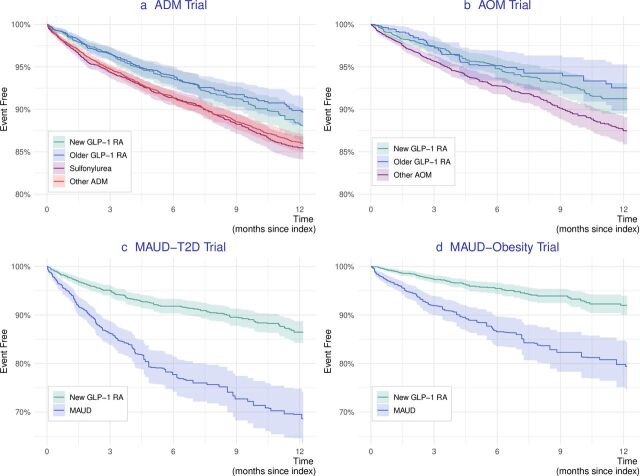
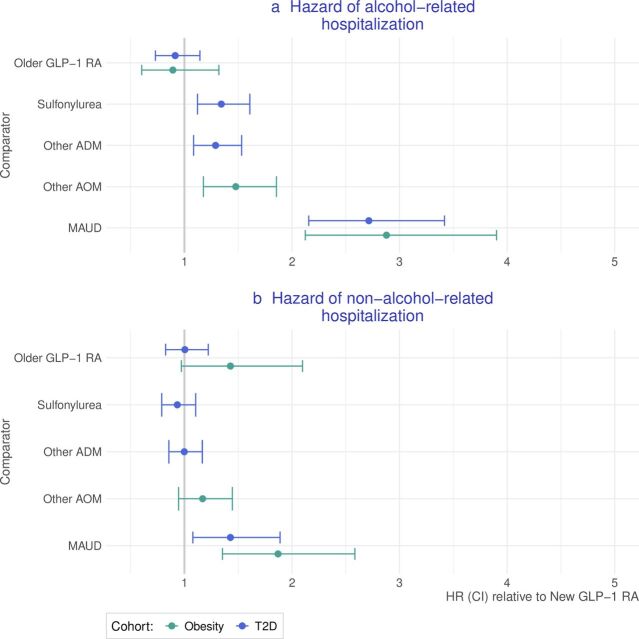
Objective: To evaluate the association between use of newer glucagon-like peptide-1 receptor agonists (GLP-1 RAs; semaglutide, tirzepatide) and alcohol-related hospitalisations among adults with alcohol use disorder (AUD) and type 2 diabetes (T2D) or obesity. Retrospective cohort study using target trial emulation. Setting: Electronic health record data from a collective of US healthcare systems. Participants: Adults with AUD and T2D or obesity who started a newer GLP-1 RA (semaglutide or tirzepatide) or a relevant active comparator between 1 January 2018 and 31 December 2024. Interventions: Initiation of a newer GLP-1 RA compared with an active comparator across four target trials: (1) anti-diabetic medication (ADM) trial, (2) anti-obesity medication (AOM) trial, (3) medications for alcohol use disorder with T2D (MAUD-T2D) trial, and (4) medications for alcohol use disorder with obesity (MAUD-obesity) trial. Main outcome measures: Time to first alcohol-related emergency department visits or hospitalisation within 1 year of treatment initiation. Non-alcohol-related hospitalisation was assessed as a negative control outcome. Propensity score based methods (weighting and matching) were used to control confounding and Cox proportional hazards models were used to estimate treatment effects. Results: A total of 40 703 adults met study criteria, including 18 676 in the ADM trial, 9391 in the AOM trial, 8942 in the MAUD-T2D trial and 11 198 in the MAUD-obesity trial. Initiation of a newer GLP-1 RA was associated with a lower hazard of alcohol-related hospitalisation in the ADM trial (HR 0.74, 95% CI 0.62 to 0.89 vs sulfonylureas; HR 0.78, 95% CI 0.65 to 0.92 vs other ADMs), the AOM trial (HR 0.68, 95% CI 0.54 to 0.85 vs other AOMs), the MAUD-T2D trial (HR 0.37, 95% CI 0.29 to 0.46) and the MAUD-obesity trial (HR 0.35, 95% CI 0.26 to 0.47). Conclusions: Among adults with AUD and T2D or obesity, initiation of newer GLP-1 RAs was associated with a lower observed risk of alcohol-related hospitalisation.
Overview
CoChat Summary
TL;DR
In a multi-target trial emulation using US EHR data from 40,703 adults with alcohol use disorder (AUD) and type 2 diabetes (T2D) or obesity, initiation of newer GLP-1 receptor agonists (semaglutide or tirzepatide) was associated with lower hazards of alcohol-related hospitalisation versus several active comparators. Associations were strongest in the MAUD trials, but negative-control findings in those trials suggested residual confounding.
Key findings
- Among 40,703 adults meeting criteria, newer GLP-1 RA initiation was associated with lower alcohol-related hospitalisation hazards in the ADM trial versus sulfonylureas (HR 0.74, 95% CI 0.62 to 0.89) and other anti-diabetic medications (HR 0.78, 95% CI 0.65 to 0.92), but not versus older GLP-1 RAs (HR 1.09, 95% CI 0.87 to 1.37).
- In the AOM trial, newer GLP-1 RAs were associated with lower hazard versus other anti-obesity medications (HR 0.68, 95% CI 0.54 to 0.85), but not versus older GLP-1 RAs (HR 1.12, 95% CI 0.76 to 1.66).
- In the MAUD-T2D trial, the hazard ratio was 0.37 (95% CI 0.29 to 0.46); in the MAUD-obesity trial, it was 0.35 (95% CI 0.26 to 0.47).
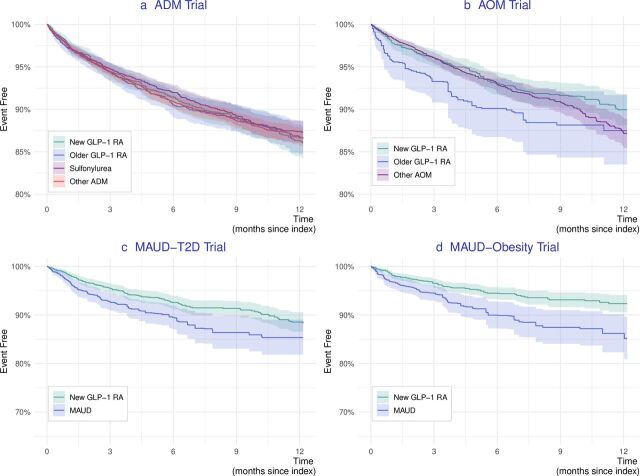
- Non-alcohol-related hospitalisations did not differ significantly in the ADM and AOM trials, but newer GLP-1 RAs were associated with lower risk in the MAUD-T2D trial (HR 0.70, 95% CI 0.53 to 0.93) and MAUD-obesity trial (HR 0.54, 95% CI 0.41 to 0.73), indicating possible residual confounding.
Methods
- Retrospective cohort study using target trial emulation with Truveta electronic health record data from a collective of 30 US healthcare systems, representing care for more than 120 million patients; data accessed 1 April 2025.
- Included adults with AUD and T2D or obesity who newly initiated a newer GLP-1 RA (semaglutide or tirzepatide) or an active comparator between 1 January 2018 and 31 December 2024, across four target trials: ADM (n=18,676), AOM (n=9,391), MAUD-T2D (n=8,942), and MAUD-obesity (n=11,198).
- Primary outcome was time to first alcohol-related emergency department visit or hospitalisation within 1 year; non-alcohol-related hospitalisation was a negative control. Propensity score weighting or matching, inverse probability of censoring weights, weighted Kaplan–Meier curves, and Cox proportional hazards models with robust standard errors were used; sensitivity analysis restricted outcomes to diagnostic-code-defined events.
Limitations
- Stated: AUD is likely under-captured and variably documented due to stigmatisation and healthcare-system differences, which may affect outcome ascertainment.
- Stated: residual confounding remains possible from unmeasured socioeconomic status, clinical stability, AUD severity, healthcare engagement, and access to higher-cost GLP-1 RAs; absence of blinding precludes assessment of expectation effects.
- Stated: alcohol-related outcomes relied on diagnosis codes and laboratory testing, which may be misclassified or under-captured, and no severity measure or quantitative alcohol-use biomarker was available; on-treatment analyses censored at discontinuation or switching may introduce bias and limit generalisability. The MAUD trials had high discontinuation (>80% of comparator groups censored) and negative-control associations, so those estimates should be interpreted with greater caution.
Model-written summary. Check it against the paper before relying on it.
Integrity signals
Registry
Cites
Statistics
Figures
Verification
Claims the paper makes
1 Valid · 0 Not valid · 18 Not checked · 92 Own results and interpretations
The sources with a verdict support this claim; the rest weren’t checked yet, have no full text we could read, or their verdicts aren’t rated yet.
In the paper
“The findings for newer GLP-1 RAs in the ADM and AOM trials (HRs ranging from 0.68 to 0.78 depending on the trial) parallel effects observed in a nationwide Swedish registry study that evaluated the effect of semaglutide on AUD hospitalisations (HR 0.64, 95% CI 0.50 to 0.83)13 and a US study that evaluated recurrent AUD hospitalisations among patients with T2D (HR 0.61, 95% CI 0.50 to 0.75).15”
§ Association between GLP-1 receptor agonists and alcohol-related hospitalisations among adults with alcohol use disorder: multi-target trial emulation study > Discussion
What the sources say
- Supportedcites [13] Lähteenvuo M, Tiihonen J, Solismaa A, et al. Repurposing Semaglutide and Liraglutide for Alcohol Use Disorder. JAMA Psychiatry 2025; 82: 94– 8. 10.1001/jamapsychiatry.2024.3599 39535805 PMC11561716 source
The Results section 'Risk of Hospitalization Due to AUD and SUD' reports exactly the figure attributed here: use of semaglutide was associated with the lowest risk of AUD hospitalization (aHR, 0.64; 95% CI, 0.50-0.83) in this nationwide Swedish register-based cohort of residents with AUD (Abstract; Discussion). The citing sentence's characterization of the source as 'a nationwide Swedish registry study that evaluated the effect of semaglutide on AUD hospitalisations' matches the paper's design (periods of GLP-1 agonist use vs nonuse). The parallel US study (HR 0.61) carries a different citation and is not judged against this source, and the 'parallel effects' comparison with the ADM/AOM trials is the citing authors' own inference rather than a claim made by this paper. (LLM, conf=0.90)
- Not checked yetcites [15] Wang W, Volkow ND, Berger NA, et al. Associations of semaglutide with incidence and recurrence of alcohol use disorder in real-world population. Nat Commun 2024; 15: 4548. 10.1038/s41467-024-48780-6 38806481 PMC11133479 source
plainstates an association- Asserted: passes — The authors put it forward as true.
- Checkable: passes — It can be checked against evidence.
- Load-bearing: passes — The paper’s conclusions depend on it.
- Based: passes — The paper gives a reason why it holds.
- Supported
A result the paper reports from its own data — it cites no other source for it, so there is none to check. The quote shows it is in the paper.
In the paper
“but not when compared with older GLP-1 RAs (HR 1.12, 95% CI 0.76 to 1.66)”
§ Association between GLP-1 receptor agonists and alcohol-related hospitalisations among adults with alcohol use disorder: multi-target trial emulation study > Results > AOM trial
plain- Asserted: passes — The authors put it forward as true.
- Checkable: passes — It can be checked against evidence.
- Load-bearing: passes — The paper’s conclusions depend on it.
- Based: passes — The paper gives a reason why it holds.
A result the paper reports from its own data — it cites no other source for it, so there is none to check. The quote shows it is in the paper.
In the paper
“Initiation of a newer GLP-1 RA was associated with a lower hazard of alcohol-related hospitalisation in the ADM trial (HR 0.74, 95% CI 0.62 to 0.89 vs sulfonylureas; HR 0.78, 95% CI 0.65 to 0.92 vs other ADMs), the AOM trial (HR 0.68, 95% CI 0.54 to 0.85 vs other AOMs), the MAUD-T2D trial (HR 0.37, 95% CI 0.29 to 0.46) and the MAUD-obesity trial (HR 0.35, 95% CI 0.26 to 0.47).”
- Also stated in: § Study design · plain
“Comparators: approved MAUD (naltrexone, disulfiram, acamprosate)”
§ Association between GLP-1 receptor agonists and alcohol-related hospitalisations among adults with alcohol use disorder: multi-target trial emulation study > Abstract > Results
plainstates an association- Asserted: passes — The authors put it forward as true.
- Checkable: passes — It can be checked against evidence.
- Load-bearing: passes — The paper’s conclusions depend on it.
- Based: passes — The paper gives a reason why it holds.
- Also stated in: § Study design · plain
A result the paper reports from its own data — it cites no other source for it, so there is none to check. The quote shows it is in the paper.
In the paper
“In the MAUD trials, however, treatment with a newer GLP-1 RA was associated with a lower risk of non-alcohol-related hospitalisation compared with MAUD in the MAUD-T2D trial (HR 0.70, 95% CI 0.53 to 0.93; e-value 2.3)”
§ Association between GLP-1 receptor agonists and alcohol-related hospitalisations among adults with alcohol use disorder: multi-target trial emulation study > Results > Negative control outcomes
plainstates an association- Asserted: passes — The authors put it forward as true.
- Checkable: passes — It can be checked against evidence.
- Load-bearing: unclear — It is unclear whether the paper’s conclusions depend on it.
- Based: passes — The paper gives a reason why it holds.
A result the paper reports from its own data — it cites no other source for it, so there is none to check. The quote shows it is in the paper.
In the paper
“Newer GLP-1 RAs were associated with a lower hazard of alcohol-related hospitalisation compared with sulfonylureas (HR 0.74, 95% CI 0.62 to 0.89; e-value 2.0)”
§ Association between GLP-1 receptor agonists and alcohol-related hospitalisations among adults with alcohol use disorder: multi-target trial emulation study > Results > ADM trial
plainstates an association- Asserted: passes — The authors put it forward as true.
- Checkable: passes — It can be checked against evidence.
- Load-bearing: passes — The paper’s conclusions depend on it.
- Based: passes — The paper gives a reason why it holds.
33 more claims
Create a free account to see all 111 claims and to verify the 20 references still open.
- It may state two separate claims as one. 48
- Probably not a substantial claim. 38
Citations
Cites
The central role of the propensity score in observational studies for causal effects
ROSENBAUM, P. R., & RUBIN, D. B. (1983) · Biometrika · doi:10.1093/biomet/70.1.41 · Cited by 31,241
Comorbidity measures for use with administrative data.
Elixhauser, A., Steiner, C., Harris, D. R., & Coffey, R. M. (1998) · Medical Care · doi:10.1097/00005650-199801000-00004 · Cited by 9,921
Sensitivity analysis in observational research: Introducing the E-value
VanderWeele, T. J., & Ding, P. (2017) · Annals of Internal Medicine · doi:10.7326/m16-2607 · Cited by 6,350
Marginal Structural Models and Causal Inference in Epidemiology
Robins, J. M., Hernán, M. Á., & Brumback, B. (2000) · Epidemiology · doi:10.1097/00001648-200009000-00011 · Cited by 5,581
Rosenbaum, P. R., & Rubin, D. B. (1985) · The American Statistician · doi:10.2307/2683903 · Cited by 4,774
Tirzepatide versus Semaglutide Once Weekly in Patients with Type 2 Diabetes
Frías, J. P., Davies, M. J., Rosenstock, J., Pérez Manghi, F. C., Fernández Landó, L., Bergman, B. K., Liu, B., Cui, X., & Brown, K. (2021) · New England Journal of Medicine · doi:10.1056/nejmoa2107519 · Cited by 2,096 · cited 1×
“17–19 While these metabolic effects are not directly related to alcohol use, they may reflect broader effects on reward pathways and appetite regulation that could also influence alcohol consumption and related outcomes.”
2010 National and State Costs of Excessive Alcohol Consumption
Sacks, J. J., Gonzales, K. R., Bouchery, E. E., Tomedi, L. E., & Brewer, R. D. (2015) · American Journal of Preventive Medicine · doi:10.1016/j.amepre.2015.05.031 · Cited by 1,180
Estimating causal effects from epidemiological data
Hernán, M. A., & Robins, J. M. (2006) · Journal of Epidemiology and Community Health · doi:10.1136/jech.2004.029496 · Cited by 1,028
Garbutt, J. C., Kranzler, H. R., O’Malley, S. S., Gastfriend, D. R., Pettinati, H. M., Silverman, B. L., Loewy, J. W., Ehrich, E. W., & Vivitrex Study Group, F. T. (2005) · JAMA · doi:10.1001/jama.293.13.1617 · Cited by 635
Tirzepatide as Compared with Semaglutide for the Treatment of Obesity
Aronne, L. J., Horn, D. B., le Roux, C. W., Ho, W., Falcon, B. L., Gomez Valderas, E., Das, S., Lee, C. J., Glass, L. C., Senyucel, C., et al. (2025) · New England Journal of Medicine · doi:10.1056/nejmoa2416394 · Cited by 634
Cited by
Тимербулатов, И. Ф., Evdokimova, T. E., Tetenova, E. J., & Надеждин, А. В. (2026) · Vestnik nevrologii psihiatrii i nejrohirurgii (Bulletin of Neurology Psychiatry and Neurosurgery) · doi:10.33920/med-01-2603-01
Agonistas do receptor de GLP-1 no transtorno por uso de álcool: revisão integrativa
Peres, G. D. L., Breda, G., Santos, K. R., Merthan, C. B., & Neto, A. S. (2026) · Brazilian Journal of One Health · doi:10.70164/bjoh.v3i3.317
Metadata
- Authors
- Rodriguez, P. J., Lusk, J. B., Mehta, H. B., Levy, J. F., Kalogeropoulos, A. P., Soneji, S., Do, D., Holler, E., Webber, E., Gluckman, T., & Stucky, N.
- Affiliations
- Truveta Inc, Bellevue, Washington, USA
- University of North Carolina at Chapel Hill (US)
- Johns Hopkins University (US)
- Stony Brook University Hospital (US)
- Duke University (US)
- Center for Cardiovascular Analytics, Research, and Data Science (CARDS), Providence Heart Institute, Portland, Oregon, USA
- Corresponding author
- Mehta, Hemalkumar B
- ORCID
- Venue
- BMJ Open
- Publisher
- BMJ
- Published
- 2026-07
- Volume
- 16
- Issue
- 7
- Pages
- e109259
- ISSN
- 2044-6055 (ISSN-L)
- PMC
- PMC13410697
- OpenAlex
- W7169872622
- Cited by
- 2
- References
- 34
- Citations by year
- 2026: 2
- FWCI
- 5.05
- Type
- journal article
- Language
- en
- Open access
- gold
- doi.org
- Licence
- Locations
- BMJ Open (publishedVersion, cc-by-nc)
- medRxiv (submittedVersion, cc-by-nc-nd)
- PubMed Central (publishedVersion, cc-by-nc)
- PubMed (publishedVersion)
- DOAJ (DOAJ: Directory of Open Access Journals) (submittedVersion)
- Funders
- Truveta (NA)
- Topics
- Health Sciences › Medicine › Endocrinology, Diabetes and Metabolism › Diabetes Treatment and Management
- Health Sciences › Medicine › Epidemiology › Substance Abuse Treatment and Outcomes
- Health Sciences › Medicine › Pathology and Forensic Medicine › Alcohol Consumption and Health Effects
- Keywords
- GLP-1 receptor agonists, semaglutide, tirzepatide, alcoholism, type 2 diabetes, obesity, target trial emulation, sulfonylureas, anti-obesity drugs, drug safety, antipsychotic drugs
- MeSH terms
- Glucagon-Like Peptide-1 Receptor Agonists, Tirzepatide, Semaglutide, Adult, Alcoholism, Diabetes Mellitus, Type 2, Glucagon-Like Peptides, Female, Hospitalization, Humans, Hypoglycemic Agents, Male, Middle Aged, Obesity
About these checks
Registry, retraction, Cites and statistics results are computed, not judged, with one exception: a printed reference that no index lists is read once by a model before it counts as a citation error. Claims are extracted by a model and kept only when their quote appears verbatim in the text; each cited source is then checked, with a model’s help, for whether it says what the claim relies on. Those verdicts can be wrong — read the claim’s quote and the cited source before relying on one.
A language model drew the claims from the paper on 2026-11-28, under version 3 of the claim definition (model deepseek-v4.1-flash, prompt extract-v3).
A second model labelled each claim on 2026-11-28 (model jev-1.13-20260917, definition revision gold-guideline-v0.2).
Cited sources are checked with a language model’s help (qwen3.8-omni-flash).
Statistics and arithmetic are recomputed, not judged.
Confidence bands are shown only for fields calibrated on our annotated test set. None is calibrated yet, so no band is shown.
What counts as a claim ›How we measure confidence ›How we check this ›
Are you an author, or do you see a problem with this page? Request a review
How to cite
Cite CoChat for the checks on this page, and the paper for its own findings.
- This page
- CoChat. (2026). Citation check: Association between GLP-1 receptor agonists and alcohol-related hospitalisations among adults with alcohol use disorder: multi-target trial emulation study. https://app.cochat.ai/papers/10.1136/bmjopen-2025-109259
- The paper
- Rodriguez, P. J., Lusk, J. B., Mehta, H. B., Levy, J. F., Kalogeropoulos, A. P., Soneji, S., Do, D., Holler, E., Webber, E., Gluckman, T., & Stucky, N. (2026). Association between GLP-1 receptor agonists and alcohol-related hospitalisations among adults with alcohol use disorder: multi-target trial emulation study. BMJ Open. https://doi.org/10.1136/bmjopen-2025-109259
Data sources
Bibliographic data: Semantic Scholar, OpenAlex, Crossref.
Contains information from the Semantic Scholar Academic Graph Datasets, made available under the ODC Attribution License (ODC-BY 1.0).
Semantic Scholar’s data is described in: Kinney, R., et al. (2023). The Semantic Scholar Open Data Platform. arXiv:2301.10140.
