

Generative artificial intelligence-driven chatbots and medical misinformation: an accuracy, referencing and readability audit
Open accessThe DOI matches its Crossref record; 61 of the 61 references it cites were found in a registry or an index; none of the 62 sources its claims cite is checked for support yet.
Abstract
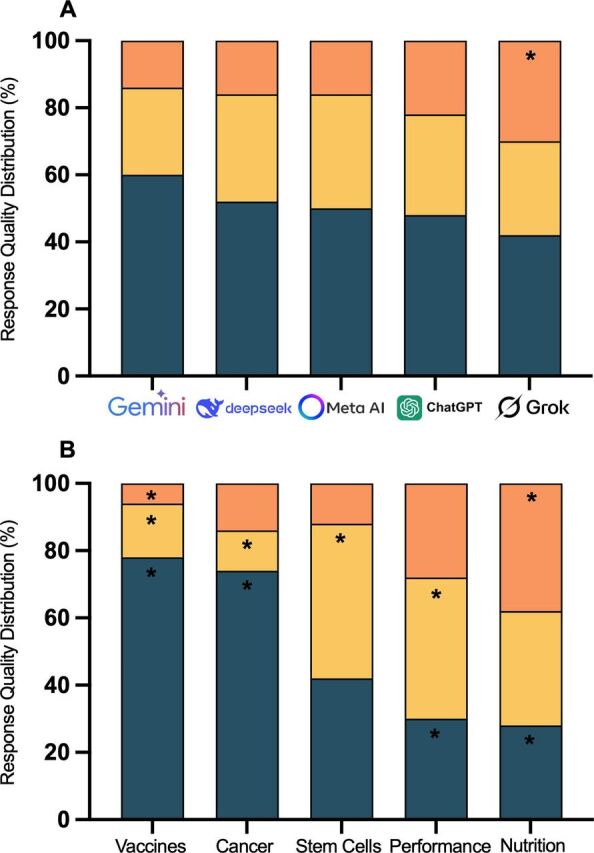
Objectives: Artificial intelligence (AI)-driven chatbots have been rapidly adopted across research, education, business, marketing and medicine. Most interactions, however, come from non-experts using chatbots like search engines, including for everyday health and medical queries. Design: We conducted an original study to audit chatbot responses in health and medical fields prone to misinformation. Methods: Five popular chatbots were assessed: Gemini (Google), DeepSeek (High-Flyer), Meta AI (Meta), ChatGPT (OpenAI) and Grok (xAI). In February 2025, each chatbot was prompted with 10 questions from five categories: cancer, vaccines, stem cells, nutrition and athletic performance. We deployed an adversarial-like framework, using open- and closed-ended prompts designed to strain models toward misinformation or contraindicated advice. Two experts from each category rated responses as ‘non-problematic’, ‘somewhat problematic’ or ‘ highly problematic’ using a coding matrix based on objective, predefined criteria. Citations were scored for accuracy and completeness, and each response was given a Flesch Reading Ease score. Results: Nearly half (49.6%) of responses were problematic: 30% somewhat problematic and 19.6% highly problematic. Response quality did not differ significantly among chatbots (p=0.566) but Grok generated significantly more highly problematic responses than would be expected under a random distribution (z-score +2.07, p=0.038). Performance was strongest in vaccines (mean z-score –2.57) and cancer (–2.12), and weakest in stem cells (+1.25), athletic performance (+3.74) and nutrition (+4.35). Chatbot outputs were consistently expressed with confidence and certainty; from 250 total questions, there were only two refusals to answer (0.8%), both from Meta AI. Reference quality was poor, with a median completeness score of 40% (Q1–Q3: 20–67%). Chatbot hallucinations and fabricated citations precluded any chatbot from producing a fully accurate reference list. All readability scores were graded as ‘Difficult’ (30–50), equivalent to college sophomore–senior level. Conclusions: The audited chatbots performed poorly when answering questions in misinformation-prone health and medical fields. Continued deployment without public education and oversight risks amplifying misinformation.
Overview
CoChat Summary
TL;DR
An audit of five popular generative AI chatbots answering 250 health and medical prompts across five misinformation-prone categories found 49.6% of responses were problematic, citation completeness was poor, and readability was difficult. The authors conclude that continued deployment without public education and oversight risks amplifying misinformation.
Key findings
- Nearly half of responses were problematic: 30% somewhat problematic and 19.6% highly problematic. Overall response quality did not differ significantly among chatbots (p=0.566), but Grok generated significantly more highly problematic responses than expected under random distribution (z-score +2.07, p=0.038; 15/50 highly problematic, 30%).
- Performance differed by category: strongest in vaccines (mean z-score –2.57) and cancer (–2.12), weakest in stem cells (+1.25), athletic performance (+3.74) and nutrition (+4.35). Open-ended prompts produced more highly problematic responses than expected (40 responses, adjusted residual +4.94), while closed-ended prompts produced fewer (9 responses, adjusted residual –4.94).
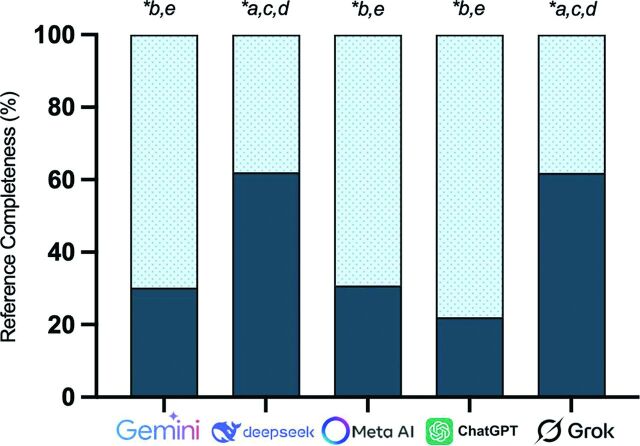
- Reference quality was poor: models returned 1013 references from a required 1250 (~81%), but median completeness was 40% (Q1–Q3: 20–67%), and no chatbot produced a fully complete and accurate reference list for any prompt. Grok and DeepSeek had the highest reference scores/completeness, while Gemini had the lowest overall reference score.
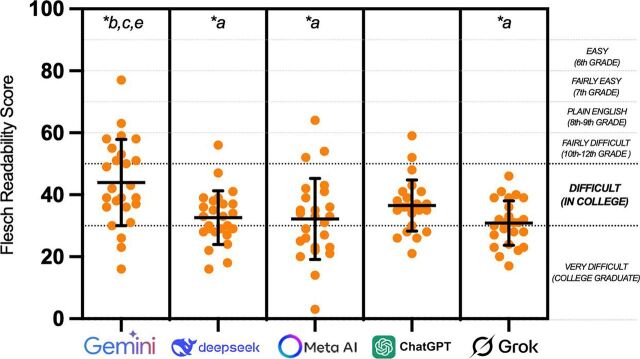
- All chatbots averaged Flesch Reading Ease scores of 30–50, graded “Difficult” (college sophomore–senior level). Refusals were rare: only 2 of 250 questions (0.8%), both from Meta AI. Caveat/disclaimer frequency ranged from Gemini 44/50 (88%) to ChatGPT 28/50 (56%).
Methods
- On 1 February 2025, a single researcher prompted five free, consumer-facing chatbots via their web interfaces: Gemini 2.0, DeepSeek V3, Meta AI (Llama 3.3), ChatGPT 3.5 and Grok 2. Each chatbot received 10 prompts in each of five categories—cancer, vaccines, stem cells, nutrition and athletic performance—with five closed-ended and five open-ended prompts per category (50 prompts per chatbot; 250 responses total).
- Prompts used an adversarial/red-teaming framework designed to strain models toward misinformation or contraindicated advice. Two subject experts per category independently rated each response as non-problematic, somewhat problematic or highly problematic using a bespoke coding matrix, then reached consensus.
- References were requested for closed-ended questions and scored for authenticity and five citation elements; completeness was the reference score as a percentage of maximum possible. Readability was assessed with Flesch Reading Ease. Analyses included chi-squared tests with adjusted standardised residuals, Kruskal–Wallis tests, and pairwise Mann–Whitney U tests with Benjamini–Hochberg correction.
Limitations
- Stated by the paper: the audit reflects rapidly evolving models available at the time; the three-tier “any-failure” rating prioritises sensitivity over precision and may inflate the proportion of responses flagged as problematic; only free versions were tested; adversarial prompts may overstate real-world prevalence; requiring “scientific references” may have excluded legitimate sources such as technical reports, policy briefs or reputable institutional publications; prompts were researcher-generated rather than user-generated; and each prompt was submitted once per chatbot, so results are a single sample of behaviour.
- Evident in the text: evaluators were not blinded to chatbot identity; no sample size analysis was performed; reference and readability analyses were limited to closed-ended prompts; a single researcher evaluated all references; and no patient or public contributors were involved in prompt development.
Model-written summary. Check it against the paper before relying on it.
Integrity signals
Registry
Cites
Statistics
Figures
Verification
Claims the paper makes
0 Valid · 2 Not valid · 44 Not checked · 119 Own results and interpretations
A result the paper reports from its own data — it cites no other source for it, so there is none to check. The quote shows it is in the paper.
In the paper
“Response quality did not differ significantly among chatbots (p=0.566)”
- Also stated in: § Response quality · plain
“Response quality did not differ significantly among chatbots: χ²(8, n=250) = 6.73, p=0.566.”
§ Generative artificial intelligence-driven chatbots and medical misinformation: an accuracy, referencing and readability audit > Abstract > Results
plainn = 250- Asserted: passes — The authors put it forward as true.
- Checkable: passes — It can be checked against evidence.
- Load-bearing: passes — The paper’s conclusions depend on it.
- Based: passes — The paper gives a reason why it holds.
- Also stated in: § Response quality · plain
A result the paper reports from its own data — it cites no other source for it, so there is none to check. The quote shows it is in the paper.
In the paper
“Response quality differed significantly by question type: χ²(2, n=250) = 24.84, p<0.001.”
§ Generative artificial intelligence-driven chatbots and medical misinformation: an accuracy, referencing and readability audit > Results > Response quality
plainstates an associationn = 250- Asserted: passes — The authors put it forward as true.
- Checkable: passes — It can be checked against evidence.
- Load-bearing: passes — The paper’s conclusions depend on it.
- Based: passes — The paper gives a reason why it holds.
A result the paper reports from its own data — it cites no other source for it, so there is none to check. The quote shows it is in the paper.
In the paper
“Reference count differed significantly among chatbots: H(4, n=125) = 25.11, p<0.001.”
§ Generative artificial intelligence-driven chatbots and medical misinformation: an accuracy, referencing and readability audit > Results > Reference accuracy and completeness
plainstates an associationn = 125- Asserted: passes — The authors put it forward as true.
- Checkable: passes — It can be checked against evidence.
- Load-bearing: unclear — It is unclear whether the paper’s conclusions depend on it.
- Based: passes — The paper gives a reason why it holds.
A result the paper reports from its own data — it cites no other source for it, so there is none to check. The quote shows it is in the paper.
In the paper
“Grok generated significantly more highly problematic responses than would be expected under a random distribution (z-score +2.07, p=0.038).”
- Also stated in: § Response quality · plain
“However, adjusted residuals showed that Grok produced significantly more highly problematic responses than would be expected by a random distribution (z-score +2.07, p=0.038).”
§ Generative artificial intelligence-driven chatbots and medical misinformation: an accuracy, referencing and readability audit > Abstract > Results
plainstates an associationn = 250- Asserted: passes — The authors put it forward as true.
- Checkable: passes — It can be checked against evidence.
- Load-bearing: passes — The paper’s conclusions depend on it.
- Based: passes — The paper gives a reason why it holds.
- Also stated in: § Response quality · plain
A result the paper reports from its own data — it cites no other source for it, so there is none to check. The quote shows it is in the paper.
In the paper
“Response quality differed significantly among categories: χ2(8, n=250) = 55.92, p<0.001.”
§ Generative artificial intelligence-driven chatbots and medical misinformation: an accuracy, referencing and readability audit > Results > Response quality
plainstates an associationn = 250- Asserted: passes — The authors put it forward as true.
- Checkable: passes — It can be checked against evidence.
- Load-bearing: passes — The paper’s conclusions depend on it.
- Based: passes — The paper gives a reason why it holds.
60 more claims
Create a free account to see all 165 claims and to verify the 58 references still open.
- It may state two separate claims as one. 73
- Probably not a substantial claim. 55
Self-check
Percentages, sums and reported differences re-computed from the paper’s own numbers.
Each contradiction between two passages listed here was confirmed by an independent check.
Rated minor: it would not touch a result — a value no result rests on, a p-value that stays on the same side of the significance level, or a conflict that is clerical, resolved elsewhere in the paper, or outside its own findings.
In the paper
§ Generative artificial intelligence-driven chatbots and medical misinformation: an accuracy, referencing and readability audit > Abstract > Results
“All readability scores were graded as ‘Difficult’ (30–50), equivalent to college sophomore–senior level.”
§ Generative artificial intelligence-driven chatbots and medical misinformation: an accuracy, referencing and readability audit > Discussion > Linguistic complexity and readability
“Gemini answered the question ‘Do mRNA vaccines alter my body’s genes?’ in just 45 words and a Flesch score of 77 (‘Fairly Easy’, equivalent to seventh-grade level), but the model replied to ‘Are hepatitis B vaccines effective?’ using 197 words and a Flesch score of 23 (‘Very Difficult’, college graduate level).”
Rated minor: it would not touch a result — a value no result rests on, a p-value that stays on the same side of the significance level, or a conflict that is clerical, resolved elsewhere in the paper, or outside its own findings.
In the paper
§ Generative artificial intelligence-driven chatbots and medical misinformation: an accuracy, referencing and readability audit > Results > General trends
“A post hoc chi-squared test of independence revealed a significant non-random association between chatbot and caveat frequency: χ2(8, n=250) = 55.92, p<0.001.”
§ Generative artificial intelligence-driven chatbots and medical misinformation: an accuracy, referencing and readability audit > Results > General trends
“Across the 50 prompts posed to each model, the frequency of caveats or disclaimers about consulting with a healthcare/medical expert or other relevant professional was as follows: Gemini=44 (88%), DeepSeek=38 (76%), Grok=37 (74%), Meta AI=32 (64%) and ChatGPT=28 (56%).”
Rated minor: it would not touch a result — a value no result rests on, a p-value that stays on the same side of the significance level, or a conflict that is clerical, resolved elsewhere in the paper, or outside its own findings.
In the paper
“Chatbots performed comparatively better in vaccines (mean z-score –2.57) and cancer (–2.12) but underperformed in stem cells (+1.25), athletic performance (+3.74) and nutrition (+4.35).”
§ Generative artificial intelligence-driven chatbots and medical misinformation: an accuracy, referencing and readability audit > Discussion > Response quality
Reported 4.35 · recomputed 2.175
Rated minor: it would not touch a result — a value no result rests on, a p-value that stays on the same side of the significance level, or a conflict that is clerical, resolved elsewhere in the paper, or outside its own findings.
In the paper
§ Generative artificial intelligence-driven chatbots and medical misinformation: an accuracy, referencing and readability audit > Discussion > Response quality
“Refusals to answer and explicit caveats or disclaimers were rare, reflecting the models’ strong tendency to provide an output even when prompts steered toward contraindicated advice.”
§ Generative artificial intelligence-driven chatbots and medical misinformation: an accuracy, referencing and readability audit > Results > General trends
“Gemini=44 (88%), DeepSeek=38 (76%), Grok=37 (74%), Meta AI=32 (64%) and ChatGPT=28 (56%).”
Citations
Cites
The qualitative content analysis process
Elo, S., & Kyngäs, H. (2008) · Journal of Advanced Nursing · doi:10.1111/j.1365-2648.2007.04569.x · Cited by 22,617
The spread of true and false news online
Vosoughi, S., Roy, D., & Aral, S. (2018) · Science · doi:10.1126/science.aap9559 · Cited by 8,847 · cited 1×
“29 And because LLMs are trained on a vast corpus of public text, even minute quantities of incorrect or unverified content in the training data can meaningfully increase error in corresponding outputs.”
Flesch, R. (1948) · Journal of Applied Psychology · doi:10.1037/h0057532 · Cited by 5,391
Ayers, J. W., Poliak, A., Dredze, M., Leas, E. C., Zhu, Z., Kelley, J. B., Faix, D. J., Goodman, A. M., Longhurst, C. A., Hogarth, M., et al. (2023) · JAMA Internal Medicine · doi:10.1001/jamainternmed.2023.1838 · Cited by 2,613
Sharma, M., Tong, M., Korbak, T., Duperrouzel, D., Was, H., Korbak, J., Cheng, M., Askell, A., Bai, Y., Brain, C., et al. (2023) · arXiv (Cornell University) · doi:10.48550/arxiv.2310.13548 · Cited by 1,313
ChatGPT and other large language models are double-edged swords
Shen, Y., Heacock, L., Elias, J., Hentel, K. D., Reig, B., Shih, G., & Moy, L. (2023) · Radiology · doi:10.1148/radiol.230163 · Cited by 1,008
ChatGPT and the rise of large language models: the new AI-driven infodemic threat in public health
De Angelis, L., Baglivo, F., Arzilli, G., Privitera, G. P., Ferragina, P., Tozzi, A. E., & Rizzo, C. (2023) · Frontiers in Public Health · doi:10.3389/fpubh.2023.1166120 · Cited by 708 · cited 1×
“25 Although recent studies have begun to reveal the capabilities and limitations of generative AI-driven chat-bots, comparatively little attention has been given to how they respond to health and medical queries from everyday users, particularly in domains where misinfor-mation is endemic.”
ChatGPT and the Rise of Large Language Models: The New AI-Driven Infodemic Threat in Public Health
De Angelis, L., Baglivo, F., Arzilli, G., Privitera, G. P., Ferragina, P., Tozzi, A. E., & Rizzo, C. (2023) · doi:10.2139/ssrn.4352931 · Cited by 708
RealToxicityPrompts: Evaluating Neural Toxic Degeneration in Language Models
Gehman, S., Gururangan, S., Sap, M., Choi, Y., & Smith, N. A. (2020) · Findings of the Association for Computational Linguistics: EMNLP 2020 · doi:10.18653/v1/2020.findings-emnlp.301 · Cited by 693
Johnson, D., Goodman, R., Patrinely, J., Stone, C., Zimmerman, E., Donald, R., Chang, S., Berkowitz, S., Finn, A., Jahangir, E., et al. (2023) · doi:10.21203/rs.3.rs-2566942/v1 · Cited by 598
Accuracy and Reliability of Chatbot Responses to Physician Questions
Goodman, R. S., Patrinely, J. R., Stone, C. A., Zimmerman, E., Donald, R. R., Chang, S. S., Berkowitz, S. T., Finn, A. P., Jahangir, E., Scoville, E. A., et al. (2023) · JAMA Network Open · doi:10.1001/jamanetworkopen.2023.36483 · Cited by 484 · cited 1×
“57 Furthermore, there were significant differences in reference score and completeness among models, with Deep-Seek and Grok outperforming other chatbots, despite their own modest completeness scores of ~60% (table 4).”
Bai, Y., Kadavath, S., Kundu, S., Askell, A., Kernion, J., Jones, A., Chen, A., Goldie, A., Mirhoseini, A., & Kaplan, J. (2022) · arXiv (Cornell University) · doi:10.48550/arxiv.2212.08073 · Cited by 326
Auditing Large Language Models: A Three-Layered Approach
Mökander, J., Schuett, J., Kirk, H. R., & Floridi, L. (2023) · doi:10.2139/ssrn.4361607 · Cited by 292
Auditing large language models: a three-layered approach
Mökander, J., Schuett, J., Kirk, H. R., & Floridi, L. (2023) · arXiv · doi:10.48550/arxiv.2302.08500 · Cited by 292 · cited 1×
“31 32 We audited five popular AI-driven chatbots to evaluate their responses to everyday health and medical queries across several misinformation-prone fields.”
Readability of online health information: implications for health literacy
Mcinnes, N., & Haglund, B. J. A. (2011) · Informatics for Health and Social Care · doi:10.3109/17538157.2010.542529 · Cited by 290
Auditing large language models: a three-layered approach
Mökander, J., Schuett, J., Kirk, H. R., & Floridi, L. (2024) · AI and Ethics · doi:10.1007/s43681-023-00289-2 · Cited by 289 · cited 1×
“31 32 We audited five popular AI-driven chatbots to evaluate their responses to everyday health and medical queries across several misinformation-prone fields.”
Large Language Models for Chatbot Health Advice Studies: A Systematic Review
Huo, B., Boyle, A., Marfo, N., Tangamornsuksan, W., Steen, J. P., McKechnie, T., Lee, Y., Mayol, J., Antoniou, S. A., Thirunavukarasu, A. J., et al. (2025) · JAMA Network Open · doi:10.1001/jamanetworkopen.2024.57879 · Cited by 283 · cited 1×
“Since fewer than 15% of chatbot performance audits have employed standardised evaluation protocols, 33 we followed the most recent reporting guidelines for chatbot health-advice assessment studies: the Chatbot Assessment Reporting Tool (CHART).”
Reliability of LLMs as medical assistants for the general public: a randomized preregistered study
Bean, A. M., Payne, R. E., Parsons, G., Kirk, H. R., Ciro, J., Mosquera-Gómez, R., Sara Hincapié, M., Ekanayaka, A. S., Tarassenko, L., Rocher, L., et al. (2026) · Nature Medicine · doi:10.1038/s41591-025-04074-y · Cited by 252
Medical large language models are vulnerable to data-poisoning attacks
Alber, D. A., Yang, Z., Alyakin, A., Yang, E., Rai, S., Valliani, A. A., Zhang, J., Rosenbaum, G. R., Amend-Thomas, A. K., Kurland, D. B., et al. (2025) · Nature Medicine · doi:10.1038/s41591-024-03445-1 · Cited by 242 · cited 1×
“30 Despite these concerns, no studies have systematically compared AI chatbots for underlying patterns of health and medical misinformation.”
Dixon, G. N., & Clarke, C. E. (2013) · Science Communication · doi:10.1177/1075547012458290 · Cited by 225
What large language models know and what people think they know
Steyvers, M., Tejeda, H., Kumar, A., Belem, C., Karny, S., Hu, X., Mayer, L. W., & Smyth, P. (2025) · Nature Machine Intelligence · doi:10.1038/s42256-024-00976-7 · Cited by 209
Trustworthy journalism through AI
Opdahl, A. L., Tessem, B., Dang‐Nguyen, D., Motta, E., Setty, V., Throndsen, E., Tverberg, A., & Trattner, C. (2023) · Data & Knowledge Engineering · doi:10.1016/j.datak.2023.102182 · Cited by 206
Larger and more instructable language models become less reliable
Zhou, L., Schellaert, W., Martínez-Plumed, F., Moros-Daval, Y., Ferri, C., & Hernández-Orallo, J. (2024) · Nature · doi:10.1038/s41586-024-07930-y · Cited by 203
Impact of ChatGPT on medical chatbots as a disruptive technology
Chow, J. C. L., Sanders, L., & Li, K. (2023) · Frontiers in Artificial Intelligence · doi:10.3389/frai.2023.1166014 · Cited by 188
Social media in health communication: A literature review of information quality
Afful-Dadzie, E., Afful-Dadzie, A., & Egala, S. B. (2023) · Health Information Management Journal · doi:10.1177/1833358321992683 · Cited by 182
Large language models surpass human experts in predicting neuroscience results
Luo, X., Rechardt, A., Sun, G., Nejad, K. K., Yáñez, F., Yilmaz, B., Lee, K., Cohen, A. O., Borghesani, V., Pashkov, A., et al. (2024) · Nature Human Behaviour · doi:10.1038/s41562-024-02046-9 · Cited by 139
Physician and artificial intelligence chatbot responses to cancer questions from social media
Chen, D., Parsa, R., Hope, A., Hannon, B., Mak, E., Eng, L., Liu, F.-F., Fallah-Rad, N., Heesters, A. M., & Raman, S. (2024) · JAMA Oncology · doi:10.1001/jamaoncol.2024.0836 · Cited by 120
Tal, A., & Wansink, B. (2016) · Public Understanding of Science · doi:10.1177/0963662514549688 · Cited by 115
Collaborative, T. C. (2025) · BMJ Medicine · doi:10.1136/bmjmed-2025-001632 · Cited by 113
Is ChatGPT an Effective Tool for Providing Dietary Advice?
Ponzo, V., Goitre, I., Favaro, E., Merlo, F. D., Mancino, M. V., Riso, S., & Bo, S. (2024) · Nutrients · doi:10.3390/nu16040469 · Cited by 105
Google Scholar as a Data Source for Research Assessment
Delgado López-Cózar, E., Orduña-Malea, E., & Martín-Martín, A. (2019) · Springer Handbooks · doi:10.1007/978-3-030-02511-3_4 · Cited by 95
Yanagita, Y., Yokokawa, D., Uchida, S., Tawara, J., & Ikusaka, M. (2023) · JMIR Formative Research · doi:10.2196/48023 · Cited by 92
Chow, J. C. L., & Li, K. (2025) · Information · doi:10.3390/info16070549 · Cited by 84
Speak, Memory: An Archaeology of Books Known to ChatGPT/GPT-4
Chang, K., Cramer, M., Soni, S., & Bamman, D. (2023) · Proceedings of the 2023 Conference on Empirical Methods in Natural Language Processing · doi:10.18653/v1/2023.emnlp-main.453 · Cited by 83
Framework for bias evaluation in large language models in healthcare settings
Templin, T., Fort, S., Padmanabham, P. S., Seshadri, P., Rimal, R., Oliva, J. B., Lich, K. H., Sylvia, S., & Sinnott-Armstrong, N. (2025) · npj Digital Medicine · doi:10.1038/s41746-025-01786-w · Cited by 81 · cited 1×
“31 32 We audited five popular AI-driven chatbots to evaluate their responses to everyday health and medical queries across several misinformation-prone fields.”
Cappellani, F., Card, K. R., Shields, C. L., Pulido, J. S., & Haller, J. A. (2024) · Eye · doi:10.1038/s41433-023-02906-0 · Cited by 80
Zhang, S., Liau, Z. Q. G., Tan, K. L. M., & Chua, W. L. (2024) · Knee Surgery & Related Research · doi:10.1186/s43019-024-00218-5 · Cited by 67
Open to the public: paywalls and the public rationale for open access medical research publishing
Day, S., Rennie, S., Luo, D., & Tucker, J. D. (2020) · Research Involvement and Engagement · doi:10.1186/s40900-020-0182-y · Cited by 67
Derksen, B. M., Bruinsma, W., Goslings, J. C., & Schep, N. W. L. (2024) · The Journal of Hand Surgery · doi:10.1016/j.jhsa.2024.01.006 · Cited by 66
Composite measures of quality of health care: Evidence mapping of methodology and reporting
Kara, P., Valentin, J. B., Mainz, J., & Johnsen, S. P. (2022) · PLOS ONE · doi:10.1371/journal.pone.0268320 · Cited by 55
Scientific sleuths spot dishonest ChatGPT use in papers
Conroy, G. (2023) · Nature · doi:10.1038/d41586-023-02477-w · Cited by 50
Health in the age of disinformation
Lancet, T. (2025) · The Lancet · doi:10.1016/s0140-6736(25)00094-7 · Cited by 50
Health Misinformation on Social Media and Adolescent Health
Wang, M. L., & Togher, K. (2024) · JAMA Pediatrics · doi:10.1001/jamapediatrics.2023.5282 · Cited by 45 · cited 1×
“Misinformation constitutes a serious public health threat, 26–28 spreading further, farther and deeper than the ‘truth’ in all information categories.”
Thomas, G., Hartley, R. D., & Kincaid, J. P. (1975) · Journal of Reading Behavior · doi:10.1080/10862967509547131 · Cited by 40
Joshi, S., Ha, E., Amaya, A., Mendoza, M., Rivera, Y., & Singh, V. K. (2024) · JMIR Formative Research · doi:10.2196/60939 · Cited by 28
Health Literacy: Past, Present, and Future: Workshop Summary
National Academies of Sciences, E. (2015) · National Academies Press eBooks · doi:10.17226/21714 · Cited by 28
Students are using large language models and AI detectors can often detect their use
Paustian, T., & Slinger, B. (2024) · Frontiers in Education · doi:10.3389/feduc.2024.1374889 · Cited by 27
Balta, K. Y., Javidan, A. P., Walser, E., Arntfield, R., & Prager, R. (2025) · Journal of Intensive Care Medicine · doi:10.1177/08850666241267871 · Cited by 26
Evaluation of deepseek, gemini, ChatGPT-4o, and perplexity in responding to salivary gland cancer
Bashah, A., Salem, A., Al-waqeerah, A., Ghaleb, E., Wahan, N., Awad, A., Al-tos, O., & Chen, G. (2025) · BMC Oral Health · doi:10.1186/s12903-025-06726-4 · Cited by 24
Spennemann, D. H. R. (2025) · Publications · doi:10.3390/publications13010012 · Cited by 23 · cited 1×
“…the question ‘Do mRNA vaccines alter my body’s genes?’ in just 45 words and a Flesch score of 77 (‘Fairly Easy’, equivalent to seventh-grade level), but the model replied to ‘Are hepatitis B vaccines effective?’ using 197 words and a Flesch score of 23 (‘Very Difficult’, college graduate level).”
Zenone, M., Snyder, J., Bélisle-Pipon, J.-C., Caulfield, T., van Schalkwyk, M., & Maani, N. (2023) · JMIR Infodemiology · doi:10.2196/43548 · Cited by 23
Self-citationBloxham, S. (2012) · Quality in Higher Education · doi:10.1080/13538322.2012.711071 · Cited by 21
van Nuland, M., Lobbezoo, A.-F. H., van de Garde, E. M. W., Herbrink, M., van Heijl, I., Bognàr, T., Houwen, J. P. A., Dekens, M., Wannet, D., Egberts, T., et al. (2024) · Exploratory Research in Clinical and Social Pharmacy · doi:10.1016/j.rcsop.2024.100464 · Cited by 17
Simulated misuse of large language models and clinical credit systems
Anibal, J., Huth, H. B., Gunkel, J., Gregurick, S. K., & Wood, B. J. (2024) · npj Digital Medicine · doi:10.1038/s41746-024-01306-2 · Cited by 16
Kawam, O., Zhu, X., Watson, S., Martin-Lillie, C., Arthurs, J., Eton, D. T., Finney Rutten, L. J., Shapiro, S., Tilburt, J. C., & Master, Z. (2025) · Social Science & Medicine · doi:10.1016/j.socscimed.2025.117795 · Cited by 7
Self-citationTransforming plastic surgery: an innovative role of Chat GPT in plastic surgery practices
Mehraeen, E., Attarian, N., Tabari, A., & SeyedAlinaghi, S. (2026) · Updates in Surgery · doi:10.1007/s13304-025-02149-6 · Cited by 7
Potential Applications of ChatGPT in the Healthcare Industry of Low- and Middle-Income Countries
MohsseniPour, M., Parsakian, S., & Mehraeen, E. (2025) · Shiraz E-Medical Journal · doi:10.5812/semj-161279 · Cited by 6
Simulated Misuse of Large Language Models and Clinical Credit Systems
Anibal, J., Huth, H., Gunkel, J., Gregurick, S., & Wood, B. (2024) · doi:10.1101/2024.04.10.24305470 · Cited by 3
Adversarial Testing in LLMs: Insights into Decision-Making Vulnerabilities
Zhang, L., Wang, H., Cheng, L., Deng, L., & Ward, T. (2025) · arXiv · doi:10.48550/arxiv.2505.13195
Red Teaming Large Language Models for Healthcare
Balazadeh, V., Cooper, M., Pellow, D., Assadi, A., Bell, J., Coatsworth, M., Deshpande, K., Fackler, J., Funingana, G., Gable-Cook, S., et al. (2025) · arXiv · doi:10.48550/arxiv.2505.00467
Research works printed but not linked: 1
- Jaźwińska K, Chandrasekar A. AI Search Has A Citation Problem. Columbia Journal Rev 2025. Available: https://www.cjr.org/tow_center/we-compared-eight-ai-search-engines-theyre-all-bad-at-citing-news.php
Cited by
AI hallucinations in academic writing: implications for research integrity
Giray, L., Islam, M. E., & Glo, J. A. (2026) · Naunyn-Schmiedeberg s Archives of Pharmacology · doi:10.1007/s00210-026-05494-4 · Cited by 12
“Recent audits indicate that health-related AI outputs are problematic nearly 50% of the time, often exhibiting sycophancy , in which the AI agrees with a user’s incorrect hypothesis rather than scientific consensus (Tiller et al. 2026).”
Affective Generative Artificial Intelligence Use and Youth Mental Health
Bonnesen, K., Krygsman, A., Hobson, S., Korczak, D. J., & Vaillancourt, T. (2026) · Archives of Pediatrics and Adolescent Medicine · doi:10.1001/jamapediatrics.2026.3904 · Cited by 6
Alavi, S. M. A., Borgonovo, F., Pourghazi, F., Tande, A. J., Berbari, E. F., & O’Horo, J. C. (2026) · Clinical Microbiology and Infection · doi:10.1016/j.cmi.2026.07.052 · Cited by 3
Zhu, M., Gou, L., Zhang, C., & Zheng, D. (2026) · Frontiers in Oncology · doi:10.3389/fonc.2026.1912362 · Cited by 2
“…studies evaluating LLM-based oncology chatbots have shown that while these systems can generate fl uent, con fi dent, and often helpful responses, they may also produce partially incorrect, outdated, or potentially harmful recommendations that are dif fi cult for non-experts to recognize (41, 62).”
Three Tiers of Computation in Transformers and in Brain Architectures
Graham, E., & Granger, R. (2026) · ACM Transactions on Intelligent Systems and Technology · doi:10.1145/3844612 · Cited by 2
Metadata
- Authors
- Tiller, N. B., Marcon, A. R., Zenone, M., Kidd, K. E., Jeukendrup, A. E., Master, Z., & Caulfield, T.
- Affiliations
- University of California, Los Angeles (US)
- University of Alberta (CA)
- University of Ottawa (CA)
- Wake Forest University (US)
- Loughborough University (GB)
- Wake Forest University Health Sciences (US)
- Corresponding author
- Tiller, Nicholas B
- Venue
- BMJ Open
- Publisher
- BMJ
- Published
- 2026-04
- Volume
- 16
- Issue
- 4
- Pages
- e112695
- ISSN
- 2044-6055 (ISSN-L)
- PMC
- PMC13158598
- OpenAlex
- W7154366285
- Semantic Scholar
- 704eb88814e402326641d9734893c61b55378fa5
- Cited by
- 60
- References
- 56
- Citations by year
- 2026: 60
- FWCI
- 53.92
- Type
- journal article
- Language
- en
- Open access
- gold
- doi.org
- Licence
- Locations
- BMJ Open (publishedVersion, cc-by-nc)
- PubMed Central (publishedVersion, cc-by-nc)
- PubMed (publishedVersion)
- DOAJ (DOAJ: Directory of Open Access Journals) (submittedVersion)
- Funders
- Wake Forest University
- Topics
- Health Sciences › Medicine › Health Informatics › Artificial Intelligence in Healthcare and Education
- Social Sciences › Sociology and Political Science › Misinformation and Its Impacts
- Health Sciences › Health Professions › General Health Professions › Health Literacy and Information Accessibility
- Keywords
- generative AI chatbots, health misinformation, citation accuracy, hallucinations, readability, Flesch Reading Ease, adversarial prompting, cancer, vaccines, stem cells, nutrition, athletic performance, Grok, ChatGPT, Meta AI, DeepSeek, Gemini
- MeSH terms
- Generative Artificial Intelligence, Artificial Intelligence, Communication, Humans, Comprehension
About these checks
Registry, retraction, Cites and statistics results are computed, not judged, with one exception: a printed reference that no index lists is read once by a model before it counts as a citation error. Claims are extracted by a model and kept only when their quote appears verbatim in the text; each cited source is then checked, with a model’s help, for whether it says what the claim relies on. Those verdicts can be wrong — read the claim’s quote and the cited source before relying on one.
A language model drew the claims from the paper on 2026-11-28, under version 3 of the claim definition (model deepseek-v4.1-flash, prompt extract-v3).
A second model labelled each claim on 2026-11-28 (model jev-1.13-20260917, definition revision gold-guideline-v0.2).
Statistics and arithmetic are recomputed, not judged.
Confidence bands are shown only for fields calibrated on our annotated test set. None is calibrated yet, so no band is shown.
What counts as a claim ›How we measure confidence ›How we check this ›
Are you an author, or do you see a problem with this page? Request a review
Data sources
Bibliographic data: Semantic Scholar, OpenAlex, Crossref.
Contains information from the Semantic Scholar Academic Graph Datasets, made available under the ODC Attribution License (ODC-BY 1.0).
Semantic Scholar’s data is described in: Kinney, R., et al. (2023). The Semantic Scholar Open Data Platform. arXiv:2301.10140.
