

Adherence to exercise rehabilitation programmes in stroke survivors: a scoping review
Open accessThe DOI matches its Crossref record; 71 of the 71 references it cites were found in a registry or an index.
Abstract
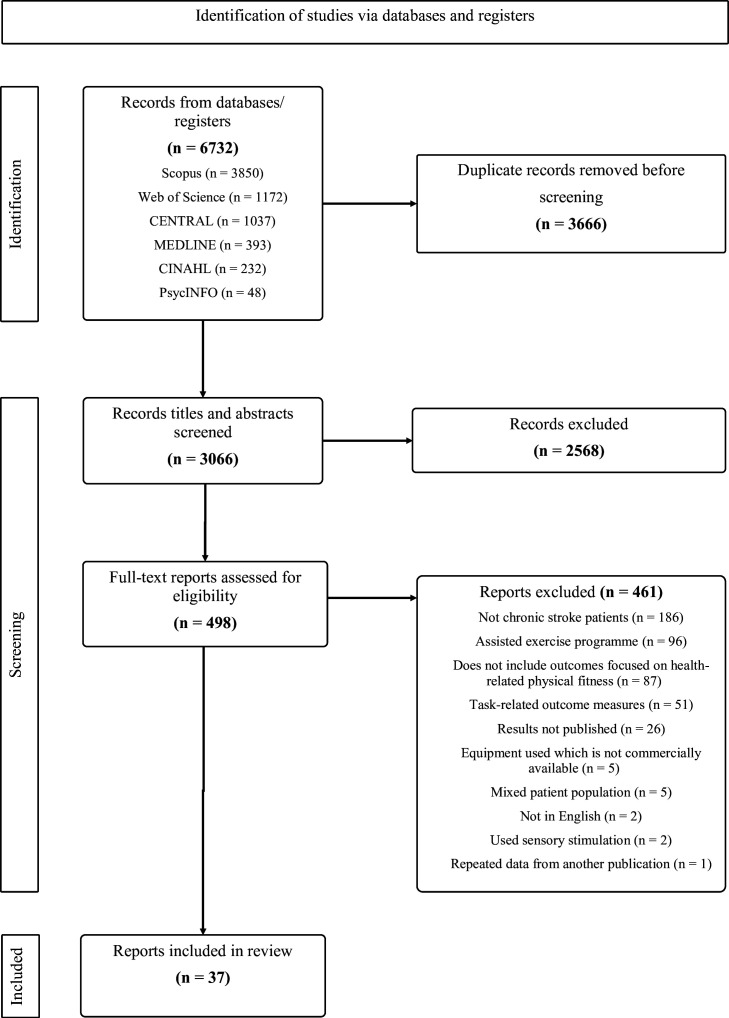
Objectives: To identify how exercise adherence is reported in research which focuses on enhancing cardiorespiratory and muscular fitness in stroke survivors. Design: Systematic scoping review. Data sources: Scopus, PubMED/MEDLINE, Cochrane Central Register of Controlled Trials, Cumulative Index to Nursing and Allied Health Literature, PsycINFO/PsycARTICLES and Web of Science. Eligibility criteria for selecting studies: The review sought published reports involving a cardiorespiratory or resistance training exercise intervention for people who experienced a stroke ≥6 months prior to participation. Reports were screened by two reviewers and were assessed for methodological quality using the Mixed Methods Appraisal Tool. Results: 37 reports (randomised trials=30, interventions without control=5, non-randomised trial=1, dose escalation trial=1; total n=1347 participants) out of 6732 records met the inclusion criteria. 29 reports (78%) documented intervention adherence by describing participant completion rates, indicating 65–100% adherence. Exercise session adherence within intervention was identifiable in 16 reports (43%), 12 of which recorded session attendance, signifying 61–100% adherence. There were also measures of the intensity or duration participants sustained during sessions in 14 studies. Only one study measured postintervention (ie, at least 3 months after intervention completion) exercise adherence, and two studies actively supported participants’ exercise motivation. Conclusion: Adherence is commonly measured by intervention completion rates. Despite its importance for intervention effectiveness, less than half of studies measured exercise session adherence within interventions. Future research should address this limitation to better understand how stroke survivors engage with exercise.
Overview
The claims and statistics of this paper haven’t been checked yet.
Free: it reads the open-access text and checks the first 5 claims that cite a source we can check. Create a free account to check every claim.
Integrity signals
Registry
Cites
Statistics
Figures
Verification
Claims the paper makes
The claims and statistics of this paper haven’t been checked yet.
Free: it reads the open-access text and checks the first 5 claims that cite a source we can check. Create a free account to check every claim.
Self-check
Percentages, sums and reported differences re-computed from the paper’s own numbers.
The self-check needs the paper’s full text.
Citations
Cites
PRISMA Extension for Scoping Reviews (PRISMA-ScR): Checklist and Explanation
Tricco, A. C., Lillie, E., Zarin, W., O'Brien, K. K., Colquhoun, H., Levac, D., Moher, D., Peters, M. D. J., Horsley, T., Weeks, L., et al. (2018) · Annals of Internal Medicine · doi:10.7326/m18-0850 · Cited by 43,565 · cited 1×
“This review followed the Preferred Reporting Items for Systematic reviews and Meta-Analyses Extension for Scoping Reviews (PRISMA-ScR) 28 guidelines.”
Munn, Z., Peters, M. D. J., Stern, C., Tufanaru, C., McArthur, A., & Aromataris, E. (2018) · BMC Medical Research Methodology · doi:10.1186/s12874-018-0611-x · Cited by 11,385 · cited 1×
“26 27 This scoping review has the following research questions:”
(1985) · Europe PMC (PubMed Central) · Cited by 9,143
Feigin, V. L., Stark, B. A., Johnson, C. O., Roth, G. A., Bisignano, C., Abady, G. G., Abbasifard, M., Abbasi-Kangevari, M., Abd-Allah, F., Abedi, V., et al. (2021) · The Lancet Neurology · doi:10.1016/s1474-4422(21)00252-0 · Cited by 7,937 · cited 1×
“The table summarises extracted information from each report and defines whether there is reported data on exercise adherence and how it is presented.”
The Mixed Methods Appraisal Tool (MMAT) version 2018 for information professionals and researchers
Hong, Q. N., Fàbregues, S., Bartlett, G., Boardman, F., Cargo, M., Dagenais, P., Gagnon, M.-P., Griffiths, F., Nicolau, B., O’Cathain, A., et al. (2018) · Education for Information · doi:10.3233/efi-180221 · Cited by 4,737 · cited 5×
“The MMAT is a useful tool to evaluate the quality of reports with different methods.”
InfluentialWorld Stroke Organization (WSO): Global Stroke Fact Sheet 2022
Feigin, V. L., Brainin, M., Norrving, B., Martins, S., Sacco, R. L., Hacke, W., Fisher, M., Pandian, J., & Lindsay, P. (2022) · International Journal of Stroke · doi:10.1177/17474930211065917 · Cited by 2,979
The well-built clinical question: A key to evidence-based decisions
(1995) · ACP Journal Club · doi:10.7326/acpjc-1995-123-3-a12 · Cited by 2,931
Consensus on Exercise Reporting Template (CERT): Explanation and elaboration statement
Slade, S. C., Dionne, C. E., Underwood, M., & Buchbinder, R. (2016) · British Journal of Sports Medicine · doi:10.1136/bjsports-2016-096651 · Cited by 961 · cited 1×
“Therefore, it is likely that any generalisation of findings from this review to people with severe disability needs to be confirmed by further research.”
Scoping reviews: reinforcing and advancing the methodology and application
Peters, M. D. J., Marnie, C., Colquhoun, H., Garritty, C. M., Hempel, S., Horsley, T., Langlois, E. V., Lillie, E., O’Brien, K. K., Tunçalp, Ӧ., et al. (2021) · Systematic Reviews · doi:10.1186/s13643-021-01821-3 · Cited by 887 · cited 1×
“26 27 This scoping review has the following research questions:”
Stroke: causes and clinical features
Murphy, S. J., & Werring, D. J. (2020) · Medicine · doi:10.1016/j.mpmed.2020.06.002 · Cited by 577 · cited 1×
“In Niama Natta and colleagues’ 38”
Recovery from stroke: current concepts and future perspectives
Grefkes, C., & Fink, G. R. (2020) · Neurological Research and Practice · doi:10.1186/s42466-020-00060-6 · Cited by 546 · cited 1×
“23 Previous reviews have identified how adherence is incorporated into randomised controlled trials of exercise training or aerobic and resistance training.”
Macko, R. F., Ivey, F. M., Forrester, L. W., Hanley, D., Sorkin, J. D., Katzel, L. I., Silver, K. H., & Goldberg, A. P. (2005) · Stroke · doi:10.1161/01.str.0000181076.91805.89 · Cited by 524
Pang, M. Y. C., Eng, J. J., Dawson, A. S., McKay, H. A., & Harris, J. E. (2005) · Journal of the American Geriatrics Society · doi:10.1111/j.1532-5415.2005.53521.x · Cited by 389
Aerobic Exercise Improves Cognition and Motor Function Poststroke
Quaney, B. M., Boyd, L. A., McDowd, J. M., Zahner, L. H., He, J., Mayo, M. S., & Macko, R. F. (2009) · Neurorehabilitation and Neural Repair · doi:10.1177/1545968309338193 · Cited by 324
Luft, A. R., Macko, R. F., Forrester, L. W., Villagra, F., Ivey, F., Sorkin, J. D., Whitall, J., McCombe-Waller, S., Katzel, L., Goldberg, A. P., et al. (2008) · Stroke · doi:10.1161/strokeaha.108.527531 · Cited by 279
Physical Activity and Exercise After Stroke: Review of Multiple Meaningful Benefits
Saunders, D. H., Greig, C. A., & Mead, G. E. (2014) · Stroke · doi:10.1161/strokeaha.114.004311 · Cited by 252
Hawley-Hague, H., Horne, M., Skelton, D. A., & Todd, C. (2016) · BMJ Open · doi:10.1136/bmjopen-2016-011560 · Cited by 241 · cited 3×
“21 Overall, it is difficult to determine adherence rates due to varied measures and inconsistent reporting; something which has been highlighted by previous reviews of poststroke adherence to home exercise or various physical activity programmes.”
MacKay-Lyons, M., Billinger, S. A., Eng, J. J., Dromerick, A., Giacomantonio, N., Hafer-Macko, C., Macko, R., Nguyen, E., Prior, P., Suskin, N., et al. (2020) · Physical Therapy · doi:10.1093/ptj/pzz153 · Cited by 232
Flansbjer, U., Miller, M., Downham, D., & Lexell, J. (2008) · Journal of Rehabilitation Medicine · doi:10.2340/16501977-0129 · Cited by 224 · cited 2×
“The table summarises extracted information from each report and defines whether there is reported data on exercise adherence and how it is presented.”
Bollen, J. C., Dean, S. G., Siegert, R. J., Howe, T. E., & Goodwin, V. A. (2014) · BMJ Open · doi:10.1136/bmjopen-2014-005044 · Cited by 217
Mudge, S., Barber, P. A., & Stott, N. S. (2009) · Archives of Physical Medicine and Rehabilitation · doi:10.1016/j.apmr.2009.07.015 · Cited by 184
Lip, G. Y. H., Lane, D. A., Lenarczyk, R., Boriani, G., Doehner, W., Benjamin, L. A., Fisher, M., Lowe, D., Sacco, R. L., Schnabel, R. B., et al. (2022) · European Heart Journal · doi:10.1093/eurheartj/ehac245 · Cited by 179
Morris, J. H., MacGillivray, S., & Mcfarlane, S. (2014) · Archives of Physical Medicine and Rehabilitation · doi:10.1016/j.apmr.2013.12.016 · Cited by 166 · cited 1×
“Therefore, it is likely that any generalisation of findings from this review to people with severe disability needs to be confirmed by further research.”
Long-term complications of stroke and secondary prevention: an overview for primary care physicians
Chohan, S., Venkatesh, P., & How, C. (2019) · Singapore Medical Journal · doi:10.11622/smedj.2019158 · Cited by 160
Moore, S. A., Hallsworth, K., Jakovljevic, D. G., Blamire, A. M., He, J., Ford, G. A., Rochester, L., & Trenell, M. I. (2015) · Neurorehabilitation and Neural Repair · doi:10.1177/1545968314562116 · Cited by 159
Aquatic therapy in stroke rehabilitation: systematic review and meta‐analysis
Veldema, J., & Jansen, P. (2020) · Acta Neurologica Scandinavica · doi:10.1111/ane.13371 · Cited by 146 · cited 1×
“…stroke has the potential to widely benefit stroke survivors in their physical and psychological recovery because it helps long-term muscular development and physical functioning, 6–9 supports executive functioning and cognition, 10 11 reduces fatigue, improves sleep and increases mental well-being.”
Boyne, P., Dunning, K., Carl, D., Gerson, M., Khoury, J., Rockwell, B., Keeton, G., Westover, J., Williams, A., McCarthy, M., et al. (2016) · Physical Therapy · doi:10.2522/ptj.20150277 · Cited by 142
Resistance training in stroke rehabilitation: systematic review and meta-analysis
Veldema, J., & Jansen, P. (2020) · Clinical Rehabilitation · doi:10.1177/0269215520932964 · Cited by 135
Frost, R., Levati, S., McClurg, D., Brady, M., & Williams, B. (2017) · Archives of Physical Medicine and Rehabilitation · doi:10.1016/j.apmr.2016.08.482 · Cited by 127 · cited 2×
“15 20 Other ways that exercise adherence has been inconsistently reported include using class attendance or duration and intensity of exercising.”
Ammann, B. C., Knols, R. H., Baschung, P., de Bie, R. A., & de Bruin, E. D. (2014) · BMC Neurology · doi:10.1186/s12883-014-0167-2 · Cited by 115 · cited 2×
“Therefore, it is likely that any generalisation of findings from this review to people with severe disability needs to be confirmed by further research.”
Exercise and Executive Function in Individuals With Chronic Stroke: A Pilot Study
Kluding, P. M., Tseng, B. Y., & Billinger, S. A. (2011) · Journal of Neurologic Physical Therapy · doi:10.1097/npt.0b013e318208ee6c · Cited by 102
Long-term benefits of progressive resistance training in chronic stroke: A 4-year follow-up
Flansbjer, U., Lexell, J., & Brogårdh, C. (2012) · Journal of Rehabilitation Medicine · doi:10.2340/16501977-0936 · Cited by 80 · cited 2×
“In Niama Natta and colleagues’ 38”
Adaptive physical activity improves mobility function and quality of life in chronic hemiparesis
Macko, R. F. (2008) · The Journal of Rehabilitation Research and Development · doi:10.1682/jrrd.2007.02.0025 · Cited by 76
Within-Session Responses to High-Intensity Interval Training in Chronic Stroke
Boyne, P., Dunning, K. K., Carl, D., Gerson, M. C., Khoury, J. C., & Kissela, B. M. (2014) · Medicine & Science in Sports & Exercise · doi:10.1249/mss.0000000000000427 · Cited by 70
Jin, H., Jiang, Y.-B., Wei, Q., Chen, L., & Ma, G. (2013) · NeuroRehabilitation (Reading, MA) · doi:10.3233/nre-130852 · Cited by 66
Pogrebnoy, D., & Dennett, A. (2020) · Archives of Physical Medicine and Rehabilitation · doi:10.1016/j.apmr.2019.06.015 · Cited by 63 · cited 1×
“24 25 This review seeks to evaluate adherence in all exercise-related interventions aimed at people with stroke, not limited to studies that assessed adherence as an explicit outcome measure or only randomised controlled trials.”
Forced, Not Voluntary, Aerobic Exercise Enhances Motor Recovery in Persons With Chronic Stroke
Linder, S. M., Rosenfeldt, A. B., Davidson, S., Zimmerman, N. M., Penko, A. L., Lee, J., Clark, C., & Alberts, J. L. (2019) · Neurorehabilitation and neural repair · doi:10.1177/1545968319862557 · Cited by 61
Measurement, determinants, barriers, and interventions for exercise adherence: a scoping review
Mahmood, A., Nayak, P., Deshmukh, A., English, C., N, M., Solomon M, J., & B, U. (2023) · Journal of Bodywork and Movement Therapies · doi:10.1016/j.jbmt.2022.09.014 · Cited by 60 · cited 2×
“Therefore, it is likely that any generalisation of findings from this review to people with severe disability needs to be confirmed by further research.”
Levy, T., Laver, K., Killington, M., Lannin, N. A., & Crotty, M. (2018) · Clinical Rehabilitation · doi:10.1177/0269215518811903 · Cited by 59 · cited 1×
“Therefore, it is likely that any generalisation of findings from this review to people with severe disability needs to be confirmed by further research.”
Lattouf, N. A., Tomb, R. R., Assi, A., Maynard, L., & Mesure, S. (2021) · Neurorehabilitation · doi:10.3233/nre-201601 · Cited by 55
Low intensity strength training for ambulatory stroke patients
Cramp, M., Greenwood, R., Gill, M., Rothwell, J. C., & Scott, O. M. (2006) · Disability and Rehabilitation · doi:10.1080/09638280500535157 · Cited by 47
Yao, M., Chen, J., Jing, J., Sheng, H., Tan, X., & Jin, J. (2017) · Patient Preference and Adherence · doi:10.2147/ppa.s139854 · Cited by 44 · cited 1×
“Therefore, it is likely that any generalisation of findings from this review to people with severe disability needs to be confirmed by further research.”
Development of strategies to support home-based exercise adherence after stroke: a Delphi consensus
Mahmood, A., Deshmukh, A. S., Natarajan, M., Marsden, D. L., Vyslysel, G., Padickaparambil, S., Shwetha, T. S., Direito, A., Senthil Kumaran, D., Girish, N., et al. (2022) · BMJ Open · doi:10.1136/bmjopen-2021-055946 · Cited by 44 · cited 1×
“15 20 Other ways that exercise adherence has been inconsistently reported include using class attendance or duration and intensity of exercising.”
The Acute Effects of Aerobic Exercise on Cognitive Control among People with Chronic Stroke
Swatridge, K., Regan, K., Staines, R. W., Roy, É., & Middleton, L. E. (2017) · Journal of Stroke and Cerebrovascular Diseases · doi:10.1016/j.jstrokecerebrovasdis.2017.06.050 · Cited by 41
Natta, D. D. N., Lejeune, T. M., Detrembleur, C., Yarou, B., Sogbossi, E. S., Alagnide, E., Kpadonou, T. G., Selves, C., & Stoquart, G. G. (2020) · Annals of Physical and Rehabilitation Medicine · doi:10.1016/j.rehab.2020.03.017 · Cited by 41
Brouwer, R., Wondergem, R., Otten, C., & Pisters, M. F. (2019) · Disability and Rehabilitation · doi:10.1080/09638288.2019.1692251 · Cited by 40
Milot, M.-H., Léonard, G., Corriveau, H., & Desrosiers, J. (2018) · Clinical Interventions in Aging · doi:10.2147/cia.s179691 · Cited by 38
Brown, E. V. D., Nolfi, D., Wallace, S. E., Hoh, J. E., & Hoffman, J. M. (2019) · Topics in Stroke Rehabilitation · doi:10.1080/10749357.2019.1707950 · Cited by 37 · cited 2×
“Therefore, it is likely that any generalisation of findings from this review to people with severe disability needs to be confirmed by further research.”
Vahlberg, B. M., Lindmark, B., Zetterberg, L., Hellström, K., & Cederholm, T. (2016) · Disability and Rehabilitation · doi:10.1080/09638288.2016.1191551 · Cited by 34 · cited 1×
“Adherence was defined and measured by two different concepts: intervention adherence (ie, retention) and exercise session adherence (compliance to exercise sessions within interventions).”
A Phase 1 Exercise Dose Escalation Study for Stroke Survivors with Impaired Walking
Dite, W., Langford, Z., Cumming, T. B., Churilov, L. P., Blennerhassett, J. M., & Bernhardt, J. A. (2015) · International Journal of Stroke · doi:10.1111/ijs.12548 · Cited by 30
Effects of 8 weeks of mat-based Pilates exercise on gait in chronic stroke patients
Roh, S.-Y., Gil, H. J., & Yoon, S. (2016) · Journal of Physical Therapy Science · doi:10.1589/jpts.28.2615 · Cited by 29
Park, G.-D., Choi, J.-U., & Kim, Y.-M. (2016) · Journal of Physical Therapy Science · doi:10.1589/jpts.28.82 · Cited by 28
Bang, D.-H., & Son, Y.-L. (2016) · Journal of Physical Therapy Science · doi:10.1589/jpts.28.2381 · Cited by 27
Jo, K. B., Lee, B. H., & Lee, J. (2017) · Journal of Neurosciences in Rural Practice · doi:10.4103/jnrp.jnrp_464_16 · Cited by 25
Tai, D., Falck, R. S., Davis, J. C., Vint, Z., & Liu-Ambrose, T. Y. L. (2022) · Journal of Sleep Research · doi:10.1111/jsr.13675 · Cited by 22
Serra, M. C., Hafer‐Macko, C. E., Robbins, R. N., O’Connor, J. C., & Ryan, A. S. (2022) · Archives of Physical Medicine and Rehabilitation · doi:10.1016/j.apmr.2022.06.011 · Cited by 21
Hashidate, H., SHIOMI, T., & Sasamoto, N. (2011) · Journal of Physical Therapy Science · doi:10.1589/jpts.23.617 · Cited by 17
The effect of lumbar stabilization exercise on the pulmonary function of stroke patients
Oh, D.-S., & Park, S.-E. (2016) · Journal of Physical Therapy Science · doi:10.1589/jpts.28.1896 · Cited by 14
Nordin, N. A. M., Yusoff, N. A. H., & Singh, D. K. A. (2019) · International Journal of Environmental Research and Public Health · doi:10.3390/ijerph16234746 · Cited by 12
Sato, C., Kamijo, Y., Sakurai, Y., Araki, S., Sakata, Y., Ishigame, A., Murai, K., Yoshioka, I., & Tajima, F. (2022) · BMC Sports Science Medicine and Rehabilitation · doi:10.1186/s13102-022-00429-x · Cited by 9
Michalski, A. C., Ferreira, A. D. S., Midgley, A. W., Costa, V. A. B., Fonseca, G. F., da Silva, N. S. L., Borges, J. P., Billinger, S. A., & da Cunha, F. A. (2022) · European Journal of Applied Physiology · doi:10.1007/s00421-022-05061-8 · Cited by 7
Kim, K., Lee, B., & Lee, W. (2014) · Journal of Physical Therapy Science · doi:10.1589/jpts.26.977 · Cited by 7
Sánchez-Sánchez, M. L., Ruescas-Nicolau, M.-A., Pérez-Miralles, J.-A., Marqués‐Sulé, E., & Espí‐López, G. V. (2016) · Topics in Stroke Rehabilitation · doi:10.1080/10749357.2016.1245395 · Cited by 7 · cited 2×
“In Niama Natta and colleagues’ 38”
Lu, R., Lloyd-Randolfi, D., Jones, H., Connor, L. T., & AlHeresh, R. A. (2020) · Topics in Stroke Rehabilitation · doi:10.1080/10749357.2020.1803573 · Cited by 7
Effect of cycling exercise on motor excitability and gait abnormalities in stroke patients
El‐Tamawy, M. S., Darwish, M. H., Basheer, M. A., Reda, A. M., Elzanaty, M. Y., & Khalifa, H. A. (2021) · The Egyptian Journal of Neurology Psychiatry and Neurosurgery · doi:10.1186/s41983-020-00236-6 · Cited by 7
Yoshioka, K., Watanabe, T., Maruyama, N., Yoshioka, M., Iino, K., Honda, K., & Hayashida, K. (2022) · Healthcare · doi:10.3390/healthcare10030527 · Cited by 7
Fathi, S., Taghizadeh, G., Azad, A., Behzadipour, S., Hafshejani, D. S., Zare, A., & Ghorbanpour, Z. (2021) · Iranian Rehabilitation Journal · doi:10.32598/irj.20.specialissue.626.8 · Cited by 7
Fonseca, G. F., Midgley, A. W., Billinger, S. A., Michalski, A. C., Costa, V. A. B., Monteiro, W., Farinatti, P., & da Cunha, F. A. (2022) · Frontiers in Physiology · doi:10.3389/fphys.2022.902903 · Cited by 7
Chun, S. P., Kim, K.-Y., Kang, T.-G., & Kim, G.-D. (2015) · International Journal of Bio-Science and Bio-Technology · doi:10.14257/ijbsbt.2015.7.3.09 · Cited by 5
Comparison of Aquatic Therapy vs. Dry Land Therapy to Improve Mobility of Chronic Stroke Patients
de la Cruz, S. P. (2020) · International Journal of Environmental Research and Public Health · doi:10.3390/ijerph17134728 · Cited by 1
Raza, M. A., Waris, M., Murtaza, F., Waris, S., Noor, R., & Bashir, M. S. (2021) · Pakistan Journal of Medical and Health Sciences · doi:10.53350/pjmhs211592171 · Cited by 1
Research works printed but not linked: 1
- Veritas Health Innovation Covidence systematic review software. Melbourne, Australia n.d. Available www.covidence.org
Cited by
Kim, M., Thawisuk, C., Uetake, S., & Kim, H.-D. (2026) · Medicina · doi:10.3390/medicina62030577 · Cited by 3
Li, W., & Li, Q. (2026) · Frontiers in Public Health · doi:10.3389/fpubh.2026.1747370 · Cited by 1
Efficacy of Digital Speech Therapy for Poststroke Dysarthria: Randomized Noninferiority Trial
Kim, Y., Kim, M., Kim, S., Kim, J., Shin, J.-H., Chang, Y., Na, J. Y., Kim, J., & Song, T.-J. (2026) · Journal of Medical Internet Research · doi:10.2196/81938
“For context, completion rates in stroke rehabilitation studies range from approximately 61% to 100%, and broader exercise adherence reviews commonly report mid-range rates of 60% ‐ 80% [53,54].”
Larssen, B. C. (2025) · cIRcle (University of British Columbia)
Tailored interventions can support fall prevention in stroke survivors
van der Wardt, V., & Logan, P. (2026) · BMJ · doi:10.1136/bmj.s532
“Adherence to all exercise components in this study was similar to other complex intervention studies in stroke survivors, 10 but it was below the level the interventiondevelopershadplannedfor.”
Metadata
- Authors
- Gwynne-Mayer, N., Drummond, A. E., Hancox, J., Alrubaia, W., & Taylor, I. M.
- Affiliations
- Loughborough University (GB)
- University of Nottingham (GB)
- Corresponding author
- Taylor, Ian M
- Venue
- BMJ Open Sport & Exercise Medicine
- Publisher
- BMJ
- Published
- 2025-07
- Volume
- 11
- Issue
- 3
- Pages
- e002102
- ISSN
- 2055-7647 (ISSN-L)
- PMC
- PMC12519362
- OpenAlex
- W4414135987
- Cited by
- 9
- References
- 71
- Citations by year
- 2026: 9
- FWCI
- 3.09
- Type
- journal article
- Language
- en
- Open access
- gold
- doi.org
- Locations
- BMJ Open Sport & Exercise Medicine (publishedVersion, cc-by)
- Europe PMC (PubMed Central) (publishedVersion, cc-by)
- PubMed (publishedVersion)
- DOAJ (DOAJ: Directory of Open Access Journals) (submittedVersion, cc-by-sa)
- Figshare (submittedVersion, cc-by)
- Funders
- UK Research and Innovation’s Economic and Social Research Council (N/A)
- Topics
- Health Sciences › Medicine › Rehabilitation › Stroke Rehabilitation and Recovery
- Health Sciences › Medicine › Public Health, Environmental and Occupational Health › Physical Activity and Health
- Health Sciences › Medicine › Physiology (medical) › Cardiovascular and exercise physiology
- Keywords
- exercise adherence, stroke survivors, stroke rehabilitation, cardiorespiratory exercise, resistance training, exercise motivation
About these checks
Registry, retraction, Cites and statistics results are computed, not judged, with one exception: a printed reference that no index lists is read once by a model before it counts as a citation error. Claims are extracted by a model and kept only when their quote appears verbatim in the text; each cited source is then checked, with a model’s help, for whether it says what the claim relies on. Those verdicts can be wrong — read the claim’s quote and the cited source before relying on one.
Statistics and arithmetic are recomputed, not judged.
Confidence bands are shown only for fields calibrated on our annotated test set. None is calibrated yet, so no band is shown.
What counts as a claim ›How we measure confidence ›How we check this ›
Are you an author, or do you see a problem with this page? Request a review
Data sources
Bibliographic data: Semantic Scholar, OpenAlex, Crossref.
Contains information from the Semantic Scholar Academic Graph Datasets, made available under the ODC Attribution License (ODC-BY 1.0).
Semantic Scholar’s data is described in: Kinney, R., et al. (2023). The Semantic Scholar Open Data Platform. arXiv:2301.10140.
