

Universal, selective and indicated interventions for supporting mental health at the workplace: an umbrella review of meta-analyses
Open accessThe DOI matches its Crossref record; 47 of the 48 references it cites were found in a registry or an index.
Abstract
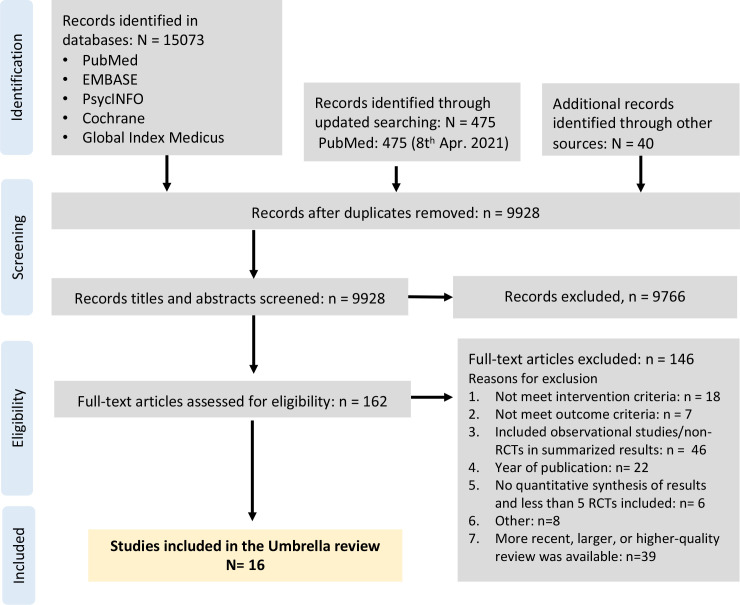
The current umbrella review aimed to assess and summarise evidence on universal, selective and indicated interventions for mental health at the workplace. This umbrella review forms one of the evidence reviews which were commissioned by the WHO to develop global guidelines on mental health at work. We conducted systematic searches in five bibliographic databases (PubMed, Embase, PsycINFO, Cochrane and Global Medicus Index) and included meta-analyses of randomised trials examining psychosocial, physical activity and lifestyle interventions delivered to all general workers (universal interventions), at-risk workers (selective interventions) and workers already experiencing symptoms of mental disorders (indicated interventions). We included outcomes from seven domains: symptoms of mental health conditions, positive mental health, quality of life, work-related outcomes, substance use, suicide-related outcomes and potential adverse effects. We identified 16 meta-analyses producing 66 pooled effect sizes of the examined interventions, mostly on symptoms of mental health conditions (n=43 pooled effect sizes) (eg, burnout, insomnia, stress) and positive mental health (n=15) (eg, well-being). Most of the evidence on universal, selective and indicated interventions was focused on psychosocial interventions, showing small to moderate effects across the various outcomes. Certainty levels according to GRADE (Grading of Recommendations Assessment, Development and Evaluation) were low to very low in almost all of the examined outcomes. The results of existing meta-analyses are promising for the use of preventative and early treatment interventions in the workplace. However, the quality and certainty of the evidence were very modest, and further research on the effectiveness of these interventions is warranted.
Overview
The claims and statistics of this paper haven’t been checked yet.
Free: it reads the open-access text and checks the first 5 claims that cite a source we can check. Create a free account to check every claim.
Integrity signals
Registry
Cites
Statistics
Figures
Verification
Claims the paper makes
The claims and statistics of this paper haven’t been checked yet.
Free: it reads the open-access text and checks the first 5 claims that cite a source we can check. Create a free account to check every claim.
Claims other papers make about this one
Each is checked against this paper’s own text: does it say what the citing paper says it does?
The cited source says what the claim attributes to it.
In the citing paper
“Although extensive research has been devoted to stress intervention programs and evidence from systematic reviews and meta-analyses suggests that these are effective in reducing stress within the working population (Bhui et al., 2012; Miguel et al., 2023; Richardson and Rothstein, 2008).”
From Learning how to recover from stress: Results from an internet-based randomized controlled pilot trial (2023) · cites this paper as Miguel et al., 2023
Self-check
Percentages, sums and reported differences re-computed from the paper’s own numbers.
The self-check needs the paper’s full text.
Citations
Cites
GRADE: an emerging consensus on rating quality of evidence and strength of recommendations
Guyatt, G. H., Oxman, A. D., Vist, G. E., Kunz, R., Falck-Ytter, Y., Alonso-Coello, P., & Schünemann, H. J. (2008) · BMJ · doi:10.1136/bmj.39489.470347.ad · Cited by 23,305
Durlak, J. A., Weissberg, R. P., Dymnicki, A. B., Taylor, R. D., & Schellinger, K. B. (2011) · Child Development · doi:10.1111/j.1467-8624.2010.01564.x · Cited by 10,854 · cited 1×
“Overall, the effects of universal interventions were generally small, which is in line with wider literature on this type of intervention, such as school 45 or higher education settings.”
Shea, B. J., Reeves, B. C., Wells, G., Thuku, M., Hamel, C., Moran, J., Moher, D., Tugwell, P., Welch, V., Kristjansson, E., et al. (2017) · BMJ · doi:10.1136/bmj.j4008 · Cited by 10,636
Murray, C. J. L., Aravkin, A. Y., Zheng, P., Abbafati, C., Abbas, K. M., Abbasi-Kangevari, M., Abd-Allah, F., Abdelalim, A., Abdollahi, M., Abdollahpour, I., et al. (2020) · The Lancet · doi:10.1016/s0140-6736(20)30752-2 · Cited by 9,854
Murray, C. J. L., Vos, T., Lozano, R., Naghavi, M., Flaxman, A. D., Michaud, C., Ezzati, M., Shibuya, K., Salomon, J. A., Abdalla, S., et al. (2012) · The Lancet · doi:10.1016/s0140-6736(12)61689-4 · Cited by 8,888
The benefits of frequent positive affect: Does happiness lead to success?
Lyubomirsky, S., King, L., & Diener, E. (2005) · Psychological Bulletin · doi:10.1037/0033-2909.131.6.803 · Cited by 7,143
Shanafelt, T. D., Boone, S., Tan, L., Dyrbye, L. N., Sotile, W., Satele, D., West, C. P., Sloan, J., & Oreskovich, M. R. (2012) · Archives of Internal Medicine · doi:10.1001/archinternmed.2012.3199 · Cited by 3,439 · cited 1×
“16 Similar concerns have been raised for other at-risk occupations, such as emergency workers 17 or humanitarian workers.”
Interventions to prevent and reduce physician burnout: a systematic review and meta-analysis
West, C. P., Dyrbye, L. N., Erwin, P. J., & Shanafelt, T. D. (2016) · The Lancet · doi:10.1016/s0140-6736(16)31279-x · Cited by 2,362
Scaling-up treatment of depression and anxiety: a global return on investment analysis
Chisholm, D., Sweeny, K., Sheehan, P., Rasmussen, B., Smit, F., Cuijpers, P., & Saxena, S. (2016) · The Lancet Psychiatry · doi:10.1016/s2215-0366(16)30024-4 · Cited by 1,451
Self-citation
Research works printed but not linked: 3
- Institute of Medicine Committee on Prevention of Mental D. Reducing risks for mental disorders: frontiers for preventive intervention research. In: Mrazek PJ, Haggerty RJ, eds. Reducing Risks for Mental Disorders: Frontiers for Preventive Intervention Research. Washington (DC): National Academies Press (US) Copyright 1994 by the National Academy of Sciences, 1994. 25144015
- National Research C, Institute of Medicine Committee on the Prevention of Mental D, Substance Abuse Among Children Y. The national academies collection: reports funded by national institutes of health. In: O’Connell ME, Boat T, Warner KE, eds. Preventing Mental, Emotional, and Behavioral Disorders Among Young People: Progress and Possibilities. Washington (DC): National Academies Press (US) Copyright © 2009, National Academy of Sciences, 2009.
- Pollock M, Fernandes RM, Becker LA, et al. Chapter V: overviews of reviews. In: Cochrane Handbook for systematic reviews of interventions. 2020: 6.
Cited by
Effectiveness of workplace interventions for health promotion
Virtanen, M., Lallukka, T. M., Elovainio, M. J., Steptoe, A., & Kivimäki, M. (2025) · The Lancet Public Health · doi:10.1016/s2468-2667(25)00095-7 · Cited by 76
A mentally healthy framework to guide employers and policy makers
Deady, M., Sanatkar, S., Tan, L., Glozier, N., Gayed, A., Petrie, K., Dalgaard, V. L., Stratton, E., LaMontagne, A. D., & Harvey, S. B. (2024) · Frontiers in Public Health · doi:10.3389/fpubh.2024.1430540 · Cited by 70
Mental health and well-being at the workplace
Sarkar, S., Menon, V., Padhy, S. K., & Kathiresan, P. (2024) · Indian Journal of Psychiatry · doi:10.4103/indianjpsychiatry.indianjpsychiatry_608_23 · Cited by 54
Effectiveness of Physical Activity-Led Workplace Health Promotion Interventions: A Systematic Review
Zhang, S., Nie, M., Peng, J., & Ren, H. C. (2025) · Healthcare · doi:10.3390/healthcare13111292 · Cited by 38
World Psychiatric Association-Asian Journal of Psychiatry Commission on Public Mental Health
Bhugra, D. K., Liebrenz, M., Ventriglio, A., Ng, R., Javed, A., Kar, A., Chumakov, E. M., Moura, H. F., Tolentino, E. J., Gupta, S., et al. (2024) · Asian Journal of Psychiatry · doi:10.1016/j.ajp.2024.104105 · Cited by 35
Metadata
- Authors
- Miguel, C., Amarnath, A., Akhtar, A., Malik, A., Baranyi, G., Barbui, C., Karyotaki, E., & Cuijpers, P.
- Affiliations
- Vrije Universiteit Amsterdam (NL)
- Karolinska Institutet (SE)
- World Health Organization (CH)
- University of Edinburgh (GB)
- University of Verona (IT)
- Corresponding author
- Miguel, Clara
- ORCID
- Venue
- Occupational and Environmental Medicine
- Publisher
- BMJ
- Published
- 2023-02-24
- Volume
- 80
- Issue
- 4
- Pages
- 225-236
- ISSN
- 0007-1072 (ISSN-L)
- 1351-0711
- 1470-7926
- PMC
- PMC10086469
- OpenAlex
- W4321782379
- Cited by
- 55
- References
- 48
- Citations by year
- 2026: 19 · 2025: 23 · 2024: 10 · 2023: 3
- FWCI
- 2.80
- Type
- journal article
- Language
- en
- Open access
- hybrid
- doi.org
- Locations
- Occupational and Environmental Medicine (publishedVersion, cc-by)
- PubMed Central (publishedVersion, cc-by)
- PubMed (publishedVersion)
- Edinburgh Research Explorer (University of Edinburgh) (submittedVersion, cc-by)
- VU Research Portal (submittedVersion, other-oa)
- Data Archiving and Networked Services (DANS) (submittedVersion, other-oa)
- Funders
- World Health Organization (Not applicable)
- Topics
- Health Sciences › Medicine › Public Health, Environmental and Occupational Health › Workplace Health and Well-being
- Health Sciences › Medicine › Public Health, Environmental and Occupational Health › Occupational Health and Burnout
- Social Sciences › Psychology › Social Psychology › Stress and Burnout Research
- Keywords
- workplace mental health, universal interventions, selective intervention, psychosocial interventions, physical activity interventions, lifestyle intervention, burnout, stress, insomnia, positive mental health, well-being, quality of life, substance use, suicide
- MeSH terms
- Humans, Mental Health, Quality of Life, Meta-Analysis as Topic, Randomized Controlled Trials as Topic, Occupational Health, Workplace
About these checks
Registry, retraction, Cites and statistics results are computed, not judged, with one exception: a printed reference that no index lists is read once by a model before it counts as a citation error. Claims are extracted by a model and kept only when their quote appears verbatim in the text; each cited source is then checked, with a model’s help, for whether it says what the claim relies on. Those verdicts can be wrong — read the claim’s quote and the cited source before relying on one.
Statistics and arithmetic are recomputed, not judged.
Confidence bands are shown only for fields calibrated on our annotated test set. None is calibrated yet, so no band is shown.
What counts as a claim ›How we measure confidence ›How we check this ›
Are you an author, or do you see a problem with this page? Request a review
How to cite
Cite CoChat for the checks on this page, and the paper for its own findings.
- This page
- CoChat. (2026). Citation check: Universal, selective and indicated interventions for supporting mental health at the workplace: an umbrella review of meta-analyses. https://app.cochat.ai/papers/10.1136/oemed-2022-108698
- The paper
- Miguel, C., Amarnath, A., Akhtar, A., Malik, A., Baranyi, G., Barbui, C., Karyotaki, E., & Cuijpers, P. (2023). Universal, selective and indicated interventions for supporting mental health at the workplace: an umbrella review of meta-analyses. Occupational and Environmental Medicine. https://doi.org/10.1136/oemed-2022-108698
Data sources
Bibliographic data: Semantic Scholar, OpenAlex, Crossref.
Contains information from the Semantic Scholar Academic Graph Datasets, made available under the ODC Attribution License (ODC-BY 1.0).
Semantic Scholar’s data is described in: Kinney, R., et al. (2023). The Semantic Scholar Open Data Platform. arXiv:2301.10140.
