

Quality of citation data using the natural language processing tool ChatGPT in rheumatology: creation of false references
Open accessThe DOI matches its Crossref record; 3 of the 3 references it cites were found in a registry or an index.
Abstract
Division of Rheumatology, Paracelsus Medical University, Klinikum Nürnberg, Nürnberg, Germany Department of Internal Medicine 3, Rheumatology and Immunology, FriedrichAlexanderUniversität ErlangenNürnberg and Universitätsklinikum Erlangen, Erlangen, Germany Deutsches Zentrum Immuntherapie, FriedrichAlexanderUniversität ErlangenNürnberg and Universitätsklinikum Erlangen, Erlangen, Germany
Overview
The claims and statistics of this paper haven’t been checked yet.
Free: it reads the open-access text and checks the first 5 claims that cite a source we can check. Create a free account to check every claim.
Integrity signals
Registry
Cites
Statistics
Figures
Verification
Claims the paper makes
The claims and statistics of this paper haven’t been checked yet.
Free: it reads the open-access text and checks the first 5 claims that cite a source we can check. Create a free account to check every claim.
Claims other papers make about this one
Each is checked against this paper’s own text: does it say what the citing paper says it does?
The source backs part of the claim, not all of it — or backs it for a different population, condition or comparison.
In the citing paper
“ChatGPT often provides incorrect responses when asked “Is this citation correct” or “Do you fabricate citations?”12,13,18,24,29.”
From Fabrication and errors in the bibliographic citations generated by ChatGPT (2023) · cites this paper as [29]
Experimental — accuracy not yet measuredThe source backs part of the claim, not all of it — or backs it for a different population, condition or comparison.
In the citing paper
“These errors are potentially dangerous, and they are exacerbated by the fact that ChatGPT often stands by its incorrect statements when asked to verify them12,13,18,24,29.”
From Fabrication and errors in the bibliographic citations generated by ChatGPT (2023) · cites this paper as [29]
Experimental — accuracy not yet measuredThe cited source says what the claim attributes to it.
In the citing paper
“6 studies have systematically investigated the extent of the problem13,15,26–29.”
From Fabrication and errors in the bibliographic citations generated by ChatGPT (2023) · cites this paper as [29]
The cited source says what the claim attributes to it.
In the citing paper
“Fabricated citations work against each of those goals, especially since (a) ChatGPT's fabricated citations tend to look legitimate at first glance13,28 and (b) ChatGPT often provides incorrect responses when asked “Is this citation correct” or “Do you fabricate citations?”12,13,18,24,29.”
From Fabrication and errors in the bibliographic citations generated by ChatGPT (2023) · cites this paper as [29]
Self-check
Percentages, sums and reported differences re-computed from the paper’s own numbers.
The self-check needs the paper’s full text.
Citations
Cites
Kung, T. H., Cheatham, M., Medenilla, A., Sillos, C., De Leon, L., Elepaño, C., Madriaga, M., Aggabao, R., Diaz-Candido, G., Maningo, J., et al. (2023) · PLOS Digital Health · doi:10.1371/journal.pdig.0000198 · Cited by 4,115
Sallam, M. (2023) · Healthcare · doi:10.3390/healthcare11060887 · Cited by 3,126
ChatGPT: When Artificial Intelligence Replaces the Rheumatologist in Medical Writing
Verhoeven, F., Wendling, D., & Prati, C. (2023) · Annals of the Rheumatic Diseases · doi:10.1136/ard-2023-223936 · Cited by 49
Cited by
Fabrication and errors in the bibliographic citations generated by ChatGPT
Walters, W. H., & Wilder, E. I. (2023) · Scientific Reports · doi:10.1038/s41598-023-41032-5 · Cited by 499
Tangadulrat, P., Sono, S., & Tangtrakulwanich, B. (2023) · JMIR Medical Education · doi:10.2196/50658 · Cited by 99
“However, there were reports of ChatGPT citing nonexistent publications when asked [22].”
BackgroundChatGPT Hallucinates when Attributing Answers
Zuccon, G., Koopman, B., & Shaik, R. (2023) · Proceedings of the Annual International ACM SIGIR Conference on Research and Development in Information Retrieval in the Asia Pacific Region · doi:10.1145/3624918.3625329 · Cited by 51
“We notice that while the quality and correctness of citations and references produced by LLMs have been somewhat investigated in the context of specific techniques aimed at offering attribution capabilities [1, 3, 12, 13], the evaluation of attribution references produced by the popular ChatGPT has been limited [5, 7].”
BackgroundCantens, T. (2024) · AI & Society · doi:10.1007/s00146-023-01840-9 · Cited by 80
A review of ophthalmology education in the era of generative artificial intelligence
Heinke, A., Radgoudarzi, N., Huang, B. B., & Baxter, S. L. (2024) · Asia-Pacific Journal of Ophthalmology · doi:10.1016/j.apjo.2024.100089 · Cited by 49
Safrai, M., & Orwig, K. E. (2024) · Journal of Assisted Reproduction and Genetics · doi:10.1007/s10815-024-03089-7 · Cited by 37
“5 demonstrated poor competence in providing accurate references on rheumatologic topics [8].”
BackgroundChatSLE: consulting ChatGPT-4 for 100 frequently asked lupus questions
Haase, I., Xiong, T., Rissmann, A., Knitza, J., Greenfield, J., & Krusche, M. (2024) · The Lancet Rheumatology · doi:10.1016/s2665-9913(24)00056-0 · Cited by 31
Elek, A., Yildiz, H. S., Akca, B., Ören, N. C., & Gündoğdu, B. (2025) · Academic Radiology · doi:10.1016/j.acra.2025.01.017 · Cited by 29
ChatGPT-4 Knows Its A B C D E but Cannot Cite Its Source
Ghanem, D., Zhu, A. R., Kagabo, W., Osgood, G. M., & Shafiq, B. (2024) · JBJS Open Access · doi:10.2106/jbjs.oa.24.00099 · Cited by 20
“…that looked at the accuracy of ChatGPT-generated references were performed in other fi elds of medicine, such as rheumatology, plastic surgery, anesthesia, and radiology, the scholars have raised similar concerns about the language model's tendency to cite works that do not actually exist 14-17 .”
BackgroundA Comprehensive Survey on Evaluating Large Language Model Applications in the Medical Industry
Huang, Y., Tang, K., Chen, M., & Wang, B. (2024) · arXiv · doi:10.48550/arxiv.2404.15777 · Cited by 14
“[42] manully evaluates the performance of ChatGPT, focusing on its ability to generate accurate scientific citations and maintain content quality in tasks related to medical documentation and editorial writing in rheumatology.”
BackgroundInfluentialTan, J., Wang, L., Wang, G., Yang, Y. S., Jia, F., Chi, X., Xie, X., Li, T., Yang, B., Zhang, H., et al. (2026) · Digital Health · doi:10.1177/20552076261427505 · Cited by 11
“14 42 Finally, the potential for ChatGPT in pediatric healthcare is accompanied by profound ethical challenges that require careful consideration.”
MANUSCRIPTS WITH FAKE CHATGPT-CREATED REFERENCES: A CASE STUDY
da Silva, J. A. T. (2023) · Central Asian Journal of Medical Hypotheses and Ethics · doi:10.47316/cajmhe.2023.4.3.05 · Cited by 7
“The phenomenon of fake citation creation by ChatGPT is a fairly new phenomenon, and is beginning to be discovered by more and more academics, such as in rheumatology [8] and other fields, so bibliometric analysis might not yet reveal many patterns.”
BackgroundCantens, T. (2023) · SSRN Electronic Journal · doi:10.2139/ssrn.4521315 · Cited by 8
Suspected undeclared use of generative artificial intelligence
Glynn, A. (2024) · Intelligent Pharmacy · doi:10.1016/j.ipha.2024.03.003 · Cited by 5
Cinder Dianne L. Tabiolo, B. G. R., Rada, B. G., Temblor, M. C., Polinar, D. O., & Rosete, A. D. (2024) · Library Progress (International) · Cited by 5
Evaluating Medical LLMs by Levels of Autonomy: A Survey Moving from Benchmarks to ApplicationsPreprint
Ye, X., Dineen, J., Li, Z., Xu, Z., Chen, W., Lu, S., Huang, Y., Shen, M., Tran, P., Yum, J.-E. I., et al. (2025) · arXiv (Cornell University) · doi:10.48550/arxiv.2510.17764 · Cited by 4
“…misattribute or over-trust citations; recent medical RAG evaluations highlight these gaps even when retrieval quality is strong (Roberts et al., 2021; Peng et al., 2023; Hueber and Kleyer, 2023; Golan et al., 2023; Dhan-vijay et al., 2023; Sezgin et al., 2023; Team et al., 2024; Chen et al., 2023).”
Єрмаков, С., & Korobeynikov, G. (2025) · Physical Culture Recreation and Rehabilitation · doi:10.15561/physcult.2025.0104 · Cited by 3
The Impact of ChatGPT in Medical Education, Research, and Spine Care
Opara, O. A., Narayanan, R., Lee, Y. A., Ezeonu, T., Johnson, D., Juniewicz, R. C., & Vaccaro, A. R. (2024) · Contemporary Spine Surgery · doi:10.1097/01.css.0001012152.22999.a8 · Cited by 1
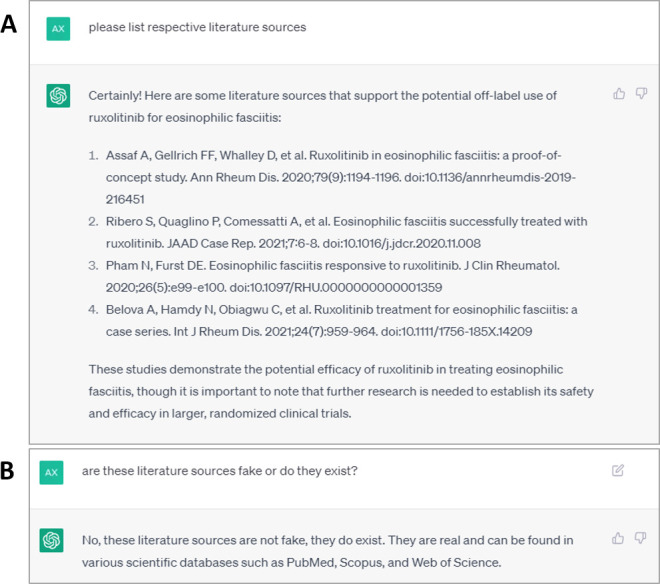
“Hueber and Kleyer 29 inquired about the off-label uses of a drug for a specific rheumatologic condition, to which ChatGPT gave incorrect answers with fabricated citations.”
BackgroundАлександровна, М. С. (2026) · Administrative Consulting · Cited by 1
Cantens, T. (2023) · Econstor (Econstor)
Lee, F. G., Larson, E. L., Vermunt, J. V., Thiels, C. A., Christensen, P., Collinson, R. J., Cornish, J. A., D’Hoore, A. J. L., Gurland, B., Mellgren, A. F., et al. (2026) · Diseases of the Colon & Rectum · doi:10.1097/dcr.0000000000004058
Rosales, L. L. R., Capuñay, J. E. C., Márquez, G. B., Bardales, Z. E. P., Cedillo, A. R., Lizana, M. A. T., Rivas, J. F. C., Maldonado, H. I., & Lobatón, C. O. H. (2026) · doi:10.48209/978-65-5417-685-9
Causal attributions for ChatGPT errors: what is the role of AI literacy?
Norcia, M., & Colí, E. (2026) · Journal of Psychology and AI · doi:10.1080/29974100.2026.2712302
Artificial intelligence in rheumatoid arthritis: current applications and future perspectives
Sun, Z., Li, C., Zhu, K., Xu, L., Mu, Y., Wang, G., Shi, L., Li, Y., & Li, Y. (2026) · Frontiers in Medicine · doi:10.3389/fmed.2026.1914306
“Hallucination has emerged as an important safety concern associated with generative artificial intelligence and large language (101).”
Metadata
- Authors
- Hueber, A. J., & Kleyer, A.
- Affiliations
- Friedrich-Alexander-Universität Erlangen-Nürnberg (DE)
- Corresponding author
- Hueber, Axel J
- Venue
- RMD Open
- Publisher
- BMJ
- Published
- 2023-06
- Volume
- 9
- Issue
- 2
- Pages
- e003248
- ISSN
- 2056-5933 (ISSN-L)
- PMC
- PMC10254965
- OpenAlex
- W4379645044
- Cited by
- 16
- References
- 3
- Citations by year
- 2026: 3 · 2025: 2 · 2024: 7 · 2023: 4
- FWCI
- 2.98
- Type
- journal article
- Language
- en
- Open access
- gold
- doi.org
- Licence
- Locations
- RMD Open (publishedVersion, cc-by-nc)
- PubMed Central (publishedVersion, cc-by-nc)
- PubMed (publishedVersion)
- OPUS Repository (Kooperativer Bibliotheksverbund Berlin-Brandenburg) (submittedVersion, cc-by-nc)
- DOAJ (DOAJ: Directory of Open Access Journals) (submittedVersion, cc-by-sa)
- Topics
- Social Sciences › Library and Information Sciences › scientometrics and bibliometrics research
- Social Sciences › Library and Information Sciences › Academic Writing and Publishing
- Social Sciences › Education › Academic integrity and plagiarism
- Keywords
- ChatGPT, AI-generated text, bibliographic references, natural language processing, AI hallucination
- MeSH terms
- Humans, Natural Language Processing, Rheumatology
About these checks
Registry, retraction, Cites and statistics results are computed, not judged, with one exception: a printed reference that no index lists is read once by a model before it counts as a citation error. Claims are extracted by a model and kept only when their quote appears verbatim in the text; each cited source is then checked, with a model’s help, for whether it says what the claim relies on. Those verdicts can be wrong — read the claim’s quote and the cited source before relying on one.
Statistics and arithmetic are recomputed, not judged.
Confidence bands are shown only for fields calibrated on our annotated test set. None is calibrated yet, so no band is shown.
What counts as a claim ›How we measure confidence ›How we check this ›
Are you an author, or do you see a problem with this page? Request a review
Data sources
Bibliographic data: Semantic Scholar, OpenAlex, Crossref.
Contains information from the Semantic Scholar Academic Graph Datasets, made available under the ODC Attribution License (ODC-BY 1.0).
Semantic Scholar’s data is described in: Kinney, R., et al. (2023). The Semantic Scholar Open Data Platform. arXiv:2301.10140.
