

Prevalence of and environmental factors associated with aerosolised Aspergillus spores at a zoological park
Open accessThe DOI matches its Crossref record; 20 of the 22 references it cites were found in a registry or an index.
Abstract
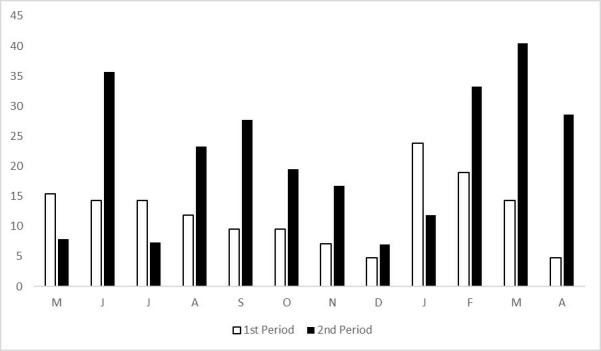
Aspergillus is a significant pathogen in zoological species, although information on environmental variables influencing fungal prevalence in zoological settings are lacking. The objective of the study was to estimate the prevalence of and to identify environmental factors associated with aerosolised Aspergillus spores at a zoological park to advance the understanding of fungal exposure as a first step towards improved mitigation strategies for susceptible animals. Twenty‐one locations were sampled for presence of Aspergillus species using the SAS Super 180 Microbial Air Sampler, while twenty‐two environmental factors were evaluated every two weeks at SeaWorld of California during two 12‐month periods. In each period, the frequency of investigated environmental factors was compared between samples classified as positive or negative for Aspergillus species using logistic regression. Prevalence of Aspergillus was higher (P<0.05) during the second 12‐month period (110/525 or 21 per cent), compared with the first period (62/483 or 13 per cent). In both periods, positive Aspergillus samples were associated with indoor sites without high‐efficiency particulate air (HEPA) filtration systems and other infection control measures (adjusted OR=4.33 and 5.19, P<0.01) or outdoor sites (adjusted OR=2.50 and3.79, P≤0.05), compared to indoor sites with HEPA filtration systems and other infection control measures, after controlling for season. Burden of airborne Aspergillus can be higher in indoor sites without HEPA filtration systems than in outdoor sites. The use of HEPA filtration systems and other infection control measures can mitigate the burden of Aspergillus . Risk‐based surveillance systems that target indoor areas without HEPA filtration systems can be an efficient approach for early detection of high burden of Aspergillus at zoological parks.
Overview
The claims and statistics of this paper haven’t been checked yet.
Free: it reads the open-access text and checks the first 5 claims that cite a source we can check. Create a free account to check every claim.
Integrity signals
Registry
Cites
Statistics
Figures
Verification
Claims the paper makes
The claims and statistics of this paper haven’t been checked yet.
Free: it reads the open-access text and checks the first 5 claims that cite a source we can check. Create a free account to check every claim.
Claims other papers make about this one
Each is checked against this paper’s own text: does it say what the citing paper says it does?
The cited source says what the claim attributes to it.
In the citing paper
“The SAS air sampler was previously used for monitoring airborne microorganisms in various indoor and outdoor occupational and recreational environments [34,35].”
Self-check
Percentages, sums and reported differences re-computed from the paper’s own numbers.
The self-check needs the paper’s full text.
Citations
Cites
Walsh, T. J., Anaissie, E. J., Denning, D. W., Herbrecht, R., Kontoyiannis, D. P., Marr, K. A., Morrison, V. A., Segal, B. H., Steinbach, W. J., Stevens, D. A., et al. (2008) · Clinical Infectious Diseases · doi:10.1086/525258 · Cited by 2,706
Medically Important Fungi: A Guide to Identification
Larone, D. H. (1976) · Cited by 809
Altman, R. B. (1997) · Saunders eBooks · Cited by 767
Profiles of Airborne Fungi in Buildings and Outdoor Environments in the United States
Shelton, B. G., Kirkland, K. H., Flanders, W. D., & Morris, G. K. (2002) · Applied and Environmental Microbiology · doi:10.1128/aem.68.4.1743-1753.2002 · Cited by 673
Medically important fungi: A guide to identification
Ajello, L. (1989) · Diagnostic Microbiology and Infectious Disease · doi:10.1016/0732-8893(89)90040-0 · Cited by 662
Aspergillus fumigatus—What Makes the Species a Ubiquitous Human Fungal Pathogen?
Kwon-Chung, K. J., & Sugui, J. A. (2013) · PLoS Pathogens · doi:10.1371/journal.ppat.1003743 · Cited by 432
Nosocomial aspergillosis in outbreak settings
Vonberg, R.-P., & Gastmeier, P. (2006) · Journal of Hospital Infection · doi:10.1016/j.jhin.2006.02.014 · Cited by 368
Gene Fitness Landscapes of Vibrio cholerae at Important Stages of Its Life Cycle
Kamp, H. D., Patimalla-Dipali, B., Lazinski, D. W., Wallace-Gadsden, F., & Camilli, A. (2013) · PLoS Pathogens · doi:10.1371/journal.ppat.1003800 · Cited by 233
Aspergillus infections in birds: a review
Beernaert, L. A., Pasmans, F., Van Waeyenberghe, L., Haesebrouck, F., & Martel, A. (2010) · Avian Pathology · doi:10.1080/03079457.2010.506210 · Cited by 206
Relationship of structure and function of the avian respiratory system to disease susceptibility
Fedde, M. R. (1998) · Poultry Science · doi:10.1093/ps/77.8.1130 · Cited by 180
Preventing healthcare-associated Aspergillus infections: review of recent CDC/HICPAC recommendations
Weber, D. J., Peppercorn, A., Miller, M. B., Sickbert-Bennett, E. E., & Rutala, W. A. (2009) · Medical Mycology · doi:10.1080/13693780802709073 · Cited by 76
Aspergillosis: a limiting factor during recovery of captive magellanic penguins
Xavier, M. O., Soares, M. P., Meinerz, A. R. M., Nobre, M. O., Osório, L. G., Silva Filho, R. P. D., & Meireles, M. C. A. (2007) · Brazilian Journal of Microbiology · doi:10.1590/s1517-83822007000300018 · Cited by 71
Clinical implications of environmental sources for Aspergillus
Warris, A., & Verweij, P. E. (2005) · Medical Mycology · doi:10.1080/13693780400025260 · Cited by 60
Reidarson, T. H., Harrell, J. H., Rinaldi, M. G., & McBain, J. F. (1998) · PubMed · Cited by 48
Dykstra, M. J., Loomis, M. R., Reininger, K., Zombeck, D. J., & Faucette, T. (1997) · PubMed · Cited by 25
Burco, J. D., Massey, J. G., Byrne, B. A., Tell, L. A., Clemons, K. V., & Ziccardi, M. H. (2014) · Journal of Zoo and Wildlife Medicine · doi:10.1638/2012-0051r1.1 · Cited by 21
Disseminated Aspergillus terreus infection in a caged pigeon
Pal, M. (1992) · Mycopathologia · doi:10.1007/bf00448810 · Cited by 18
Faucette, T., Loomis, M. R., Reininger, K., Zombeck, D. J., Stout, H., Porter, C., & Dykstra, M. J. (1999) · PubMed · Cited by 15
AVIARY AIR-HANDLER DESIGN AND ITS RELATIONSHIP TO FUNGAL SPORE LOADS IN THE AIR
Dykstra, M. J., & Reininger, K. (2007) · Journal of Zoo and Wildlife Medicine · doi:10.1638/1042-7260(2007)38[540:aadair]2.0.co;2 · Cited by 7
Risk factors associated with development of poxvirus lesions in hospitalized California sea lions
Nollens, H. H., Hernández, J. A., Jacobson, E. R., Haulena, M., & Gulland, F. M. D. (2005) · Journal of the American Veterinary Medical Association · doi:10.2460/javma.2005.227.467 · Cited by 5
Self-citation
Research works printed but not linked: 2
- Vanderheyden N Aspergillosis in psittacine chicks In: Jackson G, ed Proceedings of the annual conference of the association of avian veterinarians. 207, 1993.
- Der EF, Stablein JP, Coleman DA Comparative evaluation of three active air samplers for the monitoring of airborne microorganisms. Pharm Technol 2005; 4: 110– 6.
Cited by
Arné, P., Risco‐Castillo, V., Jouvion, G., Barzic, C. L., & Guillot, J. (2021) · Journal of Fungi · doi:10.3390/jof7030241 · Cited by 105
Álvarez‐Pérez, S., García, M. E., Martínez‐Nevado, E., & Blanco, J. L. (2023) · Research in Veterinary Science · doi:10.1016/j.rvsc.2023.104993 · Cited by 8
Adhikari, A., Banerjee, P., Thornton, T., Jones, D. H., Adeoye, C., & Sherpa, S. (2023) · Microorganisms · doi:10.3390/microorganisms11061561 · Cited by 7
Plewa-Tutaj, K., Chmielewska, Z., Twarużek, M., Kosicki, R., & Soszczyńska, E. (2025) · Pathogens · doi:10.3390/pathogens14040332 · Cited by 3
“[2] The nature of zoos as enclosed spaces with a variety of animal and plant life creates a special place where both animals and humans are exposed to potentially harmful microorganisms.”
Marques, G. N., Barny, R., Guerra, J. S., Leal, M. O., Urbani, N., & Flanagan, C. A. (2025) · Aquatic Mammals · doi:10.1578/am.51.1.2025.37 · Cited by 2
Metadata
- Authors
- Martony, M., Nollens, H., Tucker, M., Henry, L., Schmitt, T., & Hernandez, J.
- Affiliations
- University of Florida (US)
- SeaWorld San Diego (US)
- College of Veterinary Medicine University of Florida Gainesville Florida USA
- Corresponding author
- Martony, Molly
- Venue
- Veterinary Record Open
- Publisher
- Wiley
- Published
- 2019-01
- Volume
- 6
- Issue
- 1
- Pages
- e000281-e000281
- ISSN
- 2052-6113 (ISSN-L)
- 2399-2050
- PMC
- PMC6802980
- OpenAlex
- W2980738810
- Semantic Scholar
- 25a0876a05e7797aebcdc3dd38d08a5ff5194623
- Cited by
- 5
- References
- 22
- Citations by year
- 2026: 1 · 2025: 1 · 2023: 2 · 2021: 1
- FWCI
- 0.11
- Type
- journal article
- Language
- en
- Open access
- gold
- doi.org
- Licence
- Locations
- Veterinary Record Open (publishedVersion, cc-by-nc)
- Europe PMC (PubMed Central) (publishedVersion, cc-by-nc)
- PubMed Central (publishedVersion, cc-by-nc)
- PubMed (publishedVersion)
- Topics
- Physical Sciences › Environmental Science › Health, Toxicology and Mutagenesis › Indoor Air Quality and Microbial Exposure
- Health Sciences › Medicine › Infectious Diseases › Antifungal resistance and susceptibility
- Health Sciences › Medicine › Infectious Diseases › Fungal Infections and Studies
- Keywords
- Aspergillus, zoos, HEPA filtration, infection control, environmental risk factors, prevalence, zoo animal health, risk-based surveillance
About these checks
Registry, retraction, Cites and statistics results are computed, not judged, with one exception: a printed reference that no index lists is read once by a model before it counts as a citation error. Claims are extracted by a model and kept only when their quote appears verbatim in the text; each cited source is then checked, with a model’s help, for whether it says what the claim relies on. Those verdicts can be wrong — read the claim’s quote and the cited source before relying on one.
Statistics and arithmetic are recomputed, not judged.
Confidence bands are shown only for fields calibrated on our annotated test set. None is calibrated yet, so no band is shown.
What counts as a claim ›How we measure confidence ›How we check this ›
Are you an author, or do you see a problem with this page? Request a review
Data sources
Bibliographic data: Semantic Scholar, OpenAlex, Crossref.
Contains information from the Semantic Scholar Academic Graph Datasets, made available under the ODC Attribution License (ODC-BY 1.0).
Semantic Scholar’s data is described in: Kinney, R., et al. (2023). The Semantic Scholar Open Data Platform. arXiv:2301.10140.
