

Deidentification of free-text medical records using pre-trained bidirectional transformers
Open accessThe DOI matches its Crossref record; 36 of the 36 references it cites were found in a registry or an index.
Abstract
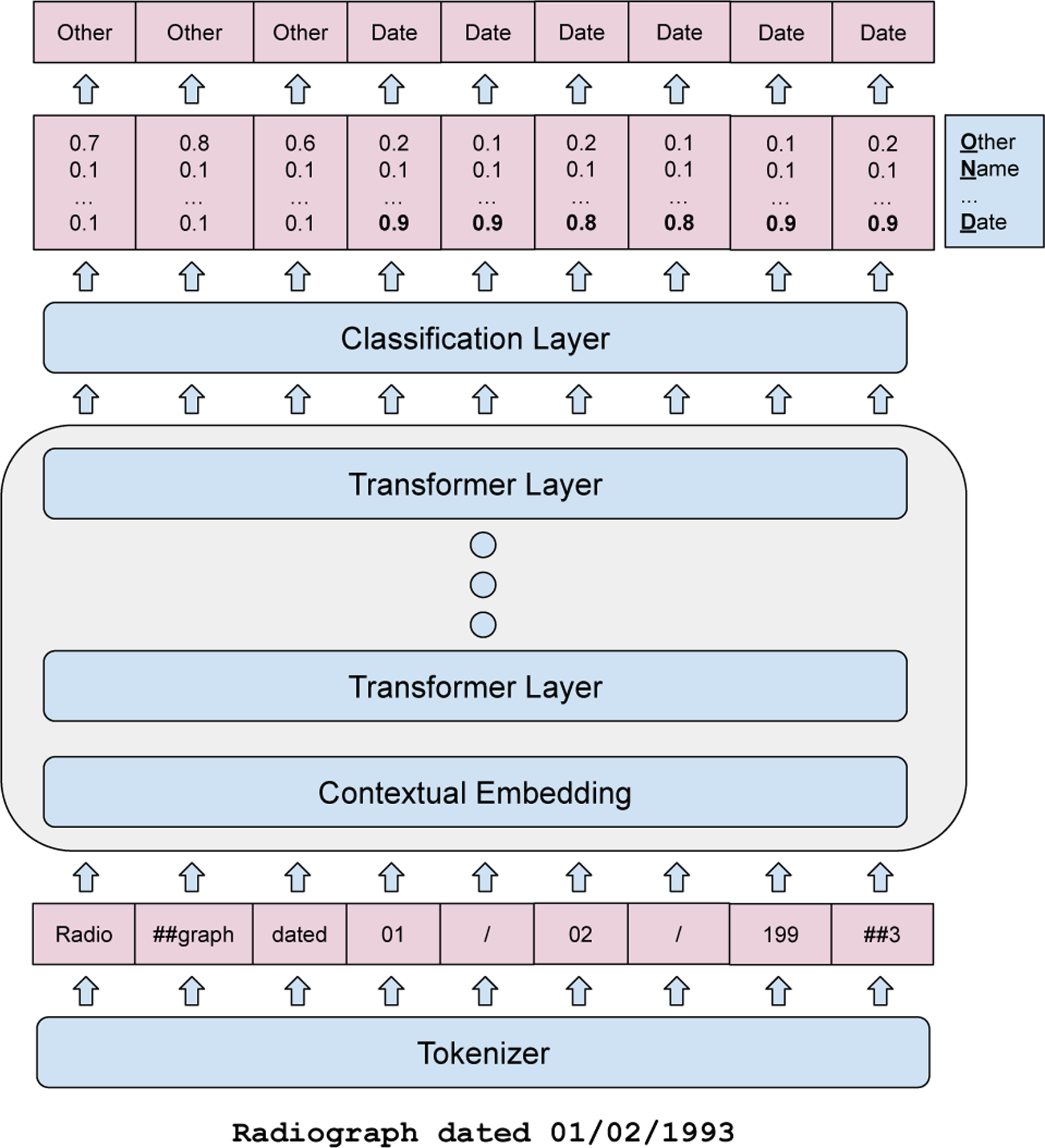
The ability of caregivers and investigators to share patient data is fundamental to many areas of clinical practice and biomedical research. Prior to sharing, it is often necessary to remove identifiers such as names, contact details, and dates in order to protect patient privacy. Deidentification, the process of removing identifiers, is challenging, however. High-quality annotated data for developing models is scarce; many target identifiers are highly heterogenous (for example, there are uncountable variations of patient names); and in practice anything less than perfect sensitivity may be considered a failure. As a result, patient data is often withheld when sharing would be beneficial, and identifiable patient data is often divulged when a deidentified version would suffice. In recent years, advances in machine learning methods have led to rapid performance improvements in natural language processing tasks, in particular with the advent of large-scale pretrained language models. In this paper we develop and evaluate an approach for deidentification of clinical notes based on a bidirectional transformer model. We propose human interpretable evaluation measures and demonstrate state of the art performance against modern baseline models. Finally, we highlight current challenges in deidentification, including the absence of clear annotation guidelines, lack of portability of models, and paucity of training data. Code to develop our model is open source, allowing for broad reuse.
Overview
The claims and statistics of this paper haven’t been checked yet.
Free: it reads the open-access text and checks the first 5 claims that cite a source we can check. Create a free account to check every claim.
Integrity signals
Registry
Cites
Statistics
Figures
Verification
Claims the paper makes
The claims and statistics of this paper haven’t been checked yet.
Free: it reads the open-access text and checks the first 5 claims that cite a source we can check. Create a free account to check every claim.
Claims other papers make about this one
Each is checked against this paper’s own text: does it say what the citing paper says it does?
The cited source says what the claim attributes to it.
In the citing paper
“Finally, we combined two published algorithms for removing PHI from free-text17,18.”
From MIMIC-IV, a freely accessible electronic health record dataset (2023) · cites this paper as [18]
Self-check
Percentages, sums and reported differences re-computed from the paper’s own numbers.
The self-check needs the paper’s full text.
Citations
Cites
Vaswani, A., Shazeer, N., Parmar, N., Uszkoreit, J., Jones, L., Gomez, A. N., Kaiser, L., & Polosukhin, I. (2017) · arXiv · doi:10.48550/arxiv.1706.03762 · Cited by 120,404 · cited 2×
“Briefly, our model consists of L identical layers applied sequentially, where each layer is a single transformer block [37].”
BackgroundMethodBERT: Pre-training of Deep Bidirectional Transformers for Language Understanding
Devlin, J., Chang, M.-W., Lee, K., & Toutanova, K. (2018) · arXiv · doi:10.48550/arxiv.1810.04805 · Cited by 73,173 · cited 3×
“1 Model We adopt the model architecture used in BERT [8] with additional components for performing named entity recognition.”
MethodInfluentialImageNet Large Scale Visual Recognition Challenge
Russakovsky, O., Deng, J., Su, H., Krause, J., Satheesh, S., Ma, S., Huang, Z., Karpathy, A., Khosla, A., Bernstein, M., et al. (2015) · International Journal of Computer Vision · doi:10.1007/s11263-015-0816-y · Cited by 39,380 · cited 1×
“The advent of large, open access text corpuses and the resurgence of neural networks has driven advances in state-of-the-art model performance in natural language processing [10, 27].”
BackgroundPyTorch: An Imperative Style, High-Performance Deep Learning Library
Paszke, A., Gross, S., Massa, F., Lerer, A., Bradbury, J., Chanan, G., Killeen, T., Lin, Z., Gimelshein, N., Antiga, L., et al. (2019) · arXiv · doi:10.48550/arxiv.1912.01703 · Cited by 31,473
RoBERTa: A Robustly Optimized BERT Pretraining Approach
Liu, Y., Ott, M., Goyal, N., Du, J., Joshi, M., Chen, D., Levy, O., Lewis, M., Zettlemoyer, L., & Stoyanov, V. (2019) · arXiv · doi:10.48550/arxiv.1907.11692 · Cited by 16,515 · cited 1×
“New models including RoBERTa [19], ALBERT [15], and XLNet [41] have demonstrated enhanced performance in several transfer learning tasks, and so could be expected to offer performance gains in deidentification.”
MethodTransformers: State-of-the-Art Natural Language Processing
Wolf, T., Debut, L., Sanh, V., Chaumond, J., Delangue, C., Moi, A., Cistac, P., Rault, T., Louf, R., Funtowicz, M., et al. (2020) · Proceedings of the 2020 Conference on Empirical Methods in Natural Language Processing: System Demonstrations · doi:10.18653/v1/2020.emnlp-demos.6 · Cited by 8,741
MIMIC-III, a freely accessible critical care database
Johnson, A. E. W., Pollard, T. J., Shen, L., Lehman, L.-W. H., Feng, M., Ghassemi, M., Moody, B., Szolovits, P., Anthony Celi, L., & Mark, R. G. (2016) · Scientific Data · doi:10.1038/sdata.2016.35 · Cited by 8,141
Self-citationBioBERT: a pre-trained biomedical language representation model for biomedical text mining
Lee, J., Yoon, W., Kim, S., Kim, D., Kim, S., So, C. H., & Kang, J. (2020) · Bioinformatics · doi:10.1093/bioinformatics/btz682 · Cited by 7,218 · cited 1×
“As BERT was trained using a general language corpus, we evaluate model performance when using pretrained weights from scientific corpora (SciBERT) or biomedical corpora (BioBERT) [3, 17].”
MethodXLNet: Generalized Autoregressive Pretraining for Language Understanding
Yang, Z., Dai, Z., Yang, Y., Carbonell, J., Salakhutdinov, R., & Le, Q. V. (2019) · arXiv · doi:10.48550/arxiv.1906.08237 · Cited by 6,687 · cited 1×
“New models including RoBERTa [19], ALBERT [15], and XLNet [41] have demonstrated enhanced performance in several transfer learning tasks, and so could be expected to offer performance gains in deidentification.”
MethodGoogle's Neural Machine Translation System: Bridging the Gap between Human and Machine Translation
Wu, Y., Schuster, M., Chen, Z., Le, Q. V., Norouzi, M., Macherey, W., Krikun, M., Cao, Y., Gao, Q., Macherey, K., et al. (2016) · arXiv · doi:10.48550/arxiv.1609.08144 · Cited by 5,319
Research works printed but not linked: 6
- Halevy Alon, Norvig Peter, and Pereira Fernando. 2009. The Unreasonable Effectiveness of Data. Intelligent Systems, IEEE 24, 2 (2009), 8– 12.
- Johnson Alistair E W, Bulgarelli Lucas, and Pollard Tom J. 2020. BERT-deid: A BERT model for deidentification of free text notes. 10.13026/0757-0y85 PMC8330601 34350426 · doi:10.13026/0757-0y85
- Lafferty John D., McCallum Andrew, and Pereira Fernando C. N.. 2001. Conditional Random Fields: Probabilistic Models for Segmenting and Labeling Sequence Data. In Proceedings of the Eighteenth International Conference on Machine Learning (ICML âĂŹ01). Morgan Kaufmann Publishers Inc., San Francisco, CA, USA, 282âĂŞ 289.
- Lee Jinhyuk, Yoon Wonjin, Kim Sungdong, Kim Donghyeon, Kim Sunkyu, Ho So Chan, and Kang Jaewoo. 2019. BioBERT: a pre-trained biomedical language representation model for biomedical text mining. Bioinformatics (09 2019). 10.1093/bioinformatics/btz682 PMC7703786 31501885 · DOI · Paper page
- Paszke Adam, Gross Sam, Chintala Soumith, and Chanan Gregory. 2017. Pytorch: Tensors and dynamic neural networks in python with strong gpu acceleration. (2017).
- Matthew E Peters Mark Neumann, Iyyer Mohit, Gardner Matt, Clark Christopher, Lee Kenton, and Zettlemoyer Luke. 2018. Deep contextualized word representations. arXiv preprint arXiv:1802.05365 (2018). · arXiv
Cited by
MIMIC-IV, a freely accessible electronic health record dataset
Johnson, A. E. W., Bulgarelli, L., Shen, L., Gayles, A., Shammout, A., Horng, S., Pollard, T. J., Hao, S., Moody, B., Gow, B., et al. (2023) · Scientific Data · doi:10.1038/s41597-022-01899-x · Cited by 3,401
“Finally, we combined two published algorithms for removing PHI from free-text 17,18 .”
MethodSelf-citationAMMU: A survey of transformer-based biomedical pretrained language models
Kalyan, K. S., Rajasekharan, A., & Sangeetha, S. (2022) · Journal of Biomedical Informatics · doi:10.1016/j.jbi.2021.103982 · Cited by 278
Transformer models in biomedicine
Madan, S., Lentzen, M., Brandt, J., Rueckert, D., Hofmann-Apitius, M., & Fröhlich, H. (2024) · BMC Medical Informatics and Decision Making · doi:10.1186/s12911-024-02600-5 · Cited by 124
Does BERT Pretrained on Clinical Notes Reveal Sensitive Data?
Lehman, E., Jain, S., Pichotta, K., Goldberg, Y., & Wallace, B. (2021) · Proceedings of the 2021 Conference of the North American Chapter of the Association for Computational Linguistics: Human Language Technologies · doi:10.18653/v1/2021.naacl-main.73 · Cited by 93
Pilán, I., Lison, P., Øvrelid, L., Papadopoulou, A. I., Sánchez, D., & Batet, M. (2022) · Computational Linguistics · doi:10.1162/coli_a_00458 · Cited by 227
Buess, L., Keicher, M., Navab, N., Maier, A., & Arasteh, S. T. (2025) · Biomedical Engineering Letters · doi:10.1007/s13534-025-00497-1 · Cited by 109
“LLMs can automate the removal of protected health information from medical documents by anonymizing identifiers such as names and dates while preserving data utility [40, 43].”
Murugadoss, K., Rajasekharan, A., Malin, B., Agarwal, V., Bade, S., Anderson, J. R., Ross, J. L., Faubion, W. A., Halamka, J. D., Soundararajan, V., et al. (2021) · Patterns · doi:10.1016/j.patter.2021.100255 · Cited by 72
Chambon, P. J., Wu, C., Steinkamp, J. M., Adleberg, J., Cook, T. S., & Langlotz, C. P. (2023) · Journal of the American Medical Informatics Association · doi:10.1093/jamia/ocac219 · Cited by 51
Kovačević, A., Bašaragin, B., Milošević, N., & Nenadić, G. (2024) · Artificial Intelligence in Medicine · doi:10.1016/j.artmed.2024.102845 · Cited by 72
Methods for Automatic Sensitive Data Detection in Large Datasets: a Review
Kužina, V., Vusak, E., & Jović, A. (2021) · International Convention on Information and Communication Technology, Electronics and Microelectronics · doi:10.23919/mipro52101.2021.9596735 · Cited by 20
“While sensitive data detection in structured data depends entirely on the domain and its associated metadata, the recent implementations of such tasks use machine learning on pre-trained word embeddings ([2], [3]).”
Ford, E. M., Curlewis, K., Squires, E., Griffiths, L. J., Stewart, R. J., & Jones, K. H. (2021) · Frontiers in Digital Health · doi:10.3389/fdgth.2021.606599 · Cited by 19
Manzanares-Salor, B., Sánchez, D., & Lison, P. (2024) · Data Mining and Knowledge Discovery · doi:10.1007/s10618-024-01066-3 · Cited by 32
“…et al. 2010; Aberdeen et al. 2010; Chen et al. 2019; Dernoncourt et al. 2017; Elazar and Goldberg 2018; Hassan et al. 2018; Huang et al. 2020; Johnson et al. 2020; Liu et al. 2017; Mamede et al. 2016; Neamatullah et al. 2008; Reddy and Knight 2016; Szarvas et al. 2007; Xu et al. 2019; Yang…”
InfluentialChen, F., Bokhari, S. M. A., Cato, K., Gürsoy, G., & Rossetti, S. C. (2024) · Applied Clinical Informatics · doi:10.1055/a-2282-4340 · Cited by 18
CLIP: A Dataset for Extracting Action Items for Physicians from Hospital Discharge Notes
Mullenbach, J., Pruksachatkun, Y., Adler, S., Seale, J., Swartz, J. L., McKelvey, T. G., Dai, H., Yang, Y., & Sontag, D. A. (2021) · doi:10.18653/v1/2021.acl-long.109 · Cited by 40
“The BERT architecture (Devlin et al., 2019) has been widely used within clinical NLP in the past year with successful results (Lee et al., 2020; Alsentzer et al., 2019; Mulyar et al., 2019; Johnson et al., 2020; McDermott et al., 2020; Zhang et al., 2020).”
BackgroundMethodKreuzthaler, M., Brochhausen, M., Zayas, C. E., Blobel, B. G. M. E., & Schulz, S. (2023) · Frontiers in Medicine · doi:10.3389/fmed.2023.1073313 · Cited by 17
“Anonymization means marking names of persons and institutions (95) in order to remove the direct reference to persons and institutions, an absolute requirement for clinical texts to be processed for purposes other than patient care and by persons other than those directly caring.”
BackgroundEnhancing text anonymization via re-identification risk-based explainability
Manzanares-Salor, B., & Sánchez, D. (2025) · Knowledge-Based Systems · doi:10.1016/j.knosys.2024.112945 · Cited by 13
An, J., Kim, J., Sunwoo, L., Baek, H., Yoo, S., & Lee, S. (2025) · BMC Medical Informatics and Decision Making · doi:10.1186/s12911-025-02913-z · Cited by 12
“While de-identification research in English clinical narrative texts [12–14] is extensive, the work on non-English clinical notes is limited.”
PHICON: Improving Generalization of Clinical Text De-identification Models via Data Augmentation
Yue, X., & Zhou, S. (2020) · Clinical Natural Language Processing Workshop (ClinicalNLP) · doi:10.18653/v1/2020.clinicalnlp-1.23 · Cited by 26
Kraljević, Ž., Shek, A., Yeung, J. A., Sheldon, E. J., Shuaib, H., Al-Agil, M., Bai, X., Noor, K., Shah, A. D., Dobson, R., et al. (2023) · IEEE International Conference on Healthcare Informatics (ICHI) · doi:10.1109/ichi57859.2023.00098 · Cited by 18
Mercorelli, L. R., Nguyen, H. H., Gartell, N., Brookes, M., Morris, J. M., & Tam, C. S. (2022) · Australian Health Review · doi:10.1071/ah21361 · Cited by 10
De-identification of Privacy-related Entities in Job PostingsPreprint
Jensen, K. N., Zhang, M., & Plank, B. (2021) · arXiv (Cornell University) · doi:10.48550/arxiv.2105.11223 · Cited by 22
“Most recently, Johnson et al. (2020) fine-tuned BERTbase and BERTlarge (Devlin et al., 2019) for de-identification.”
MethodA Transformer-Based Pipeline for German Clinical Document De-Identification
Arzideh, K., Baldini, G., Winnekens, P., Friedrich, C. M., Nensa, F., Idrissi-Yaghir, A., & Hosch, R. (2025) · Applied Clinical Informatics · doi:10.1055/a-2424-1989 · Cited by 12
Manzanares-Salor, B., & Sánchez, D. (2025) · Expert Systems with Applications · doi:10.1016/j.eswa.2025.129474 · Cited by 13
PRvL: Quantifying the Capabilities and Risks of Large Language Models for PII Redaction
Garza, L., Kotal, A., Piplai, A., Elluri, L., Das, P. K., & Chadha, A. R. (2025) · IEEE International Conference on Trust, Privacy and Security in Intelligent Systems and Applications (TPS-ISA) · doi:10.1109/tps-isa67132.2025.00025 · Cited by 15
“Transformer-based models have also gained traction for their ability to capture long-range dependencies and contextual cues more effectively [30], [31].”
Liu, L., Perez‐Concha, O., Nguyen, A. N., Bennett, V., Blake, V., Gallego, B., & Jorm, L. R. (2023) · Interactive Journal of Medical Research · doi:10.2196/46322 · Cited by 10
Unsupervised Text Deidentification
Morris, J. X., Chiu, J., Zabih, R., & Rush, A. M. (2022) · Findings of the Association for Computational Linguistics: EMNLP (Findings of EMNLP) · doi:10.18653/v1/2022.findings-emnlp.352 · Cited by 26
Automatic Evaluation of Disclosure Risks of Text Anonymization Methods
Manzanares-Salor, B., Sánchez, D., & Lison, P. (2022) · Lecture notes in computer science · doi:10.1007/978-3-031-13945-1_12 · Cited by 15
Staufer, D., Pallas, F., & Berendt, B. (2024) · ACM Conference on Fairness, Accountability, and Transparency (FAccT) · doi:10.1145/3630106.3658936 · Cited by 14
“Others use recurrent neural networks [12, 30], reinforcement learning [71], support vector machines [65], or pre-trained language models [23] to identify and remove entities that fall into pre-defined categories.”
BackgroundMAP: evaluation and multi-agent enhancement of large language models for inpatient pathways
Chen, Z., Peng, Z., Liang, X., Wang, C., Liang, P., Zeng, L., Ju, M., & Yuan, Y. (2026) · npj Health Systems · doi:10.1038/s44401-026-00085-0 · Cited by 18
“4a, state-of-the-art LLMs demonstrated notable limitations in supporting the diagnosis of complex clinical presentations involving multiple organ systems.”
Ahmed, A., Abbasi, A., & Eickhoff, C. (2021) · PubMed · doi:10.48550/arxiv.2103.13546 · Cited by 7
Schiezaro, M., Rosa, G. M., Campos, B. A. G., & Pedrini, H. (2026) · Frontiers in Public Health · doi:10.3389/fpubh.2025.1717303 · Cited by 7
Toward training NLP models to take into account privacy leakages
Berthelier, G., Boutet, A., & Richard, A. (2023) · IEEE International Conference on Big Data (BigData) · doi:10.1109/bigdata59044.2023.10386735 · Cited by 10
“Johnson et al. for example proposed to use a neural network based on a BERT architecture [5] to detect a certain number of identifying elements in medical documents.”
Automated redaction of names in adverse event reports using transformer-based neural networks
Meldau, E.-L., Bista, S., Melgarejo-González, C., & Norén, G. N. (2024) · BMC Medical Informatics and Decision Making · doi:10.1186/s12911-024-02785-9 · Cited by 5
Muthukrishnan, H., George, J. G., & Aggarwal, A. (2025) · International Seminar on Application for Technology of Information and Communication (iSemantic) · doi:10.1109/isemantic67418.2025.11291786 · Cited by 4
Neural text sanitization with privacy risk indicators: an empirical analysis
Papadopoulou, A. I., Lison, P., Anderson, M., Øvrelid, L., & Pilán, I. (2026) · Language Resources and Evaluation · doi:10.1007/s10579-026-09911-1 · Cited by 9
“Char - acter-based recurrent neural networks (Dernoncourt et al., 2017; Liu et al., 2017 ) and transformer architectures have also been investigated for this purpose (Johnson et al., 2020 ).”
Singhofer, F., Garifullina, A., Kern, M., & Scherp, A. (2021) · ACM Symposium on Document Engineering (DocEng) · doi:10.1145/3469096.3469871 · Cited by 6
“Johnson et al. [11] were first to propose a de-identification system using transformer models [32].”
MethodTseng, F.-P., Ko, H.-C., Hou, X.-Y., Wijaya, D., Chang, C., & Tsai, R. T. (2025) · Communications in computer and information science · doi:10.1007/978-981-97-7966-6_11 · Cited by 2
De-identification of Thai Free-text Clinical Notes
Suvirat, K., Chairat, S., Horsiritham, K., Kongkamol, C., & Chaichulee, S. (2023) · Biomedical Engineering International Conference · doi:10.1109/bmeicon60347.2023.10321968 · Cited by 2
“Our results show that MEDPSU-RoBERTa consistently outperforms the other models in overall de-identification performance, highlighting the advantage of fine-tuning to domain-specific clinical data [11].”
Anonimização de textos médicos com processamento de linguagem natural
da Silva, R. P., & Pazin‐Filho, A. (2025) · Journal of Health Informatics · doi:10.59681/2175-4411.v17.2025.1227 · Cited by 2
Sriram, R., Sundaram, S. S., & Sophie, S. L. (2024) · Journal of Electronics Electromedical Engineering and Medical Informatics · doi:10.35882/jeeemi.v7i1.616 · Cited by 3
“Johnson [20] presents the BERT model, attaining a notable F1 score of 92.45%.”
InfluentialG2MBCF: Enhanced Named Entity Recognition for sensitive entities identification
Tian, W., Gu, K., Xiao, S., Zhang, J., & Cui, W. (2025) · Data & Knowledge Engineering · doi:10.1016/j.datak.2025.102444 · Cited by 2
A locally deployable agentic framework for clinical data deidentificationPreprint
Hirsch, A., Ten, F. W., Krueger, K. S., Geyer, R., Roeschl, T., Gröschel, M. I., Rostin, P., Eils, R., Spott, M., Praßer, F., et al. (2026) · medRxiv · doi:10.64898/2026.05.28.26353952 · Cited by 3
Robot Control via Natural Instructions Empowered by Large Language Model
Wu, Z., Shu, P., Li, Y., Li, Q., Liu, T., & Li, X. R. (2024) · Springer eBooks · doi:10.1007/978-3-031-66656-8_19 · Cited by 3
MedVidDeID: Protecting privacy in clinical encounter video recordings
Mopidevi, S., Jang, K. J., Alasaly, B., Pugh, S., Park, J., Batugo, A., Hwang, S., Eaton, E., Mowery, D. L., & Johnson, K. B. (2025) · Journal of Biomedical Informatics · doi:10.1016/j.jbi.2025.104901 · Cited by 3
“Recent approaches employ architectures such as pre-trained bidirectional transformers [32, 33] to identify and redact PHI in Electronic Health Records (EHRs), enabling large-scale anonymization and facilitating secure sharing of clinical text for research and model development.”
Deep Learning Models for Automatic De-identification of Clinical Text
Sriram, R., Sundaram, S. S., & Sophie, S. L. (2023) · IFIP advances in information and communication technology · doi:10.1007/978-3-031-39811-7_10 · Cited by 3
De-identification of Clinical Document Images using Deep Learning and Data-Driven MethodsPreprint
Sri, R., Sundaram, S. S., & Sophie, S. L. (2023) · Research Square · doi:10.21203/rs.3.rs-3343674/v1
Rule-Based Named Entity Recognition for Hindi
Suri, D., Malviya, N., & Joshi, N. (2025) · Communications in computer and information science · doi:10.1007/978-3-031-91331-0_4
Data-Centric Security Model Based on Attribute-Based Cryptography For Healthcare Systems
Kachouh, B., Sliman, L., Samhat, A. E., & Barkaoui, K. (2025) · Communications in computer and information science · doi:10.1007/978-3-031-93598-5_14
A contrastive dual attention framework for enhancing adverse drug event relations extraction
Kashtriya, P., & Singh, P. (2025) · Revista Cientifica de Sistemas e Informatica · doi:10.51252/rcsi.v5i2.968
Identifying Personal Information in Textual Data
Kayem, A. V. D. M. (2025) · Advances in information security · doi:10.1007/978-3-031-93906-8_7
Kumar, N., Andreotti, A., Kocaman, V., Gul, Y., Butgul, M., & Talby, D. (2026) · Lecture notes in networks and systems · doi:10.1007/978-3-032-26211-0_12
Clinical Text De-Identification Beyond PHI Detection: A Scoping Review
Sariyar, M. (2026) · J — Multidisciplinary Scientific Journal · doi:10.3390/j9030022
Aragão, C. G., Oliveira, M. C., & Vieira, T. M. D. A. (2026) · Research Square · doi:10.21203/rs.3.rs-10425027/v1
Kohail, S., Albajali, A., & Alshehhi, M. (2026) · Proceedings - IEEE Symposium on Computer-Based Medical Systems · doi:10.1109/cbms69103.2026.00257
“More recently, transformer-based methods have further improved PHI detection and de-identification accuracy [7].”
Metadata
- Authors
- Johnson, A. E. W., Bulgarelli, L., & Pollard, T. J.
- Affiliations
- Massachusetts Institute of Technology (US)
- Venue
- Proceedings of the ACM Conference on Health, Inference, and Learning
- Publisher
- ACM
- Published
- 2020-04-02
- Volume
- 2020
- Pages
- 214-221
- PMC
- PMC8330601
- OpenAlex
- W3012137864
- Cited by
- 55
- References
- 33
- Citations by year
- 2026: 7 · 2025: 16 · 2024: 7 · 2023: 8 · 2022: 5 · 2021: 10 · 2020: 2
- FWCI
- 2.39
- Type
- conference paper
- Language
- en
- Open access
- hybrid
- doi.org
- Licence
- Locations
- ACM Conference on Health, Inference, and Learning (CHIL) (publishedVersion, other-oa)
- PubMed (publishedVersion)
- PubMed Central (acceptedVersion, cc-by-nc)
- DSpace@MIT (Massachusetts Institute of Technology) (submittedVersion, cc-by-nc)
- Funders
- NIH (NIH-R01-EB017205)
- Topics
- Physical Sciences › Computer Science › Artificial Intelligence › Privacy-Preserving Technologies in Data
- Physical Sciences › Computer Science › Artificial Intelligence › Machine Learning in Healthcare
- Health Sciences › Health Professions › Health Information Management › Thoreau and American Literature
- Keywords
- de-identification, clinical notes, patient identifiers, bidirectional transformer, pre-trained language models, patient privacy, data sharing, annotation guidelines, model portability, limited training data
About these checks
Registry, retraction, Cites and statistics results are computed, not judged, with one exception: a printed reference that no index lists is read once by a model before it counts as a citation error. Claims are extracted by a model and kept only when their quote appears verbatim in the text; each cited source is then checked, with a model’s help, for whether it says what the claim relies on. Those verdicts can be wrong — read the claim’s quote and the cited source before relying on one.
Statistics and arithmetic are recomputed, not judged.
Confidence bands are shown only for fields calibrated on our annotated test set. None is calibrated yet, so no band is shown.
What counts as a claim ›How we measure confidence ›How we check this ›
Are you an author, or do you see a problem with this page? Request a review
Data sources
Bibliographic data: Semantic Scholar, OpenAlex, Crossref.
Contains information from the Semantic Scholar Academic Graph Datasets, made available under the ODC Attribution License (ODC-BY 1.0).
Semantic Scholar’s data is described in: Kinney, R., et al. (2023). The Semantic Scholar Open Data Platform. arXiv:2301.10140.
