

Towards Accountability for Machine Learning Datasets: Practices from Software Engineering and Infrastructure
Open accessThe DOI matches its Crossref record; 143 of the 143 references it cites were found in a registry or an index.
Abstract
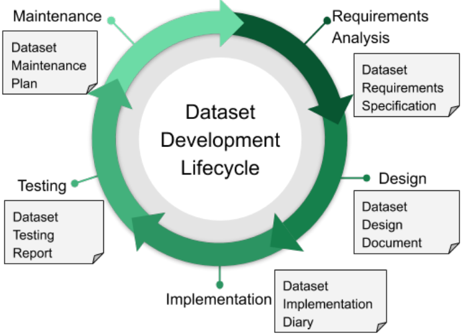
Datasets that power machine learning are often used, shared, and reused with little visibility into the processes of deliberation that led to their creation. As artificial intelligence systems are increasingly used in high-stakes tasks, system development and deployment practices must be adapted to address the very real consequences of how model development data is constructed and used in practice. This includes greater transparency about data, and accountability for decisions made when developing it. In this paper, we introduce a rigorous framework for dataset development transparency that supports decision-making and accountability. The framework uses the cyclical, infrastructural and engineering nature of dataset development to draw on best practices from the software development lifecycle. Each stage of the data development lifecycle yields documents that facilitate improved communication and decision-making, as well as drawing attention to the value and necessity of careful data work. The proposed framework makes visible the often overlooked work and decisions that go into dataset creation, a critical step in closing the accountability gap in artificial intelligence and a critical/necessary resource aligned with recent work on auditing processes.
Overview
The claims and statistics of this paper haven’t been checked yet.
Free: it reads the open-access text and checks the first 5 claims that cite a source we can check. Create a free account to check every claim.
Integrity signals
Registry
Cites
Statistics
Figures
Verification
Claims the paper makes
The claims and statistics of this paper haven’t been checked yet.
Free: it reads the open-access text and checks the first 5 claims that cite a source we can check. Create a free account to check every claim.
Claims other papers make about this one
Each is checked against this paper’s own text: does it say what the citing paper says it does?
The source backs part of the claim, not all of it — or backs it for a different population, condition or comparison.
In the citing paper
“Important constituent elements are the notions of data sheets [18, 25, 38], model cards [40], and system cards [22]: frameworks that can help structure the systematic presentation of metadata about models and systems and that feed into auditing procedures [37].”
From Rethinking open source generative AI: open washing and the EU AI Act (2024) · cites this paper as [25]
Experimental — accuracy not yet measuredThe source backs part of the claim, not all of it — or backs it for a different population, condition or comparison.
In the citing paper
“Work on AI safety and reproducibility has long pointed out the crucial importance of training data for understanding model performance, ensuring reproducibility, and assessing legal exposure [2, 25, 29, 46, 58].”
From Rethinking open source generative AI: open washing and the EU AI Act (2024) · cites this paper as [25]
Experimental — accuracy not yet measuredThe source backs part of the claim, not all of it — or backs it for a different population, condition or comparison.
In the citing paper
“This has been flagged as one of the causes of historical and representational bias in ML systems that use those data, with numerous authors urging for slower and more methodical approaches to data collection [36,53].”
From A Survey of Data Quality Requirements That Matter in ML Development Pipelines (2023) · cites this paper as [36]
Experimental — accuracy not yet measuredThe source backs part of the claim, not all of it — or backs it for a different population, condition or comparison.
In the citing paper
“Earlier trends of opportunistic data collection and post hoc justifications of large datasets are gradually moving towards a requirement for more deliberative data collection methods [35,36], sampling techniques [16] and minimal data architectures [57] to deliver better performance without reducing model accuracy.”
From A Survey of Data Quality Requirements That Matter in ML Development Pipelines (2023) · cites this paper as [36]
Experimental — accuracy not yet measuredThe source backs part of the claim, not all of it — or backs it for a different population, condition or comparison.
In the citing paper
“Numerous authors have observed that ML systems perform better for users whose demographic characteristics match those represented in the training data [9,36].”
From A Survey of Data Quality Requirements That Matter in ML Development Pipelines (2023) · cites this paper as [36]
Experimental — accuracy not yet measured
2 more claims about this paper
Create a free account to see every claim other papers make about this one.
Self-check
Percentages, sums and reported differences re-computed from the paper’s own numbers.
The self-check needs the paper’s full text.
Citations
Cites
Dilemmas in a general theory of planning
Rittel, H. W. J., & Webber, M. M. (1973) · Policy Sciences · doi:10.1007/bf01405730 · Cited by 16,338 · cited 2×
“s. Undesirable data feedback loops and unutilized data features can be mitigated with careful requirements practices. Data Postmortems and Premortems. Even the best designed systems occasionally fail [25, 119], however cyclical development practiceshelpavoidmakingthesamefailurestwice,andthepostmortem is a critical too…”
BackgroundInfluentialScience in Action: How to Follow Scientists and Engineers through Society
Bijker, W. E., & Latour, B. (1988) · Technology and Culture · doi:10.2307/3105094 · Cited by 10,767
Playing Atari with Deep Reinforcement Learning
Mnih, V., Kavukcuoglu, K., Silver, D., Graves, A., Antonoglou, I., Wierstra, D., & Riedmiller, M. (2013) · arXiv · doi:10.48550/arxiv.1312.5602 · Cited by 9,471
(1987) · Cited by 8,955
Laboratory Life: The Construction of Scientific Facts
Latour, B. (1986) · DigitalGeorgetown (Georgetown University Library) · Cited by 7,491
Situated Knowledges: The Science Question in Feminism and the Privilege of Partial Perspective
Haraway, D. (1988) · PhilPapers (PhilPapers Foundation) · Cited by 6,992
Representing and Intervening: Introductory Topics in the Philosophy of Natural Science
Hacking, I. (1983) · doi:10.1017/cbo9780511814563 · Cited by 4,814
The ethics of algorithms: Mapping the debate
Mittelstadt, B. D., Allo, P., Taddeo, M., Wachter, S., & Floridi, L. (2016) · Big Data & Society · doi:10.1177/2053951716679679 · Cited by 4,567 · cited 1×
“how consent is obtained, and the data collection process needs to keep “the receipts” as evidence of due process. To facilitate this, it is therefore necessary that dataset requirements be traceable [100], and in many cases requirements should be measurable. Non-boolean test outcomes are still useful in flagging conce…”
BackgroundThe Politics and Poetics of Infrastructure
Larkin, B. (2013) · Annual Review of Anthropology · doi:10.1146/annurev-anthro-092412-155522 · Cited by 4,095 · cited 1×
“s, with which they interact through technical interfaces. Datasets are also infrastructure in the infrastructure studies sense, in that they arrange a way to view and structure knowledge of the world [22, 88]. We show how framing datasets as infrastructure helps to shed light on many of the social and technical phenom…”
BackgroundWicked Problems in Design Thinking
Buchanan, R. (1992) · Design Issues · doi:10.2307/1511637 · Cited by 3,539 · cited 1×
“s. Undesirable data feedback loops and unutilized data features can be mitigated with careful requirements practices. Data Postmortems and Premortems. Even the best designed systems occasionally fail [25, 119], however cyclical development practiceshelpavoidmakingthesamefailurestwice,andthepostmortem is a critical too…”
Background
Research works printed but not linked: 25
- 2. Alain Abran, James W Moore, Pierre Bourque, Robert Dupuis, and L Tripp. 2004. Software engineering body of knowledge. IEEE Computer Society, Angela Burgess (2004).
- 19. Anandhi S Bharadwaj. 2000. A resource-based perspective on information technology capability and firm performance: an empirical investigation. MIS quarterly (2000), 169-196.
- 22. Geoffrey C Bowker and Susan Leigh Star. 2000. Sorting things out: Classification and its consequences. MIT press. · doi:10.5555/380681
- 24. Harvey Brooks. 1994. The relationship between science and technology. Research policy 23, 5 (1994), 477-486.
- 27. Joy Buolamwini and Timnit Gebru. 2018. Gender shades: Intersectional accu- racy disparities in commercial gender classification. In Conference on fairness, accountability and transparency. 77-91.
- 29. Lawrence Busch. 2014. A dozen ways to get lost in translation: Inherent chal- lenges in large scale data sets. International Journal of Communication 8 (2014), 18.
- 32. Danielle Citron and Frank Pasquale. 2014. The scored society: Due process for automated predictions. Washington Law Review 89 (03 2014), 1-33.
- 34. IEEE Standards Coordinating Committee et al. 1990. IEEE Standard Glossary of Software Engineering Terminology (IEEE Std 610.12-1990). Los Alamitos. CA: IEEE Computer Society 169 (1990).
- 36. Kate Crawford, Mary L Gray, and Kate Miltner. 2014. Critiquing Big Data: Politics, ethics, epistemology (special section introduction). International Journal of Communication 8 (2014), 10.
- 37. Kate Crawford and Trevor Paglen. 2019. Excavating AI: The politics of images in machine learning training sets. Excavating AI (2019).
- 56. Martin Glinz. 2011. A glossary of requirements engineering terminology. Stan- dard Glossary of the Certified Professional for Requirements Engineering (CPRE) Studies and Exam, Version 1 (2011), 56.
- 59. Ben Green. 2020. Data science as political action: Grounding data science in a politics of justice. Available at SSRN 3658431 (2020).
- 83. Nitin Kohli, Renata Barreto, and Joshua A Kroll. 2018. Translation tutorial: a shared lexicon for research and practice in human-centered software systems. In 1st Conference on Fairness, Accountability, and Transparancy. New York, NY, USA, Vol. 7.
- 94. Xiaoxuan Liu, Livia Faes, Aditya U Kale, Siegfried K Wagner, Dun Jack Fu, Alice Bruynseels, Thushika Mahendiran, Gabriella Moraes, Mohith Shamdas, Christoph Kern, et al. 2019. A comparison of deep learning performance against health-care professionals in detecting diseases from medical imaging: a system- atic review and meta-analysis. The lancet digital health 1, 6 (2019), e271-e297.
- 106. Helen Nissenbaum. 1996. Accountability in a computerized society. Science and engineering ethics 2, 1 (1996), 25-42.
- 107. Roy Osherove. 2015. The art of unit testing. MITP-Verlags GmbH & Co. KG.
- 119. Rashida Richardson, Jason M Schultz, and Kate Crawford. 2019. Dirty data, bad predictions: How civil rights violations impact police data, predictive policing systems, and justice. NYUL Rev. Online 94 (2019), 15.
- 140. Astra Taylor. 2018. The automation charade. Logic Magazine (2018).
- 143. Joel Walmsley. 2020. Artificial intelligence and the value of transparency. AI & SOCIETY (2020), 1-11.
- 144. Kai Wegrich and Gerhard Hammerschmid. 2017. Infrastructure governance as political choice. The governance of infrastructure (2017), 21-42.
- 10.18653/v1 · DOI
- 150. Richard Xiao. 2010. Corpus creation. Handbook of Natural Language Processing (2n Revised edition) (2010), 147-165.
- 10.18653/v1 · DOI
- 153. Matei Zaharia, Andrew Chen, Aaron Davidson, Ali Ghodsi, Sue Ann Hong, Andy Konwinski, Siddharth Murching, Tomas Nykodym, Paul Ogilvie, Mani Parkhe, Fen Xie, and Corey Zumaret. 2018. Accelerating the Machine Learning Lifecycle with MLflow. In IEEE Data Eng. Bull. 41, no. 4. 39-45.
- 157. Matthew Zook, Solon Barocas, Danah Boyd, Kate Crawford, Emily Keller, Seeta Peña Gangadharan, Alyssa Goodman, Rachelle Hollander, Barbara A Koenig, Jacob Metcalf, et al. 2017. Ten simple rules for responsible big data research.
Cited by
Items 201–282 of 282
Marginalized measures: The harmonization of diversity in precision medicine research
Jeske, M., Saperstein, A., Lee, S. S., & Shim, J. K. (2024) · Social Studies of Science · doi:10.1177/03063127241288498 · Cited by 6
Naktal Moaid, E. D. A. N., & Mahmood, B. M. (2022) · Technium Romanian Journal of Applied Sciences and Technology · doi:10.47577/technium.v4i4.6381 · Cited by 3
Vega, C., Kratochvíl, M., Satagopam, V., & Schneider, R. (2022) · Lecture notes in computer science · doi:10.1007/978-3-031-07802-6_30 · Cited by 4
Git Workflow for Active Learning: A Development Methodology Proposal for Data-Centric AI Projects
Stieler, F., & Bauer, B. (2023) · International Conference on Evaluation of Novel Approaches to Software Engineering · doi:10.5220/0011988400003464 · Cited by 3
Carlsson, L. S., & Samuelsson, P. (2023) · Processes · doi:10.3390/pr11123447 · Cited by 2
Li, Z. (2024) · Socius Sociological Research for a Dynamic World · doi:10.1177/23780231241259617 · Cited by 5
Governing Artificial Intelligence Through Auditing
Oluka, A., & Mashau, P. (2026) · Advances in computational intelligence and robotics book series · doi:10.4018/979-8-3373-3922-1.ch005 · Cited by 4
[Data] Quality Lies In The Eyes Of The Beholder
Pleimling, X., Shah, V., & Lourentzou, I. (2022) · International Conference on PErvasive Technologies Related to Assistive Environments (PETRA) · doi:10.1145/3529190.3529222 · Cited by 3
Machine learning practices in accounting and auditing
Singh, C., Thakkar, R., Weerawarna, R., & Patel, V. B. (2023) · International Journal of Science and Research Archive · doi:10.30574/ijsra.2023.10.1.0720 · Cited by 2
Kou, T. (2024) · ACM Conference on Fairness, Accountability, and Transparency (FAccT) · doi:10.1145/3630106.3658951 · Cited by 7
García, J. R., & Salamanca, W. M. (2024) · International Journal of Management and Sustainability · doi:10.18488/11.v13i2.3767 · Cited by 4
Impact Charts: A Tool for Identifying Systematic Bias in Social Systems and Data
Vengroff, D. E. (2024) · ACM Conference on Fairness, Accountability, and Transparency (FAccT) · doi:10.1145/3630106.3658965 · Cited by 3
Development of a Python Library to Generate Synthetic Datasets for Artificial Intelligence Education
Kim, S.-K., & Jeon, Y.-J. (2024) · International Journal on Advanced Science Engineering and Information Technology · doi:10.18517/ijaseit.14.3.18158 · Cited by 4
How to use generative AI more responsibly
Dancy, C. L. (2024) · Nature Reviews Psychology · doi:10.1038/s44159-024-00339-4 · Cited by 2
Social-sum-Mal: A Dataset for Abstractive Text Summarization in Malayalam
Rahul Raj, M., & Pankaj, D. S. (2024) · ACM Transactions on Asian and Low-Resource Language Information Processing · doi:10.1145/3696107 · Cited by 7
Making AI Work: Tracing Human Labour in the Supply Chains of Dataset Production
Chandhiramowuli, S. (2024) · ACM Conference on Computer Supported Cooperative Work (CSCW) · doi:10.1145/3678884.3682055 · Cited by 5
A Systematic Review of Open Datasets Used in Text-to-Image (T2I) Gen AI Model Safety
Bavalatti, T., Ahmed, O., Potdar, D., Rouf, R., Jawed, F., Govind, M., & Krishnan, S. (2025) · IEEE Access · doi:10.1109/access.2025.3539933 · Cited by 11
Case Studies Within Smart and Secure Software Development
Al-Tamimi, S. A., & Al-Haija, Q. S. A. (2025) · IGI Global eBooks · doi:10.4018/979-8-3693-9851-7.ch006 · Cited by 2
Generating and Verifying Synthetic Datasets with Requirements Engineering
Vonderhaar, L., Elvira, T., & Ochoa, O. (2025) · IEEE/ACM International Conference on AI Engineering – Software Engineering for AI (CAIN) · doi:10.1109/cain66642.2025.00032 · Cited by 2
FactSheets for Hardware-Aware AI Models: A Case Study of Analog In Memory Computing AI Models
Dominique, B., Maghraoui, K. E., Piorkowski, D., & Herger, L. M. (2023) · IEEE International Conference on Software Services Engineering (SSE) · doi:10.1109/sse60056.2023.00029 · Cited by 5
Yung, V., Colyvas, J. A., & Hwang, H. (2023) · doi:10.31235/osf.io/ewamx · Cited by 2
Supporting responsible machine learning in heliophysics
Narock, A. A., Bard, C., Thompson, B. J., Halford, A. J., McGranaghan, R. M., da Silva, D. O., Kosar, B., & Shumko, M. (2022) · Frontiers in Astronomy and Space Sciences · doi:10.3389/fspas.2022.1064233 · Cited by 1
Software Defect Prediction For Quality Evaluation Using Learning Techniques Ensemble Stacking
Kusuma, M. R., Gata, W., Kurniawan, S., Saputra, D. D., & Panggabean, S. (2023) · Inspiration Jurnal Teknologi Informasi dan Komunikasi · doi:10.35585/inspir.v13i2.58 · Cited by 3
CISOL: An Open and Extensible Dataset for Table Structure Recognition in the Construction Industry
Tschirschwitz, D., & Rodehorst, V. (2025) · IEEE Winter Conference on Applications of Computer Vision · doi:10.1109/wacv61041.2025.00739 · Cited by 4
Localisation of an assessment tool for disease registry software
Isfahani, S. S., Jabali, M. S., Sedaghat, S., Jalali, R., & Bagherian, H. (2025) · Health Information Management Journal · doi:10.1177/18333583251362536 · Cited by 1
Dataset documentation for responsible AI: analysis of suitability and usage for health datasets
Heinke, A., Huang, L., Simpkins, K. U., Kalaw, F. G. P., Karsolia, A., Singh, K. K., Soundarajan, S., Panny, B., Nebeker, C., Baxter, S. L., et al. (2026) · npj Digital Medicine · doi:10.1038/s41746-026-02714-2 · Cited by 4
Agile issues resolution with graph neural networks and orthogonal arrays
Ranković, N., & Ranković, D. (2026) · Innovations in Systems and Software Engineering · doi:10.1007/s11334-026-00636-6 · Cited by 1
Colavizza, G., & Jaillant, L. (2026) · Archives and Records · doi:10.1080/23257962.2026.2675937 · Cited by 1
AI Transparency: Governance Compliance or Stakeholder Requirements?
Bano, M., & Zowghi, D. (2026) · IEEE International Requirements Engineering Conference (RE) · doi:10.1109/re68928.2026.00021 · Cited by 1
Health Talk: Understanding Practices of Popular Professional YouTubers
Phan, T., Michoud, C., Volpato, L., Carral, M. D. R., & Gática-Pérez, D. (2022) · International Conference on Mobile and Ubiquitous Multimedia (MUM) · doi:10.1145/3568444.3568453 · Cited by 1
Is the climate getting WARMer? A framework and tool for climate data comparison
Bhardwaj, E., & Khaiter, P. A. (2023) · Environmental Modelling & Software · doi:10.1016/j.envsoft.2023.105879 · Cited by 1
Qazi, S., & Qazi, S. (2023) · Journal of Hunan University Natural Sciences · doi:10.55463/issn.1674-2974.50.12.1 · Cited by 1
5. Reassembling the Black Box of Machine Learning : Of Monsters and the Reversibility of Foldings
Jarke, J., & Heuer, H. (2024) · Amsterdam University Press eBooks · doi:10.1515/9789048556908-005 · Cited by 11
Two Algorithms for Sargassum Segmentation in Citizen Science Images
Arellano‐Verdejo, J., & Lazcano‐Hernández, H. E. (2023) · Mexican International Conference on Computer Science · doi:10.1109/enc60556.2023.10508690 · Cited by 1
Research on Artificial Intelligence-Assisted Software Test Automation Methods
Hu, Y. (2024) · Applied Mathematics and Nonlinear Sciences · doi:10.2478/amns-2024-2874 · Cited by 1
Understanding the Perceptions and Practices of the Machine Learning Professionals in Bangladesh
Nowshin, A., Shiba, S. A., Saha, P., Sadeque, F., & Haque, S. M. T. (2024) · ACM Conference on Computer Supported Cooperative Work (CSCW) · doi:10.1145/3678884.3681920 · Cited by 1
Framework for Managing Artificial Intelligence (AI) Projects: Avoiding Harms, Losses, and Damages
Miller, G. J. (2025) · Information systems engineering and management · doi:10.1007/978-3-031-80275-1_7 · Cited by 4
CLASSIFYING HUMANS: THE INDIRECT REVERSE OPERATIVITY OF MACHINE VISION
Kronman, L. (2023) · Photographies · doi:10.1080/17540763.2023.2189160 · Cited by 3
Exploring Data Pipelines through the Process Lens: a Reference Model forComputer VisionPreprint
Balayn, A., Kulynych, B., & Gürses, S. F. (2021) · arXiv (Cornell University) · doi:10.48550/arxiv.2107.01824 · Cited by 6
Are accessible software accountable?: A commentary
Goldberg, M. R., Karimi, H. A., Jordan, J. B., & Lazar, J. K. (2022) · Assistive Technology · doi:10.1080/10400435.2021.2024627 · Cited by 1
Munging the Ghosts in the Machine: Coded Bias and the Craft of Wrangling Archival DataPreprint
Yung, V., & Colyvas, J. A. (2023) · doi:10.31235/osf.io/2dve6 · Cited by 1
Can AI provenance inform archival provenance?
Corry, F. (2026) · Cambridge Forum on AI: Culture and Society · doi:10.1017/cfc.2026.10025
“Work related to provenance in these domains has generated numerous publications, groups and frameworks (Gebru et al. 2021; Holland et al. 2020; Hutchinson et al. 2021; Pushkarna et al. 2022).”
Building Legal DatasetsPreprint
Soh, J. (2021) · arXiv (Cornell University) · doi:10.48550/arxiv.2111.02034 · Cited by 4
Kronman, L., & Zingerle, A. (2022) · doi:10.24840/xcoax_2022_53
Corpus Modeling and the Geometries of Text: Meaning Spaces as Metaphor and MethodPreprint
Stoltz, D. S., Taylor, M. A., & Combs, M. A. (2023) · doi:10.31235/osf.io/z4eyw
Exploring Issues of Story-Based Effort Estimation in Agile Software DevelopmentPreprint
Iqbal, M., Ijaz, M., Mazhar, T., Shahzad, T., Abbas, Q., Ghadi, Y. Y., Ahmed, W., & Hamam, H. (2023) · SSRN Electronic Journal · doi:10.2139/ssrn.4588362
Model: Dear Validity, Advice for Wayward Algorithms
Washington, A. L. (2023) · Oxford University Press eBooks · doi:10.1093/oso/9780197693025.003.0004
Corpus Modeling and the Geometries of Text: Meaning Spaces as Metaphor and Method
Stoltz, D. S., Combs, M. A., & Taylor, M. A. (2023) · Oxford University Press eBooks · doi:10.1093/oxfordhb/9780197653609.013.1 · Cited by 2
Yung, V., Colyvas, J. A., & Hwang, H. (2024) · Oxford University Press eBooks · doi:10.1093/oxfordhb/9780197653609.013.41 · Cited by 2
Munging the Ghosts in the Machine: Coded Bias and the Craft of Wrangling Archival Data
Yung, V., & Colyvas, J. A. (2024) · Oxford University Press eBooks · doi:10.1093/oxfordhb/9780197653609.013.3 · Cited by 1
Novel Mathematical Optimization Models for Explainable and Fair Machine Learning
Kurishchenko, K. (2024) · OpenArchive@CBS (Copenhagen Business School) · doi:10.22439/phd.21.2024
Monitoring Racial Disparities in the Era of Artificial IntelligencePreprint
Mbalaka, B. (2024) · Research Square · doi:10.21203/rs.3.rs-4580530/v1
Faizi, J., Habibi, Z., & Umar, M. S. (2024) · International Journal of Latest Technology in Engineering Management & Applied Science · doi:10.51583/ijltemas.2024.130805
Designing accountable IoT systems to overcome IoT storage limitation
Li, J., Xiao, Y., Li, S., & Li, T. (2024) · Computers & Security · doi:10.1016/j.cose.2024.104118 · Cited by 1
Enhancing Software Testing with Machine Learning
Mothey, M. (2023) · International Journal of Scientific Research in Computer Science Engineering and Information Technology · doi:10.32628/cseit2390682
Ensuring Dataset Accountability in Machine Learning: Insights from Software Engineering
Kotagi, V., Nassa, V. K., Patil, D., Gadhave, R. T., Adusumilli, S. B. K., & Kumar, P. P. (2024) · International Conference on Contemporary Computing and Informatics (IC3I) · doi:10.1109/ic3i61595.2024.10829177 · Cited by 1
Responsible Data Repurposing: A Conceptual FoundationPreprint
Ogunseye, S., & Parsons, J. (2025) · SSRN Electronic Journal · doi:10.2139/ssrn.5255086 · Cited by 1
Accountability of Robust and Reliable AI-Enabled Systems: A Preliminary Study and Roadmap
Scaramuzza, F., Tamburri, D. A., & van den Heuvel, W. (2025) · Lecture notes in computer science · doi:10.1007/978-981-96-7423-7_23
Priyadarshini, S. B. B., Tripathy, S., Dutta, P. K., & Paliktzoglou, V. (2025) · Lecture notes in social networks · doi:10.1007/978-3-031-92681-5_7
Algazo, F. A., Ibrahim, S., & Yusoff, W. S. (2025) · Lecture notes in networks and systems · doi:10.1007/978-3-032-00329-4_14
Towards Facial Expression Analysis for Enhanced Threat Detection in Surveillance
Mutshafa, L., & Moyo, B. (2025) · IFIP advances in information and communication technology · doi:10.1007/978-3-032-13075-4_4
Co‐designing a Large Language Model Benchmarking Dataset for Primary Care with Nurses in Kenya
Musau, W., Obong’o, C. O., Wanjiru, S., Otiangala, D., Emmanuel-Fabula, M., & Mateen, B. A. (2025) · Ethnographic Praxis in Industry Conference Proceedings · doi:10.1111/epic.70016 · Cited by 1
The Many Shades of Clouds: How Law Fails (Us) in Seeing Power in the Digital Economy
Terzis, P., Mittal, A., & van Hoboken, J. V. J. (2026) · Regulation & Governance · doi:10.1111/rego.70149 · Cited by 3
On the evaluation and generalization of visual representations
Sarıyıldız, M. B. (2023) · theses.fr (ABES) · doi:10.70675/3a865f57z2943z4e75z8ecdz20502b52d317
Foundation Vision-Language models
Laurençon, H. (2025) · theses.fr (ABES) · doi:10.70675/ec0311a0zb6a4z4249zb9fbz01bf51a02c7c · Cited by 1
Building Bridges: A Participatory Framework for AI Accountability in South Asia
Islam, F., Mayeesha, T. T., & Ahmed, N. (2026) · CHI Conference Extended Abstracts on Human Factors in Computing Systems (CHI EA) · doi:10.1145/3772363.3799093
Scheuerman, M. K., Hutiri, W. T., Rahmattalabi, A., Matthews, V., Xiang, A., & Andrews, J. T. A. (2026) · CHI Conference on Human Factors in Computing Systems · doi:10.1145/3772318.3790364 · Cited by 3
Agents of Change: Decoding Human Voices in Large Language Models
Cardoso, J. (2026) · IEEE Technology and Society Magazine · doi:10.1109/mts.2026.3688159
57Bridging the Gap Between Ethics and Algorithms: Inclusive Leadership in Big Data Environments
Kyriakidou, O. (2025) · De Gruyter eBooks · doi:10.1515/9783111662145-004
Accountability Challenges in AI-Automated Life Cycle Assessments
Preuss, N., & You, F. (2026) · ACM Conference on Fairness, Accountability, and Transparency (FAccT) · doi:10.1145/3805689.3812254 · Cited by 1
The Paradox of ‘Algorithmic’ Accountability and its Implications for Design
Ramesh, D., Parthasarathy, S., & Banović, N. (2026) · ACM Conference on Fairness, Accountability, and Transparency (FAccT) · doi:10.1145/3805689.3812374
The Consensus Trap: Dissecting Subjectivity and the “Ground Truth” Illusion in Data Annotation
Munir, S., Mah, B., Kalsi, K., Kapania, S., Posada, J., Law, E., Wang, D., & Ahmed, S. I. (2026) · ACM Conference on Fairness, Accountability, and Transparency (FAccT) · doi:10.1145/3805689.3806510 · Cited by 5
Wang, Y. Y., Irion, K., Groth, P., & Harmouch, H. (2026) · ACM Conference on Fairness, Accountability, and Transparency (FAccT) · doi:10.1145/3805689.3812313
The Jungkook Effect: Celebrity Data, Fan Cultures, and the Ethics of Generative AI
Bakalov, R. (2026) · ACM Conference on Fairness, Accountability, and Transparency (FAccT) · doi:10.1145/3805689.3812285
Mirzaseyedi, M., Lago, P., Laberge, L. A., & Hamou‐Lhadj, A. (2026) · ACM/IEEE International Conference on Software Engineering: Companion Proceedings (ICSE-Companion) · doi:10.1145/3786581.3786939
What dataset is and why the libraries need it
Вахрушев, М. В., Goncharov, M. V., & Kolosov, K. A. (2026) · Scientific and Technical Libraries · doi:10.33186/1027-3689-2026-7-66-80
de Souza, F. B., Giam, A., Chen, Y., Chen, Z., Duan, W., Poh, L. H., & Pang, S. D. (2026) · npj Materials Sustainability · doi:10.1038/s44296-026-00122-x
219Chapter 11 Means of Discrimination. A Feminist Materialist Analysis of Making and Collecting Data
Savić, S. (2026) · De Gruyter eBooks · doi:10.1515/9783111373096-012
The Reversed Turing Test: Measuring Superhuman AI Performance Beyond Imitation
León, M. (2026) · WSEAS TRANSACTIONS ON COMPUTER RESEARCH · doi:10.37394/232018.2026.14.53
Sharma, G., & Molamohammadi, M. (2026) · arXiv · doi:10.48550/arxiv.2604.22679
Metadata
- Authors
- Hutchinson, B., Smart, A., Hanna, A., Denton, R., Greer, C., Kjartansson, O., Barnes, P., & Mitchell, M.
- Venue
- Proceedings of the 2021 ACM Conference on Fairness, Accountability, and Transparency
- Publisher
- ACM
- Published
- 2021-03
- Pages
- 560-575
- OpenAlex
- W3135371071
- Semantic Scholar
- 300fa071d990d5c48385da39dccea6b7b280edec
- Cited by
- 279
- References
- 123
- Citations by year
- 2026: 25 · 2025: 31 · 2024: 54 · 2023: 73 · 2022: 60 · 2021: 35
- FWCI
- 50.18
- Type
- conference paper
- Language
- en
- Open access
- hybrid
- doi.org
- Licence
- Locations
- ACM Conference on Fairness, Accountability, and Transparency (FAccT) (publishedVersion, cc-by)
- arXiv (Cornell University) (submittedVersion)
- arXiv (Cornell University)
- Topics
- Physical Sciences › Computer Science › Artificial Intelligence › Ethics and Social Impacts of AI
- Physical Sciences › Computer Science › Artificial Intelligence › Explainable Artificial Intelligence (XAI)
- Physical Sciences › Computer Science › Information Systems › Software Engineering Techniques and Practices
- Keywords
- accountability, software development lifecycle, data work, data documentation, auditing, decision-making, data infrastructure
About these checks
Registry, retraction, Cites and statistics results are computed, not judged, with one exception: a printed reference that no index lists is read once by a model before it counts as a citation error. Claims are extracted by a model and kept only when their quote appears verbatim in the text; each cited source is then checked, with a model’s help, for whether it says what the claim relies on. Those verdicts can be wrong — read the claim’s quote and the cited source before relying on one.
Statistics and arithmetic are recomputed, not judged.
Confidence bands are shown only for fields calibrated on our annotated test set. None is calibrated yet, so no band is shown.
What counts as a claim ›How we measure confidence ›How we check this ›
Are you an author, or do you see a problem with this page? Request a review
Data sources
Bibliographic data: Semantic Scholar, OpenAlex, Crossref.
Contains information from the Semantic Scholar Academic Graph Datasets, made available under the ODC Attribution License (ODC-BY 1.0).
Semantic Scholar’s data is described in: Kinney, R., et al. (2023). The Semantic Scholar Open Data Platform. arXiv:2301.10140.
