

Competitive Caching with Machine Learned Advice
Open accessThe DOI matches its Crossref record; 55 of the 55 references it cites were found in a registry or an index; none of the 10 sources its claims cite is checked for support yet.
Abstract
Traditional online algorithms encapsulate decision making under uncertainty, and give ways to hedge against all possible future events, while guaranteeing a nearly optimal solution, as compared to an offline optimum. On the other hand, machine learning algorithms are in the business of extrapolating patterns found in the data to predict the future, and usually come with strong guarantees on the expected generalization error. In this work, we develop a framework for augmenting online algorithms with a machine learned predictor to achieve competitive ratios that provably improve upon unconditional worst-case lower bounds when the predictor has low error. Our approach treats the predictor as a complete black box and is not dependent on its inner workings or the exact distribution of its errors. We apply this framework to the traditional caching problem—creating an eviction strategy for a cache of size k . We demonstrate that naively following the oracle’s recommendations may lead to very poor performance, even when the average error is quite low. Instead, we show how to modify the Marker algorithm to take into account the predictions and prove that this combined approach achieves a competitive ratio that both (i) decreases as the predictor’s error decreases and (ii) is always capped by O (log k ), which can be achieved without any assistance from the predictor. We complement our results with an empirical evaluation of our algorithm on real-world datasets and show that it performs well empirically even when using simple off-the-shelf predictions.
Overview
CoChat Summary
TL;DR
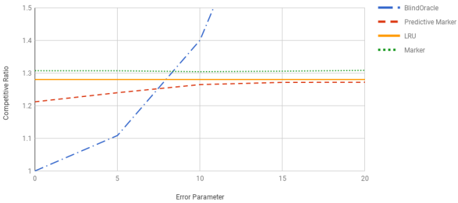
The paper introduces an OMLA framework for augmenting online algorithms with machine-learned predictions, instantiated for caching as Predictive Marker. Predictive Marker improves competitive ratio as predictor error decreases while retaining an O(log k) worst-case bound, and experiments on BrightKite/CitiBike data show it outperforms LRU, Marker, and blindly following the oracle.
Key findings
- Predictive Marker achieves competitive ratio `min(2 + 2·√(5ε), 4H_k)` under absolute loss and `min(2 + 2·3√(14ε), 4H_k)` under squared loss, where `ε` is the predictor error and `H_k` is the k-th harmonic number (Corollaries 1–2).
- Blindly following the predictor is insufficient: algorithms B and W have competitive ratio `Ω(ε)` under absolute loss (Propositions 3.1–3.2).
- On PLECO predictions, Predictive Marker had competitive ratios `1.266` on BK and `1.810` on Citi, versus LRU `1.280`/`1.859`, Marker `1.310`/`1.869`, and Blind Oracle `2.049`/`2.023`; it was `2.5%` better than the next best method, LRU, with `p < 0.001` (Table 2).
- LRU can be expressed as a predictor in the framework and robustified, and a black-box combination of an `α`-robust and `γ`-competitive algorithm yields a `9α`-robust and `9γ`-competitive algorithm (Theorem 4.3).
Methods
- Theoretical design: the OMLA framework treats the predictor as a black box, defines `ε`-accurate predictors, and analyzes caching where the predictor forecasts the next arrival time of each requested element; analysis uses the Marker algorithm, blame chains, and a loss-function “spread” `S_ℓ`, with extensions to randomized predictors via Jensen’s inequality.
- Experiments: two public datasets—BK (100 sequences, length 2,101, unique elements 67–800) and Citi (24 sequences, length 25,000, unique elements 593–719)—with synthetic lognormal prediction errors and off-the-shelf PLECO predictions; algorithms compared are LRU, Marker, Predictive Marker, and Blind Oracle, using competitive ratio (misses divided by optimum), with `k = 10` for BK and `k = 100` for Citi.
- Main analysis: proves consistency, robustness, and worst-case competitiveness bounds, plus a lower bound showing any deterministic `ε`-assisted marking algorithm using predictions only for tie-breaking has competitive ratio `Ω(min(S_ℓ(ε), k))` (Theorem 3.4).
Limitations
- The paper states that deciding the prediction model and loss function involves learnability trade-offs, and better understanding these exact trade-offs is “a major open direction”; it also conjectures that a randomized approach might achieve rate `log(1 + √ε)` for absolute loss, with subsequent work making progress.
- The paper states the empirical gains are modest (`2.5%` better than LRU) and that the off-the-shelf PLECO model was not tuned or optimized for predicting next appearance.
- Evident from the text: the main theoretical results focus on per-item decomposable loss functions, and the experiments cover only two datasets and specific cache sizes (`k = 10` and `k = 100`), so broader empirical and model generality is not established here.
Model-written summary. Check it against the paper before relying on it.
Integrity signals
Registry
Cites
Statistics
Figures
Verification
Claims the paper makes
0 Valid · 3 Not valid · 10 Not checked · 73 Own results and interpretations
A result the paper states — it cites no source for it, so there is none to check. The quote shows it is in the paper.
In the paper
“Lemma 3.2. Using algorithm SM , in expectation at most H k special elements cause cache misses per phase.”
plain- Asserted: passes — The authors put it forward as true.
- Checkable: passes — It can be checked against evidence.
- Load-bearing: passes — The paper’s conclusions depend on it.
- Based: passes — The paper gives a reason why it holds.
A result the paper reports from its own data — it cites no other source for it, so there is none to check. The quote shows it is in the paper.
In the paper
“At the same time, our experimental results show that even with simple predictors, our algorithm provides an improvement compared to LRU.”
plainstates a cause- Asserted: passes — The authors put it forward as true.
- Checkable: passes — It can be checked against evidence.
- Load-bearing: passes — The paper’s conclusions depend on it.
- Based: passes — The paper gives a reason why it holds.
A result the paper states — it cites no source for it, so there is none to check. The quote shows it is in the paper.
In the paper
“Theorem 4.3. For the caching problem, let A be an α -robust algorithm and B a γ -competitive algorithm. We can then create a black-box algorithm ALG that is both 9 α -robust and 9 γ -competitive.”
plainstates a cause- Asserted: passes — The authors put it forward as true.
- Checkable: passes — It can be checked against evidence.
- Load-bearing: passes — The paper’s conclusions depend on it.
- Based: passes — The paper gives a reason why it holds.
- Rests on an assumption not shown here.
A result the paper reports from its own data — it cites no other source for it, so there is none to check. The quote shows it is in the paper.
In the paper
“While the gains appear modest, we note they are statistically significant at p < 0 . 001 .”
plainstates an association- Asserted: passes — The authors put it forward as true.
- Checkable: passes — It can be checked against evidence.
- Load-bearing: passes — The paper’s conclusions depend on it.
- Based: passes — The paper gives a reason why it holds.
The paper states this without a source or data behind it here, so there is nothing to check it against. The quote shows it is in the paper.
In the paper
“Also note that any marked element needs to have arrived later than any unmarked element.”
plainstates an association- Asserted: passes — The authors put it forward as true.
- Checkable: passes — It can be checked against evidence.
- Load-bearing: passes — The paper’s conclusions depend on it.
- Based: unclear — It is unclear why the paper says it holds.
47 more claims
Create a free account to see all 86 claims and every source verdict.
- Probably not a substantial claim. 17
- It may state two separate claims as one. 20
- The quote only partly states this claim. 2
Self-check
Percentages, sums and reported differences re-computed from the paper’s own numbers.
Each contradiction between two passages listed here was confirmed by an independent check.
Rated minor: it would not touch a result — a value no result rests on, a p-value that stays on the same side of the significance level, or a conflict that is clerical, resolved elsewhere in the paper, or outside its own findings.
In the paper
§ 3.3 Analysis · p. 17
“Corollary 2. The competitive ratio of ϵ -assisted Predictive Marker with respect to the absolute loss metric ℓ 2 is bounded by cr PM ,ℓ 1 ( ϵ ) ≤ min ( 2 + 2 · 3 √ 14 ϵ, 4 H k ) .”
§ 3.3 Analysis · p. 15
“For squared loss, ℓ 2 ( A,B ) = ∑ i ( a i -b i ) 2 , the spread of ℓ 2 is S ℓ 2 ( m ) ≤ 3 √ 14 m.”
Rated minor: it would not touch a result — a value no result rests on, a p-value that stays on the same side of the significance level, or a conflict that is clerical, resolved elsewhere in the paper, or outside its own findings.
In the paper
§ 2.3 Caching with ML Advice · p. 10
“Given a sequence σ , the label of the i -th element is y ( σ i ) = min t>i { t : x ( σ t ) = x ( σ i ) } .”
§ 2.3 Caching with ML Advice · p. 10
“Note that the feature is not only a function of the element identity z ( σ i ) ; when an element reappears, its features may be drastically different.”
Rated minor: it would not touch a result — a value no result rests on, a p-value that stays on the same side of the significance level, or a conflict that is clerical, resolved elsewhere in the paper, or outside its own findings.
In the paper
§ 5 Experiments · p. 22
“We create 12 sequences, one for each month of 2017 for the New York City dataset.”
§ 5 Experiments · p. 22
“| Citi | 24 | 25,000 | 593 - 719 |”
Citations
Cites
Intriguing properties of neural networks
Szegedy, C., Zaremba, W., Sutskever, I., Bruna, J., Erhan, D., Goodfellow, I., & Fergus, R. (2013) · arXiv · doi:10.48550/arxiv.1312.6199 · Cited by 8,143
Motwani, R., & Raghavan, P. (1995) · Cambridge University Press eBooks · doi:10.1017/cbo9780511814075 · Cited by 5,123
Friendship and mobility: user movement in location-based social networks
Cho, E., Myers, S. A., & Leskovec, J. (2011) · Proceedings of the 17th ACM SIGKDD international conference on Knowledge discovery and data mining · doi:10.1145/2020408.2020579 · Cited by 2,903 · cited 1×
“This dataset is publicly available at [CML11, Bri].”
MethodOnline Computation and Competitive Analysis
Borodin, A., & El‐Yaniv, R. (1998) · Cited by 2,333
Amortized efficiency of list update and paging rules
Sleator, D. D., & Tarjan, R. E. (1985) · Communications of the ACM · doi:10.1145/2786.2793 · Cited by 2,123
A study of replacement algorithms for a virtual-storage computer
Belady, L. A. (1966) · IBM Systems Journal · doi:10.1147/sj.52.0078 · Cited by 1,659
The Case for Learned Index Structures
Kraska, T., Beutel, A., Chi, E. H., Dean, J., & Polyzotis, N. (2018) · Proceedings of the 2018 International Conference on Management of Data · doi:10.1145/3183713.3196909 · Cited by 956
(2015) · neural information processing systems · Cited by 912
The working set model for program behavior
Denning, P. J. (1983) · Communications of the ACM · doi:10.1145/357980.357997 · Cited by 845
Smoothed analysis of algorithms: Why the simplex algorithm usually takes polynomial time
Spielman, D. A., & Teng, S.-H. (2004) · Journal of the ACM · doi:10.1145/990308.990310 · Cited by 825
The working set model for program behavior
Denning, P. J. (1968) · Communications of the ACM · doi:10.1145/363095.363141 · Cited by 662
Fiat, A., Karp, R. M., Luby, M., McGeoch, L. A., Sleator, D. D., & Young, N. E. (1991) · Journal of Algorithms · doi:10.1016/0196-6774(91)90041-v · Cited by 457
Graph stream algorithms: a survey
McGregor, A. (2014) · ACM SIGMOD Record · doi:10.1145/2627692.2627694 · Cited by 357
Stochastic bandits robust to adversarial corruptions
Lykouris, T., Mirrokni, V., & Leme, R. P. (2018) · ACM Symposium on Theory of Computing (STOC) · doi:10.1145/3188745.3188918 · Cited by 260
Self-citationOnline Learning with Predictable SequencesPreprint
Rakhlin, A., & Sridharan, K. (2012) · arXiv (Cornell University) · doi:10.48550/arxiv.1208.3728 · Cited by 249
Near-Optimal Bounds for Online Caching with Machine Learned Advice
Rohatgi, D. (2020) · Society for Industrial and Applied Mathematics eBooks · doi:10.1137/1.9781611975994.112 · Cited by 198
The sample complexity of revenue maximization
Cole, R., & Roughgarden, T. (2014) · Proceedings of the forty-sixth annual ACM symposium on Theory of computing · doi:10.1145/2591796.2591867 · Cited by 190 · cited 1×
“Introduced in the seminal work of Cole and Roughgarden [CR14], this notion of Learning from Samples, can be viewed as first designing a good prediction function, h , and then using it in the algorithms.”
MethodOnline Algorithms for Rent-Or-Buy with Expert Advice.
Gollapudi, S., & Panigrahi, D. (2019) · International Conference on Machine Learning · Cited by 169
The best of both worlds: stochastic and adversarial banditsPreprint
Bubeck, S., & Slivkins, A. (2012) · arXiv (Cornell University) · doi:10.48550/arxiv.1202.4473 · Cited by 168
Competitive k-server algorithms
Fiat, A., Rabani, Y., & Ravid, Y. (1994) · Journal of Computer and System Sciences · doi:10.1016/s0022-0000(05)80060-1 · Cited by 158
The dynamics of repeat consumption
Anderson, A., Kumar, R., Tomkins, A., & Vassilvitskii, S. (2014) · International World Wide Web Conference (WWW) · doi:10.1145/2566486.2568018 · Cited by 135 · cited 1×
“We run experiments with both synthetic predictions to showcase the sensitivity of our methods to learning errors, and with preditions using an off the shelf classifier, published previously (Anderson et al., 2014).”
MethodSelf-citationOnline Scheduling via Learned Weights
Lattanzi, S., Lavastida, T., Moseley, B., & Vassilvitskii, S. (2019) · Society for Industrial and Applied Mathematics eBooks · doi:10.1137/1.9781611975994.114 · Cited by 128
Self-citationCompetitive analysis of randomized paging algorithms
Achlioptas, D., Chrobak, M., & Noga, J. (2000) · Theoretical Computer Science · doi:10.1016/s0304-3975(98)00116-9 · Cited by 127
A Model for Learned Bloom Filters, and Optimizing by SandwichingPreprint
Mitzenmacher, M. (2019) · arXiv (Cornell University) · doi:10.48550/arxiv.1901.00902 · Cited by 127
Online Metric Algorithms with Untrusted Predictions
Antoniadis, A., Coester, C., Eliáš, M., Polak, A., & Simon, B. (2023) · ACM Transactions on Algorithms · doi:10.1145/3582689 · Cited by 124
Online Algorithms with Advice: A Survey
Boyar, J., Favrholdt, L. M., Kudahl, C., Larsen, K. S., & Mikkelsen, J. W. (2017) · ACM Computing Surveys · doi:10.1145/3056461 · Cited by 120
Smoothed Analysis of the k-Means Method
Arthur, D., Manthey, B., & Röglin, H. (2011) · Journal of the ACM · doi:10.1145/2027216.2027217 · Cited by 118
Learning-Based Frequency Estimation Algorithms.
Hsu, C.-Y., Indyk, P., Katabi, D., & Vakilian, A. (2018) · DSpace@MIT (Massachusetts Institute of Technology) · Cited by 116
Improving Online Algorithms via ML Predictions
Kumar, R., Purohit, M., & Svitkina, Z. (2024) · arXiv · doi:10.48550/arxiv.2407.17712 · Cited by 111
Online Optimization with Uncertain Information
Mahdian, M., Nazerzadeh, H., & Saberi, A. (2012) · ACM Transactions on Algorithms · doi:10.1145/2071379.2071381 · Cited by 80
Learning Simple AuctionsPreprint
Morgenstern, J., & Roughgarden, T. (2016) · arXiv (Cornell University) · doi:10.48550/arxiv.1604.03171 · Cited by 76 · cited 1×
“Indeed, some of the follow up work [MR16, BRS17] proves tight bounds on precisely how many samples are necessary to achieve good approximation guarantees.”
BackgroundWorst-case and Smoothed Analysis of the ICP Algorithm, with an Application to the k-means Method
Arthur, D., & Vassilvitskii, S. (2006) · Annual Symposium on Foundations of Computer Science · doi:10.1109/focs.2006.79 · Cited by 74
Self-citationOn paging with locality of reference
Albers, S., Favrholdt, L. M., & Giel, O. (2004) · Journal of Computer and System Sciences · doi:10.1016/j.jcss.2004.08.002 · Cited by 73
Online Algorithms with Advice: A Survey
Boyar, J., Favrholdt, L. M., Kudahl, C., Larsen, K. S., & Mikkelsen, J. W. (2016) · ACM SIGACT News · doi:10.1145/2993749.2993766 · Cited by 72
Competitive k-server algorithms
Fiat, A., Rabani, Y., & Ravid, Y. (2002) · Annual Symposium on Foundations of Computer Science · doi:10.1109/fscs.1990.89566 · Cited by 71
Simultaneous approximations for adversarial and stochastic online budgeted allocation
Mirrokni, V., Gharan, S. O., & Zadimoghaddam, M. (2012) · Cited by 69
The limitations of optimization from samples
Balkanski, E., Rubinstein, A., & Singer, Y. (2017) · ACM Symposium on Theory of Computing (STOC) · doi:10.1145/3055399.3055406 · Cited by 56 · cited 1×
“Indeed, some of the follow up work [MR16, BRS17] proves tight bounds on precisely how many samples are necessary to achieve good approximation guarantees.”
BackgroundAilon, N., Chazelle, B., Clarkson, K. L., Liu, D., Mulzer, W. J. H., & Seshadhri, C. (2011) · SIAM Journal on Computing · doi:10.1137/090766437 · Cited by 54
Online Algorithms for Weighted Paging with Predictions
Jiang, Z., Panigrahi, D., & Sun, K. (2022) · ACM Transactions on Algorithms · doi:10.1145/3548774 · Cited by 52
Revenue Optimization with Approximate Bid Predictions
Medina, A. M., & Vassilvitskii, S. (2017) · arXiv · doi:10.48550/arxiv.1706.04732 · Cited by 51 · cited 1×
“Medina and Vassilvitskii [MV17] showed how to use a machine learned oracle to optimize revenue in repeated posted price auctions.”
BackgroundSelf-citationWorst-Case and Smoothed Analysis of the ICP Algorithm, with an Application to the k-Means Method
Arthur, D., & Vassilvitskii, S. (2009) · SIAM Journal on Computing · doi:10.1137/070683921 · Cited by 50
Self-citationOnline Allocation with Traffic Spikes: Mixing Adversarial and Stochastic Models
Esfandiari, H., Korula, N., & Mirrokni, V. (2015) · ACM Conference on Economics and Computation (EC) · doi:10.1145/2764468.2764536 · Cited by 42
Smoothed Analysis of the 2-Opt Algorithm for the General TSP
Englert, M., Röglin, H., & Vöcking, B. (2016) · ACM Transactions on Algorithms · doi:10.1145/2972953 · Cited by 29
Online Computation with Untrusted AdvicePreprint
Angelopoulos, S., Dürr, C., Jin, S., et al. (2020) · arXiv (Cornell University) · doi:10.4230/lipics.itcs.2020.52 · Cited by 25
Partitioned Learned Bloom FilterPreprint
Vaidya, K., Knorr, E., Kraska, T., & Mitzenmacher, M. (2020) · arXiv (Cornell University) · doi:10.48550/arxiv.2006.03176 · Cited by 25
Customizing ML Predictions for Online AlgorithmsPreprint
Anand, K., Ge, R., & Panigrahi, D. (2022) · arXiv (Cornell University) · doi:10.48550/arxiv.2205.08715 · Cited by 23
On paging with locality of reference
Albers, S., Favrholdt, L. M., & Giel, O. (2002) · ACM Symposium on Theory of Computing (STOC) · doi:10.1145/509907.509949 · Cited by 22 · cited 1×
“ation,wheretheonlinealgorithmhasalarger cache than the offline optimum [ST85], to models of real-world inputs that restrict the inputs analyzedbythealgorithm, forexample, insistingonlocalityofreference [AFG02], orthemore generalWorkingSetmodel [Den68]. Theideaofmakingassumptionsonthenatureoftheinputtoprovebetterboundsis…”
BackgroundOnline Page Migration with ML AdvicePreprint
Indyk, P., Mallmann-Trenn, F., Mitrović, S., & Rubinfeld, R. (2020) · arXiv (Cornell University) · doi:10.48550/arxiv.2006.05028 · Cited by 14
Privacy-Aware Remote Information Retrieval User Experiments Logging Tool
Li, H., Lu, H., Huang, S., Ma, W., Zhang, M., Liu, Y., & Ma, S. (2021) · International ACM SIGIR Conference on Research and Development in Information Retrieval (SIGIR) · doi:10.1145/3404835.3462793 · Cited by 5
The Sample Complexity of Revenue MaximizationPreprint
Cole, R. J., & Roughgarden, T. (2015) · arXiv (Cornell University) · doi:10.48550/arxiv.1502.00963 · Cited by 5
Stochastic bandits robust to adversarial corruptions
Lykouris, T., Mirrokni, V., & Leme, R. P. (2018) · arXiv (Cornell University) · doi:10.48550/arxiv.1803.09353 · Cited by 4
Self-citationOnline Computation with Untrusted AdvicePreprint
Angelopoulos, S., Dürr, C., Jin, S., et al. (2019) · arXiv (Cornell University) · doi:10.48550/arxiv.1905.05655
Mitzenmacher, M. (2020) · arXiv · doi:10.48550/arxiv.2006.15463
On paging with locality of reference
Albers, S., Favrholdt, L. M., & Giel, O. (2002) · Proceedings of the thiry-fourth annual ACM symposium on Theory of computing - STOC '02 · doi:10.1145/509948.509949
Simultaneous Approximations for Adversarial and Stochastic Online Budgeted Allocation
Mirrokni, V. S., Gharan, S. O., & Zadimoghaddam, M. (2012) · Proceedings of the Twenty-Third Annual ACM-SIAM Symposium on Discrete Algorithms · doi:10.1137/1.9781611973099.134
Research works printed but not linked: 9
- Thodoris Lykouris and Sergei Vassilvtiskii . 2018 . Competitive caching with machine learned advice . In Proceedings of the 35th International Conference on Machine Learning (Proceedings of Machine Learning Research). PMLR, 3296–3305 . Thodoris Lykouris and Sergei Vassilvtiskii. 2018. Competitive caching with machine learned advice. In Proceedings of the 35th International Conference on Machine Learning (Proceedings of Machine Learning Research). PMLR, 3296–3305.
- 10.5555/3294771.3294948 · doi:10.5555/3294771.3294948
- 10.5555/2095116.2095250 · doi:10.5555/2095116.2095250
- 10.5555/3326943.3326986 · doi:10.5555/3326943.3326986
- 10.5555/211390 · doi:10.5555/211390
- 10.5555/3327546.3327635 · doi:10.5555/3327546.3327635
- 10.5555/3381089.3381201 · doi:10.5555/3381089.3381201
- 10.5555/2969442.2969519 · doi:10.5555/2969442.2969519
- [Wei20] Alexander Wei. Better and simpler learning-augmented online caching. In International Conference on Approximation Algorithms for Combinatorial Optimization Problems (APPROX) , 2020.
Cited by
Quantum Machine Learning for 6G Communication Networks: State-of-the-Art and Vision for the Future
Nawaz, S. J., Sharma, S. K., Wyne, S., Patwary, M. N., & Asaduzzaman, M. (2019) · IEEE Access · doi:10.1109/access.2019.2909490 · Cited by 658
Improving Online Algorithms via ML Predictions
Kumar, R., Purohit, M., & Svitkina, Z. (2024) · arXiv · doi:10.48550/arxiv.2407.17712 · Cited by 111
Mitzenmacher, M., & Vassilvitskii, S. (2022) · Communications of the ACM · doi:10.1145/3528087 · Cited by 280
“A formal model of learning with predictions, including the notions of α -consistency and β -robustness, was presented by Lykouris and Vassilvitskii (2018).”
MethodSelf-citationPatil, A., Iyer, S., López, O. L. A., Pandya, R. J., Pai, K., Kalla, A., & Kallimani, R. (2024) · Computer Networks · doi:10.1016/j.comnet.2024.110697 · Cited by 72
Chasing Convex Bodies Optimally
Sellke, M. (2020) · Society for Industrial and Applied Mathematics eBooks · doi:10.1137/1.9781611975994.92 · Cited by 61
Metadata
- Authors
- Lykouris, T., & Vassilvitskii, S.
- Affiliations
- Microsoft (United States) (US)
- Google (United States) (US)
- Venue
- Journal of the ACM
- Published
- 2021-07-14
- Volume
- 68
- Issue
- 4
- Pages
- 1-25
- ISSN
- 0004-5411 (ISSN-L)
- 1557-735X
- OpenAlex
- W2786176077
- Cited by
- 172
- References
- 41
- Citations by year
- 2026: 36 · 2025: 32 · 2024: 31 · 2023: 18 · 2022: 25 · 2021: 17
- FWCI
- 10.19
- Type
- journal article
- Language
- en
- Open access
- hybrid
- doi.org
- Licence
- Locations
- Journal of the ACM (publishedVersion, cc-by-nc-nd)
- arXiv (Cornell University) (submittedVersion)
- arXiv (Cornell University)
- International Conference on Machine Learning
- Funders
- NSF (CCF-1563714)
- Google Ph.D. Fellowship
- Topics
- Physical Sciences › Mathematics › Theoretical Computer Science › Optimization and Search Problems
- Physical Sciences › Mathematics › Theoretical Computer Science › Algorithms and Data Compression
- Physical Sciences › Computer Science › Computer Networks and Communications › Caching and Content Delivery
- Keywords
- online algorithms, competitive ratio
About these checks
Registry, retraction, Cites and statistics results are computed, not judged, with one exception: a printed reference that no index lists is read once by a model before it counts as a citation error. Claims are extracted by a model and kept only when their quote appears verbatim in the text; each cited source is then checked, with a model’s help, for whether it says what the claim relies on. Those verdicts can be wrong — read the claim’s quote and the cited source before relying on one.
A language model drew the claims from the paper on 2026-10-10, under version 3 of the claim definition (model deepseek-v4.1-flash, prompt extract-v3).
A second model labelled each claim on 2026-10-10 (model jev-1.13-20260917, definition revision gold-guideline-v0.2).
Statistics and arithmetic are recomputed, not judged.
Confidence bands are shown only for fields calibrated on our annotated test set. None is calibrated yet, so no band is shown.
What counts as a claim ›How we measure confidence ›How we check this ›
Are you an author, or do you see a problem with this page? Request a review
Data sources
Bibliographic data: Semantic Scholar, OpenAlex, Crossref.
Contains information from the Semantic Scholar Academic Graph Datasets, made available under the ODC Attribution License (ODC-BY 1.0).
Semantic Scholar’s data is described in: Kinney, R., et al. (2023). The Semantic Scholar Open Data Platform. arXiv:2301.10140.
