

The DOI matches its Crossref record; 48 of the 48 references it cites were found in a registry or an index; 5 of the 17 sources its claims cite were checked for support.
ET-BERT: A Contextualized Datagram Representation with Pre-training Transformers for Encrypted Traffic Classification
Open accessAbstract
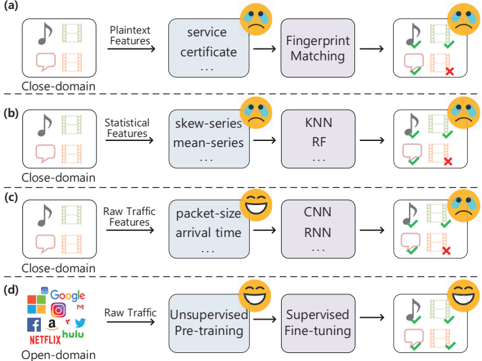
Encrypted traffic classification requires discriminative and robust traffic representation captured from content-invisible and imbalanced traffic data for accurate classification, which is challenging but indispensable to achieve network security and network management. The major limitation of existing solutions is that they highly rely on the deep features, which are overly dependent on data size and hard to generalize on unseen data. How to leverage the open-domain unlabeled traffic data to learn representation with strong generalization ability remains a key challenge. In this paper, we propose a new traffic representation model called Encrypted Traffic Bidirectional Encoder Representations from Transformer (ET-BERT), which pre-trains deep contextualized datagram-level representation from large-scale unlabeled data. The pre-trained model can be fine-tuned on a small number of task-specific labeled data and achieves state-of-the-art performance across five encrypted traffic classification tasks, remarkably pushing the F1 of ISCX-VPN-Service to 98.9% (5.2%↑), Cross-Platform (Android) to 92.5% (5.4%↑), CSTNET-TLS 1.3 to 97.4% (10.0%↑). Notably, we provide explanation of the empirically powerful pre-training model by analyzing the randomness of ciphers. It gives us insights in understanding the boundary of classification ability over encrypted traffic. The code is available at: https://github.com/linwhitehat/ET-BERT.
Overview
CoChat Summary
TL;DR
ET-BERT pre-trains a Transformer on large-scale unlabeled encrypted traffic using BURST-based datagram tokens and two self-supervised tasks, then fine-tunes for classification. It reports state-of-the-art F1 across five encrypted traffic tasks, including 98.9% on ISCX-VPN-Service and 97.4% on CSTNET-TLS 1.3.
Key findings
- ET-BERT achieves state-of-the-art performance across five encrypted traffic classification tasks; the abstract reports F1 of 98.9% on ISCX-VPN-Service (5.2%↑), 92.5% on Cross-Platform (Android) (5.4%↑), and 97.4% on CSTNET-TLS 1.3 (10.0%↑).
- In the comparison tables, ET-BERT(packet) reaches F1 of 0.9754 on Cross-Platform(iOS), 0.9206 on Cross-Platform(Android), 0.9890 on ISCX-VPN-Service, 0.9937 on ISCX-VPN-App, 0.9921 on ISCX-Tor, 0.9916 on USTC-TFC, and 0.9741 on CSTNET-TLS 1.3.
- Ablation on ISCX-VPN-App shows removing SBP lowers F1 by 3.97%, removing MBM lowers it by 9.33%, replacing BURST input with packets lowers it by 1.37%, and removing pre-training lowers it by 37.57%.
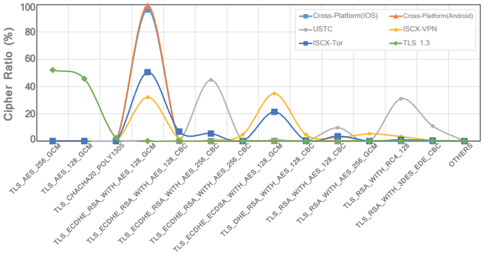
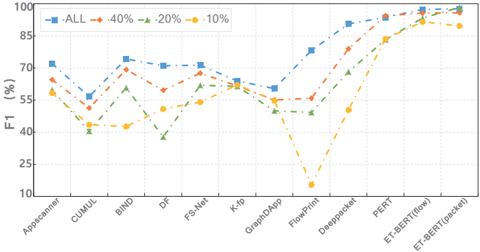
- Few-shot results on ISCX-VPN-Service show ET-BERT(packet) F1 of 95.78%, 98.33%, and 91.55% at 40%, 20%, and 10% data; Deeppacket’s performance decreases by 40.22% from full size to 10%. Randomness analysis finds ciphers fail perfect randomness, and ET-BERT reaches near-100% F1 on datasets with weaker randomness, averaging 99.14% in ETCV, 99.21% in EACT, and 99.30% in EMC.
Methods
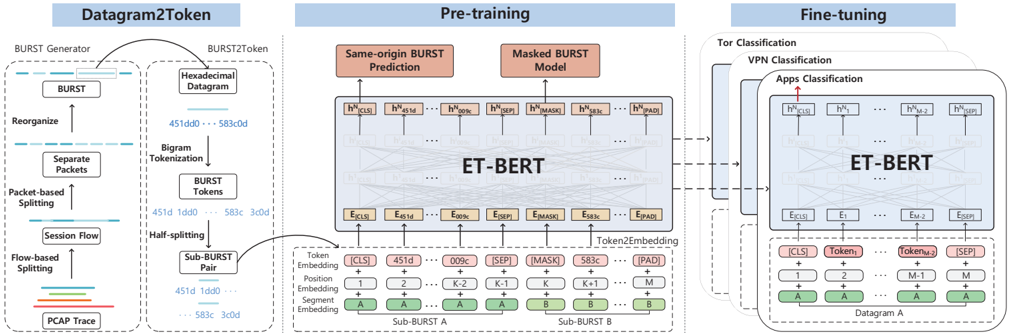
- Two-stage design: self-supervised pre-training on unlabeled traffic with a Transformer (12 blocks, 12 attention heads, token dimension 768, 512 input tokens), followed by fine-tuning on task-specific labeled data. Datagram2Token converts flows into BURSTs, then bi-gram/BPE tokens (vocabulary size 65,536), with token, position, and segment embeddings.
- Pre-training tasks: Masked BURST Model masks 15% of tokens (80% replaced with [MASK], 10% random token, 10% unchanged); Same-origin BURST Prediction uses a binary classifier to predict whether two sub-BURSTs are from the same BURST origin, with 50% actual next sub-BURST and 50% random sub-BURST. Pre-training uses about 30GB unlabeled traffic (about 15GB public datasets and 15GB passively collected CSTNET traffic).
- Downstream evaluation covers five tasks on six public datasets plus a new CSTNET-TLS 1.3 dataset; fine-tuning randomly selects at most 500 flows and 5,000 packets per class, with an 8:1:1 train/validation/test split. Metrics are Accuracy, Precision, Recall, and F1 with macro average; ET-BERT is compared with 11 methods and uses packet-level and flow-level fine-tuning strategies.
Limitations
- Stated: generalizability is challenged by variability of encrypted traffic over time; TLS 1.3 labeling via SNI will not be possible with ECH, and the authors mitigate this by active visiting and labeling with unique process identifiers.
- Stated: pre-training security depends on clean pre-training data; an attacker can add low-frequency subwords as “toxic” embeddings to create a poisoned pre-trained model with a backdoor, and how to construct such toxic tokens for encrypted traffic has not been studied.
- Evident from the text: the TLS 1.3 dataset labels rely on SNI, so evaluation may not transfer under ECH; datasets are fixed snapshots and no temporal drift evaluation is reported; pre-training mixes public and CSTNET traffic, so domain bias is possible.
Model-written summary. Check it against the paper before relying on it.
Integrity signals
Registry
Cites
Statistics
Figures
Verification
Claims the paper makes
3 Valid · 1 Not valid · 11 Not checked · 57 Own results and interpretations
The cited sources support only part of this claim — read each source’s verdict below.
In the paper
“Furthermore, due to the rapid development of encryption technology, traffic classification methods for a specific kind of encrypted traffic cannot adapt well to the new environment or unseen encryption strategies [29].”
What the sources say
- Partly supportedcites [29] [29] Shahbaz Rezaei and Xin Liu. 2019. Deep Learning for Encrypted Traffic Classification: An Overview. IEEE Commun. Mag. 57, 5 (2019), 76-81. - sourceExperimental — accuracy not yet measured
In “Stronger Encryption Protocols” (p. 7), the paper explains that TLS 1.3 and QUIC leave fewer handshake fields unencrypted, creating a challenge for methods developed for TLS 1.2. It says whether the remaining fields suffice for classification is unclear, not that such methods cannot adapt to new environments or unseen encryption strategies. (LLM, conf=0.85)
plainstates a cause- Asserted: passes — The authors put it forward as true.
- Checkable: passes — It can be checked against evidence.
- Load-bearing: passes — The paper’s conclusions depend on it.
- Based: passes — The paper gives a reason why it holds.
- Partly supported
The cited sources support only part of this claim — read each source’s verdict below.
In the paper
“However, these methods are not applicable to the newly emerging encrypted techniques ( e.g. TLS 1.3) since the plaintext becomes more sparse or obfuscated.”
What the sources say
- Partly supportedcites [37] [37] Thijs van Ede, Riccardo Bortolameotti, Andrea Continella, and et al. 2020. FlowPrint: Semi-Supervised Mobile-App Fingerprinting on Encrypted Network Traffic. In 27th Annual Network and Distributed System Security Symposium, NDSS 2020, San Diego, California, USA, February 23-26, 2020 . The Internet Society. - sourceExperimental — accuracy not yet measured
The ‘Detection of Previously Unseen Apps’ section says that two earlier detectors handle only unencrypted data and cannot be applied to encrypted traffic. The paper does not attribute that limitation specifically to TLS 1.3 or say that plaintext becomes sparser or obfuscated; the Feature Exploration section instead describes which features remain available in TLS-encrypted traffic. Page numbers are not available in our copy. (LLM, conf=0.84)
plainstates a cause- Asserted: passes — The authors put it forward as true.
- Checkable: passes — It can be checked against evidence.
- Load-bearing: passes — The paper’s conclusions depend on it.
- Based: passes — The paper gives a reason why it holds.
- Partly supported
A result the paper reports from its own data — it cites no other source for it, so there is none to check. The quote shows it is in the paper.
In the paper
“According to model '6', we perform supervised learning on labeled data by training the Transformer model directly and the F1 score decreases remarkably by 37.57% compared with ET-BERT.”
plainstates a cause- Asserted: passes — The authors put it forward as true.
- Checkable: passes — It can be checked against evidence.
- Load-bearing: passes — The paper’s conclusions depend on it.
- Based: passes — The paper gives a reason why it holds.
A result the paper reports from its own data — it cites no other source for it, so there is none to check. The quote shows it is in the paper.
In the paper
“ET-BERT achieves 5.69% and 1.72% improvement over the existing state-of-the-art model Deeppacket on ISCX-VPN-Service and ISCX-VPN-App.”
plainstates a cause- Asserted: passes — The authors put it forward as true.
- Checkable: passes — It can be checked against evidence.
- Load-bearing: passes — The paper’s conclusions depend on it.
- Based: passes — The paper gives a reason why it holds.
A result the paper reports from its own data — it cites no other source for it, so there is none to check. The quote shows it is in the paper.
In the paper
“outperforms existing works remarkably by 5.4%, 0.2%, 5.2%, 4.4%, 10.0%.”
boostedstates a cause- Asserted: passes — The authors put it forward as true.
- Checkable: passes — It can be checked against evidence.
- Load-bearing: passes — The paper’s conclusions depend on it.
- Based: passes — The paper gives a reason why it holds.
44 more claims
Create a free account to see all 72 claims and to verify the 2 references still open.
- It may state two separate claims as one. 18
- The quote only partly states this claim. 2
- Probably not a substantial claim. 6
Self-check
Percentages, sums and reported differences re-computed from the paper’s own numbers.
Each contradiction between two passages listed here was confirmed by an independent check.
Rated minor: it would not touch a result — a value no result rests on, a p-value that stays on the same side of the significance level, or a conflict that is clerical, resolved elsewhere in the paper, or outside its own findings.
In the paper
§ 4.5 Few-shot Analysis
“To validate the effectiveness and robustness of ET-BERT in fewshot settings, we design comparison experiments with different data proportions on ISCX-VPN-Service.”
§ 5 DISCUSSION
“Figure 4: Comparison Results on Few-shot ISCX-VPN-App.”
Rated minor: it would not touch a result — a value no result rests on, a p-value that stays on the same side of the significance level, or a conflict that is clerical, resolved elsewhere in the paper, or outside its own findings.
In the paper
§ 4.1 Experiment Setup
“we conduct experiments across five encrypted traffic classification tasks on six public datasets and one newly proposed dataset.”
§ 6 CONCLUSION
“We comprehensively evaluate the generalization and robustness of ET-BERT on 5 publicly available datasets and the TLS 1.3 dataset collected from CSTNET.”
Citations
Cites
Vaswani, A., Shazeer, N., Parmar, N., Uszkoreit, J., Jones, L., Gomez, A. N., Kaiser, L., & Polosukhin, I. (2017) · arXiv · doi:10.48550/arxiv.1706.03762 · Cited by 120,404
Exploiting Generative AI to Scale up Intelligent Tutoring Systems
Jakubův, J., Chvalovský, K., Goertzel, Z., Kaliszyk, C., Olšák, M., Piotrowski, B., Schulz, S., Suda, M., & Urban, J. (2023) · DROPS (Schloss Dagstuhl – Leibniz Center for Informatics) · doi:10.4230/lipics.itp.2023.19 · Cited by 76,658
BERT: Pre-training of Deep Bidirectional Transformers for Language Understanding
Devlin, J., Chang, M.-W., Lee, K., & Toutanova, K. (2018) · arXiv · doi:10.48550/arxiv.1810.04805 · Cited by 73,173
BERT: Pre-training of Deep Bidirectional Transformers for Language Understanding
Devlin, J., Chang, M.-W., Lee, K., & Toutanova, K. (2019) · Proceedings of the 2019 Conference of the North American Chapter of the Association for Computational Linguistics: Human Language Technologies, Volume 1 (Long and Short Papers) · doi:10.18653/v1/n19-1423 · Cited by 54,325
An Image is Worth 16x16 Words: Transformers for Image Recognition at Scale
Dosovitskiy, A., Beyer, L., Kolesnikov, A., Weissenborn, D., Zhai, X., Unterthiner, T., Dehghani, M., Minderer, M., Heigold, G., Gelly, S., et al. (2020) · arXiv · doi:10.48550/arxiv.2010.11929 · Cited by 47,472
RoBERTa: A Robustly Optimized BERT Pretraining Approach
Liu, Y., Ott, M., Goyal, N., Du, J., Joshi, M., Chen, D., Levy, O., Lewis, M., Zettlemoyer, L., & Stoyanov, V. (2019) · arXiv · doi:10.48550/arxiv.1907.11692 · Cited by 16,515
Elements of Information Theory
Cover, T. M., & Thomas, J. A. (2005) · doi:10.1002/047174882x · Cited by 13,791
BioBERT: a pre-trained biomedical language representation model for biomedical text mining
Lee, J., Yoon, W., Kim, S., Kim, D., Kim, S., So, C. H., & Kang, J. (2020) · Bioinformatics · doi:10.1093/bioinformatics/btz682 · Cited by 7,218
Google's Neural Machine Translation System: Bridging the Gap between Human and Machine Translation
Wu, Y., Schuster, M., Chen, Z., Le, Q. V., Norouzi, M., Macherey, W., Krikun, M., Cao, Y., Gao, Q., Macherey, K., et al. (2016) · arXiv · doi:10.48550/arxiv.1609.08144 · Cited by 5,319
Toward Generating a New Intrusion Detection Dataset and Intrusion Traffic Characterization
Sharafaldin, I., Habibi Lashkari, A., & Ghorbani, A. A. (2018) · Proceedings of the 4th International Conference on Information Systems Security and Privacy · doi:10.5220/0006639801080116 · Cited by 5,318 · cited 1×
“This dataset contains two parts: (1) about 15GB traffic from the public datasets [9, 30]; (2) about 15GB traffic from our passively collected traffic under the China Science and Technology Network (CSTNET).”
Method
Cited by
Zhou, H., Hu, C., Yuan, Y., Cui, Y., Jin, Y., Chen, C., Wu, H., Yuan, D., Jiang, L., Wu, D., et al. (2025) · IEEE Communications Surveys & Tutorials · doi:10.1109/comst.2024.3465447 · Cited by 244
“LLMs can be effectively applied for encrypted traffic classification [130], [131]. algorithms, and black-box optimization.”
BackgroundMethodZhao, R., Zhan, M., Deng, X., Wang, Y., Wang, Y., Gui, G., & Xue, Z. (2023) · Proceedings of the AAAI Conference on Artificial Intelligence · doi:10.1609/aaai.v37i4.25674 · Cited by 180
NetLLM: adapting large language models for networking
Wu, D., Wang, X., Qiao, Y., Wang, Z., Jiang, J., Cui, S., & Wang, F. (2024) · Proceedings of the ACM SIGCOMM 2024 Conference · doi:10.1145/3651890.3672268 · Cited by 167
“On theflipside,RLiscommonlyemployedtosolvedecision-making problemsinnetworking,includingcongestioncontrol[1,106],adap-tivebitratestreaming(ABR)[44,62]andcloudclusterjobscheduling(CJS)[63,78].”
MethodA survey of large language models for cyber threat detection
Chen, Y., Cui, M., Wang, D., Cao, Y., Yang, P., Jiang, B., Lü, Z., & Liu, B. (2024) · Computers & Security · doi:10.1016/j.cose.2024.104016 · Cited by 226
Netmamba: Efficient Network Traffic Classification Via Pre-Training Unidirectional Mamba
Wang, T., Xie, X., Wang, W., Wang, C., Zhao, Y., & Cui, Y. (2024) · IEEE International Conference on Network Protocols (ICNP) · doi:10.1109/icnp61940.2024.10858569 · Cited by 134
“To collect more comprehensive traffic information without compromising model efficiency due to excessively long packet sequences, we follow approaches outlined in prior studies [9], [10], which involve selectively utilizing specific packets within a flow.”
Influential
Metadata
- Authors
- Lin, X., Xiong, G., Gou, G., Li, Z., Shi, J., & Yu, J.
- Affiliations
- Chinese Academy of Sciences (CN)
- Venue
- Proceedings of the ACM Web Conference 2022
- Publisher
- ACM
- Published
- 2022-04-25
- Pages
- 633-642
- OpenAlex
- W4224315052
- Cited by
- 599
- References
- 46
- Citations by year
- 2026: 217 · 2025: 199 · 2024: 123 · 2023: 52 · 2022: 8
- FWCI
- 52.77
- Type
- conference paper
- Language
- en
- Open access
- hybrid
- doi.org
- Licence
- Locations
- International World Wide Web Conference (WWW) (publishedVersion, cc-by)
- arXiv (Cornell University) (submittedVersion)
- arXiv (Cornell University)
- Funders
- the Strategic Priority Research Program of Chinese Academy of Sciences (No. XDC02040400)
- The National Key Research and Development Program of China (No. 2021YFB3101400)
- Topics
- Physical Sciences › Computer Science › Artificial Intelligence › Internet Traffic Analysis and Secure E-voting
- Physical Sciences › Computer Science › Computer Networks and Communications › Network Security and Intrusion Detection
- Physical Sciences › Computer Science › Computer Networks and Communications › Software-Defined Networks and 5G
- Keywords
- encrypted traffic classification, BERT, context representation, network security, network management, fine-tuning
About these checks
Registry, retraction, Cites and statistics results are computed, not judged, with one exception: a printed reference that no index lists is read once by a model before it counts as a citation error. Claims are extracted by a model and kept only when their quote appears verbatim in the text; each cited source is then checked, with a model’s help, for whether it says what the claim relies on. Those verdicts can be wrong — read the claim’s quote and the cited source before relying on one.
The claim verdicts this report counts are experimental: their accuracy is not yet measured.
A language model drew the claims from the paper on 2026-10-10, under version 3 of the claim definition (model deepseek-v4.1-flash, prompt extract-v3).
A second model labelled each claim on 2026-10-10 (model jev-1.13-20260917, definition revision gold-guideline-v0.2).
Cited sources are checked with a language model’s help (gpt-6-sol).
Statistics and arithmetic are recomputed, not judged.
Confidence bands are shown only for fields calibrated on our annotated test set. None is calibrated yet, so no band is shown.
What counts as a claim ›How we measure confidence ›How we check this ›
Are you an author, or do you see a problem with this page? Request a review
How to cite
Cite CoChat for the checks on this page, and the paper for its own findings.
- This page
- CoChat. (2026). Citation check: ET-BERT: A Contextualized Datagram Representation with Pre-training Transformers for Encrypted Traffic Classification. https://app.cochat.ai/papers/10.1145/3485447.3512217
- The paper
- Lin, X., Xiong, G., Gou, G., Li, Z., Shi, J., & Yu, J. (2022). ET-BERT: A Contextualized Datagram Representation with Pre-training Transformers for Encrypted Traffic Classification. Proceedings of the ACM Web Conference 2022. https://doi.org/10.1145/3485447.3512217
Data sources
Bibliographic data: Semantic Scholar, OpenAlex, Crossref.
Contains information from the Semantic Scholar Academic Graph Datasets, made available under the ODC Attribution License (ODC-BY 1.0).
Semantic Scholar’s data is described in: Kinney, R., et al. (2023). The Semantic Scholar Open Data Platform. arXiv:2301.10140.
