

Deepfake Video Detection with Spatiotemporal Dropout Transformer
Open accessThe DOI matches its Crossref record; 55 of the 55 references it cites were found in a registry or an index; 6 of the 11 sources its claims cite were checked for support.
Abstract
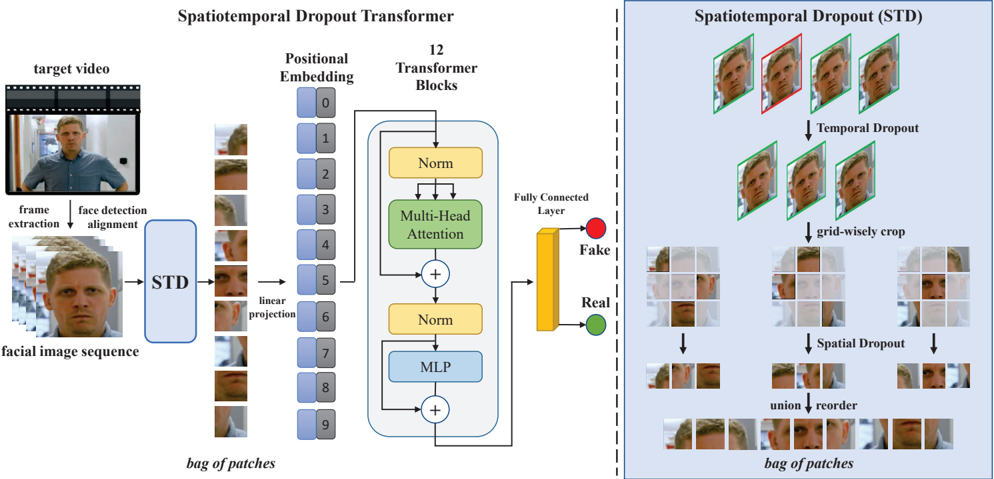
While the abuse of deepfake technology has caused serious concerns recently, how to detect deepfake videos is still a challenge due to the high photo-realistic synthesis of each frame. Existing image-level approaches often focus on single frame and ignore the spatiotemporal cues hidden in deepfake videos, resulting in poor generalization and robustness. The key of a video-level detector is to fully exploit the spatiotemporal inconsistency distributed in local facial regions across different frames in deepfake videos. Inspired by that, this paper proposes a simple yet effective patch-level approach to facilitate deepfake video detection via spatiotemporal dropout transformer. The approach reorganizes each input video into bag of patches that is then fed into a vision transformer to achieve robust representation. Specifically, a spatiotemporal dropout operation is proposed to fully explore patch-level spatiotemporal cues and serve as effective data augmentation to further enhance model's robustness and generalization ability. The operation is flexible and can be easily plugged into existing vision transformers. Extensive experiments demonstrate the effectiveness of our approach against 25 state-of-the-arts with impressive robustness, generalizability, and representation ability.
Overview
CoChat Summary
TL;DR
The paper proposes a Spatiotemporal Dropout Transformer (STDT) that reorganizes deepfake videos into bags of facial patches and applies temporal and spatial dropout to capture patch-level spatiotemporal inconsistency. It reports state-of-the-art AUC on FaceForensics++, DFDC, and Celeb-DF(v2), with strong robustness and cross-dataset generalization.
Key findings
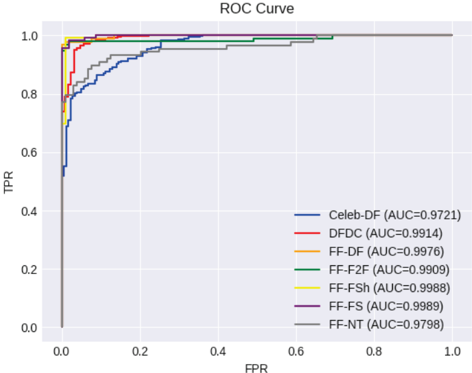
- STDT achieves the highest AUC among 25 compared state-of-the-arts on all three benchmarks: 99.8% on FaceForensics++, 99.1% on DFDC, and 97.2% on Celeb-DF(v2), which is at least 0.3%, 0.6%, and 2.8% higher than the state-of-the-arts, respectively.
- Intra-dataset results show all ACC above 90% and AUC above 97%; on the Deepfakes, Face2Face, FaceShifter, and FaceSwap subsets of FF++, all AUC are above 99%.
- Ablation on Celeb-DF(v2) shows spatiotemporal dropout (S+T) gives the best performance: ACC 91.70%, AUC 97.21%, REC 95.01%, PRE 92.55%, F1 93.76%, compared with no dropout at ACC 87.65%, AUC 93.43%, REC 94.71%, PRE 85.70%, F1 90.96%.
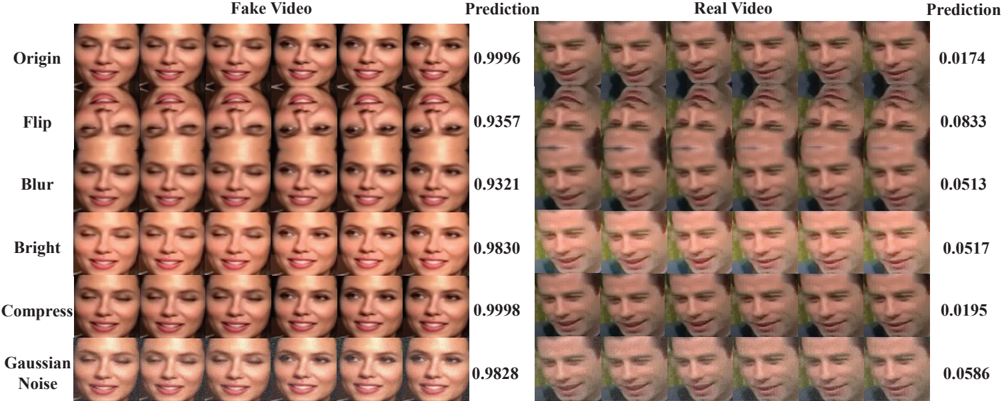
- Incorporating STD into four ViT backbones consistently improves performance, averaging ACC improvement of 11.15% and AUC improvement of 7.76%; robustness tests under Flip, Blur, Bright, Compress, and Gaussian Noise remain close to origin, e.g., Flip gives ACC 90.54%, AUC 96.56% versus origin ACC 91.70%, AUC 97.21%.
Methods
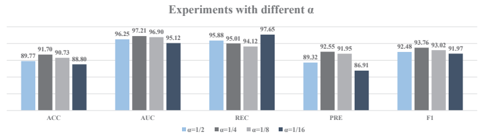
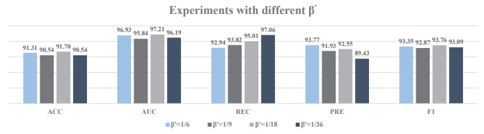
- The approach extracts 24 raw frames per video, performs face detection and alignment, then applies temporal dropout with rate α = 1/4 and spatial dropout with rate β = 17/18 after cropping each face into 6 × 6 non-overlapping patches; remaining patches are reorganized into a bag of patches.
- The bag of patches is fed into a ViT-Base-16 backbone with 12 layers, 12 self-attention heads, dropout rate 0.1, attention dropout 0.0, projected token dimension 768, and MLP header dimension 3072; training uses Binary Cross Entropy, SGD, OneCycleLR, global learning rate 10^-3, and weight decay 10^-4.
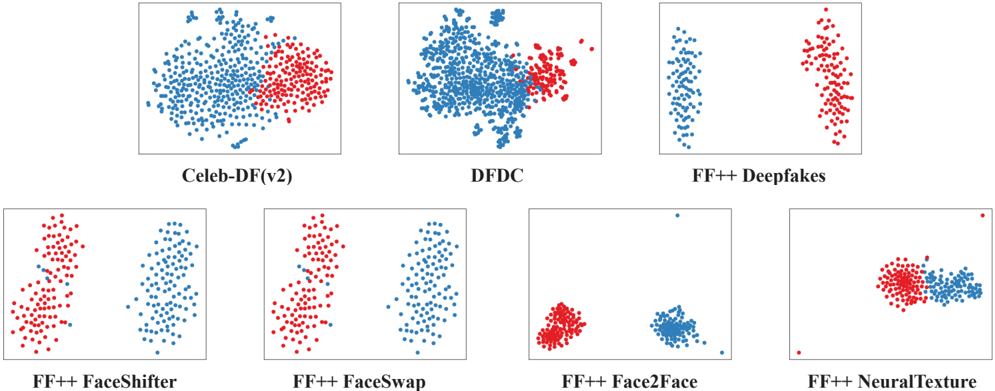
- Experiments compare against 25 state-of-the-art methods on FaceForensics++ (FF++), DFDC, and Celeb-DF(v2), using AUC as the main metric, plus robustness tests, cross-dataset generalization tests, t-SNE visualization, and ablation studies on dropout operation, dropout rates, and ViT backbones.
Limitations
- The paper states future work will extend the approach to more video understanding tasks and enhance its interpretability to provide more human-understandable detection results.
- Evident from the text: the ablation analysis is conducted on Celeb-DF(v2) only, and cross-dataset generalization results are notably lower than intra-dataset results, e.g., training on Celeb-DF and testing on DFDC gives AUC 70.14%, while training on DFDC and testing on Celeb-DF gives AUC 73.60%.
Model-written summary. Check it against the paper before relying on it.
Integrity signals
Registry
Cites
Statistics
Figures
Verification
Claims the paper makes
6 Valid · 1 Not valid · 0 Not checked · 51 Own results and interpretations
Every source the paper cites for this claim was checked and supports it.
In the paper
“The main reason is that our approach focuses on capturing the patch-level inconsistency from both inter-frame and intra-frames rather than inter-frame inconsistency like [50] .”
§ Deepfake Video Detection with Spatiotemporal Dropout Transformer > 4.2 State-of-the-Art Comparison
What the sources say
- Supportedcites [50] 50. Daichi Zhang, Chenyu Li, Fanzhao Lin, Dan Zeng, and Shiming Ge. 2021. Detect- ing Deepfake Videos with Temporal Dropout 3DCNN. In IJCAI. 1288-1294. source
The citation identifies Zhang et al. as an example of an approach that detects inter-frame inconsistency; the citing authors’ description of their own patch-level approach is not attributed to it. The source’s Introduction (page unavailable in our copy) says its 3DCNN captures temporal inconsistencies between frames. (LLM, conf=0.92)
plainstates a cause- Asserted: passes — The authors put it forward as true.
- Checkable: passes — It can be checked against evidence.
- Load-bearing: passes — The paper’s conclusions depend on it.
- Based: unclear — It is unclear why the paper says it holds.
- Supported
The cited sources support only part of this claim — read each source’s verdict below.
In the paper
“related experiments results further demonstrate ViT also has remarkable representation capacity when dealing with images and videos [19].”
§ Deepfake Video Detection with Spatiotemporal Dropout Transformer > Deepfake Detection.
What the sources say
- Partly supportedcites [19] 19. Kai Han, Yunhe Wang, Hanting Chen, Xinghao Chen, Jianyuan Guo, Zhenhua Liu, Yehui Tang, An Xiao, Chunjing Xu, Yixing Xu, et al. 2020. A survey on visual transformer. arXiv preprint (2020). sourceExperimental — accuracy not yet measured
Our copy of TNT supports only the image side: the Introduction (p. 2) states that ViT divides an image into local patches so that 'the attention can be naturally calculated between any two image patches for generating effective feature representations for the recognition task', and Table 9 (Transfer Learning, p. 9) reports ViT-B/16 ↑384 results on downstream image classification. Nothing in the paper demonstrates ViT's capacity on videos: the experimental datasets (Table 2, p. 5; Section 3.1, p. 6) are ImageNet, CIFAR-10/100, Oxford Flowers/Pets, iNat-19, COCO2017 detection and ADE20K segmentation, all still images. The single mention of video (Introduction, p. 1) credits Wang et al.'s non-local networks [41] for 'capturing long-range dependencies in video and image recognition', not ViT, and the paper's own conclusion (Section 4, p. 10) is that TNT, not ViT, better preserves local structure — ViT 'corrupts the local structure of a patch' (Section 2.2, p. 3). (LLM, conf=0.72)
boosted- Asserted: passes — The authors put it forward as true.
- Checkable: passes — It can be checked against evidence.
- Load-bearing: passes — The paper’s conclusions depend on it.
- Based: passes — The paper gives a reason why it holds.
- Partly supported
A result the paper reports from its own data — it cites no other source for it, so there is none to check. The quote shows it is in the paper.
In the paper
“FaceShifter 98.64 99.88 98.28 99.13 98.70”
§ Deepfake Video Detection with Spatiotemporal Dropout Transformer > 4.2 State-of-the-Art Comparison
plain- Asserted: passes — The authors put it forward as true.
- Checkable: passes — It can be checked against evidence.
- Load-bearing: passes — The paper’s conclusions depend on it.
- Based: passes — The paper gives a reason why it holds.
A result the paper reports from its own data — it cites no other source for it, so there is none to check. The quote shows it is in the paper.
In the paper
“Celeb-DF 91.70 97.21 95.01 92.55 93.76”
§ Deepfake Video Detection with Spatiotemporal Dropout Transformer > 4.2 State-of-the-Art Comparison
plain- Asserted: passes — The authors put it forward as true.
- Checkable: passes — It can be checked against evidence.
- Load-bearing: passes — The paper’s conclusions depend on it.
- Based: passes — The paper gives a reason why it holds.
A result the paper reports from its own data — it cites no other source for it, so there is none to check. The quote shows it is in the paper.
In the paper
“Deepfakes 97.97 99.76 95.70 100.0 97.80”
§ Deepfake Video Detection with Spatiotemporal Dropout Transformer > 4.2 State-of-the-Art Comparison
plain- Asserted: passes — The authors put it forward as true.
- Checkable: passes — It can be checked against evidence.
- Load-bearing: passes — The paper’s conclusions depend on it.
- Based: passes — The paper gives a reason why it holds.
26 more claims
Create a free account to see all 58 claims and every source verdict.
- It may state two separate claims as one. 19
- The quote only partly states this claim. 2
- Probably not a substantial claim. 6
Claims other papers make about this one
Each is checked against this paper’s own text: does it say what the citing paper says it does?
In the citing paper
“Some models excelled in additional metrics, such as the STDT [28] model, with its 97.44% accuracy, 99.1% AUC, and 98.48% F1 score.”
From GenConViT: Deepfake Video Detection Using Generative Convolutional Vision Transformer (2025) · cites this paper as [28]
Self-check
Percentages, sums and reported differences re-computed from the paper’s own numbers.
Rated minor: it would not touch a result — a value no result rests on, a p-value that stays on the same side of the significance level, or a conflict that is clerical, resolved elsewhere in the paper, or outside its own findings.
In the paper
“Celeb-DF(v2) contains 590 original videos covering different ages, genders, and ethnics, and 5,639 corresponding synthesized videos (4,807 for training, 1,203 for validation, and 518 for testing).”
§ Deepfake Video Detection with Spatiotemporal Dropout Transformer > 4.1 Experimental Settings
Reported 6229 · recomputed 6528
Citations
Cites
BERT: Pre-training of Deep Bidirectional Transformers for Language Understanding
Devlin, J., Chang, M.-W., Lee, K., & Toutanova, K. (2019) · Proceedings of the 2019 Conference of the North American Chapter of the Association for Computational Linguistics: Human Language Technologies, Volume 1 (Long and Short Papers) · doi:10.18653/v1/n19-1423 · Cited by 54,325 · cited 1×
“Transformers [21] have achieved impressive performance in natural language processing (NLP) tasks due to their strong representation capacity, such as BERT [22].”
BackgroundAn Image is Worth 16x16 Words: Transformers for Image Recognition at Scale
Dosovitskiy, A., Beyer, L., Kolesnikov, A., Weissenborn, D., Zhai, X., Unterthiner, T., Dehghani, M., Minderer, M., Heigold, G., Gelly, S., et al. (2020) · arXiv · doi:10.48550/arxiv.2010.11929 · Cited by 47,472
Swin Transformer: Hierarchical Vision Transformer using Shifted Windows
Liu, Z., Lin, Y., Cao, Y., Hu, H., Wei, Y., Zhang, Z., Lin, S., & Guo, B. (2021) · 2021 IEEE/CVF International Conference on Computer Vision (ICCV) · doi:10.1109/iccv48922.2021.00986 · Cited by 35,534
(2008) · Journal of Machine Learning Research · Cited by 33,051
End-to-End Object Detection with Transformers
Carion, N., Massa, F., Synnaeve, G., Usunier, N., Kirillov, A., & Zagoruyko, S. (2020) · Lecture Notes in Computer Science · doi:10.1007/978-3-030-58452-8_13 · Cited by 18,285
End-to-End Object Detection with Transformers
Carion, N., Massa, F., Synnaeve, G., Usunier, N., Kirillov, A., & Zagoruyko, S. (2020) · arXiv · doi:10.48550/arxiv.2005.12872 · Cited by 18,253 · cited 1×
“Specifically, vision transformer (ViT) [23] utilizes the same self-attention mechanism and crops an image into a sequence of flattened patches as the input token sequence used in the NLP task to train the transformer encoder for different downstream tasks, such as classification and object detection [23, 24].”
MethodA Style-Based Generator Architecture for Generative Adversarial Networks
Karras, T., Laine, S., & Aila, T. (2019) · 2019 IEEE/CVF Conference on Computer Vision and Pattern Recognition (CVPR) · doi:10.1109/cvpr.2019.00453 · Cited by 11,714 · cited 1×
“For example, generative adversarial networks (GANs) [5] have enabled plenty of high-quality face manipulation [16, 17] and face synthesis [18, 19, 20].”
BackgroundAnalyzing and Improving the Image Quality of StyleGAN
Karras, T., Laine, S., Aittala, M., Hellsten, J., Lehtinen, J., & Aila, T. (2020) · 2020 IEEE/CVF Conference on Computer Vision and Pattern Recognition (CVPR) · doi:10.1109/cvpr42600.2020.00813 · Cited by 6,332
Analyzing and Improving the Image Quality of StyleGAN
Karras, T., Laine, S., Aittala, M., Hellsten, J., Lehtinen, J., & Aila, T. (2019) · arXiv · doi:10.48550/arxiv.1912.04958 · Cited by 6,332
Pyramid Vision Transformer: A Versatile Backbone for Dense Prediction without Convolutions
Wang, W., Xie, E., Li, X., Fan, D.-P., Song, K., Liang, D., Lu, T., Luo, P., & Shao, L. (2021) · 2021 IEEE/CVF International Conference on Computer Vision (ICCV) · doi:10.1109/iccv48922.2021.00061 · Cited by 5,259 · cited 1×
“Various ViT architectures have been proposed [25, 26, 27] recently and related experiments results further demonstrate ViT also has remarkable representation capacity when dealing with images and videos [28].”
Background
Research works printed but not linked: 4
- 16. Ian J. Goodfellow, Jean Pouget-Abadie, Mehdi Mirza, Bing Xu, David Warde- Farley, Sherjil Ozair, Aaron C. Courville, and Yoshua Bengio. 2014. Generative Adversarial Nets. In NeurIPS. 2672-2680.
- 19. Kai Han, Yunhe Wang, Hanting Chen, Xinghao Chen, Jianyuan Guo, Zhenhua Liu, Yehui Tang, An Xiao, Chunjing Xu, Yixing Xu, et al. 2020. A survey on visual transformer. arXiv preprint (2020).
- 29. Yuezun Li, Xin Yang, Pu Sun, Honggang Qi, and Siwei Lyu. 2020. Celeb-DF: A Large-Scale Challenging Dataset for DeepFake Forensics. In CVPR. 3204-3213.
- 45. Ashish Vaswani, Noam Shazeer, Niki Parmar, Jakob Uszkoreit, Llion Jones, et al. 2017. Attention is all you need. In NeurIPS. 5998-6008.
Cited by
A Review of Deep Learning-based Approaches for Deepfake Content Detection
Passos, L. A., Jodas, D., Costa, K. A. P., Júnior, L. A. S., Rodrigues, D., Ser, J. D., Camacho*, D., & Papa, J. (2023) · doi:10.22541/au.169735672.27713914/v1 · Cited by 116
A review of deep learning‐based approaches for deepfake content detection
(2024) · doi:10.1111/exsy.13570 · Cited by 116
A novel approach for detecting deep fake videos using graph neural network
El-Gayar, M. M., Abouhawwash, M., Askar, S., & Sweidan, S. (2024) · Journal Of Big Data · doi:10.1186/s40537-024-00884-y · Cited by 84
Fully Unsupervised Deepfake Video Detection Via Enhanced Contrastive Learning
Qiao, T., Xie, S., Chen, Y., Retraint, F., & Luo, X. (2024) · IEEE Transactions on Pattern Analysis and Machine Intelligence · doi:10.1109/tpami.2024.3356814 · Cited by 48
“…by “Deepfake” (DF) or “Faceswap” (FS); right: the expression is tampered from fake videos generated by “Face2Face” (F2F) or “NeuralTextures” (NT). networks and representation learning methods indeed bring the remarkable improvement of detection accuracy [17], [18], [19], [20], [21], [22], [23].”
BackgroundGenConViT: Deepfake Video Detection Using Generative Convolutional Vision Transformer
Deressa, D. W., Mareen, H., Lambert, P., Atnafu, S., Akhtar, Z., & Van Wallendael, G. (2025) · Applied Sciences · doi:10.3390/app15126622 · Cited by 46
“Some models excelled in additional metrics, such as the STDT [77] model with 97 .”
InfluentialWang, R., Ye, D., Tang, L., Zhang, Y., & Deng, J. (2024) · IEEE Signal Processing Letters · doi:10.1109/lsp.2024.3433596 · Cited by 75
UMMAFormer: A Universal Multimodal-adaptive Transformer Framework for Temporal Forgery Localization
Zhang, R., Wang, H., Du, M., Liu, H., Zhou, Y., & Zeng, Q. (2023) · Proceedings of the 31st ACM International Conference on Multimedia · doi:10.1145/3581783.3613767 · Cited by 42
“This has led to a growing interest in developing methods for detecting manipulated content in multimedia forensics, with a primary focus on deepfake detection [13, 28, 60, 63, 65] in facial and audio media.”
MethodDual Attention Network Approaches to Face Forgery Video Detection
Luo, Y.-X., & Chen, J.-L. (2022) · IEEE Access · doi:10.1109/access.2022.3215963 · Cited by 30
Learning Natural Consistency Representation for Face Forgery Video Detection
Zhang, D., Xiao, Z., Li, S., Lin, F., Li, J., & Ge, S. (2024) · Lecture notes in computer science · doi:10.1007/978-3-031-73010-8_24 · Cited by 66
Self-citationDeepfake Detection and Localization Using Multi-View Inconsistency Measurement
Zhang, B., Yin, Q., Lu, W., & Luo, X. (2024) · IEEE Transactions on Dependable and Secure Computing · doi:10.1109/tdsc.2024.3472064 · Cited by 35
Disrupting Diffusion: Token-Level Attention Erasure Attack against Diffusion-based Customization
Liu, Y., An, J., Zhang, W., Wu, D., Gu, J., Lin, Z., & Wang, W. (2024) · ACM International Conference on Multimedia (ACM MM) · doi:10.1145/3664647.3681243 · Cited by 42
DIP: Diffusion Learning of Inconsistency Pattern for General DeepFake Detection
Nie, F., Ni, J., Zhang, J., Zhang, B., & Zhang, W. (2024) · IEEE Transactions on Multimedia · doi:10.1109/tmm.2024.3521766 · Cited by 30
UAM‐Net : Robust Deepfake Detection Through Hybrid Attention Into Scalable Convolutional Network
Sudarshana, K., & Yendapalli, V. (2025) · Expert Systems · doi:10.1111/exsy.70009 · Cited by 21
Singh, R. P., Sree, N. H., Reddy, K. L. S. P., & Jashwanth, K. (2024) · SN Computer Science · doi:10.1007/s42979-024-03455-3 · Cited by 16
Generalizing Face Forgery Detection via Uncertainty Learning
Wu, Y., Song, X., Chen, J., & Jiang, Y. (2023) · ACM International Conference on Multimedia (ACM MM) · doi:10.1145/3581783.3612102 · Cited by 18
Customized Transformer Adapter With Frequency Masking for Deepfake Detection
Shi, Z., Chen, H., Jia, Y., Zhang, D., Lu, W., & Yang, X. (2025) · IEEE Transactions on Information Forensics and Security · doi:10.1109/tifs.2025.3574983 · Cited by 18
Self-citationTemporal Diversified Self-Contrastive Learning for Generalized Face Forgery Detection
Zhang, R., He, P., Li, H., Wang, S., & Cao, Y. (2024) · IEEE Transactions on Circuits and Systems for Video Technology · doi:10.1109/tcsvt.2024.3436554 · Cited by 13
Spatio-Temporal Catcher: A Self-Supervised Transformer for Deepfake Video Detection
Li, M., Li, X., Yu, K., Deng, C. D., Huang, H., Mao, F., Xue, H., & Li, M. (2023) · ACM International Conference on Multimedia (ACM MM) · doi:10.1145/3581783.3613842 · Cited by 23
A Closer Look at Video Sampling for Sequential Action Recognition
Zhang, Y., Zhao, J., Chen, Z., Mi, S., Zhu, H., & Geng, X. (2023) · IEEE Transactions on Circuits and Systems for Video Technology · doi:10.1109/tcsvt.2023.3274108 · Cited by 7
AIM-Bone: Texture Discrepancy Generation and Localization for Generalized Deepfake Detection
Liu, B., Zhang, X., Ling, H., Li, Z., Wang, R., Zhang, H., & Li, P. (2025) · IEEE Transactions on Biometrics Behavior and Identity Science · doi:10.1109/tbiom.2025.3526655 · Cited by 9
Zhang, G., Liang, Y., Tian, K., Yi, J., Alsolai, H., Liu, M., & Hu, X. (2025) · IEEE Transactions on Consumer Electronics · doi:10.1109/tce.2025.3624764 · Cited by 16
Exploring coordinated motion patterns of facial landmarks for deepfake video detection
Zhang, Y., Niu, R., Zhang, X., Chen, S., Wang, M., & Li, X. (2025) · Applied Soft Computing · doi:10.1016/j.asoc.2025.112974 · Cited by 9
Anti-Compression Contrastive Facial Forgery Detection
Huang, J., Du, C., Zhu, X., Ma, S., Nepal, ., & Xu, C. (2023) · IEEE Transactions on Multimedia · doi:10.1109/tmm.2023.3347103 · Cited by 10
Semantic Token Transformer for Face Forgery Detection
Peng, C., Luo, X., Liu, D., Wang, N., Hu, R., & Gao, X. (2025) · IEEE Transactions on Information Forensics and Security · doi:10.1109/tifs.2025.3567110 · Cited by 10
Deepfake Video Detection Using Facial Feature Points and Ch-Transformer
Yang, R., Lan, R., Deng, Z., Luo, X., & Sun, X. (2024) · ACM Transactions on Multimedia Computing Communications and Applications · doi:10.1145/3672566 · Cited by 11
Bi-Stream Coteaching Network for Weakly-Supervised Deepfake Localization in Videos
Li, Z., Teng, Z., Zhang, B., & Fan, J. (2025) · IEEE Transactions on Information Forensics and Security · doi:10.1109/tifs.2025.3533906 · Cited by 9
Sun, Y., Nguyen, H. H., Lu, C.-S., Zhang, Z., Sun, L., & Echizen, I. (2024) · IEEE International Joint Conference on Biometrics (IJCB) · doi:10.1109/ijcb62174.2024.10744491 · Cited by 12
Vulnerability-Aware Spatio-Temporal Learning for Generalizable Deepfake Video Detection
Nguyen, D., Astrid, M., Kacem, A., Ghorbel, E., & Aouada, D. (2025) · IEEE/CVF International Conference on Computer Vision (ICCV) · doi:10.1109/iccv51701.2025.01004 · Cited by 37
Mining Temporal Inconsistency with 3D Face Model for Deepfake Video Detection
Cheng, Z., Chen, C., Zhou, Y., & Hu, X. (2023) · Lecture notes in computer science · doi:10.1007/978-981-99-8540-1_19 · Cited by 11
SFCL: A Spatial-Frequency Collaborative Learning Framework for Generalizable Deepfake Detection
Qiao, M., Tian, R., Zhai, Y., & Li, C. (2025) · IEEE International Joint Conference on Biometrics (IJCB) · doi:10.1109/ijcb65343.2025.11410680 · Cited by 6
Enhancing deepfake robustness via real discrete codebook reconstruction
Chen, P., Xu, M., Bao, H., & Xu, L. (2025) · The Visual Computer · doi:10.1007/s00371-025-03886-w · Cited by 3
Guardian AI: Synthetic Media Forensics through Multimodal Fusion and Advanced Machine Learning
Karthikeyan, K., Swetha, R., Deepanraj, S., & Dhandapani, S. (2024) · International Conference on Cognitive Robotics and Intelligent Systems (ICC-ROBINS) · doi:10.1109/icc-robins60238.2024.10533980 · Cited by 5
Securing Reality: AI-Driven Detection of Deepfakes and Counterfeit Currency
Jambula, N., Reddy, N. K., Pandey, K., & Mahesh, M. (2025) · International Joint Symposium on Artificial Intelligence and Natural Language Processing (iSAI-NLP) · doi:10.1109/isai-nlp66160.2025.11320726 · Cited by 1
Scale-space Tokenization for Improving the Robustness of Vision Transformers
Xu, L., Kawakami, R., & Inoue, N. (2023) · ACM International Conference on Multimedia (ACM MM) · doi:10.1145/3581783.3612060 · Cited by 4
DeepFake Detection With Multi-View Fusion and Graph Convolutional Network
Xu, X., Chen, J., Zhang, Y., Li, C., Singh, A. K., & Lv, Z. (2025) · IEEE Transactions on Multimedia · doi:10.1109/tmm.2025.3618565 · Cited by 9
Nguyen-Le, H.-H., Tran, V.-T., Nguyen, D.-T., & Le-Khac, N.-A. (2026) · Artificial Intelligence Review · doi:10.1007/s10462-026-11608-4 · Cited by 28
CHRONICL OF DIPFEYK SCIENTIFIC RESEARCH: ANALYSIS
Davydenko, A., & Азарний, Д. (2025) · Collection of scientific works of the Military Institute of Kyiv National Taras Shevchenko University · doi:10.17721/2519-481x/2025/87-09
CPL: Curriculum Pseudo Labeling for Weakly Supervised Temporal Forgery Localization
Zhang, D., Fang, M., Lu, Z., & Xie, H. (2025) · IEEE International Conference on Acoustics Speech and Signal Processing · doi:10.1109/icassp49660.2025.10887844
Self-citationFANB-Net: Frequency-Awared Attention and Noise-Injected Boosting for AI-Generated Image Detection
Guo, J., Xu, Z., Luo, J., Lee, L., Wang, F. L., & Yang, Z. (2026) · Lecture notes in computer science · doi:10.1007/978-981-95-6960-1_26 · Cited by 1
Ni, L., Lyu, K., Shi, J., Liu, X., Yu, B., & Zhang, J. (2025) · SSRN Electronic Journal · doi:10.2139/ssrn.5828025
Towards Tamper-Resistant Digital Media: An AI and Blockchain Approach for Deepfake Detection
Sakthivel, K., Harine, N., & Chandra Mohan, G. (2025) · International Conference on Electronics, Communication and Aerospace Technology (ICECA) · doi:10.1109/iceca66444.2025.11382545 · Cited by 1
Pandey, M., Koundal, D., & Kumar, S. (2026) · Discover Computing · doi:10.1007/s10791-026-10548-5
SADN: Saliency-Based Attention Discrimination Network for Deepfake Detection
Wang, X., Lu, D., Dong, J., Hedjam, R., & Zhong, G. (2026) · Lecture notes in computer science · doi:10.1007/978-981-95-5696-0_8
Transfer Learning with Vision Transformer for Human-Indistinguishable Deepfake Detection
Amin, U., & Mateen, M. (2026) · International Conference on IT and Industrial Technologies (ICIT) · doi:10.1109/icit68548.2026.11577692
Kotwal, J. G., Pandit, R. J., Dhole, T. S., Chetwani, P. S., Inamdar, B. A., & Pawar, S. D. (2025) · International Conference on Robotics, Automation and Artificial Intelligence (RAAI) · doi:10.1109/raai67517.2025.11423383 · Cited by 2
Jeswani, U., & Priyadharshini, S. (2026) · International Conference on Innovative Trends in Information Technology (ICITIIT) · doi:10.1109/icitiit68860.2026.11499629
Ustvarjanje ponarejenih videoposnetkov s pomočjo difuzijskih modelov
Markelj, B., Peer, P., & Batagelj, B. (2024) · Računalniška obdelava slik in njena uporaba v Sloveniji (ROSUS) · doi:10.18690/um.feri.1.2024.8
Optimizing Deepfake Detection Transformer on FaceForensics++: A Hyperparameter Grid Search Study
Rana, P., Kumar, L., Gupta, R., Dhiman, S., Bagga, V., & Gupta, B. (2026) · International Conference Big Data and Machine Learning · doi:10.1109/icbdml68582.2026.11544685
Metadata
- Authors
- Zhang, D., Lin, F., Hua, Y., Wang, P., Zeng, D., & Ge, S.
- Affiliations
- Chinese Academy of Sciences (CN)
- Shanghai University (CN)
- Venue
- Proceedings of the 30th ACM International Conference on Multimedia
- Publisher
- ACM
- Published
- 2022-10-10
- Pages
- 5833-5841
- OpenAlex
- W4304015019
- Semantic Scholar
- 584c84f7b842a0a94605ed2a73f76004ee3afbd3
- Cited by
- 50
- References
- 36
- Citations by year
- 2026: 7 · 2025: 19 · 2024: 16 · 2023: 7 · 2022: 1
- FWCI
- 3.90
- Type
- conference paper
- Language
- en
- Open access
- hybrid
- doi.org
- Licence
- Locations
- ACM International Conference on Multimedia (ACM MM) (publishedVersion, cc-by)
- arXiv (Cornell University) (submittedVersion)
- arXiv (Cornell University)
- Funders
- National Key Research and Development Program of China (Grant No. 2020AAA0140001)
- National Natural Science Foundation of China (61772513)
- Topics
- Physical Sciences › Computer Science › Computer Vision and Pattern Recognition › Digital Media Forensic Detection
- Physical Sciences › Computer Science › Computer Vision and Pattern Recognition › Generative Adversarial Networks and Image Synthesis
- Social Sciences › Sociology and Political Science › Misinformation and Its Impacts
- Keywords
- deepfake video detection, vision transformer, data augmentation, facial region
About these checks
Registry, retraction, Cites and statistics results are computed, not judged, with one exception: a printed reference that no index lists is read once by a model before it counts as a citation error. Claims are extracted by a model and kept only when their quote appears verbatim in the text; each cited source is then checked, with a model’s help, for whether it says what the claim relies on. Those verdicts can be wrong — read the claim’s quote and the cited source before relying on one.
The claim verdicts this report counts are experimental: their accuracy is not yet measured.
A language model drew the claims from the paper on 2026-10-10, under version 3 of the claim definition (model deepseek-v4.1-flash, prompt extract-v3).
A second model labelled each claim on 2026-10-10 (model jev-1.13-20260917, definition revision gold-guideline-v0.2).
Cited sources are checked with a language model’s help (gpt-6-sol and qwen3.8-omni-flash).
Statistics and arithmetic are recomputed, not judged.
Confidence bands are shown only for fields calibrated on our annotated test set. None is calibrated yet, so no band is shown.
What counts as a claim ›How we measure confidence ›How we check this ›
Are you an author, or do you see a problem with this page? Request a review
Data sources
Bibliographic data: Semantic Scholar, OpenAlex, Crossref.
Contains information from the Semantic Scholar Academic Graph Datasets, made available under the ODC Attribution License (ODC-BY 1.0).
Semantic Scholar’s data is described in: Kinney, R., et al. (2023). The Semantic Scholar Open Data Platform. arXiv:2301.10140.
