

TARNet: Task-Aware Reconstruction for Time-Series Transformer
Open accessThe DOI matches its Crossref record; 30 of the 30 references it cites were found in a registry or an index.
Abstract
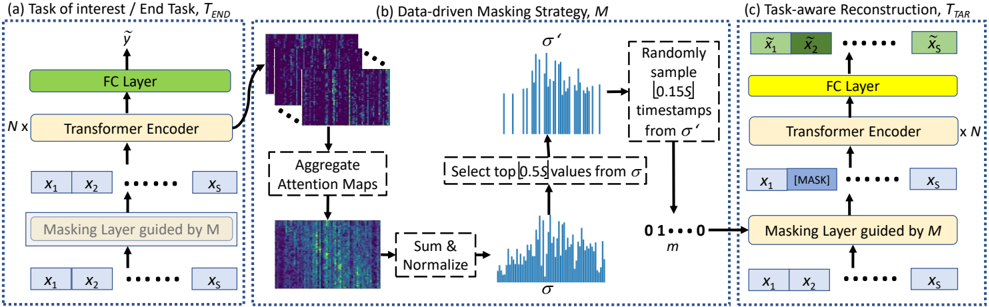
Time-series data contains temporal order information that can guide representation learning for predictive end tasks (e.g., classification, regression). Recently, there are some attempts to leverage such order information to first pre-train time-series models by reconstructing time-series values of randomly masked time segments, followed by an end-task fine-tuning on the same dataset, demonstrating improved end-task performance. However, this learning paradigm decouples data reconstruction from the end task. We argue that the representations learnt in this way are not informed by the end task and may, therefore, be sub-optimal for the end-task performance. In fact, the importance of different timestamps can vary significantly in different end tasks. We believe that representations learnt by reconstructing important timestamps would be a better strategy for improving end-task performance. In this work, we propose TARNet, Task-Aware Reconstruction Network, a new model using Transformers to learn task-aware data reconstruction that augments end-task performance. Specifically, we design a data-driven masking strategy that uses self-attention score distribution from end-task training to sample timestamps deemed important by the end task. Then, we mask out data at those timestamps and reconstruct them, thereby making the reconstruction task-aware. This reconstruction task is trained alternately with the end task at every epoch, sharing parameters in a single model, allowing the representation learnt through reconstruction to improve end-task performance. Extensive experiments on tens of classification and regression datasets show that TARNet significantly outperforms state-of-the-art baseline models across all evaluation metrics.
Overview
The claims and statistics of this paper haven’t been checked yet.
Free: it reads the open-access text and checks the first 5 claims that cite a source we can check. Create a free account to check every claim.
Integrity signals
Registry
Cites
Statistics
Figures
Verification
Claims the paper makes
The claims and statistics of this paper haven’t been checked yet.
Free: it reads the open-access text and checks the first 5 claims that cite a source we can check. Create a free account to check every claim.
Self-check
Percentages, sums and reported differences re-computed from the paper’s own numbers.
The self-check needs the paper’s full text.
Citations
Cites
BERT: Pre-training of Deep Bidirectional Transformers for Language Understanding
Devlin, J., Chang, M.-W., Lee, K., & Toutanova, K. (2018) · arXiv · doi:10.48550/arxiv.1810.04805 · Cited by 73,173 · cited 1×
“Learning data representation through reconstruction has been explored in natural language processing [7] and time-series [37].”
BackgroundXGBoost: A Scalable Tree Boosting System
Chen, T., & Guestrin, C. (2016) · Proceedings of the 22nd ACM SIGKDD International Conference on Knowledge Discovery and Data Mining · doi:10.1145/2939672.2939785 · Cited by 54,569 · cited 1×
“(3) Tree-based methods: Random Forest [26] and XGBoost [4].”
MethodSupport Vector Regression Machines
Drucker, H., Burges, C. J. C., Kaufman, L., Smola, A. J., & Vapnik, V. N. (1996) · Cited by 4,658
Random Forest: A Classification and Regression Tool for Compound Classification and QSAR Modeling
Svetnik, V., Liaw, A., Tong, C., Culberson, J. C., Sheridan, R. P., & Feuston, B. P. (2003) · Journal of Chemical Information and Computer Sciences · doi:10.1021/ci034160g · Cited by 3,573 · cited 1×
“(3) Tree-based methods: Random Forest [26] and XGBoost [4].”
MethodA Transformer-based Framework for Multivariate Time Series Representation Learning
Zerveas, G., Jayaraman, S., Patel, D., Bhamidipaty, A., & Eickhoff, C. (2021) · Proceedings of the 27th ACM SIGKDD Conference on Knowledge Discovery & Data Mining · doi:10.1145/3447548.3467401 · Cited by 1,278 · cited 10×
“Learning data representation through reconstruction has been explored in natural language processing [7] and time-series [37].”
BackgroundMethodResultInfluentialMultivariate LSTM-FCNs for time series classification
Karim, F., Majumdar, S., Darabi, H., & Harford, S. (2019) · Neural Networks · doi:10.1016/j.neunet.2019.04.014 · Cited by 1,138 · cited 2×
“(2) MLSTM-FCNs [18] expands LSTM-FCN and Attention LSTMFCN by adding squeeze-and-excitation blocks.”
BackgroundMethodDempster, A., Petitjean, F., & Webb, G. I. (2020) · Data Mining and Knowledge Discovery · doi:10.1007/s10618-020-00701-z · Cited by 982 · cited 3×
“TARNet performs the best on 17 datasets, as compared to 7 and 6 by the next best baselines TST [37] and Rocket [5], respectively.”
BackgroundMethodTime-Series Representation Learning via Temporal and Contextual ContrastingPreprint
Eldele, E., Ragab, M., Chen, Z., Wu, M., Kwoh, C., Li, X.-L., & Guan, C.-T. (2021) · International Joint Conference on Artificial Intelligence · doi:10.48550/arxiv.2106.14112 · Cited by 968 · cited 2×
“(9) TS-TCC [11] encourages consistency of different data augmentations to learn transformation-invariant representations.”
BackgroundTS2Vec: Towards Universal Representation of Time Series
Yue, Z., Wang, Y., Duan, J., Yang, T., Huang, C., Tong, Y., & Xu, B. (2022) · Proceedings of the AAAI Conference on Artificial Intelligence · doi:10.1609/aaai.v36i8.20881 · Cited by 850 · cited 1×
“(7) TS2Vec [35] performs hierarchical contrastive learning over augmented context views.”
BackgroundTime Series Classification Using Multi-Channels Deep Convolutional Neural Networks
Zheng, Y., Liu, Q., Chen, E., Ge, Y., & Zhao, J. L. (2014) · Lecture Notes in Computer Science · doi:10.1007/978-3-319-08010-9_33 · Cited by 652 · cited 1×
“Most neural networksbased methods use some arrangement of LSTM, CNN or both [18, 39].”
Method
Research works printed but not linked: 9
- Hassan Ismail Fawaz, Germain Forestier, Jonathan Weber, Lhassane Idoumghar, and Pierre-Alain Muller. 2019. Deep learning for time series classification: a review. Data mining and knowledge discovery 33, 4 (2019), 917-963.
- Hassan Ismail Fawaz, Benjamin Lucas, Germain Forestier, Charlotte Pelletier, Daniel F Schmidt, Jonathan Weber, Geoffrey I Webb, Lhassane Idoumghar, Pierre- Alain Muller, and François Petitjean. 2020. Inceptiontime: Finding alexnet for time series classification. Data Mining and Knowledge Discovery 34, 6 (2020).
- Chang Wei Tan, Christoph Bergmeir, Francois Petitjean, and Geoffrey I Webb. 2020. Monash university, uea, ucr time series regression archive. arXiv e-prints (2020), arXiv-2006.
- Ashish Vaswani, Noam Shazeer, Niki Parmar, Jakob Uszkoreit, Llion Jones, Aidan N Gomez, Łukasz Kaiser, and Illia Polosukhin. 2017. Attention is all you need. In Advances in neural information processing systems. 5998-6008.
- Zhiguang Wang, Weizhong Yan, and Tim Oates. 2017. Time series classification from scratch with deep neural networks: A strong baseline. In 2017 International joint conference on neural networks (IJCNN). IEEE, 1578-1585.
- Chao-Han Huck Yang, Yun-Yun Tsai, and Pin-Yu Chen. 2021. Voice2series: Re- programming acoustic models for time series classification. In ICML.
- Lexiang Ye and Eamonn Keogh. 2009. Time series shapelets: a new primitive for data mining. In KDD. 947-956.
- Zhihan Yue, Yujing Wang, Juanyong Duan, Tianmeng Yang, Congrui Huang, and Bixiong Xu. 2021. Learning Timestamp-Level Representations for Time Series with Hierarchical Contrastive Loss. arXiv preprint arXiv:2106.10466 (2021). · arXiv
- Xuchao Zhang, Yifeng Gao, Jessica Lin, and Chang-Tien Lu. 2020. Tapnet: Multi- variate time series classification with attentional prototypical network. In AAAI.
Cited by
Deep Learning for Time Series Classification and Extrinsic Regression: A Current Survey
Mohammadi Foumani, N., Miller, L., Tan, C. W., Webb, G. I., Forestier, G., & Salehi, M. (2024) · ACM Computing Surveys · doi:10.1145/3649448 · Cited by 268
“…2021 CNN + Transformers Sequence masking Voice2Series [22] 2021 CNN+Transformers Binary masking TST [19] 2021 Transformers Binary masking TARNet [150] 2022 Transformers Binary masking TimeMAE [151] 2023 CNN + Transformers Sequence masking CRT [152] 2023 Transformers Sequence masking Other…”
MethodSelf-Supervised Learning for Time Series Analysis: Taxonomy, Progress, and Prospects
Zhang, K., Wen, Q., Zhang, C., Cai, R., Jin, M., Liu, Y., Zhang, J. Y., Liang, Y., Pang, G., Song, D., et al. (2024) · IEEE Transactions on Pattern Analysis and Machine Intelligence · doi:10.1109/tpami.2024.3387317 · Cited by 295
“Unlike random masking, TARNet [77] considers the pre-trained model based on the masking strategy irrelevant to the downstream task, which leads to sub-optimal representations.”
MethodA Survey on Time-Series Pre-Trained Models
Ma, Q., Liu, Z., Zheng, Z., Huang, Z., Zhu, S., Yu, Z., & Kwok, J. T.-Y. (2024) · IEEE Transactions on Knowledge and Data Engineering · doi:10.1109/tkde.2024.3475809 · Cited by 182
“Transformers have received much attention because of their ability to capture input data’s contextual (future-past) dependencies, making them a good choice for modeling sequence data [122].”
BackgroundGinAR: An End-To-End Multivariate Time Series Forecasting Model Suitable for Variable Missing
Yu, C., Wang, F., Shao, Z., Qian, T., Zhang, Z., Wei, W., & Xu, Y. (2024) · ACM SIGKDD Conference on Knowledge Discovery and Data Mining (KDD) · doi:10.1145/3637528.3672055 · Cited by 83
“On the one hand, since each missing variable is usually a straight-line sequence composed of outliers, the sequence model in STGNNs [16] cannot mine any valuable pattern and information, resulting in incorrect temporal dependencies.”
BackgroundYao, B., Li, X., Ji, Z., Xiao, K., & Xu, W. (2023) · Computers & Industrial Engineering · doi:10.1016/j.cie.2023.109855 · Cited by 66
WHEN: A Wavelet-DTW Hybrid Attention Network for Heterogeneous Time Series Analysis
Wang, J., Yang, C., Jiang, X., & Wu, J. (2023) · ACM SIGKDD Conference on Knowledge Discovery and Data Mining (KDD) · doi:10.1145/3580305.3599549 · Cited by 56
“In the recent, deep neural networks begin to automatically learn complex features in TSC, including supervised feature mining [24], unsupervised feature learning [23], transformer methods [15, 48, 49, 68], etc.”
BackgroundSenane, Z., Cao, L., Buchner, V., Tashiro, Y., You, L., Herman, P. A., Nordahl, M. G., Tu, R., & von Ehrenheim, V. (2024) · ACM SIGKDD Conference on Knowledge Discovery and Data Mining (KDD) · doi:10.1145/3637528.3671673 · Cited by 60
Multivariate time series classification with crucial timestamps guidance
Zhang, D., Gao, J., & Li, X. (2024) · Expert Systems with Applications · doi:10.1016/j.eswa.2024.124591 · Cited by 37
RETRACTED: Mixup domain adaptations for dynamic remaining useful life predictions
Furqon, M., Pratama, M., Liu, L., Habibullah, H., & Doğançay, K. (2024) · Knowledge-Based Systems · doi:10.1016/j.knosys.2024.111783 · Cited by 34
“Note that [16] does not yet explore the controlled reconstruction technique for domain adaptations.”
BackgroundMethodInfluentialRetractedWang, Z., Wang, W., Sun, C., Li, J., Xie, S., Xu, J., Zou, K., Jin, Y., Yan, S., Liao, X., et al. (2025) · npj Digital Medicine · doi:10.1038/s41746-025-01587-1 · Cited by 37
“Somefeature engineering algorithms that can vectorize time series data, such as Time2VecorTARNet 115,116 ,canalsobeconsideredfortheconstruction of hand-crafted features.”
Zhong, G., Liu, F., Jiang, J., Wang, B., & Chen, C. L. P. (2023) · Information Sciences · doi:10.1016/j.ins.2023.119914 · Cited by 31
Rethinking general time series analysis from a frequency domain perspective
Zhuang, W., Fan, J., Fang, J., Fang, W., & Xia, M. (2024) · Knowledge-Based Systems · doi:10.1016/j.knosys.2024.112281 · Cited by 26
Tan, Y., Dede, M., Mohanty, V., Dou, J., Hill, H., Bernstam, E., & Chen, K. (2024) · Journal of Biomedical Informatics · doi:10.1016/j.jbi.2024.104648 · Cited by 19
A time series long-short term codec for compression and representation
Zuo, H., Wu, J., Lim, K. H., Liao, Y., Song, L., Zhu, Y., Li, Z., & Zhang, C. (2025) · Applied Intelligence · doi:10.1007/s10489-025-06842-2 · Cited by 21
“TARNet [27] enhances downstream task performance by data-driven temporal attention masking that prioritizes critical timestamp reconstruction.”
Unleashing the Power of Shared Label Structures for Human Activity Recognition
Zhang, X., Chowdhury, R. R., Zhang, J., Hong, D., Gupta, R. K., & Shang, J. (2023) · ACM International Conference on Information and Knowledge Management (CIKM) · doi:10.1145/3583780.3615101 · Cited by 26
Self-citationTS-MAE: A masked autoencoder for time series representation learning
Liu, Q., Ye, J., Liang, H., Sun, L., & Du, B. (2024) · Information Sciences · doi:10.1016/j.ins.2024.121576 · Cited by 30
A hierarchical transformer-based network for multivariate time series classification
Tang, Y., Wei, Y., Li, T., Zheng, X., & Ji, C. (2025) · Information Systems · doi:10.1016/j.is.2025.102536 · Cited by 19
Multi-Hop Multi-View Memory Transformer for Session-Based Recommendation
Zhuo, X., Qian, S., Hu, J., Dai, F., Lin, K., & Wu, G. (2024) · ACM Transactions on Information Systems · doi:10.1145/3663760 · Cited by 19
“…with the wide application of a series of Transformers [49] in sequential tasks (e.g., machine translation [8, 31] and time series forecasting [7, 65]), many SR methods have introduced the core of Transformers (i.e., a self-attention mechanism) to obtain the influence coefficient of…”
A Co-training Approach for Noisy Time Series Learning
Zhang, W., Zhang, J., Li, J., & Tsung, F. (2023) · ACM International Conference on Information and Knowledge Management (CIKM) · doi:10.1145/3583780.3614759 · Cited by 25
Knowledge Aware State-Space Capsule Network for Multivariate Time Series Classification
Xiao, Z., Wan, Q., Ding, W., Song, F., & Tong, H. (2026) · IEEE Transactions on Knowledge and Data Engineering · doi:10.1109/tkde.2026.3692700 · Cited by 13
“Furthermore, the task-aware time series transformer [63] represents an advanced model that integrates task-specific attention mechanisms to further refine temporal feature learning, demonstrating the potential of attention-based methods in complex time series applications.”
EMIT - Event-Based Masked Auto Encoding for Irregular Time Series
Patel, H., Qiu, R., Irwin, A., Sadiq, S. W., & Wang, S. (2024) · Proceedings · doi:10.1109/icdm59182.2024.00044 · Cited by 12
“TARNet [9] alternates between pretext and down-stream tasks, using task-informed data masking.”
UniMTS: Unified Pre-training for Motion Time Series
Zhang, X., Teng, D., Chowdhury, R., Li, S., Hong, D., Gupta, R., & Shang, J. (2024) · Advances in Neural Information Processing Systems 37 · doi:10.52202/079017-3414 · Cited by 8
Self-citationST-MTM: Masked Time Series Modeling with Seasonal-Trend Decomposition for Time Series Forecasting
Seo, H., & Lim, C. (2025) · ACM SIGKDD Conference on Knowledge Discovery and Data Mining (KDD) · doi:10.1145/3690624.3709254 · Cited by 8
An Improved Transformer Framework for Well-Overflow Early Detection via Self-Supervised Learning
Wan, Y., Liu, W., Fu, J., He, L., & Han, X. (2022) · Energies · doi:10.3390/en15238799 · Cited by 9
Singh, U., Arora, P., Ganesan, S., Kumar, M., Kulkarni, S. V., & Joshi, S. R. (2024) · Joint International Conference on Data Science & Management of Data (CODS-COMAD) · doi:10.1145/3632410.3632456 · Cited by 7
Dynamic Long-Term Time-Series Forecasting via Meta Transformer Networks
Ma’Sum, M. A., Sarkar, M. R., Pratama, M., Ramasamy, S., Anavatti, S. G., Liu, L., Habibullah, H., & Kowalczyk, R. (2024) · IEEE Transactions on Artificial Intelligence · doi:10.1109/tai.2024.3365775 · Cited by 7
“…is to extend the concept of DualNet for the dynamic time-series forecasting problem having different characteristics of those continual image classification problems and applies the controlled time-series reconstruction strategy [18] as the slow learning approach rather than the BT strategy [19].”
BackgroundMethodInfluentialMD-Former: Multiscale Dual Branch Transformer for Multivariate Time Series Classification
Du, Y., Chu, S., Wang, J., Shi, M., Huang, D., & Song, W. (2025) · Sensors · doi:10.3390/s25051487 · Cited by 8
“TARNet [36] uses a Transformer to learn task-aware data reconstruction, aiming to enhance the model’s representation ability for downstream tasks.”
Contextual Dependency Vision Transformer for spectrogram-based multivariate time series analysis
Yao, J., Han, L., Yang, K., Guo, G., Liu, N., Huang, X., Zheng, Z., Zhang, D., & Han, J. (2023) · Neurocomputing · doi:10.1016/j.neucom.2023.127215 · Cited by 8
Tang, Y., Wei, Y., Hu, Y., Zheng, X., & Ji, C. (2025) · ACM Transactions on Knowledge Discovery from Data · doi:10.1145/3761818 · Cited by 7
“Notable benchmark methods include TST [61], ConvTran [13], and TARNet [7].”
Robust returns ranking prediction and portfolio optimization for M6
Ai, H., Liu, C. H. B., & Lin, P. (2024) · International Journal of Forecasting · doi:10.1016/j.ijforecast.2024.04.004 · Cited by 6
Orthogonality Matters: Invariant Time Series Representation for Out-of-distribution Classification
Shi, R., Huang, H., Yin, K., Zhou, W., & Jin, H. (2024) · ACM SIGKDD Conference on Knowledge Discovery and Data Mining (KDD) · doi:10.1145/3637528.3671768 · Cited by 12
Deep multimodal learning for time series analysis in social computing: a survey
Yang, C., Chen, Y., Li, Z., Wang, X., Shi, K., Yao, L., Xu, G., & Guo, Z. (2025) · International Journal of Multimedia Information Retrieval · doi:10.1007/s13735-025-00363-x · Cited by 7
Wonderwall: A Virtual-to-Real Foundation Model for IMU-based HAR
Miao, S., & Chen, L. (2026) · Proceedings of the ACM on Interactive Mobile Wearable and Ubiquitous Technologies · doi:10.1145/3789688 · Cited by 9
“For full-shot evaluation, we benchmarked performance with complete training data against three categories of models: Pretrained Models —ImageBind [13], IMU2CLIP [35], UniMTS [70]; Self-supervised Models —TST [66], TARNet [10], TS2Vec [65], and BioBankSSL [64]; and Conventional Models —”
Cho, S., Kim, D. K., Park, J., & Park, I.-B. (2025) · Intelligent Data Analysis · doi:10.1177/1088467x241308796 · Cited by 5
Matching Skeleton-based Activity Representations with Heterogeneous Signals for HAR
Li, S., Zhang, J., Fu, X., Zhang, X., Shang, J., & Gupta, R. K. (2025) · ACM Conference on Embedded Networked Sensor Systems (SenSys) · doi:10.1145/3715014.3722089 · Cited by 5
Self-citationXi, W., Zuo, R., Alvarez, A., Zhang, J., & Lin, J. (2026) · Data Mining and Knowledge Discovery · doi:10.1007/s10618-026-01224-9 · Cited by 7
DARKER: Efficient Transformer with Data-Driven Attention Mechanism for Time Series
Zuo, R., Li, G., Cao, R., Choi, B., Xu, J., & Bhowmick, S. S. (2024) · Proceedings of the VLDB Endowment · doi:10.14778/3681954.3681996 · Cited by 7
TriFusNet: A Triple-Fusion Convolutional Network for Multivariate Time Series Classification
Liu, W., Pan, S., Chang, S., Huang, Q., & Jiang, N. (2026) · IEEE Transactions on Knowledge and Data Engineering · doi:10.1109/tkde.2026.3679706 · Cited by 4
“8) TARNet [37]: a task-aware reconstruction network (TARNet) for MTSC, which uses Transformers as back-bones.”
Postural Sway Classification using Modified Vision Transformer
Nehary, E. A., Rajan, S., & Andò, B. (2023) · IEEE Biomedical Circuits and Systems Conference (BioCAS) · doi:10.1109/biocas58349.2023.10389098 · Cited by 3
Time series classification of multi-channel nerve cuff recordings using deep learning
Gill, A. P. S., & Zariffa, J. (2024) · PLoS ONE · doi:10.1371/journal.pone.0299271 · Cited by 3
NRFormer: Nationwide Nuclear Radiation Forecasting with Spatio-Temporal Transformer
Lyu, T., Han, J., & Liu, H. (2025) · ACM SIGKDD Conference on Knowledge Discovery and Data Mining (KDD) · doi:10.1145/3711896.3737252 · Cited by 6
Pan, H., Geng, H., Zhang, P., & Yuan, X. (2025) · IEEE Access · doi:10.1109/access.2025.3555521 · Cited by 3
“The MTAMA-DoC model incorporates task-aware guided masking mechanism [34].”
Diffusion-Guided Diversity for Single Domain Generalization in Time Series Classification
Zhang, J., Feng, L., Guo, X., Yu, H., Dong, Y., & Xu, D. (2025) · ACM SIGKDD Conference on Knowledge Discovery and Data Mining (KDD) · doi:10.1145/3711896.3736909 · Cited by 6
Zhang, S., Wang, J., Nie, S., Yue, J., Zhu, W., & Lin, Y. (2025) · ACM SIGKDD Conference on Knowledge Discovery and Data Mining (KDD) · doi:10.1145/3711896.3737033 · Cited by 4
MIRA: A Transformer-Based Framework for Idler Roller Anomaly Detection and Localization
Nam, Y., Shim, S. Y., Shin, K. S., & Suh, Y.-J. (2025) · Sensors · doi:10.3390/s25247469 · Cited by 2
UniMTS: Unified Pre-training for Motion Time Series
Zhang, X., Teng, D., Chowdhury, R. R., Li, S., Hong, D., Gupta, R. K., & Shang, J. (2024) · arXiv · Cited by 9
“UniMTS takes a contrastive learning-based approach that aligns paired motion time series with text descriptions to enable activity generalization, as shown in Figure 2.”
Self-citationMulti-Task Diffusion Learning for Time Series Classification
Zheng, S., Liu, Z., Tian, L., Ye, L., Zheng, S., Peng, P., & Chu, W. (2024) · Electronics · doi:10.3390/electronics13204015 · Cited by 1
“More recently, Zerveas et al. [37] and Chowdhury et al. [38] harnessed the attention mechanism inherent in Transformer models to capture protracted temporal dependencies within time series data, yielding enhancements in classification performance.”
TARNet for the Classification of Time Series with Missing Values: A Strong Baseline
Búza, K., & Novak, E. (2024) · Acta Universitatis Sapientiae Informatica · doi:10.47745/ausi-2024-0001 · Cited by 1
MTS-DMAE: Dual-Masked Autoencoder for Unsupervised Multivariate Time Series Representation Learning
Xu, Y., Zhang, Y., & Fu, Y. (2025) · Proceedings · doi:10.1109/icdm65498.2025.00090 · Cited by 1
“This consistency demonstrates the robustness and general adaptability of our pretext task designs, affirming their efficacy across a wide spectrum of data characteristics.”
InfluentialTwo Phase Multi-Task Learning for Cybersickness Prediction and Adaptive Reduction
Ridwan, A. E. M., Saha, P., Quarles, J. P., & Islam, R. (2026) · IEEE Transactions on Visualization and Computer Graphics · doi:10.1109/tvcg.2026.3680682 · Cited by 1
MDCAD-Net: A Multi-Dilated Convolution Attention Denoising Network for Bearing Fault Diagnosis
Duan, R., Yan, R., & Jin, G. (2026) · Vibration · doi:10.3390/vibration9020030 · Cited by 1
“Additionally, we include SequentialLSTM [53], which captures temporal dependencies through long short-term memory units, as well as two Transformer-based models: Autoformer [54], incorporating decomposition with auto-correlation and TARNet [55], employing task-aware reconstruction mechanisms.”
TranSPAN: Analyzing Signal Property Learning in Transformer-Based Time Series Classification
Munasinghe, N., Wickramanayake, S., & Meedeniya, D. (2026) · IEEE Access · doi:10.1109/access.2026.3694629 · Cited by 1
“TARNet [9] introduces a task-aware reconstruction objective that jointly optimizes classification and signal reconstruction, encouraging more informative representations.”
InfluentialYan, L., & Xiao, J. (2026) · IEEE Access · doi:10.1109/access.2026.3719357 · Cited by 1
Novel deep‐learning model for chemical process fault detection based on DCW transformer
Xie, Y. H., Hu, F., & Zhu, Y. N. (2024) · The Canadian Journal of Chemical Engineering · doi:10.1002/cjce.25507 · Cited by 1
Comprehensive Analysis of Masking Techniques in Molecular Graph Representation Learning
Koo, B., & Kwon, S. (2025) · IEEE Access · doi:10.1109/access.2025.3531302 · Cited by 1
“In addition, the masking phase has been moved to down-stream tasks rather than pre-training, as demonstrated in TARNet [25], where masking is applied during the down-stream task.”
3T-Net: Transformer Encoders for Destination Prediction
Zhang, J., Nikovski, D. N., & Kojima, T. (2023) · Chinese Control Conference (CCC) · doi:10.23919/ccc58697.2023.10240616
Prediction of ICU Mortality Risk Based on Task-Aware Feature Reconstruction
Yan, M., Ji, R., Quan, X., & Yan, X. (2023) · China Automation Congress (CAC) · doi:10.1109/cac59555.2023.10451372
“The main idea of the framework is to construct a reconstruction task T R [16], which adopts the data masking strategy M to select important timestamps, and masks/reconstructs the ICU sequence data based on these timestamps.”
MethodFang, K., & Xu, C. K. (2024) · International Conference on Machine Learning and Natural Language Processing (MLNLP) · doi:10.1109/mlnlp63328.2024.10800570
“Current mainstream studies include few-shot/zero-shot learning [25], task-specific fine-tuning [26], [27], Prompt-as-Prefix (PaP) [28], and cross-modality adaptation [29], among others.”
Variational Information Bottleneck with Gaussian Processes for Time-Series Classification
Efrati, I., & Fine, S. (2024) · International Conference on Machine Learning and Applications · doi:10.1109/icmla61862.2024.00126
“For comparison, we added the following deep learning models: ShapeNet [18], time-series Transformer (TST) [28], ResNet, MLSTM-FCNs [15], Negative samples (NS) [11], TNC [27], TS-TCC [9], TAPNet [29], RLPAM [12] and TARNet [6].”
Enhancing Effective Channels of Data for Multivariate Time Series Classification
Lin, S., Wang, L., Liu, S., Liu, L., Xu, F., & Sun, Y. (2025) · Communications in computer and information science · doi:10.1007/978-981-96-9911-7_17
Forstenhäusler, M., Kulzer, D. F., Anagnostopoulos, C. B., Parambath, S. P., & Weber, N. (2025) · neural information processing systems · doi:10.52202/085713-0720 · Cited by 4
RSFomer: Time Series Transformer for Robust Sports Action Recognition
Guo, Y., Zhou, Z., Wang, Y., Zhu, N., Zhang, X., Xiao, H., Miao, Y., & Li, B. (2025) · ACM International Conference on Multimedia (ACM MM) · doi:10.1145/3746027.3754807 · Cited by 1
“We selected 7 representative methods for comparison, including KNN [28], Decision Tree [8], Random Forest [20], TARNet [6], FormerTime [5], TodyNet [34], and ConvTran [12].”
Self-citationYang, H., Lian, C., Xu, B., Ding, R., & Zeng, Z. (2025) · IEEE Transactions on Industrial Informatics · doi:10.1109/tii.2025.3627498
“Building uponthisfoundation,Tarnet[20]introducedatask-guidedmask-ingstrategythatleveragesattentionmechanismstoidentifyand reconstructcriticaltimestamps,therebyenhancingthepercep-tualrelevanceofthereconstructiontask.”
Multi-Modal Personalized Federated Learning for Human Intent Prediction
Forstenhäusler, M., & Anagnostopoulos, C. B. (2025) · IEEE International Conference on Distributed Computing Systems Workshops (ICDCSW) · doi:10.1109/icdcsw63273.2025.00073
Forstenhäusler, M., Anagnostopoulos, C., Parambath, S., Külzer, D., & Weber, N. (2025) · IEEE International Conference on Distributed Computing Systems Workshops (ICDCSW) · doi:10.1109/icdcsw63273.2025.00041
Búza, K., & Antal, M. (2026) · Acta Universitatis Sapientiae Informatica · doi:10.1007/s44427-025-00016-1
“More recently, transformers have been developed for time series classification, such as TarNet [46].”
E2net: Enhanced Ensemble Networks for Dynamic Long-Term Time Series Forecasting
Rizki, A., Shiddiqi, A. M., Saikhu, A., Za’in, C., Ismail, M., & Manalu, A. A. H. (2025) · International Conference on Artificial Intelligence for Sustainable Innovation (AI-SI) · doi:10.1109/ai-si66213.2025.11341449
“Recent dual-network approaches [15], [16] leverage multiple learners—fast and slow—combined via self-supervised learning and data augmentation [17] or reconstruction [18].”
Dai, A., Zhang, R., Ye, S., Hu, Z., Chen, J., Liu, Y., & Liu, T. (2026) · IEEE Access · doi:10.1109/access.2026.3663681
“…computation of relationships between any two timestamps, effectively overcoming the receptive field limitations of CNNs. Notably, this powerful modeling ability is mainly used to capture temporal patterns [12], [13], [14], [15], while the interaction between channels (variables) is often neglected.”
ChainOpt: Heterogeneity-Aware Blockchain Performance Optimization for Dynamic Workloads
Zhao, B. R., Zeng, Y., Zhao, J., Wang, H., Zhang, S., Li, L., Zhu, H., Huang, R., & Lv, W. (2026) · IEEE Transactions on Computers · doi:10.1109/tc.2026.3678269
“Transformer-based methods, known for their powerful sequence modeling capabilities, have shown strong promise in addressing this task [31], [32].”
Autonomous Human Movement Analyzer System
Mashukov, I., Chen, P., & Ding, W. (2026) · International Conference on Machine Learning and Autonomous Systems (ICMLAS) · doi:10.1109/icmlas67792.2026.11483903
“In this work, an encoder-only Transformer architecture is adopted for the experiment, following recent studies that have shown its effectiveness for time series regression and classification tasks [2], [3].”
Wang, L., Chen, T., Li, X., Huang, T., Zhou, B., Zhang, Y., & Ke, S. (2026) · Journal of King Saud University - Computer and Information Sciences · doi:10.1007/s44443-026-00855-8
“Transformer-based approaches have made significant advancements, with models such as Conti-former (Chen et al. 2023), Tarnet (Chowdhury et al. 2022), Ts-fastformer (Lee et al. 2024), YOAO (Zhang et al. 2025) and TVC Former (Liu et al. 2025) emerging.”
DITS: Double Imputation for Enhanced Irregular Multivariate Time Series Classification
Deng, S., Qu, H., Wen, Z., Jin, S., & Dai, P. (2026) · Communications in computer and information science · doi:10.1007/978-981-95-7996-9_19
TS-MTM: Temporal-Spectral Masked Time-Series Modeling for Forecasting
Zhang, P., Ouyang, X., Li, X., Yang, F., Huang, W. X., Ren, L., Peng, R., Zhai, Q., & Fu, H. (2026) · ACM SIGKDD Conference on Knowledge Discovery and Data Mining (KDD) · doi:10.1145/3770855.3817840
Neuralized Multi-Wavelet Decomposition for Time Series Classification and Forecasting
Jiang, X., Wang, J., Ji, J., Wang, Y., Yang, C., & Wu, J. (2026) · IEEE Transactions on Knowledge and Data Engineering · doi:10.1109/tkde.2026.3732941
“This includes supervised feature mining [22], unsupervised feature learning [30], and Transformer-based models [31], [32].”
Deep Switching Koopman Networks: Discovery of Switching Dynamic Regimes in Industrial Systems
Zhu, Z., Zhang, L., Shao, C., Wang, W., & Tsung, F. (2026) · IEEE International Conference on Automation Science and Engineering (CASE) · doi:10.1109/case69030.2026.11704349
OntoAR-HAR: Ontology-Guided Agentic RAG with Personalized Memory for Human Activity RecognitionPreprint
Lu, X., Zhu, T., Yu, L., Li, S., Ban, L., Duan, F., Nie, M., Chen, L., & Wan, Y. (2026) · arXiv (Cornell University) · doi:10.48550/arxiv.2610.15292
“Baselines cover cross-modal models (ImageBind [35] and IMU2CLIP [21]), self-supervised temporal models (TST [36], TARNet [37], and TS2Vec [8]), supervised or pretrained HAR models (THAT [38], IMUGPT [39], TimesNet [40], GPT4TS [41], SHARE [42], and UniMTS [13]), and retrieval-based ZARA [4].”
MoPFormer: Motion-Primitive Transformer for Wearable-Sensor Activity Recognition
Zhang, H., Zhuang, Z., Wang, X., Yang, X., & Zhang, Y. (2025) · arXiv · doi:10.48550/arxiv.2505.20744
“Reconstruction-based methods such as TST [55] and TARNet [13] focus on rebuilding input signals.”
Metadata
- Authors
- Chowdhury, R. R., Zhang, X., Shang, J., Gupta, R. K., & Hong, D.
- Affiliations
- University of California San Diego (US)
- Amazon (United States) (US)
- Venue
- Proceedings of the 28th ACM SIGKDD Conference on Knowledge Discovery and Data Mining
- Publisher
- ACM
- Published
- 2022-08-14
- Pages
- 212-220
- OpenAlex
- W4290877088
- Cited by
- 68
- References
- 21
- Citations by year
- 2026: 14 · 2025: 21 · 2024: 23 · 2023: 9 · 2022: 1
- FWCI
- 9.60
- Type
- conference paper
- Language
- en
- Open access
- hybrid
- doi.org
- Licence
- Locations
- ACM SIGKDD Conference on Knowledge Discovery and Data Mining (KDD) (publishedVersion, cc-by)
- Funders
- Semiconductor Research Corporation (2018-JU-2779)
- National Science Foundation Convergence Accelerator (OIA-2040727)
- Topics
- Physical Sciences › Computer Science › Signal Processing › Time Series Analysis and Forecasting
- Social Sciences › Decision Sciences › Management Science and Operations Research › Stock Market Forecasting Methods
- Physical Sciences › Computer Science › Artificial Intelligence › Neural Networks and Applications
- Keywords
- time series representation learning, temporal masking, time series classification, time series regression
About these checks
Registry, retraction, Cites and statistics results are computed, not judged, with one exception: a printed reference that no index lists is read once by a model before it counts as a citation error. Claims are extracted by a model and kept only when their quote appears verbatim in the text; each cited source is then checked, with a model’s help, for whether it says what the claim relies on. Those verdicts can be wrong — read the claim’s quote and the cited source before relying on one.
Statistics and arithmetic are recomputed, not judged.
Confidence bands are shown only for fields calibrated on our annotated test set. None is calibrated yet, so no band is shown.
What counts as a claim ›How we measure confidence ›How we check this ›
Are you an author, or do you see a problem with this page? Request a review
Data sources
Bibliographic data: Semantic Scholar, OpenAlex, Crossref.
Contains information from the Semantic Scholar Academic Graph Datasets, made available under the ODC Attribution License (ODC-BY 1.0).
Semantic Scholar’s data is described in: Kinney, R., et al. (2023). The Semantic Scholar Open Data Platform. arXiv:2301.10140.
