

“The less I type, the better”: How AI Language Models can Enhance or Impede Communication for AAC Users
Open accessThe DOI matches its Crossref record; 38 of the 38 references it cites were found in a registry or an index; 5 of the 24 sources its claims cite were checked for support.
Abstract
Users of augmentative and alternative communication (AAC) devices sometimes find it difficult to communicate in real time with others due to the time it takes to compose messages. AI technologies such as large language models (LLMs) provide an opportunity to support AAC users by improving the quality and variety of text suggestions. However, these technologies may fundamentally change how users interact with AAC devices as users transition from typing their own phrases to prompting and selecting AI-generated phrases. We conducted a study in which 12 AAC users tested live suggestions from a language model across three usage scenarios: extending short replies, answering biographical questions, and requesting assistance. Our study participants believed that AI-generated phrases could save time, physical and cognitive effort when communicating, but felt it was important that these phrases reflect their own communication style and preferences. This work identifies opportunities and challenges for future AI-enhanced AAC devices.
Overview
CoChat Summary
TL;DR
This CHI 2023 paper studies how 12 adult AAC users respond to AI language model–generated “speech macros” that expand short inputs into full phrases for different communication tasks. Participants saw clear potential to reduce typing, physical effort, and cognitive effort, but only if the output matched their tone, identity, and privacy needs.
Key findings
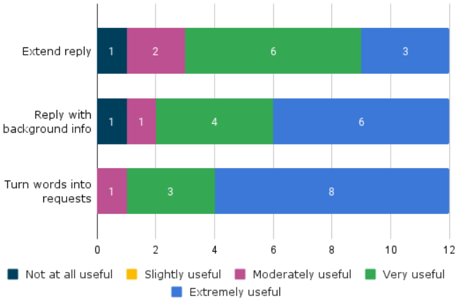
- Across the study, participants found the macros generally useful, with “Turn words into Requests” rated most often as extremely or very useful, followed by “Reply with Background Information” and then “Extend Reply.”
- Participants valued the potential to save time and effort; one participant said the extend-reply macro could help them “socialize and network more,” and another said it could reduce cognitive effort in figuring out what to say.
- The model sometimes produced plausible but inappropriate or inaccurate output: for example, with input “transfer” it suggested money-transfer phrases, and with “suction” it suggested unrelated content like “a suction cup that needs to go on the wall.”
- Participants wanted output to reflect their personal style and identity; they often described suggestions as too bland, impersonal, abrupt, or robotic, and some worried automated phrases could affect relationships or make them seem less authentic.
Methods
- The authors ran a remote user study with 12 adult expert AAC users in the United States, the United Kingdom, or Canada; participants used a variety of AAC access methods including eye gaze, switch scanning, direct selection, touch, mouse/joystick, keyboard, and toes.
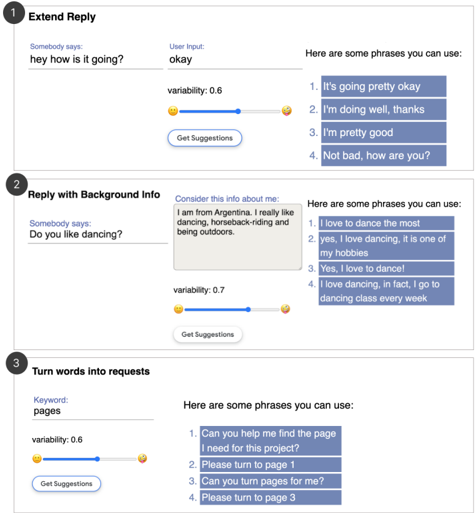
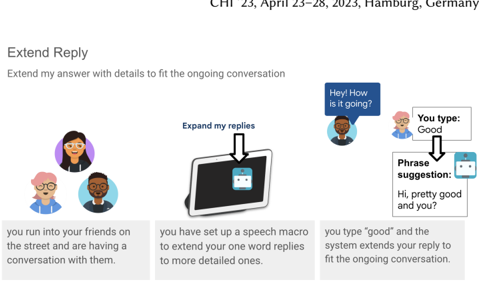
- Participants tested three speech macro prototypes built with LaMDA: Extend Reply, Reply with Background Information, and Turn Words into Requests.
- Data came from a 90-minute video call plus a post-study survey; recordings were transcribed, combined with chat logs and notes, and analyzed qualitatively using thematic analysis and affinity diagramming by two researchers.
Limitations
- The paper states that participants were limited to 5–10 inputs during the session, so feedback was based on a short, constrained exposure rather than extended use.
- The prototype used a generic dialog-based language model and did not customize speech macros with user-specific data; the paper says this means it does not provide a clear picture of how well current language models could perform for AAC suggestions.
- The study included participants with typical language skills and no aphasia, so this is an evident limitation in scope: the findings may not transfer to AAC users with language comprehension or production impairments.
Model-written summary. Check it against the paper before relying on it.
Integrity signals
Registry
Cites
Statistics
Figures
Verification
Claims the paper makes
5 Valid · 3 Not valid · 12 Not checked · 83 Own results and interpretations
The cited sources support only part of this claim — read each source’s verdict below.
In the paper
“Preliminary research with simulated user data has shown that LLMs can retrieve contextually relevant sentences [31]”
What the sources say
- Partly supportedcites [31] matched to “KWickChat: A Multi-Turn Dialogue System for AAC Using Context-Aware Sentence Generation by Bag-of-Keywords” (2022) sourceExperimental — accuracy not yet measured
Sections 7 and 8 evaluate a language model using a surrogate user and simulated conversational context, and report that context helps it produce better responses. But Section 3 distinguishes the paper’s GPT-2 sentence-generation model from sentence retrieval: the LLM generates sentences rather than retrieving them. Page numbers are not available in our copy. (LLM, conf=0.86)
plainstates a cause- Asserted: passes — The authors put it forward as true.
- Checkable: passes — It can be checked against evidence.
- Load-bearing: passes — The paper’s conclusions depend on it.
- Based: passes — The paper gives a reason why it holds.
- Partly supported
The cited sources support only part of this claim — read each source’s verdict below.
In the paper
“Current LLMs are able to generate text that is indistinguishable from text written by a human [8]”
What the sources say
- Partly supportedcites [8] [8] Elizabeth Clark, Tal August, Sofa Serrano, Nikita Haduong, Suchin Gururangan, and Noah A Smith. 2021. All That's 'Human' Is Not Gold: Evaluating Human Evaluation of Generated Text. In Proceedings of the 59th Annual Meeting of the Association for Computational Linguistics and the 11th International Joint Conference on Natural Language Processing (Volume 1: Long Papers) . Association for Computational Linguistics, Online, 7282-7296. - sourceExperimental — accuracy not yet measured
The Results (§2.4; page unavailable) report that untrained evaluators distinguished GPT-3 text from human-authored text at chance level across stories, news, and recipes. The claim generalizes this finding to current LLMs broadly: the same section reports that evaluators distinguished GPT-2 text from human-authored text significantly better than chance. (LLM, conf=0.88)
plain- Asserted: passes — The authors put it forward as true.
- Checkable: passes — It can be checked against evidence.
- Load-bearing: passes — The paper’s conclusions depend on it.
- Based: passes — The paper gives a reason why it holds.
- Partly supported
A result the paper reports from its own data — it cites no other source for it, so there is none to check. The quote shows it is in the paper.
In the paper
“Our study participants believed that AI-generated phrases could save time, physical and cognitive efort when communicating”
plain- Asserted: passes — The authors put it forward as true.
- Checkable: passes — It can be checked against evidence.
- Load-bearing: passes — The paper’s conclusions depend on it.
- Based: passes — The paper gives a reason why it holds.
A result the paper reports from its own data — it cites no other source for it, so there is none to check. The quote shows it is in the paper.
In the paper
“Many phrases were either considered as very appropriate or were phrases that were close to something the participant would say but that needed a little more editing to get it right.”
plain- Asserted: passes — The authors put it forward as true.
- Checkable: passes — It can be checked against evidence.
- Load-bearing: unclear — It is unclear whether the paper’s conclusions depend on it.
- Based: passes — The paper gives a reason why it holds.
A result the paper reports from its own data — it cites no other source for it, so there is none to check. The quote shows it is in the paper.
In the paper
“We found the system was not able to suggest relevant requests related to access or health needs.”
plainSingle case- Asserted: passes — The authors put it forward as true.
- Checkable: passes — It can be checked against evidence.
- Load-bearing: passes — The paper’s conclusions depend on it.
- Based: passes — The paper gives a reason why it holds.
35 more claims
Create a free account to see all 103 claims and to verify the 1 reference still open.
- Probably not a substantial claim. 47
- It may state two separate claims as one. 31
- The quote only partly states this claim. 2
Citations
Cites
Using thematic analysis in psychology
Braun, V., & Clarke, V. (2006) · Qualitative Research in Psychology · doi:10.1191/1478088706qp063oa · Cited by 194,414
BERT: Pre-training of Deep Bidirectional Transformers for Language Understanding
Devlin, J., Chang, M.-W., Lee, K., & Toutanova, K. (2019) · Proceedings of the 2019 Conference of the North American Chapter of the Association for Computational Linguistics: Human Language Technologies, Volume 1 (Long and Short Papers) · doi:10.18653/v1/n19-1423 · Cited by 54,325 · cited 1×
“Recently, advances in large, neural language models (LLMs) such as GPT-3 [6] and BERT [10] have created new opportunities for improving the usability and efciency of AAC devices.”
BackgroundQualitative Data Analysis: An Expanded Sourcebook
(1994) · Journal of Environmental Psychology · doi:10.1016/s0272-4944(05)80231-2 · Cited by 48,420
Language Models are Few-Shot Learners
Brown, T. B., Mann, B., Ryder, N., Subbiah, M., Kaplan, J., Dhariwal, P., Neelakantan, A., Shyam, P., Sastry, G., Askell, A., et al. (2020) · arXiv · doi:10.48550/arxiv.2005.14165 · Cited by 23,372
Computer-Mediated Communication: Impersonal, Interpersonal, and Hyperpersonal Interaction
WALTHER, J. B. (1996) · Communication Research · doi:10.1177/009365096023001001 · Cited by 4,798
LaMDA: Language Models for Dialog Applications
Thoppilan, R., De Freitas, D., Hall, J., Shazeer, N., Kulshreshtha, A., Cheng, H.-T., Jin, A., Bos, T., Baker, L., Du, Y., et al. (2022) · arXiv · doi:10.48550/arxiv.2201.08239 · Cited by 778 · cited 1×
“Informed by prior work that uncovered challenges in AAC-based social interactions [16, 20, 35], we created multiple prompts using the transformer-based large language model LaMDA developed for dialogue applications [32].”
MethodRe-examining Whether, Why, and How Human-AI Interaction Is Uniquely Difficult to Design
Yang, Q., Steinfeld, A., Rosé, C., & Zimmerman, J. (2020) · Proceedings of the 2020 CHI Conference on Human Factors in Computing Systems · doi:10.1145/3313831.3376301 · Cited by 622
Lee, C. P. (2007) · Computer Supported Cooperative Work (CSCW) · doi:10.1007/s10606-007-9044-5 · Cited by 413 · cited 1×
“…to communicating technology capabilities and limitations to users, designers, and technologists has been the use of boundary objects [40], representations of abstract ideas in the form of interactive prototypes or other artifacts that facilitate communication among diferent stakeholders [23].”
BackgroundOh, C., Song, J., Choi, J., Kim, S., Lee, S., & Suh, B. (2018) · Proceedings of the 2018 CHI Conference on Human Factors in Computing Systems · doi:10.1145/3173574.3174223 · Cited by 301 · cited 1×
“Other approaches have developed open-ended working prototypes to explore what tasks an AI system can and cannot do for specifc users [26, 28].”
BackgroundAll That’s ‘Human’ Is Not Gold: Evaluating Human Evaluation of Generated Text
Clark, E., August, T., Serrano, S., Haduong, N., Gururangan, S., & Smith, N. A. (2021) · Proceedings of the 59th Annual Meeting of the Association for Computational Linguistics and the 11th International Joint Conference on Natural Language Processing (Volume 1: Long Papers) · doi:10.18653/v1/2021.acl-long.565 · Cited by 290 · cited 1×
“Current LLMs are able to generate text that is indistinguishable from text written by a human [8], potentially enabling AAC users to generate human-level speech with minimal efort.”
Background
Research works printed but not linked: 6
- [5] Tom Brown, Benjamin Mann, Nick Ryder, Melanie Subbiah, Jared D Kaplan, Prafulla Dhariwal, Arvind Neelakantan, Pranav Shyam, Girish Sastry, Amanda Askell, et al. 2020. Language models are few-shot learners. Advances in neural information processing systems 33 (2020), 1877-1901. -
- 10.18653/v1 · DOI
- 10.18653/v1 · DOI
- [16] D Jefery Higginbotham and DP Wilkins. 1999. Slipping through the timestream: Social issues of time and timing in augmented interactions. Constructing (in) competence: Disabling evaluations in clinical and social interaction 2 (1999), 49-82. -
- 10.5555/2392855.2392859 · doi:10.5555/2392855.2392859
- [33] Ha Trinh, Annalu Waller, Keith Vertanen, Per Ola Kristensson, and Vicki L Hanson. 2012. Applying prediction techniques to phoneme-based AAC systems. In Proceedings of the Third Workshop on Speech and Language Processing for Assistive Technologies . 19-27. -
Cited by
Yildirim, N., Richardson, H., Wetscherek, M. T., Bajwa, J., Jacob, J., Pinnock, M. A., Harris, S., Coelho De Castro, D., Bannur, S., Hyland, S., et al. (2024) · Proceedings of the CHI Conference on Human Factors in Computing Systems · doi:10.1145/3613904.3642013 · Cited by 82
“Recent literature highlights prompt prototyping as a potential research direction for experience prototyping with LLMs and generative AI capabilities [63, 103, 131].”
"I look at it as the king of knowledge": How Blind People Use and Understand Generative AI Tools
Adnin, R., & Das, M. (2024) · The 26th International ACM SIGACCESS Conference on Computers and Accessibility · doi:10.1145/3663548.3675631 · Cited by 73
“…in their regular work practices, extending prior research that investigated disability representation and biases in GenAI [ 25, 29, 60] and potentials of GenAI to support access needs of people with neurodivergence [32, 46, 86] and other disabilities like chronic illness and aphantasia [30].”
BackgroundJang, J., Moharana, S., Carrington, P., & Begel, A. (2024) · Proceedings of the CHI Conference on Human Factors in Computing Systems · doi:10.1145/3613904.3642894 · Cited by 64
“Others have suggested its potential for supporting communication for people with disabilities, such as enhancing experiences for AAC users [87], writing AI-assisted emails for adults with dyslexia [28] and even speech-language pathologists in delivering therapy to autistic individuals in clinical…”
BackgroundTang, Y., Chen, L., Chen, Z., Chen, W., Cai, Y., Du, Y., Yang, F., & Sun, L. (2024) · CHI Conference on Human Factors in Computing Systems · doi:10.1145/3613904.3642899 · Cited by 101
“Valencia et al. [14] utilized the ability of LLMs to extract, expand, and generate information to support the specific communication needs of AAC users.”
BackgroundInfluentialPang, R. Y., Schroeder, H., Smith, K. S., Barocas, S., Xiao, Z., Tseng, E., & Bragg, D. (2025) · CHI Conference on Human Factors in Computing Systems · doi:10.1145/3706598.3713726 · Cited by 146
“We found diverse accessibility contexts, including the blind or low-vision (BLV) community [151, 180], people with autism [70], learning disabilities involving Augmentative and Alternative Communication (AAC) [156], andsituationalimpairments[106],aswellaspapers onolderadults[172].”
PANDALens: Towards AI-Assisted In-Context Writing on OHMD During Travels
Cai, R., Janaka, N., Chen, Y., Wang, L., Zhao, S., & Liu, C. (2024) · Proceedings of the CHI Conference on Human Factors in Computing Systems · doi:10.1145/3613904.3642320 · Cited by 36
“Similarly, although AI helps in post-processing, including editing [75, 88], a lack of proper user guidance can lead to misleading information [7, 38, 85] and templated output [49, 65, 84] that deviates from user expectations.”
Sketching AI Concepts with Capabilities and Examples: AI Innovation in the Intensive Care Unit
Yildirim, N., Zlotnikov, S., Sayar, D., Kahn, J. M., Bukowski, L. A., Amin, S. S., Riman, K. A., Davis, B. S., Minturn, J. S., King, A. J., et al. (2024) · CHI Conference on Human Factors in Computing Systems · doi:10.1145/3613904.3641896 · Cited by 55
“Few examples worth noting present case studies on envisioning and designing AI use cases in child welfare [112], fact-checking [80], law [27], and content moderation [50], and accessibility [84, 122].”
BackgroundFontana De Vargas, M., Yu, C., Shane, H. C., & Moffatt, K. (2024) · Proceedings of the CHI Conference on Human Factors in Computing Systems · doi:10.1145/3613904.3642080 · Cited by 30
“Notably, most participants in the Valencia et al. [51]’s work found that a prompt-based generation of sentences from single words to be "very or extremely useful", potentially helping them to create requests for routine, self-care and accessibility related tasks in a daily basis.”
BackgroundEveryday Uncertainty: How Blind People Use GenAI Tools for Information Access
Tang, X., Abdolrahmani, A., Gergle, D., & Piper, A. M. (2025) · Proceedings of the 2025 CHI Conference on Human Factors in Computing Systems · doi:10.1145/3706598.3713433 · Cited by 30
“…models (LLMs) and large multimodal models (LMMs), such as GPT-4 [3], emerging GenAI tools have led to a growing interest in making text, code, images, visual interfaces, audio, and videos more accessible to people with disabilities (PWD) 1 [44, 52, 134], particularly blind people [4, 27, 59, 83].”
Atcheson, A., Khan, O., Siemann, B., Jain, A., & Karahalios, K. (2025) · Proceedings of the 2025 CHI Conference on Human Factors in Computing Systems · doi:10.1145/3706598.3714121 · Cited by 22
“For users of augmentative and alternative communication (AAC) devices, using GenAI to generate text suggestions can save time, effort, and frustration when communicating by enabling more efficient construction of responses using prompts [114].”
Choi, D., Park, S., Lee, K., Hong, H., & Kim, Y. (2025) · CHI Conference on Human Factors in Computing Systems · doi:10.1145/3706598.3713792 · Cited by 47
“TalkBetter [58] monitors conversations between parents and language-delayed children, triggering alerts when parents show undesirable language habits, such as interrupting, speaking too quickly, or not waiting.”
COMPA: Using Conversation Context to Achieve Common Ground in AAC
Valencia, S., Huynh, J., Jiang, E. Y., Wu, Y., Wan, T., Zheng, Z., Admoni, H., Bigham, J. P., & Pavel, A. (2024) · CHI Conference on Human Factors in Computing Systems · doi:10.1145/3613904.3642762 · Cited by 36
Self-citationSupporting Text Entry in Virtual Reality with Large Language Models
Chen, L., Cai, Y., Wang, R., Ding, S., Tang, Y., Hansen, P., & Sun, L. (2024) · IEEE Conference on Virtual Reality and 3D User Interfaces (VR) · doi:10.1109/vr58804.2024.00073 · Cited by 24
“Addition-525 ally, LLMs have found applications in augmentative and alternative communication (AAC), utilizing conversation history, user profiles, and reduced user input with predefined options to generate daily communications for individuals with disabilities [57,66].”
BackgroundMethodUsing large language models to accelerate communication for eye gaze typing users with ALS
Cai, S., Venugopalan, S., Seaver, K., Xiao, X., Tomanek, K., Jalasutram, S., Morris, M. R., Kane, S. K., Narayanan, A., MacDonald, R. L., et al. (2024) · Nature Communications · doi:10.1038/s41467-024-53873-3 · Cited by 56
“The SpeakFaster UI is only one of many possible UI designs for supporting AAC text entry with LLMs 19,20 .”
Self-citationLight, J., Holyfield, C., McNaughton, D., Nieder, D., & Preece, J. (2025) · Augmentative and Alternative Communication · doi:10.1080/07434618.2025.2502032 · Cited by 22
“…(b) leverage Ai to integrate new literacy supports into AAc technologies by applying large language models to expand on AAc users’ keyword messages (valencia et al., 2023; Zastudil et al., 2024); applying models of emerging literacy to improve text prediction; and integrating speech input of…”
Breaking Badge: Augmenting Communication with Wearable AAC Smartbadges and Displays
Curtis, H., Lau, Y. H., & Neate, T. (2024) · CHI Conference on Human Factors in Computing Systems · doi:10.1145/3613904.3642327 · Cited by 27
“These fndings renew salient discussions concerning ethical AI-enhanced AAC features and design [47, 65, 81, 89, 93].”
BackgroundMethodInfluential"As an Autistic Person Myself:" The Bias Paradox Around Autism in LLMs
Park, S., Min, A., Beltran, J. A., & Hayes, G. R. (2025) · CHI Conference on Human Factors in Computing Systems · doi:10.1145/3706598.3713420 · Cited by 29
“They have been used in research involving people with speech and language disabilities [20, 56, 64], a group that includes many autistic 1 people.”
Influential40 Years of Eye Typing: Challenges, Gaps, and Emergent Strategies
Hamid, A., & Kristensson, P. O. (2024) · Proceedings of the ACM on Human-Computer Interaction · doi:10.1145/3655596 · Cited by 17
“These technologies may be able to improve entry rates and lower cognitive load and fatigue, but will also have a profound impact on the way users interact with AAC devices and their perceptions of autonomy and self-expression [96].”
BackgroundGriffiths, T., Slaughter, R., & Waller, A. (2024) · Journal of Enabling Technologies · doi:10.1108/jet-01-2024-0007 · Cited by 20
Generative AI applied to AAC for aphasia: a pilot study of Aphasia-GPT
Bailey, D. J., Herget, F., Hansen, D., Burton, F., Pitt, G., Harmon, T., & Wingate, D. (2026) · Aphasiology · doi:10.1080/02687038.2024.2445663 · Cited by 13
“The system with the greatest similarities is the one designed by Valencia et al. (2023).”
InfluentialBeyond Repairing with Electronic Speech: Towards Embodied Communication and Assistive Technology
Curtis, H., & Neate, T. (2024) · CHI Conference on Human Factors in Computing Systems · doi:10.1145/3613904.3642274 · Cited by 16
“Especially given the emergence in artifcial intelligence (AI) (e.g., [5, 29, 86]), videoconferencing (e.g., [61, 72]) and virtual reality (VR) (e.g., [44, 60, 94]) technologies for communities with disabilities.”
BackgroundEnhancing Communication Equity: Evaluation of an Automated Speech Recognition Application in Ghana
Ayoka, G., Barbareschi, G., Cave, R., & Holloway, C. (2024) · CHI Conference on Human Factors in Computing Systems · doi:10.1145/3613904.3641903 · Cited by 16
“…to record for people by simplifying or shortening the sentences for participants with more profound communication difficulties, as well as creating contextualised sentences that match the vocabulary of participants similarly to the the work done by the mother of P13 or the SLT of P20 [89].”
ResultSelf-citation“I'm treating it kind of like a diary”: Characterizing How Users with Disabilities Use AI Chatbots
Mullen, K., Xue, W., & Kudumu, M. (2024) · International ACM SIGACCESS Conference on Computers and Accessibility (ASSETS) · doi:10.1145/3663548.3688549 · Cited by 18
“One study by Valencia et al. [12] looked at how LLMs could be leveraged to decrease time and effort barriers for augmentative and alternative communication (AAC) users.”
AI-Driven Support for People with Speech & Language Difficulties
Dangol, A., Huang, Y., Setlur, S., Smolansky, A., Subramonyam, H., Suh, H., Xiong, J., & Kientz, J. A. (2024) · CHI Conference Extended Abstracts on Human Factors in Computing Systems (CHI EA) · doi:10.1145/3613905.3643984 · Cited by 14
“In the past, CHI has been a platform for hosting numerous papers around this very topic [5–7, 10, 22, 31].”
LaMPost: AI Writing Assistance for Adults with Dyslexia Using Large Language Models
Goodman, S. M., Buehler, E., Clary, P., Coenen, A., Donsbach, A., Horne, T. N., Lahav, M., MacDonald, R., Michaels, R. B., Narayanan, A., et al. (2024) · Communications of the ACM · doi:10.1145/3626952 · Cited by 20
“Since then, much has changed: our work has helped to guide subsequent literature (for example , Valencia et al. 21 ), open-ended LLM applications are now available to everyday users (for example , OpenAI’s ChatGPT, Google’s Bard), and LLMs themselves have advanced significantly (for example , GPT-4).”
InfluentialWhy So Serious? Exploring Timely Humorous Comments in AAC Through AI-Powered Interfaces
Weinberg, T. M., Kadoma, K., Penuela, R. E. G., Valencia, S., & Roumen, T. J. (2025) · CHI Conference on Human Factors in Computing Systems · doi:10.1145/3706598.3714102 · Cited by 22
“In building tools that impact agency, it is essential to prioritize empowering the user’s intentions while avoiding overreliance on purely automated content [59].”
InfluentialSelf-citationFuture of AAC technologies: priorities for inclusive innovation
Williams, K., & Holyfield, C. (2025) · Augmentative and Alternative Communication · doi:10.1080/07434618.2025.2513906 · Cited by 12
“Recent work in this area in AAc is promising (valencia et al., 2023).”
Alonzo, O., & Hassan, S. (2025) · International ACM SIGACCESS Conference on Computers and Accessibility (ASSETS) · doi:10.1145/3663547.3746355 · Cited by 15
AI and Accessibility: Breaking Barriers for People with Disabilities
Ferebee, S. S. (2025) · Premier Journal of Artificial Intelligence · doi:10.70389/pjai.100012 · Cited by 20
Birčanin, F., Sitbon, L., Hoogstrate, M., Abbas, A. K. A., Saffar, A. H., & Brereton, M. F. (2025) · CHI Conference on Human Factors in Computing Systems · doi:10.1145/3706598.3713117 · Cited by 12
SkiMR: Dwell-free Eye Typing in Mixed Reality
Hu, J., Dudley, J. J., & Kristensson, P. O. (2024) · IEEE Conference on Virtual Reality and 3D User Interfaces (VR) · doi:10.1109/vr58804.2024.00065 · Cited by 15
“As indicated in prior research [18,44], users tend to minimize their typing efforts when using eye typing.”
MethodLi, Y., Wang, H., Hossain, E., Mann, M., Yu, J., Newman, K. S., Bao, A., Willis, A. S., Kurumada, C., Hall, W. C., et al. (2025) · ACM International Conference on Interaction Design and Children (IDC) · doi:10.1145/3713043.3727054 · Cited by 6
Comuniqa: Exploring Large Language Models For Improving English Speaking Skills
Sharma, S., Mhasakar, M., Mehra, A., Venaik, U., Singhal, U., Kumar, D., & Mittal, K. C. (2024) · ACM SIGCAS/SIGCHI Conference on Computing and Sustainable Societies (COMPASS) · doi:10.1145/3674829.3675082 · Cited by 27
Zastudil, C., Holyfield, C., Kapp, C., Hamilton, K., Baru, K., Newsam, L., Smith, J. A., & MacNeil, S. (2025) · International ACM SIGACCESS Conference on Computers and Accessibility (ASSETS) · doi:10.1145/3663547.3746384 · Cited by 6
“…1: Reduce the barriers to configuring VSDs. VSDs are typically used by expert practitioners and researchers in a clinical context [85]; to use VSDs outside of this relatively narrow context, scaffolding the process of mapping relevant and developmentally appropriate vocabulary [44] needs to…”
Pinto, A., Quilter, E. E. V., Vasikaran, J., Koerner, S., Chimonas, T., Nielsen, E. E., Marshall, P., & O'Hara, K. P. (2025) · Australian Conference on Human-Computer Interaction (OzCHI) · doi:10.1145/3764687.3764713 · Cited by 9
Modeling Accessibility: Characterizing What We Mean by “Accessible”
Mack, K., Martinez, J. J., Lewis, A., Mankoff, J. C., Fogarty, J. A., Findlater, L., Evans, H., Bennett, C. L., & McDonnell, E. J. (2025) · International ACM SIGACCESS Conference on Computers and Accessibility (ASSETS) · doi:10.1145/3663547.3746344 · Cited by 15
“Juan’s team at work is sitting down to read a printed out document – he will be able to read it visually, but within the hour, he will be very dizzy and nauseous”
Generative AI and Accessibility Workshop: Surfacing Opportunities and Risks
Glazko, K. S., Huh, M., Johnson, J., Pavel, A., & Mankoff, J. C. (2025) · CHI Conference Extended Abstracts on Human Factors in Computing Systems (CHI EA) · doi:10.1145/3706599.3706734 · Cited by 9
“Some of the issues surfaced in these works include receiving inaccurate information from outputs [7, 12, 17], over-reliance and dependence [8, 22], opting for lower-quality results [31, 32, 37], harmful advice [30], or encountering bias and stereotypes [12].”
McNaughton, D., Rackensperger, T., & McLemore, L. (2025) · Augmentative and Alternative Communication · doi:10.1080/07434618.2025.2504497 · Cited by 8
“…(Ai) also may provide new supports to rapidly access the words and phrases that are important to an individual in a particular context. in valencia et al. (2023) the authors describe the exploratory use of Speech Macros : software tools that can provide easy access to contex-tually…”
HoloAAC: A Mixed Reality AAC Application for People with Expressive Language Difficulties
Yu, L., Feng, H., Alghofaili, R., Byun, B., O’Neal, T., Rampalli, S., Chung, Y., Motti, V. G., & Yu, L.-F. (2024) · Lecture notes in computer science · doi:10.1007/978-3-031-61047-9_20 · Cited by 7
“Furthermore, the seamless integration of large language models (LLMs) such as ChatGPT into our approach is promising as AI-generated phrases can potentially lessen physical and cognitive sentence creation efforts during communication [43].”
MethodDesign Probes for AI-Driven AAC: Addressing Complex Communication Needs in Aphasia
Mao, L., Lee, J. H., Faroqi‐Shah, Y., & Valencia, S. (2025) · Designing Interactive Systems Conference · doi:10.1145/3715336.3735736 · Cited by 7
“…further improve communication efficiency and autonomy, including using computer vision in AAC to identify objects and suggest phrases for ALS [39], generating symbolic boards from photos for autism [23], and integrating LLMs into AAC systems to create sentences from user-provided keywords [67].”
InfluentialSelf-citationOptimizing mentor-mentee matching: a framework for AI-MC as a UX approach in online learning
Wang, S.-M., Yaqin, M. A., & Phan, M. N. (2025) · Interactive Learning Environments · doi:10.1080/10494820.2025.2544199 · Cited by 6
“These prototypes act as “boundary objects” (Valencia et al., 2023), bridging communication gaps between users, designers, and technologists, ensuring a shared understanding of LLMs’ capabilities and limitations.”
Kladouchou, V., Makri, S., Frankowska-Takhari, S., Neate, T., MacFarlane, A., Wilson, S., & Roper, A. (2025) · CHI Conference on Human Factors in Computing Systems · doi:10.1145/3706598.3713808 · Cited by 11
Haroon, R., Wigdor, K., Yang, K., Toumanios, N., Crehan, E. T., & Dogar, F. R. (2025) · International ACM SIGACCESS Conference on Computers and Accessibility (ASSETS) · doi:10.1145/3663547.3746337 · Cited by 11
Johnson, J., Lewis, A., Mankoff, J. C., & Banner, O. (2026) · CHI Conference on Human Factors in Computing Systems · doi:10.1145/3772318.3790652 · Cited by 12
“…spans neurodiver-gent communities [16, 36, 45, 63, 84], d/Deaf and Hard-of-Hearing (DHH) individuals [17], blind and visually impaired (BVI) users [26, 44, 89], AAC users [25, 77, 91], people with intellectual or developmental disabilities [74], and disability communities more broadly [23, 32, 54].”
Large Language Models and Inclusivity in Bioethics Scholarship
Varma, S. (2023) · The American Journal of Bioethics · doi:10.1080/15265161.2023.2250286 · Cited by 4
Making my voice and owning its future
Preece, J., Sullivan, E., Tams-Gray, F., & Pullin, G. (2024) · Medical Humanities · doi:10.1136/medhum-2024-013021 · Cited by 8
“There is an intense focus on AI in AAC and some of the controversies its are beginning to be explored and debated (Valencia et al .”
Zeng, Y., Tang, Q., Chen, S., & Chen, X. (2023) · Asia-Pacific Journal of Oncology Nursing · doi:10.1016/j.apjon.2023.100344 · Cited by 5
“22 In conclusion, AAC technology is currently used in the language rehabilitation of patients with oncological aphasia.”
Reconstructing impaired language using generative AI for people with aphasia
Adikari, A., Alahakoon, D., Pallewela, N., Pierce, J. E., Hernandez, N. J., & Rose, M. L. (2025) · Scientific Reports · doi:10.1038/s41598-025-24725-x · Cited by 6
“Valencia et al. 20 investigated LLMs in augmentative and alternative communication (AAC) devices for individuals with communication challenges, largely anarthric speech (anarthria is a motor speech disorder whereby muscle weakness and/or incoordination impairs clear articulation or prevents…”
InfluentialLiu, Y., Shah, A., Ackerman, J., & Saha, M. (2025) · CHI Conference on Human Factors in Computing Systems · doi:10.1145/3706598.3714262 · Cited by 15
“We use jargon explanations as the first step towards investigating the space.”
The right to communicate and be heard. ASID’s position on Facilitated Communication
Bigby, C. (2025) · Research and Practice in Intellectual and Developmental Disabilities · doi:10.1080/23297018.2025.2550630 · Cited by 4
Taheri, A., Bhardwaj, P., Caetano, A., Zhong, A., & Sra, M. (2023) · ACM Symposium on User Interface Software and Technology (UIST) · doi:10.1145/3586182.3616680 · Cited by 5
“V-Buddy offers easy-to-select options, generated using a GPT-4 model inspired by Valencia et al.’s work [18], which showcased the utility of LLMs to expand short text snippets into longer output aiding augmentative and alternative communication (AAC) for non-verbal individuals.”
Method‘What I Think about When I Type about Talking’: Reflections on Text-Entry Acceleration Interfaces
Waller, A., Griffiths, T., & Kristensson, P. O. (2025) · Communications of the ACM · doi:10.1145/3703451 · Cited by 2
“Indeed, recent research in this area by Valencia and colleagues 29 demonstrated that, while users were broadly happy with the prediction and expansion candidates offered by an LLM, they expressed concern that the LLM output in isolation did not reflect their personal communication style,…”
Before the Technological Fix: Scoping AI and AAC for Social Futures
Ibrahim, S. B., Griffiths, T., Clarke, M., Judge, S., Slovák, P., Pullin, G., & Higginbotham, D. J. (2026) · CHI Conference Extended Abstracts on Human Factors in Computing Systems (CHI EA) · doi:10.1145/3772363.3798436 · Cited by 3
Hong, J., Rao, P., Wang, W., & Najafizadeh, L. (2026) · IEEE Transactions on Biomedical Engineering · doi:10.1109/tbme.2026.3693965 · Cited by 2
Predictive Anchoring: A Novel Interaction to Support Contextualized Suggestions for Grid Displays
Zastudil, C., Holyfield, C., Smith, J. A., Nguyen, H. V., & MacNeil, S. (2024) · International ACM SIGACCESS Conference on Computers and Accessibility (ASSETS) · doi:10.1145/3663548.3688501 · Cited by 4
“This process is typically done manually by a communication partner (e.g., a SLP), but it can also be done automatically by leveraging a combination of users’ context and machine learning algorithms [11, 12, 24, 40, 57, 58].”
BackgroundOne Does Not Simply ‘Mm-hmm’: Exploring Backchanneling in the AAC Micro-Culture
Weinberg, T. M., O’Connor, C., Penuela, R. E. G., Valencia, S., & Roumen, T. J. (2025) · International ACM SIGACCESS Conference on Computers and Accessibility (ASSETS) · doi:10.1145/3663547.3746381 · Cited by 8
“Expressivity in AAC is governed by these competing goals: agency vs timing, although in most cases AAC users will prioritize agency [66], Weinberg et al. [74] found that in time pressured scenarios, like making timely humorous comments in an ongoing conversation, this priority shift towards timing…”
InfluentialSelf-citationArtificial Intelligence in Communication Support Technologies for people with disabilities
González, N. V. Y., Londoño, J. D., & Pinzo, K. S. J. (2024) · Congreso Internacional de Innovación y Tendencias en Ingeniería (CONIITI) · doi:10.1109/coniiti64189.2024.10854792 · Cited by 2
“Furthermore, AI-based systems for non-standard voice recognition have revolutionized AAC technology by offering personalized and efficient communication solutions for individuals with severe speech impairments [22].”
Unraveling time in communicative interactions involving children who use aided communication
Batorowicz, B., Stadskleiv, K., Campbell, F. A., & von Tetzchner, S. (2025) · Augmentative and Alternative Communication · doi:10.1080/07434618.2025.2477701 · Cited by 2
“…et al., 2013; stadskleiv et al., 2014), communication partners characteristics and behaviors (e.g., ibrahim et al., 2024; Neuvonen et al., 2023; Valencia et al., 2023) or environmental factors (e.g., Finak et al., 2025). this study aimed to unpack the children’s time use during a…”
InfluentialA Stakeholder Value Framework for Augmentative and Alternative Communication
Zolyomi, A., Koushik, V., Asyet, D., & Huynh, L. H. (2025) · CHI Conference on Human Factors in Computing Systems · doi:10.1145/3706598.3713584 · Cited by 3
“Further research and understanding of how these values become supported or compromised by the design of AAC can enhance the quality of life and social inclusion for AAC stakeholders.”
Azzopardi, R. M., Xuereb, P. A., Agius, M. M., Schembri, S. B., & Seychell, D. (2025) · Lecture notes in computer science · doi:10.1007/978-3-031-93848-1_20 · Cited by 1
Zhou, S., Armstrong, M., Barbareschi, G., Ajioka, T., Hu, Z., Muto, M., Ando, R., Yoshifuji, K., & Minamizawa, K. (2025) · Augmented Humans International Conference (AHs) · doi:10.1145/3745900.3746089 · Cited by 6
“…interface modalities ranging from switches [30, 87], gaze-based input [8, 31], brain-machine interfaces [18, 66], and more recently generative AI models [20, 78], to accommodate different input capabilities and allow for independent communication without the need for an external assistant.”
Utilizing Ai to Support Conversations in Individuals With Asd
Esparragoza, J. M., Delgado, A. R., de la Cruz, B., & Valles, D. (2025) · IEEE Annual Ubiquitous Computing, Electronics & Mobile Communication Conference (UEMCON) · doi:10.1109/uemcon67449.2025.11267765 · Cited by 1
“The study results showed that AI-generated phrases can help reduce time, as well as physical and mental effort, during communication, but the participants reflect that the the AI content produced should reflect the user’s personal style and preference as well [16].”
Exploring the Usability of Gaze-based Mobile Communication in Ghana
Austin, V., Ayoka, G., Barbareschi, G., Cave, R., & Holloway, C. (2025) · International ACM SIGACCESS Conference on Computers and Accessibility (ASSETS) · doi:10.1145/3663547.3746395 · Cited by 1
“In recent years, the integration of artificial intelligence (AI) and machine learning is being utilized to improve communication rates for people using eye gaze - through more accurate gaze prediction and reduced latency [14, 68].”
Self-citationSPICA: Scalable and Personalized Conversational Agent Framework for AAC Users
Pal, S., Murali, N., Jadhav, A. V., Bizovi, J., Satchidanand, A., Golleru, M., Agarwal, S., Hutchinson, T. E., Higginbotham, D. J., & Srihari, R. K. (2026) · ACM International Conference on Intelligent User Interfaces (IUI) · doi:10.1145/3742413.3789116
Surveilling Suitability: How AI Hiring Interviews Impact Job Seekers with Disabilities
Kameswaran, V., Hong, V., Clark, J., Hou, Y., Daumé, H., & Shilton, K. (2026) · CHI Conference on Human Factors in Computing Systems · doi:10.1145/3772318.3791516 · Cited by 2
“Novel AI capabilities have also been leveraged to build new accessible tools that allow people with disabilities to accomplish previously impossible tasks or perform existing tasks more efficiently (e.g., [113, 144, 154]).”
Do-It-Yourself AAC: Co-Designing User-Programmable AI Communication Tools with People with Aphasia
Lee, J. H., & Valencia, S. (2026) · CHI Conference on Human Factors in Computing Systems · doi:10.1145/3772318.3790321 · Cited by 1
“AAC research also echos similar warnings, where large-language models can potentially save time on generating phrases but disregard users’ communication styles or intents [43].”
Self-citationAnnotateGPT: Designing Human–AI Collaboration in Pen-Based Document Annotation
Leung, B., Shimabukuro, M., & Collins, C. M. (2026) · CHI Conference on Human Factors in Computing Systems · doi:10.1145/3772318.3790867 · Cited by 2
A Scholar's Year in Review: Navigating the Convergence of AI, Economics, and Physics in 2023Preprint
Goldman, D. S. (2024) · doi:10.31219/osf.io/rbtpk
AI Role-Playing Assisted Children's Emotional Education: Serious Game “Emopals”
Yang, Y., & Guo, Y. (2025) · Lecture notes in computer science · doi:10.1007/978-3-031-93845-0_22
Azzopardi, R. M., Xuereb, P. A., Agius, M. M., Schembri, S. B., & Seychell, D. (2025) · Springer eBooks · doi:10.1007/978-3-032-01632-4_7
EyeChat: An Eye-Gaze-Controlled Web-Browsing System for Head-Mounted Augmented Reality Displays
Mirbagheri, M., & Chau, T. T. (2025) · IEEE Access · doi:10.1109/access.2025.3606899
“Studies have shown that prediction of the current word can improve text entry rates by more than 50% and reduce KSPC by up to 75% [14], [27], [28].”
Cauchois, N., Guerrier, Y., de Oliveira, K. M., & Kolski, C. (2025) · Lecture notes in computer science · doi:10.1007/978-3-032-04999-5_1 · Cited by 1
Nunes, M. F., Farinha, A. C., Bolaños, T. A., Gonçalves, F., Magalhães, B. M. B. D. S., Grover, P., & Silva, H. (2025) · medRxiv · doi:10.1101/2025.09.24.25336481
“The effort and time required to compose messages also leads to reduced participation, missed conversational turns, and difficulty keeping up with group discussions 42 .”
InfluentialDIY in Action: Understanding Do-It-Yourself Practices from Tangible Symbol Cards
Parent, A. S. W., Brady, L. B., Ivy, S. E., Hercman, J., & Hurst, A. K. (2025) · International ACM SIGACCESS Conference on Computers and Accessibility (ASSETS) · doi:10.1145/3663547.3759745
“Past work has explored digital and high-tech tools to support alternative augmentative communication (AAC) [6, 7, 9, 24, 31].”
Chavan, D. R., Moon, P., & Dixon, E. (2025) · International ACM SIGACCESS Conference on Computers and Accessibility (ASSETS) · doi:10.1145/3663547.3759720 · Cited by 1
“…Communication (AAC) devices as well as fear that AI-generated messages did not match their user’s tone, personality, or cultural identity [9], [29] Despite the essential nature of AAC devices for supporting communication and participation in social, educational, and community activities for…”
Fenech, P. A. M., & Vella, R. (2025) · Malta Journal of Education · doi:10.62695/gxsv5798
“Augmentative and alternative communication (AAC) technologies have emerged as vital tools for supporting students with complex communication needs; Valencia et al. (2023) emphasise AI-generated phrases’ potential to save time while ensuring alignment with users’ preferences.”
SocializeChat: A GPT-Based AAC Tool Grounded in Personal Memories to Support Social Communication
Xiang, W., Xu, Y., Fang, Y., Teng, Z., Jiang, Z., Hu, B., & Yang, J. (2025) · Conference proceedings/Conference proceedings - IEEE International Conference on Systems, Man, and Cybernetics · doi:10.1109/smc58881.2025.11342589
“User studies also have reported that the language generated by AI could make close partners feel insulted and damage the relationship [15].”
InfluentialMicro-Behavioral Analysis of Online Shopping Patterns for Blind Users
Prakash, Y., Nayak, A. K., Venkatraman, N., Jayarathna, S., Lee, H.-N., & Ashok, V. G. (2026) · Conference on Human Information Interaction and Retrieval · doi:10.1145/3786304.3788841 · Cited by 5
“This synergy offers a dual benefit: Users can swiftly navigate to the desired content, and the AI assistant can facilitate a more personalized interaction by understanding and adapting to individual user queries [54].”
Lee, J. H. (2026) · ACM SIGACCESS Accessibility and Computing · doi:10.1145/3803767.3803769
AI-Mediated Assistive Technologies for Effective ASL Interactions
Li, Y. (2026) · ACM SIGACCESS Accessibility and Computing · doi:10.1145/3803767.3803781
Liu, J., Shirvani, M. S., Hong, H., Kim, I.-J., & Yoon, D. (2026) · Proceedings of the ACM on Human-Computer Interaction · doi:10.1145/3788072 · Cited by 3
Pitt, K. M., Ousley, C. L., Gibbons, C., Martinez, E., Kirkpatrick, C. E., & Bubak, A. (2026) · American Journal of Speech-Language Pathology · doi:10.1044/2026_ajslp-25-00469
Personalizing Utterances Using the Big Five of SGD Users
Tsukaki, K., & Hirotomi, T. (2026) · Lecture notes in computer science · doi:10.1007/978-3-032-31285-3_57 · Cited by 1
Baugh, E., Pudi, V., Manz, N., Gramling, R. E., Eckenstein, M., Tandan, R., & Kolb, N. (2026) · doi:10.2196/preprints.107286
Generative AI as an Enabler of Inclusive and Personalized Learning in Special Education
Pandey, S. (2026) · Advances in computational intelligence and robotics book series · doi:10.4018/979-8-3373-9169-4.ch003
Gorenshtein, A., Omar, M., Jia, E., Adiniaev, Y., Daniel, O., Kruskal, J. B., Ahmed, M., Brook, O. R., Barash, Y., & Klang, E. (2026) · medRxiv · doi:10.64898/2026.08.20.26360941 · Cited by 1
Augmentative and Alternative Communication and Language: Some Old and New Urgent Issues
von Tetzchner, S., Smith, M., Soto, G., & Stadskleiv, K. (2026) · Current Developmental Disorders Reports · doi:10.1007/s40474-026-00363-4 · Cited by 2
Kherella, E., Shaughnessy, J., Belleza, F. A., & Xie, J. (2026) · Proceedings of the Human Factors and Ergonomics Society Annual Meeting · doi:10.1177/10711813261484496
Giraldo, M., & Sacchi, F. (2026) · Healthcare · doi:10.3390/healthcare14182900 · Cited by 3
Ability adaptive AAC: toward a modular, open-source framework
Katz, D., Zisman, A., Johnston, A., Bennasar, M., Muhammad, A., & Muftah, A. (2026) · Augmentative and Alternative Communication · doi:10.1080/07434618.2026.2716643
Metadata
- Authors
- Valencia, S., Cave, R., Kallarackal, K., Seaver, K., Terry, M., & Kane, S. K.
- Affiliations
- Google (United States) (US)
- University College London (GB)
- MGH Institute of Health Professions (US)
- Venue
- Proceedings of the 2023 CHI Conference on Human Factors in Computing Systems
- Publisher
- ACM
- Published
- 2023-04-19
- Pages
- 1-14
- OpenAlex
- W4366551359
- Cited by
- 97
- References
- 29
- Citations by year
- 2026: 25 · 2025: 43 · 2024: 26 · 2023: 3
- FWCI
- 66.89
- Type
- conference paper
- Language
- en
- Open access
- hybrid
- doi.org
- Licence
- Locations
- CHI Conference on Human Factors in Computing Systems (publishedVersion, cc-by)
- UCL Discovery (University College London) (submittedVersion, cc-by)
- Topics
- Health Sciences › Health Professions › Occupational Therapy › Assistive Technology in Communication and Mobility
- Physical Sciences › Computer Science › Human-Computer Interaction › Gaze Tracking and Assistive Technology
- Social Sciences › Human Factors and Ergonomics › Digital Accessibility for Disabilities
- Keywords
- augmentative and alternative communication, large language models, communication effort, user preferences, communication styles, real-time communication, assistive technology
About these checks
Registry, retraction, Cites and statistics results are computed, not judged, with one exception: a printed reference that no index lists is read once by a model before it counts as a citation error. Claims are extracted by a model and kept only when their quote appears verbatim in the text; each cited source is then checked, with a model’s help, for whether it says what the claim relies on. Those verdicts can be wrong — read the claim’s quote and the cited source before relying on one.
The claim verdicts this report counts are experimental: their accuracy is not yet measured.
A language model drew the claims from the paper on 2026-10-01, under version 3 of the claim definition (model deepseek-v4.1-flash, prompt extract-v3).
A second model labelled each claim on 2026-10-01 (model jev-1.13-20260917, definition revision gold-guideline-v0.2).
Cited sources are checked with a language model’s help (gpt-6-sol).
Statistics and arithmetic are recomputed, not judged.
Confidence bands are shown only for fields calibrated on our annotated test set. None is calibrated yet, so no band is shown.
What counts as a claim ›How we measure confidence ›How we check this ›
Are you an author, or do you see a problem with this page? Request a review
Data sources
Bibliographic data: Semantic Scholar, OpenAlex, Crossref.
Contains information from the Semantic Scholar Academic Graph Datasets, made available under the ODC Attribution License (ODC-BY 1.0).
Semantic Scholar’s data is described in: Kinney, R., et al. (2023). The Semantic Scholar Open Data Platform. arXiv:2301.10140.
