

AdaCAD: Parametric Design as a New Form of Notation for Complex Weaving
Open accessThe DOI matches its Crossref record; 50 of the 50 references it cites were found in a registry or an index; none of the 30 sources its claims cite is checked for support yet.
Abstract
Woven textiles are increasingly a medium through which HCI is inventing new technologies. Key challenges in integrating woven textiles in HCI include the high level of textile knowledge required to make effective use of the new possibilities they afford and the need for tools that bridge the concerns of textile designers and concerns of HCI researchers. This paper presents AdaCAD, a parametric design tool for designing woven textile structures. Through our design and evaluation of AdaCAD we found that parametric design helps weavers notate and explain the logics behind the complex structures they generate. We discuss these finding in relation to prior work in integrating craft and/or weaving in HCI, histories of woven notation, and boundary object theory to illuminate further possibilities for collaboration between craftspeople and HCI practitioners.
Overview
CoChat Summary
TL;DR
AdaCAD is an open-source parametric design tool for complex weaving, developed through first-person research and collaboration with three expert weavers. The study argues that parametric design can serve as a notation for weaving processes and rationales, helping weavers document, modify, and communicate complex structures.
Key findings
- The paper’s central finding is that AdaCAD’s parametric workflow functioned as a notational system for describing the processes and rationales by which woven structures emerge, aiding both design and communication.
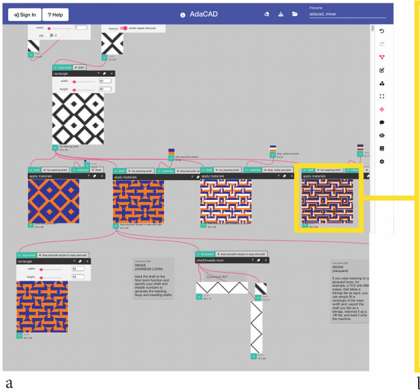
- Collaborations with three weavers generated specific features: Kathryn Walters (7 months, 5 meetings) led to the layer notation operation and support for multiple orientation points; Etta Sandry (6 months, 4 meetings) led to a variable width sampler operation and support for direct tieup looms; Marianne Fairbanks (4 months, 4 meetings) led to the all possible structures operation.
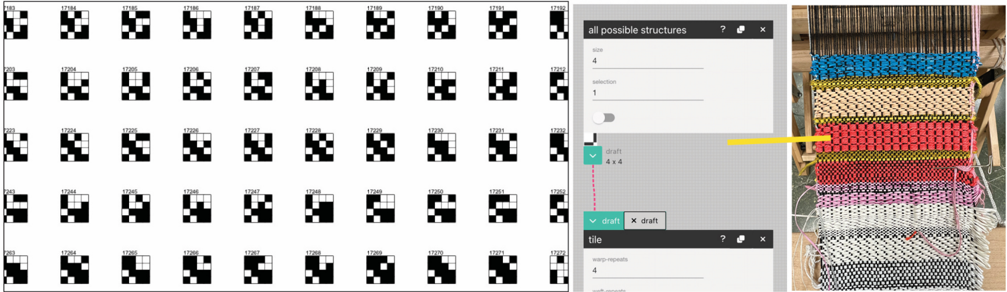
- The all possible structures operation revealed 102 possible 3x3 structures and 22,874 possible 4x4 structures, though some are rotations, reflections, or shifts of others.
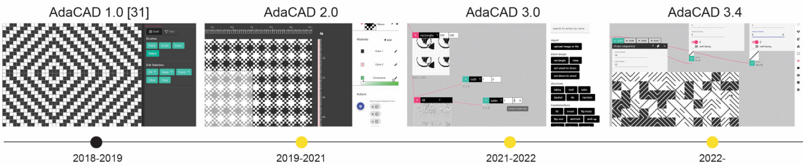
- Weavers found the parametric approach unfamiliar and sometimes disorienting but productive: Marianne described it as “disorienting” and “ground up”; Kathryn said AdaCAD made tacit algorithms explicit and produced a “brain on a page”; Etta found the blank workspace intimidating and requiring play and practice. At the time of writing, AdaCAD had 55 operations; site tracking showed 221 loads by 87 unique users in the 30 days prior to September 14, 2022, and an introductory YouTube video had 237 views.
Methods
- The project used first-person research plus collaboration with three expert weavers; Devendorf developed AdaCAD for her own complex weaving practice, presented it through public talks, YouTube videos, Zoom calls, and a documentation site, then worked with interested weavers.
- The three collaborators were recruited opportunistically: Kathryn Walters, Etta Sandry, and Marianne Fairbanks. Meetings were unstructured, lasted 60–90 minutes, occurred roughly monthly, and were recorded and transcribed; collaboration durations ranged from seven months/five meetings to four months/four meetings.
- Analysis used open-coding of interviews and transcripts through a structured analytical framework aligned with Verbeek’s theory of technological mediation; Devendorf made software updates between meetings in response to discussions.
Limitations
- Stated: the small group of collaborations could not be representative of all possible approaches; there was no systematic method for logging informal first-person experiences; collaborators were not paid except one artist-in-residence, and the authors note possible bias from Devendorf offering software development or employment, though they attempted to mitigate this and cannot speak to the effects of those assurances.
- Stated: first-person design implicitly privileged the first-person’s equipment, resources, and personal “alchemy,” as revealed by Etta’s direct-tie loom needs and Kathryn’s different draft orientation; some features remained future work.
- Evident from the text: the evaluation is qualitative and based on three expert/complex weavers, with no controlled comparison or broad user study; usage evidence is limited to site loads and video views, and the authors note they cannot describe every operation due to space.
Model-written summary. Check it against the paper before relying on it.
Integrity signals
Registry
Cites
Statistics
Figures
Verification
Claims the paper makes
0 Valid · 5 Not valid · 25 Not checked · 112 Own results and interpretations
A result the paper reports from its own data — it cites no other source for it, so there is none to check. The quote shows it is in the paper.
In the paper
“This emerged most notably with Etta, who found that AdaCAD did not support the drafting style for the loom she most commonly used, a direct-tie loom.”
§ AdaCAD: Parametric Design as a New Form of Notation for Complex Weaving > 4.1 The Alchemy of Weavers
plainSingle case- Asserted: passes — The authors put it forward as true.
- Checkable: passes — It can be checked against evidence.
- Load-bearing: unclear — It is unclear whether the paper’s conclusions depend on it.
- Based: passes — The paper gives a reason why it holds.
- Rests on an assumption not shown here.
A result the paper reports from its own data — it cites no other source for it, so there is none to check. The quote shows it is in the paper.
In the paper
“Our parametric approach to woven design was seen as novel, came most naturally to weavers with a particularly algorithmic approach to complex structure design, and required some conceptual labor for our collaborators to use effectively.”
§ AdaCAD: Parametric Design as a New Form of Notation for Complex Weaving > 1 INTRODUCTION
plain- Asserted: passes — The authors put it forward as true.
- Checkable: passes — It can be checked against evidence.
- Load-bearing: passes — The paper’s conclusions depend on it.
- Based: passes — The paper gives a reason why it holds.
A result the paper states — it cites no source for it, so there is none to check. The quote shows it is in the paper.
In the paper
“AdaCAD evolved alongside these projects, particularly looking to fill areas that were missing or difficult for us to access in the existing suite of accessible complex weaving tools.”
§ AdaCAD: Parametric Design as a New Form of Notation for Complex Weaving > 3.3.1 Phase 1: First-Person Design and Use.
plainstates a cause- Asserted: passes — The authors put it forward as true.
- Checkable: passes — It can be checked against evidence.
- Load-bearing: passes — The paper’s conclusions depend on it.
- Based: passes — The paper gives a reason why it holds.
A result the paper reports from its own data — it cites no other source for it, so there is none to check. The quote shows it is in the paper.
In the paper
“AdaCAD opened up new ideas of possibility and inspiration to weavers, mostly in terms of adding complexity or otherwise computational modes of exploration into their process.”
§ AdaCAD: Parametric Design as a New Form of Notation for Complex Weaving > 4.2 Opening New Spaces for Experimentation
plainstates a cause- Asserted: passes — The authors put it forward as true.
- Checkable: passes — It can be checked against evidence.
- Load-bearing: passes — The paper’s conclusions depend on it.
- Based: passes — The paper gives a reason why it holds.
A result the paper reports from its own data — it cites no other source for it, so there is none to check. The quote shows it is in the paper.
In the paper
“Our parametric approach to woven design was seen as novel, came most naturally to weavers with a particularly algorithmic approach to complex structure design, and required some conceptual labor for our collaborators to use effectively.”
§ AdaCAD: Parametric Design as a New Form of Notation for Complex Weaving > 1 INTRODUCTION
plainstates an association- Asserted: passes — The authors put it forward as true.
- Checkable: passes — It can be checked against evidence.
- Load-bearing: unclear — It is unclear whether the paper’s conclusions depend on it.
- Based: passes — The paper gives a reason why it holds.
26 more claims
Create a free account to see all 142 claims and every source verdict.
- Probably not a substantial claim. 86
- It may state two separate claims as one. 53
Self-check
Percentages, sums and reported differences re-computed from the paper’s own numbers.
Each contradiction between two passages listed here was confirmed by an independent check.
Rated minor: it would not touch a result — a value no result rests on, a p-value that stays on the same side of the significance level, or a conflict that is clerical, resolved elsewhere in the paper, or outside its own findings.
In the paper
§ AdaCAD: Parametric Design as a New Form of Notation for Complex Weaving > 2.2 Textile Design Tools
“Our original publication of AdaCAD in 2019 exists within this space by presenting designers with multiple linked views of their design: one emphasizing woven structure and the other emphasizing the path of electronics through the cloth [35].”
§ AdaCAD: Parametric Design as a New Form of Notation for Complex Weaving > References
“35. Ellen Harlizius-Klück. 2017. Weaving as Binary Art and the Al- gebra of Patterns.”
Citations
Cites
Star, S. L., & Griesemer, J. R. (1989) · Social Studies of Science · doi:10.1177/030631289019003001 · Cited by 10,847
Making: Anthropology, Archaeology, Art and Architecture
Ingold, T. (2013) · doi:10.4324/9780203559055 · Cited by 2,085
Moralizing Technology: Understanding and Designing the Morality of Things
Verbeek, P.-P. (2011) · doi:10.7208/chicago/9780226852904.001.0001 · Cited by 923
Making by making strange: Defamiliarization and the design of domestic technologies
Bell, G., Blythe, M., & Sengers, P. (2005) · ACM Transactions on Computer-Human Interaction · doi:10.1145/1067860.1067862 · Cited by 479
The computer boys take over: computers, programmers, and the politics of technical expertise
(2011) · Choice Reviews Online · doi:10.5860/choice.48-3324 · Cited by 321
Autobiographical design in HCI research: designing and learning through use-it-yourself
Neustaedter, C., & Sengers, P. (2012) · Proceedings of the Designing Interactive Systems Conference · doi:10.1145/2317956.2318034 · Cited by 302
Things We Could Design: For More Than Human-Centered Worlds
Wakkary, R. (2021) · The MIT Press eBooks · doi:10.7551/mitpress/13649.001.0001 · Cited by 247
Devendorf, L., Lo, J., Howell, N., Lee, J. L., Gong, N.-W., Karagozler, M. E., Fukuhara, S., Poupyrev, I., Paulos, E., & Ryokai, K. (2016) · Proceedings of the 2016 CHI Conference on Human Factors in Computing Systems · doi:10.1145/2858036.2858192 · Cited by 235
Self-citationAutomatic Machine Knitting of 3D Meshes
Narayanan, V., Albaugh, L., Hodgins, J. K., Coros, S., & McCann, J. (2018) · ACM Transactions on Graphics · doi:10.1145/3186265 · Cited by 171
Revealing Tensions in Autobiographical Design in HCI
Desjardins, A., & Ball, A. (2018) · Proceedings of the 2018 Designing Interactive Systems Conference · doi:10.1145/3196709.3196781 · Cited by 152
Research works printed but not linked: 5
- Julie Holyoke. 2021. Digital Jacquard Design. Bloomsbury Visual Arts.
- Alex McLean. 2022. Laura Devendorf: Weaving Algorithmic Patterns with Ada- CAD. https://algorithmicpattern.org/events/laura-devendorf/
- G. H. Oelsner. 2016. A Handbook of Weaves. Forgotten Books, Place of publication not identified.
- Virginia Postrel. 2021. Fabric of Civilization. Basic Books, New York.
- Alice Schlein and Bhakti Ziek. 2006. The Woven Pixel: Designing for Jacquard and Dobby Looms Using Photoshop®. Bridgewater Press. Google-Books-ID: svK3PAAACAAJ.
Cited by
Vasquez, E. S. L., Alistar, M., Devendorf, L., & Rivera, M. L. (2024) · CHI Conference on Human Factors in Computing Systems · doi:10.1145/3613904.3642387 · Cited by 45
Self-citationWeaving Textile-form Interfaces: A Material-Driven Design Journey
Buso, A., McQuillan, H., Voorwinden, M., & Karana, E. (2023) · Designing Interactive Systems Conference · doi:10.1145/3563657.3596086 · Cited by 32
Design Bookkeeping: Making Practice Intelligible through a Managerial Lens
Meiklejohn, E., Devendorf, L., & Posch, I. (2024) · Designing Interactive Systems Conference · doi:10.1145/3643834.3660754 · Cited by 24
Self-citationTwigg-Smith, H., Whiting, E., & Peek, N. (2024) · CHI Conference on Human Factors in Computing Systems · doi:10.1145/3613904.3642799 · Cited by 24
Opportunities with Multi-Layer Weave Structures in Woven E-Textile Design
Pouta, E. A. M., Mikkonen, J. V., & Salovaara, A. (2024) · ACM Transactions on Computer-Human Interaction · doi:10.1145/3689039 · Cited by 20
Animated Linen: Using High-twist Hygromorphic Yarn to Produce Interactive Woven Textiles
Walters, K., Devendorf, L., & Landahl, K. (2024) · Designing Interactive Systems Conference · doi:10.1145/3643834.3662146 · Cited by 20
Self-citationLoom Pedals: Retooling Jacquard Weaving for Improvisational Design Workflows
Wu, S., Corr, X. A., Gao, X., de Koninck, S., Bowers, R., & Devendorf, L. (2024) · International Conference on Tangible, Embedded, and Embodied Interaction (TEI) · doi:10.1145/3623509.3633358 · Cited by 19
Self-citationJohn, K., Li, Y., & Seifi, H. (2024) · CHI Conference on Human Factors in Computing Systems · doi:10.1145/3613904.3642090 · Cited by 18
Navigating the Posthuman Turn in Computing and Design: A Posthuman Vocabulary
Dedeoğlu, Ç., & Chandra, P. (2025) · ACM SIGCAS/SIGCHI Conference on Computing and Sustainable Societies (COMPASS) · doi:10.1145/3715335.3735487 · Cited by 18
texTENG: Fabricating Wearable Textile-Based Triboelectric Nanogenerators
Batra, R., Pourjafarian, N., Chang, S. F., Tsai, M., Revelo, J., & Kao, H.-L. (2025) · Augmented Humans International Conference (AHs) · doi:10.1145/3745900.3746071 · Cited by 15
What's in a cable? Abstracting Knitting Design Elements with Blended Raster/Vector Primitives
Twigg-Smith, H., Peng, Y., Whiting, E., & Peek, N. (2024) · ACM Symposium on User Interface Software and Technology (UIST) · doi:10.1145/3654777.3676351 · Cited by 14
Awad, A., Ibrahim, S., & Nabil, S. (2025) · Designing Interactive Systems Conference · doi:10.1145/3715336.3735696 · Cited by 13
Jones, L., Stewart, M., Shereck, S. A., Lintag, J., Doherty, D., Bucchino, B., & Nabil, S. (2025) · International Conference on Tangible, Embedded, and Embodied Interaction (TEI) · doi:10.1145/3689050.3704957 · Cited by 12
A Design Space for Animated Textile-forms through Shuttle Weaving: A Case of 3D Woven Trousers
Voorwinden, M., Buso, A., Karana, E., & McQuillan, H. (2025) · Designing Interactive Systems Conference · doi:10.1145/3715336.3735741 · Cited by 12
Lovato, M. S., Suina, J., Tso, J., Kaminsky, A., Friedman-Gerlicz, C., & Buechley, L. (2025) · CHI Conference on Human Factors in Computing Systems · doi:10.1145/3706598.3713159 · Cited by 9
Knitting with unknown trees: assembling a more-than-human practice
Oogjes, D., Kökel, E., Ofer, N., Kuo, H.-L., Vugts, J., Nachtigall, T. R., & Hopkins, T. (2025) · Designing Interactive Systems Conference · doi:10.1145/3715336.3735431 · Cited by 8
Weaving Augmented Reality Markers
P., N. M. K., Vasquez, E. S. L., Curran, H., de Koninck, S., & Devendorf, L. (2023) · ACM International Joint Conference on Pervasive and Ubiquitous Computing (UbiComp) · doi:10.1145/3594739.3610786 · Cited by 7
Self-citationWoven Textile-Form Design: A Method to Design Woven 3D Form
Voorwinden, M., & McQuillan, H. (2025) · Journal of Textile Design Research and Practice · doi:10.1080/20511787.2025.2567765 · Cited by 6
QUILT: Supporting Modular Design of Machine-Knitting Programs
Hester, J., Law, S., & Hofmann, M. K. (2025) · ACM Symposium on User Interface Software and Technology (UIST) · doi:10.1145/3746059.3747608 · Cited by 5
Making Design Tools Like a Weaver: Four Rules
Devendorf, L., Wu, S., & Friske, M. (2023) · XRDS Crossroads The ACM Magazine for Students · doi:10.1145/3596929 · Cited by 5
Self-citationCao, H. (2024) · Applied and Computational Engineering · doi:10.54254/2755-2721/98/20241127 · Cited by 5
He, G., & Gao, S. (2025) · Textile & Leather Review · doi:10.31881/tlr.2025.027 · Cited by 4
Ueda, K. (2026) · Arts · doi:10.3390/arts15020034 · Cited by 3
Ibrahim, S., Khorsandi, P. M., Pier, J., Sultan, J., & Nabil, S. (2026) · CHI Conference on Human Factors in Computing Systems · doi:10.1145/3772318.3790342 · Cited by 3
Warped Tour: Analyzing Design Tools Support for Multilayer Weaving Production in HCI
Frost, D., & Jacobs, J. (2026) · Designing Interactive Systems Conference · doi:10.1145/3800645.3812988 · Cited by 2
A Critique of Craftsmanship in Computational Design Practices
Baron, A. M. (2025) · Journal of Computational Design · doi:10.53710/jcode.1505120 · Cited by 1
Knotation: Supporting Exploration in Macrame Textile Crafting Through Parametric Motif Design
Lu, Y., Höllerer, T., & Jacobs, J. (2024) · IEEE Symposium on Visual Languages and Human-Centric Computing (VL/HCC) · doi:10.1109/vl/hcc60511.2024.00042 · Cited by 1
skCAD: A Design Tool for Solid Knitting with Automatic Pattern Generation
Hirose, Y., Larsson, M., & Igarashi, T. (2026) · CHI Conference on Human Factors in Computing Systems · doi:10.1145/3772318.3791148 · Cited by 1
Reweaving Nishijin: Parametric Design System to Shape the Future of Kyoto Traditional Textiles
Kizuka, A., Ueda, K., Horikawa, J., & Roth, B. (2025) · CHI Conference Extended Abstracts on Human Factors in Computing Systems (CHI EA) · doi:10.1145/3706599.3721170 · Cited by 1
Computational Tailor-Making for Personalized, Shape-changing, and Sustainable Fabrics
Narumi, K., Hirose, Y., Lee, H., Larsson, M., He, L., Leake, M., Forman, J., Farahi, B., Yao, L., & Igarashi, T. (2025) · ACM Symposium on User Interface Software and Technology (UIST) · doi:10.1145/3746058.3758470 · Cited by 1
From Piping to Printing: An Action-Based Approach to Computational Food Fabrication
Luo, D., Ingram, W. F., & Danielescu, A. (2026) · International Conference on Tangible, Embedded, and Embodied Interaction (TEI) · doi:10.1145/3731459.3773322 · Cited by 1
Weaving and Disguising Infrared Markers toward Invisible Textile Interaction
Sugiyama, H., Lee, H., Fujino, H., Kuwana, M., Dogan, M. D., He, L., & Narumi, K. (2026) · CHI Conference Extended Abstracts on Human Factors in Computing Systems (CHI EA) · doi:10.1145/3772363.3799013 · Cited by 1
Ibrahim, S., Khorsandi, P. M., Pier, J., Sultan, J., & Nabil, S. (2026) · CHI Conference Extended Abstracts on Human Factors in Computing Systems (CHI EA) · doi:10.1145/3772363.3799138 · Cited by 1
Designing a toolkit to explore the Design Space of Woven Textiles
Voorwinden, M., Klop, S., & McQuillan, H. (2026) · Proceedings of DRS · doi:10.21606/drs.2026.1440 · Cited by 1
InvisIto: Weaving Unobtrusive Infrared Markers for Ubiquitous Textile Interaction
Lee, H., Sugiyama, H., Min, T., Fujino, H., Kuwana, M., Sugiura, Y., Dogan, M. D., He, L., & Narumi, K. (2026) · ACM Symposium on User Interface Software and Technology (UIST) · doi:10.1145/3830398.3830562 · Cited by 1
Gelosi, D., & Devendorf, L. (2026) · Textile Intersections 2026 · doi:10.21606/ti-2026.166
Self-citationImagining Open-Source Ecosystems for Experimental Weaving: A View from the AdaCAD Project
Devendorf, L., Gelosi, D., & Sandry, E. (2026) · Textile Intersections 2026 · doi:10.21606/ti-2026.127
Self-citationHandmade Digital Jacquard: Weaving New Ideas on Low-Cost Computational Looms
Gielen, A., Soler, J. C., Deivekis, A. S., Andersen, K., Feijs, L. M. G., & Nachtigall, T. R. (2026) · Designing Interactive Systems Conference · doi:10.1145/3800645.3812820
Spectrospira: A Case of Designing and Displaying a Cyanobacteria Photobioreactor
Bell, F., & Polli, A. (2026) · Designing Interactive Systems Conference · doi:10.1145/3800645.3812785
Beadle: Exploring, Perceiving, and Redesigning Thermoplastic Materiads using Fuse Beads
Gardner, M. J., Rakib, M. A. N., & Torres, C. (2026) · Creativity and Cognition · doi:10.1145/3803784.3807542
Creativity-Expansive Tooling: Design-Led Approaches to Algorithmic Design for Fabrication
Gelosi, D. (2026) · CHI Conference Extended Abstracts on Human Factors in Computing Systems (CHI EA) · doi:10.1145/3772363.3799189
CapSenseBand: Sustaining Cross-Disciplinary Creativity When Stitches Must Meet Signals
Xing, S. P., Hu, H., Wei, L., Le, F. A. N. G., Bai, Z., Jiang, S., & Wang, S. J. (2026) · Creativity and Cognition · doi:10.1145/3803784.3816847
Computational Tools for Modular Design and Debugging in Machine Knitting
Hester, J. A. (2026) · ACM Symposium on User Interface Software and Technology (UIST) · doi:10.1145/3830397.3841700
LOOMING between shaft looms and a TC2 Jacquard Loom - A Serendipitous Expedition with Live Weaving
Lin, P., McLean, A., Milne, H., Vorselen, F., & Andersen, K. (2026) · Textile Intersections · doi:10.21606/ti-2026.113
Experimental Weaving at the Unstable Design Lab
Devendorf, L., Gelosi, D., Frost, S., Vasquez, E. S. L., Sandry, E. W., Gabriel, L. M., Friske, M., de Koninck, S., & Wu, S. (2025) · CHI Conference Extended Abstracts on Human Factors in Computing Systems (CHI EA) · doi:10.1145/3706599.3721164
Self-citationTang, Y., Xu, C., Xue, Y., & Han, Z. (2026) · Textile & Leather Review · doi:10.31881/tlr.2026.4653
Weaving as media technology: images, objects, and embodied knowledge
Kim, J.-A. (2026) · QSpace (Queen's University Library)
AquaWeave: Weaving Liquid-Activated Morphing Bio-Textiles
Zhu, J., Zhu, K., Fan, E. L., Wu, M., Chang, S., & Kao, H.-L. (2026) · ACM Symposium on User Interface Software and Technology (UIST) · doi:10.1145/3830398.3830607
Conversing Through Thread: Reciprocal Weaving Between Beginner Weavers in InTwine
Indriani, I., Kato, A., & Yamaoka, J. (2026) · doi:10.1145/3829215.3843687
Metadata
- Authors
- Devendorf, L., Walters, K., Fairbanks, M., Sandry, E., & Goodwill, E. R.
- Affiliations
- University of Colorado Boulder (US)
- University of Borås (SE)
- University of Wisconsin–Madison (US)
- Concordia University (CA)
- Venue
- Proceedings of the 2023 CHI Conference on Human Factors in Computing Systems
- Publisher
- ACM
- Published
- 2023-04-19
- Pages
- 1-18
- OpenAlex
- W4366549598
- Semantic Scholar
- 839c2e8624be3b00db88b599656aa278b0a046b6
- Cited by
- 48
- References
- 49
- Citations by year
- 2026: 22 · 2025: 14 · 2024: 9 · 2023: 3
- FWCI
- 7.57
- Type
- conference paper
- Language
- en
- Open access
- hybrid
- doi.org
- Licence
- Locations
- CHI Conference on Human Factors in Computing Systems (publishedVersion, cc-by-nd)
- DiVA - University of Borås (Högskolan i Borås) (submittedVersion, other-oa)
- Funders
- National Science Foundation (1943109)
- Topics
- Physical Sciences › Computer Science › Human-Computer Interaction › Innovative Human-Technology Interaction
- Social Sciences › Arts and Humanities › Museology › Crafts, Textile, and Design
- Social Sciences › Arts and Humanities › Visual Arts and Performing Arts › Art, Technology, and Culture
- Keywords
- parametric design, woven fabrics, weaving
About these checks
Registry, retraction, Cites and statistics results are computed, not judged, with one exception: a printed reference that no index lists is read once by a model before it counts as a citation error. Claims are extracted by a model and kept only when their quote appears verbatim in the text; each cited source is then checked, with a model’s help, for whether it says what the claim relies on. Those verdicts can be wrong — read the claim’s quote and the cited source before relying on one.
A language model drew the claims from the paper on 2026-11-21, under version 3 of the claim definition (model deepseek-v4.1-flash, prompt extract-v3).
A second model labelled each claim on 2026-11-21 (model jev-1.13-20260917, definition revision gold-guideline-v0.2).
Statistics and arithmetic are recomputed, not judged.
Confidence bands are shown only for fields calibrated on our annotated test set. None is calibrated yet, so no band is shown.
What counts as a claim ›How we measure confidence ›How we check this ›
Are you an author, or do you see a problem with this page? Request a review
Data sources
Bibliographic data: Semantic Scholar, OpenAlex, Crossref.
Contains information from the Semantic Scholar Academic Graph Datasets, made available under the ODC Attribution License (ODC-BY 1.0).
Semantic Scholar’s data is described in: Kinney, R., et al. (2023). The Semantic Scholar Open Data Platform. arXiv:2301.10140.
