

The DOI matches its Crossref record; 52 of the 52 references it cites were found in a registry or an index; 14 of the 27 sources its claims cite were checked for support.
Detecting Automatic Software Plagiarism via Token Sequence Normalization
Open accessAbstract
While software plagiarism detectors have been used for decades, the assumption that evading detection requires programming proficiency is challenged by the emergence of automated plagiarism generators. These generators enable effortless obfuscation attacks, exploiting vulnerabilities in existing detectors by inserting statements to disrupt the matching of related programs. Thus, we present a novel, language-independent defense mechanism that leverages program dependence graphs, rendering such attacks infeasible. We evaluate our approach with multiple real-world datasets and show that it defeats plagiarism generators by offering resilience against automated obfuscation while maintaining a low rate of false positives.
Overview
CoChat Summary
TL;DR
The paper presents token sequence normalization, a language-independent defense mechanism that uses a token normalization graph to remove dead statements and topologically sort independent statements before token-based plagiarism comparison. Evaluated with JPlag on four Java datasets, it defeats insertion- and reordering-based automatic obfuscation while leaving false positives and runtime largely unchanged.
Key findings
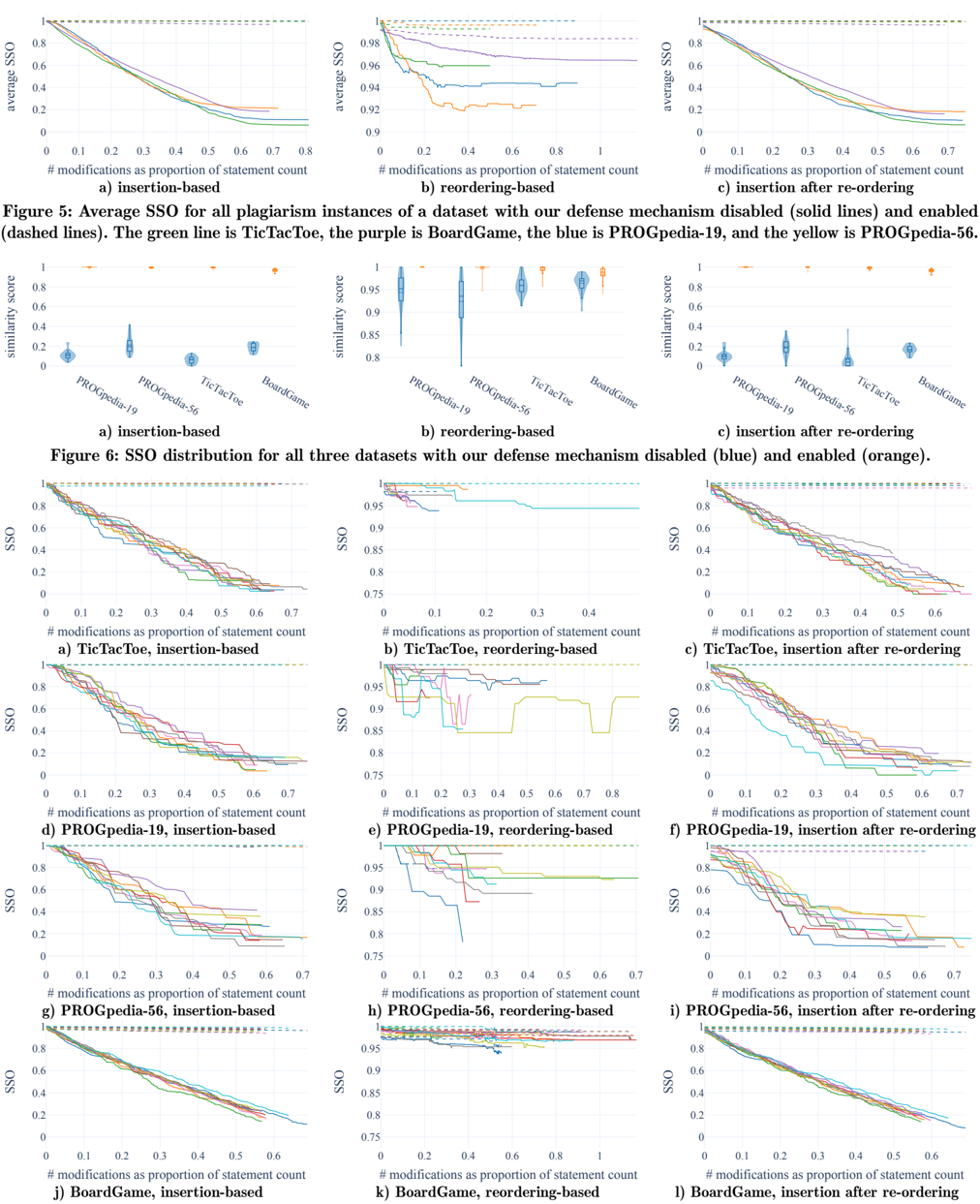
- For insertion-based attacks, JPlag without the defense computes an average similarity score to original (SSO) of less than 25% across all four datasets, dropping below 10% for TicTacToe; with the defense, mean SSO rises to over 99% for PROGpedia-19, PROGpedia-56, and TicTacToe, and over 96% for BoardGame.
- For reordering-based attacks, without the defense TicTacToe and BoardGame average SSO never drops below 95%, while PROGpedia datasets range between 90% and 95%; with the defense, all mean SSOs rise above 98%.
- For combined insertion-after-reordering attacks, without the defense average SSO is less than 20% for PROGpedia and BoardGame and below 10% for TicTacToe; with the defense, all SSOs rise to over 95%.
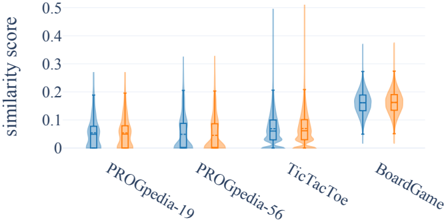
- The defense leaves unrelated-solution similarity nearly unchanged: changes are less than 2%, and over 95% of individual unrelated comparisons have a similarity below 1%; runtime overhead is 0.89 seconds for TicTacToe and 6.45 seconds for BoardGame.
Methods
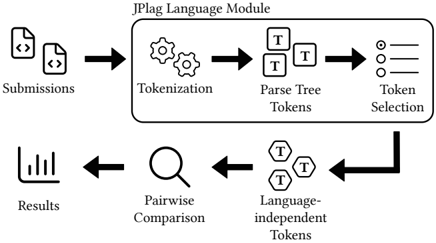
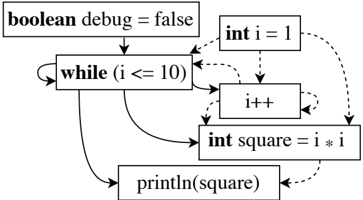
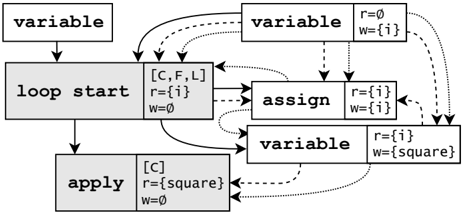
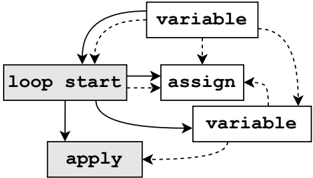
- Design: a language-independent defense mechanism that enriches the token sequence with semantic information, constructs a token normalization graph (TNG) based on program dependence graphs, removes dead nodes, removes variable flow edges, and uses topological sorting to generate a normalized token sequence before pairwise comparison.
- Data: four Java datasets—PROGpedia Task 19 (27 submissions, mean 131 LOC, median 106 LOC), PROGpedia Task 56 (28 submissions, mean 85 LOC, median 77 LOC), TicTacToe (626 submissions, mean 236 LOC, median 225 LOC), and BoardGame (434 submissions, mean 1529 LOC, median 1487 LOC)—totaling 1,115 originals and 285 plagiarism instances.
- Analysis: implemented for JPlag and evaluated using the Goal-Question-Metric method against insertion-based, reordering-based, and combined automated obfuscation attacks, comparing similarity scores with and without normalization, false-positive rate, and runtime.
Limitations
- The paper states that complex attacks such as refactoring or reimplementation (e.g., converting for-loops to while-loops) are not addressed, and the approach’s impact on them remains unclear; the threat model assumes obfuscation preserves program behavior.
- The paper states that AI-based attacks, especially LLM-based obfuscation or fully generated solutions, are not optimized for and require additional defense mechanisms beyond the paper’s scope.
- The text makes evident that evaluation is limited to Java datasets due to limited real-world dataset availability, although the mechanism is claimed to be language-independent; two datasets cannot be fully published due to sensitive data, and the PROGpedia datasets are too small for meaningful runtime measurements.
Model-written summary. Check it against the paper before relying on it.
Integrity signals
Registry
Cites
Statistics
Figures
Verification
Claims the paper makes
13 Valid · 0 Not valid · 2 Not checked · 76 Own results and interpretations
Every source the paper cites for this claim was checked and supports it.
In the paper
“Mossad repeatedly inserts statements into the plagiarized program to break up these subsequences until the plagiarism is no longer recognized.”
§ Detecting Automatic Software Plagiarism via Token Sequence Normalization > Automatic Plagiarism Generators.
What the sources say
- Supportedcites [13] 13. Breanna Devore-McDonald and Emery D. Berger. 2020. Mossad: Defeating Software Plagiarism Detection. Proceedings of the ACM on Programming Languages 4, OOPSLA, Article 138 (nov 2020), 28 pages. https://doi.org/10.1145/3428206 source
Section 4 describes Mossad systematically inserting benign statements within fingerprint windows to disrupt Moss’s token-based matching. Section 4.4 says it continues generating variants until the target Moss similarity score is reached; Section 4 reports that the resulting variants can escape detection. Page numbers were not available in our copy. (LLM, conf=0.92)
plainstates a cause- Asserted: passes — The authors put it forward as true.
- Checkable: passes — It can be checked against evidence.
- Load-bearing: passes — The paper’s conclusions depend on it.
- Based: passes — The paper gives a reason why it holds.
- Supported
The sources with a verdict support this claim; the rest weren’t checked yet, have no full text we could read, or their verdicts aren’t rated yet.
In the paper
“These generators enable effortless obfuscation attacks, exploiting vulnerabilities in existing detectors by inserting statements to disrupt the matching of related programs.”
§ Detecting Automatic Software Plagiarism via Token Sequence Normalization > Abstract
What the sources say
- Not checked — no full text of the sourcecites [6] 6. Stella Biderman and Edward Raff. 2022. Fooling MOSS Detec- tion with Pretrained Language Models, In Proceedings of the 31st ACM International Conference on Information & Knowl- edge Management (Atlanta, GA, USA), Mohammad Al Hasan and Li Xiong 0001 (Eds.). International Conference on In- formation and Knowledge Management, 2933-2943. https: //doi.org/10.1145/3511808.3557079 source
- Supportedcites [13] 13. Breanna Devore-McDonald and Emery D. Berger. 2020. Mossad: Defeating Software Plagiarism Detection. Proceedings of the ACM on Programming Languages 4, OOPSLA, Article 138 (nov 2020), 28 pages. https://doi.org/10.1145/3428206 source
Section 1.1 describes Mossad as an automatic transformation framework that produces plagiarized programs which escape detection. Section 3.3 explains the vulnerability: inserting tokens or statements changes the hashes used to match similar code fragments, causing Moss to miss the similarity. Section 4.3 confirms that Mossad inserts statements while preserving program behavior. (LLM, conf=0.93)
plainstates a cause- Asserted: passes — The authors put it forward as true.
- Checkable: passes — It can be checked against evidence.
- Load-bearing: passes — The paper’s conclusions depend on it.
- Based: passes — The paper gives a reason why it holds.
Every source the paper cites for this claim was checked and supports it.
In the paper
“However, these detectors are not resilient against insertion-based and reordering-based attacks [13].”
§ Detecting Automatic Software Plagiarism via Token Sequence Normalization > 3 STATE OF THE ART
What the sources say
- Supportedcites [13] 13. Breanna Devore-McDonald and Emery D. Berger. 2020. Mossad: Defeating Software Plagiarism Detection. Proceedings of the ACM on Programming Languages 4, OOPSLA, Article 138 (nov 2020), 28 pages. https://doi.org/10.1145/3428206 source
Section 3.3 shows that inserting a benign line disrupts a hash and causes a failed match. Section 3.2 reports that Moss missed plagiarism when one or two consecutive lines were rearranged, although it detected larger rearrangements. Together, these passages support vulnerability to insertion and some reordering attacks. (LLM, conf=0.88)
plain- Asserted: passes — The authors put it forward as true.
- Checkable: passes — It can be checked against evidence.
- Load-bearing: passes — The paper’s conclusions depend on it.
- Based: passes — The paper gives a reason why it holds.
- Supported
A result the paper states — it cites no source for it, so there is none to check. The quote shows it is in the paper.
In the paper
“Our defense mechanism comes with a negligible runtime overhead of mere seconds for large real-world datasets, thus showing its practicality.”
§ Detecting Automatic Software Plagiarism via Token Sequence Normalization > Evaluation.
plain- Asserted: passes — The authors put it forward as true.
- Checkable: passes — It can be checked against evidence.
- Load-bearing: passes — The paper’s conclusions depend on it.
- Based: passes — The paper gives a reason why it holds.
- Rests on an assumption not shown here.
A result the paper reports from its own data — it cites no other source for it, so there is none to check. The quote shows it is in the paper.
In the paper
“We increase similarity scores of plagiarized solutions from 10-30% to a minimum of 95%.”
§ Detecting Automatic Software Plagiarism via Token Sequence Normalization > Evaluation.
plainstates a cause- Asserted: passes — The authors put it forward as true.
- Checkable: passes — It can be checked against evidence.
- Load-bearing: passes — The paper’s conclusions depend on it.
- Based: passes — The paper gives a reason why it holds.
- Rests on an assumption not shown here.
28 more claims
Create a free account to see all 91 claims and to verify the 3 references still open.
- Probably not a substantial claim. 29
- It may state two separate claims as one. 42
- The quote only partly states this claim. 1
Citations
Cites
Experimentation in Software Engineering
Wohlin, C., Runeson, P., Höst, M., Ohlsson, M. C., Regnell, B., & Wesslén, A. (2012) · doi:10.1007/978-3-642-29044-2 · Cited by 4,460
Guidelines for conducting and reporting case study research in software engineering
Runeson, P., & Höst, M. (2009) · Empirical Software Engineering · doi:10.1007/s10664-008-9102-8 · Cited by 3,862
The program dependence graph and its use in optimization
Ferrante, J., Ottenstein, K. J., & Warren, J. D. (1987) · ACM Transactions on Programming Languages and Systems · doi:10.1145/24039.24041 · Cited by 2,755
A Methodology for Collecting Valid Software Engineering Data
Basili, V. R., & Weiss, D. M. (1984) · IEEE Transactions on Software Engineering · doi:10.1109/tse.1984.5010301 · Cited by 1,149
Schleimer, S., S, W. D., & Aiken, A. (2003) · Proceedings of the 2003 ACM SIGMOD International Conference on Management of Data · doi:10.1145/872757.872770 · Cited by 1,099
In Other (People's) Words: Plagiarism by university students--literature and lessons
PARK, C. (2003) · Assessment & Evaluation in Higher Education · doi:10.1080/02602930301677 · Cited by 892
Topological sorting of large networks
Kahn, A. B. (1962) · Communications of the ACM · doi:10.1145/368996.369025 · Cited by 769
Deep learning code fragments for code clone detection
White, M., Tufano, M., Vendome, C., & Poshyvanyk, D. (2016) · Proceedings of the 31st IEEE/ACM International Conference on Automated Software Engineering · doi:10.1145/2970276.2970326 · Cited by 558
Roy, C. K., & Cordy, J. R. (2008) · 2008 16th IEEE International Conference on Program Comprehension · doi:10.1109/icpc.2008.41 · Cited by 533
GPLAG: detection of software plagiarism by program dependence graph analysis
Liu, C., Chen, C., Han, J., & Yu, P. S. (2006) · Proceedings of the 12th ACM SIGKDD international conference on Knowledge discovery and data mining · doi:10.1145/1150402.1150522 · Cited by 422
Research works printed but not linked: 1
- Michael Wise. 1993. String Similarity via Greedy String Tiling and Running Karp-Rabin Matching. Unpublished Basser Department of Computer Science Report (01 1993).
Cited by
Automated Detection of AI-Obfuscated Plagiarism in Modeling Assignments
Sağlam, T., Hahner, S., Schmid, L., & Burger, E. (2024) · Proceedings of the 46th International Conference on Software Engineering: Software Engineering Education and Training · doi:10.1145/3639474.3640084 · Cited by 17
Self-citationObfuscation-Resilient Software Plagiarism Detection with JPlag
Sağlam, T., Hahner, S., Schmid, L., & Burger, E. (2024) · ACM/IEEE International Conference on Software Engineering: Companion Proceedings (ICSE-Companion) · doi:10.1145/3639478.3643074 · Cited by 19
Self-citationFine-grained vulnerability detection for medical sensor systems
Sun, L., Wang, Y., Li, H., & Muhammad, G. (2024) · Internet of Things · doi:10.1016/j.iot.2024.101362 · Cited by 6
Maisch, R., Hagel, N., & Bartel, A. (2025) · European Conference on Software Engineering Education (ECSEE) · doi:10.1145/3723010.3723019 · Cited by 3
Criminal Minds: How First-Year CS Students Plagiarize Code
Maisch, R., Schmid, L., Glassey, R. J., Fuchß, D., Niehues, N., Liu, H., & Koziolek, A. (2026) · ACM Joint European Software Engineering Conference and Symposium on the Foundations of Software Engineering (ESEC/FSE) · doi:10.1145/3803437.3805789 · Cited by 1
Self-citation
Metadata
- Authors
- Sağlam, T., Brödel, M., Schmid, L., & Hahner, S.
- Affiliations
- Karlsruhe Institute of Technology (DE)
- Venue
- Proceedings of the IEEE/ACM 46th International Conference on Software Engineering
- Publisher
- ACM
- Published
- 2024-04-12
- Pages
- 1-13
- ISSN
- 0270-5257 (ISSN-L)
- OpenAlex
- W4394769395
- Semantic Scholar
- 510c0061fabb019d114b9d8455c03d259be083e8
- Cited by
- 9
- References
- 51
- Citations by year
- 2026: 3 · 2025: 2 · 2024: 4
- FWCI
- 3.43
- Type
- conference paper
- Language
- en
- Open access
- hybrid
- doi.org
- Licence
- Locations
- ACM/IEEE International Conference on Software Engineering: Companion Proceedings (ICSE-Companion) (publishedVersion, cc-by)
- Repository KITopen (Karlsruhe Institute of Technology) (submittedVersion)
- Funders
- Bundesministerium für Wirtschaft und Klimaschutz (19S21002)
- Topics
- Physical Sciences › Computer Science › Information Systems › Software Engineering Research
- Social Sciences › Education › Academic integrity and plagiarism
- Physical Sciences › Computer Science › Hardware and Architecture › Physical Unclonable Functions (PUFs) and Hardware Security
- Keywords
- software plagiarism detection, program dependence graph, false positives
About these checks
Registry, retraction, Cites and statistics results are computed, not judged, with one exception: a printed reference that no index lists is read once by a model before it counts as a citation error. Claims are extracted by a model and kept only when their quote appears verbatim in the text; each cited source is then checked, with a model’s help, for whether it says what the claim relies on. Those verdicts can be wrong — read the claim’s quote and the cited source before relying on one.
The claim verdicts this report counts are experimental: their accuracy is not yet measured.
A language model drew the claims from the paper on 2026-10-10, under version 3 of the claim definition (model deepseek-v4.1-flash, prompt extract-v3).
A second model labelled each claim on 2026-10-10 (model jev-1.13-20260917, definition revision gold-guideline-v0.2).
Cited sources are checked with a language model’s help (gpt-6-sol).
Statistics and arithmetic are recomputed, not judged.
Confidence bands are shown only for fields calibrated on our annotated test set. None is calibrated yet, so no band is shown.
What counts as a claim ›How we measure confidence ›How we check this ›
Are you an author, or do you see a problem with this page? Request a review
How to cite
Cite CoChat for the checks on this page, and the paper for its own findings.
- This page
- CoChat. (2026). Citation check: Detecting Automatic Software Plagiarism via Token Sequence Normalization. https://app.cochat.ai/papers/10.1145/3597503.3639192
- The paper
- Sağlam, T., Brödel, M., Schmid, L., & Hahner, S. (2024). Detecting Automatic Software Plagiarism via Token Sequence Normalization. Proceedings of the IEEE/ACM 46th International Conference on Software Engineering. https://doi.org/10.1145/3597503.3639192
Data sources
Bibliographic data: Semantic Scholar, OpenAlex, Crossref.
Contains information from the Semantic Scholar Academic Graph Datasets, made available under the ODC Attribution License (ODC-BY 1.0).
Semantic Scholar’s data is described in: Kinney, R., et al. (2023). The Semantic Scholar Open Data Platform. arXiv:2301.10140.
