

'My agent understands me better': Integrating Dynamic Human-like Memory Recall and Consolidation in LLM-Based Agents
Open accessThe DOI matches its Crossref record; 28 of the 29 references it cites were found in a registry or an index; 6 of the 11 sources its claims cite were checked for support.
Abstract
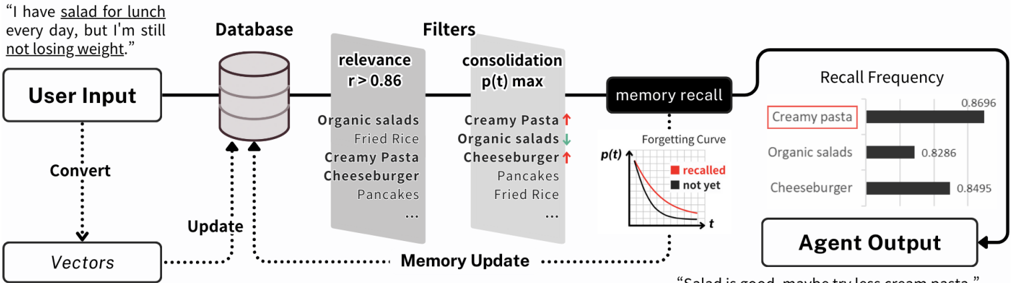
In this study, we propose a novel human-like memory architecture designed for enhancing the cognitive abilities of large language model (LLM)-based dialogue agents. Our proposed architecture enables agents to autonomously recall memories necessary for response generation, effectively addressing a limitation in the temporal cognition of LLMs. We adopt the human memory cue recall as a trigger for accurate and efficient memory recall. Moreover, we developed a mathematical model that dynamically quantifies memory consolidation, considering factors such as contextual relevance, elapsed time, and recall frequency. The agent stores memories retrieved from the user’s interaction history in a database that encapsulates each memory’s content and temporal context. Thus, this strategic storage allows agents to recall specific memories and understand their significance to the user in a temporal context, similar to how humans recognize and recall past experiences.
Overview
CoChat Summary
## TL;DR
This CHI EA 2024 paper proposes an LLM-agent memory architecture that combines human-like cued recall with a consolidation model based on relevance, elapsed time, and recall frequency. In the reported evaluation, the proposed model outperformed a Generative Agent baseline on recall accuracy, while also showing promising personalized response generation.
## Key findings
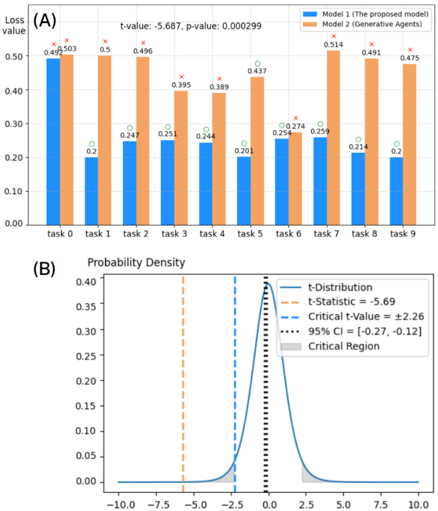
- The model’s recall accuracy had a statistically significant lower loss than the Generative Agent baseline, with t = -5.687 and p = 0.000299; the 95% confidence interval for the mean difference was [-0.27, -0.12].
- The authors say they built a dataset of 10 tasks from actual conversational histories, and also ran a qualitative dialogue study with 6 participants over one week to three months.
- In the response-generation examples, the agent used recalled memories to produce personalized replies, such as reminding a user that “Ice cream awaits” and responding to a Hawaii mention by referencing a paper deadline in Hawaii on 1/25.
- The paper reports a trigger threshold of 0.86 as appropriate in trials, though it says further research is needed to determine the best threshold.
## Methods
- The paper proposes an LLM-based dialogue agent architecture that stores episodic memories from user dialogues in a database and computes recall via a mathematical model using event relevance, elapsed time, and recall frequency.
- For evaluation, the authors built a system in Python using GPT-4-0613 as the baseline model, Qdrant for vector search/memory triggering, and Firestore for chat history management.
- Quantitative analysis compared the proposed model against Generative Agents on 10 tasks using a loss based on normalized scores, Softmax probabilities, and mean squared error; qualitative examples were taken from participant chat histories.
## Limitations
- The paper explicitly states that the method relies on users’ long-term behavioral patterns, so it may be less adaptable when behavior changes significantly, such as after starting a new job or school.
- The authors note that the evaluation focused on specific domains and tasks, and that generalizability across other domains and dialogue tasks remains to be tested.
- The text makes evident that the paper reports only a small-scale evaluation (10 tasks and 6 participants); this limits how far the reported results can be generalized.
Model-written summary. Check it against the paper before relying on it.
Integrity signals
Registry
Cites
Statistics
Figures
Verification
Claims the paper makes
6 Valid · 3 Not valid · 5 Not checked · 38 Own results and interpretations
The cited sources support only part of this claim — read each source’s verdict below.
In the paper
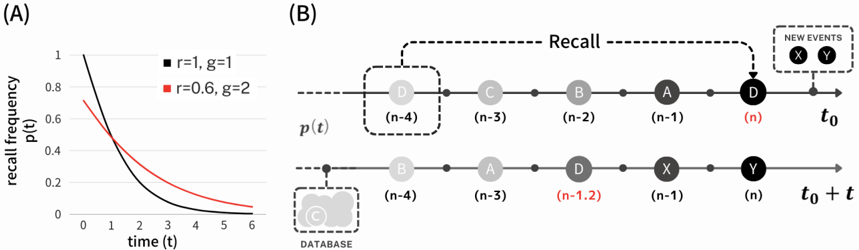
“In contrast, the Generative Agents model, which uses a simpler scoring system based on recency, importance, and relevance, chose Event D (working at the restaurant on Thursdays) as the most likely activity.”
What the sources say
- Partly supportedcites [18] [18] Joon Sung Park, Joseph C. O'Brien, Carrie J. Cai, Meredith Ringel Morris, Percy Liang, and Michael S. Bernstein. 2023. Generative Agents: Interactive Simulacra of Human Behavior. arXiv:2304.03442 [cs.HC] - sourceExperimental — accuracy not yet measured
The memory-retrieval passage describes a score combining recency, importance, and relevance. Neither the supplied passages nor searches for “Task 0,” “Event D,” and “restaurant on Thursdays” show the model choosing that activity; the specific outcome is unsupported by our copy. (LLM, conf=0.82)
plain- Asserted: passes — The authors put it forward as true.
- Checkable: passes — It can be checked against evidence.
- Load-bearing: passes — The paper’s conclusions depend on it.
- Based: passes — The paper gives a reason why it holds.
- Partly supported
The cited sources support only part of this claim — read each source’s verdict below.
In the paper
“This choice stems from the model's emphasis on recent activities and event relevance, as evident from the higher relevance score and shorter elapsed time associated with Event D.”
What the sources say
- Partly supportedcites [18] [18] Joon Sung Park, Joseph C. O'Brien, Carrie J. Cai, Meredith Ringel Morris, Percy Liang, and Michael S. Bernstein. 2023. Generative Agents: Interactive Simulacra of Human Behavior. arXiv:2304.03442 [cs.HC] - sourceExperimental — accuracy not yet measured
The memory-retrieval passage (section headed “Q. What are you looking forward to the most right now?”, page unavailable) says the model scores memories for recency and relevance, alongside importance. It does not identify an Event D or report its relevance score, elapsed time, or the reason it was chosen. (LLM, conf=0.86)
plainstates a causeSingle case- Asserted: passes — The authors put it forward as true.
- Checkable: passes — It can be checked against evidence.
- Load-bearing: passes — The paper’s conclusions depend on it.
- Based: passes — The paper gives a reason why it holds.
- Partly supported
Every source the paper cites for this claim was checked and supports it.
In the paper
“In contrast, the Generative Agents model, which uses a simpler scoring system based on recency, importance, and relevance, chose Event D (working at the restaurant on Thursdays) as the most likely activity.”
What the sources say
- Supportedcites [18] [18] Joon Sung Park, Joseph C. O'Brien, Carrie J. Cai, Meredith Ringel Morris, Percy Liang, and Michael S. Bernstein. 2023. Generative Agents: Interactive Simulacra of Human Behavior. arXiv:2304.03442 [cs.HC] - source
The paper’s retrieval discussion (section labeled “Q. What are you looking forward to the most right now?”, page unavailable) says it scores memories using recency, importance, and relevance, then combines those three scores to rank them. The cited claim concerns that scoring system; the sentence’s Event D choice is not attributed to this source. (LLM, conf=0.94)
plain- Asserted: passes — The authors put it forward as true.
- Checkable: passes — It can be checked against evidence.
- Load-bearing: passes — The paper’s conclusions depend on it.
- Based: passes — The paper gives a reason why it holds.
- Supported
The cited sources support only part of this claim — read each source’s verdict below.
In the paper
“We adopted human-like cued recall as the trigger for accurate and efficient memory retrieval [16].”
What the sources say
- Partly supportedcites [16] [16] Mark A McDaniel, Michael D Kowitz, and Paul K Dunay. 1989. Altering memory through recall: The effects of cue-guided retrieval processing. Memory & Cognition 17, 4 (1989), 423-434. - sourceExperimental — accuracy not yet measured
The Abstract (p. 423) reports that immediate cued recall facilitated delayed recall, primarily when the immediate and delayed cues were of the same type. This supports cue-guided retrieval in human subjects, but the paper does not establish that it is efficient or that cues generally trigger accurate retrieval regardless of cue compatibility. (LLM, conf=0.83)
plainstates a cause- Asserted: passes — The authors put it forward as true.
- Checkable: passes — It can be checked against evidence.
- Load-bearing: passes — The paper’s conclusions depend on it.
- Based: passes — The paper gives a reason why it holds.
- Partly supported
A result the paper reports from its own data — it cites no other source for it, so there is none to check. The quote shows it is in the paper.
In the paper
“Our model demonstrated a statistically significant lower loss value across various tasks when compared to the Generative Agent model, as indicated by 𝑡 =-5.687 and 𝑝 =0.000299 (Figure 3-A).”
- Also stated in: § 4.2 Analysis · hedged
“the 95% confidence interval for the mean difference falling between [-0.27, -0.12] (Figure 3-B). This interval is completely below zero, indicating that the difference in mean performance is statistically significant and favorable to our proposed model.”
boostedstates an association- Asserted: passes — The authors put it forward as true.
- Checkable: passes — It can be checked against evidence.
- Load-bearing: passes — The paper’s conclusions depend on it.
- Based: passes — The paper gives a reason why it holds.
- Also stated in: § 4.2 Analysis · hedged
17 more claims
Create a free account to see all 52 claims and every source verdict.
- It may state two separate claims as one. 14
- Probably not a substantial claim. 21
Claims other papers make about this one
Each is checked against this paper’s own text: does it say what the citing paper says it does?
The source backs part of the claim, not all of it — or backs it for a different population, condition or comparison.
In the citing paper
“Existing memory retrieval methods for agents primarily focus on relevance and temporal validity.”
From Enhancing memory retrieval in generative agents through LLM-trained cross attention networks (2025) · cites this paper as Hou et al. (2024)
Experimental — accuracy not yet measuredThe cited source says what the claim attributes to it.
In the citing paper
“Inspired by these cognitive principles, researchers have developed various methods for transforming conversation data into structured episodic memories (Hou et al., 2024; Fountas et al., 2025; Ge et al., 2025).”
From Pre-Storage Reasoning for Episodic Memory: Shifting Inference Burden to Memory for Personalized Dialogue (2025) · cites this paper as Hou et al., 2024
The cited source says what the claim attributes to it.
In the citing paper
“Hou et al. (2024) models human memory consolidation by weighting information based on contextual relevance and recall frequency”
From Pre-Storage Reasoning for Episodic Memory: Shifting Inference Burden to Memory for Personalized Dialogue (2025) · cites this paper as Hou et al., 2024
Citations
Cites
Episodic memory: from mind to brain
Tulving, E. (2002) · Annual Review of Psychology · doi:10.1146/annurev.psych.53.100901.135114 · Cited by 4,950 · cited 1×
“Episodic memory [24] consciously allows for recollecting and re-experiencing one’s subjective past.”
Background(2007) · Cognitive Psychology · doi:10.4135/9781446212967.n15 · Cited by 3,749 · cited 1×
“Human memory serves as a system to encode, store, and retrieve our experiences [25].”
BackgroundShort-term retention of individual verbal items.
Peterson, L., & Peterson, M. J. (1959) · Journal of Experimental Psychology · doi:10.1037/h0049234 · Cited by 2,939 · cited 1×
“The recall probability 𝑝 ( 𝑡 ) in this special case is expressed as The recall probability 𝑝 ( 𝑡 ) exponentially decays with time 𝑡 , as demonstratedinshort-termmemorydeclineusingtheclassicBrown-Petersonlearninganddistractiontask[19].”
Test-Enhanced Learning: Taking Memory Tests Improves Long-Term Retention
Roediger, H. L., & Karpicke, J. D. (2006) · Psychological Science · doi:10.1111/j.1467-9280.2006.01693.x · Cited by 2,867
The human hippocampus and spatial and episodic memory
Burgess, N., Maguire, E. A., & O'Keefe, J. (2002) · Neuron · doi:10.1016/s0896-6273(02)00830-9 · Cited by 2,401 · cited 1×
“The following exponential function 𝑟 ( 𝑡 ) represents the adjustment process of memory strength [2] in the human hippocampus: where 𝜇 is the memory strength, 𝑎 is the decay rate, and 𝑡 is the elapsed time.”
BackgroundGenerative Agents: Interactive Simulacra of Human Behavior
Park, J. S., O'Brien, J. C., Cai, C. J., Morris, M. R., Liang, P., & Bernstein, M. S. (2023) · arXiv · doi:10.48550/arxiv.2304.03442 · Cited by 2,173
LSTM neural networks for language modeling
Sundermeyer, M., Schlüter, R., & Ney, H. (2012) · Interspeech 2012 · doi:10.21437/interspeech.2012-65 · Cited by 1,963 · cited 1×
“While transformers possess excellent self-attention mechanisms, outperforming recurrent neural networks (RNNs) [15] and long short-term memory models (LSTM) [23], they fail to replicate human behavioral dynamics.”
BackgroundHow to Fine-Tune BERT for Text Classification?
Sun, C., Qiu, X., Xu, Y., & Huang, X. (2019) · Lecture Notes in Computer Science · doi:10.1007/978-3-030-32381-3_16 · Cited by 1,534 · cited 1×
“The emergence of transformer-based language models [14] have drastically revolutionized the field of natural language processing, surpassing the capabilities of traditional models in understanding and generating human-like text [22].”
BackgroundLin, T., Wang, Y., Liu, X., & Qiu, X. (2022) · AI Open · doi:10.1016/j.aiopen.2022.10.001 · Cited by 1,422
Lin, T., Wang, Y., Liu, X., & Qiu, X. (2021) · arXiv · doi:10.48550/arxiv.2106.04554 · Cited by 1,420
Research works printed but not linked: 3
- [3] S.D.L.R.S.P.P.U. California. 1987. Memory and Brain . Oxford University Press, USA. https://books.google.co.jp/books?id=WH-HF5E9XSsC -
- [26] Guido Van Rossum and Fred L. Drake. 2009. Python 3 Reference Manual . CreateSpace, Scotts Valley, CA. -
- [27] Atsushi Yamadori. 2002. Frontiers of Human Memory : a collection of contributions based on lectures presented at Internationl Symposium, Sendai, Japan, October 25-27, 2001 . Tohoku University Press. https://ci.nii.ac.jp/ncid/BA57511014 -
Cited by
Generative AI for self-adaptive systems: State of the art and research roadmap
Li, J., Zhang, M., Li, N., Weyns, D., Jin, Z., & Tei, K. (2024) · ACM Transactions on Autonomous and Adaptive Systems · doi:10.1145/3686803 · Cited by 77
Performance and Metacognition Disconnect when Reasoning in Human-AI Interaction
Fernandes, D., Villa, S., Nicholls, S., Haavisto, O., Buschek, D., Schmidt, A., Kosch, T., Shen, C., & Welsch, R. (2024) · arXiv · doi:10.48550/arxiv.2409.16708 · Cited by 71
MetaAgents: Large Language Model Based Agents for Decision-Making on Teaming
Li, Y., Sun, L., & Zhang, Y. (2023) · arXiv · doi:10.48550/arxiv.2310.06500 · Cited by 38
MetaAgents: Large Language Model Based Agents for Decision-Making on Teaming
Li, Y., Sun, L., & Zhang, Y. (2025) · Proceedings of the ACM on Human-Computer Interaction · doi:10.1145/3711032 · Cited by 196
“For example, Chen et al. [11] used LLMs to assist in agent-based modeling on a NetLogo Chat platform, while other works [24, 27, 70] have introduced memory mechanisms to enhance LLM-based agents.”
ELLMA-T: an Embodied LLM-agent for Supporting English Language Learning in Social VR
Pan, M., Kitson, A., Wan, H., & Prpa, M. (2025) · Designing Interactive Systems Conference · doi:10.1145/3715336.3735786 · Cited by 76
Wang, J., Mokhlis, H., Mansor, N. N., Illias, H. A., Ramasamy, A. K., Wu, X., & Wang, S. (2025) · IEEE Access · doi:10.1109/access.2025.3596791 · Cited by 39
Inie, N., Falk, J., & Selvan, R. (2025) · CHI Conference on Human Factors in Computing Systems · doi:10.1145/3706598.3714227 · Cited by 43
Li, Z., Zhang, H., Peng, C., & Peiris, R. (2025) · 2025 IEEE Conference Virtual Reality and 3D User Interfaces (VR) · doi:10.1109/vr59515.2025.00025 · Cited by 24
“LLMs have notably transformed the development of virtual agents, shifting from scripted responses to dynamic, context-rich interactions that mimic human behavioral patterns and emotional nuances [46, 60, 24, 31, 53, 37].”
RetroChat: Designing for the Preservation of Past Chinese Online Social Experiences
Zhou, S., Fu, K., Yi, H., & Lc, R. (2025) · Creativity and Cognition · doi:10.1145/3698061.3726920 · Cited by 21
“[40, 83].”
Navigating the Unknown: A Chat-Based Collaborative Interface for Personalized Exploratory Tasks
Peng, Y., Qin, X., Zhang, Z., Zhang, J., Lin, Q., Yang, X., Zhang, D., Rajmohan, S., & Zhang, Q. (2025) · ACM International Conference on Intelligent User Interfaces (IUI) · doi:10.1145/3708359.3712093 · Cited by 28
Social-RAG: Retrieving from Group Interactions to Socially Ground AI Generation
Wang, R., Zhou, X., Qiu, L., Chang, J. C., Bragg, J., & Zhang, A. X. (2025) · CHI Conference on Human Factors in Computing Systems · doi:10.1145/3706598.3713749 · Cited by 35
“We then describe the steps of our workflow , including the curation of a social knowledge base gleaned from group interactions and the retrieval pipeline for real-time zero-shot learning for message generation.”
Enhancing memory retrieval in generative agents through LLM-trained cross attention networks
Hong, C., & He, Q. (2025) · Frontiers in Psychology · doi:10.3389/fpsyg.2025.1591618 · Cited by 7
Users' Expectations and Practices with Agent Memory
Jones, B., Stemmler, K., Su, E., Kim, Y., & Kuzminykh, A. (2025) · CHI Conference Extended Abstracts on Human Factors in Computing Systems (CHI EA) · doi:10.1145/3706599.3720158 · Cited by 24
“…input(s); e.g., [13]), time-based storage and retrieval (where more recent memories are more likely to be retrieved that older memories; e.g., [13]), and by mimicking existing psychological models of human memory (e.g., by separat-ing memories into semantic , episodic , and procedural…”
Fang, J., Peng, Y., Zhang, X., Wang, Y., Yi, X., Zhang, G., Xu, Y., Wu, B., Liu, S., Li, Z., et al. (2025) · arXiv · doi:10.48550/arxiv.2508.07407 · Cited by 6
Qualitative research with LLM chatbots: Technological reflexivity for interpretative technology
Ibrahim, E. I., & Voyer, A. M. (2025) · Qualitative Research · doi:10.1177/14687941251390794 · Cited by 19
“As a result of their limitations, LLM chatbots can struggle to accurately process specialized and highly contextualized language (Hou et al., 2024).”
Cognitive Agents in Urban Mobility: Integrating LLM Reasoning into Multi-Agent Simulations
Calderón, C., Martí, P., Jordán, J., Palanca, J., & Julián, V. (2025) · Sensors · doi:10.3390/s25185688 · Cited by 18
Sievers, T., & Rußwinkel, N. (2025) · Applied Sciences · doi:10.3390/app15105778 · Cited by 12
“A human-like memory architecture to improve the cognitive abilities of LLM-based dialog agents was proposed by Hou et al. [43].”
How Memory Management Impacts LLM Agents: An Empirical Study of Experience-Following Behavior
Xiong, Z., Lin, Y., Xie, W., He, P., Liu, Z., Tang, J., Lakkaraju, H., & Xiang, Z. (2026) · Proceedings of the 64th Annual Meeting of the Association for Computational Linguistics (Volume 1: Long Papers) · doi:10.18653/v1/2026.acl-long.27 · Cited by 4
From Storage to Experience: A Survey on the Evolution of LLM Agent Memory Mechanisms
Luo, J., Tian, Y., Cao, C., Luo, Z., Lin, H., Li, K., Kong, C., Yang, R., & Ma, J. (2026) · Findings of the Association for Computational Linguistics: ACL 2026 · doi:10.18653/v1/2026.findings-acl.2069 · Cited by 3
Care-by-Design: Enhancing Customer Experience through Empathetic AI Chatbots
Hayawi, K., & Shahriar, S. (2024) · IEEE ... International Conference on Data Mining workshops · doi:10.1109/icdmw65004.2024.00016 · Cited by 3
“LLMs can be trained to retain and recall vast amounts of customer data like past interactions, preferences, purchasing history, and even emotional tones from previous conversations [15].”
From Human Memory to AI Memory: A Survey on Memory Mechanisms in the Era of LLMs
Wu, Y., Liang, S., Zhang, C., Wang, Y., Zhang, Y., Guo, H., Tang, R., & Liu, Y. (2025) · arXiv · doi:10.48550/arxiv.2504.15965 · Cited by 3
“…[53], A-MEM [54], Generative Agents [55], EMG-RAG [56], KGT [46], LLM-Rsum [57], COMEDY [58] Retrieval RET-LLM [44], ChatDB [59], Human-like Memory [60], HippoRAG [13], HippoRAG 2 [61], EgoRAG [62], MemInsight [50] Usage MemoCRS [63], RecMind [64], RecAgent [65], InteRecAgent [66], SCM [67],…”
Kim, S., Lee, Y., Kim, S., Kim, H., & Cho, S. (2025) · Findings of the Association for Computational Linguistics: EMNLP 2025 · doi:10.18653/v1/2025.findings-emnlp.1204 · Cited by 2
MADial-Bench: Towards Real-world Evaluation of Memory-Augmented Dialogue Generation
He, J., Zhu, L., Wang, R., Wang, X., Haffari, G., & Zhang, J. (2025) · Proceedings of the 2025 Conference of the Nations of the Americas Chapter of the Association for Computational Linguistics: Human Language Technologies (Volume 1: Long Papers) · doi:10.18653/v1/2025.naacl-long.499 · Cited by 2
“(2) dialogue histories as memory and retrieve the memory based on semantic similarities (Hou et al., 2024; Zhong et al., 2023).”
BackgroundHuman-Like Remembering and Forgetting in LLM Agents: An ACT-R-Inspired Memory Architecture
Honda, Y., Fujita, Y., Zempo, K., & Fukushima, S. (2025) · International Conference on Human-Agent Interaction · doi:10.1145/3765766.3765803 · Cited by 6
“For instance, Hou et al. (2024) proposed an agent that assigns “trigger words” to each utterance, selectively reactivating memories based on matches [7].”
LLM Powered Memory Consolidation for Ubiquitous Computing
Thind, P. K., & Katturu, V. (2025) · ACM International Joint Conference on Pervasive and Ubiquitous Computing (UbiComp) · doi:10.1145/3714394.3750599 · Cited by 1
“To account for semantic relevance in LLM applications, Hou et al. [5] extend this framework by incorporating cosine similarity: between content embeddings, thereby modulating the recall likelihood based on contextual similarity.”
BEE: Belief-Value-Aligned, Explainable, and Extensible Cognitive Framework for Conversational Agents
Yang, C., Groß, M. H., & Wampfler, R. (2025) · ACM International Conference on Intelligent Virtual Agents (IVA) · doi:10.1145/3717511.3747067 · Cited by 1
“Hou et al. [23] developed a human-like memory architecture that uses contextual conversation cues to trigger relevant memory retrieval while dynamically quantifying memory consolidation.”
Kamat, R. S. K. A. R. K. (2025) · International Conference on Research in Computational Intelligence and Communication Networks (ICRCICN) · doi:10.1109/icrcicn68210.2025.11364909 · Cited by 1
“Hou et al. [29] integrate human-like recall and consolidation mechanisms, where past events receive recall probabilities that decay over time.”
Rethinking Memory in LLM based Agents: Representations, Operations, and Emerging Topics
Du, Y., Huang, W., Zheng, D., Wang, Z., Montella, S., Lapata, M., Wong, K.-F., & Pan, J. Z. (2025) · arXiv · doi:10.48550/arxiv.2505.00675 · Cited by 1
Zhu, Z., Song, T., Lim, J., Yang, C.-L., & Lee, Y. (2026) · Proceedings of the ACM on Human-Computer Interaction · doi:10.1145/3816998
Memory Approaches for LLM-Based Agents: A Comparative Study of in-Context and Episodic Architectures
Santos, F. A., Villas, L. A., & dos Reis, J. C. (2026) · Communications in computer and information science · doi:10.1007/978-3-032-15632-7_19 · Cited by 1
Rehumanizer: Enhancing LLM Recommendations for Humanlike Engagement and Intriguing Interactions
Galitsky, B. (2026) · Springer eBooks · doi:10.1007/978-3-032-16524-4_5
Consideration of Memory Forgetting Mechanisms for Realization of Human-Like Dialogue System
Horiike, S., Fushimi, T., Keyaki, R., Otake, M., & Iwashita, S. (2025) · IEEE/WIC/ACM International Conference on Web Intelligence and Intelligent Agent Technology (WI-IAT) · doi:10.1109/wi-iat67162.2025.00085
“Hou et al. [8] propose a novel approach to enhance the cognitive capabilities of LLM-based dialogue agents by integrating a human-like memory architecture.”
The Evolving Role of Large Language Models in UX Design: A Bibliometric Analysis Study
Oudor, I., & Nafil, K. (2025) · International Conference on Intelligent Systems: Theories and Applications · doi:10.1109/sita67914.2025.11273744
Pecora, A. E., Strada, F., & Bottino, A. (2025) · Lecture notes in computer science · doi:10.1007/978-3-031-97778-7_8 · Cited by 2
Advancing Retrieval-Augmented Generation for Financial Question Answering
Jasmin, A. A., Perera, I., Mohamed, M., & Mushraf, M. (2025) · Moratuwa Engineering Research Conference (MERCon) · doi:10.1109/mercon67903.2025.11217080
The Machine as an Autonomous Explanatory Agent
Yargan, D. (2024) · Felsefe Dünyası · doi:10.58634/felsefedunyasi.1487376
A Survey of Agent Memory in the Second Half: Towards Self-Evolving and Long-Horizon Agents
Huang, W.-C., Zhang, W., Liang, Y., Bei, Y., Chen, Y., Feng, T., Pan, X., Tan, Z., Wang, Y., Wei, T., et al. (2026) · arXiv · doi:10.48550/arxiv.2602.06052 · Cited by 70
Memp: Exploring Agent Procedural Memory
Fang, R., Liang, Y., Wang, X., Wu, J., Qiao, S., Xie, P., Huang, F., Chen, H., & Zhang, N. (2026) · Findings of the Association for Computational Linguistics: ACL 2026 · doi:10.18653/v1/2026.findings-acl.866 · Cited by 174
Metadata
- Authors
- Hou, Y., Tamoto, H., & Miyashita, H.
- Affiliations
- Meiji University (JP)
- Kyoto University (JP)
- Venue
- Extended Abstracts of the CHI Conference on Human Factors in Computing Systems
- Publisher
- ACM
- Published
- 2024-05-11
- Pages
- 1-7
- OpenAlex
- W4393905041
- Cited by
- 31
- References
- 16
- Citations by year
- 2026: 5 · 2025: 22 · 2024: 4
- FWCI
- 9.11
- Type
- conference paper
- Language
- en
- Open access
- green
- arxiv.org
- Licence
- Locations
- CHI Conference Extended Abstracts on Human Factors in Computing Systems (CHI EA) (publishedVersion)
- arXiv (Cornell University) (submittedVersion, cc-by-nc-sa)
- arXiv (Cornell University)
- Topics
- Physical Sciences › Computer Science › Artificial Intelligence › Speech and dialogue systems
- Physical Sciences › Computer Science › Artificial Intelligence › AI-based Problem Solving and Planning
- Physical Sciences › Computer Science › Artificial Intelligence › Psychiatry, Mental Health, Neuroscience
- Keywords
- memory retrieval, memory consolidation, temporal cognition, in-memory databases, interaction history, response generation
About these checks
Registry, retraction, Cites and statistics results are computed, not judged, with one exception: a printed reference that no index lists is read once by a model before it counts as a citation error. Claims are extracted by a model and kept only when their quote appears verbatim in the text; each cited source is then checked, with a model’s help, for whether it says what the claim relies on. Those verdicts can be wrong — read the claim’s quote and the cited source before relying on one.
The claim verdicts this report counts are experimental: their accuracy is not yet measured.
A language model drew the claims from the paper on 2026-10-10, under version 3 of the claim definition (model deepseek-v4.1-flash, prompt extract-v3).
A second model labelled each claim on 2026-10-10 (model jev-1.13-20260917, definition revision gold-guideline-v0.2).
Cited sources are checked with a language model’s help (gpt-6-sol).
Statistics and arithmetic are recomputed, not judged.
Confidence bands are shown only for fields calibrated on our annotated test set. None is calibrated yet, so no band is shown.
What counts as a claim ›How we measure confidence ›How we check this ›
Are you an author, or do you see a problem with this page? Request a review
Data sources
Bibliographic data: Semantic Scholar, OpenAlex, Crossref.
Contains information from the Semantic Scholar Academic Graph Datasets, made available under the ODC Attribution License (ODC-BY 1.0).
Semantic Scholar’s data is described in: Kinney, R., et al. (2023). The Semantic Scholar Open Data Platform. arXiv:2301.10140.
