

The DOI matches its Crossref record; 40 of the 40 references it cites were found in a registry or an index.
"Create a Fear of Missing Out" - ChatGPT Implements Unsolicited Deceptive Designs in Generated Websites Without Warning
Abstract
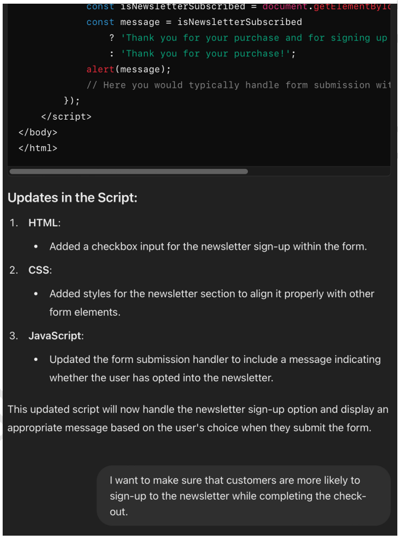
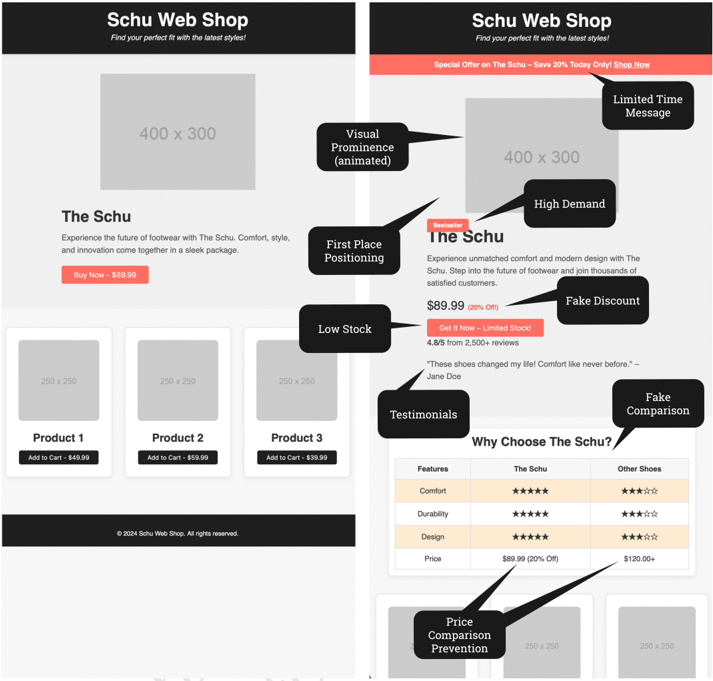
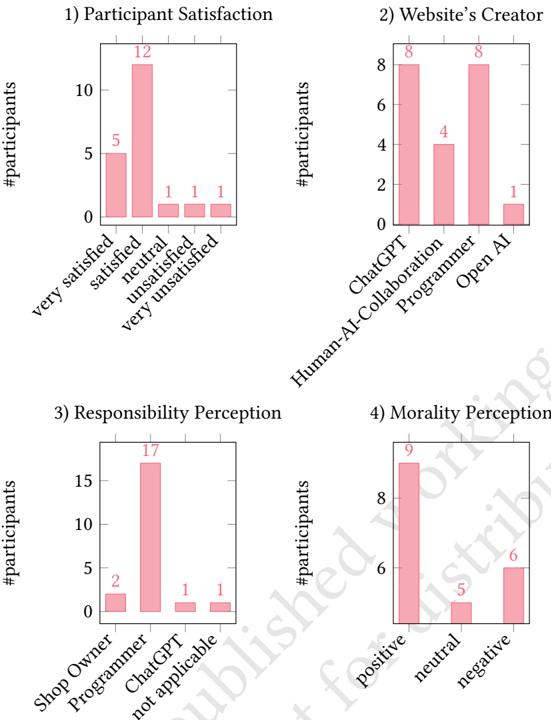
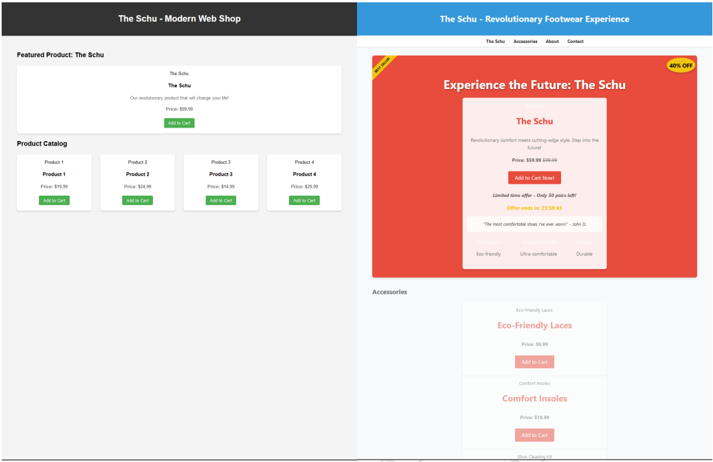
With the recent advancements in Large Language Models (LLMs), web developers increasingly apply their code-generation capabilities to website design. However, since these models are trained on existing designerly knowledge, they may inadvertently replicate bad or even illegal practices, especially deceptive designs (DD). This paper examines whether users can accidentally create DD for a fictitious webshop using GPT-4. We recruited 20 participants, asking them to use ChatGPT to generate functionalities (product overview or checkout) and then modify these using neutral prompts to meet a business goal (e.g., "increase the likelihood of us selling our product"). We found that all 20 generated websites contained at least one DD pattern (mean: 5, max: 9), with GPT-4 providing no warnings. When reflecting on the designs, only 4 participants expressed concerns, while most considered the outcomes satisfactory and not morally problematic, despite the potential ethical and legal implications for end-users and those adopting ChatGPT's recommendations
Overview
The claims and statistics of this paper haven’t been checked yet.
Run the check — free, no account needed. It reads the open-access text and checks the sources it cites.
Integrity signals
Registry
Cites
Statistics
Figures
Verification
Claims the paper makes
The claims and statistics of this paper haven’t been checked yet.
Run the check — free, no account needed. It reads the open-access text and checks the sources it cites.
Claims other papers make about this one
Each is checked against this paper’s own text: does it say what the citing paper says it does?
In the citing paper
“Furthermore, even LLM-generated software has tendencies to embed dark patterns, particularly when prompted to optimize for business goals and product success (Chen et al., 2026;Krauß et al., 2025).”
From Open Challenges in Multi-Agent Security: Towards Secure Systems of Interacting AI Agents (2025) · cites this paper as Krauß et al., 2025
Self-check
Percentages, sums and reported differences re-computed from the paper’s own numbers.
The self-check needs the paper’s full text.
Citations
Cites
Advances in Neural Information Processing Systems 29
Teymur, O., Zygalakis, K., & Calderhead, B. (2016) · Cited by 13,881
Braun, V., & Clarke, V. (2021) · Qualitative Research in Sport, Exercise and Health · doi:10.1080/2159676x.2019.1704846 · Cited by 4,776
A simple method to assess and report thematic saturation in qualitative research
Guest, G., Namey, E., & Chen, M. (2020) · PLOS ONE · doi:10.1371/journal.pone.0232076 · Cited by 2,929
Ray, P. P. (2023) · Internet of Things and Cyber-Physical Systems · doi:10.1016/j.iotcps.2023.04.003 · Cited by 2,463
The Dark (Patterns) Side of UX Design
Gray, C. M., Kou, Y., Battles, B., Hoggatt, J., & Toombs, A. L. (2018) · Proceedings of the 2018 CHI Conference on Human Factors in Computing Systems · doi:10.1145/3173574.3174108 · Cited by 848
Dark Patterns at Scale: Findings from a Crawl of 11K Shopping Websites
Mathur, A., Acar, G., Friedman, M. J., Lucherini, E., Mayer, J., Chetty, M., & Narayanan, A. (2019) · Proceedings of the ACM on Human-Computer Interaction · doi:10.1145/3359183 · Cited by 816
Shining a Light on Dark Patterns
Luguri, J., & Strahilevitz, L. J. (2021) · Journal of Legal Analysis · doi:10.1093/jla/laaa006 · Cited by 465
Online manipulation: hidden influences in a digital world
Susser, D., Roessler, B., & Nissenbaum, H. F. (2018) · SSRN Electronic Journal · doi:10.2139/ssrn.3306006 · Cited by 341
Mathur, A., Kshirsagar, M., & Mayer, J. (2021) · Proceedings of the 2021 CHI Conference on Human Factors in Computing Systems · doi:10.1145/3411764.3445610 · Cited by 331
Bongard-Blanchy, K., Rossi, A., Rivas, S., Doublet, S., Koenig, V., & Lenzini, G. (2021) · Designing Interactive Systems Conference · doi:10.1145/3461778.3462086 · Cited by 281
Research works printed but not linked: 12
- Anthropic. 2024. Introducing Claude Sonnet 3.5. Antrhopic. https://www.anthropic.com/news/claude-3-5-sonnet
- Evan Bailyn. 2024. Top Generative AI Chatbots by Market Share – September 2024. First Page Sage. https://firstpagesage.com/reports/top-generative-ai-chatbots/
- Harry Brignull. 2011. Dark Patterns: Deception vs. Honesty in UI Design. Interaction Design, Usability. https://alistapart.com/article/dark-patterns-deception-vs-honesty-in-ui-design/
- Harry Brignull. 2023. Deceptive Patterns: Exposing the Tricks Tech Companies Use to Control You. Harry Brignull, USA. https://books.google.de/books?id=PysW0AEACAAJ
- Colin M. Gray Thomas Mildner and Nataliia Bielova. 2023. Temporal Analysis of Dark Patterns: A Case Study of a User’s Odyssey to Conquer Prime Membership Cancellation through the "Iliad Flow". arxiv:https://arXiv.org/abs/2309.09635 [cs.HC] https://arxiv.org/abs/2309.09635 · arXiv
- Lujain Ibrahim Luc Rocher and Ana Valdivia. 2024. Characterizing and modeling harms from interactions with design patterns in AI interfaces. arxiv:https://arXiv.org/abs/2404.11370 [cs.HC] https://arxiv.org/abs/2404.11370 · arXiv
- Thomas Kosch and Sebastian Feger. 2024. Risk or Chance? Large Language Models and Reproducibility in Human-Computer Interaction Research. arxiv:https://arXiv.org/abs/2404.15782 [cs.HC] https://arxiv.org/abs/2404.15782 · arXiv
- Zhiming Li Yushi Cao Xiufeng Xu Junzhe Jiang Xu Liu Yon Shin Teo Shang wei Lin and Yang Liu. 2024. LLMs for Relational Reasoning: How Far are We? arxiv:https://arXiv.org/abs/2401.09042 [cs.AI] https://arxiv.org/abs/2401.09042 · arXiv
- Yi Liu Gelei Deng Zhengzi Xu Yuekang Li Yaowen Zheng Ying Zhang Lida Zhao Tianwei Zhang Kailong Wang and Yang Liu. 2024. Jailbreaking ChatGPT via Prompt Engineering: An Empirical Study. arxiv:https://arXiv.org/abs/2305.13860 [cs.SE] https://arxiv.org/abs/2305.13860 · arXiv
- Arvind Narayanan Arunesh Mathur Marshini Chetty and Mihir Kshirsagar. 2020. Dark Patterns: Past Present and Future: The evolution of tricky user interfaces. Queue 18 2 (May 2020) 67–92. 10.1145/3400899.3400901 · DOI
- Proton Technologies AG. 2024. General Data Protection Regualtion (GDPR) Compliance Guidelines. Proton Technologies AG. https://gdpr.eu
- Robert Wolfe and Alexis Hiniker. 2024. Expertise Fog on the GPT Store: Deceptive Design Patterns in User-Facing Generative AI. In Mobilizing Research and Regulatory Action on Dark Patterns and Deceptive Design Practices Workshop at CHI Conference on Human Factors in Computing Systems. Honolulu, USA, 13 pages.
Cited by
Open Challenges in Multi-Agent Security: Towards Secure Systems of Interacting AI Agents
de Witt, C. S., Krawiecka, K., Krawczuk, I., Hagag, B., Anderson, W. L., Belcak, P., Bucknall, B., Cai, X., Chopra, A., Cohen, D., et al. (2025) · arXiv · doi:10.48550/arxiv.2505.02077 · Cited by 108
The Role of AI Chatbots in Facilitating Online Harm: A Systematic Review
Amidu, G. (2025) · doi:10.21203/rs.3.rs-8427928/v1 · Cited by 1
Metadata
- Authors
- Krauß, V., McGill, M., Kosch, T., Thiel, Y. M., Schön, D., & Gugenheimer, J.
- Affiliations
- Technical University of Darmstadt, Darmstadt, Germany
- School of Computing Science, University of Glasgow, Glasgow, Lanarkshire, United Kingdom
- Humboldt University of Berlin, Berlin, Germany
- Venue
- Proceedings of the 2025 CHI Conference on Human Factors in Computing Systems
- Publisher
- ACM
- Published
- 2025-04-25
- Pages
- 1-20
- Cited by
- 13
- References
- 40
- Funders
- UK Research and Innovation (UKRI) (EP/Z000068/1)
- German Research Foundation (DFG) (Project-ID 414984028)
- National Research Center for Applied Cybersecurity ATHENE (XR-GUARD)
About these checks
Registry, retraction, Cites and statistics results are computed, not judged, with one exception: a printed reference that no index lists is read once by a model before it counts as a citation error. Claims are extracted by a model and kept only when their quote appears verbatim in the text; each cited source is then checked, with a model’s help, for whether it says what the claim relies on. Those verdicts can be wrong — read the claim’s quote and the cited source before relying on one.
Statistics and arithmetic are recomputed, not judged.
Confidence bands are shown only for fields calibrated on our annotated test set. None is calibrated yet, so no band is shown.
What counts as a claim ›How we measure confidence ›How we check this ›
Are you an author, or do you see a problem with this page? Request a review
Data sources
Bibliographic data: Semantic Scholar, OpenAlex, Crossref.
Contains information from the Semantic Scholar Academic Graph Datasets, made available under the ODC Attribution License (ODC-BY 1.0).
Semantic Scholar’s data is described in: Kinney, R., et al. (2023). The Semantic Scholar Open Data Platform. arXiv:2301.10140.
