

The DOI matches its Crossref record; 30 of the 30 references it cites were found in a registry or an index; none of the 68 sources its claims cite is checked for support yet.
Algorithmic Authority in Practice: Generative AI, Decision-Making, and Accountability in Public Administration
Open accessAbstract
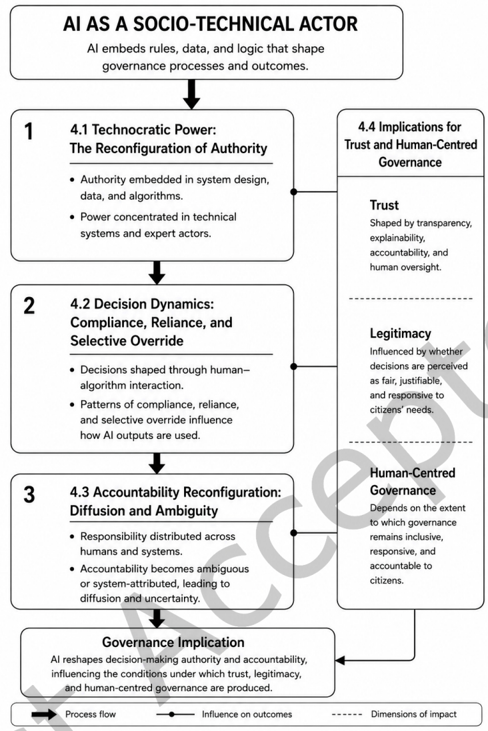
Generative AI (GenAI) is reshaping public sector decision-making, yet empirical understanding of how it reconfigures governance remains limited. Drawing on 24 semi-structured interviews with public officials in Kenya, this interpretive qualitative study examines how GenAI reshapes decision-making authority, accountability, and trust in human-centred governance. The findings identify three interrelated mechanisms: the concentration of epistemic authority in generative outputs, strongest among officials lacking the technical or situated knowledge to interrogate them; a structured pattern of default compliance and selective override, where organisational norms place the burden of justification on deviation rather than compliance; and a diffusion of accountability through system-based attribution for co-produced outputs, reversible where organisations maintained clear review and documentation. GenAI’s fluent, narrative outputs, unlike the scores and flags of earlier systems, appear to lend a persuasive authority we interpret as theoretically significant rather than formally demonstrated. Officials perceived that resulting opacity and diffused responsibility could strain institutional trust even where performance improves, reflecting their accounts rather than direct evidence from citizens. The study contributes a process-oriented, GenAI-specific analytical framework, empirically grounds hybrid discretion in organisational practice, extends emerging accounts of GenAI-specific accountability entanglement, and offers a theoretically informed account of officials’ perceptions of GenAI’s implications for institutional trust.
Overview
CoChat Summary
TL;DR
Drawing on 24 semi-structured interviews with Kenyan public officials, this interpretive study argues that generative AI reshapes public administration through three interrelated mechanisms: concentration of epistemic authority in fluent narrative outputs, default compliance with an asymmetric burden of justification for overrides, and diffusion of accountability through system-based attribution. The paper frames these as conditional rather than universal effects, and treats implications for citizen trust as officials' perceptions rather than direct evidence.
Key findings
- Epistemic authority concentrates in GenAI outputs, most strongly among officials lacking technical or situated knowledge; the paper attributes this to the persuasive form of fluent, full-sentence recommendations rather than to numerical scores or binary flags, though it states this is "theoretically significant rather than formally demonstrated."
- Decision behaviour follows a structured pattern of default compliance and selective override: deviation required written justification while adherence did not, so "the burden of proof" shifted onto human decision-makers. Overrides were reactive, triggered by conflict with local knowledge, and scepticism was experiential (arising from prior system error) rather than procedural.
- Accountability diffused via system attribution ("the system flagged it"); absence of clear accountability frameworks emerged spontaneously in 14 of 24 interviews, across all levels and all five organisations. One counterexample in a grants unit showed accountability remaining traceable where a named reviewer documented an override.
- Officials perceived that opacity and diffused responsibility could strain institutional trust even where performance improves; positive trust effects were described as contingent on transparency and comprehensible outcomes.
Methods
- Interpretive qualitative embedded single-case design: five purposively selected Kenyan public-sector organisations (anonymised A–E) participating in the national RCoC/KSG–MICDE–UNDP–Microsoft AI skilling initiative, spanning central policy, agency operations, regulatory oversight, statistics/planning, digital services, and frontline provision.
- 24 semi-structured interviews conducted November 2025–March 2026 (11 face-to-face, 13 online), each 55–70 minutes; participants had 3–18 months of GenAI use and all used it at least weekly; 2 were involved in system design/fine-tuning, 22 were end users. Systems were commercial LLMs behind custom government interfaces, deployed 10 months to 2 years, advisory only with human sign-off.
- Thematic analysis following Braun and Clarke's six phases under an abductive logic; open coding produced 347 descriptive codes grouped under three sensitising dimensions (technocratic power, decision dynamics, accountability reconfiguration). Single-coder analysis supported by a dated coding manual and audit trail; disconfirming evidence was actively sought.
Limitations
- Stated: single national context limits contextual generalisability (analytical rather than empirical generalisation); the coordinated, compressed RCoC rollout plus Kenyan capacity constraints and regulatory gaps may have made default compliance and epistemic authority concentration especially visible; the regulatory-gap severity is likely context-dependent, while the persuasive authority of narrative outputs and the asymmetric burden of justification may travel more readily.
- Stated: reliance on interview data captures accounts rather than direct observation of decision-making; the study reflects officials' perspectives only, with no citizens interviewed, so trust claims are perceptions and inferences rather than citizen-level evidence.
- Evident in the text: analysis was conducted by a single researcher without independent coding; the study was not designed to compare generative with non-generative systems, so the claim that GenAI produces stronger authority effects than earlier technologies is not empirically established; the accountability-preserving counterexample rests on a single case.
Model-written summary. Check it against the paper before relying on it.
Integrity signals
Registry
Cites
Statistics
Figures
Verification
Claims the paper makes
0 Valid · 0 Not valid · 48 Not checked · 174 Own results and interpretations
A result the paper reports from its own data — it cites no other source for it, so there is none to check. The quote shows it is in the paper.
In the paper
“Across the interviews, participants described relying on GenAI outputs not merely as advisory suggestions but as implicit determinations of appropriate action.”
§ Algorithmic Authority in Practice: Generative AI, Decision-Making, and Accountability in Public Administration > 4.1 The Concentration of Epistemic Authority in Generative Outputs
plain- Asserted: passes — The authors put it forward as true.
- Checkable: passes — It can be checked against evidence.
- Load-bearing: passes — The paper’s conclusions depend on it.
- Based: passes — The paper gives a reason why it holds.
A result the paper reports from its own data — it cites no other source for it, so there is none to check. The quote shows it is in the paper.
In the paper
“The indings identify three interrelated mechanisms: the concentration of epistemic authority in generative outputs, strongest among oicials lacking the technical or situated knowledge to interrogate them;”
§ Algorithmic Authority in Practice: Generative AI, Decision-Making, and Accountability in Public Administration > Abstract
plainstates an association- Asserted: passes — The authors put it forward as true.
- Checkable: passes — It can be checked against evidence.
- Load-bearing: passes — The paper’s conclusions depend on it.
- Based: passes — The paper gives a reason why it holds.
A result the paper reports from its own data — it cites no other source for it, so there is none to check. The quote shows it is in the paper.
In the paper
“The data indicate that GenAI introduces a distinct form of epistemic authority concentration, whereby systemgenerated outputs become the default basis for decision-making.”
§ Algorithmic Authority in Practice: Generative AI, Decision-Making, and Accountability in Public Administration > 4.1 The Concentration of Epistemic Authority in Generative Outputs
hedgedstates a cause- Asserted: passes — The authors put it forward as true.
- Checkable: passes — It can be checked against evidence.
- Load-bearing: passes — The paper’s conclusions depend on it.
- Based: passes — The paper gives a reason why it holds.
A result the paper states — it cites no source for it, so there is none to check. The quote shows it is in the paper.
In the paper
“When citizens cannot understand how decisions are made or are unaware that a generative system has been involved, oicials in this study perceived their capacity for informed engagement as substantially diminished.”
§ Algorithmic Authority in Practice: Generative AI, Decision-Making, and Accountability in Public Administration > 4.4 Implications for Trust and Human-Centred Governance
plainstates a cause- Asserted: passes — The authors put it forward as true.
- Checkable: passes — It can be checked against evidence.
- Load-bearing: passes — The paper’s conclusions depend on it.
- Based: passes — The paper gives a reason why it holds.
A result the paper states — it cites no source for it, so there is none to check. The quote shows it is in the paper.
In the paper
“Substantively, however, those decisions are increasingly shaped, structured, and constrained by system-generated outputs.”
§ Algorithmic Authority in Practice: Generative AI, Decision-Making, and Accountability in Public Administration > 5.1 GenAI and the Reconfiguration of Decision-Making Authority
plainstates a cause- Asserted: passes — The authors put it forward as true.
- Checkable: passes — It can be checked against evidence.
- Load-bearing: passes — The paper’s conclusions depend on it.
- Based: passes — The paper gives a reason why it holds.
114 more claims
Create a free account to see all 222 claims and every source verdict.
- The quote only partly states this claim. 1
- Probably not a substantial claim. 45
- It may state two separate claims as one. 71
Self-check
Percentages, sums and reported differences re-computed from the paper’s own numbers.
Each contradiction between two passages listed here was confirmed by an independent check.
Rated minor: it would not touch a result — a value no result rests on, a p-value that stays on the same side of the significance level, or a conflict that is clerical, resolved elsewhere in the paper, or outside its own findings.
In the paper
§ Algorithmic Authority in Practice: Generative AI, Decision-Making, and Accountability in Public Administration > 4.2 Paterns of Compliance, Reliance, and Selective Override
“A statistics and planning professional reported that łyou can question the system, but you need strong justiicationÐotherwise it's easier to just go with itž (P15, Statistics and Planning Professional).”
§ Algorithmic Authority in Practice: Generative AI, Decision-Making, and Accountability in Public Administration > 4.2 Paterns of Compliance, Reliance, and Selective Override
“The same participant located the source of this diiculty speciically in the form of the system's output: When you want to go against it, you have to explain yourself.And the system has already given its reasonsÐin full sentences, in a logical order.So you're not disagreeing with a number, you're disagreeing with an argument.That's harder, and it looks worse on the ile.(P13, Statistics and Planning Professional).”
Citations
Cites
Using thematic analysis in psychology
Braun, V., & Clarke, V. (2006) · Qualitative Research in Psychology · doi:10.1191/1478088706qp063oa · Cited by 194,414
Saturation in qualitative research: exploring its conceptualization and operationalization
Saunders, B., Sim, J., Kingstone, T., Baker, S., Waterfield, J., Bartlam, B., Burroughs, H., & Jinks, C. (2018) · Quality & Quantity · doi:10.1007/s11135-017-0574-8 · Cited by 12,033
What is an adequate sample size? Operationalising data saturation for theory-based interview studies
Francis, J. J., Johnston, M., Robertson, C., Glidewell, L., Entwistle, V., Eccles, M. P., & Grimshaw, J. M. (2010) · Psychology & Health · doi:10.1080/08870440903194015 · Cited by 3,429
What is Wrong with Social Theory?
Blumer, H. (1954) · American Sociological Review · doi:10.2307/2088165 · Cited by 2,535
Kuziemski, M., & Misuraca, G. (2020) · Telecommunications Policy · doi:10.1016/j.telpol.2020.101976 · Cited by 610
Alon-Barkat, S., & Busuioc, M. (2023) · Journal of Public Administration Research and Theory · doi:10.1093/jopart/muac007 · Cited by 469
Laux, J., Wachter, S., & Mittelstadt, B. (2024) · Regulation & Governance · doi:10.1111/rego.12512 · Cited by 365
The challenges and limits of big data algorithms in technocratic governance
Janssen, M., & Kuk, G. (2016) · Government Information Quarterly · doi:10.1016/j.giq.2016.08.011 · Cited by 363
Katzenbach, C., & Ulbricht, L. (2019) · Internet Policy Review · doi:10.14763/2019.4.1424 · Cited by 359
Young, M. M., Bullock, J. B., & Lecy, J. D. (2019) · Perspectives on Public Management and Governance · doi:10.1093/ppmgov/gvz014 · Cited by 255
Research works printed but not linked: 7
- Alan Bryman, Edward Bell, and James J Teevan. 2012. Social research methods. Vol. 4. Oxford university press Oxford.
- Cary Coglianese and David Lehr. 2019. Transparency and Algorithmic Governance. Administrative Law Review 71, 1 (2019), 1–56.
- Martyn Denscombe. 2017. EBOOK: The good research guide: For small-scale social research projects. McGraw-Hill Education (UK).
- Michael Quinn Patton. 2015. Qualitative Research & Evaluation Methods(4 ed.). SAGE Publications, Thousand Oaks, CA.
- Piotr Rutkowski. 2025. AI-Driven Solutions as Pharmakon in Political Decision-Making: Depoliticisation, Technocracy, and the Aesthetic Dimensions of Governance. In Organizations, Humanism and AI. Routledge, 57–78.
- Kuika J. Watat, G. M. Jonathan, and L. Zhang. 2025. Why Generative Artificial Intelligence Does Not Survive First Contact with Bureaucracy. In Proceedings of the International Conference on Information Systems (ICIS 2025). Association for Information Systems (AIS), 1–8.
- Robert K Yin. 2018. Case study research and applications. Vol. 6. Sage Thousand Oaks, CA.
Cited by
Still being checked.
Metadata
- Authors
- Jonathan, G. M.
- Affiliations
- Stockholm University (SE)
- Corresponding author
- Jonathan, Gideon Mekonnen
- Venue
- Digital Government: Research and Practice
- Published
- 2026-11-05
- ISSN
- 2639-0175 (ISSN-L)
- 2691-199X
- OpenAlex
- W7225308130
- Semantic Scholar
- 2865f29ed9a561275ce221a1a86ba5463c0bc314
- Cited by
- 0
- References
- 21
- FWCI
- 0.00
- Type
- journal article
- Language
- en
- Open access
- hybrid
- doi.org
- Licence
- cc-by
- Locations
- Digital Government Research and Practice (publishedVersion, cc-by)
- Topics
- Social Sciences › Political Science and International Relations › E-Government and Public Services
- Physical Sciences › Computer Science › Artificial Intelligence › Ethics and Social Impacts of AI
- Social Sciences › Public Administration › Public Policy and Administration Research
- Keywords
- generative AI, public administration, decision-making power, accountability, institutional trust, epistemic authority, organizational norms, Kenya
About these checks
Registry, retraction, Cites and statistics results are computed, not judged, with one exception: a printed reference that no index lists is read once by a model before it counts as a citation error. Claims are extracted by a model and kept only when their quote appears verbatim in the text; each cited source is then checked, with a model’s help, for whether it says what the claim relies on. Those verdicts can be wrong — read the claim’s quote and the cited source before relying on one.
A language model drew the claims from the paper on 2026-11-14, under version 3 of the claim definition (model deepseek-v4.1-flash, prompt extract-v3).
A second model labelled each claim on 2026-11-14 (model jev-1.13-20260917, definition revision gold-guideline-v0.2).
Statistics and arithmetic are recomputed, not judged.
Confidence bands are shown only for fields calibrated on our annotated test set. None is calibrated yet, so no band is shown.
What counts as a claim ›How we measure confidence ›How we check this ›
Are you an author, or do you see a problem with this page? Request a review
How to cite
Cite CoChat for the checks on this page, and the paper for its own findings.
- This page
- CoChat. (2026). Citation check: Algorithmic Authority in Practice: Generative AI, Decision-Making, and Accountability in Public Administration. https://app.cochat.ai/papers/10.1145/3859490
- The paper
- Jonathan, G. M. (2026). Algorithmic Authority in Practice: Generative AI, Decision-Making, and Accountability in Public Administration. Digital Government: Research and Practice. https://doi.org/10.1145/3859490
Data sources
Bibliographic data: Semantic Scholar, OpenAlex, Crossref.
Contains information from the Semantic Scholar Academic Graph Datasets, made available under the ODC Attribution License (ODC-BY 1.0).
Semantic Scholar’s data is described in: Kinney, R., et al. (2023). The Semantic Scholar Open Data Platform. arXiv:2301.10140.
