

The Market Stability Reserve in the EU Emissions Trading System: A Critical Review
Open accessThe DOI matches its Crossref record; 91 of the 92 references it cites were found in a registry or an index; 20 of the 72 sources its claims cite were checked for support.
Abstract
Having experienced low prices for about a decade, the European Union Emissions Trading System has been supplemented with the market stability reserve (MSR) that adjusts the supply of allowances to market outcomes. We critically review the literature assessing the performance of the MSR against several policy objectives. In doing so, we cover both conceptual aspects and quantitative assessments. We conclude by pointing out important policy implications and open issues for further research.
Overview
CoChat Summary
TL;DR
This critical review assesses the EU ETS Market Stability Reserve (MSR) and concludes that it helped reduce the allowance overhang and revived prices in the short run, but does not reliably deliver its stated goals of increasing resilience and synergies with overlapping policies. It argues the banking-based design lacks a clear economic rationale and can destabilize prices, especially for anticipated shocks.
Key findings
- The MSR was introduced after a surplus of approximately 140% of annual ETS emissions in 2018. It adjusts supply via the total number of allowances in circulation (TNAC): intake above 833 million allowances, release of 100 million below 400 million, and idle in between. The 2018 reform doubled the intake rate and added cancellations, making the long-run cap endogenous.
- Short-term price support is limited, while long-term price and cancellation effects are highly uncertain. Cumulative MSR cancellation estimates range from 1–13 GtCO2 (Osorio et al. 2021) or 1–15 GtCO2 in Table 1; Bruninx et al. (2020) find 5.6–17.8 GtCO2 across demand trajectories; Quemin & Trotignon (2021) find around 5 GtCO2 under infinite horizon and around 10.5 versus 8 GtCO2 under rolling finite horizon with versus without full sophistication.
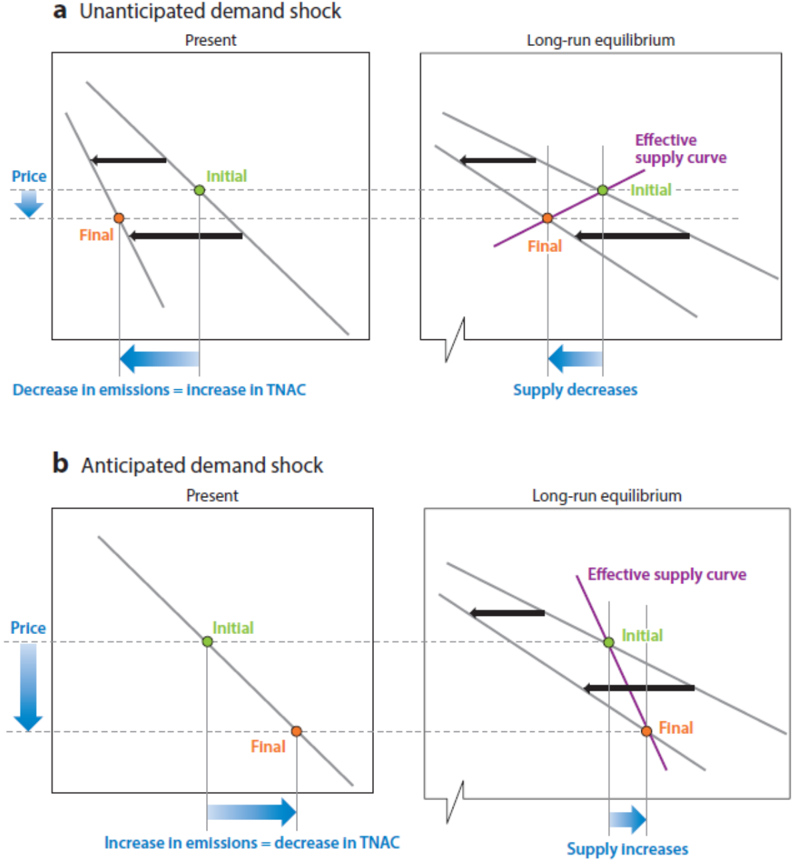
- Anticipated demand-reducing policies can backfire: if future scarcity falls, current prices drop, emissions rise, banking and MSR cancellations fall, potentially increasing total emissions (a green paradox). Unanticipated shocks are buffered, but anticipated shocks can make the implicit allowance supply curve downward-sloping and amplify price responses and self-fulfilling prophecies.
- The 2023 reform postpones the intake-rate decrease from 24% to 12% from 2023 to 2030, applies a 100% marginal intake rate when TNAC is between 833 and 1,096 million allowances, and caps the MSR at 400 million allowances from 2023. It retains the banking-based approach, so stabilizing and destabilizing effects may both strengthen.
Methods
- Critical literature review, not new empirical analysis. It covers conceptual/theoretical and applied/simulation-based studies on MSR performance.
- Organizes assessment around MSR objectives: short- and long-term price levels, price volatility/stability/resilience to shocks, and interactions with overlapping climate and energy policies; summarizes quantitative estimates in Table 1.
- Draws on studies using stylized theoretical models, detailed simulation models (e.g., electricity and industry sectors), stochastic dynamic optimization, and calibrated models with different assumptions about firm behavior.
Limitations
- Stated: MSR impacts are extremely sensitive to modeling approaches, parameters, and assumptions about firm behavior (e.g., cost optimization, discount rate, planning horizon, risk aversion); quantitative estimates vary widely; the objective of increasing low-carbon investment incentives is the least quantified; some analyses do not back-cast, so effect sizes may be unrealistic.
- Stated: no research to date on policymakers’ beliefs about MSR effects; the political dimension and market microstructure/noncompliance actors are understudied.
- Evident: As a review, findings synthesize existing literature rather than provide new primary data; conclusions depend on the reviewed studies’ models and assumptions, and the paper itself notes there is no single metric for MSR effectiveness.
Model-written summary. Check it against the paper before relying on it.
Integrity signals
Registry
Cites
Statistics
Figures
Verification
Claims the paper makes
19 Valid · 2 Not valid · 35 Not checked · 48 Own results and interpretations
The cited sources support only part of this claim — read each source’s verdict below.
In the paper
“If at the time the actual demand reduction takes place when the MSR has stopped taking in allowances, then the net effect of announcing a future allowance-demand-reducing climate policy is to increase total emissions (see Figure 1 b ).”
What the sources say
- Supportedcites Gerlagh et al. (2021) matched to “An endogenous emissions cap produces a green paradox” (2021) source
Section 3.4 reports that when a demand-reducing policy is announced in 2020 but takes effect in 2048 or later, its net effect in the simulations is to increase cumulative emissions. Section 3.3 identifies 2048 as the point after which the MSR stops taking in allowances. No page number is provided in the supplied passages. (LLM, conf=0.92)
- Not matchedcites Perino et al. (2022a)
More than one paper fits this citation.
plainstates a cause- Asserted: passes — The authors put it forward as true.
- Checkable: passes — It can be checked against evidence.
- Load-bearing: passes — The paper’s conclusions depend on it.
- Based: passes — The paper gives a reason why it holds.
- Supported
The cited sources support only part of this claim — read each source’s verdict below.
In the paper
“Gerlagh et al. (2021) and Perino et al. (2022a) formally show that adjusting the long-run cap based on the number of banked allowances is a double-edged sword.”
What the sources say
- Supportedcites Gerlagh et al. (2021) matched to “An endogenous emissions cap produces a green paradox” (2021) source
The Model section shows both edges of a cap tied to banked allowances: cancellation makes early demand-reducing policies lower cumulative emissions, but anticipated future demand reductions can instead increase them. The Policy Implications section likewise says MSR cancellation reduces emissions overall while its interaction with other emissions-reducing policies may be counterproductive. Page numbers are unavailable in our copy. (LLM, conf=0.93)
- Not matchedcites Perino et al. (2022a)
More than one paper fits this citation.
boosted- Asserted: passes — The authors put it forward as true.
- Checkable: passes — It can be checked against evidence.
- Load-bearing: passes — The paper’s conclusions depend on it.
- Based: passes — The paper gives a reason why it holds.
- Supported
Every source the paper cites for this claim was checked and supports it.
In the paper
“Illustrating the importance of these factors, Baudry et al. (2021) find that ignoring transaction costs can lead to underestimating the price increase in response to a reduction in supply (as is the case under the current MSR withdrawal mode).”
What the sources say
- Supportedcites Baudry et al. (2021) matched to “Emissions trading with transaction costs” (2021) source
The Introduction states that, in the authors’ calibrated setting, ignoring transaction costs underestimates the price increase following a reduction in total permits. Section 4.2.1 likewise reports larger price increases with trading costs than in the frictionless case. The claim says this *can* happen, which fits the paper’s qualified finding. (LLM, conf=0.94)
plainstates a cause- Asserted: passes — The authors put it forward as true.
- Checkable: passes — It can be checked against evidence.
- Load-bearing: passes — The paper’s conclusions depend on it.
- Based: passes — The paper gives a reason why it holds.
- Supported
The cited sources support only part of this claim — read each source’s verdict below.
In the paper
“They quantify how the effect of the MSR on the long-term price is highly dependent on the discount rate (a higher discount rate implies less banking and thus fewer cancellations) and the linear reduction factor (LRF; a higher LRF implies more banking and thus more cancellations but this effect saturates).”
What the sources say
- Partly supportedcites Osorio et al. (2021) matched to “Reviewing the Market Stability Reserve in light of more ambitious EU ETS emission targets” (2021) sourceExperimental — accuracy not yet measured
Section 2 explains that a higher discount rate means less banking and fewer MSR cancellations; Section 3.4.1 finds that increasing the LRF initially raises cancellations, but that the effect weakens and reverses above about 3%. The paper links cancellations to higher allowance prices in Section 3.2, but the cited passages quantify sensitivity of cancellations, not the MSR’s effect on the long-term price as the claim states. Page numbers were not available in our copy. (LLM, conf=0.86)
plainstates an association- Asserted: passes — The authors put it forward as true.
- Checkable: passes — It can be checked against evidence.
- Load-bearing: passes — The paper’s conclusions depend on it.
- Based: passes — The paper gives a reason why it holds.
- Partly supported
The cited sources support only part of this claim — read each source’s verdict below.
In the paper
“First, it sustains multiple equilibria and affects market liquidity in ways that blur predictability of market outcomes (Gerlagh et al. 2021, Perino et al. 2022b)”
What the sources say
- Supportedcites Gerlagh et al. 2021 matched to “An endogenous emissions cap produces a green paradox” (2021) source
Appendix C, in the Figure 5 caption, explicitly describes “the multiplicity of equilibria generated by the MSR” and identifies three equilibria in the illustrated case. (LLM, conf=0.94)
- Not matchedcites Perino et al. 2022b
More than one paper fits this citation.
plainstates a cause- Asserted: passes — The authors put it forward as true.
- Checkable: passes — It can be checked against evidence.
- Load-bearing: passes — The paper’s conclusions depend on it.
- Based: passes — The paper gives a reason why it holds.
- Supported
44 more claims · 3 with their cited sources checked
Create a free account to see all 104 claims and to verify the 10 references still open.
- It may state two separate claims as one. 41
- Probably not a substantial claim. 23
Self-check
Percentages, sums and reported differences re-computed from the paper’s own numbers.
Each contradiction between two passages listed here was confirmed by an independent check.
Rated minor: it would not touch a result — a value no result rests on, a p-value that stays on the same side of the significance level, or a conflict that is clerical, resolved elsewhere in the paper, or outside its own findings.
In the paper
§ 3.2. Applied Analysis
“Total cancellation volume and hence scale of price rise highly uncertain (1-15 GtCO 2 range)”
§ 3.2. Applied Analysis
“they find cancellations by the MSR spanning 5.6 to 17.8 GtCO2 for different demand trajectories.”
Citations
Cites
Noise Trader Risk in Financial Markets
De Long, J. B., Shleifer, A., Summers, L. H., & Waldmann, R. J. (1990) · Journal of Political Economy · doi:10.1086/261703 · Cited by 6,234 · cited 1×
“…flexibility mechanisms should neither invite speculative trading nor undermine market stability in the sense of ensuring the ability of market forces to keep prices in line with fundamentals (i.e., anticipated allowance scarcity) and keep the impact of noise trading in check (De Long et al.1990).”
BackgroundWeitzman, M. L. (1974) · The Review of Economic Studies · doi:10.2307/2296698 · Cited by 2,071
Effluent charges and licenses under uncertainty
Roberts, M. J., & Spence, M. (1976) · Journal of Public Economics · doi:10.1016/0047-2727(76)90014-1 · Cited by 775
Combining price and quantity controls to mitigate global climate change
Pizer, W. A. (2002) · Journal of Public Economics · doi:10.1016/s0047-2727(01)00118-9 · Cited by 697 · cited 2×
“Although previous theoretical (Roberts & Spence 1976, Pizer 2002, Newell et al. 2005, Murray et al. 2009, Burtraw et al. 2022) and most practical [Regional Greenhouse Gas Initiative (RGGI), California’s cap-and-trade program] attempts at managing allowance markets have explicitly defined allowance…”
BackgroundThe European Union Emissions Trading Scheme: Origins, Allocation, and Early Results
Ellerman, A. D., & Buchner, B. K. (2007) · Review of Environmental Economics and Policy · doi:10.1093/reep/rem003 · Cited by 656 · cited 1×
“Due to several constraints caused by, for example, the retention of sovereignty in taxation by its member states, an EU-wide harmonized carbon tax was politically infeasible (Christiansen & Wettestad 2003, Ellerman & Buchner 2007).”
BackgroundKoch, N., Fuss, S., Grosjean, G., & Edenhofer, O. (2014) · Energy Policy · doi:10.1016/j.enpol.2014.06.024 · Cited by 448 · cited 1×
“There was no sustained impact on prices as would be expected in a market with well-functioning intertemporal arbitrage (Koch et al. 2014, Richstein et al. 2015, Salant 2016, Chaton et al. 2018).”
BackgroundPolitical internalization of economic externalities and environmental policy
Aidt, T. S. (1998) · Journal of Public Economics · doi:10.1016/s0047-2727(98)00006-1 · Cited by 365 · cited 1×
“Further economic research could complement and extend this line of work, notably in the tradition of endogenous environmental policy in a common agency model of politics (see,notably,Aidt 1998).”
BackgroundBankable permits for the control of environmental pollution
Kling, C., & Rubin, J. (1997) · Journal of Public Economics · doi:10.1016/s0047-2727(96)01600-3 · Cited by 273 · cited 1×
“They build on the work of Kling & Rubin (1997), who suggested a time-dependent trading ratio to move allowances from one period to the next and combine it with a rule to set the cap in the final period that includes counterbalancing the bank of allowances.”
BackgroundSchennach, S. M. (2000) · Journal of Environmental Economics and Management · doi:10.1006/jeem.1999.1122 · Cited by 268 · cited 1×
“In between these two types of approaches, Quemin & Trotignon (2021) derive expected equilibrium paths along certainty-equivalent paths for baseline emissions, invoking a first-order approximation first suggested by Schennach (2000).”
BackgroundNew EU ETS Phase 4 rules temporarily puncture waterbed
Perino, G. (2018) · Nature Climate Change · doi:10.1038/s41558-018-0120-2 · Cited by 192
Self-citation
Research works printed but not linked: 16
- Burtraw D. 2015. Low Allowance Prices in the EU Emissions Trading System: New Research on an Evolving Program. Resources Magazine, 15 June 2015, Resources for the Future. https://www.resurces.org/common-resources/low-allowance-prices-in-the-eu-emissions-tradi ng-system-new-research-on-an-evolving-program/
- Doda B, Verde S, Borghesi S. 2022. ETS alignment: a price collar proposal for carbon market integration . Tech. Rep. 2022/02, Florence Sch. Regul., Eur. Univ. Inst., Florence, It.
- ESMA. 2022. Final Report on Emission Allowances and Associated Derivatives. ESMA70-445-38.
- Eur. Parliam., 2022, Amendments adopted by the European Parliament on 22 June 2022 on the proposal for a directive of the European Parliament and of the Council amending Directive 2003/87/EC establishing a system for greenhouse gas emission allowance trading within the Union, Decision (EU) 2015/1814 concerning the establishment and operation of a market stability reserve for the Union greenhouse gas emission trading scheme and Regulation (EU) 2015/757 (COM20210551–C9-0318/2021-2021/0211(COD)
- Eur. Comm. 2014. Impact assessment accompanying the proposal to establish and operate a market stability reserve in the EU-ETS.
- Eur. Parliam. Counc. 2015. DECISION (EU) 2015/1814 OF THE EUROPEAN PARLIAMENT AND OF THE COUNCIL of 6 October 2015 Concerning the Establishment and Operation of a Market Stability Reserve for the Union Greenhouse Gas Emission Trading Scheme and Amending Directive 2003/87/EC. Off. J. Eur. Union 9.10.2015:L264/1-L264/5
- Eur. Comm. 2018. Publication of the Total Number of Allowances in Circulation in 2017 for the Purposes of the Market Stability Reserve under the EU Emissions Trading System Established by Directive 2003/87/EC.
- Eur. Parliam. 2022. Amendments adopted by the European Parliament on 22 June 2022 on the proposal for a directive of the European Parliament and of the Council amending Directive 2003/87/EC establishing a system for greenhouse gas emission allowance trading within the Union, Decision (EU) 2015/1814 concerning the establishment and operation of a market stability reserve for the Union greenhouse gas emission trading scheme and Regulation (EU) 2015/757 (COM20210551 - C9-0318/2021-2021/0211(COD)
- Friedrich M, Mauer EM, Pahle M, Tietjen O. 2020b. From fundamentals to financial assets: the evolution of understanding price formation in the EU ETS . Work. Pap., ZBW-Leibniz Inf. Cent. Econ., Kiel/Hamburg, Ger.
- Umweltbundesamt. 2022. Trading activities and strategies in the European carbon market . Climate Change | 16/2022, German Environment Agency. https://www.umweltbundesamt.de/publikationen/trading-activities-strategies-in-the-european
- Marcu A, López Hernandéz J, De Graeve B. 2023. EU ETS Review: Political agreement after trilogues . Policy Brief, Roundtable Clim. Change Sustain. Transit., Brussels
- Pahle M, Edenhofer O. 2021. Discretionary intervention destabilizes the EU Emissions Trading System: evidence and recommendations for a rule-based cap adjustment. CESifo Forum 22(3):41-46
- Pirrong SC. 2009. Market oversight for cap-and-trade: efficiently regulating the carbon derivatives market . Policy Brief 09-04, Energy Secur. Init., Brookings Inst., Washington, DC
- Reg. Greenhouse Gas Init. 2017. 2017 Model Rule-Part XX CO2 Budget Trading Program. Tech. rep., Regional Greenhouse Gas Initiative https://www.rggi.org/sites/default/files/Uploads/Design-Archive/Model-Rule/2017-ProgramReview-Update/2017\_Model\_Rule\_revised.pdf
- Weitzman ML. 1978. Optimal rewards for economic regulation. Am. Econ. Rev. 68(4):683-91
- Willner M, Perino G. 2022a. An upgrade for the EU ETS: Making Art. 29a and 30h fit for effective price containment . Policy Brief, Cent. Earth Syst. Res. Sustain., Hamburg, Ger.
Cited by
The environmental-financial performance nexus of EU ETS firms: A quantile regression approach
Flori, A., Borghesi, S., & Marin, G. (2024) · Energy Economics · doi:10.1016/j.eneco.2024.107328 · Cited by 50
“…et al., 2017), while others have analysed the policy design of the EU ETS (see, e.g., Sijm, 2005; Hepburn et al., 2006; Convery, 2009; De Perthuis and Trotignon, 2014; Kollenberg and Taschini, 2016; Koch et al., 2016; Perino and Willner, 2016; Naegele and Zaklan, 2019 and Borghesi et al., 2023).”
BackgroundSelf-citationThe emerging endgame: The EU ETS on the road towards climate neutrality
Pahle, M., Quemin, S., Osorio, S., Günther, C., & Pietzcker, R. (2025) · Resource and Energy Economics · doi:10.1016/j.reseneeco.2024.101476 · Cited by 72
Self-citationDesign and impact assessment of policies to overcome oversupply in China's national carbon market
Ji, C.-J., Wang, X., Wang, X.-Y., & Tang, B.-J. (2024) · Journal of Environmental Management · doi:10.1016/j.jenvman.2024.120388 · Cited by 38
The Emerging Endgame: The EU ETS on the Road Towards Climate NeutralityPreprint
Pahle, M., Quemin, S., Osorio, S., Günther, C., & Pietzcker, R. (2023) · SSRN Electronic Journal · doi:10.2139/ssrn.4373443 · Cited by 41
“This is amplified by regulatory uncertainty: First, tapping into the MSR to fund part of the REPowerEU plan may possibly undermine confidence in the system overall (Borghesi et al., 2023).”
Self-citationPerino, G., Ritz, R. A., & van Benthem, A. (2025) · The Economic Journal · doi:10.1093/ej/ueaf021 · Cited by 32
Self-citationReal options analysis of decarbonization investments in the chemical industry
Tautorat, P., Iversen, J., Schmidt, T. S., & Steffen, B. (2025) · Applied Energy · doi:10.1016/j.apenergy.2025.126238 · Cited by 14
Carbon market design and market sentiment
Perino, G. (2024) · Journal of Environmental Economics and Management · doi:10.1016/j.jeem.2024.103057 · Cited by 16
Self-citationSequencing Carbon Dioxide Removal into the EU ETSPreprint
Sultani, D., Osorio, S., Günther, C., Pahle, M., Sievert, K., Schmidt, T. S., Steffen, B., & Edenhofer, O. (2024) · SSRN Electronic Journal · doi:10.2139/ssrn.4875550 · Cited by 24
“…well, substantial concerns exist regarding its capacity to perform its second intended function, i.e. whether it is fit to uphold the ETS’ resilience to major shocks by adjusting the supply of allowances to be auctioned (Perino, 2018; Osorio et al, 2021; Perino et al, 2022; Borghesi et al, 2023).”
BackgroundSelf-citationSearching for a Carbon Laffer Curve: Estimates from the European Union Emissions Trading System
Mazzarano, M., & Borghesi, S. (2024) · Metroeconomica · doi:10.1111/meca.12458 · Cited by 10
“In the first group of regressions, it could be argued that auctioned volumes might not be strictly exogenous: the MSR modifies auction volumes in response to an unbalance between the demand and supply of allowances (Borghesi et al., 2023).”
Self-citationBridging the gap: a review on the interaction between (micro)plastics and climate change
da Costa, J. P. (2025) · Philosophical Transactions of the Royal Society A Mathematical Physical and Engineering Sciences · doi:10.1098/rsta.2024.0501 · Cited by 10
Technology Diffusion in Carbon Markets: Evidence from Aviation
Fageda, X., & Teixido-Figueras, J. J. (2025) · Environmental and Resource Economics · doi:10.1007/s10640-025-01047-0 · Cited by 7
“It was expected to affect both levels and the volatility of carbon prices (Borghesi et al. 2023; Bruninx et al. 2020 ; Perino and Willner 2016 ), which appears to have been confirmed by recent high and increasing carbon prices.”
Uncovering drivers of EU carbon futures with Bayesian networks
Maciejowski, J., & Leonelli, M. (2025) · Applied Energy · doi:10.1016/j.apenergy.2025.127034 · Cited by 7
“Both Borghesi et al. (2023) and Salvagnin et al. (2024) note that regulatory uncertainty about the future configuration of these mechanisms, especially during global events or geopolitical disruptions, can lead to volatile price movements.”
Impact of different CO2 price paths on the development of the European electricity system
Tekin, E., Gillich, A., & Hufendiek, K. (2024) · Energy Strategy Reviews · doi:10.1016/j.esr.2024.101499 · Cited by 7
Endowment effects, expectations, and trading behavior in carbon cap and trade
Yoon, B., Filipski, M., Landry, C. E., & Yoo, S. J. (2024) · Energy Economics · doi:10.1016/j.eneco.2024.107927 · Cited by 6
What determines the price of carbon? New evidence from phase III and IV of the EU ETS
Dittmann, B., Lauter, T., Prokopczuk, M., & Sibbertsen, P. (2025) · Journal of Climate Finance · doi:10.1016/j.jclimf.2025.100070 · Cited by 12
Technology Diffusion in Carbon Markets: Evidence from AviationPreprint
Fageda, X., & Teixido-Figueras, J. J. (2024) · SSRN Electronic Journal · doi:10.2139/ssrn.4891205 · Cited by 4
Emission Reduction Effect of Carbon Trading Policy Based on Multi-Period DID and Synergy Effect
Li, P., Xu, L., Gu, X., & Chen, Y. (2025) · Sustainability · doi:10.3390/su17114764 · Cited by 3
“Borghesi et al. [4] systematically evaluated the design and efficacy of the EU ETS Market Stability Reserve (MSR), observing that while MSR mitigated carbon price volatility and enhanced resilience to external shocks, its operational complexity and regulatory uncertainty weakened market…”
Multi-step ahead carbon credit price forecasting using time series foundation models
Jiang, L. L., Cheong, W. S., & Ling, J. N. S. (2026) · Applied Soft Computing · doi:10.1016/j.asoc.2026.115290 · Cited by 3
Brown Price and Green Firms: An ETS Price Floor for a Clean Transition?
Borghesi, S., Comincioli, N., Kort, P. M., Thijssen, J., & Vergalli, S. (2025) · Environmental and Resource Economics · doi:10.1007/s10640-025-00984-0 · Cited by 4
“…e u - e t s / f r e e - a l l o c a t i o n _ e n. during recent crises, some adjustments might be needed in the future to address the rapidly changing and increasingly uncertain context and the expected shortage of allowances as the cap moves to zero (Flachsland et al. 2018; Borghesi et al. 2023).”
Self-citationEndowment Effects, Expectations, and Trading Behavior in Carbon Cap and TradePreprint
Yoon, B., Filipski, M., Landry, C. E., et al. (2023) · SSRN Electronic Journal · doi:10.2139/ssrn.4486520 · Cited by 2
Hiçyılmaz, B., & Karakaya, E. (2023) · Elsevier eBooks · doi:10.1016/b978-0-44-313776-1.00167-7 · Cited by 2
Emissions Trading with Supply Adjustment Mechanisms and Market PowerPreprint
Brinker, T., Quemin, S., & Schoch, N. (2025) · SSRN Electronic Journal · doi:10.2139/ssrn.5354164 · Cited by 2
Self-citationPlarre, A., Slednev, V., & Fïchtner, W. (2025) · International Conference on the European Energy Market (EEM) · doi:10.1109/eem64765.2025.11050219 · Cited by 1
“At the same time, the volatility of CO₂ prices poses uncertainties for long-term investment decisions, particularly with regard to low-emission technologies [1].”
Virtuous and vicious cycles in the energy transition
Collett, M., Barbrook-Johnson, P., Rosenow, J., Sharpe, S., & Grubb, M. J. (2026) · Nature Reviews Clean Technology · doi:10.1038/s44359-026-00149-2 · Cited by 3
Hu, Y., & Luo, A.-L. (2026) · Energy Strategy Reviews · doi:10.1016/j.esr.2026.102200 · Cited by 4
Carbon Neutrality and Net-Zero Regulation
Biagini, S. (2025) · SIAM Journal on Financial Mathematics · doi:10.1137/24m1701149 · Cited by 1
The Emerging Endgame: The EU Ets on the Road Towards Climate NeutralityPreprint
Pahle, M., Quemin, S., Osorio, S., Günther, C., & Pietzcker, R. (2024) · SSRN Electronic Journal · doi:10.2139/ssrn.4707860 · Cited by 1
Self-citationThe Impact of Information Provision on Revealed-Preference Support for Climate PoliciesPreprint
Flörchinger, D., Perino, G., Frondel, M., & Jarke-Neuert, J. (2024) · SSRN Electronic Journal · doi:10.2139/ssrn.4798209 · Cited by 1
Self-citationRegulating the Trade in Cap-and-TradePreprint
Sun, J., & Yueshen, B. Z. (2025) · SSRN Electronic Journal · doi:10.2139/ssrn.5062560
Ensuring Transparency in Carbon Markets With Blockchain Technology
Panwar, R., Kumar, A., Dhar, P., Sharma, A. K., Sharma, A., & Goel, P. K. (2025) · IGI Global eBooks · doi:10.4018/979-8-3373-2091-5.ch007
The EU ETS is unprepared for 2040 and beyond 1Preprint
Koten, S. V. (2025) · SSRN Electronic Journal · doi:10.2139/ssrn.5324241
The Impact of Sector Coupling on Climate Policy Regulations
Böhringer, C., & Helm, C. (2025) · Journal of the Association of Environmental and Resource Economists · doi:10.1086/737529
The EU Ets is Unprepared for 2040 and BeyondPreprint
Koten, S. V. (2025) · SSRN Electronic Journal · doi:10.2139/ssrn.5364084
Climate calm? Long-run temperature signals and volatility in EU carbon futures
Morales, A. B. (2026) · International Review of Economics & Finance · doi:10.1016/j.iref.2026.105221
Carbon Pricing, Strategic Play, and Market Efficiency *Preprint
Bohland, M., Goerg, S. J., & Schwenen, S. (2025) · SSRN Electronic Journal · doi:10.2139/ssrn.5665951
Xu, J., Ma, C., Dong, Y., et al. (2026) · Lecture notes on data engineering and communications technologies · doi:10.1007/978-981-95-2348-1_15
Grether, J., & Monney, M. (2026) · Sustainability · doi:10.3390/su18010482
Andrae, S. (2026) · IGI Global eBooks · doi:10.4018/979-8-3373-6219-9.ch002
Liu, P., Cai, G., & Yang, L. (2026) · Renewable and Sustainable Energy Reviews · doi:10.1016/j.rser.2026.116731
A generalized MILP framework for plant-level decarbonization
Ahmed, M., Brown, S., & Cordiner, J. (2026) · Energy Conversion and Management X · doi:10.1016/j.ecmx.2026.101677
Governing the energy transition through the EU carbon market as a complex adaptive system
Wu, G. (2026) · Discover Sustainability · doi:10.1007/s43621-026-02949-9 · Cited by 2
Policy credibility and speculation in the EU ETSPreprint
Terranova, R., Campiglio, E., & Reissl, S. (2026) · SSRN Electronic Journal · doi:10.2139/ssrn.6528976
The Determinants of acceptability of environmental policies
Ibarra, S. I. (2024) · theses.fr (ABES) · doi:10.70675/2a470fe9zda83z4311za398z8889002c1795 · Cited by 1
Ein Kompass für die Reform des europäischen Emissionshandels
Pahle, M. (2026) · Wirtschaftsdienst · doi:10.2478/wd-2026-0082
Self-citationPrimary and Secondary ETS Markets: Carbon Derivatives and the Economic Nature of CO₂Preprint
Foggia, G. D., Beccarello, M., & Jammeh, B. (2026) · Qeios · doi:10.32388/oci53z
Digital Signal Precision and Carbon Price Stability
Hu, X. (2026) · Journal of Digital Economy · doi:10.1016/j.jdec.2026.06.003
PYSEUS: A Closed Optimization Framework Linking EU ETS Design and Long-Term PowerSystem Evolution
Plarre, A., & Slednev, V. (2026) · International Conference on the European Energy Market (EEM) · doi:10.1109/eem68581.2026.11589822
Modeling EUA price dynamics: A multistage PDE framework with Market Stability Reserve mechanisms
Chen, T.-F., Chiu, H., & Shen, C. (2026) · International Review of Economics & Finance · doi:10.1016/j.iref.2026.105626 · Cited by 1
Franco, Á. M. G., Casasola, S. D., & Soto, H. S. (2026) · Economies · doi:10.3390/economies14070287 · Cited by 1
“Regulatory credibility is another key factor in the economic logic of an ETS, as it directly shapes investment decisions and organizational commitments to adopt sustainable mitigation strategies (Borghesi et al., 2023).”
InfluentialOh, S. (2026) · Energy Research & Social Science · doi:10.1016/j.erss.2026.104857
Coordination Models for Carbon Dual Control and Carbon Market Cap Setting under Market Expansion
Sun, Q., Zhao, Z., & Lv, C. (2026) · doi:10.1109/sesg69629.2026.11634466
Foggia, G. D., Beccarello, M., Arrigo, U., & Jammeh, B. (2026) · SSRN Electronic Journal · doi:10.2139/ssrn.7353595
Predicting Carbon Prices with Explainable Time-Varying Feature Selection: Evidence from the EU ETS
Jiang, H., & Cao, R. (2026) · Computational Economics · doi:10.1007/s10614-026-11412-w
Liu, X. (2026) · Energy and climate management. · doi:10.26599/ecm.2026.9400042
Climate Regulation, Firm Emissions, and Green Takeovers a
Jonghe, O. D., Mulier, K., Schepens, G., & STIMPFLE, L. (2026) · Journal of money credit and banking · doi:10.1111/jmcb.70089 · Cited by 1
Metadata
- Authors
- Borghesi, S., Pahle, M., Perino, G., Quemin, S., & Willner, M.
- Affiliations
- University of Siena (IT)
- Potsdam Institute for Climate Impact Research (DE)
- Universität Hamburg (DE)
- Électricité de France (France) (FR)
- Venue
- Annual Review of Resource Economics
- Publisher
- Annual Reviews
- Published
- 2023-10-05
- Volume
- 15
- Issue
- 1
- Pages
- 131-152
- ISSN
- 1941-1340 (ISSN-L)
- 1941-1359
- OpenAlex
- W4383498712
- Semantic Scholar
- bd51a4174bf4a9e2d9ec4a78dad380b7e75d594e
- Cited by
- 54
- References
- 83
- Citations by year
- 2026: 23 · 2025: 18 · 2024: 11 · 2023: 2
- FWCI
- 3.37
- Type
- journal article
- Language
- en
- Open access
- hybrid
- doi.org
- Locations
- Annual Review of Resource Economics (publishedVersion, cc-by)
- HAL (submittedVersion, other-oa)
- London School of Economics and Political Science Research Online (London School of Economics and Political Science) (submittedVersion)
- Publication Database PIK (Potsdam Institute for Climate Impact Research (PIK)) (submittedVersion, cc-by)
- London School of Economics and Political Science Theses Online (London School of Economics and Political Science) (submittedVersion)
- RePEc: Research Papers in Economics (submittedVersion)
- Cadmus - EUI Research Repository (European University Institute) (submittedVersion, cc-by)
- Use Siena air (University of Siena) (submittedVersion, cc-by)
- Funders
- Deutsche Forschungsgemeinschaft (EXC2037, 390683824)
- Bundesministerium für Bildung und Forschung (03SFK5S0)
- Topics
- Social Sciences › Economics, Econometrics and Finance › Economics and Econometrics › Climate Change Policy and Economics
- Social Sciences › Law › EU Law and Policy Analysis
- Life Sciences › Agricultural and Biological Sciences › General Agricultural and Biological Sciences › Agricultural Economics and Policy
- Keywords
- Market Stability Reserve, EU Emissions Trading System, carbon pricing, emission allowances, carbon price volatility, climate policy, policy evaluation
About these checks
Registry, retraction, Cites and statistics results are computed, not judged, with one exception: a printed reference that no index lists is read once by a model before it counts as a citation error. Claims are extracted by a model and kept only when their quote appears verbatim in the text; each cited source is then checked, with a model’s help, for whether it says what the claim relies on. Those verdicts can be wrong — read the claim’s quote and the cited source before relying on one.
The claim verdicts this report counts are experimental: their accuracy is not yet measured.
A language model drew the claims from the paper on 2026-10-10, under version 3 of the claim definition (model deepseek-v4.1-flash, prompt extract-v3).
A second model labelled each claim on 2026-10-10 (model jev-1.13-20260917, definition revision gold-guideline-v0.2).
Cited sources are checked with a language model’s help (gpt-6-sol).
Statistics and arithmetic are recomputed, not judged.
Confidence bands are shown only for fields calibrated on our annotated test set. None is calibrated yet, so no band is shown.
What counts as a claim ›How we measure confidence ›How we check this ›
Are you an author, or do you see a problem with this page? Request a review
Data sources
Bibliographic data: Semantic Scholar, OpenAlex, Crossref.
Contains information from the Semantic Scholar Academic Graph Datasets, made available under the ODC Attribution License (ODC-BY 1.0).
Semantic Scholar’s data is described in: Kinney, R., et al. (2023). The Semantic Scholar Open Data Platform. arXiv:2301.10140.
