

Polymer/QDs Nanocomposites for Waveguiding Applications
Open accessThe DOI matches its Crossref record; 50 of the 50 references it cites were found in a registry or an index; none of the 30 sources its claims cite is checked for support yet.
Abstract
In this paper we review our recent progress in a still young type of active waveguides based on hybrid organic (polymer)—inorganic (semiconductor quantum dots) materials. They can be useful for the implementation of new photonic devices, because combining the properties of the semiconductor nanostructures (quantum size carrier confinement and temperature independent emission) with the technological capabilities of polymers. These optical waveguides can be easily fabricated by spin‐coating and UV photolithography on many substrates (SiO 2 /Si, in the present work). We demonstrate that it is possible to control the active wavelength in a broad range (400–1100 nm), just by changing the base quantum dot material (CdS, CdSe, CdTe and PbS, but other are possible), without the necessity of changing fabrication conditions. Particularly, we have determined the optimum conditions to produce multi‐color photoluminescence waveguiding by embedding CdS, CdSe and CdTe quantum dots into Poly(methyl methacrylate). Finally, we show new results regarding the incorporation of CdSe nanocrystals into a SU‐8 resist, in order to extrapolate the study to a photolithographic and technologically more important polymer. In this case ridge waveguides are able to confine in 2D the light emitted by the quantum dots.
Overview
CoChat Summary
TL;DR
This review summarizes hybrid polymer/quantum-dot nanocomposite waveguides made by embedding CdS, CdSe, CdTe, and PbS QDs in PMMA and CdSe in SU-8. It reports tunable waveguided photoluminescence from 400 to 1100 nm and multicolor/2D ridge waveguiding.
Key findings
- QD-PMMA films act as active waveguide cores; emission wavelength is tuned over 400–1100 nm by changing the QD material (CdS, CdSe, CdTe, PbS) without changing fabrication conditions. Optimum waveguiding uses filling factors between 10⁻³ and 10⁻⁴; CdSe filling factors >10⁻³ strongly attenuate the beam and prevent waveguiding, while 10⁻⁴–10⁻³ maintains small propagation losses of 10–20 cm⁻¹.
- Waveguided PL peaks reported: CdSe-PMMA surface-pumped at 591 nm; CdS-PMMA at 453 nm with 22 nm linewidth; CdTe-PMMA at 523 nm with 35 nm linewidth; PbS-PMMA at 1050 nm with ~130 nm linewidth.
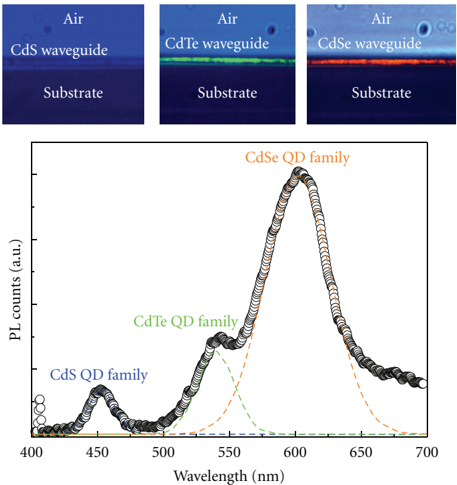
- Multicolor waveguiding was achieved by dispersing CdS, CdTe, and CdSe in the same PMMA matrix; the PL spectrum was reproduced by three Gaussian components at 452, 539, and 601 nm. Earlier CdSe/CdTe in PMMA guided green (535 nm) and orange (595 nm) colors.
- CdSe/SU-8 ridge waveguides fabricated by UV photolithography confined PL in 2D; an 8 μm-wide ridge showed a waveguided-PL peak centered at 610 nm with ~35 nm linewidth. SU-8 transmittance was similar to glass between 600 and 1500 nm but increased absorption below 600 nm.
Methods
- Review of the authors’ recent progress; QDs (CdS, CdSe, CdTe, PbS) were synthesized following Peng’s group procedure with oleic acid capping, mixed with PMMA in toluene, and spin-coated on SiO₂/Si. Films were baked at 80–150°C for 2 min, with thickness around 1–2 μm for visible-emitting waveguides and 2 μm for IR; SiO₂ cladding was ~0.6 μm (lab-made TEOS) or 2 μm (Cimat Silicon).
- Optical characterization included absorption and PL spectra, transmittance, and waveguiding measurements. PL was pumped with a 404 nm GaN laser or 633 nm HeNe laser; waveguiding was measured by end-fire coupling with microscope objectives or by top-surface pumping with a cylindrical lens, using spectrographs and a CCD camera. PbS QD radius was measured by TEM.
- For SU-8, a ligand exchange on oleate-terminated QDs enhanced solubility in γ-butyrolactone; CdSe/SU-8 nanocomposite was spin-coated and patterned by UV photolithography into ridge waveguides with widths of 4–20 μm and height 2.5 μm, then characterized by end-fire pumping at 533 nm.
Limitations
- The paper does not include a formal limitations section; stated constraints include that high CdSe filling factors >10⁻³ attenuate light and prevent waveguiding, PbS cannot be pumped at 404 nm because its absorption coefficient is too high, SU-8 has poor chemical compatibility with as-synthesized QDs and requires ligand exchange, and SU-8 absorbs below 600 nm.
- The text makes evident that this is a review of the authors’ recent progress, with some results described as “preliminary” in the perspectives section, rather than a comprehensive comparative or statistical study.
Model-written summary. Check it against the paper before relying on it.
Integrity signals
Registry
Cites
Statistics
Figures







Verification
Claims the paper makes
0 Valid · 4 Not valid · 20 Not checked · 46 Own results and interpretations
A result the paper states — it cites no source for it, so there is none to check. The quote shows it is in the paper.
In the paper
“Again, a larger Stokes shift is observed in the case of the PbS-PMMA nanocomposite as compared to the colloid.”
§ Polymer/QDs Nanocomposites for Waveguiding Applications > 3. QD Emission and Absorption
plainstates an associationSingle case- Asserted: passes — The authors put it forward as true.
- Checkable: passes — It can be checked against evidence.
- Load-bearing: unclear — It is unclear whether the paper’s conclusions depend on it.
- Based: passes — The paper gives a reason why it holds.
A result the paper reports from its own data — it cites no other source for it, so there is none to check. The quote shows it is in the paper.
In the paper
“We demonstrate that it is possible to control the active wavelength in a broad range (400-1100 nm), just by changing the base quantum dot material (CdS, CdSe, CdTe and PbS, but other are possible), without the necessity of changing fabrication conditions.”
- Also stated in: § 1. Introduction · plain
“New active planar waveguides covering a broad range of the light spectrum from 400 to 1100 nm, are implemented by embedding different types of QDs (CdS, CdTe, CdSe, and/or PbS) into PMMA matrix.”
§ Polymer/QDs Nanocomposites for Waveguiding Applications > Abstract
boostedstates a cause- Asserted: passes — The authors put it forward as true.
- Checkable: passes — It can be checked against evidence.
- Load-bearing: passes — The paper’s conclusions depend on it.
- Based: passes — The paper gives a reason why it holds.
- Rests on an assumption not shown here.
- Also stated in: § 1. Introduction · plain
A result the paper states — it cites no source for it, so there is none to check. The quote shows it is in the paper.
In the paper
“After it, straight ridges can be defined by means of UVphotolithography on the SiO 2 /Si substrate coated with the QD-SU8 nanocomposite.”
§ Polymer/QDs Nanocomposites for Waveguiding Applications > 1. Introduction
plainstates a cause- Asserted: passes — The authors put it forward as true.
- Checkable: passes — It can be checked against evidence.
- Load-bearing: passes — The paper’s conclusions depend on it.
- Based: passes — The paper gives a reason why it holds.
A result the paper states — it cites no source for it, so there is none to check. The quote shows it is in the paper.
In the paper
“These optical waveguides can be easily fabricated by spin-coating and UV photolithography on many substrates (SiO 2 /Si, in the present work).”
§ Polymer/QDs Nanocomposites for Waveguiding Applications > Abstract
plainstates a cause- Asserted: passes — The authors put it forward as true.
- Checkable: passes — It can be checked against evidence.
- Load-bearing: passes — The paper’s conclusions depend on it.
- Based: passes — The paper gives a reason why it holds.
- Rests on an assumption not shown here.
A result the paper reports from its own data — it cites no other source for it, so there is none to check. The quote shows it is in the paper.
In the paper
“Between 400 and 1500 nm, the absorption is almost that of the glass.”
§ Polymer/QDs Nanocomposites for Waveguiding Applications > 4. Planar QD-PMMA Waveguides
plain- Asserted: passes — The authors put it forward as true.
- Checkable: passes — It can be checked against evidence.
- Load-bearing: passes — The paper’s conclusions depend on it.
- Based: passes — The paper gives a reason why it holds.
30 more claims
Create a free account to see all 70 claims and every source verdict.
- It may state two separate claims as one. 26
- The quote only partly states this claim. 2
- Probably not a substantial claim. 10
Self-check
Percentages, sums and reported differences re-computed from the paper’s own numbers.
Each contradiction between two passages listed here was confirmed by an independent check.
Rated minor: it would not touch a result — a value no result rests on, a p-value that stays on the same side of the significance level, or a conflict that is clerical, resolved elsewhere in the paper, or outside its own findings.
In the paper
§ Polymer/QDs Nanocomposites for Waveguiding Applications > 3. QD Emission and Absorption
“The (FWHM) full width at half maximum of the PL lines decreases with the emission wavelength, being it around 20, 30, and 40 nm for the CdS, CdTe and CdSe, respectively”
§ Polymer/QDs Nanocomposites for Waveguiding Applications > 5.1. Multicolor Waveguiding.
“The PL spectrum can be nicely reproduced by the sum of three Gaussian components (dashed lines) whose peaks take place at 452, 539, and 601 nm, corresponding to the CdS, CdTe, and CdSe QD ensembles, respectively.”
Rated minor: it would not touch a result — a value no result rests on, a p-value that stays on the same side of the significance level, or a conflict that is clerical, resolved elsewhere in the paper, or outside its own findings.
In the paper
“In this case the FWHM reaches a value of 120 nm, doubling the value measured for CdSe QDs”
§ Polymer/QDs Nanocomposites for Waveguiding Applications > 3. QD Emission and Absorption
Reported 2 · recomputed 3
Citations
Cites
Experimental Determination of the Extinction Coefficient of CdTe, CdSe, and CdS Nanocrystals
Yu, W. W., Qu, L., Guo, W., & Peng, X. (2003) · Chemistry of Materials · doi:10.1021/cm034081k · Cited by 4,997 · cited 1×
“According to the data reported by other authors [26], these exciton transitions correspond to a QD radius of 4.”
BackgroundSynthesis and Characterization of Monodisperse Nanocrystals and Close-Packed Nanocrystal Assemblies
Murray, C. B., Kagan, C. R., & Bawendi, M. G. (2000) · Annual Review of Materials Science · doi:10.1146/annurev.matsci.30.1.545 · Cited by 4,353 · cited 1×
“It is well known that surface modification of QDs may result in a change in the solubility properties of QDs [44].”
BackgroundPerspectives on the Physical Chemistry of Semiconductor Nanocrystals
Alivisatos, A. P. (1996) · The Journal of Physical Chemistry · doi:10.1021/jp9535506 · Cited by 3,595 · cited 1×
“As a result, the effective bandgap of QDs and hence their photoluminescence (PL) can be tuned by either modifying their radius [14] or the composition: CdS [15], CdSe [16], and CdTe [17] in the visible spectra and PbS [18], PbSe [19], and InAs [20] in the near infrared.”
BackgroundOptical Gain and Stimulated Emission in Nanocrystal Quantum Dots
Klimov, V. I., Mikhailovsky, A. A., Xu, S., Malko, A., Hollingsworth, J. A., Leatherdale, C. A., Eisler, H.-J., & Bawendi, M. G. (2000) · Science · doi:10.1126/science.290.5490.314 · Cited by 2,825 · cited 1×
“It has already been demonstrated amplification and lasing using PbSe QDs [32], CdSe-ZnS [33], and CdS-CdSe-ZnS [34] core-shell QDs dispersed in sol-gel films of TiO2 and ZrO2 planar waveguides.”
MethodNanostructured materials for photon detection
Konstantatos, G., & Sargent, E. H. (2010) · Nature Nanotechnology · doi:10.1038/nnano.2010.78 · Cited by 1,463 · cited 1×
“The incorporation of optically active materials such as organic dyes [3], rare earth ions [4], semiconducting [5], and metal nanoparticles [6] into polymers has found multitude of applications in optical amplification [7], photovoltaics [8], photodetection [9], sensing [10], and plasmonics [11].”
BackgroundGee, G. (1972) · Polymer · doi:10.1016/0032-3861(72)90025-0 · Cited by 1,360
Bright, multicoloured light-emitting diodes based on quantum dots
Sun, Q., Wang, Y. A., Li, L. S., Wang, D., Zhu, T., Xu, J., Yang, C., & Li, Y. (2007) · Nature Photonics · doi:10.1038/nphoton.2007.226 · Cited by 1,147 · cited 1×
“In addition taking in account that the emission wavelength can be tuned by changing the material forming the QDs and their size [14–20], it has demonstrated the applications of colloidal QDs in LEDs technology [35].”
BackgroundOrganic photonics for communications
Clark, J., & Lanzani, G. (2010) · Nature Photonics · doi:10.1038/nphoton.2010.160 · Cited by 823 · cited 1×
“The integration of nanocrystal QDs in polymers (eventually photolithographic ones) opens a new method to implement hybrid organic-inorganic photonic and optoelectronic devices [31].”
MethodFull Color Emission from II-VI Semiconductor Quantum Dot-Polymer Composites
Lee, J., Sundar, V. C., Heine, J. R., Bawendi, M. G., & Jensen, K. F. (2000) · Advanced Materials · doi:10.1002/1521-4095(200008)12:15<1102::aid-adma1102>3.0.co;2-j · Cited by 776
Amplification of long-range surface plasmons by a dipolar gain medium
De Leon, I., & Berini, P. (2010) · Nature Photonics · doi:10.1038/nphoton.2010.37 · Cited by 407 · cited 1×
“The incorporation of optically active materials such as organic dyes [3], rare earth ions [4], semiconducting [5], and metal nanoparticles [6] into polymers has found multitude of applications in optical amplification [7], photovoltaics [8], photodetection [9], sensing [10], and plasmonics [11].”
BackgroundTang, J., Brzozowski, L., Barkhouse, D. A. R., Wang, X., Debnath, R., Wolowiec, R., Palmiano, E., Levina, L., Pattantyus-Abraham, A. G., Jamakosmanovic, D., et al. (2010) · ACS Nano · doi:10.1021/nn901564q · Cited by 392 · cited 1×
“2 nm has been measured by transmission electron microscopy (TEM) for PbS QDs, which is consistent with published data [29].”
ResultColloidal Quantum Dot Photovoltaics: A Path Forward
Kramer, I. J., & Sargent, E. H. (2011) · ACS Nano · doi:10.1021/nn203438u · Cited by 363 · cited 1×
“The incorporation of optically active materials such as organic dyes [3], rare earth ions [4], semiconducting [5], and metal nanoparticles [6] into polymers has found multitude of applications in optical amplification [7], photovoltaics [8], photodetection [9], sensing [10], and plasmonics [11].”
BackgroundDesigner polymer–quantum dot architectures
Tomczak, N., Jańczewski, D., Han, M., & Vancso, G. J. (2009) · Progress in Polymer Science · doi:10.1016/j.progpolymsci.2008.11.004 · Cited by 332 · cited 1×
“One of the most promising approaches is the incorporation of nanoparticles into a host matrix to form a nanocomposite [1].”
BackgroundTunable Near-Infrared Optical Gain and Amplified Spontaneous Emission Using PbSe Nanocrystals
Schaller, R. D., Petruska, M. A., & Klimov, V. I. (2003) · The Journal of Physical Chemistry B · doi:10.1021/jp0311660 · Cited by 321 · cited 1×
“It has already been demonstrated amplification and lasing using PbSe QDs [32], CdSe-ZnS [33], and CdS-CdSe-ZnS [34] core-shell QDs dispersed in sol-gel films of TiO2 and ZrO2 planar waveguides.”
MethodIntegrated Photonics: Fundamentals
Lifante, G. (2003) · Wiley eBooks · doi:10.1002/0470861401 · Cited by 320 · cited 1×
“The fabrication of two-dimensional waveguides is of high interest for integrated photonic devices [30].”
BackgroundBright White‐Light Emission from Semiconductor Nanocrystals: by Chance and by Design
Sapra, S., Mayilo, S., Klar, T. A., Rogach, A. L., & Feldmann, J. (2007) · Advanced Materials · doi:10.1002/adma.200602267 · Cited by 253 · cited 1×
“This property joined to the fact that it is possible to disperse several types of QDs into the matrix [36, 37], suggest the possibility to obtain white waveguided light; in a similar way that it is used in recent LED technology [38].”
Optofluidic trapping and transport on solid core waveguides within a microfluidic device
Schmidt, B. S., Yang, A. H. J., Erickson, D., & Lipson, M. (2007) · Optics Express · doi:10.1364/oe.15.014322 · Cited by 250 · cited 1×
“Particularly, SU-8 is a commercially available photoresist and one of the most used for polymer based waveguiding applications [41, 42] because it is easily patternable by UV photolithography and has a high refractive index (around 1.”
BackgroundExperimental Determination of the Extinction Coefficient of CdTe, CdSe and CdS Nanocrystals.
Yu, W. W., Qu, L., Guo, W., et al. (2004) · Chemistry of Materials · doi:10.1021/cm033007z · Cited by 222
Blue semiconductor nanocrystal laser
Chan, Y., Steckel, J. S., Snee, P. T., Caruge, J.-M., Hodgkiss, J. M., Nocera, D. G., & Bawendi, M. G. (2005) · Applied Physics Letters · doi:10.1063/1.1863445 · Cited by 175 · cited 1×
“As a result, the effective bandgap of QDs and hence their photoluminescence (PL) can be tuned by either modifying their radius [14] or the composition: CdS [15], CdSe [16], and CdTe [17] in the visible spectra and PbS [18], PbSe [19], and InAs [20] in the near infrared.”
BackgroundOptical Fiber Sensing Using Quantum Dots
Jorge, P. A. S., Martins, M. A., Trindade, T., Santos, J. L., & Farahi, F. (2007) · Sensors · doi:10.3390/s7123489 · Cited by 146 · cited 1×
“Finally, it has already studied the utility of colloidal QDs for sensing in optical fibers [39].”
BackgroundColloidal quantum dot random laser
Chen, Y., Herrnsdorf, J., Guilhabert, B., et al. (2011) · Optics Express · doi:10.1364/oe.19.002996 · Cited by 143 · cited 1×
“As a result, the effective bandgap of QDs and hence their photoluminescence (PL) can be tuned by either modifying their radius [14] or the composition: CdS [15], CdSe [16], and CdTe [17] in the visible spectra and PbS [18], PbSe [19], and InAs [20] in the near infrared.”
BackgroundSukhovatkin, V., Musikhin, S. F., Gorelikov, I., Cauchi, S., Bakueva, L., Kumacheva, E., & Sargent, E. H. (2005) · Optics Letters · doi:10.1364/ol.30.000171 · Cited by 100 · cited 1×
“As a result, the effective bandgap of QDs and hence their photoluminescence (PL) can be tuned by either modifying their radius [14] or the composition: CdS [15], CdSe [16], and CdTe [17] in the visible spectra and PbS [18], PbSe [19], and InAs [20] in the near infrared.”
BackgroundJasieniak, J. J., Fortunati, I., Gardin, S., Signorini, R., Bozio, R., Martucci, A., & Mulvaney, P. (2008) · Advanced Materials · doi:10.1002/adma.200701582 · Cited by 95 · cited 1×
“It has already been demonstrated amplification and lasing using PbSe QDs [32], CdSe-ZnS [33], and CdS-CdSe-ZnS [34] core-shell QDs dispersed in sol-gel films of TiO2 and ZrO2 planar waveguides.”
MethodA new SU-8 process to integrate buried waveguides and sealed microchannels for a Lab-on-a-Chip
Ruano-López, J. M., Aguirregabiria, M., Tijero, M., Arroyo, M. T., Elizalde, J., Berganzo, J., Aranburu, I., Blanco, F. J., & Mayora, K. (2006) · Sensors and Actuators B: Chemical · doi:10.1016/j.snb.2005.05.011 · Cited by 85 · cited 1×
“Among these wide range of applications, polymers are especially suitable materials for waveguiding in integrated optic devices, because of its high transparency above 400 nm, low propagation losses, and easy fabrication [12].”
BackgroundPhotoluminescence waveguiding in CdSe and CdTe QDs–PMMA nanocomposite films
Suárez, I., Gordillo, H., Abargues, R., Albert, S., & Martínez‐Pastor, J. P. (2011) · Nanotechnology · doi:10.1088/0957-4484/22/43/435202 · Cited by 81 · cited 5×
“The concentration of QDs into the matrix has been adjusted according to our previous results [24], where an optimum filling factor between 10−3 and 10−4 was found to achieve an optimum waveguiding.”
BackgroundMethodResultInfluentialSelf-citationJasieniak, J., Pacifico, J., Signorini, R., Chiasera, A., Ferrari, M., Martucci, A., & Mulvaney, P. (2007) · Advanced Functional Materials · doi:10.1002/adfm.200600955 · Cited by 79 · cited 1×
“QDs has been incorporated in sol-gel oxide waveguides to develop optical amplification [21], but also in PMMA to implement a microcavity laser [22] or to amplify the spontaneous emission [23].”
MethodWu, Z., Mi, Z., Bhattacharya, P., Zhu, T., & Xu, J. (2007) · Applied Physics Letters · doi:10.1063/1.2731657 · Cited by 77 · cited 2×
“It has already been demonstrated amplification and lasing using PbSe QDs [32], CdSe-ZnS [33], and CdS-CdSe-ZnS [34] core-shell QDs dispersed in sol-gel films of TiO2 and ZrO2 planar waveguides.”
BackgroundLocalized surface plasmon resonance sensor based on Ag-PVA nanocomposite thin films
Gradess, R., Abargues, R., Habbou, A., Canet‐Ferrer, J., Pedrueza‐Villalmanzo, E., Russell, A. N., Valdés, J. L., & Martínez‐Pastor, J. P. (2009) · Journal of Materials Chemistry · doi:10.1039/b910020b · Cited by 66 · cited 1×
“The incorporation of optically active materials such as organic dyes [3], rare earth ions [4], semiconducting [5], and metal nanoparticles [6] into polymers has found multitude of applications in optical amplification [7], photovoltaics [8], photodetection [9], sensing [10], and plasmonics [11].”
BackgroundSelf-citationOptical and thermal properties of large-area OLED lightings with metallic grids
Park, J., Lee, J., & Noh, Y. (2011) · Organic Electronics · doi:10.1016/j.orgel.2011.10.024 · Cited by 59 · cited 1×
“This property joined to the fact that it is possible to disperse several types of QDs into the matrix [36, 37], suggest the possibility to obtain white waveguided light; in a similar way that it is used in recent LED technology [38].”
Advanced Fluorescence Reporters in Chemistry and Biology II
Demchenko, A. P. (2010) · Springer series on fluorescence · doi:10.1007/978-3-642-04701-5 · Cited by 54 · cited 1×
“solutions) consist of single Gaussian lines slightly red-shifted with respect to the exciton peak in absorption by about 40 nm, which is known as Stokes shift [27].”
BackgroundSmirnova, T. N., Sakhno, O. V., Yezhov, P. V., Kokhtych, L. M., Goldenberg, L. M., & Stumpe, J. (2009) · Nanotechnology · doi:10.1088/0957-4484/20/24/245707 · Cited by 51 · cited 2×
“Then, it is expected that the polymer/NQD can be used for active purposes in waveguides [24], microcavities [22], and other photonic structures [23].”
BackgroundMethod(2003) · Cited by 48
Abargues, R., Abderrafi, K., Pedrueza‐Villalmanzo, E., Gradess, R., Marqués-Hueso, J., Valdés, J. L., & Martínez‐Pastor, J. P. (2009) · New Journal of Chemistry · doi:10.1039/b900185a · Cited by 41 · cited 1×
“The incorporation of optically active materials such as organic dyes [3], rare earth ions [4], semiconducting [5], and metal nanoparticles [6] into polymers has found multitude of applications in optical amplification [7], photovoltaics [8], photodetection [9], sensing [10], and plasmonics [11].”
BackgroundSelf-citationOrganic Semiconductor Optical Amplifiers
Amarasinghe, D., Ruseckas, A., Turnbull, G. A., & Samuel, I. D. W. (2009) · Proceedings of the IEEE · doi:10.1109/jproc.2009.2023250 · Cited by 40 · cited 1×
“The incorporation of optically active materials such as organic dyes [3], rare earth ions [4], semiconducting [5], and metal nanoparticles [6] into polymers has found multitude of applications in optical amplification [7], photovoltaics [8], photodetection [9], sensing [10], and plasmonics [11].”
BackgroundSharma, H., Sharma, S. N., Singh, G., & Shivaprasad, S. M. (2006) · Physica E: Low-dimensional Systems and Nanostructures · doi:10.1016/j.physe.2005.12.154 · Cited by 39 · cited 1×
“The spectra have a similar shape as the colloidal solution, but a larger Stokes shift is observed for CdSe and CdTe QDs, probably due to the presence of nanoparticle aggregates [28].”
BackgroundHu, L., Wu, H., Du, L., Ge, H., Chen, X., & Dai, N. (2011) · Nanotechnology · doi:10.1088/0957-4484/22/12/125202 · Cited by 38 · cited 2×
“The incorporation of optically active materials such as organic dyes [3], rare earth ions [4], semiconducting [5], and metal nanoparticles [6] into polymers has found multitude of applications in optical amplification [7], photovoltaics [8], photodetection [9], sensing [10], and plasmonics [11].”
BackgroundPelletier, N., Beche, B., Gaviot, E., Camberlein, L., Grossard, N., Polet, F., & Zyss, J. (2006) · IEEE Sensors Journal · doi:10.1109/jsen.2006.874489 · Cited by 36 · cited 1×
“Particularly, SU-8 is a commercially available photoresist and one of the most used for polymer based waveguiding applications [41, 42] because it is easily patternable by UV photolithography and has a high refractive index (around 1.”
BackgroundTemperature Sensor Based on Colloidal Quantum Dots–PMMA Nanocomposite Waveguides
Bueno, A., Suárez, I., Abargues, R., Sales, S., & Martínez‐Pastor, J. P. (2012) · IEEE Sensors Journal · doi:10.1109/jsen.2012.2210037 · Cited by 34 · cited 1×
“Then, QD-polymer waveguides can be applied to be a good probe for temperature sensing [40].”
BackgroundSelf-citationRib waveguide dye-doped polymer amplifier with up to 26dB optical gain at 625nm
Reilly, M. A., Marinelli, C., Morgan, C. N., et al. (2004) · Applied Physics Letters · doi:10.1063/1.1828578 · Cited by 31 · cited 1×
“The incorporation of optically active materials such as organic dyes [3], rare earth ions [4], semiconducting [5], and metal nanoparticles [6] into polymers has found multitude of applications in optical amplification [7], photovoltaics [8], photodetection [9], sensing [10], and plasmonics [11].”
BackgroundOptical gain from InAs nanocrystal quantum dots in a polymer matrix
Chen, G., Rapaport, R., Fuchs, D. T., Lucas, L. A., Lovinger, A. J., Vilan, S., Aharoni, A., & Banin, U. (2005) · Applied Physics Letters · doi:10.1063/1.2149176 · Cited by 29 · cited 1×
“As a result, the effective bandgap of QDs and hence their photoluminescence (PL) can be tuned by either modifying their radius [14] or the composition: CdS [15], CdSe [16], and CdTe [17] in the visible spectra and PbS [18], PbSe [19], and InAs [20] in the near infrared.”
BackgroundEu$^{3+}$-Doped Planar Optical Polymer Waveguide Amplifiers
Tsang, K.-C., Wong, C., & Pun, E. Y. (2010) · IEEE Photonics Technology Letters · doi:10.1109/lpt.2010.2049100 · Cited by 22 · cited 1×
“The incorporation of optically active materials such as organic dyes [3], rare earth ions [4], semiconducting [5], and metal nanoparticles [6] into polymers has found multitude of applications in optical amplification [7], photovoltaics [8], photodetection [9], sensing [10], and plasmonics [11].”
BackgroundAdvanced Fluorescence Reporters in Chemistry and Biology III
Demchenko, A. P. (2011) · Springer series on fluorescence · doi:10.1007/978-3-642-18035-4 · Cited by 21
(2008) · Journal of Optoelectronics and Advanced Materials · Cited by 19
Growth kinetics of CdTe colloidal nanocrystals
Ferreira, D. L., Silva, F. O., Viol, L. C. D. S., Licínio, P., Valadares, M., Cury, L. A., Schiavon, M. A., & Alves, J. L. A. (2009) · The Journal of Chemical Physics · doi:10.1063/1.3212964 · Cited by 16 · cited 1×
“As a result, the effective bandgap of QDs and hence their photoluminescence (PL) can be tuned by either modifying their radius [14] or the composition: CdS [15], CdSe [16], and CdTe [17] in the visible spectra and PbS [18], PbSe [19], and InAs [20] in the near infrared.”
BackgroundErratum: Nanostructured materials for photon detection
Konstantatos, G., & Sargent, E. H. (2010) · Nature Nanotechnology · doi:10.1038/nnano.2010.247 · Cited by 11
Yu, W. W., & Peng, X. (2007) · Angewandte Chemie International Edition · doi:10.1002/anie.200790059 · Cited by 10
Photonic emitters and circuits based on colloidal quantum dot composites
Menon, V. M., Husaini, S., Valappil, N., & Luberto, M. (2009) · SPIE Proceedings · doi:10.1117/12.813464 · Cited by 5 · cited 4×
“In this way we propose a ligand exchange on oleate-terminated QDs to enhance their solubility in γbutyrolactone [22].”
BackgroundMethodInfluentialTunable Near‐Infrared Optical Gain and Amplified Spontaneous Emission Using PbSe Nanocrystals.
Schaller, R. D., Petruska, M. A., & Klimov, V. I. (2004) · ChemInform · doi:10.1002/chin.200409004 · Cited by 4
Yu, W. W., & Peng, X. (2007) · Angewandte Chemie · doi:10.1002/ange.200790059
26dB optical gain in a rib waveguide dye-doped polymer amplifier operating at 625 nm
Reilly, M. A., Ramon, M., Marinelli, C., et al. (2005) · SPIE Proceedings · doi:10.1117/12.590359
Cited by
Soft Bioelectronics Based on Nanomaterials
Cho, K. W., Sunwoo, S.-H., Hong, Y. J., Koo, J. H., Kim, J. H., Baik, S., Hyeon, T., & Kim, D.-H. (2022) · Chemical Reviews · doi:10.1021/acs.chemrev.1c00531 · Cited by 244
Fluorescent nanomaterial-derived white light-emitting diodes: what's going on
Zhang, Q., Wang, C., Ling, L., & Chen, S. (2014) · Journal of Materials Chemistry C · doi:10.1039/c4tc00048j · Cited by 119
Das, H. T., Barai, P., Dutta, S., Das, N., Das, P., Roy, M., Alauddin, M., & Barai, H. R. (2022) · Polymers · doi:10.3390/polym14051053 · Cited by 50
“One of electrochemical performance is given in the Figure 3; displaying the cyclic voltammetry curves, Ragone plot (energy and power density), efficiency of device and demonstration of device with practical application [34].”
BackgroundComputational insights into CdSe quantum dots' interactions with acetate ligands
Tamukong, P. K., Peiris, W. D. N., & KILINA, S. V. (2016) · Physical Chemistry Chemical Physics · doi:10.1039/c6cp01665k · Cited by 41
Au, T. H., Trinh, D. T., Tong, Q. C., Do, D. B., Phú, N. Đ., Phan, M., & Lai, N. D. (2017) · Nanomaterials · doi:10.3390/nano7050105 · Cited by 28
“Various kinds of nanofillers, such as carbon nanostructures [1], metallic [2], and semiconducting nanoparticles [3], are selected to incorporate into polymer matrices for creating functional nanocomposites with hybrid properties.”
Background
Metadata
- Authors
- Gordillo, H., Suárez, I., Abargues, R., Rodríguez-Cantó, P., Albert, S., & Martínez-Pastor, J. P.
- Affiliations
- Consejo Superior de Investigaciones Científicas (ES)
- Corresponding author
- Suárez, I.
- Venue
- Journal of Nanomaterials
- Publisher
- Wiley
- Published
- 2012-01
- Volume
- 2012
- Issue
- 1
- ISSN
- 1687-4110 (ISSN-L)
- 1687-4129
- OpenAlex
- W2075961844
- Cited by
- 49
- References
- 46
- Citations by year
- 2026: 1 · 2025: 1 · 2023: 1 · 2022: 5 · 2021: 7 · 2019: 7 · 2018: 5 · 2017: 3 · 2016: 4 · 2015: 7 · 2014: 3 · 2013: 4 · 2012: 1
- FWCI
- 2.21
- Type
- journal article
- Language
- en
- Open access
- hybrid
- doi.org
- Locations
- Journal of Nanomaterials (publishedVersion, cc-by)
- DOAJ (DOAJ: Directory of Open Access Journals) (submittedVersion, cc-by-sa)
- Funders
- Ministerio de Ciencia e Innovación (TEC2011-29120-C05-01, PROMETEO/2009/074)
- Generalitat Valenciana (TEC2011-29120-C05-01, PROMETEO/2009/074)
- Topics
- Physical Sciences › Materials Science › Materials Chemistry › Quantum Dots Synthesis And Properties
- Physical Sciences › Engineering › Electrical and Electronic Engineering › Photonic and Optical Devices
- Physical Sciences › Physics and Astronomy › Atomic and Molecular Physics, and Optics › Semiconductor Quantum Structures and Devices
- Keywords
- organic-inorganic hybrid materials, quantum dots, CdS quantum dots, CdSe quantum dots, CdTe quantum dots, PbS quantum dots, poly(methyl methacrylate), SU-8 resist, photoluminescence, ridge waveguide, spin coating, UV lithography, wavelength tuning
About these checks
Registry, retraction, Cites and statistics results are computed, not judged, with one exception: a printed reference that no index lists is read once by a model before it counts as a citation error. Claims are extracted by a model and kept only when their quote appears verbatim in the text; each cited source is then checked, with a model’s help, for whether it says what the claim relies on. Those verdicts can be wrong — read the claim’s quote and the cited source before relying on one.
A language model drew the claims from the paper on 2026-10-10, under version 3 of the claim definition (model deepseek-v4.1-flash, prompt extract-v3).
A second model labelled each claim on 2026-10-10 (model jev-1.13-20260917, definition revision gold-guideline-v0.2).
Statistics and arithmetic are recomputed, not judged.
Confidence bands are shown only for fields calibrated on our annotated test set. None is calibrated yet, so no band is shown.
What counts as a claim ›How we measure confidence ›How we check this ›
Are you an author, or do you see a problem with this page? Request a review
Data sources
Bibliographic data: Semantic Scholar, OpenAlex, Crossref.
Contains information from the Semantic Scholar Academic Graph Datasets, made available under the ODC Attribution License (ODC-BY 1.0).
Semantic Scholar’s data is described in: Kinney, R., et al. (2023). The Semantic Scholar Open Data Platform. arXiv:2301.10140.
