Cited by 4

The DOI matches its Crossref record.

Conditioning with Fludarabine-Busulfan versus Busulfan-Cyclophosphamide Is Associated with Lower aGVHD and Higher Survival but More Extensive and Long Standing Bone Marrow Damage

He, Xin, Ye, YongBin, Xu, XiaoJun, Wang, Jing, Huang, YuXian, Weng, GuangYang, Zhang, MingWan, Guo, KunYuan·2016·BioMed Research International

Abstract

Acute graft-versus-host disease (aGVHD) is a major complication of allogeneic hematopoietic stem cell transplantation (allo-HSCT) and a major cause of nonrelapse mortality after allo-HSCT. A conditioning regimen plays a pivotal role in the development of aGVHD. To provide a platform for studying aGVHD and evaluating the impact of different conditioning regimens, we established a murine aGVHD model that simulates the clinical situation and can be conditioned with Busulfan-Cyclophosphamide (Bu-Cy) and Fludarabine-Busulfan (Flu-Bu). In our study, BALB/c mice were conditioned with Bu-Cy or Flu-Bu and transplanted with 2×10⁷ bone marrow cells and 2×10⁷ splenocytes from either allogeneic (C57BL/6) or syngeneic (BALB/c) donors. The allogeneic recipients conditioned with Bu-Cy had shorter survivals (P<0.05), more severe clinical manifestations, and higher hepatic and intestinal pathology scores, associated with increased INF-γ expression and diminished IL-4 expression in serum, compared to allogeneic recipients conditioned with Flu-Bu. Moreover, higher donor-derived T-cell infiltration and severely impaired B-cell development were seen in the bone marrow of mice, exhibiting aGVHD and conditioned with Flu-Bu. Our study showed that the conditioning regimen with Bu-Cy resulted in more severe aGVHD while the Flu-Bu regimen was associated with more extensive and long standing bone marrow damage.

Overview

The claims and statistics of this paper haven’t been checked yet.

Run the check — free, no account needed. It reads the open-access text and checks the sources it cites.

A few free checks a day · papers already verified open instantly · results are public

Integrity signals

Registry

Crossref · 10.1155/2016/3071214

Cites

Statistics

Figures

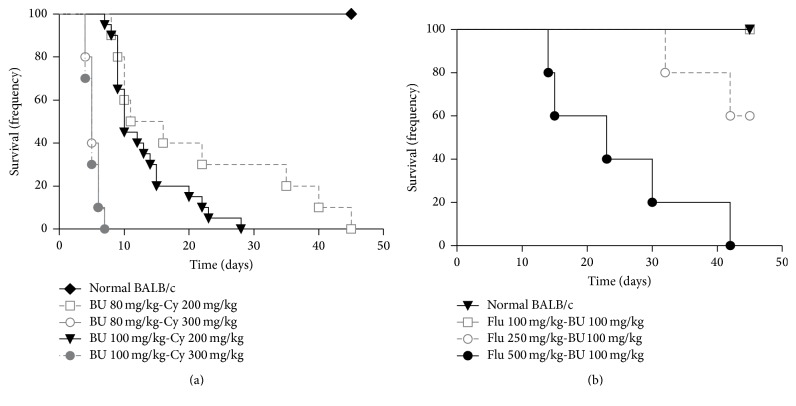
Figure 1 Survival analysis of different conditioning doses. Male BALB/c were conditioned with different doses of Bu-Cy or Flu-Bu and transplanted with 2 × 10⁷ bone marrow cells and 2 × 10⁷ splenocytes from C57BL/6. (a) Survival analysis of mice conditioned with Bu-Cy. (b) Survival analysis of mice conditioned with Flu-Bu.
Figure 1 Survival analysis of different conditioning doses. Male BALB/c were conditioned with different doses of Bu-Cy or Flu-Bu and transplanted with 2 × 10⁷ bone marrow cells and 2 × 10⁷ splenocytes from C57BL/6. (a) Survival analysis of mice conditioned with Bu-Cy. (b) Survival analysis of mice conditioned with Flu-Bu.CC BY · PubMed Central
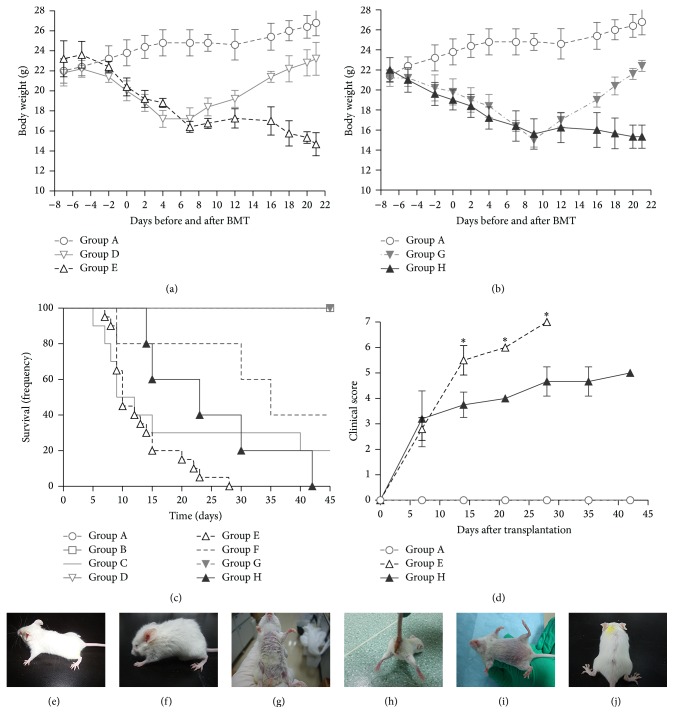
Figure 2 aGVHD manifestations, survival, and aGVHD clinical scores. (a) Weight loss started after conditioning and bone marrow transplantation in allogeneic and syngeneic groups conditioned with Bu-Cy. (b) Weight loss started after conditioning and bone marrow transplantation in allogeneic and syngeneic groups conditioned with Flu-Bu. (c) Survival analysis of different treatment groups. (d) aGVHD clinical scores of allogeneic recipients. (e) Appearance of mice in Group A. (f–h). Appearance of allogeneically transplanted mice (conditioned with Bu-Cy). (i-j) Appearance of allogeneically transplanted mice (conditioned with Flu-Bu). Group A: Normal BALB/c in the same condition; Group B: BALB/c injected intraperitoneally with 0.0625 mL DMSO; Group C: BALB/c conditioned with Bu (100 mg/kg)-Cy (200 mg/kg); Group D: BALB/c conditioned with Bu (100 mg/kg)-Cy (200 mg/kg) and transplanted with 2 × 10⁷ bone marrow cells, 2 × 10⁷ spleen cells from BALB/c; Group E: BALB/c conditioned with Bu (100 mg/kg)-Cy (200 mg/kg) and transplanted with 2 × 10⁷ bone marrow cells, 2 × 10⁷ spleen cells from C57BL/6; Group F: BALB/c conditioned with Flu (500 mg/kg)-Bu (100 mg/kg); Group G: BALB/c conditioned with Flu (500 mg/kg)-Bu (100 mg/kg) and transplanted with 2 × 10⁷ bone marrow cells, 2 × 10⁷ spleen cells from BALB/c; Group H: BALB/c conditioned with Flu (500 mg/kg)-Bu (100 mg/kg) and transplanted with 2 × 10⁷ bone marrow cells, 2 × 10⁷ spleen cells from C57BL/6. All data are presented as mean ± s.e. for 3–7 animals in each group per time point. ∗ P < 0.05.
Figure 2 aGVHD manifestations, survival, and aGVHD clinical scores. (a) Weight loss started after conditioning and bone marrow transplantation in allogeneic and syngeneic groups conditioned with Bu-Cy. (b) Weight loss started after conditioning and bone marrow transplantation in allogeneic and syngeneic groups conditioned with Flu-Bu. (c) Survival analysis of different treatment groups. (d) aGVHD clinical scores of allogeneic recipients. (e) Appearance of mice in Group A. (f–h). Appearance of allogeneically transplanted mice (conditioned with Bu-Cy). (i-j) Appearance of allogeneically transplanted mice (conditioned with Flu-Bu). Group A: Normal BALB/c in the same condition; Group B: BALB/c injected intraperitoneally with 0.0625 mL DMSO; Group C: BALB/c conditioned with Bu (100 mg/kg)-Cy (200 mg/kg); Group D: BALB/c conditioned with Bu (100 mg/kg)-Cy (200 mg/kg) and transplanted with 2 × 10⁷ bone marrow cells, 2 × 10⁷ spleen cells from BALB/c; Group E: BALB/c conditioned with Bu (100 mg/kg)-Cy (200 mg/kg) and transplanted with 2 × 10⁷ bone marrow cells, 2 × 10⁷ spleen cells from C57BL/6; Group F: BALB/c conditioned with Flu (500 mg/kg)-Bu (100 mg/kg); Group G: BALB/c conditioned with Flu (500 mg/kg)-Bu (100 mg/kg) and transplanted with 2 × 10⁷ bone marrow cells, 2 × 10⁷ spleen cells from BALB/c; Group H: BALB/c conditioned with Flu (500 mg/kg)-Bu (100 mg/kg) and transplanted with 2 × 10⁷ bone marrow cells, 2 × 10⁷ spleen cells from C57BL/6. All data are presented as mean ± s.e. for 3–7 animals in each group per time point. ∗ P < 0.05.CC BY · PubMed Central
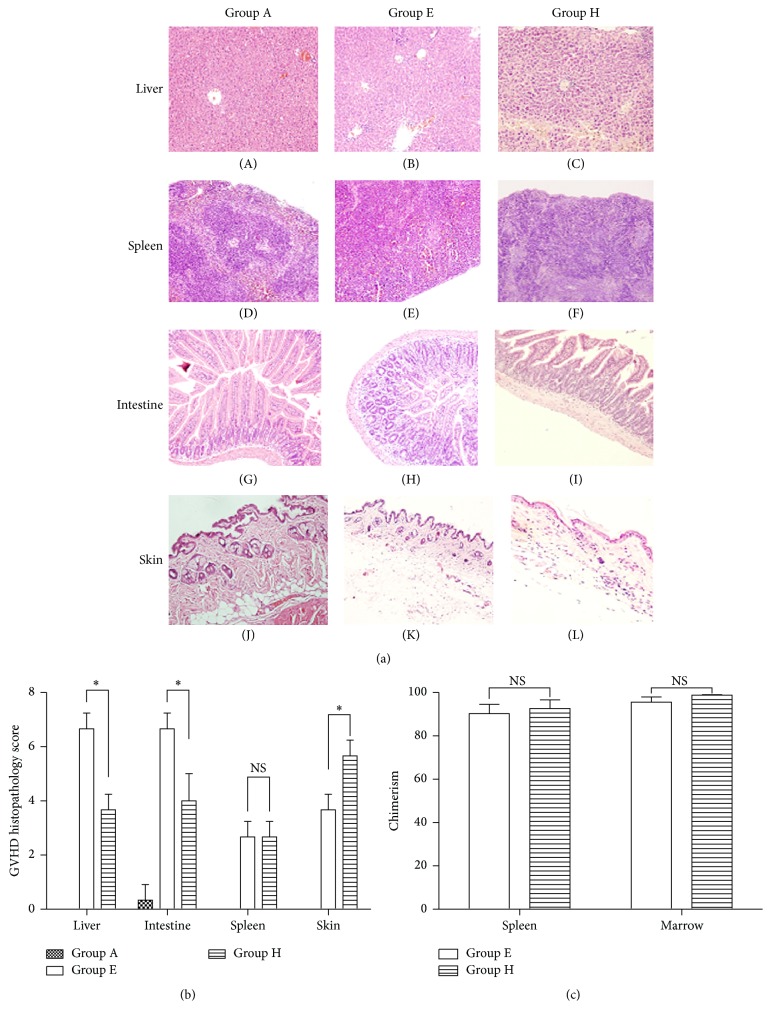
Figure 3 Pathologic changes of aGVHD and chimerism analysis. (a) Pathologic changes of liver, spleen, intestine, and skin on day +14 after transplantation. (b) Pathologic scores for liver, spleen, intestine, and skin on day +14 after transplantation. (c) Bone marrow and spleen chimerism of allogeneic recipients on day +14 after transplantation. Group A: normal BALB/c in the same condition. Group E: BALB/c conditioned with Bu (100 mg/kg)-Cy (200 mg/kg) and transplanted with 2 × 10⁷ bone marrow cells, 2 × 10⁷ spleen cells from C57BL/6. Group H: BALB/c conditioned with Flu (500 mg/kg)-Bu (100 mg/kg) and transplanted with 2 × 10⁷ bone marrow cells, 2 × 10⁷ spleen cells from C57BL/6. All data are presented as mean ± s.e. for 3–7 animals in each group per time point. ∗ P < 0.05; NS, not significant, P > 0.05.
Figure 3 Pathologic changes of aGVHD and chimerism analysis. (a) Pathologic changes of liver, spleen, intestine, and skin on day +14 after transplantation. (b) Pathologic scores for liver, spleen, intestine, and skin on day +14 after transplantation. (c) Bone marrow and spleen chimerism of allogeneic recipients on day +14 after transplantation. Group A: normal BALB/c in the same condition. Group E: BALB/c conditioned with Bu (100 mg/kg)-Cy (200 mg/kg) and transplanted with 2 × 10⁷ bone marrow cells, 2 × 10⁷ spleen cells from C57BL/6. Group H: BALB/c conditioned with Flu (500 mg/kg)-Bu (100 mg/kg) and transplanted with 2 × 10⁷ bone marrow cells, 2 × 10⁷ spleen cells from C57BL/6. All data are presented as mean ± s.e. for 3–7 animals in each group per time point. ∗ P < 0.05; NS, not significant, P > 0.05.CC BY · PubMed Central
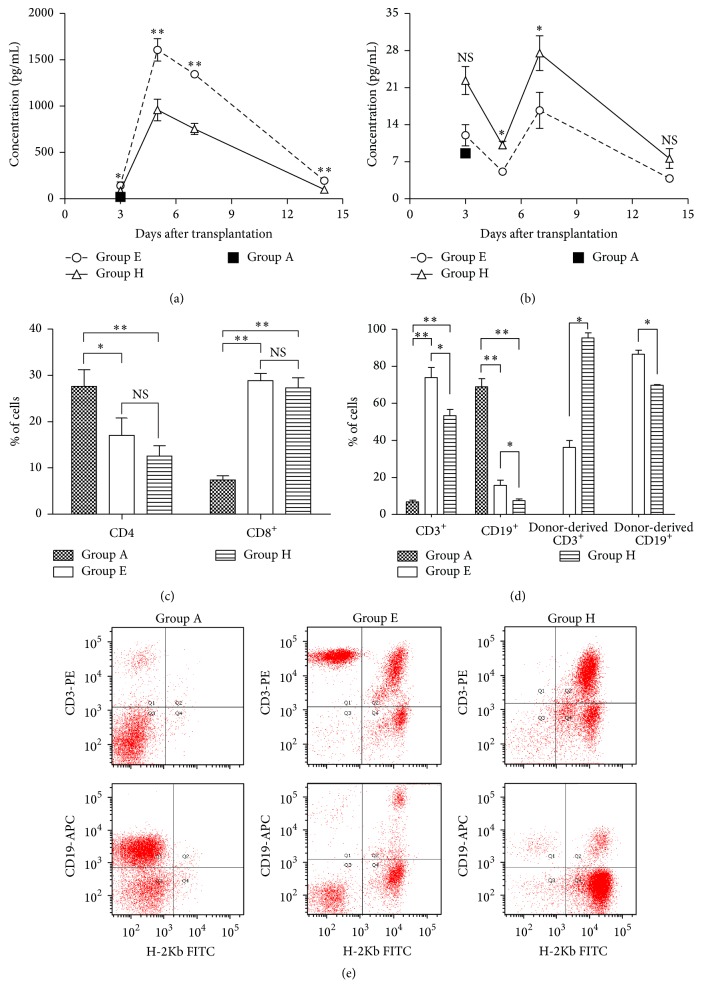
Figure 4 Expression of IFN-γ and IL-4 in serum on days +3, +5, +7, and +14 after allo-HSCT, proportion of CD3+ and CD19+ cells in bone marrow and CD4+ and CD8+ cells in spleen 14 days after transplantation. (a) INF-γ concentration in serum on days +3, +5, +7, and +14 after allo-HSCT. (b) IL-4 concentration in serum on days +3, +5, +7, and +14 after allo-HSCT (c) Proportion of CD4+ and CD8+ T-cells in spleen 14 days after allo-HSCT. (d, e) Proportion of CD3+ and donor-derived CD3+ T-cells and CD19+ and donor-derived CD19+ B-cells in bone marrow 14 days after allo-HSCT. Group A: normal BALB/c in the same condition. Group E: BALB/c conditioned with Bu (100 mg/kg)-Cy (200 mg/kg) and transplanted with 2 × 10⁷ bone marrow cells, 2 × 10⁷ spleen cells from C57BL/6. Group H: BALB/c conditioned with Flu (500 mg/kg)-Bu (100 mg/kg) and transplanted with 2 × 10⁷ bone marrow cells, 2 × 10⁷ spleen cells from C57BL/6. All data are presented as mean ± s.e. for 3–7 animals in each group per time point. ∗ P < 0.05; ∗∗ P < 0.01; NS, not significant, P > 0.05.
Figure 4 Expression of IFN-γ and IL-4 in serum on days +3, +5, +7, and +14 after allo-HSCT, proportion of CD3+ and CD19+ cells in bone marrow and CD4+ and CD8+ cells in spleen 14 days after transplantation. (a) INF-γ concentration in serum on days +3, +5, +7, and +14 after allo-HSCT. (b) IL-4 concentration in serum on days +3, +5, +7, and +14 after allo-HSCT (c) Proportion of CD4+ and CD8+ T-cells in spleen 14 days after allo-HSCT. (d, e) Proportion of CD3+ and donor-derived CD3+ T-cells and CD19+ and donor-derived CD19+ B-cells in bone marrow 14 days after allo-HSCT. Group A: normal BALB/c in the same condition. Group E: BALB/c conditioned with Bu (100 mg/kg)-Cy (200 mg/kg) and transplanted with 2 × 10⁷ bone marrow cells, 2 × 10⁷ spleen cells from C57BL/6. Group H: BALB/c conditioned with Flu (500 mg/kg)-Bu (100 mg/kg) and transplanted with 2 × 10⁷ bone marrow cells, 2 × 10⁷ spleen cells from C57BL/6. All data are presented as mean ± s.e. for 3–7 animals in each group per time point. ∗ P < 0.05; ∗∗ P < 0.01; NS, not significant, P > 0.05.CC BY · PubMed Central

Verification

Claims the paper makes

The claims and statistics of this paper haven’t been checked yet.

Run the check — free, no account needed. It reads the open-access text and checks the sources it cites.

A few free checks a day · papers already verified open instantly · results are public

Claims other papers make about this one

Each is checked against this paper’s own text: does it say what the citing paper says it does?

Self-check

Percentages, sums and reported differences re-computed from the paper’s own numbers.

The self-check needs the paper’s full text.

Citations

Cites

No references could be resolved yet.

Research works printed but not linked: 40

  1. 10.5966/sctm.2012-0115 · DOI
  2. 10.1101/cshperspect.a015529 · DOI
  3. 10.1182/blood-2014-01-514786 · DOI
  4. 10.1016/s0140-6736(09)60237-3 · DOI
  5. 10.1182/blood-2015-01-624163 · DOI
  6. 10.1111/tan.12497 · DOI
  7. 10.3389/fimmu.2015.00101 · DOI
  8. 10.1084/jem.20060376 · DOI
  9. 10.1038/bmt.2012.120 · DOI
  10. 10.1200/jco.2011.40.2362 · DOI
  11. 10.1016/S1470-2045(15)00200-4 · DOI
  12. 10.1046/j.1365-2141.2001.02825.x · DOI
  13. 10.1097/01.tp.0000183289.79693.3d · DOI
  14. 10.1038/bmt.2008.261 · DOI
  15. 10.1172/jci76031 · DOI
  16. 10.4049/jimmunol.173.9.5467 · DOI
  17. 10.1016/j.bbmt.2010.11.029 · DOI
  18. 10.1136/archdischild-2013-304832 · DOI
  19. 10.1016/j.bbmt.2003.11.004 · DOI
  20. 10.3109/08923973.2014.895743 · DOI
  21. 10.4049/jimmunol.1303099 · DOI
  22. 10.1136/gut.2009.197434 · DOI
  23. 10.1016/j.bbmt.2012.10.028 · DOI
  24. 10.1038/bmt.2015.279 · DOI
  25. 10.1016/j.trsl.2007.06.003 · DOI
  26. 10.1182/blood-2012-07-442665 · DOI
  27. 10.1084/jem.20020666 · DOI
  28. 10.1182/blood-2010-08-303008 · DOI
  29. 10.1172/JCI7894 · DOI
  30. 10.1182/blood-2009-05-219402 · DOI
  31. 10.1111/imm.12436 · DOI
  32. 10.1182/blood-2009-05-222190 · DOI
  33. 10.3389/fimmu.2016.00144 · DOI
  34. 10.1002/stem.1691 · DOI
  35. 10.1146/annurev.immunol.25.022106.141606 · DOI
  36. 10.1182/blood-2009-11-253559 · DOI
  37. 10.1016/j.jaci.2013.01.047 · DOI
  38. 10.1016/j.bbmt.2008.07.008 · DOI
  39. 10.1182/blood-2013-11-539031 · DOI
  40. 10.1182/blood-2014-06-576991 · DOI

Cited by

Metadata

Authors
He, X., Ye, Y., Xu, X., Wang, J., Huang, Y., Weng, G., Zhang, M., & Guo, K.
Affiliations
  • Department of Hematology, Zhongshan Hospital of Sun Yat-Sen University and Zhongshan City People’s Hospital, Zhongshan 528403, China
  • Department of Hematology, Zhujiang Hospital, Southern Medical University, Guangzhou 510282, China
Venue
BioMed Research International
Publisher
Wiley
Published
2016
Volume
2016
Pages
1-10
ISSN
  • 2314-6133
  • 2314-6141
Cited by
4
References
0
Language
en
Funders
  • Natural Science & Technology Major Project Foundation of Zhongshan city (20113A002, 2011106)
  • Natural Science Foundation of Guangdong province (20113A002, 2011106)

About these checks

Registry, retraction, Cites and statistics results are computed, not judged, with one exception: a printed reference that no index lists is read once by a model before it counts as a citation error. Claims are extracted by a model and kept only when their quote appears verbatim in the text; each cited source is then checked, with a model’s help, for whether it says what the claim relies on. Those verdicts can be wrong — read the claim’s quote and the cited source before relying on one.

Statistics and arithmetic are recomputed, not judged.

Confidence bands are shown only for fields calibrated on our annotated test set. None is calibrated yet, so no band is shown.

What counts as a claim ›How we measure confidence ›How we check this ›

Are you an author, or do you see a problem with this page? Request a review