

The DOI matches its Crossref record.
Organ Donation and Elective Ventilation: A Necessary Strategy
Open accessAbstract
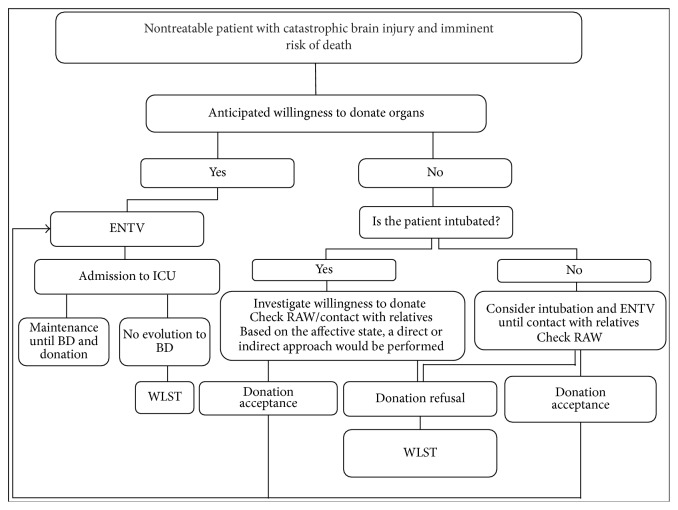
Organ transplantation is the sole treatment to improve or save the life of patients with final-stage organ failure. The shortage of available organs for transplantation constitutes a universal problem, estimating that 10% of patients on waiting lists die. Brain death is an undesirable result; nevertheless, it has beneficial side-effects since it is the most frequent source of organs for transplantation. However, this phenomenon is relatively uncommon and has a limited potential. One of the options that focuses on increasing organ donation is to admit patients with catastrophic brain injuries (with a high probability of brain death and nontreatable) to the Intensive Care Unit, with the only purpose of donation. To perform elective nontherapeutic ventilation (ENTV), a patient’s anticipated willingness to donate organs and/or explicit acceptance by his/her relatives is required. This process should focus exclusively on those patients with catastrophic brain injuries and imminent risk of death which, due to its acute damage, are not considered treatable. This article defends ENTV as an effective strategy to improve donation rate, analyzing its ethical and legal basis.
Overview
The claims and statistics of this paper haven’t been checked yet.
Run the check — free, no account needed. It reads the open-access text and checks the sources it cites.
Integrity signals
Registry
Cites
Statistics
Figures
Verification
Claims the paper makes
The claims and statistics of this paper haven’t been checked yet.
Run the check — free, no account needed. It reads the open-access text and checks the sources it cites.
Claims other papers make about this one
Each is checked against this paper’s own text: does it say what the citing paper says it does?
The source backs part of the claim, not all of it — or backs it for a different population, condition or comparison.
In the citing paper
“In particular, the time-critical nature of the process usually requires the initiation of organ preservation processes prior to family consultation to maintain organ viability. 186,190,191”
From European Resuscitation Council Guidelines 2021: Ethics of resuscitation and end of life decisions (2021) · cites this paper as [191]
Experimental — accuracy not yet measured
Self-check
Percentages, sums and reported differences re-computed from the paper’s own numbers.
The self-check needs the paper’s full text.
Citations
Cites
No references could be resolved yet.
Research works printed but not linked: 26
- 10.1016/j.medin.2015.01.008 · DOI
- 10.1111/j.1600-6143.2012.04138.x · DOI
- 10.1016/0140-6736(90)91134-V · DOI
- 1995, British Medical Journal, 310, article 714
- 10.1136/medethics-2012-100995 · DOI
- 10.1155/2014/973758 · DOI
- 10.1136/medethics-2012-100990 · DOI
- 10.1136/medethics-2012-100992 · DOI
- 10.1177/0969733014558969 · DOI
- 10.1136/medethics-2012-101159 · DOI
- 10.1136/jme.22.2.72 · DOI
- 10.1136/medethics-2013-101384 · DOI
- 10.1503/cmaj.109-4259 · DOI
- 10.1503/cmaj.109-4260 · DOI
- 10.1007/s12028-015-0137-6 · DOI
- 10.1161/str.0000000000000069 · DOI
- 10.1111/anae.13065 · DOI
- 10.1001/jama.290.6.790 · DOI
- 10.1001/jamainternmed.2015.0372 · DOI
- 10.1016/j.medin.2014.01.005 · DOI
- 1991, AACN Clinical Issues in Critical Care Nursing, 2, 242
- 10.1161/str.0000000000000015 · DOI
- 10.1007/bf01404948 · DOI
- 10.1385/ncc:2:2:110 · DOI
- 10.1161/01.str.32.4.891 · DOI
- 10.1016/s0210-5691(08)70956-2 · DOI
Cited by
European Resuscitation Council Guidelines 2021: Ethics of resuscitation and end of life decisions
Mentzelopoulos, S. D., Couper, K., Voorde, P. V. D., Druwé, P., Blom, M., Perkins, G. D., Lulic, I., Djakow, J., Raffay, V., Lilja, G., et al. (2021) · Resuscitation · doi:10.1016/j.resuscitation.2021.02.017 · Cited by 246
Metadata
- Authors
- Escudero, D., Otero, J., Menéndez de León, B., & Perez-Basterrechea, M.
- Affiliations
- Hospital Universitario Central de Asturias (ES)
- Unit of Transplants, Cell Therapy and Regenerative Medicine, Central University Hospital of Asturias, Oviedo, Spain
- Intensive Care Unit, Central University Hospital of Asturias, Oviedo, Spain
- Corresponding author
- Escudero, Dolores
- Venue
- BioMed Research International
- Publisher
- Wiley
- Published
- 2017
- Volume
- 2017
- Pages
- 1-6
- ISSN
- 1110-7243 (ISSN-L)
- 2314-6133
- 2314-6141
- PMC
- PMC5274675
- OpenAlex
- W2577282651
- Cited by
- 19
- References
- 0
- Citations by year
- 2024: 1 · 2023: 2 · 2022: 2 · 2021: 4 · 2020: 1 · 2019: 6 · 2018: 2 · 2017: 1
- FWCI
- 2.57
- Type
- journal article
- Language
- en
- Open access
- hybrid
- doi.org
- Locations
- BioMed Research International (publishedVersion, cc-by)
- PubMed Central (publishedVersion, cc-by)
- PubMed (publishedVersion)
- DOAJ (DOAJ: Directory of Open Access Journals) (submittedVersion, cc-by-sa)
- Funders
- FICYT (GRUPIN 14-069)
- Topics
- Health Sciences › Medicine › Public Health, Environmental and Occupational Health › Organ Donation and Transplantation
- Health Sciences › Medicine › Public Health, Environmental and Occupational Health › Ethics in Clinical Research
- Health Sciences › Medicine › Public Health, Environmental and Occupational Health › Palliative Care and End-of-Life Issues
- Keywords
- organ donation, brain death, organ shortage, organ donation rates, legal and ethical issues, family consent
- MeSH terms
- Brain Death, Brain Injuries, Humans, Intensive Care Units, Tissue and Organ Procurement, Organ Transplantation
About these checks
Registry, retraction, Cites and statistics results are computed, not judged, with one exception: a printed reference that no index lists is read once by a model before it counts as a citation error. Claims are extracted by a model and kept only when their quote appears verbatim in the text; each cited source is then checked, with a model’s help, for whether it says what the claim relies on. Those verdicts can be wrong — read the claim’s quote and the cited source before relying on one.
Statistics and arithmetic are recomputed, not judged.
Confidence bands are shown only for fields calibrated on our annotated test set. None is calibrated yet, so no band is shown.
What counts as a claim ›How we measure confidence ›How we check this ›
Are you an author, or do you see a problem with this page? Request a review
Data sources
Bibliographic data: Semantic Scholar, OpenAlex, Crossref.
Contains information from the Semantic Scholar Academic Graph Datasets, made available under the ODC Attribution License (ODC-BY 1.0).
Semantic Scholar’s data is described in: Kinney, R., et al. (2023). The Semantic Scholar Open Data Platform. arXiv:2301.10140.
