

The DOI matches its Crossref record; 25 of the 25 references it cites were found in a registry or an index.
UAV-Assisted Data Dissemination in Delay-Constrained VANETs
Open accessAbstract
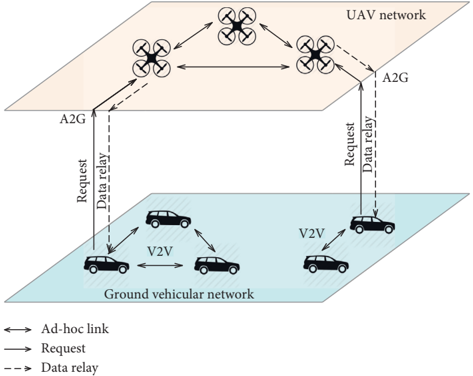
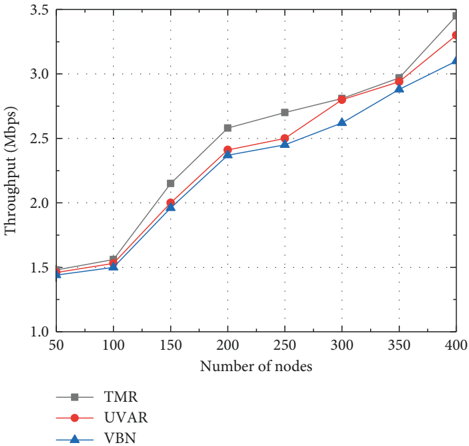
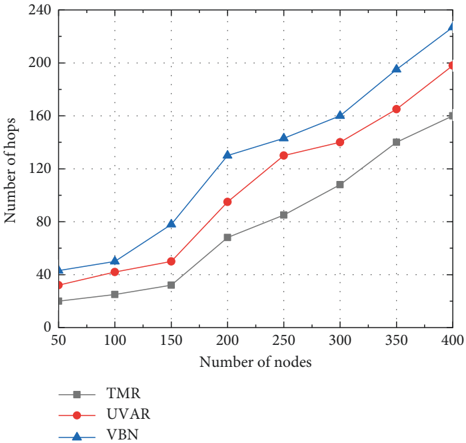
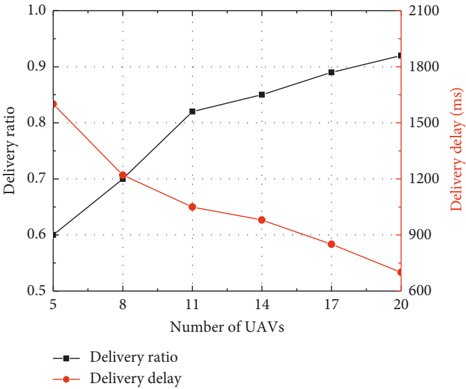
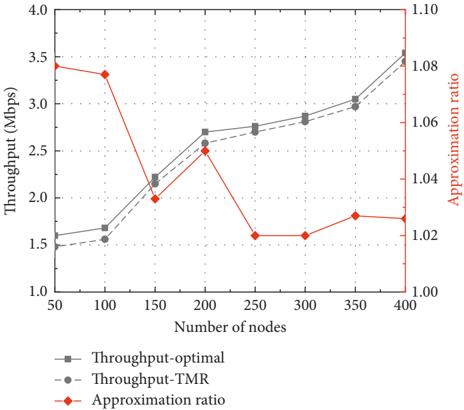
Due to the high mobility of vehicles, the frequent path failures caused by dynamic network topology, and a variety of obstructions, efficient data dissemination with delay constraint in vehicular ad hoc networks (VANETs) is a challenging issue. To address these problems, a novel mobile relaying technique by employing unmanned aerial vehicles (UAVs) is considered to facilitate data dissemination in vehicular environments where the communication infrastructures are not available or the network connectivity is poor. This paper studies and formulates the throughput maximization problem in UAV-assisted VANETs, which aims to achieve high throughput while guarantee the delay constraint of data flows to the vehicles in the area. To maximize the network throughput, the maximization problem tries to find an optimal delivery strategy for data dissemination by optimizing the transmission rate. To solve the problem, the knapsack problem can be reduced to the maximization problem, which is proved NP-hard. A polynomial time approximation scheme is proposed to achieve an approximate solution. Detailed theoretical analysis including time complexity and approximation ratio of the proposed algorithm is presented. Simulation results demonstrate the effectiveness of the proposed algorithm.
Overview
The claims and statistics of this paper haven’t been checked yet.
Run the check — free, no account needed. It reads the open-access text and checks the sources it cites.
Integrity signals
Registry
Cites
Statistics
Figures

Verification
Claims the paper makes
The claims and statistics of this paper haven’t been checked yet.
Run the check — free, no account needed. It reads the open-access text and checks the sources it cites.
Claims other papers make about this one
Each is checked against this paper’s own text: does it say what the citing paper says it does?
In the citing paper
“This way, the BESDDFFS system ensures secure data delivery with up to 66% lesser delay, 36% greater throughput, and 12% greater ratio of successfully delivered packets and accurate verification of potential fires than previously proposed system [130]”
From A Survey of Video Surveillance Systems in Smart City (2023) · cites this paper as [130]
Self-check
Percentages, sums and reported differences re-computed from the paper’s own numbers.
The self-check needs the paper’s full text.
Citations
Cites
OpenStreetMap: User-Generated Street Maps
Haklay, M., & Weber, P. (2008) · IEEE Pervasive Computing · doi:10.1109/mprv.2008.80 · Cited by 3,208
Survey of Important Issues in UAV Communication Networks
Gupta, L., Jain, R. K., & Vaszkun, G. (2015) · IEEE Communications Surveys & Tutorials · doi:10.1109/comst.2015.2495297 · Cited by 2,397
Unmanned Aerial Vehicle With Underlaid Device-to-Device Communications: Performance and Tradeoffs
Mozaffari, M., Saad, W., Bennis, M., & Debbah, M. A. (2016) · IEEE Transactions on Wireless Communications · doi:10.1109/twc.2016.2531652 · Cited by 1,134
Efficient Deployment of Multiple Unmanned Aerial Vehicles for Optimal Wireless Coverage
Mozaffari, M., Saad, W., Bennis, M., & Debbah, M. A. (2016) · IEEE Communications Letters · doi:10.1109/lcomm.2016.2578312 · Cited by 1,095
1Unmanned Aerial Vehicle with Underlaid Device-to-Device Communications: Performance and Tradeoffs
Mozaffari, M., Member, S., Saad, W., Member, S., Member, S., & Debbah, M. A. (2016) · Cited by 760
Data communication in VANETs: Protocols, applications and challenges
Cunha, F. D., Villas, L. A., Boukerche, A., Maia, G., Viana, A. C., Mini, R. A. F., & Loureiro, A. A. F. (2016) · Ad Hoc Networks · doi:10.1016/j.adhoc.2016.02.017 · Cited by 492
Software Defined Space-Air-Ground Integrated Vehicular Networks: Challenges and Solutions
Zhang, N., Zhang, S., Yang, P., Alhussein, O., Zhuang, W., & Shen, X. (2017) · IEEE Communications Magazine · doi:10.1109/mcom.2017.1601156 · Cited by 468
Multi-UAV-Aided Networks: Aerial-Ground Cooperative Vehicular Networking Architecture
Zhou, Y. F., Cheng, N., Lu, N., & Shen, X. (2015) · IEEE Vehicular Technology Magazine · doi:10.1109/mvt.2015.2481560 · Cited by 318
Cooperative Data Scheduling in Hybrid Vehicular Ad Hoc Networks: VANET as a Software Defined Network
Liu, K., Ng, J. K., Lee, V. C. S., Son, S. H., & Stojmenović, I. (2015) · IEEE/ACM Transactions on Networking · doi:10.1109/tnet.2015.2432804 · Cited by 269
Self-Organization as a Supporting Paradigm for Military UAV Relay Networks
Orfanus, D., de Freitas, E. P., & Eliassen, F. (2016) · IEEE Communications Letters · doi:10.1109/lcomm.2016.2524405 · Cited by 244
Research works printed but not linked: 2
- 2016, Connectivity of VANET segments using UAVs
- 2018, Delay-constrained throughput maximization in UAV-assisted VANETs wireless algorithms, systems, and applications (WASA), 10874
Cited by
Sorted by citations
UAV assistance paradigm: State-of-the-art in applications and challenges
Alzahrani, B., Oubbati, O. S., Barnawi, A., Atiquzzaman, M., & Alghazzawi, D. (2020) · Journal of Network and Computer Applications · doi:10.1016/j.jnca.2020.102706 · Cited by 446
Routing Protocols for Unmanned Aerial Vehicle Networks: A Survey
Arafat, M. Y., & Moh, S. (2019) · IEEE Access · doi:10.1109/access.2019.2930813 · Cited by 224
Unmanned Aerial Vehicle Communications for Civil Applications: A Review
Ghamari, M., Rangel, P., Mehrübeoğlu, M., Tewolde, G., & Sherratt, R. S. (2022) · IEEE Access · doi:10.1109/access.2022.3208571 · Cited by 163
A Critical Review of Communications in Multi-robot Systems
Gielis, J., Shankar, A., & Prorok, A. (2022) · Current Robotics Reports · doi:10.1007/s43154-022-00090-9 · Cited by 160
Routing Protocols for Unmanned Aerial Vehicle-Aided Vehicular Ad Hoc Networks: A Survey
Nazib, R. A., & Moh, S. (2020) · IEEE Access · doi:10.1109/access.2020.2989790 · Cited by 134
Metadata
- Authors
- Fan, X., Huang, C., Fu, B., Wen, S., & Chen, X.
- Affiliations
- Wuhan University (CN)
- The University of Texas Rio Grande Valley (US)
- Corresponding author
- Huang, Chuanhe
- Venue
- Mobile Information Systems
- Publisher
- Wiley
- Published
- 2018-10-25
- Volume
- 2018
- Pages
- 1-12
- ISSN
- 1574-017X (ISSN-L)
- 1875-905X
- OpenAlex
- W2898465095
- Cited by
- 34
- References
- 25
- Citations by year
- 2026: 1 · 2025: 1 · 2024: 3 · 2023: 6 · 2022: 7 · 2021: 9 · 2020: 4 · 2019: 3
- FWCI
- 1.53
- Type
- journal article
- Language
- en
- Open access
- hybrid
- doi.org
- Locations
- Mobile Information Systems (publishedVersion, cc-by)
- DOAJ (DOAJ: Directory of Open Access Journals) (submittedVersion)
- Funders
- National Natural Science Foundation of China (61772385, 61373040, 61572370)
- Topics
- Physical Sciences › Engineering › Electrical and Electronic Engineering › Vehicular Ad Hoc Networks (VANETs)
- Physical Sciences › Engineering › Aerospace Engineering › UAV Applications and Optimization
- Physical Sciences › Computer Science › Computer Networks and Communications › Mobile Ad Hoc Networks
- Keywords
- vehicular ad hoc networks, mobile relaying, throughput maximization, knapsack problem, polynomial-time approximation scheme, NP-hardness, transmission rate optimization, dynamic topology
About these checks
Registry, retraction, Cites and statistics results are computed, not judged, with one exception: a printed reference that no index lists is read once by a model before it counts as a citation error. Claims are extracted by a model and kept only when their quote appears verbatim in the text; each cited source is then checked, with a model’s help, for whether it says what the claim relies on. Those verdicts can be wrong — read the claim’s quote and the cited source before relying on one.
Statistics and arithmetic are recomputed, not judged.
Confidence bands are shown only for fields calibrated on our annotated test set. None is calibrated yet, so no band is shown.
What counts as a claim ›How we measure confidence ›How we check this ›
Are you an author, or do you see a problem with this page? Request a review
How to cite
Cite CoChat for the checks on this page, and the paper for its own findings.
- This page
- CoChat. (2026). Citation check: UAV-Assisted Data Dissemination in Delay-Constrained VANETs. https://app.cochat.ai/papers/10.1155/2018/8548301
- The paper
- Fan, X., Huang, C., Fu, B., Wen, S., & Chen, X. (2018). UAV-Assisted Data Dissemination in Delay-Constrained VANETs. Mobile Information Systems. https://doi.org/10.1155/2018/8548301
