

The DOI matches its Crossref record; 11 of the 11 references it cites were found in a registry or an index.
Yield, Quality, and Antioxidant Activity of Clove (Syzygium aromaticum L.) Bud Oil at the Different Phenological Stages in Young and Mature Trees
Open accessAbstract
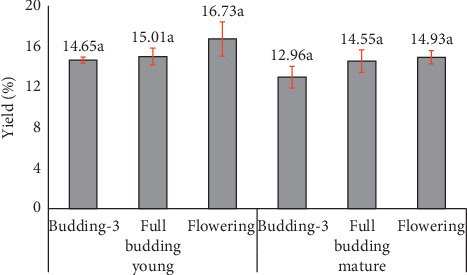
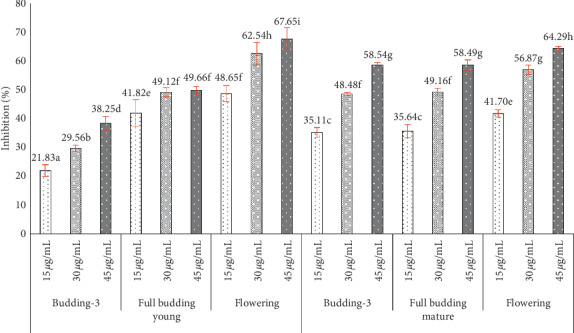
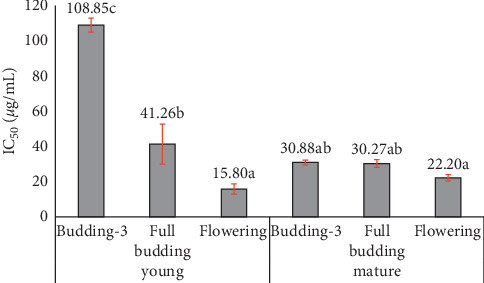
Buds and flowers of clove (Syzygium aromaticumL.) are economically important essential oil sources. The purpose of this study was to assess the yield, quality, and antioxidant activity of Zanzibar clove bud oil between three phenological stages (budding-3, full-budding, and flowering) in young (3-4 years) and mature trees (45 years). Chemical compositions of the oil were analyzed using GC-MS, and the physicochemical properties were measured based on SNI 06-4267-1996. Antioxidant activity was analyzed using the DPPH method. The results showed flowering buds of young trees produced higher yield (16.73%) than that of the mature ones (14.93%). The GC-MS analysis showed that the main bioactive compound of clove oil was eugenol (68.05–82.38%), which is highest at the flowering stage in mature trees. Almost all of the clove bud oils met physicochemical properties standard required by the SNI 06-4267-1996. DPPH scavenging activity IC50ranged 15.80–108.85 µg/mL, with the highest antioxidant activity at the flowering stage of young trees. The results indicate that clove at flowering stage produced the best essential oil ingredient, as well as the most efficient source of natural antioxidants with slight differences in quality between the young and mature trees.
Overview
The claims and statistics of this paper haven’t been checked yet.
Run the check — free, no account needed. It reads the open-access text and checks the sources it cites.
Integrity signals
Registry
Cites
Statistics
Figures
Verification
Claims the paper makes
The claims and statistics of this paper haven’t been checked yet.
Run the check — free, no account needed. It reads the open-access text and checks the sources it cites.
Claims other papers make about this one
Each is checked against this paper’s own text: does it say what the citing paper says it does?
The source backs part of the claim, not all of it — or backs it for a different population, condition or comparison.
In the citing paper
“Various authors have reported that the composition and extracted yield of EOs depends on the species, soil composition, plant organ (aerial parts, inflorescence, or roots), age, cycle stage, selected extraction method, and conditions of extraction [2,5,6,7,8,9,10,11,12,13,14,15,16,17].”
From Clove essential oil (Syzygium aromaticum L. Myrtaceae): Extraction, chemical composition, food applications, and essential bioactivity for human health (2021) · cites this paper as [9]
Experimental — accuracy not yet measuredThe cited source says what the claim attributes to it.
In the citing paper
“Alfikri et al. [9] reported that the phenological stage influences the yield and quality of clove essential oil.”
From Clove essential oil (Syzygium aromaticum L. Myrtaceae): Extraction, chemical composition, food applications, and essential bioactivity for human health (2021) · cites this paper as [9]
The cited source says what the claim attributes to it.
In the citing paper
“In addition, they reported that clove flower buds in the flowering stage had the highest yield, eugenol content, and refractive index.”
From Clove essential oil (Syzygium aromaticum L. Myrtaceae): Extraction, chemical composition, food applications, and essential bioactivity for human health (2021) · cites this paper as [9]
The cited source says what the claim attributes to it.
In the citing paper
“The best quality of clove essential oil was obtained from the buds of mature trees, while the CEO obtained from young trees had the strongest antioxidant activity [9].”
From Clove essential oil (Syzygium aromaticum L. Myrtaceae): Extraction, chemical composition, food applications, and essential bioactivity for human health (2021) · cites this paper as [9]
Self-check
Percentages, sums and reported differences re-computed from the paper’s own numbers.
The self-check needs the paper’s full text.
Citations
Cites
Antioxidant properties of resveratrol: A structure–activity insight
Gülçın, İ. (2009) · Innovative Food Science & Emerging Technologies · doi:10.1016/j.ifset.2009.07.002 · Cited by 898
Antioxidant Activity of Eugenol: A Structure–Activity Relationship Study
Gülçın, İ. (2011) · Journal of Medicinal Food · doi:10.1089/jmf.2010.0197 · Cited by 491
Antioxidant activity of clove oil – A powerful antioxidant source
Gülçın, İ., Elmastaş, M., & Aboul-Enein, H. Y. (2010) · Arabian Journal of Chemistry · doi:10.1016/j.arabjc.2010.09.016 · Cited by 471
Radünz, M., da Trindade, M. L. M., Camargo, T. M., Radünz, A. L., Borges, C. D., Gandra, E. Á., & Helbig, E. (2018) · Food Chemistry · doi:10.1016/j.foodchem.2018.09.173 · Cited by 312
Zuraida, Z., Sulistiyani, S., Sajuthi, D., & Suparto, I. H. (2017) · Jurnal Penelitian Hasil Hutan · doi:10.20886/jphh.2017.35.3.211-219 · Cited by 74
Pujiarti, R., Ohtani, Y., & Ichiura, H. (2011) · Journal of Wood Science · doi:10.1007/s10086-011-1183-0 · Cited by 53
Self-citationChemical Composition of the Essential Oils in Eugenia caryophylata, Thunb from Amboina Island
Sohilait, H. J. (2015) · Science Journal of Chemistry · doi:10.11648/j.sjc.20150306.13 · Cited by 31
Gaylor, R., Jahiel, M., Panja, R., et al. (2013) · International Journal of Basic and Applied Sciences · doi:10.14419/ijbas.v2i4.1100 · Cited by 18
The New Nigerian Agricultural Policy: Efficient for Food Security?
Owolabi, I. O., Ashaolu, J. T., & Twumasi-Ankrah, S. (2016) · Food Science and Technology · doi:10.13189/fst.2016.040101 · Cited by 12
Physicochemical properties and the extraction process of natural melanin from Auricularia polytricha
Zheng, M., Fu, J., Liu, X., et al. (2019) · SDRP Journal of Food Science & Technology · doi:10.25177/jfst.4.1.2 · Cited by 9
Research works printed but not linked: 4
- 2013, International Journal of Basic and Applied Sciences, 2, 312
- 2012, Bulletin of Anatomy and Physiology, 20, 1
- 2013, ISSN Journal, 1, 87
- 2018, Journal of Food Chemistry, 276, 180
Cited by
Sorted by citations
Plant-Derived Antioxidants: Significance in Skin Health and the Ageing Process
Michalak, M. (2022) · International Journal of Molecular Sciences · doi:10.3390/ijms23020585 · Cited by 460
Haro-González, J. N., Castillo-Herrera, G. A., Martínez-Velázquez, M., & Espinosa-Andrews, H. (2021) · Molecules · doi:10.3390/molecules26216387 · Cited by 463
Metadata
- Authors
- Alfikri, F. N., Pujiarti, R., Wibisono, M. G., & Hardiyanto, E. B.
- Affiliations
- Universitas Gadjah Mada (ID)
- Corresponding author
- Pujiarti, Rini
- Venue
- Scientifica
- Publisher
- Wiley
- Published
- 2020-06-03
- Volume
- 2020
- Pages
- 1-8
- ISSN
- 2090-908X (ISSN-L)
- PMC
- PMC7290900
- OpenAlex
- W3032897427
- Cited by
- 86
- References
- 11
- Citations by year
- 2026: 15 · 2025: 14 · 2024: 19 · 2023: 11 · 2022: 17 · 2021: 10
- FWCI
- 6.16
- Type
- journal article
- Language
- en
- Open access
- gold
- doi.org
- Locations
- Scientifica (publishedVersion, cc-by)
- PubMed Central (publishedVersion, cc-by)
- PubMed (publishedVersion)
- DOAJ (DOAJ: Directory of Open Access Journals) (submittedVersion, cc-by-sa)
- Funders
- Universitas Gadjah Mada
- Topics
- Life Sciences › Agricultural and Biological Sciences › Food Science › Essential Oils and Antimicrobial Activity
- Life Sciences › Agricultural and Biological Sciences › Plant Science › Medicinal Plant Research
- Physical Sciences › Chemistry › Organic Chemistry › Edible Oils Quality and Analysis
- Keywords
- Syzygium aromaticum, essential oils, phenological stages, flowering stage, eugenol, antioxidant activity, DPPH radical scavenging, essential oil yield, essential oil quality
About these checks
Registry, retraction, Cites and statistics results are computed, not judged, with one exception: a printed reference that no index lists is read once by a model before it counts as a citation error. Claims are extracted by a model and kept only when their quote appears verbatim in the text; each cited source is then checked, with a model’s help, for whether it says what the claim relies on. Those verdicts can be wrong — read the claim’s quote and the cited source before relying on one.
Statistics and arithmetic are recomputed, not judged.
Confidence bands are shown only for fields calibrated on our annotated test set. None is calibrated yet, so no band is shown.
What counts as a claim ›How we measure confidence ›How we check this ›
Are you an author, or do you see a problem with this page? Request a review
