

Resistance of Recycled Aggregate Concrete (RAC) Subjected to Drying-Wetting Cycles to Attack of Magnesium and Sodium Sulfates
Open accessThe DOI matches its Crossref record; 14 of the 14 references it cites were found in a registry or an index; none of the 14 sources its claims cite is checked for support yet.
Abstract
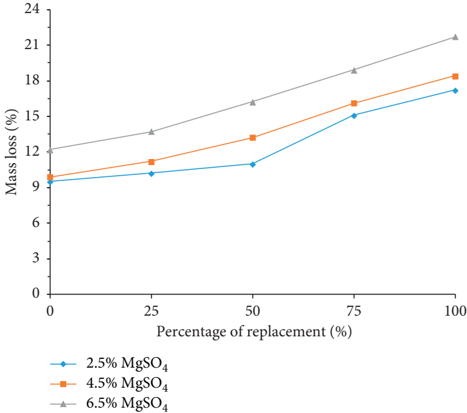
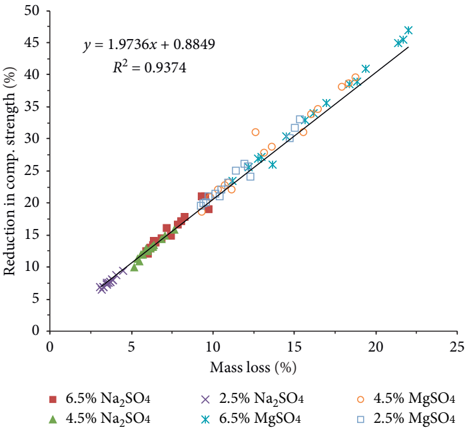
Recycled aggregates were widely used in the concrete industry as a replacement of natural aggregates in the last two decades. In this study, the resistance of concrete mixtures having various levels of recycled aggregate as a replacement of natural coarse aggregate to the attack of magnesium and sodium sulfates was investigated. Five mixtures made with 0%, 25%, 50%, 75%, and 100% recycled aggregate were partially immersed in magnesium and sodium sulfate solutions having concentrations of 2.5%, 4.5%, and 6.5% and subjected to drying-wetting cycles for a total of 10 weeks. Mass losses of concrete specimens owing to the attack of sulfate solutions and the effect of drying-wetting cycles were recorded weekly. Results show that the incorporation of recycled aggregate decreased the compressive strength of concrete at ages of 7 and 28 days. The decline in the compressive strength was more significant when the replacement percentage exceeds 50%. Mass losses of concrete specimens were found to be increased as the level of recycled aggregate increased. Mass losses of concrete specimens having 100% recycled aggregate were approximately as twice as those of concrete specimens having 0% recycled aggregate owing to 10 weeks of partial immersion in magnesium sulfate solutions of concentrations of 2.5%, 4.5%, and 6.5%. The attack of sodium sulfates was less aggressive than that of the magnesium sulfates. Results also show that the reduction in the compressive strength is directly proportional to the mass loss following a linear equation of R-squared value of 0.937.
Overview
CoChat Summary
TL;DR
This study tested recycled aggregate concrete (RAC) with 0–100% recycled coarse aggregate under 10 weeks of drying-wetting cycles and partial immersion in magnesium or sodium sulfate solutions at 2.5%, 4.5%, and 6.5%. Increasing recycled aggregate reduced compressive strength and increased sulfate-induced mass loss, with sodium sulfate less aggressive than magnesium sulfate and compressive-strength reduction linearly related to mass loss (R² = 0.937).
Key findings
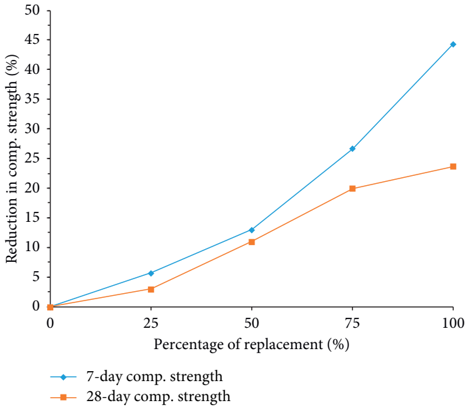
- Compressive strength decreased as recycled aggregate replacement increased; at 7 days, 75% and 100% replacement reduced strength by 26.7% and 44.4%, while at 28 days the reductions were 20.5% and 25.2%, respectively.
- After 10 weeks in 2.5% magnesium sulfate, mass losses were 9.5%, 10.2%, 11%, 15.1%, and 17.2% for M0, M25, M50, M75, and M100; for the reference mixture in 2.5%, 4.5%, and 6.5% magnesium sulfate, mass losses were 9.5%, 9.9%, and 12.2%.
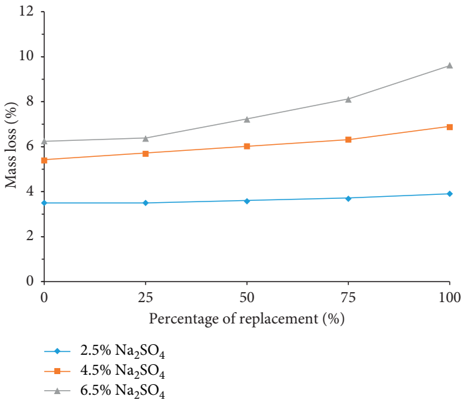
- Sodium sulfate attack was less aggressive: reference mass losses in 2.5%, 4.5%, and 6.5% sodium sulfate were 3.5%, 5.4%, and 6.23%, and 100% recycled aggregate mixtures showed increases of approximately 11%, 27%, and 54% over the reference; sodium sulfate mass losses were about half those from magnesium sulfate.
- Reduction in compressive strength increased with mass loss, following a linear trend with R² = 0.937 and a slope of approximately 2, indicating each 1% mass loss corresponded to about 2% compressive-strength reduction.
Methods
- Five mixtures (M0, M25, M50, M75, M100) used 0%, 25%, 50%, 75%, and 100% recycled coarse aggregate as replacement of natural coarse aggregate; the reference mixture was designed per ACI 211.1 with a targeted 28-day compressive strength of 30 MPa, using Type I ordinary Portland cement and 150 × 150 × 150 mm cubes.
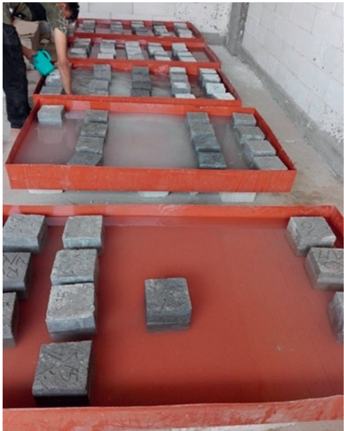
- Twenty-four cubes were made per mixture: six for compressive strength at 7 and 28 days (three at each age) and eighteen for sulfate attack (three specimens for each of six sulfate solutions). Magnesium and sodium sulfate solutions at 2.5%, 4.5%, and 6.5% were used, with specimens partially immersed to 60 mm depth and subjected to weekly drying-wetting cycles for 10 weeks.
- Mass loss was recorded weekly as a percentage of initial mass; after exposure, compressive strength was measured and reduction calculated relative to 28-day strength; regression analysis related mass loss to compressive-strength reduction.
Limitations
- The paper states that the recorded mass losses involved the combined effect of sulfate attack and drying-wetting, so results should be interpreted within that context.
- Evident from the text: the study used only one source of recycled aggregate (average source cube compressive strength 37.2 MPa, standard deviation 7.5%), only coarse recycled aggregate replacement, and a limited 10-week testing period with three sulfate concentrations; it did not separate drying-wetting damage from sulfate attack.
Model-written summary. Check it against the paper before relying on it.
Integrity signals
Registry
Cites
Statistics
Figures
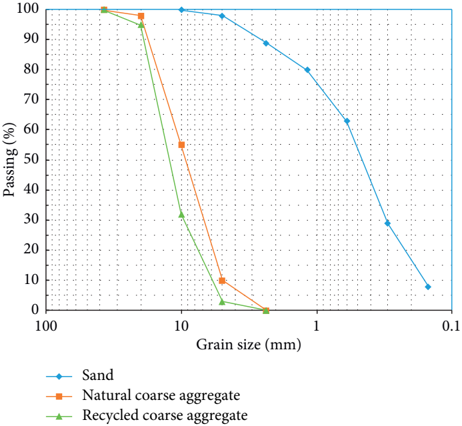
Verification
Claims the paper makes
0 Valid · 0 Not valid · 11 Not checked · 43 Own results and interpretations
A result the paper reports from its own data — it cites no other source for it, so there is none to check. The quote shows it is in the paper.
In the paper
“e decrease in the compressive strength was proportional to the replacement percentage of recycled aggregates.”
- Also stated in: § 4. Conclusions · plain
“e decline in the compressive strength was directly proportional to the percentage of the replacement.”
§ Resistance of Recycled Aggregate Concrete (RAC) Subjected to Drying-Wetting Cycles to Attack of Magnesium and Sodium Sulfates > 3.1. Effect of RA on Compressive Strength.
plainstates an association- Asserted: passes — The authors put it forward as true.
- Checkable: passes — It can be checked against evidence.
- Load-bearing: passes — The paper’s conclusions depend on it.
- Based: passes — The paper gives a reason why it holds.
- Also stated in: § 4. Conclusions · plain
A result the paper reports from its own data — it cites no other source for it, so there is none to check. The quote shows it is in the paper.
In the paper
“Otherwise, all the other concrete specimens of different mixtures exhibited mass loss owing to the partial immersion in sodium sulfate of various concentrations.”
§ Resistance of Recycled Aggregate Concrete (RAC) Subjected to Drying-Wetting Cycles to Attack of Magnesium and Sodium Sulfates > 3.3. Resistance of Concrete Having RA to Sodium Sulfate Attack.
plainstates a cause- Asserted: passes — The authors put it forward as true.
- Checkable: passes — It can be checked against evidence.
- Load-bearing: unclear — It is unclear whether the paper’s conclusions depend on it.
- Based: passes — The paper gives a reason why it holds.
A result the paper reports from its own data — it cites no other source for it, so there is none to check. The quote shows it is in the paper.
In the paper
“e tables also reveal that the rate of mass losses of reference and modified mixtures was higher in the second half than that of the first half of the testing period.”
§ Resistance of Recycled Aggregate Concrete (RAC) Subjected to Drying-Wetting Cycles to Attack of Magnesium and Sodium Sulfates > 3.2. Resistance of Concrete Having RA to Magnesium Sulfate Attack.
plainstates an association- Asserted: passes — The authors put it forward as true.
- Checkable: passes — It can be checked against evidence.
- Load-bearing: unclear — It is unclear whether the paper’s conclusions depend on it.
- Based: passes — The paper gives a reason why it holds.
A result the paper reports from its own data — it cites no other source for it, so there is none to check. The quote shows it is in the paper.
In the paper
“is behavior of the mass loss was similar for all modified mixtures having different percentages of recycled aggregate.”
§ Resistance of Recycled Aggregate Concrete (RAC) Subjected to Drying-Wetting Cycles to Attack of Magnesium and Sodium Sulfates > 3.2. Resistance of Concrete Having RA to Magnesium Sulfate Attack.
plain- Asserted: passes — The authors put it forward as true.
- Checkable: passes — It can be checked against evidence.
- Load-bearing: unclear — It is unclear whether the paper’s conclusions depend on it.
- Based: passes — The paper gives a reason why it holds.
A result the paper reports from its own data — it cites no other source for it, so there is none to check. The quote shows it is in the paper.
In the paper
“In other words, the rate of the mass loss of the mixtures was approximately constant in the different concentrations of magnesium sulfate solutions considering that the absolute value of the mass loss was different.”
§ Resistance of Recycled Aggregate Concrete (RAC) Subjected to Drying-Wetting Cycles to Attack of Magnesium and Sodium Sulfates > 3.2. Resistance of Concrete Having RA to Magnesium Sulfate Attack.
plain- Asserted: passes — The authors put it forward as true.
- Checkable: passes — It can be checked against evidence.
- Load-bearing: unclear — It is unclear whether the paper’s conclusions depend on it.
- Based: passes — The paper gives a reason why it holds.
32 more claims
Create a free account to see all 54 claims and every source verdict.
- It may state two separate claims as one. 6
- Probably not a substantial claim. 12
- The quote only partly states this claim. 2
Self-check
Percentages, sums and reported differences re-computed from the paper’s own numbers.
Each contradiction between two passages listed here was confirmed by an independent check.
Rated minor: it would not touch a result — a value no result rests on, a p-value that stays on the same side of the significance level, or a conflict that is clerical, resolved elsewhere in the paper, or outside its own findings.
In the paper
§ Resistance of Recycled Aggregate Concrete (RAC) Subjected to Drying-Wetting Cycles to Attack of Magnesium and Sodium Sulfates > 4. Conclusions
“Although concrete specimens having various percentages of recycled aggregate did not exhibit any mass losses during the first week of the partial immersion in various concentrations of sodium sulfate solutions”
§ Resistance of Recycled Aggregate Concrete (RAC) Subjected to Drying-Wetting Cycles to Attack of Magnesium and Sodium Sulfates > 4. Conclusions
“| 1 st week | 0.09 | 0.09 | 0.11 | 0.18 | 0.23 |”
Rated minor: it would not touch a result — a value no result rests on, a p-value that stays on the same side of the significance level, or a conflict that is clerical, resolved elsewhere in the paper, or outside its own findings.
In the paper
§ Resistance of Recycled Aggregate Concrete (RAC) Subjected to Drying-Wetting Cycles to Attack of Magnesium and Sodium Sulfates > 3.2. Resistance of Concrete Having RA to Magnesium Sulfate Attack.
“e three tables clearly show that the mass loss proportionally increased with testing period and the replacement percentage of recycled aggregate.”
§ Resistance of Recycled Aggregate Concrete (RAC) Subjected to Drying-Wetting Cycles to Attack of Magnesium and Sodium Sulfates > 4. Conclusions
“| 1 st week | 0.32 | 0.23 | 0.23 | 0.26 | 0.30 |”
Citations
Cites
Mechanical behaviour of concrete made with fine recycled concrete aggregates
Evangelista, L., & de Brito, J. (2007) · Cement and Concrete Composites · doi:10.1016/j.cemconcomp.2006.12.004 · Cited by 1,059
Mechanical properties of concrete with recycled coarse aggregate
Rahal, K. (2007) · Building and Environment · doi:10.1016/j.buildenv.2005.07.033 · Cited by 762
Use of recycled concrete aggregate in high-strength concrete
Limbachiya, M. C., Leelawat, T., & Dhir, R. K. (2000) · Materials and Structures · doi:10.1007/bf02480538 · Cited by 714
Does gypsum formation during sulfate attack on concrete lead to expansion?
Tian, B., & Cohen, M. D. (2000) · Cement and Concrete Research · doi:10.1016/s0008-8846(99)00211-2 · Cited by 453
Recycling and reuse of waste concrete in China
Li, X. (2008) · Resources, Conservation and Recycling · doi:10.1016/j.resconrec.2008.09.006 · Cited by 369
The influence of the use of recycled aggregates on the compressive strength of concrete: a review
Silva, R. V., de Brito, J., & Dhir, R. K. (2015) · European Journal of Environmental and Civil Engineering · doi:10.1080/19648189.2014.974831 · Cited by 366
Mechanism of sulfate attack: a fresh look
Santhanam, M., Cohen, M. D., & Olek, J. (2003) · Cement and Concrete Research · doi:10.1016/s0008-8846(02)00958-4 · Cited by 365
Qi, B., Gao, J., Chen, F., & Shen, D. (2017) · Construction and Building Materials · doi:10.1016/j.conbuildmat.2017.02.022 · Cited by 148
Hewayde, E., Nehdi, M. L., Allouche, E. N., & Nakhla, G. (2007) · Journal of Materials in Civil Engineering · doi:10.1061/(asce)0899-1561(2007)19:2(155 · Cited by 111
Self-citationXiao, Q. H., Li, Q., Cao, Z. Y., & Tian, W. Y. (2019) · Construction and Building Materials · doi:10.1016/j.conbuildmat.2018.12.066 · Cited by 110
Research works printed but not linked: 13
- Al-Eleaj and Hussin, "Resistance of recycled aggregate con- crete to sulfate attack," Master thesis, Faculty of Engineering, University of Kashan, Kashan, Iran, 2009.
- G. Gonzalez and H. Moo-Young, Transportation Applications of Recycled Concrete Aggregate, FHWA State of the Practice National Review, pp. 1-47, Federal Highway Administration, Washington, DC, USA, 2004.
- H. Kim, "Crushed returned concrete aggregate in new con- crete: characterization, performance, modeling, specification, and application," Doctoral dissertation, University of Mary- land, College Park, MD, USA, 2009.
- R. Kumutha and K. Vijai, "Strength of concrete incorporating aggregates recycled from demolition waste," ARPN Journal of Engineering and Applied Sciences, vol. 5, no. 5, pp. 64-71, 2010.
- S. Kumar, S. N. Sachdeva, and P. Aggarwal, "Effect of sulphate solution on recycled aggregate concrete," International Journal of Engineering Research & Technology (IJERT), vol. 3, no. 7, pp. 294-298, 2014.
- C. S. Poon, S. Azhar, and S. C. Kou, "Recycled aggregates for concrete applications," in Proceeding of the Materials Science and Technology in Engineering Conference-Now, New and Next, pp. 15-17, Hong Kong, China, January 2003.
- S. F. Ramadan, M. Solikin, and I. SriSunarjono, "Effect of recycled coarse aggregate on concrete properties," Interna- tional Journal of Innovative Science Engineering and Tech- nology, vol. 4, pp. 19060-19061, 2015.
- T. C. Hansen and H. Narud, "Strength of recycled concrete made from crushed concrete coarse aggregate," Concrete International, vol. 5, no. 1, pp. 79-83, 1983.
- J. M. V. Gómez Soberón, "Shrinkage of concrete with re- placement of aggregate with recycled concrete aggregate," in Proceedings of the SP-209: ACI Fifth International Confrence on Innovation in Design with Emphasis on Seismic, Wind and Environmental Loading, Quality Control, and Innovation in Materials/Hot Weather Concreting, Cancun, Mexico, December 2002.
- K. AL-Zouhayli, "Experimental study on concrete produced from recycled concrete aggregate," Tishreen University Jour- nal for Research and Scientific Studies-Engineering Sciences Series, vol. 36, no. 2, pp. 253-266, 2014.
- P. K. Mehta, "Sulfate attack on concrete separating myths from reality," Concrete International, vol. 22, no. 8, pp. 57-61, 2000.
- P. W. Brown and H. F. W. Taylor, " e role of ettringite in external sulfate attack," in Materials Science of Concrete: Sulfate Attack Mechanisms, pp. 73-98, e American Ceramic Society, Westerville, OH, USA, 1999.
- K. Hawi, "Effect of sulfate attack on concrete," Babel Uni- versity Journal, vol. 22, no. 3, pp. 581-593, 2014.
Cited by
Bayraktar, O. Y., Özel, H. B., Benli, A., Yılmazoglu, M. U., Türkel, İ., Dal, B. B., Şevik, H., & Kaplan, G. (2024) · Construction and Building Materials · doi:10.1016/j.conbuildmat.2024.139422 · Cited by 84
Sobuz, M. H. R., Datta, S. D., & Akid, A. S. M. (2022) · Australian Journal of Civil Engineering · doi:10.1080/14488353.2022.2088646 · Cited by 50
Du, T., Chen, J., Qu, F., Li, C., Zhao, H., Xie, B., Yuan, M., & Li, W. (2022) · Structures · doi:10.1016/j.istruc.2022.11.035 · Cited by 31
Liu, K., Fu, K., Bao, J., Chen, C., Zhang, R., & Sang, Y. (2025) · Journal of Building Engineering · doi:10.1016/j.jobe.2024.111664 · Cited by 17
Abbas, S. N., & Qureshi, M. I. (2024) · Progress in Engineering Science · doi:10.1016/j.pes.2024.100026 · Cited by 17
Metadata
- Authors
- Hewayde, E., Pachenari, A., & Al-Eleaj, H.
- Affiliations
- Al-Muthanna University (IQ)
- University of Kashan (IR)
- Corresponding author
- Hewayde, Esam
- Venue
- Journal of Engineering
- Publisher
- Wiley
- Published
- 2020-01-29
- Volume
- 2020
- Pages
- 1-9
- ISSN
- 2314-4904 (ISSN-L)
- 2314-4912
- OpenAlex
- W3004072007
- Cited by
- 20
- References
- 14
- Citations by year
- 2026: 4 · 2025: 5 · 2024: 5 · 2023: 2 · 2022: 4
- FWCI
- 0.74
- Type
- journal article
- Language
- en
- Open access
- gold
- doi.org
- Locations
- Journal of Engineering (publishedVersion, cc-by)
- DOAJ (DOAJ: Directory of Open Access Journals) (submittedVersion)
- Topics
- Physical Sciences › Engineering › Building and Construction › Recycled Aggregate Concrete Performance
- Physical Sciences › Engineering › Civil and Structural Engineering › Concrete and Cement Materials Research
- Physical Sciences › Engineering › Civil and Structural Engineering › Concrete Corrosion and Durability
- Keywords
- recycled aggregate concrete, magnesium sulfate attack, sodium sulfate attack, wetting-drying cycles, compressive strength, mass loss, coarse aggregate replacement, sulfate resistance, concrete durability
About these checks
Registry, retraction, Cites and statistics results are computed, not judged, with one exception: a printed reference that no index lists is read once by a model before it counts as a citation error. Claims are extracted by a model and kept only when their quote appears verbatim in the text; each cited source is then checked, with a model’s help, for whether it says what the claim relies on. Those verdicts can be wrong — read the claim’s quote and the cited source before relying on one.
A language model drew the claims from the paper on 2026-11-27, under version 3 of the claim definition (model deepseek-v4.1-flash, prompt extract-v3).
A second model labelled each claim on 2026-11-27 (model jev-1.13-20260917, definition revision gold-guideline-v0.2).
Statistics and arithmetic are recomputed, not judged.
Confidence bands are shown only for fields calibrated on our annotated test set. None is calibrated yet, so no band is shown.
What counts as a claim ›How we measure confidence ›How we check this ›
Are you an author, or do you see a problem with this page? Request a review
How to cite
Cite CoChat for the checks on this page, and the paper for its own findings.
- This page
- CoChat. (2026). Citation check: Resistance of Recycled Aggregate Concrete (RAC) Subjected to Drying-Wetting Cycles to Attack of Magnesium and Sodium Sulfates. https://app.cochat.ai/papers/10.1155/2020/9746341
- The paper
- Hewayde, E., Pachenari, A., & Al-Eleaj, H. (2020). Resistance of Recycled Aggregate Concrete (RAC) Subjected to Drying-Wetting Cycles to Attack of Magnesium and Sodium Sulfates. Journal of Engineering. https://doi.org/10.1155/2020/9746341
Data sources
Bibliographic data: Semantic Scholar, OpenAlex, Crossref.
Contains information from the Semantic Scholar Academic Graph Datasets, made available under the ODC Attribution License (ODC-BY 1.0).
Semantic Scholar’s data is described in: Kinney, R., et al. (2023). The Semantic Scholar Open Data Platform. arXiv:2301.10140.
