

The DOI matches its Crossref record; 4 of the 4 references it cites were found in a registry or an index.
Ensemble Classifiers for Arabic Sentiment Analysis of Social Network (Twitter Data) towards COVID-19-Related Conspiracy Theories
Open accessAbstract
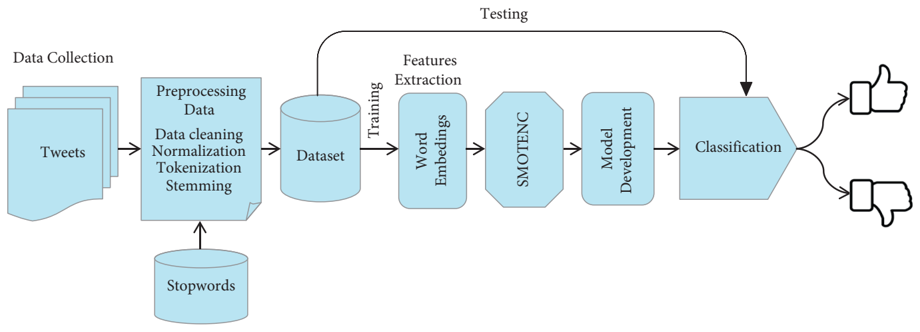
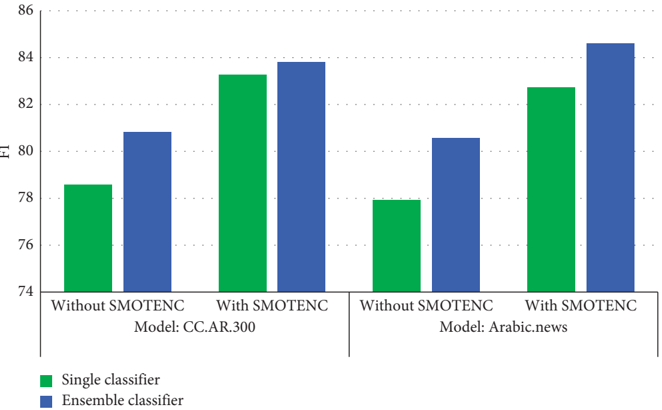
Sentiment analysis has recently become increasingly important with a massive increase in online content. It is associated with the analysis of textual data generated by social media that can be easily accessed, obtained, and analyzed. With the emergence of COVID-19, most published studies related to COVID-19’s conspiracy theories were surveys on the people's sentiments and opinions and studied the impact of the pandemic on their lives. Just a few studies utilized sentiment analysis of social media using a machine learning approach. These studies focused more on sentiment analysis of Twitter tweets in the English language and did not pay more attention to other languages such as Arabic. This study proposes a machine learning model to analyze the Arabic tweets from Twitter. In this model, we apply Word2Vec for word embedding which formed the main source of features. Two pretrained continuous bag-of-words (CBOW) models are investigated, and Naïve Bayes was used as a baseline classifier. Several single-based and ensemble-based machine learning classifiers have been used with and without SMOTE (synthetic minority oversampling technique). The experimental results show that applying word embedding with an ensemble and SMOTE achieved good improvement on average of F1 score compared to the baseline classifier and other classifiers (single-based and ensemble-based) without SMOTE.
Overview
The claims and statistics of this paper haven’t been checked yet.
Run the check — free, no account needed. It reads the open-access text and checks the sources it cites.
Integrity signals
Registry
Cites
Statistics
Figures
Verification
Claims the paper makes
The claims and statistics of this paper haven’t been checked yet.
Run the check — free, no account needed. It reads the open-access text and checks the sources it cites.
Claims other papers make about this one
Each is checked against this paper’s own text: does it say what the citing paper says it does?
The source backs part of the claim, not all of it — or backs it for a different population, condition or comparison.
In the citing paper
“The utilization of LSA substantially enhances our capacity to extract and discern the semantic associations that manifest in the thoughts of speakers or writers during communication.”
From Large language models (LLMs): survey, technical frameworks, and future challenges (2024) · cites this paper as Al-Hashedi et al. 2022
Experimental — accuracy not yet measured
Self-check
Percentages, sums and reported differences re-computed from the paper’s own numbers.
The self-check needs the paper’s full text.
Citations
Cites
Using social and behavioural science to support COVID-19 pandemic response
Bavel, J. J. V., Baicker, K., Boggio, P. S., Capraro, V., Cichocka, A., Cikara, M., Crockett, M. J., Crum, A. J., Douglas, K. M., Druckman, J. N., et al. (2020) · Nature Human Behaviour · doi:10.1038/s41562-020-0884-z · Cited by 4,964
The pandemic of social media panic travels faster than the COVID-19 outbreak
Depoux, A., Martin, S., Karafillakis, E., Preet, R., Wilder-Smith, A., & Larson, H. (2020) · Journal of Travel Medicine · doi:10.1093/jtm/taaa031 · Cited by 1,068
Coronavirus conspiracy beliefs, mistrust, and compliance with government guidelines in England
Freeman, D., Waite, F., Rosebrock, L., Petit, A., Causier, C., East, A., Jenner, L., Teale, A.-L., Carr, L., Mulhall, S., et al. (2022) · Psychological Medicine · doi:10.1017/s0033291720001890 · Cited by 714
Boberg, S., Quandt, T., Schatto-Eckrodt, T., & Frischlich, L. (2020) · arXiv · doi:10.48550/arxiv.2004.02566 · Cited by 141
Research works printed but not linked: 27
- S. Shahsavari, 2020, Conspiracy in the time of corona: automatic detection of covid-19 conspiracy theories in social media and the news, 10.1007/s42001-020-00086-5 · DOI
- 10.7759/cureus.7255 · DOI
- 10.3389/fpsyg.2016.00009 · DOI
- J. Waterson, How false claims about 5G health risks spread into the mainstream, The Guardian
- 10.1561/1500000011 · DOI · Paper page
- 10.1016/j.knosys.2020.105949 · DOI
- 10.5455/JPMA.38 · DOI
- 10.34297/AJBSR.2020.08.001252 · DOI
- 10.1177/18344909211037385 · DOI
- 10.3389/fpsyg.2020.565128 · DOI
- 10.21203/rs.3.rs-33972/v1 · DOI
- 10.21203/rs.3.rs-33972/v1 · DOI
- M. Alhajji, 2020, Sentiment analysis of tweets in Saudi Arabia regarding governmental preventive measures to contain COVID-19, 10.20944/preprints202004.0031.v1 · DOI
- K. Suppala, 2019, Sentiment analysis using naive Bayes classifier, International Journal of nInnovative Technology and Exploring Engineering, 8, 265
- 10.2196/19458 · DOI
- 10.17583/rimcis.2020.5386 · DOI
- 10.1109/eSmarTA52612.2021.9515749 · DOI
- 10.1109/ITSS-IoE53029.2021.9615256 · DOI
- 10.1155/2020/7403128 · DOI
- 10.3115/v1/d14-1162 · DOI · Paper page
- G. Vinodhini, 2012, Sentiment analysis and opinion mining: a survey, International Journal, 2, 282
- 10.1504/ijbdi.2014.063845 · DOI
- 10.1109/iacs.2014.6841964 · DOI
- 10.1016/s1532-0464(03)00034-0 · DOI · Paper page
- M. Swamynathan, 2019, Mastering Machine Learning with Python in Six Steps: A Practical Implementation Guide to Predictive Data Analytics Using Python, 10.1007/978-1-4842-4947-5 · DOI
- 10.1016/j.eswa.2016.03.045 · DOI · Paper page
- 10.1177/0165551515613226 · DOI
Cited by
Sorted by citations
Large language models (LLMs): survey, technical frameworks, and future challenges
Kumar, P. (2024) · Artificial Intelligence Review · doi:10.1007/s10462-024-10888-y · Cited by 395
Metadata
- Authors
- Al-Hashedi, A., Al-Fuhaidi, B., Mohsen, A. M., Ali, Y., Gamal Al-Kaf, H. A., Al-Sorori, W., & Maqtary, N.
- Affiliations
- University of Science and Technology, Sana’a (YE)
- Faculty of Computing and IT, University of Science and Technology Sana’a, Sana’a, Yemen
- Corresponding author
- Al-Fuhaidi, Belal
- Venue
- Applied Computational Intelligence and Soft Computing
- Publisher
- Wiley
- Published
- 2022-01-13
- Volume
- 2022
- Pages
- 1-10
- ISSN
- 1687-9724 (ISSN-L)
- 1687-9732
- OpenAlex
- W4206646040
- Cited by
- 70
- References
- 4
- Citations by year
- 2026: 3 · 2025: 12 · 2024: 18 · 2023: 25 · 2022: 12
- FWCI
- 4.48
- Type
- journal article
- Language
- en
- Open access
- gold
- doi.org
- Locations
- Applied Computational Intelligence and Soft Computing (publishedVersion, cc-by)
- University of Science and Technology Institutional Repository (University of Science and Technology, Sana’a, Yemen) (submittedVersion, cc-by)
- DOAJ (DOAJ: Directory of Open Access Journals) (submittedVersion, cc-by-sa)
- Greater South Information System
- Topics
- Physical Sciences › Computer Science › Artificial Intelligence › Sentiment Analysis and Opinion Mining
- Social Sciences › Sociology and Political Science › Misinformation and Its Impacts
- Physical Sciences › Computer Science › Artificial Intelligence › Hate Speech and Cyberbullying Detection
- Keywords
- Arabic sentiment analysis, COVID-19 conspiracy theories, Twitter, ensemble classifiers, Word2Vec, SMOTE, class imbalance, social media text, naive Bayes
About these checks
Registry, retraction, Cites and statistics results are computed, not judged, with one exception: a printed reference that no index lists is read once by a model before it counts as a citation error. Claims are extracted by a model and kept only when their quote appears verbatim in the text; each cited source is then checked, with a model’s help, for whether it says what the claim relies on. Those verdicts can be wrong — read the claim’s quote and the cited source before relying on one.
Statistics and arithmetic are recomputed, not judged.
Confidence bands are shown only for fields calibrated on our annotated test set. None is calibrated yet, so no band is shown.
What counts as a claim ›How we measure confidence ›How we check this ›
Are you an author, or do you see a problem with this page? Request a review
