

The DOI matches its Crossref record.
A Massage Area Positioning Algorithm for Intelligent Massage System
Open accessAbstract
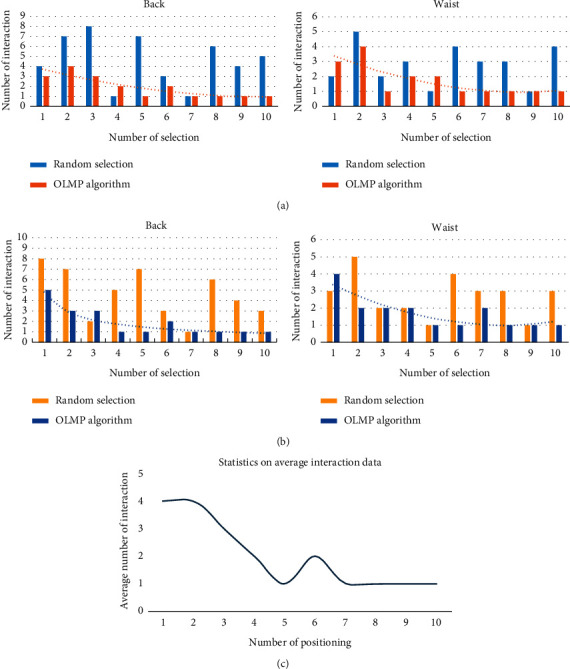
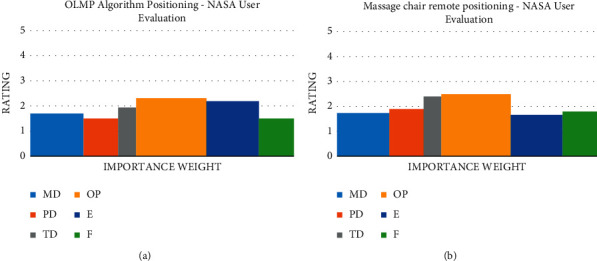
A growing number of studies have been conducted over the past few years on the positioning of daily massage robots. However, most methods used for research have low interactivity, and a systematic method should be designed for accurate and intelligent positioning, thus compromising usability and user experience. In this study, a massage positioning algorithm with online learning capabilities is presented. The algorithm has the following main innovations: (1) autonomous massage localization can be achieved by gaining insights into natural human-machine interaction behavior and (2) online learning of user massage habits can be achieved by integrating recursive Bayesian ideas. As revealed by the experimental results, combining natural human-computer interaction and online learning with massage positioning is capable of helping people get rid of positioning aids, reducing their psychological and cognitive load, and achieving a more desirable positioning effect. Furthermore, the results of the analysis of user evaluations further verify the effectiveness of the algorithm.
Overview
The claims and statistics of this paper haven’t been checked yet.
Run the check — free, no account needed. It reads the open-access text and checks the sources it cites.
Integrity signals
Registry
Cites
Statistics
Figures

Verification
Claims the paper makes
The claims and statistics of this paper haven’t been checked yet.
Run the check — free, no account needed. It reads the open-access text and checks the sources it cites.
Claims other papers make about this one
Each is checked against this paper’s own text: does it say what the citing paper says it does?
The source backs part of the claim, not all of it — or backs it for a different population, condition or comparison.
In the citing paper
“Poor visual design increases cognitive load and the likelihood of human error, whereas ergonomically informed interfaces can substantially improve task performance.”
From The Impact of User Interface and Experience (UI/UX) Design on Visual Ergonomics: A Technical Approach for Reducing Human Error in Industrial Settings (2026) · cites this paper as [4]
Experimental — accuracy not yet measuredThe source backs part of the claim, not all of it — or backs it for a different population, condition or comparison.
In the citing paper
“Many systems exhibit visual overload or unintuitive navigation structures, which hinder comprehension and negatively affect usability [3,4].”
From The Impact of User Interface and Experience (UI/UX) Design on Visual Ergonomics: A Technical Approach for Reducing Human Error in Industrial Settings (2026) · cites this paper as [4]
Experimental — accuracy not yet measuredThe check wasn’t confident either way, so it gives no verdict — never disputed.
In the citing paper
“In such contexts, insufficient visual ergonomics can result in delayed responses, misinterpretation of system states, and increased operational risk.”
From The Impact of User Interface and Experience (UI/UX) Design on Visual Ergonomics: A Technical Approach for Reducing Human Error in Industrial Settings (2026) · cites this paper as [4]
Experimental — accuracy not yet measured
Self-check
Percentages, sums and reported differences re-computed from the paper’s own numbers.
The self-check needs the paper’s full text.
Citations
Cites
No references could be resolved yet.
Research works printed but not linked: 19
- 10.5772/60525 · DOI
- 10.1207/s15427633scc0504_2 · DOI
- 10.1348/026151000165553 · DOI
- 10.1145/3173574.3174227 · DOI
- 10.1088/1757-899x/569/4/042029 · DOI
- Y. Xiangping, 2018, Acupoint positioning system based on pso-bp neural network, Application of Electronic Technique, 09
- 10.1007/s12369-015-0323-x · DOI
- 10.3389/fnhum.2012.00103 · DOI
- 10.1126/scirobotics.abc5044 · DOI
- 10.1109/mvt.2021.3140047 · DOI
- 10.1109/mra.2013.2275695 · DOI
- 10.1177/1460458217729729 · DOI
- 10.1109/tiv.2022.3163458 · DOI
- 10.1016/j.neucom.2020.10.016 · DOI
- 10.1038/s42003-021-02891-8 · DOI
- 10.1016/j.eswa.2019.04.004 · DOI
- 10.1109/setit.2016.7939929 · DOI
- 10.1109/cvprw50498.2020.00528 · DOI
- 10.1109/cvpr.2017.494 · DOI
Cited by
Sorted by citations
Vizcarra, A., Quiroz, G., & Cornejo, J. (2026) · Designs · doi:10.3390/designs10010008 · Cited by 3
Metadata
- Authors
- Zhou, L., Feng, Z., Cai, Z., Yang, X., Ai, C., & Shao, H.
- Affiliations
- University of Jinan (CN)
- Corresponding author
- Feng, Zhiquan
- Venue
- Computational Intelligence and Neuroscience
- Publisher
- Wiley
- Published
- 2022-08-04
- Volume
- 2022
- Pages
- 1-13
- ISSN
- 1687-5265 (ISSN-L)
- 1687-5273
- PMC
- PMC9371831
- OpenAlex
- W4289794223
- Cited by
- 4
- References
- 0
- Citations by year
- 2025: 2 · 2024: 1 · 2023: 1
- FWCI
- 0.94
- Type
- journal article
- Language
- en
- Open access
- hybrid
- doi.org
- Locations
- Computational Intelligence and Neuroscience (publishedVersion, cc-by)
- PubMed Central (publishedVersion, cc-by)
- PubMed (publishedVersion)
- DOAJ (DOAJ: Directory of Open Access Journals) (submittedVersion)
- Funders
- Independent Innovation Team Project of Jinan City (2019GXRC013, ZR2020LZH004)
- Natural Science Foundation of Shandong Province (2019GXRC013, ZR2020LZH004)
- Topics
- Social Sciences › Psychology › Social Psychology › Social Robot Interaction and HRI
- Physical Sciences › Engineering › Biomedical Engineering › Prosthetics and Rehabilitation Robotics
- Physical Sciences › Engineering › Control and Systems Engineering › Robot Manipulation and Learning
- Keywords
- massage robot, robot localization, human-robot interaction, online learning, user behavior modeling, cognitive load, user experience
- MeSH terms
- Algorithms, Bayes Theorem, Computers, Humans, Massage
About these checks
Registry, retraction, Cites and statistics results are computed, not judged, with one exception: a printed reference that no index lists is read once by a model before it counts as a citation error. Claims are extracted by a model and kept only when their quote appears verbatim in the text; each cited source is then checked, with a model’s help, for whether it says what the claim relies on. Those verdicts can be wrong — read the claim’s quote and the cited source before relying on one.
Statistics and arithmetic are recomputed, not judged.
Confidence bands are shown only for fields calibrated on our annotated test set. None is calibrated yet, so no band is shown.
What counts as a claim ›How we measure confidence ›How we check this ›
Are you an author, or do you see a problem with this page? Request a review
How to cite
Cite CoChat for the checks on this page, and the paper for its own findings.
- This page
- CoChat. (2026). Citation check: A Massage Area Positioning Algorithm for Intelligent Massage System. https://app.cochat.ai/papers/10.1155/2022/7678516
- The paper
- Zhou, L., Feng, Z., Cai, Z., Yang, X., Ai, C., & Shao, H. (2022). A Massage Area Positioning Algorithm for Intelligent Massage System. Computational Intelligence and Neuroscience. https://doi.org/10.1155/2022/7678516
