

The DOI matches its Crossref record.
Assessment of Safety, Effects, and Muscle-Specific Accumulation of Dietary Butylated Hydroxytoluene (BHT) in Paralichthys olivaceus
Abstract
Butylated hydroxytoluene (BHT) is a commonly used antioxidant added to animal/fish feed to limit lipid autoxidation and peroxidation. Although there have been reviews and reports of BHT toxicity in animals, limited information is available with respect to the toxic effects and accumulation of BHT due to oral exposure in aquaculture species. Therefore, 120 days of feeding trial was conducted to evaluate the effects of dietary BHT on the marine fish olive flounder Paralichthys olivaceus. Graded levels of BHT were added to the basal diet in increments of 0, 10, 20, 40, 80, and 160 mg BHT/kg, corresponding to 0 (BHT0), 11 (BHT11), 19 (BHT19), 35 (BHT35), 85 (BHT85), and 121 (BHT121) mg BHT/kg diets, respectively. Fish with an average weight of 77.5 ± 0.3 g ( mean ± SD ) were fed one of the six experimental diets in triplicate groups. Growth performance, feed utilization, and survival rate were not significantly affected by the dietary BHT levels among all experimental groups, whereas BHT concentration in the muscle tissue was found to increase in a dose-dependent manner up to 60 days of the experimental period. Thereafter, BHT accumulation in muscle tissue showed a declining trend among all treatment groups. Furthermore, the whole-body proximate composition, nonspecific immune responses, and hematological parameters (except triglycerides) were not significantly influenced by the dietary levels of BHT. Blood triglyceride content was significantly higher in fish fed the BHT-free diet compared to all other treatment groups. Thus, this study demonstrates that dietary BHT (up to 121 mg/kg) is a safe and effective antioxidant without exhibiting any adverse effects on the growth performance, body composition, and immune responses in the marine fish olive flounder, P. olivaceus.
Overview
The claims and statistics of this paper haven’t been checked yet.
Run the check — free, no account needed. It reads the open-access text and checks the sources it cites.
Integrity signals
Registry
Cites
Statistics
Figures
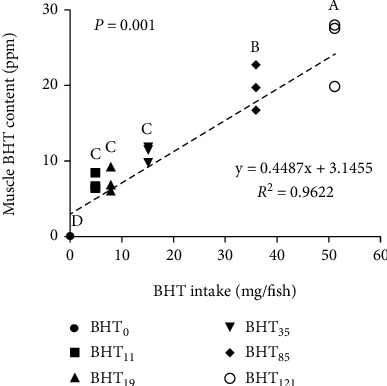
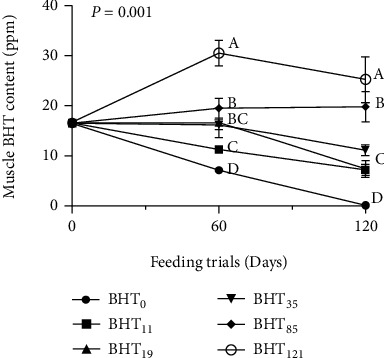
Verification
Claims the paper makes
The claims and statistics of this paper haven’t been checked yet.
Run the check — free, no account needed. It reads the open-access text and checks the sources it cites.
Claims other papers make about this one
Each is checked against this paper’s own text: does it say what the citing paper says it does?
In the citing paper
“BHT preserves the integrity of myofibrillar structures by preventing the formation of ROS, thereby mitigating the extent of proteolysis and maintaining muscle firmness [77,78].”
From Preservative Potential of Anethum graveolens Essential Oil on Fish Fillet Quality and Shelf Life During Refrigerated Storage (2025) · cites this paper as [77]
Self-check
Percentages, sums and reported differences re-computed from the paper’s own numbers.
The self-check needs the paper’s full text.
Citations
Cites
No references could be resolved yet.
Research works printed but not linked: 50
- 10.1111/j.1365-277X.2004.00552.x · DOI
- 10.1016/j.foodchem.2009.04.131 · DOI
- 10.1016/S0044-8486(99)00174-X · DOI
- 10.1021/bk-1992-0506.ch017 · DOI
- 10.4027/isscp.2008.04 · DOI
- 10.1007/s10499-012-9586-5 · DOI
- 10.1016/j.scitotenv.2014.09.042 · DOI
- 10.1016/j.foodchem.2011.11.127 · DOI
- 10.1111/j.1749-7345.2010.00389.x · DOI
- 10.1016/j.envres.2017.01.026 · DOI
- 10.1016/j.foodchem.2008.11.076 · DOI
- 10.1016/S0308-8146(99)00172-7 · DOI
- 10.1016/S0044-8486(03)00025-5 · DOI
- 10.1016/j.aquaculture.2004.02.008 · DOI
- 10.1111/j.1365-2621.1983.tb14817.x · DOI
- 10.1016/0044-8486(92)90264-L · DOI
- 10.1021/jf070418h · DOI · Paper page
- 10.1016/S0278-6915(99)00085-X · DOI
- 10.1016/S0165-7836(03)00067-5 · DOI
- 10.1093/jn/112.8.1590 · DOI
- 10.1080/19440049.2010.508195 · DOI
- International Life Sciences Institute, 1984, Butylated hydroxytoluene (BHT). A Monograph
- 10.1080/10498850.2012.720652 · DOI
- 10.1016/j.etp.2005.10.001 · DOI
- 10.1016/0006-2952(84)90643-9 · DOI
- 10.1007/BF00334616 · DOI
- 10.1016/j.envpol.2019.113624 · DOI
- KOSIS, 2021, Fisheries Production in Korea
- 10.1016/j.aquaculture.2022.738432 · DOI
- 10.1111/jwas.12804 · DOI
- 10.1016/j.anifeedsci.2022.115367 · DOI
- AOAC, 2000, Official Methods of Analysis International
- 10.1021/jf8025524 · DOI
- 10.1016/j.fsi.2017.10.054 · DOI
- 10.1111/j.1749-7345.2010.00366.x · DOI
- 10.1007/s10499-012-9538-0 · DOI
- International Maritime Organisation (IMO), 2003, Review of the BC code, including evaluation of properties of solid bulk cargoes
- 10.1016/S1050-4648(03)00113-X · DOI
- 10.1016/j.fsi.2009.12.024 · DOI
- 10.1016/S0896-6273(00)80192-0 · DOI · Paper page
- 10.1016/j.aquaculture.2010.07.021 · DOI
- 10.5657/FAS.2013.0149 · DOI
- 10.1016/j.vetimm.2004.04.021 · DOI
- 10.1007/s10126-010-9279-x · DOI
- 10.1111/anu.12641 · DOI
- 10.1111/are.13749 · DOI
- A. F. Elgazar, 2013, Effects of butylated hydroxytoluene and butylated hydroxyanisole against hepatotoxicity induced by carbon tetrachloride in rats, World Applied Sciences Journal, 22, 63
- L. L. Yu, 2016, Tolerance evaluation of butyl- hydroxyanisole in diets of largemouth bass (Micropterus salmoides), Chinese Journal of Animal Nutrition, 28, 747
- 10.1016/0300-9629(85)90923-5 · DOI
- 10.1016/j.aquaculture.2016.03.033 · DOI
Cited by
Tayel, A., Hassanin, F. S., Edris, S. N., Hamad, A., & Sabeq, I. I. (2025) · Foods · doi:10.3390/foods14091591 · Cited by 7
Metadata
- Authors
- Lee, S., Kim, M.-G., Hur, S.-W., Katya, K., Kim, K.-W., & Lee, B.-J.
- Affiliations
- Aquafeed Research Center, National Institute of Fisheries Science, Pohang 37517, Republic of Korea
- Malaysian Aquaponics Research Center, Semenyih, Kuala Lumpur 43500, Malaysia
- Department of Smart Fisheries Resources, Kongju National University, Yesan 32439, Republic of Korea
- Venue
- Aquaculture Nutrition
- Publisher
- Wiley
- Published
- 2023-02-02
- Volume
- 2023
- Pages
- 1-8
- ISSN
- 1365-2095
- 1353-5773
- PMC
- PMC9973148
- Cited by
- 10
- References
- 0
- Language
- en
- Funders
- National Institute of Fisheries Science (R2023036)
About these checks
Registry, retraction, Cites and statistics results are computed, not judged, with one exception: a printed reference that no index lists is read once by a model before it counts as a citation error. Claims are extracted by a model and kept only when their quote appears verbatim in the text; each cited source is then checked, with a model’s help, for whether it says what the claim relies on. Those verdicts can be wrong — read the claim’s quote and the cited source before relying on one.
Statistics and arithmetic are recomputed, not judged.
Confidence bands are shown only for fields calibrated on our annotated test set. None is calibrated yet, so no band is shown.
What counts as a claim ›How we measure confidence ›How we check this ›
Are you an author, or do you see a problem with this page? Request a review
Data sources
Bibliographic data: Semantic Scholar, OpenAlex, Crossref.
Contains information from the Semantic Scholar Academic Graph Datasets, made available under the ODC Attribution License (ODC-BY 1.0).
Semantic Scholar’s data is described in: Kinney, R., et al. (2023). The Semantic Scholar Open Data Platform. arXiv:2301.10140.
