

The DOI matches its Crossref record; 28 of the 29 references it cites were found in a registry or an index.
Outcomes in Patients with Poor-Risk Cytogenetics with or without TP53 Mutations Treated with Venetoclax and Azacitidine
Open accessPublished version of a preprint
Abstract
Purpose: To evaluate efficacy and safety of venetoclax + azacitidine in treatment-naïve patients with acute myeloid leukemia harboring poor-risk cytogenetics and TP53mut or TP53wt. Patients and Methods: We analyzed data from a phase III study (NCT02993523) comparing venetoclax (400 mg orally days 1–28) + azacitidine (75 mg/m2 days 1–7) or placebo + azacitidine, and from a phase Ib study (NCT02203773) of venetoclax + azacitidine. Patients were ineligible for intensive therapy. TP53 status was analyzed centrally; cytogenetic studies were performed locally. Results: Patients (n = 127) with poor-risk cytogenetics receiving venetoclax + azacitidine (TP53wt = 50; TP53mut = 54) were compared with patients with poor-risk cytogenetics (n = 56) receiving azacitidine alone (TP53wt = 22; TP53mut = 18). For poor-risk cytogenetics + TP53wt patients, venetoclax + azacitidine versus azacitidine alone resulted in composite remission rates (CRc) of 70% versus 23%, median duration of remission (DoR) of 18.4 versus 8.5 months, and median overall survival (OS) of 23.4 versus 11.3 months, respectively. Outcomes with venetoclax + azacitidine were comparable with similarly treated patients with intermediate-risk cytogenetics and TP53wt. For poor-risk cytogenetics + TP53mut patients, venetoclax + azacitidine versus azacitidine alone resulted in CRc of 41% versus 17%, median DoR of 6.5 versus 6.7 months, and median OS of 5.2 versus 4.9 months, respectively. For poor-risk cytogenetics + TP53mut patients, predominant grade ≥3 adverse events (AE) for venetoclax + azacitidine versus azacitidine were febrile neutropenia (55%/39%), thrombocytopenia (28%/28%), neutropenia (26%/17%), anemia (13%/6%), and pneumonia (28%/33%). AEs were comparable between TP53mut and TP53wt patients. Conclusions: In poor-risk cytogenetics + TP53mut patients, venetoclax + azacitidine improved remission rates but not DoR or OS compared with azacitidine alone. However, in poor-risk cytogenetics + TP53wt patients, venetoclax + azacitidine resulted in higher remission rates and longer DoR and OS than azacitidine alone, with outcomes comparable with similarly treated patients with intermediate-risk cytogenetics. Toxicities were similar in TP53mut and TP53wt patients. See related commentary by Green and Zeidner, p. 5235
Overview
The claims and statistics of this paper haven’t been checked yet.
Run the check — free, no account needed. It reads the open-access text and checks the sources it cites.
Integrity signals
Registry
Cites
Statistics
Figures
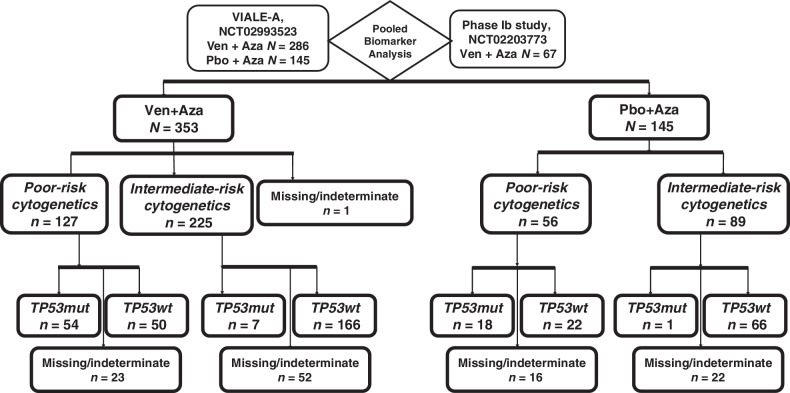
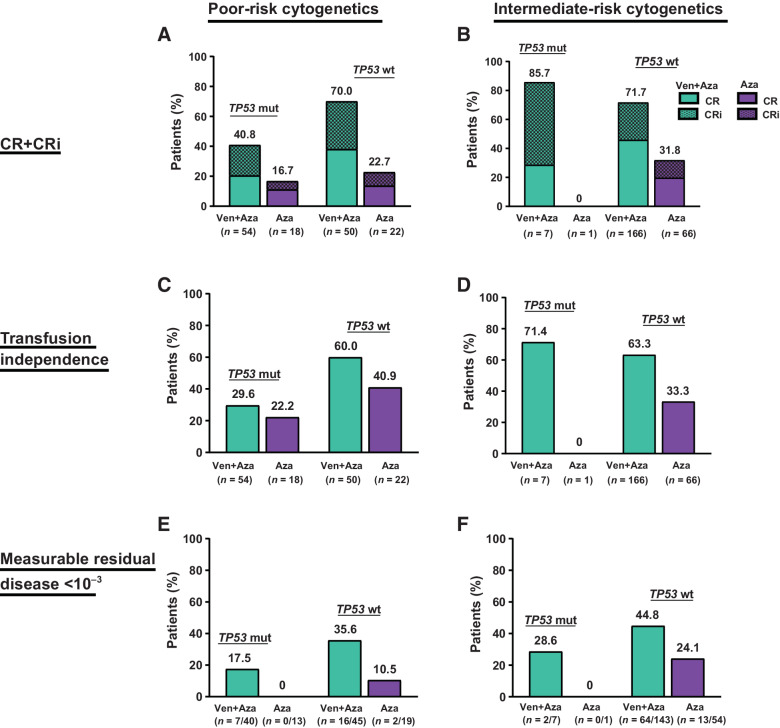
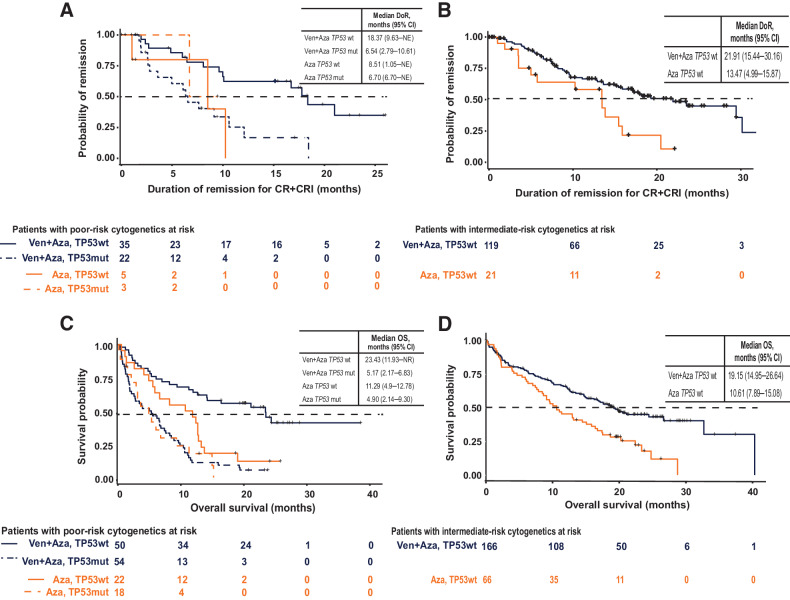
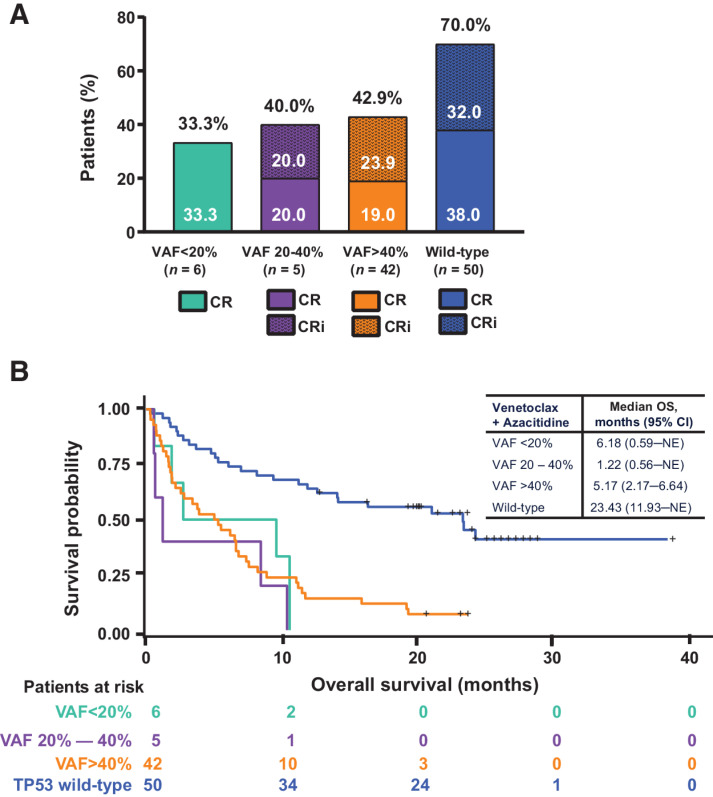
Verification
Claims the paper makes
The claims and statistics of this paper haven’t been checked yet.
Run the check — free, no account needed. It reads the open-access text and checks the sources it cites.
Claims other papers make about this one
Each is checked against this paper’s own text: does it say what the citing paper says it does?
The source backs part of the claim, not all of it — or backs it for a different population, condition or comparison.
In the citing paper
“Azacitidine (AZA) + venetoclax (VEN) is the standard of care for AML with a composite CR (CRc) rate in mTP53 AML of 55% (albeit CR rate of ~20%) but without improvement of OS (<6 months).”
From Long‐term follow‐up and combined Phase 2 results of eprenetapopt and azacitidine in patients with TP53 mutant MDS/AML (2025) · cites this paper as [19]
Experimental — accuracy not yet measuredThe source backs part of the claim, not all of it — or backs it for a different population, condition or comparison.
In the citing paper
“AZA + VEN has emerged as the standard of care for all subtypes of AML in older and unfit patients, but the combination remains controversial in mTP53 AML because even though the combination leads to a CRc rate of approximately 60%, the true CR rate was ~20% with no improvement of the median OS of approximately 6 months observed across multiple studies”
From Long‐term follow‐up and combined Phase 2 results of eprenetapopt and azacitidine in patients with TP53 mutant MDS/AML (2025) · cites this paper as [19]
Experimental — accuracy not yet measured
Self-check
Percentages, sums and reported differences re-computed from the paper’s own numbers.
The self-check needs the paper’s full text.
Citations
Cites
Döhner, H., Estey, E. H., Grimwade, D. J., Amadori, S., Appelbaum, F. R., Büchner, T., Dombret, H., Ebert, B. L., Fenaux, P., Larson, R. A., et al. (2016) · Blood · doi:10.1182/blood-2016-08-733196 · Cited by 5,938
Self-citationDöhner, H., Weisdorf, D. J., & Bloomfield, C. D. (2015) · New England Journal of Medicine · doi:10.1056/nejmra1406184 · Cited by 3,468
Azacitidine and Venetoclax in Previously Untreated Acute Myeloid Leukemia
DiNardo, C. D., Jonas, B. A., Pullarkat, V., Thirman, M. J., Garcia, J. S., Wei, A. H., Konopleva, M., Döhner, H., Letai, A., Fenaux, P., et al. (2020) · New England Journal of Medicine · doi:10.1056/nejmoa2012971 · Cited by 2,900
Self-citationCheson, B. D., Bennett, J. M., Kopecky, K. J., Büchner, T., Willman, C. L., Estey, E. H., Schiffer, C. A., Döhner, H., Tallman, M. S., Lister, T. A., et al. (2003) · Journal of Clinical Oncology · doi:10.1200/jco.2003.04.036 · Cited by 2,686
DiNardo, C. D., Pratz, K., Pullarkat, V., Jonas, B. A., Arellano, M., Becker, P. S., Frankfurt, O., Konopleva, M., Wei, A. H., Kantarjian, H. M., et al. (2019) · Blood · doi:10.1182/blood-2018-08-868752 · Cited by 1,825
Self-citationAge and acute myeloid leukemia
Appelbaum, F. R., Gundacker, H. M., Head, D. R., Slovak, M. L., Willman, C. L., Godwin, J. E., Anderson, J. E., & Petersdorf, S. H. (2006) · Blood · doi:10.1182/blood-2005-09-3724 · Cited by 1,371
Rücker, F. G., Schlenk, R. F., Bullinger, L., Käyser, S., Teleanu, V., Kett, H., Habdank, M., Kugler, C.-M., Holzmann, K., Gaidzik, V. I., et al. (2011) · Blood · doi:10.1182/blood-2011-08-375758 · Cited by 694
Dinardo, C. D., Tiong, I. S., Quaglieri, A., MacRaild, S., Loghavi, S., Brown, F. C., Thijssen, R., Pomilio, G., Ivey, A., Salmon, J. M., et al. (2020) · Blood · doi:10.1182/blood.2019003988 · Cited by 681
Self-citationThe TP53 Apoptotic Network Is a Primary Mediator of Resistance to BCL2 Inhibition in AML Cells
Nechiporuk, T., Kurtz, S. E., Nikolova, O. H., Liu, T., Jones, C. L., D’Alessandro, A., Culp‐Hill, R., d’Almeida, A., Joshi, S. K., Rosenberg, M. W., et al. (2019) · Cancer Discovery · doi:10.1158/2159-8290.cd-19-0125 · Cited by 392
Fröhling, S., Schlenk, R. F., Käyser, S., Morhardt, M., Benner, A., Döhner, K., Döhner, H., & for the German-Austrian AML Study Group (2006) · Blood · doi:10.1182/blood-2006-04-014324 · Cited by 300
Kadia, T. M., Jain, P., Ravandi, F., Garcia‐Manero, G., Andreef, M., Takahashi, K., Borthakur, G. M., Jabbour, E. J., Konopleva, M. Y., Daver, N. G., et al. (2016) · Cancer · doi:10.1002/cncr.30203 · Cited by 271
Self-citationBowen, D., Groves, M. J., Burnett, A. K., Patel, Y., Allen, C. G., Green, C. L., Gale, R. E., Hills, R. K., & Linch, D. C. (2008) · Leukemia · doi:10.1038/leu.2008.173 · Cited by 214
Sallman, D. A., Asch, A. S., Malki, M. M. A., Lee, D. J., Donnellan, W. B., Marcucci, G., Kambhampati, S., Daver, N. G., Garcia‐Manero, G., Komrokji, R. S., et al. (2019) · Blood · doi:10.1182/blood-2019-126271 · Cited by 213
Schoch, C., Kern, W., Kohlmann, A., Hiddemann, W., Schnittger, S., & Haferlach, T. (2005) · Genes Chromosomes and Cancer · doi:10.1002/gcc.20193 · Cited by 188
Short, N. J., Bravo, G. M., Hwang, H., Ning, J., Franquiz, M. J., Kanagal‐Shamanna, R., Patel, K. P., Dinardo, C. D., Ravandi, F., Garcia‐Manero, G., et al. (2020) · Blood Advances · doi:10.1182/bloodadvances.2020003120 · Cited by 188
Self-citationPratz, K. W., Jonas, B. A., Pullarkat, V. A., Récher, C., Schuh, A. C., Thirman, M. J., Garcia, J. S., Dinardo, C. D., Vorobyev, V. I., Fracchiolla, N., et al. (2021) · Journal of Clinical Oncology · doi:10.1200/jco.21.01546 · Cited by 180
Self-citationPollyea, D. A., Dinardo, C. D., Arellano, M. L., Pigneux, A., Fiedler, W., Konopleva, M., Rizzieri, D. A., Smith, B. D., Shinagawa, A., Lemoli, R. M., et al. (2022) · Clinical Cancer Research · doi:10.1158/1078-0432.ccr-21-3467 · Cited by 172
Self-citationUpdates on targeted therapies for acute myeloid leukaemia
Käyser, S., & Levis, M. J. (2021) · British Journal of Haematology · doi:10.1111/bjh.17746 · Cited by 170
Genomic Classification in Acute Myeloid Leukemia
Papaemmanuil, E., Döhner, H., & Campbell, P. J. (2016) · New England Journal of Medicine · doi:10.1056/nejmc1608739 · Cited by 166
Ohgami, R. S., Ma, L., Merker, J. D., Gotlib, J. R., Schrijver, I., Zehnder, J. L., & Arber, D. A. (2014) · Modern Pathology · doi:10.1038/modpathol.2014.160 · Cited by 141
Thijssen, R., Diepstraten, S. T., Moujalled, D. M., Chew, E., Flensburg, C., Shi, M. X., Dengler, M. A., Litalien, V., MacRaild, S., Chen, M., et al. (2021) · Blood · doi:10.1182/blood.2020010167 · Cited by 135
Self-citationDöhner, H., Dolnik, A., Tang, L., Seymour, J. F., Minden, M. D., Stone, R. M., Bernal, T., Al‐Ali, H. K., Santini, V., Vyas, P., et al. (2018) · Leukemia · doi:10.1038/s41375-018-0257-z · Cited by 132
Mutant p53: Multiple Mechanisms Define Biologic Activity in Cancer
Kim, M., Zhang, Y., & Lozano, G. (2015) · Frontiers in Oncology · doi:10.3389/fonc.2015.00249 · Cited by 113
Chiche, E., Rahmé, R., Bertoli, S., Dumas, P., Micol, J., Hicheri, Y., Pasquier, F., Péterlin, P., Chevallier, P., Thomas, X., et al. (2021) · Blood Advances · doi:10.1182/bloodadvances.2020003159 · Cited by 106
Real-world experience of CPX-351 as first-line treatment for patients with acute myeloid leukemia
Rautenberg, C., Stölzel, F., Röllig, C., Stelljes, M., Gaidzik, V. I., Lauseker, M., Kriege, O., Verbeek, M., Unglaub, J. M., Thol, F. R., et al. (2021) · Blood Cancer Journal · doi:10.1038/s41408-021-00558-5 · Cited by 64
Goel, S., Hall, J., Pradhan, K., Hirsch, C. M., Przychodzen, B. P., Shastri, A., Mantzaris, I., Janakiram, M., Battini, R., Kornblum, N. S., et al. (2016) · Leukemia · doi:10.1038/leu.2016.74 · Cited by 42
Lindsley, R. C., Gibson, C. J., Murdock, H. M., Stone, R. M., Cortes, J. E., Uy, G. L., Lin, T. L., Ritchie, E. K., Prébet, T., Ryan, R. J., et al. (2019) · Blood · doi:10.1182/blood-2019-124500 · Cited by 42
National Cancer Institute (2020) · Definitions · doi:10.32388/vsumbc · Cited by 23
Cited by
Sorted by citations
Acute myeloid leukemia: 2023 update on diagnosis, risk‐stratification, and management
Shimony, S. O., Stahl, M. F., & Stone, R. M. (2023) · American Journal of Hematology · doi:10.1002/ajh.26822 · Cited by 494
The BCL2 family: from apoptosis mechanisms to new advances in targeted therapy
Vogler, M., Braun, Y., Smith, V. M., Westhoff, M.-A., Pereira, R. S., Pieper, N. M., Anders, M., Callens, M., Vervliet, T., Abbas, M., et al. (2025) · Signal Transduction and Targeted Therapy · doi:10.1038/s41392-025-02176-0 · Cited by 462
Recent advances in targeted therapies in acute myeloid leukemia
Bhansali, R. S., Pratz, K. W., & Lai, C. (2023) · Journal of Hematology & Oncology · doi:10.1186/s13045-023-01424-6 · Cited by 297
Self-citationDöhner, H., Dinardo, C. D., Appelbaum, F. R., Craddock, C., Dombret, H., Ebert, B. L., Fenaux, P., Godley, L. A., Hasserjian, R. P., Larson, R. A., et al. (2024) · Blood · doi:10.1182/blood.2024025409 · Cited by 258
Self-citationPratz, K. W., Jonas, B. A., Pullarkat, V. A., Thirman, M. J., Garcia, J. S., Döhner, H., Récher, C., Fiedler, W., Yamamoto, K., Wang, J., et al. (2024) · American Journal of Hematology · doi:10.1002/ajh.27246 · Cited by 240
Self-citation
Metadata
- Authors
- Pollyea, D. A., Pratz, K. W., Wei, A. H., Pullarkat, V., Jonas, B. A., Recher, C., Babu, S., Schuh, A. C., Dail, M., Sun, Y., Potluri, J., Chyla, B., & DiNardo, C. D.
- Affiliations
- University of Colorado Anschutz (US)
- Abramson Cancer Center (US)
- The Royal Melbourne Hospital (AU)
- City Of Hope National Medical Center (US)
- University of California Davis Medical Center (US)
- 6Centre Hospitalier Universitaire de Toulouse, Toulouse, France.
- 7Fort Wayne Medical Oncology and Hematology, Fort Wayne, Indiana.
- Princess Margaret Cancer Centre (CA)
- 9Genentech Inc., South San Francisco, California.
- AbbVie (United States) (US)
- The University of Texas MD Anderson Cancer Center (US)
- Corresponding author
- Pollyea, Daniel A.
- ORCID
- Venue
- Clinical Cancer Research
- Published
- 2022-08-25
- Volume
- 28
- Issue
- 24
- Pages
- 5272-5279
- ISSN
- 1078-0432 (ISSN-L)
- 1557-3265
- PMC
- PMC9751752
- OpenAlex
- W4293253462
- Cited by
- 159
- References
- 29
- Citations by year
- 2026: 24 · 2025: 41 · 2024: 44 · 2023: 39 · 2022: 10
- FWCI
- 24.37
- Type
- journal article
- Language
- en
- Open access
- hybrid
- doi.org
- Licence
- Locations
- Clinical Cancer Research (publishedVersion, cc-by-nc-nd)
- PubMed Central (publishedVersion, cc-by-nc-nd)
- PubMed (publishedVersion)
- Digital Commons-TMC (Texas Medical Center) (submittedVersion)
- eScholarship (California Digital Library) (submittedVersion, cc-by-nc-nd)
- Funders
- AbbVie (NCT02993523)
- Genentech (NCT02203773)
- Topics
- Health Sciences › Medicine › Hematology › Acute Myeloid Leukemia Research
- Life Sciences › Biochemistry, Genetics and Molecular Biology › Molecular Biology › Retinoids in leukemia and cellular processes
- Health Sciences › Medicine › Hematology › Chronic Lymphocytic Leukemia Research
- Keywords
- venetoclax, azacitidine, acute myeloid leukemia, poor-risk cytogenetics, TP53 mutation, wild-type p53, combination therapy, remission duration, overall survival, febrile neutropenia, adverse events, treatment-naive patients, elderly patients, prognostic factors, prognostic score
- MeSH terms
- Antineoplastic Combined Chemotherapy Protocols, Azacitidine, Humans, Mutation, Sulfonamides, Leukemia, Myeloid, Acute, Tumor Suppressor Protein p53, Treatment Outcome, Clinical Trials, Phase I as Topic, Clinical Trials, Phase III as Topic, Bridged Bicyclo Compounds, Heterocyclic, Cytogenetic Analysis
About these checks
Registry, retraction, Cites and statistics results are computed, not judged, with one exception: a printed reference that no index lists is read once by a model before it counts as a citation error. Claims are extracted by a model and kept only when their quote appears verbatim in the text; each cited source is then checked, with a model’s help, for whether it says what the claim relies on. Those verdicts can be wrong — read the claim’s quote and the cited source before relying on one.
Statistics and arithmetic are recomputed, not judged.
Confidence bands are shown only for fields calibrated on our annotated test set. None is calibrated yet, so no band is shown.
What counts as a claim ›How we measure confidence ›How we check this ›
Are you an author, or do you see a problem with this page? Request a review
