

The DOI matches its Crossref record; 96 of the 96 references it cites were found in a registry or an index.
Predictors of Institutionalization of Dementia Patients in Mild and Moderate Stages: A 4-Year Prospective Analysis
Open accessAbstract
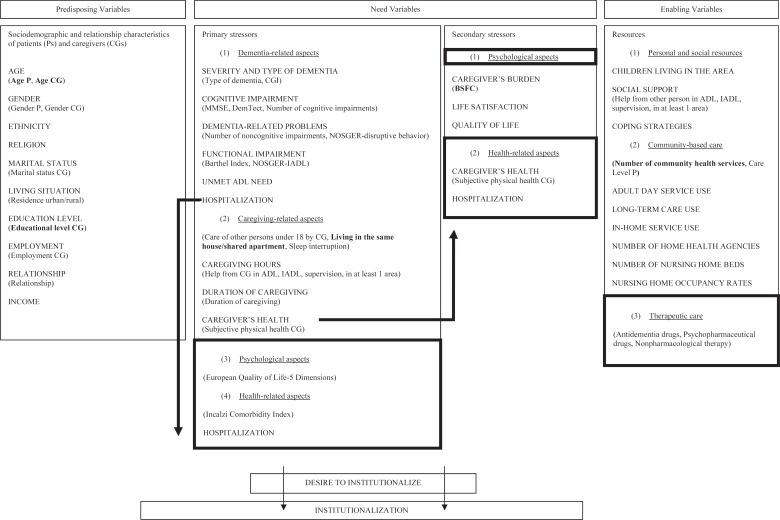
Background: Institutionalization is the most important milestone in the care of dementia patients. This study was aimed at identifying relevant predictors of institutionalization in a broad empirical context and interpreting them on the basis of the predictor model proposed by Luppa et al. [Dement Geriatr Cogn Disord 2008;26:65-78]. Methods: At the start of this study, 357 patients with mild to moderate dementia were examined by their general practitioners, and a telephone interview was conducted with their caregivers. Four years later, the outcomes ‘institutionalization' and ‘death' were determined from health insurance data. Forty-one variables were examined for their predictive influence by univariate and multivariate Cox regression. Results: The risk of institutionalization increased significantly (p ≤ 0.05) with older ages of patients [hazard ratio (HR) = 1.05] and caregivers (HR = 1.03), a higher educational level of the caregiver (HR = 1.83), greater use of community health services (HR = 1.59), greater caregiver burden (HR = 1.02), and when the caregiver and patient lived apart (HR = 1.97). Conclusion: The results show that there is a multifactorial influence on institutionalization of dementia patients by sociodemographic, health-related, and psychological aspects as well as the care situation, thus validating the predictor model by Luppa et al. [Dement Geriatr Cogn Disord 2008;26:65-78]. Caregiver burden was found to be the strongest predictor accessible to interventions.
Overview
The claims and statistics of this paper haven’t been checked yet.
Run the check — free, no account needed. It reads the open-access text and checks the sources it cites.
Integrity signals
Registry
Cites
Statistics
Figures
Verification
Claims the paper makes
The claims and statistics of this paper haven’t been checked yet.
Run the check — free, no account needed. It reads the open-access text and checks the sources it cites.
Claims other papers make about this one
Each is checked against this paper’s own text: does it say what the citing paper says it does?
The source backs part of the claim, not all of it — or backs it for a different population, condition or comparison.
In the citing paper
“In addition, worsening psychological and physical health in caregivers can adversely impact the individual with dementia—for example, they increase the likelihood of institutionalization of the person with dementia, which is associated with decreased psychological and physical health and increased mortality in individuals with dementia [11], [12], [13], [14].”
From A novel two-day intervention reduces stress in caregivers of persons with dementia (2018) · cites this paper as [12]
Experimental — accuracy not yet measured
Self-check
Percentages, sums and reported differences re-computed from the paper’s own numbers.
The self-check needs the paper’s full text.
Citations
Cites
Folstein, M. F., Folstein, S. E., & McHugh, P. R. (1975) · Journal of Psychiatric Research · doi:10.1016/0022-3956(75)90026-6 · Cited by 88,282
Regression Models and Life-Tables
Cox, D. R. (1992) · Springer Series in Statistics · doi:10.1007/978-1-4612-4380-9_37 · Cited by 26,297
EuroQol: a new facility for the measurement of health-related quality of life
(1990) · Health Policy · doi:10.1016/0168-8510(90)90421-9 · Cited by 15,736
(1965) · PubMed · Cited by 14,925
Functional evaluation : Barthel index
Mahonery, F. I. (1965) · Medical Entomology and Zoology · Cited by 12,762
Missing data: our view of the state of the art
Schafer, J. L., & Graham, J. W. (2002) · Psychological Methods · doi:10.1037/1082-989x.7.2.147 · Cited by 11,638
Revisiting the Behavioral Model and Access to Medical Care: Does it Matter?
Andersen, R. M. (1995) · Journal of Health and Social Behavior · doi:10.2307/2137284 · Cited by 9,831
EuroQol: the current state of play
Brooks, R. (1996) · Health Policy · doi:10.1016/0168-8510(96)00822-6 · Cited by 5,815
Caregiving and the stress process: an overview of concepts and their measures
Pearlin, L. I., Mullan, J. T., Semple, S. J., & Skaff, M. M. (1990) · The Gerontologist · doi:10.1093/geront/30.5.583 · Cited by 4,810
Peduzzi, P., Concato, J., Feinstein, A. R., & Holford, T. R. (1995) · Journal of Clinical Epidemiology · doi:10.1016/0895-4356(95)00048-8 · Cited by 2,154
Cited by
Sorted by citations
Items 101–120 of 120
Predictors of Nursing Home Admission in the Older Population in BelgiumPreprint
Berete, F., Demarest, S. S., Charafeddine, R., Ridder, K. D., Vanoverloop, J., Oyen, H. J. V., Bruyère, O., & der Heyden, J. V. (2022) · Research Square · doi:10.21203/rs.3.rs-1169480/v1 · Cited by 1
Hess, W., Schwarzkopf, L., Hünger, M., & Holle, R. (2014) · Statistics in Medicine · doi:10.1002/sim.6206
Self-citationTreatment Approaches to Neurocognitive Disorders
Moukaddam, N. J., Bejjani, C., & Shah, A. A. (2016) · Psychiatric Annals · doi:10.3928/00485713-20160105-01
León‐Salas, B., Ayala, A., Blaya‐Nováková, V., Ávila‐Villanueva, M., Rodríguez‐Blázquez, C., Rojo‐Pérez, F., Fernández‐Mayoralas, G., Martínez‐Martín, P., Forjaz, M. J., & Marañón, G. (2014)
Francisco, G. L. (2019) · Digital Library of Theses and Dissertations (Universidade de São Paulo) · doi:10.11606/d.100.2019.tde-03022019-090209
Rhodus, E. K. (2019) · UKnowledge (University of Kentucky) · doi:10.13023/etd.2019.165
Enabling the person with moderate dementia to remain at home
Nazarko, L. (2020) · British Journal of Healthcare Assistants · doi:10.12968/bjha.2020.14.7.324
Psychoses Due to Medical Illness or Iatrogenesis
Alves, G. S., Trovão, L. D. O., & Briand, L. (2021) · Elsevier eBooks · doi:10.1016/b978-0-323-68309-8.00009-6
Grosu, M.-I., Rugină, A., Bădii, G. B., & Cristofor, A. C. (2021) · Bulletin of Integrative Psychiatry · doi:10.36219/bpi.2021.1.13
Meuer, J., Dietzel, N., Meuer, S., Reichold, M., Prokosch, H., Graessel, E., & Kolominsky‐Rabas, P. L. (2021) · neuroreha · doi:10.1055/a-1472-9826
Self-citationCrisis and Assessment of Need in Dementia
Hoe, J., Ledgerd, R., Toot, S., & Orrell, M. W. (2021) · Cambridge University Press eBooks · doi:10.1017/9781911623373.007
Developing and implementing dementia policy in ireland
(2019) · Human Rights Documents online · doi:10.1163/2210-7975_hrd-9978-20180002
Novel perspectives from existing data on early Alzheimer’s disease pathology and dementia care use
Janssen, O. (2022) · Research Publications (Maastricht University) · doi:10.26481/dis.20220617oj
Kim, B., Shin, J., & Lee, K. H. (2025) · Journal of Alzheimer s Disease · doi:10.1177/13872877251365642
Berete, F., Demarest, S., Charafeddine, R., De Ridder, K., Vanoverloop, J., Oyen, H. J. V., Bruyère, O., & der Heyden, J. V. (2022) · Figshare · doi:10.6084/m9.figshare.21376383
Lau, J. H., Abdin, E., Jeyagurunathan, A., Seow, E., Ng, L. L., Vaingankar, J. A., Chong, S. A., & Subramaniam, M. (2021) · Figshare · doi:10.6084/m9.figshare.13612739
Childers, P., Ruggiano, N., & Brown, E. L. (2025) · Journal of Applied Gerontology · doi:10.1177/07334648251410630
Ortiz, B. L., Scheffler, A. W., Callahan, P. M., Shdo, S. M., Rijpma, M. G., Antoniou, R., Hirst, R. B., Brown, L. M., Rabinovici, G. D., Rosen, H. J., et al. (2026) · Journal of Alzheimer s Disease · doi:10.1177/13872877261422511
Nursing Home Entry in Sweden: The Role of Sociodemographic Factors, Health, and Dementia
Högström, O., Tazzeo, C., Chen, E., Schmidt‐Mende, K., & Modig, K. (2026) · Journal of the American Medical Directors Association · doi:10.1016/j.jamda.2026.106228
Grundberg, Å., Sormunen, T., & Westerbotn, M. (2026) · Dementia · doi:10.1177/14713012261481860
Metadata
- Authors
- Eska, K., Graessel, E., Donath, C., Schwarzkopf, L., Lauterberg, J., & Holle, R.
- Affiliations
- Friedrich-Alexander-Universität Erlangen-Nürnberg (DE)
- Helmholtz Munich (DE)
- Institute for Quality and Efficiency in Health Care (DE)
- Corresponding author
- Eska, Kathrin
- Venue
- Dementia and Geriatric Cognitive Disorders Extra
- Publisher
- S. Karger AG
- Published
- 2013-11-01
- Volume
- 3
- Issue
- 1
- Pages
- 426-445
- ISSN
- 1664-5464 (ISSN-L)
- PMC
- PMC3843910
- OpenAlex
- W2035225376
- Cited by
- 119
- References
- 96
- Citations by year
- 2026: 4 · 2025: 6 · 2024: 10 · 2023: 8 · 2022: 8 · 2021: 25 · 2020: 7 · 2019: 11 · 2018: 9 · 2017: 11 · 2016: 9 · 2015: 5 · 2014: 6
- FWCI
- 4.74
- Type
- journal article
- Language
- en
- Open access
- gold
- doi.org
- Licence
- Locations
- Dementia and Geriatric Cognitive Disorders Extra (publishedVersion, cc-by-nc)
- Europe PMC (PubMed Central) (publishedVersion, cc-by-nc)
- PubMed Central (publishedVersion, cc-by-nc)
- PubMed (publishedVersion)
- DOAJ (DOAJ: Directory of Open Access Journals) (submittedVersion, cc-by-sa)
- Site cant be reached (submittedVersion, cc-by-nc)
- OPUS FAU (Kooperativer Bibliotheksverbund Berlin-Brandenburg (KOBV), on behalf of the Universitätsbibliothek Erlangen-Nürnberg) (submittedVersion, cc-by-nc-nd)
- Funders
- Pfizer
- Deutsche Forschungsgemeinschaft
- Eisai
- Topics
- Health Sciences › Medicine › Psychiatry and Mental health › Dementia and Cognitive Impairment Research
- Health Sciences › Medicine › Geriatrics and Gerontology › Geriatric Care and Nursing Homes
- Health Sciences › Medicine › Public Health, Environmental and Occupational Health › Palliative Care and End-of-Life Issues
- Keywords
- dementia, institutionalization, predictors of institutionalization, mild to moderate dementia, caregiver burden, community-based care, risk factors
About these checks
Registry, retraction, Cites and statistics results are computed, not judged, with one exception: a printed reference that no index lists is read once by a model before it counts as a citation error. Claims are extracted by a model and kept only when their quote appears verbatim in the text; each cited source is then checked, with a model’s help, for whether it says what the claim relies on. Those verdicts can be wrong — read the claim’s quote and the cited source before relying on one.
Statistics and arithmetic are recomputed, not judged.
Confidence bands are shown only for fields calibrated on our annotated test set. None is calibrated yet, so no band is shown.
What counts as a claim ›How we measure confidence ›How we check this ›
Are you an author, or do you see a problem with this page? Request a review
